CB LIVE! Courage to Leap and Lead with Tricia Brouk, Episode 110
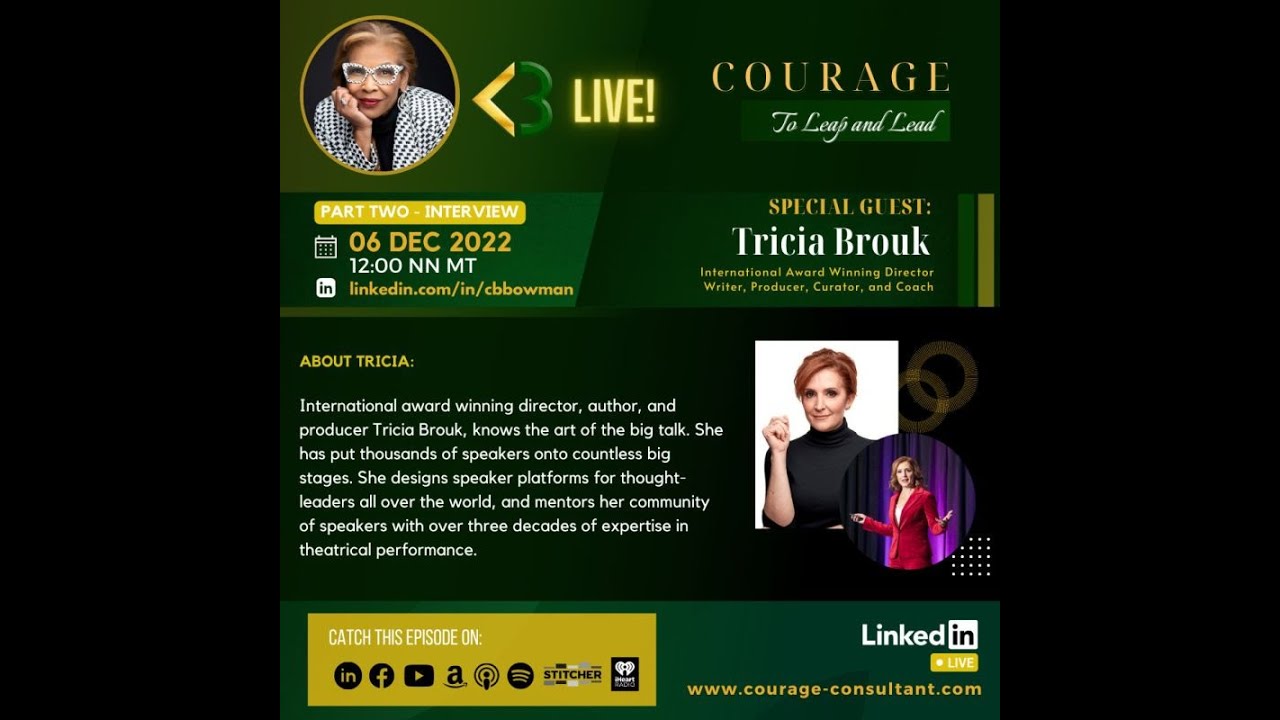
Tricia Brouk, founder of The Big Talk Academy, and CB Bowman discuss how courage is built and taught. Brouk works with a high-performance coach, business coach, and spiritual advisor to grow as a speaker-coach. Bowman introduces "microcourage": small acts like calling out disrespect on a subway.
Chapters
Hello, everybody. This is part 2 of an interview that I started with Tricia before, and I'm going to tell you, hold on to your seats because we're talking about courage. I can't even say it, I'm so emotional. We're talking about courage at a great level that's so deep and profound. Because what Tricia does is that she helps speakers communicate their true north. That's powerful. Have you ever gone to an event and heard a speaker and you thought, oh my God, this is so boring, and you get up and walk out or play I think in my life, and I've seen hundreds of plays, I've walked out on 2. And that's for one reason. It's not connecting with you. Now, have you ever heard a speaker where you sat there mesmerized? I remember when I was part of the National Speakers Association hearing a famous celebrity speak. You know what? She wasn't a good speaker in terms of her pronouns and her nouns, but she was the most— I don't even know how to explain it.
Mm-hmm.
I was riveted to my seat. Riveted. I couldn't move. I couldn't breathe. That's what Tricia helps speakers do. So let's go, Tricia. Thank you for coming back and sharing more of your work. What, what, you know, what's the name of your company?
It's called The Big Talk, and The Big Talk Academy is our signature speaker and thought leadership incubator.
Do you find that there are more women who sign up for your program than men?
I do find that there are more women. We certainly have men as well. I bet it's about 60/40, 70/30. So, but we do have more women. I've never asked, I've never thought about why that is. But we do have more women. Yeah.
You know, I realized a couple of weeks ago, and I, I have a friend who's training to do her first TED Talk, and I said to another friend of mine, I said, it's my gut feeling that there are more women who train to do a TED Talk than there are men who do that. I'm not sure why. I'm not sure if it has to do with our imposter syndrome, our need to be terrific, our need to be perfect. I don't know why that is, but it occurred to me to ask you.
It might be some of that, and it might also be that we, or more women, know the power of coaching and direction. And they are willing to get the support they need in order to be the best versions of themselves. I mean, I have 3 coaches.
Mm-hmm. You have 3 coaches personally?
I do. Yeah.
What are you being coached on?
I have a high performance coach, a business coach, and a spiritual advisor.
Okay, let's break it down. What does a high performance coach do?
We talk about mindset, champion's mind. We talk about how to be at the top of my game physically, mentally, any kind of little adjustments that we can make in my routine, anything that I can do to have even higher of a, of a, you know, readiness. I am— I have the highest level of readiness. If Michelle— when Michelle Obama calls me, I'm gonna say yes. I won't have to figure out what I need to do, right? And then my business coach—
Did you ask her to call me too? When you speak to her?
Absolutely. Absolutely. And then my business coach, we talk about how to increase, you know, my reach as The Big Talk, as The Big Talk Academy. And then my spiritual advisor, she really— we say that she's backstage. So she is constantly tuning in and tapping into my energy and what my needs might be energetically and making those adjustments when I don't even know it. So I will all of a sudden feel this energetic shift. And I'm sure that Lynn is doing a clearing of some kind with me.
When did you decide to have 3 coaches? I mean, because you're pretty spectacular alone.
Oh, thank you, CB. That means so much to me. I know that in order to play at elevation, the level that I want to play at, I need to have other mentors looking at the holistic Tricia Brooke and my company in a way that I may not be able to because I'm in it. So I, I always had a dance teacher who was pushing me, and I am extremely motivated. I don't need somebody to tell me to go to ballet class. I was always doing that on my own, and I'm extremely motivated now. I, I, I'm the person who says she's going to do something and does it 10 times. And I also realized the power in mentors, and I need and want somebody to be paying attention So that I can focus on what I need to get done. I also have a vegan chef because I'm not a vegan cook, and I want to have the best possible nutrition in order to play at elevation.
How does one afford all of that?
That's a great question, and I work very hard. And I invest heavily in myself and in my company in order to have an ROI that affords me to have the team I want and that affords me to have the lifestyle I want.
I love that. Hey, I want to go back to talking about the courage of your speakers and how you support them in writing, uh, in speaking. You said you have a team. Most people want to work with the leader. How do you parcel out your clients working with your team?
Great question. We have 2 coaches who have gone through many of my programs, and who align with our values and who understand the mission and the purpose of The Big Talk. And That's a tricky one. I'm still in the Big Talk Academy, I still run the group calls that happen twice a month. But what's really wonderful is the more agency I give to my speakers, and the more I coach them, as I watch them coaching our, our clients and our students, the more leadership skills they start to embody. And for anybody out there who is listening or watching who runs company, it is so important that you start to put processes in place now about how you do things so that you can pull yourself out of the company. You staying in the company is going to keep your company small, whether you like it or not. So you training your coaches to do what you do as well, if not better than you, will serve your company because Ultimately, as entrepreneurs, what we want to do is serve as many people as possible. I want to be able to put as many speakers onto big stages as possible. I want to mentor as many thought leaders, influencers, professionals as possible in sharing their story, whether it is from across the kitchen table with their families, from the front of a classroom with their students, or across the boardroom with their team members. Being able to teach people how to be an influential voice and speak effectively is how we unite humanity.
I love that. I, I think that, you know, I think very selfishly, I think about experiences I've had, and I think about my wishes. I wish that People of color who don't have the finances to do what you're talking about, that experience what you're talking about. I hope someday that you will do a film on what you do so that we— I'm going to include myself— can get a glimpse into how to be ourselves in a way that's productive as you have been.
Thank you for saying that, CB, and I really hear you. And that is why I do a podcast. That is why I have scholarships to the Big Talk Academy. That is why I talk about this as openly as possible. And I love that you say a film because I am actually being featured right now in a documentary called Big Stages. And part of the process was having an incredibly diverse cast. And that was really, really important to me. That was, that was a deal breaker. Like, the casting was absolutely like, it had to be the right casting for me. And that was a diverse cast.
Why didn't I know about this? Where was I?
I don't know.
Being late to the game.
We have a lot to do together from now on.
Yes, I am writing this down. Oh my goodness, I want to know how to support what you're doing because it's so important. I remember ironically over the weekend my neighborhood had a girls get-together and we went to see see million-dollar houses that were designed for the holidays. It was so much fun. And one of the women told me that she's now substitute teaching and she has this great fear. And I said, don't have a fear. I've done it. Been there, done that. And she said to me, what did you do as a substitute teacher? What grade did you teach? And I said, I taught elementary. And I said, one of the biggest things I did is that I made each of the students get up and give a presentation.
Wow.
Nobody was allowed to laugh. Could only be supportive.
Love that.
And you did what? I said, I did. I said, and it was the talk of the entire school whenever the teachers came back. The students were so happy when they were out and I was the substitute teacher.
That's amazing. How did the students respond?
Did they—
they had courage?
They had courage. They were scared. And I'll tell you, there was one kid whose parents were in jail. And he would come to school with tattered clothes. And he was like the boss. I mean, everybody did, you know. And he had to get up and speak. And the bravo disappeared.
Hmm.
And the heart came out. And he was not expecting that. And then whenever I saw him in the hall, and he was walking with his Soup, you know, his followers, and they were just carrying on. He would see me and he would go, that's Miss B. We better behave. Respect. Respect.
You earned that respect because you put him in a position of having to use his courage, not his bravado.
Exactly.
That's amazing.
And I just, I love this kid. I loved this kid. I felt for him. And so, yeah, we have to do something.
Yeah. Yes.
When I was in marketing in General Foods, one of the biggest— oops, I shouldn't have mentioned the name of the company. Forget that, everybody. One of my biggest upsets was when I see companies with this type of money do commercials where the language, the English language, is abused. And children hear it, adults hear it, and they think that's the way to speak. And I think, what are we doing? What are we doing to people of color? What are we doing to the underserved population? We're helping them stay where they are. But let me not get off on my tangent. My point is, um, it would be so awesome if people— if you could give your gift to a wider audience. So give us the name of your podcast.
For sure. It's called The Big Talk with Tricia Brooke, and The Influential Voice is also my book. Which is $17. The audiobook, I think, is $9. So those are 2 options as well.
The Influential—
The Influential Voice: Saying What You Mean for Lasting Legacy. And this was very— this was a book that was birthed at a time where I was Really, really digging deep for courage, CB. Many, many people had asked me to write a book on public speaking. And so I was shopping around a book proposal. And lots of agents and publishers in New York were having meetings with me, and it just wasn't landing. And I now learned why I didn't really want to write a book about public speaking. And when Ahmaud Arbery and Breonna Taylor and George Floyd were murdered in that very short span of time, I sat down and wrote chapter 1 about the systemic racism in this country and the language that was coming from the White House and how damaging it was. And it took a lot of courage. I am a white woman of privilege, and I wanted to speak out so that I could, um, give people permission to become allies who were afraid because they didn't know what to say, so they didn't say anything, which is a huge problem, right?
Mm-hmm.
So I, I wrote The Influential Voice with the hopes that we could open up a conversation and a dialogue about what it means to use your voice, how to support the voices of others, and how to coexist. And it was— it's, it's— I'm very proud of this book. And it took a lot of courage for me to talk about it and to write about it.
You know, I haven't read your book. I love the philosophy. Because I remember when Floyd was killed and I was in a group of PR people who met every week to keep in touch. And I said to them, feel free to ask me anything you want to ask. I said because I had seen an actress on one of the late-night TV shows, and she was asked at the time, what do you think about this situation? This was a Black woman, and Jimmy Fallon was trying to you know, let people voice where they were. And she said, well, I think it's not my job to educate white people on what we're going through. And at the time I said, bravo. And then I woke up the next morning and I thought, if not me, then who? How can we begin to communicate if it's not our job to communicate? So I said to this group, feel free to communicate. And so we did breakout sessions, and I was in one of the breakouts. And there was 4 white men. And they said, We're so sorry for what you're going through. And I said, well, you can't be sorry for what I'm going through because you're not me. You don't know what I'm going through.
Right.
But what— let's talk about that. Let's talk about what is on your mind. Why do you feel sorry? And they said, well, in unison, we feel sorry because we didn't know what was going on. We had no idea what was happening. We should have.
That's right.
And I said, well, here's what happened. When you scratch your eyeglasses and you wear them, eventually you don't see the scratch. If you drop your glasses on concrete and they shatter, you see the break, and you will always see the break.
Right.
I said, what the killing of Floyd has done is dropped our glasses on concrete.
Yeah.
So rather than feeling guilty for what you haven't seen, let's start with what you see now.
Beautiful.
And what do you want to do?
Right. And how are you going to do it? We must always be in action, and we must always be using our voice.
Exactly. Exactly. And then I thought, well, I should open a company on DEI. And you know what I realized? After a year of putting everything together with a group of people, I realized that's not my jam. And so I said to them, this is not my jam. There's too many people out there who know so much more than I do about this subject.
Many of my speakers.
Yeah. Yeah. I said, I'm going to stop here. And what I'm going to do is I'm going to gift to each of you whatever we've done.
Amazing.
And then a couple of months later, somebody said to me, one of my members of ACEC said, I'd like for you to be a keynote speaker. And I said, oh yeah, anything for a member of ACEC. That was a downfall. And I said, okay, so you want me to speak about being an executive coach? And she said, no. And I said, now you want me to speak about being a person of color? And she said, no. I said, well then, what the heck do you want me to speak about? And she said, courage. Oh. And I said, my dear, I know nothing about being courageous. And she said, well, my dear, you're the most courageous person I've ever met.
Oh, what a beautiful compliment.
So I was stuck. A funny thing happened on the way to the theater. Once my hands hit the keyboard, I could not stop writing. And where we are now is my book will be released in January. It's called Courage to Leap and Lead.
Can't wait for it.
And what I did is, for the first time, I told stories about my moments of being courageous. And so therefore, I was, I was really interested in what you said, because some of these are very deep stories. Some of them are funny and deep. But my goal is to use that as a speaking platform to let people know that There's a new way of looking at courage.
I love that.
And that we need to look at ourselves every single day and applaud the courage that we have within us.
Absolutely.
And then after I wrote it, I said, are you crazy letting all these people know about this part of your life? This is an opportunity for you to be abused.
Oh yeah, that's right.
And that's why I said what I said to you. And then I thought, kiddo, if you think you could be abused at this point in your life, you've got another thing coming. Go for it.
That's part of being an influential voice too, is you have to be willing to be criticized and to have the haters. to be able to speak out and to, to be in alignment with what you know to be true as a speaker and as an influential voice, for sure.
Absolutely. Absolutely. And I think, you know, I interviewed Elaine Gardner on this show, who told an incredible story about courage. And I said to Elaine, you need to write a book on this. Because she actually has a company that helps people that have experienced crisis. One of her clients was one of the schools where kids got shot.
Yeah.
And she said, I don't, I don't know if I can tell this story. And I said, if I could tell mine, you can tell yours. Because people need to understand the technique that you're using of music to heal people.
Yeah.
And they need to understand that you're doing this not because it just came to you out of a cloud. Rescued you.
Right.
And so she's now writing a book.
I love what you just said, CB, which is, if I can tell my story, you can tell yours. And I think that ripple effect, the courage effect, if you will, is such a powerful thing. When one of us has courage, it gives others permission to have courage. So the courage effect is something that you are creating with this show and with your book.
Thank you, because that's exactly what I wanted to do. And with each story, there's an empty page where you can write your story. And somebody said to me, well, why don't you just do it as a separate journal? And I said, because I want it to be in the here and now. When we're reading, we flash back. And I don't want anybody to forget those flashbacks, because they're so important to healing, and to understand the courage that you had.
Yeah.
So I'm so happy to hear about your work. Because I, I truly believe what you're saying and what you're doing is sharing your stories of courage only makes you more courageous.
Absolutely.
And it helps other people.
Right? Being a human is challenging. We're all flawed. We've all had trauma. We've all had heartache. We've all had joy. We've all had miracles. And we all have that in common. So when you give yourself permission to be courageous and to share your powerful personal story, you can change and even save a life. And trusting that having the courage to share your story in service of others will support the one person who's meant to hear it. Without question.
So let me ask you on a lighter side, when people come to you, and we'll sort of wrap up this question, when they come to you with their amazing stories that they want to tell, and you coach them, do they end up telling a different story or just telling the story better?
Both, both. Absolutely. Many come to me and they have a million ideas or no ideas. And that creates paralysis for both of them. Many Many come with, this is really what I want to talk about. I'm super, super focused on this, and we end up talking about something specifically different. Here's an example. One of my speakers came to me and she said, I want to talk about my foundation. I started a foundation for rare eye disease. 3 of my— I have 3 children, 2 were born blind. And I said, okay, let's Let's talk about it. So we had our active listening session. And at the end of this 2-hour where I basically just asked tons of questions, I said, Kristin, your talk is not about the foundation and rare eye disease. Your talk is about how you learned to see the world through the eyes of your children.
Yeah.
So that's the work that I'm so blessed to be able to do.
The clarity in the message. Not only the clarity, it's, it's the part of the message that you uniquely own.
Yes, absolutely. We've all had this. This is the one thing in the world that we all now have in common is The coronavirus, a pandemic. Every single human being has this experience. Now, each of us have a different point of view, so none of us are going to tell the story the same way. And that's why it's really important. If you think, well, somebody else told this story, or my trauma is not as bad as someone else's, none of that is true. Your personal story is yours to tell through your lens and your point of view.
I love that because it supports something that I said in a conversation. Somebody was interviewing me for her book and it was about courage. And she said something like, well, how does courage work? Isn't it the same for everyone? And I said, oh, absolutely not. Courage is uniquely different to each person. And I had somebody question me on that, and they said, well, give me an example. And she— I said, right now, your struggle that you're going through is the— is your being Jewish and existing in this world. With the rebirth of the anti-Semitic zone. I said, that courage that you have every single day to walk out into the world is very different than somebody who may be suffering from substance abuse.
Yeah.
That's a very different set of courage. So you can't, you can't really borrow somebody's courage. What you can learn is the outcome, the outcomes of being courageous.
I love that. You can't borrow someone's courage, but you can learn the outcomes of being courageous.
Yeah.
So if you are identifying an outcome of being courageous, Then you can kind of back into what kind of courage you need to have that outcome.
Yeah, understand that. For example, somebody who is— here's how you can do it. Somebody is in substance abuse, and they have to stay away from it every day. You can say to yourself, okay, I'm going to diet. And I need to stay away from foods every single day. You can do a correlation, but you're not going to feel the same as the person who's getting a needle in their arm and then the whatever physical response they have. You may say, okay, I'll have that ice cream and this is my physical response, right? So But you can say if a person recovers from substance abuse, the elation that they had, you can say, I want an elation. I want my own elation. And I, I am going to do what I need to do to have that. I want people to be proud of me, and I want to be proud of myself. So I'm going to do— so that is transferable.
Got it.
Right?
I love it.
You can't say to me, well— and you hear this all the time— I understand what it's like to be a Black woman in corporate America. No, you don't. But you may understand what it's like to be a Jewish woman in corporate America. Nobody is going to sit and draw pygmies of you because you didn't bring them lunch. They may do something else. So my courage to go to work every day is going to be very different than your courage to go to work every single day.
Right. That's amazing, CB. You're— the way you've broken down courage into a science and into movement is amazing.
Thank you. Well, my book is about microcourage, which I coined. Yeah. Microcourage is recognizing It's not running into a building to save a child.
Right.
It's you having the courage to say to somebody, be yourself. Tell us your story. Right now you're telling us somebody else's story. Now that takes courage.
Yes, it does.
Right? That's a micro courage. And you need to say, I've done good when that person tells their story. You're part of that courage that that person had.
May I share another story with you? Do we have time?
Absolutely.
I, I'm just thinking about the transfer of courage in relationship to a story that's in my book. I was at the Becoming tour, Michelle Obama, and it was at the Barclay Center. And I knew that when it ended, it would be very crowded. And Lots of people leaving at once, and I'm not big on crowds, so I left right before it was over, got onto the subway to come back to Manhattan. And it was 10 o'clock at night on a Saturday, lots of people. It was not a dangerous scenario at all. And on the train, and there are 3 young men, white, white young men, having a conversation about 2 girls that they went to school with. Loud enough for everyone on the train to hear it. And they were being extremely rude and what I would consider violent in the use of their language about these 2 girls. So I got up, and again, the train was— there were people on there, so I was not unsafe. I got up, I went over to these 3 boys. And I said, please stop talking about your colleague in this way. You are committing violence against her, against me, and against every other woman on this train. They were so shocked. They, of course, rolled their eyes and made fun of me. But one of the 3 boys didn't. And it is my hope That by calling them out, not in front of everyone, I was speaking to them, not the whole train, that that one boy will have the courage the next time the other 2 are talking like that to say, please stop doing this, it's not okay. And you just made me realize that that's what you're talking about when it comes to transferring courage.
Yes. And you're having that micro courage moment. Wow. Wow. Thank you for standing up for womankind.
My pleasure. We have to, we have to speak out and use our voice. And those are the micro courages that will have the ripple effect of transferring courage to others. And that is what you're doing.
Thank you. Well, I am— must get to my editing so I can get this book out. You know, and you know, so I had to have micro coverage in this because I said to my publisher, I said, I looked at the book and I have to admit I never edited it before I sent it to you. And he said, CB, I love how you admit when you screw up. But we will get through this. And then I sent him another note and I said, I can't even open it up. And he said— I said, am I the only one who suffers like that once they've written a book? And he said, absolutely not. It's called the imposter syndrome. And I said, oh no, I don't. And I started—
Oh, that's so funny.
He also said, CB, think about it this way. By delaying this, you're not helping so many people.
That's right.
So your choice. This guy is calling me out left and right. I better get busy.
You seem to attract people who call you out, right?
It's true.
That's, those are the people we want in our, in our periphery, the truth tellers.
I have been lucky. I have been very lucky. So with that, I am going to sadly say goodbye for now, because I have to get to work on the book. Even though I'd love to talk to you all day. Audience to hear you all day. But we now have a source, future movie documentary. We have the podcast, The Big Talk. And people, I believe, can absolutely reach out to you on LinkedIn.
For sure. I'm on LinkedIn. I'm on Instagram. If your viewers want chapter 1 of the book for complimentary, all you have to do is go to theinfluentialvoicebook.com/chapter. And you can read the first chapter for free.
Fantastic. And I'm going to invite you to be part of my launch party.
So I would love to.
Fantastic. And we met, what, on LinkedIn?
We are both part of the MG100.
MG100. But we started to really communicate on LinkedIn, didn't we?
Yeah, for sure.
So thank you. Kudos to LinkedIn, right?
Yes. I so appreciate you. Thank you for this amazing conversation.
Oh, my pleasure. It's been an honor. Well, everybody, I really hate to end this one, but we must. And so I will see you the next time. And you know what I just realized? This is going to air after Thanksgiving. So please take our thoughts and our greetings and just use them all year round. That's what's important. Bye for now. Thank you, Tricia.
Thank you, CB.
See you live soon.
More from CB



211- Courage to Leap & Lead with Louise Story part 1Courage to Leap & Lead







