CB LIVE! : Courage to Leap and Lead! Guest: Ayse Birsel, Episode 87
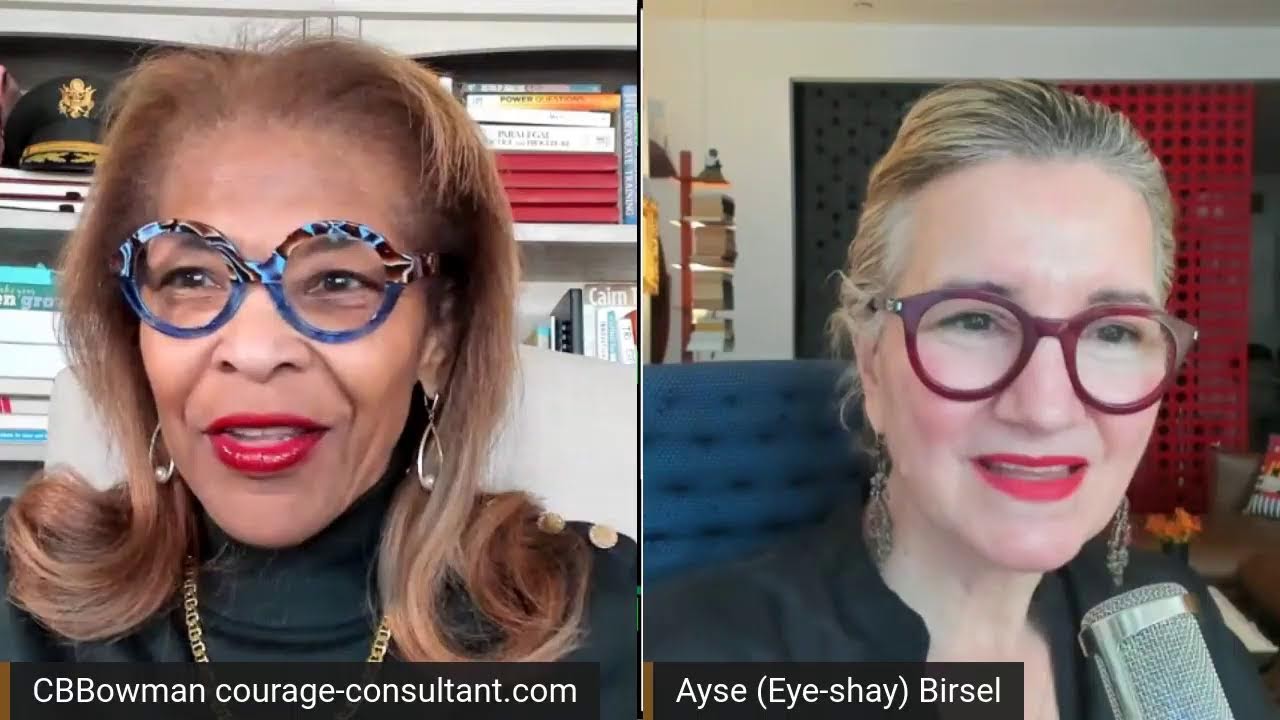
In this episode of CB LIVE! host CB Bowman interviews industrial designer and design‑thinking coach Ayşe Birsel. The conversation weaves together Birsel’s personal and professional journey—from growing up in Turkey, studying industrial design at Middle East Technical University, earning a Fulbright to Pratt Institute, and early collaborations with Knoll and TOTO—through the challenges of the 2008 economic crash that forced her to rethink her career. Birsel explains the "deconstruction‑reconstruction" process she created, which she first applied to a major GE project and then to her own life, giving rise to her book Design the Life You Love and a suite of workshops, virtual teas, and community programs. The dialogue explores themes of courage, especially the everyday courage of designing one’s own life, and how that courage translates into hybrid‑work design, women’s leadership, and the MG100 network. Birsel shares practical tools such as the "heroes" exercise, identifying values, super‑powers and kryptonite, and how these inform personal and organizational design. The interview also highlights her connection to Marshall Goldsmith’s 100 Coaches, her collaborations with Herman Miller (Overlay Boundary System, Resolve office system), and upcoming projects like Design the Long Life You Love. Throughout, CB and Ayşe emphasize synchronicity, the importance of listening to employee voices, and the role of intentional design in creating fulfilling work and personal lives.
Chapters
Hello everyone, it is Tuesday and you know your favorite person comes on on Tuesday. It's CB Bowman. How are you guys today? You know, we had here in Colorado, it was 70 degrees, then the next day we got 6 inches of snow. And then it went to 40 degrees and we got a little bit more snow. And today it's supposed to be in its 60s and we still have snow on the ground. You know, that's life in Colorado. We say, if you don't like the weather, blink twice and it'll change and carry a wardrobe in your car. Is it not exciting? Hey, I have another exciting show for you today. So this is my sister from another mother and another father, right? We found out we had so much in common. And you know I like to be transparent. My guest today is part of MG100. But you know what? I think our paths crossed when we were youngsters.
What?
We're still youngsters.
Okay.
So I want to tell you about her. She has an incredible design background. She designed furniture that I purchased when I was an interior designer for architects.
How is that?
How is that possible that we should meet years later in our new careers, right? It just tells you about synchronicity. And the Excitement of Life. Wow. And then—
You have good taste.
Oh, this— we both do, right?
This woman is a powerhouse when I tell you. You want to not miss one second of this interview. So, but before we start, I want to remind you to subscribe to my LinkedIn newsletter And visit all of my podcasts and leave a comment because I want to hear from you. And you know what? If you leave your name and your email, I'll reach back out to you and we'll have a one-on-one power conversation. So, you know, our platform this year is about courage. I love the word. I love what it stands for. You know, we all think about courage as this big, huge thing, like running into the building to save a life. And yes, that is courage. But you know what? Just getting up every day in today's society is courage. So we need to really take a look at that word. And our guest today really emphasizes courage, and she approaches it from a different perspective. Of designing the life you love. How romantic. How exciting is that? Imagine we can now have the life we love. You know what I heard on the news the other day, yesterday, was, you know, this great resignation where everybody after the pandemics, plural, left their jobs. They wanted to find a better job that represented their values, their true north. And the fact is, now I hear that they're disillusioned because that didn't happen. Well, maybe it didn't happen because you didn't plan the life you love, right?
Right.
So today our guest is going to talk to us about how do you do that in this day and age of uncertainty. I did it. Stay tuned. But now we have someone who could tell us how to do that right now, and you don't have to figure it out the hard way like I did. She's gonna make it so easy for you. May I present my sister from another parents, Ayesha. Ayesha, welcome!
CB!
I love being your sister, and, and we, we have the same eyeglass DNA and the same lipstick DNA.
There. And the same husband DNA, right?
That, that is true. Yes, mixed couples.
So what is—
what do we mean by that? My husband is Italian. Can you just imagine a household with a Black woman and an Italian man? Oh, the heat! I'm telling you, and I'm not just talking about the kitchen. I'm talking about the arguments. Wow!
Explosive, exciting, right?
And Aisha is married to a gentleman from Africa, right?
Yeah, he's from—he's French Senegalese.
Senegalese.
Yes.
So handsome.
Yeah.
Ooh, can I see that? It's a good thing I'm married to this Italian here.
I know, I'm, I'm so glad you got married.
So tell us, I want to start from the beginning. How did a woman get into industrial design? Because, you know, during that time There were like zero to none women in the field.
You know, it's so interesting that, CB, you're asking me about that. I think, uh, well, you know that I grew up in Turkey, right?
No, no, I didn't.
Oh, I love Turkey. Do you know that I was proposed to in Turkey?
Really? I didn't know that. Oh my, that's so romantic. Ooh.
I was walking down the street and this really cute guy came up and he said, what are you doing today? And I said, I'm walking to the bazaar. And he said, oh, I can show you how to get there. And me being completely naive said, okay, sure. And so I followed him and he took me to the bazaar and it was wonderful. And he took me all around and he introduced me to the vendors. And then he said, "Would you be interested in marriage?" What?
What? I need to get to Turkey a lot earlier in my life. Wow! So now I'm really intrigued.
Turkey and industrial design. How does that?
I grew up in a family of lawyers and. And I was brought up as a strong girl and to believe in myself. And so, but in a family of lawyers, I thought, I love to draw and I didn't really feel that I would be able to be creative. So I thought, well, maybe I should do architecture. But then a family friend came to tea and talked to me about industrial design, which I had never heard those 2 words together before. And he showed me— we were drinking tea, so he showed me the teacup and he said, you know, somebody designed this and the edge is curved so that it can fit our lips better. And it has a handle so that we don't burn ourselves holding the hot tea. And then it has a saucer so that if you or I spill the tea, we won't ruin your mother's beautiful tablecloth. And I mean, that was such a beautiful explanation of industrial design. And I fell in love with the human scale of it. I thought, oh my God, like architecture is great, but this is more intimate. You know, this is truly human scale. And the industrial design school in Turkey was in the Middle East Technical University, is one of the best schools in the world. And they had just started their industrial design department, and it had yet to give graduates. It was in its 3rd year. And I applied, I got in. And what's interesting, CB, is we were like 50/50 men and women.
Hmm.
Because there was not this preconception that industry is like for guys. And so, it's only after I came back to the States that I realized, Like, when I entered my master's degree at Pratt Institute, I was the only woman in my class. And I was like, why? You know? And to this day, I'm trying to change that. Like, as like a woman designer, this is for men and women and people of any gender. This is a great profession.
Well, I have to tell you a story. You know, our listeners love tuning into this show because we're just chatting like we're in the living room, right? Well, I applied to get into Pratt University for interior design, and I was turned down by the chairman, Harold Leeds. And I said, huh. And I studied oil painting there. And I thought, the nerve of him to turn me down. So I applied to Parsons School of Design, and I got in like that. Then years later, I went to an event at Pratt, and I ran into Harold Leeds. And it was for a competition that I won on interior design.
That's right.
And he said to me— he came up to me, he said, I just want to introduce myself. I'm Dr. Harold Leeds. And I said, from Pratt? And he said, yeah, how do you know me? And I said, well, it's very interesting. And he said, I would love it if you came to Pratt. And I said, let me tell you a story.
And I told him the story. And he said— he just stood there.
Yes.
That's probably one of the greatest mistakes we've ever made.
I love that story, and I have a story like that myself.
Yes.
Because, uh, Rhode Island School of Design—
Oh yes.
Uh, also similar to you, uh, didn't accept my application and Pratt did, so I ended up going to Pratt. But then years later, they gave me an award like you And when I did my acceptance speech, I thanked them. I said, thank you for not accepting me, because thanks to you, I'm where I'm at now. This is, you know, isn't that funny?
See, I told you we were sisters from different parents.
Oh my God, this is too funny.
I love this story, and I love when these things happen, you know.
It's just like, it's just meant to be, right? So, okay, so you got it. Now I want to ask you, I think I remember, but it may not be— in Turkey, your cups were meant so that you hold them in your hands?
Yes, very likely. So we do have the Turkish teacup, but here's the, um, you know, I'm a big tea drinker, right? So yes, this, let's see, this kind of—
yes.
So it was the whole idea of like holding your teacup and the saucer and all that.
Yes, but originally did Originally in Turkey, did they have teacups that you— without handles?
Exactly. The traditional Turkish teacup is without handles.
That's what I thought.
And it's tulip-shaped. It's just— that also is a great piece of design. It fits in the palm of your hand. It follows this, the shape of your hand. Yes.
Yes. And so for you to be exposed to the teacup with the handle And the explanation must have been so exciting.
Yeah.
Well, you know, my mom had these teacups that, you know, in Turkey people drink. People drink tea and they drink coffee. And different, all kinds of different designs to do it with. So it was just a wonderful introduction. into industrial design.
Okay. So then you go to Pratt and you graduate and you come to New York.
So I graduate from the Middle East Technical University.
Right.
And I applied and got a Fulbright scholarship. And that's what got me to New York.
Wow.
And I was really— yeah. And I was 21 when I arrived in New York. It was—
How did you get a Fulbright scholarship?
I don't know. I didn't think it was such a big deal at the time. I stand corrected.
Yeah. You know, I love it when, as I said, synchronicity.
You know, things happen to us when they should happen, and we don't always recognize it or respect it. And years later, it comes back and we say, wow, we are so lucky that this happened, you know, in our lives.
Absolutely.
And how— and to quote Marshall, how do we pay it forward? And sometimes we can't. It's just It's the karma that happens, right? Yeah.
And sometimes we don't know, right, that we might be doing something that really benefits—
Yes.
Person, and we don't even know it.
So true. So true.
And vice versa.
Yeah. Yeah. I've had that happen in my coaching where I'll say something to somebody and it just, it just rolls off my head. And years later, they'll come back to me. CB, you made such a difference when you said that. And I'm like, when did I say that?
And what was in the reference? Was it real or was it Memorex?
Okay, so now after you graduate from school with a Fulbright, um, what happens next?
So then, I mean, my years at Pratt were among my happiest years. And the chair at the time was Bruce Hannah, who is this amazing designer and an amazing professor. And as I was graduating, he said, I have a project. Would you like to work on it with me? And of course I said yes. So immediately, you know, I didn't have to, like, I was coming out of graduate school and my chair offered me this project. And the project was with Knoll, if you can believe it.
What?
Because, yeah, Bruce had designed some beautiful, like, office systems and chairs and products for Knoll. And they, Andrew Cogan, was the CEO at the time. And Andrew, I think, was 27 years old. I was 24 years old, maybe 25. And Bruce invited me to collaborate. It was just like a dream project.
Wow.
And furthermore, when the project came out and it was— I had so much fun working with Bruce. It was just amazing and an incredible learning experience. And when the product came out and the product is still on the market, It's called the Orchestra Office Accessories. And they gave me credit. So it came out as Orchestra Office Accessories, Bruce, Hannah, and I Shape Yourself.
Wow.
And that was just a miracle of a gift. And so I had so much confidence in myself and I thought to myself, I'm going to just continue doing this. This is easy. And then, of course, I had, like, I don't know, 4 years after that where I couldn't find any projects. Yeah. Okay. Because, you know, I learned my lesson. But the beginning was just amazing.
Yeah. Oh, my God. Yes, I do remember Noel. Oh, my God. I can't— I just can't even believe how much we have in common. Okay. So after the 4-year period, what happened?
So those years were difficult. And I thought to myself, boy, industrial design is hard. Maybe I should— I seriously thought about becoming a lawyer. I thought maybe now I can do law and then become a—
A patent lawyer.
A patent lawyer, exactly. And, but luckily 2 things happened. One was I freelanced for Cato Gerber, which was a huge branding firm at the time, and met Leah Kaplan, who's one of my oldest friends and collaborators to this day. We work together and she was my— she was younger than I and she was my boss.
Wow.
And I really, I fell in love with her. And then, So, keep that in mind. And then, I also freelanced at Smart, and Tucker Viemeister was one of the partners, co-founders. And so, and I became friends with Tucker as well. So, then there was Toto. Toto in Japan at the time was the largest, and to this day, they are the largest manufacturer of bathroom and kitchen products.
Mm-hmm.
But they were based in Japan at the time. They wanted to— apparently wanted to do a seminar on bathrooms, and they were looking for somebody from the Middle East because, you know, all the Turkish hammams and like the bathrooms— I mean, the bath culture in Turkey and the Ottoman Empire is amazing.
Yeah.
So they were like, it would be good to have a representative. Who do we know? And then Tucker sent them my thesis from Pratt, which was called The Water Room. And so it was a whole— it was a conceptual bathroom inspired by water in nature. And it had won at the time the i-D Magazine's Gold Award. Do you remember i-D Magazine way back?
Oh, yes.
So Tucker doesn't even tell me. He just like, Photocopies the ID magazine.
Wait, wait, I'm gonna give you one. Do you remember Al Batare magazine?
Yes. Oh my God!
I at that time I was in the catering business and I did their opening party in New York. Really? Yes. Wow.
Now did I come to that party, CB? It was many times did our paths cross.
I— yeah, I think it was, it was on 57th Street and Lexington, someplace around there. Yeah, I had left Seinfeld and I went into the catering business, and that was one of my big clients.
That, that's a big deal.
Yeah.
Your food must have been both delicious and well designed.
It was. It was.
I had things like Scotch eggs, which nobody had had at that point. I mean, I did a whole roasted pig. I mean, it was— it was outrageous.
Wow.
Wow. I should interview you, CB.
I would love it. Okay, so now go ahead. This is so—
Anyways, to make a long story short, Tucker introduces me to them and they're like, let's invite her. So then I end up going to Japan. Tucker and all these other amazing designers. And then everybody had research on bathrooms. I had my thesis, which was a conceptual bathroom that was beautiful, and they were like, we want that. I was like, okay, well then you want me. So then I moved to Japan and worked for Toto and designed toilets for them and a washlet, which then was coined as the unofficially the most comfortable toilet seat in the world.
Oh my God.
And then that was designed for the American market. So once that was made, I came back to the States with the product. And then so that, that was that. And then when I came back again, I went into one of the— it's kind of like, you know how in design you have waves, you have peaks, and then you have these incredible like valleys?
Yeah.
So Knoll was a huge peak, and then I was in a valley, and then TOTO was a huge peak, and then I was in a valley again. I came back to New York. Nobody knew of me. They weren't interested in me. The product wasn't the TOTO WASHLET, which, you know, eventually won lots of awards, wasn't in the market just yet. Like, I was in that in-between state, didn't know what to do. I even thought like I should become a lawyer, you know? And then I connected with Leah and Leah was like, well, you should meet my dad. And I'm like, your dad? And she said, yeah, Ralph Kaplan. And Ralph Kaplan was the chair of i-D Magazine. He had written amazing books on design, By Design. Anybody who's interested in the audience, you have to read By Design if you haven't read it. So I'm like, what? You— Kaplan? Ralph Kaplan is your dad? So anyways, uh, I meet Ralph Kaplan and Ralph says, oh, Ayşe, um, I like your work. I'm gonna introduce you to Herman Miller. No way. And that's how, uh, my collaboration with Herman Miller started, you know, a 20-year collaboration.
So for those—
Talk about, you know, how people change lives, right?
Synchronicity. So for those people who don't know, Herman Miller— oh my God, the top furniture design company. Um, you're talking about icon pieces of furniture. The Eames chair, the just— it just goes on and on and on. And you know, it was just great.
The Eames folding screen, CB, that you made me just take away.
I didn't realize that! Oh my God. So here's the thing, audience. I always do a little 15-minute prep with my guests just to check their lighting and the backdrop. And Ayesha had this beautiful scream, but it was like there was no fire in it. I mean, it was just very peaceful.
And I said, Ayesha, that's not you.
She made me take away— take it away.
Isaac, you know, you like—
you represent fire and ice and just like Yeah, and I love the screen that was in 2 colors in back of her and all the books and the beautiful pillowcases, which you can't see now. And I said, that's you, that's the design you, you know, with all kinds of creative books and energy around you.
And so you take away this beautiful screen.
Thank you, CB. I love it. You, you, you redesigned my, uh, my environment, and I'm gonna use it from now on.
You know, there you go.
So then, okay, Herman Miller. Oh my God, I wish I could remember the salesperson that I worked with because he was brilliant. And you know what, when I stop and think about it, he represented way before its time the Costco spirit, which was he never tried to sell me anything. It was just all— we just had such a strong bond. And I would walk into the show and I'd say, I'll take it all.
And he'd give me the price. That's okay, my clients have this budget. Take it all.
And oh my God, that was absolutely— and it still is to me the best designed chair in the world, the rosewood on it. Oh yeah, you're taking me way back in my memory. Okay, so now you've— are you still working for Herman Miller? What's going on now? Bring us up to date.
So I, um, the most recent, um, system that we designed for them is on the market, and it's called the Overlay Boundary System.
Oh.
And it's a beautiful system, and it's actually perfect for COVID because it allows people to create, you know, small, medium, and large size enclosures and creates boundary. And so that's our most recent collaboration. And before that, My beginning with them was the Resolve office system, which totally kind of revolutionized office systems at the time. And it was just a— again, timing is everything. It was the perfect time right before the dot-com. It was when startups really were happening. And it was just an incredibly exciting time. And we were all learning to work with technology. So it was really asking the question, Kind of like we're doing now. We can work anywhere with technology. So why do we still come to offices?
I have no idea. You know, I was a big proponent of not having an office at least 10, 15 years ago. To me, it just made no sense. But then I'm a high introvert.
I don't have to deal. Yeah.
I stay in my own head and think and process. And I think that companies are making a mistake now because the ones that are supporting the old philosophy of that you have to be in, in the office to be productive and creative. And I think that that is so wrong. And they have evidence now that it's wrong. But, you know, stubbornness ranks so high in corporate America, they don't have the courage to move forward with the times.
I think it's the courage and the openness to new ideas. But I love the idea of the hybrid office because it brings 2 very different work environments together and creates a harmonious whole. Because, and you and I know this because you've designed offices and I've designed office systems, we both have worked with how to make people more productive and happy in office environments and work on work performance. And really, the office by itself is not enough, and the home by itself is not enough. But together— Well, I think in-person meetings, right, is— but then with intentionality, like, why are we meeting together in person? Yes. What are the advantages of that? There has to be like that intentionality. And then why are we at home? And what kind of work do we do when we're at home? And the companies that are listening to their employees, to their people, to that voice, I think are really allowing people to have that hybrid solution and autonomy, which is so, so important. And it's about trust, you know, trusting your people.
You just said something really important, which is listening to people in terms of the environment that sets them free. Yeah, to be productive, to be true to the company, to be true to themselves, right? When I saw your background, I felt like this is not going to allow people to know Ayishe, right? When, when you look in my home, I've got books all over, but they're very ordered. And you could see the military hat in back of me, which was my dad, who was a lieutenant colonel.
That's what I thought.
Right? And so There's something about getting to know people and their values by being able to have a hybrid office. Because here's what happens. People who are working in the office that love an office environment, the people that are working at home get to see a different dimension because now that office becomes something that triggers them. Right. And so therefore they've made the decision to go to the office, whereas somebody else has made a decision to stay at home, and that's what's triggering or energizing them. So it gives more depth to relationship building, I think.
You know, it does. And you know, you're reminding me that, um, when I first started designing office systems with the people at— with the teams at Herman Miller. One of my close collaborators was Jim Long, and Jim was the director of research. And research was very important to our work, you know, how people work, what are their tools, you know, and what's the future of work. And he had taught me that this very simple notion that An office system is one person decides for 1,000. So, that person could be the corporation, the head of the corporation. It could be the architect. It could be the facility manager. But one person decides for 1,000. And he had said, and that's why, as a designer, you have to make sure that people are well taken care of, no matter who orders the product and how they order it. You need to honor the user because they can't choose. Somebody else makes that choice. And today, when I think of that, you're making me think of that. I think now 1,000 people can decide for 1,000 people. We can all decide for ourselves.
Right.
And so we need to listen to those voices and say, okay, what do you want? I think that's the incredible shift that we're going through. And some companies have really a hard time with that.
And some people have a hard time with it because, Ayse, up until now, I would say our culture not just in other countries, but actually in here, if you look really deep, is that we've allowed other people to make decisions for us.
Hmm.
And all of a sudden we've realized because of these pandemics that that's probably not good enough for us. Now we want the freedom to make our own decisions. But the downside of it is we don't know where to begin. We don't have the tools to be courageous, to figure it out, except if you contact me. No, but—
Exactly. So that's the courage that you're talking about is really the courage of designing your life and designing your work. And giving yourself— I think you set me up perfectly, CB, because I often talk about, like, give yourself permission to design your life, to design your work, and have a life that represents your own values. And that takes courage.
Yeah.
Because design takes courage. You know, you're imagining the future based on what you know today. And there's inherent risk in that, right?
Yes.
When it comes to your life and to your work, it's so personal that it takes even more courage. But the upside is instead of life coming at you, you're going at life and you make choices.
Yes, exactly.
And you imagine your own future and you, you know, the reason that it's called Design the Life you love is to help you understand and think about what gives you joy and get you towards, you know, closer to things that give you joy.
You know, you're so right. We have— and I know I've talked to you about this— I have something called the Women's Power Pack Group. And we just put together— it started out with a group of women that were very successful helping other women that were successful. And it started out as a beta test mode. And now we've come to the point where we've actually just this week designed a program to take into corporations based upon each of our strengths. And it's so scary how it came together because we have somebody who's a specialist in innovation, one who's a specialist in mindset, Myself, who's a specialist in courage, and another person who's a specialist in capacity. And we realize that this is something that women in particular— there are 5 components. We realize that these components are things that successful women are missing. The question becomes, Why are they missing? And it really goes back to they didn't design the life that they wanted in the corporate world. And so our group is going in and working with companies to help women design that life, because it doesn't mean that you have to leave your company. It means you have to have the courage to speak up and design your life. I love that.
CB, did you send a newsletter about that or something about that just today or recently?
No, I didn't. There's another person that we know that is doing work in how do— how have women had breakthroughs. And so she would like to interview us in terms of what was the moment that we realized our value. And I think that that's so important because she's going to present that to a lot of women, because a lot of women don't know their value and can't figure out how to get there. And it's not easy. It requires a lot of work. And your work in Designing Your Life helps women and men realize their true value, because the way that you've designed the system. The questions that you have to answer allows people to say, oh my God, I didn't realize I had those skills. I didn't realize I had that opportunity. I didn't realize I had the courage to make a breakthrough.
Right.
And that's so sad because we're not writing the epitaph that we want to write. Yeah, it's beautiful. Yeah, so our group is about helping women write that epitaph and open the doors for themselves and other women. But Ayesha, let's talk about your work specifically because I went through your program and I'm the Courage Master and there was so much that I learned.
I was like, oh my God, wow, I missed that one and I missed that one and now I'm— It was like, catch it!
Tell us, how did you move from industrial design to designing your life? I mean, I see a perfect movement line, but for those of us that are curious about it.
It's a continuum, right? One feeds the other, but Let's see, in 2008, the real story is in 2008, when the economy crashed, almost all our clients, including Herman Miller, like the big clients that, you know, big brands, took their work in-house. And we were together with Bibi, my husband and partner, we were at the top of our game. And suddenly, we found ourselves with no work. And I was really— we had 2 small kids, babies, and I had uprooted Bibi. He is and he was an automobile designer, and he had designed these award-winning automobiles for Renault. And then that's how we met, actually. I did a concept car for Renault. And then fell in love. And then, you know, we decided to move to New York because my studio was here and we became partners. So then, a couple years later where we were really parenting like crazy, working like crazy, suddenly the economy crashes. And I was like, well, nothing is going to happen to us because— We're doing great work with great brands. Well, wrong. Our clients, of course, they had to cut budgets. And so everybody stopped. Like, the first budget that goes is like the product design. And, you know, in those moments, nobody wants to take risk. And so we had no work. And I thought, I took it upon myself and I was like, okay, I uprooted BB. So it's my responsibility. I'm going to find us work. And if I can't find this work, I'm going to find, like, I'll go and work for someone. So then I started seeing headhunters and I was like, I have all these years of experience. And they were like, well, have you ever worked in an office before? Have you held a corporate position? I was like, no, I've worked with them and I've designed offices. And they were like, nope, we have nothing for you. And so in that moment, I had mentioned Leah is one of my oldest friends and collaborators. She saw how frustrated I was and she said, look, Ayşe, you have all this time in your hands. Why don't you use this time to think about how you think? Because you think differently. And that was like one person who still believed in me. And I took her seriously and I was so grateful to her. And that became my project. So I started to think about, well, how do I think? Like, I've designed all these things from toilets to automobiles to office systems to kitchen gadgets. How do I think? And it's a very interesting exercise because it's kind of like a deep dive into your own brain, right?
Yes.
From that developed a design process that I call deconstruction reconstruction. And once I had that, 2 things happened. One is I had a meeting with GE. I showed them, here's my process. And GE being GE, they were at their top of the game then. And they loved process, right? So they said, oh, come and deconstruct and reconstruct value of design across 5 of our businesses. And that was the turning point. It was a huge project. It gave us opportunity to prove that deconstruction reconstruction was a real process. And we worked with GE and that was lovely. But the other thing that I did at the time was like, I think that our life is our biggest project. And so I was like, well, now I have a design process. Can I apply it to my life? If our life— it's really if this process works, it should work with my life. And so then I did that. And a friend of mine said, Ayesha, why don't you do a workshop? Shirley Moulton, who had just started Academy of Life, about lessons we don't learn at school. And I did my first workshop, and that was the beginning point of Design the Life You Love.
Oh my God. So tell me—
Long story, but I just wanted to give you a sense of how sometimes challenges could be the beginning of a beautiful story.
Yeah, yeah.
If the economy— I mean, I wish the economy had not crashed, and I wish that we could have continued doing what we were doing, but that would have been a different life, right?
You know, I'm a firm believer in— and people, when I first started saying this, they didn't get it until they started to know me. But I'm a firm believer. I'm a graduate of the New School for Social Research, and there I learned to leap first And then figure out where I was going to land. Because we were educated to learn and truly believe there's no such thing as failure, which is what my courage is about. It's an opportunity to learn. And so don't be afraid of leaping and breaking both of your legs, because then you've learned how to leap better.
Right?
Yeah. So I, I truly, truly agree with what you're saying. When I started the Association of Corporate Executive Coaches, I thought, what am I going to say to master-level coaches that they don't know? And I thought about it, and I thought about it, and I said, so what makes me good as a master-level And I realized that it was my corporate background. And it was also the hurt that I experienced in my life being a Black woman. So if I took those 2 things together and I said, okay, what can I offer? And it turns out it's a concept of you being an enterprise-wide business partner with your clients. And you have to realize that. You have to get behind the scenes, under the sheets, whatever you want to call it, and really understand the success and the failures of this organization and what their competition looks like, what their workers look like, in order to be able to coach somebody at the top of an organization. It's not about a skill of Counting beans, to be very vague about it. It's about how those beans fit together. Doesn't matter if you have 2 or you have 1,000, but how— you have to look at it like a jigsaw puzzle. You have to figure out the interrelationship, and then that interrelationship, as it comes together, makes it stronger. Because you no longer have one separate piece of being over there, a piece of being over there. So the coaches in ACE understand that it's together that provides strength, and you have to be part of the organization. It's not a one-and-done deal.
Right.
It's togetherness that makes a difference. And so I think that the work that you do, when I look at the comparison, It's not looking at yourself as separate entities. Because believe it or not, what we're really saying is people tend to look at themselves like an out-of-body experience. My body is there, but my mind is there and my heart is there. That's not living the life you love.
No.
It all has to be on one sheet, one thing that comes together and makes this big explosion.
Then you have it.
I love it, CB. Yes, it really is. Yeah.
Share with us some of the things, not all, some of the things that you ask us to do in designing our lives.
I mean, first of all, thank you so much for creating this space for me to share what I love doing because it truly transforms people's lives. And I'm so glad that you had a chance to do it recently. But the— I mean, one of my favorite examples is the heroes exercise.
I love that.
Which is why we're together, because that is what Marshall did. So CB, at the top of the Our— mentioned that we're both members of the Marshall Goldsmith 100 Coaches. And the seeds for our organization were created. Marshall had them in my session about 5 years ago. He actually came to promote Design the Life You Love with his friends. My book had just come out. And Marshall said, well, don't you do a workshop and I'll invite my friends? And I said, great. I mean, and Marshall, everybody is his friend. He's so well known. He's the world's number one leadership coach. And so he invites his friends, 70 people show up. And among them, Marshall, which I loved him for that, that it wasn't just like, I'll send you my friends. He was like, no, I'm going to come and do it myself. And So when he designed his life, one of the questions that I have for people is, who's your hero? And Marshall said, my heroes are my teachers, Buddha, Peter Drucker, Francis Hesselbein, people who've taught me everything I know for free. And then I turned around and I said, well, So what are you going to do to be more like your hero? And then Marshall thought, well, I'm going to teach everything I know to others for free. And then he went home and he said, I'm starting— he did a little video telling the world that that's what he wants to do, put it on LinkedIn thinking, well, a few people will reply. And 17,000 applications later, Marshall Goldsmith 100 Coaches was born. It was first 15 people. And I call myself member 0 or member 1 because he said, this happened in your workshop, so you're coming. I'm like, of course I'm coming. Who wouldn't want to learn from Marshall? And he became my mentor. and my coach, and I became his coach. So to this day, I coach Marshall, and, uh, which is an incredible, like, honor and responsibility. Yeah, so choose me.
Well, he chose well.
He chose well.
Thank you. Thank you. So the, the— I mean, that's one of the ways the, the, um, CB, you know that InDesign You have a holistic viewpoint. You look at the big picture, right? You gather inspiration and connect the dots in new and different ways. You do it with empathy. You do it with optimism because the same challenges that slow you down could be also your opportunities.
Mm-hmm.
You lean into those challenges and constraints. You have an open mind because often the best ideas come from the worst places. Like you said, you fail, and from that, you learn something, and that gets you to your next great idea. All those things that we use in design are tools that I use to help people design their life and their work and truly get them to live according to their values, and have an original life. And one of the things that I often talk about is, like, I don't know, you and I, like you said, we're like sisters from a different mom. We probably grew up more or less with the same map, roadmap, right?
Yes.
Go to school, work hard, do well, work hard at work, get married, whatever. It was just very straightforward. And then retire, that kind of thing. Well, none of that works today, right? You can't give a kid that roadmap.
No. And in fact, it's the worst thing you could do.
Exactly. So then what do you do? And for ourselves, I mean, COVID, I think, showed that to all of us. You were saying that earlier, like, we have to figure things out for ourselves. And that's both the incredible constraint of COVID And the beauty of COVID is that it made us rethink what do we want out of life? Is what we had enough? Like, how could we do things that bring us joy? Because I think we all realized our own mortality, you know?
Yes, we did.
We did. But that's— yeah, you know, it's again, turning challenges into opportunities. Well, then what's the kind of life? What's the kind of legacy you want to have? What's the kind of person you want to be? And so anyways, that's the idea. And our heroes make us think of what inspires us.
Well, what I loved, and we have a statement coming in from Allison, she's a member of ACEC. And I want to read it in a second. But one of the things that I loved in your exercise, it was not only who are your heroes, and we had a limited number that we could select, but you asked why.
Yeah.
And I never thought about why I have certain heroes. And when I thought about it, the 3 that I had selected had in common humility and braveness. Braveness that related to courage. They all had courage.
Yeah.
And I thought, if they're my heroes, how is my life similar or not? And if not similar, are they truly my heroes? So it led me down this whole path of self-analysis, and I thank you for that because— It was an exercise that— it was a complete exercise. I've had people say to me, who are your heroes? Like when people interview me and I rattle off some names. But this allowed me to go much further in that comparison of my heroes and myself. Not to say that I was the same or that I took the same path, but a higher level. of looking at them. So I thank you for that.
My pleasure. Really, the hero's exercise is about what are your values. And so CB, your values are humility and braveness or bravery and courage. There's a reason why you're an expert on courage. But then, like you said, once you understand those values, they're the foundation of our design, our life design, our work design. That's how we make choices. So it's important that I connect you and everyone first with their values. And the heroes is kind of— If I were to ask you, what are your values? It's a hard question for many people to answer.
Yeah.
And it doesn't have much depth. But when you think about it through the lens of your heroes, you don't realize you're thinking about your own values. And it becomes very interesting, very deep, very nuanced. And then I say, well, those are your values. And then what are you going to do about it? And then you realize my values are alive. They're not just static things. I can use them. And so then, and that I think is really what designing your life is all about. Designing a chair or designing a product is the same thing. Which values am I designing for?
Yeah. And I want to be honest with the audience. Allison, hold on one second. When I first heard about this, So I'm a hard-driving, kick-ass woman. I do—
You are?
She hides it well, everyone.
I think I've been busted, audience.
I'm like, you know, don't give me the frills, just tell me. And at the same time, I'm very sensitive.
I know, you're, you're the iron fist in the velvet glove.
Okay.
Yes. You don't want to play in my playhouse? I'm not talking to you.
And so when I first heard about your program and I came to one of your virtual teas, I thought, oh God, this is another one of these frilly things. I can't do it. I can't do it. I love Ayishe, but I just can't do it. And then I had the opportunity to actually experience And man, was I wrong.
Yay!
Holy Toledo! So much I uncovered about my strength and who I am and how to use it. And you know what it did? It actually caused me to become calmer.
Ooh.
Generous with other people who I thought were like, listen, you're just being— you're out there visiting ET someplace, you know, get real with your life. And I never thought about my clients like that. But in terms of friendship, I'm like, check, nope, check, you know. But this allowed me to say, okay, this is the— this is why I process things this way. And I have to recognize that other people can't, won't, or don't. And it's okay because that's the life they've chosen.
And look, look, look at how authentic you are, right? So it really is about— one of the questions I ask is about superpowers. What are your superpowers? Which CB, you have plenty of. But also, what's your kryptonite? Because we all have—
Yes.
Our kryptonite. And to get people to realize, you know, somebody's kryptonite could be impatience. It could be fear of failure. It could be so many things. But to be kind of true to yourself about those things and recognize they're part of who we are. But that, again, design is intentionality. If we know our superpowers and our kryptonite, we could make sure that we spend more time with our superpowers. And then we're more understanding of our kryptonite. And then we can figure out the tools to manage them.
Yes.
Like procrastination is a kryptonite for many of us, right? And then our friend Alyssa Cohen wrote about— she had on LinkedIn the other day, somewhere she talks about how to overcome your kryptonite. And I loved it.
Oh.
And I'm like, okay, well, now I've learned my lesson. And one of the learnings of kryptonite is not to take on, like, not to think I have to do it all at once. Yeah. To get started. And then once you get started, you're already in the game, you know? And I thought, she's so right. And that's the, you know, thank you, Alisa.
Kat, we're learning so much from you.
Okay.
Now Allison says, what an exciting and inspiring conversation! Exclamation mark. Absolutely loved it and learned so much. This has been my work lately to design the me. Very appreciative of the learnings. Courage over comfort. Oh, Allison, you hit it out of the ballpark. I love it. And you know what? I've been talking to Allison and she's doing an amazing job at designing her life. So I want to encourage her to take your Now let's talk about your program specifically. You have a virtual tea, then you have this workshop, and you have your book.
Yes.
Which order should people do what, and what's available?
Okay, so, um, CB, you have your book next to you that you could show it? Yes, I do. Hold on, I moved it. There we go. Design the Life You Love. It doesn't come with Post-its, that's just me. Okay, but, um, so you can get the book, and then CB, you'll give everybody a way to find me. That you can find me on LinkedIn, but I also have— you can get onto our newsletter, which is the best way to know what we're doing. The virtual tea is something that we started at the top of COVID because I wanted a way to connect with my community and see if we can help each other. In 3 weeks' time, we're going to celebrate our 100th virtual tea.
Woo!
It's amazing. It is a beautiful community of people who are designing their life and their work through COVID. And it's every Wednesday at 5:00 PM New York time. And people all across the globe, unless they're sleeping, our community in India, in Asia, and Japan are complaining because it's their bedtime, 5:00 PM. But we have people from the East Coast, West Coast, South America, Europe, and Africa joining us. So that's quite amazing. And that's free. And it's really my way of giving back to my community. And then the workshops that we do, you know, our friend Beth Polish from—
MG100.
She and I started collaborating on Design the X You Love, which is the program that you took. So we do that with corporations, especially through this transitional moment. Design the hybrid you love, design the culture you love, design the resilience you love. These are things that we do with human-centered corporations that want to listen to the voices of their employees. And then what else? Oh, and then one last. Ron Carucci and I, who's— Ron is also part of our MG100.
Yes.
And he has this amazing book called Be Honest and To Be Honest. And when I read that book, I reached out to Ron and I said, designing your life is actually designing an honest life. Could we do something together?
Yes.
So, we started doing Design the Honest Life You Love. And we have an upcoming workshop in May for anybody who's interested in the honest life, honest friendship, honest work, whatever you want to call it. And it's kind of the intersection of design thinking and behavioral Psychology. So that's—
I think he's coming on the show, actually. Um, but, uh, we'll— I'll talk to him about that. But I think he's scheduled to come on the show. I can't remember. Fabulous. Yeah, because we're, we're literally booked out till the end of August.
I'm not surprised, CB. I've been waiting for months to get on your show. Finally. Yeah. We'll have such a good time.
Hey, but I want to know if you're going to be doing some kind of workshop, not for corporate people, but for average people like myself to come and do Design the Life You Love.
So when you say average, it's so funny because I call everyone— if there's one thing I've learned from helping people design their life, is that people are extraordinary. I mean, CB, you're extraordinary, that I know. But a lot of people say, oh, but I'm not a designer, I'm not a creative person. Well, you actually are. And if there's one thing I've learned is that how extraordinarily creative everyone is, regardless of their discipline. But you all need a process and set of tools, just like I do. So, all I do is I give you my process, And then I get out of the way. And like you just explained, you design your life. It's your life. And it's very pure. It's you, your life, and design process. That's it.
Yeah.
If anybody is interested in doing that individually, not through a corporation, sign up for my newsletter because we do it There's no rhyme or reason. When there is like a group of people who are interested, we do it. Okay. So we'll do it again. Sounds like CB, you're interested and your community might be interested.
So I think the people in ACEC, Association of Corporate Executive Coaches, would love to go.
Let's do it. Yeah, I would love that.
All right. Well, if you're not a member of ACEC, you're out of luck.
This is your opportunity to become a member.
Hey, you know, I just want you to know that we have people who are listening in, in Russia, um, in the Mideast, from all over. So it's really interesting when they tune in because I can't translate the language, but I see them whenever my show is on. So it's great. So I hope you all will go to my podcast and to LinkedIn and Facebook and YouTube and comment, please. Even if you're using your language, that would be great. We've got Google Translate, you know, so this would be awesome. Listen, Ayesha, I mean, I know we ran over, but—
I didn't see the time go by. My audience knows I don't know how to tell time. I just have a good time here.
That's one of, uh, design— designer strengths.
Everybody, I, I do know that you do have other things to do in your life, so number one is to get busy designing the life you love. Yeah, with courage.
I could actually share. Is there a way for me to share? Where would I write? I could put in my newsletter link, but I don't know.
In the comments.
But you know what I'm going to do? If you send it back out to me, I'll put it on LinkedIn. Perfect. And I can also— guys, you know, I have the LinkedIn newsletter, which comes out the first week of every month. It will be in there. A whole bunch of stuff about Ayoshe. I— you know what, Ayoshe? You're gonna have to write an article for my newsletter.
Ooh.
About your work. Wouldn't that be cool? Let's do it.
Yeah, let's do it. You know, my second book is coming out, CB.
What's your second book?
It's called Design the Long Life You Love. Now, who doesn't want to design their long life?
I love it. Okay, well, you— I'll write about that.
You'll have to come back on the show to talk about that.
And then in the meantime, you have to write an article. My next— did I release the March? I didn't release the March. I'm behind.
Oh my God, I released February. Okay, right away I have to release March.
Okay, you do that, and then you call on me and I'll do the, uh, Whichever one you want.
I, I need the—
I need the article today. I have to get this out this week.
I mean, yeah, I see how you do this. I totally forgot it was smart. I see you, CB. Yes, I get you on camera. You can't say no.
Yeah, I'll say yes. Okay, anything for you, my friend.
Thank you. Okay, everybody, this was lovely. I hope—
I know you've had fun. I know you've had a chance to experience, to learn a lot, and that's what we're about.
And to remind me that I'm behind in my schedule for my March release.
I love you guys. Can't wait for next Tuesday, and you'll see who I have on next Tuesday. It's been such a pleasure. I love this.
I love that, CB. Thank you. Now I know personally why people rave about your show.
You know, I also brought them. No, no, no, no, don't believe me. Hey everybody, see you next Tuesday.
Thank you.
More from CB



211- Courage to Leap & Lead with Louise Story part 1Courage to Leap & Lead







