CB LIVE! Courage to Leap & Lead with Magdalena Mook - part 2, episode 120
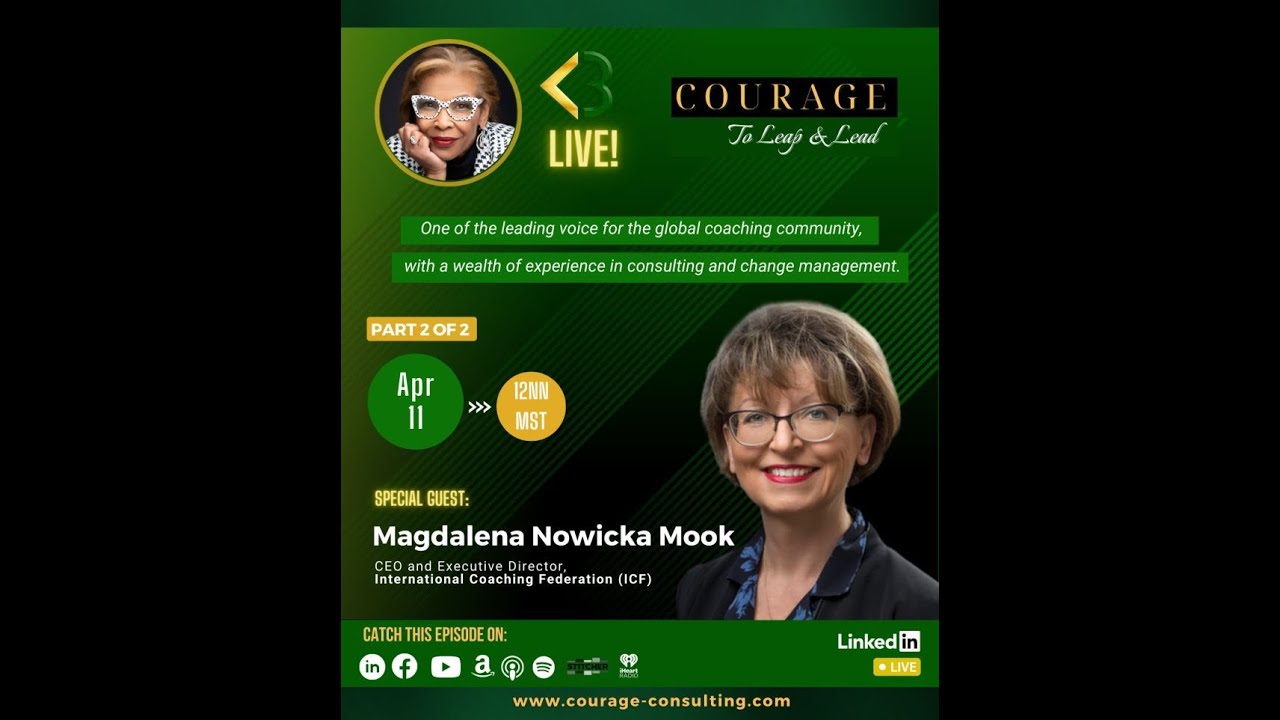
Magdalena Mook, former CEO of the International Coaching Federation, talks about delegating to build confidence, grooming successors early, and pressing forward with a three-year transformation plan when COVID-19 hit. She credits personal coaching with teaching her humility and the importance of asking before assuming.
Chapters
You've got courage to leap, courage to lead.
Be brave and be bold.
Whoa, let it roar. Welcome to the Courage to Leap and Lead podcast, where each of our guests share the stories of courage that helped them become powerful leaders. Before we start today's show, please remember to visit courageconsulting.com where you can find all of the episodes and lots of other excellent resources. That's courageconsulting.com. Now here's your host, Leadership Courage Coach CB Bowman.
Hi, this is CB and welcome to part 2 of my interview with Magda. And if you missed part 1, You must go back and listen to it. This is an extraordinary woman with marvelous stories to share with us about her life growing up in Poland and then taking all the studies that men study. And so we're now going to talk about what did she do next with all this knowledge. Magda, welcome back.
Thank you, thank you. It's been fun.
So Magda, I'm going to fast forward a little bit. How did you get from working with the American government in Poland to being head of a coaching association?
Yeah, nothing ever happens easily or, or without some serendipity. Well, as I said, you know, I was always interested in international relations, hence my master's degree, and I was working with another not-for-profit organization when ICF was seeking then assistant executive director. And in particular, they were looking for somebody with experience in international relations because ICF already was international, not anywhere close to international like we are right now, but definitely with the great, great appreciation for the global nature of the coaching profession. So when I first started working with ICF in 2005, I knew some about coaching, but not that much. And then I was afforded the opportunity to work with a professional coach.
Oh, okay.
And that was definitely life-changing. To this day, every, every staff member of ICF has access to professional coach every time. Uh, and I'm still friends with the very first coach I worked with. And—
Okay, wait, timeout. You're not gonna get away that easy. What were some of the highlights of things that you were coached about?
So let me, let me tell you, because several years back Not that many. I called up my, my first coach and I said, Beth, I have to apologize. She says, for what? Said, for being not very available client. She says, what do you mean? I said, now I know because I know so much more about coaching. Now I know where you tried to encourage me and maybe even push me and challenge me to do certain things. And I wasn't ready for that. I was not. Now I know it. And now I can so appreciate somebody who's exposed to coaching for the first time. You need to ease to it and you seriously find more opportunity within yourself to go deeper and deeper and deeper. and deeper, but it doesn't happen overnight. So I think I'm saying that because it is, it is, um, for all of you new clients to coaching, hang in there. It's getting only better.
It's getting better.
And for all the coaches, like, stick with it. They got— they, they're gonna come around. They're gonna come around.
Yes.
Eventually they're gonna come around. Um, so yeah, because the coaching was, uh, in a, in a, um, systemic, if you will, way of being an executive for ICF, it was about leadership, it was about management, it was about engaging, uh, people to work as a team. So I think, I think that the, the actual topics of coaching were not very different from what many executive leadership coaches are working with their clients today. Uh, uh, and, and yet, you know, I of course still work with the coach. It's just, it's just that our respective levels are different.
So, okay, you're not answering my question.
All right, ask another question.
All right, my question to you is, what coaching did you receive that made you a different person? And so here's why I'm asking the question, to give you a little background.
Hmm.
So being the CEO of the Association of Corporate Executive Coaches, we had monthly meetings with the executive advisory group. And at one point, somebody said to me, CB, what is our role? I was surprised. I said, to advise? And so they were brave enough to say, well, you're not letting us do your job— do our jobs. I said, what are you talking about? They said, well, you come to us with the solutions in hand.
Mm-hmm.
And you tell us, you update us. And I said, are you trying to tell me to shut up? And they said yes. A very brave group. And I was very upset.
Hmm.
Fast forward, our dear friend Marshall Goldsmith interviewed, I think it was Ellen Malaly. And he said to Alan, what's the thing, the most important thing that you've learned being in your position? And he said, I've learned to shut up in meetings. And I went, I spun off my chair and I said, oh gosh, I'm in such good company.
Yeah, if Alan can say that, oh my gosh, right?
Exactly, exactly. So, and, and you know what, my association improved dramatically when I did learn how to shut up. So my question to you is, in your coaching, what courageous thing did you learn that made a big difference in your leadership?
Mm-hmm. I'm a coaching junkie. I love to work with— I work with many, many, many coaches. I just love experiencing different kind— different approaches to coaching. I am trained as a coach. I'm trained as a systemic coach, but one is very similar to yours. You know, when I first started with ICF, there were 5 of us stuffers. We're 95 now. Um, so everybody was in everybody's business, and it was necessary because there was nobody else to do it, right? So one of the absolutely first, um, humongous difference was to delegate.
Hmm.
And to unders— to understand 2 things. One was that by delegating, uh, you are putting confidence in your people, and this is how they see it. You give them a job, you have their back. If they need you, you're there. Otherwise, let them go.
Yes.
So that was very important that there was—
Let's dive into that a little bit. Because I will tell you my experience, that was incredibly hard. It was like having root canal.
Yeah, because I can do it faster, I can do it better, you know, I don't do that. But then it's like, what? One of the other experiences before coaching that I had in my professional life was I met a gentleman. He was a state legislator, and he young, you know, very, very well and Ambitious, yes, but also seriously good and progressing in his career. And I asked him, I said, so are people jealous of you? He said, no, because the first thing I do is to groom my successor. I'm like, what? You just started in your new position. He says, yes, and stuff happens. I may wanna leave. Somebody else may want me. To leave. The place have to be left in good hands. It's never too early to groom your successor.
Okay.
So that was a very good lesson from perspective, like, no, don't, don't hesitate, uh, to hire great people. Don't hesitate to hire people who know more than you know in certain area. You need them. You need them for the success of an enterprise. But that also means if you hire good people, let them do their job and shut up.
Yes.
When there is their time to speak. So that was definitely a huge one. And the other one, which was probably the first lesson, was don't assume, ask. And because I was talking to my coach and I'm like, oh, you know, I'm so overwhelmed, I'm so overworked, and but I don't have anybody to delegate it to. She says, how do you know?
God, this is a good coach.
And I'm like, well, they're busy. She says, yeah, and did they tell you they can't take it on? No. Talk to them first. So don't assume they are also overwhelmed and overworked. And second, Look into what's on your plate. Maybe something is not that important. So that was, you know, introduction to prioritization.
Yes, I love it.
Which is another huge, huge deal. And the bigger we grow, the more important those lessons seem to be.
So Magda, I totally agree with everything that you said, and you said it so eloquently. Looking back over your career, tell us about 2 moments or 2 points in time where you really had to show how courageous you were. Could be in business, it could be in life. Oh, you can tell us about more than 2 because I— from that response, I think there's been a few more.
So, so again, it just sounds like, you know, you can see some gray in my hair. It's for a reason.
And let me just share with you the reason why I asked that question is because the basis of this show is that we're not bragging about our success.
True.
What we're doing is sharing with people how they can bring your failures into success. And that's a big difference. Because I think here, specifically in the United States, when we fail, it's fait accompli.
Yeah.
And my perspective, as it talks about in the book, is no, that's your university of life. You get to pick and select from them that the courses that you excelled in, right, make a difference in those that you didn't. So I'm asking you to share a couple of those moments so that other people can learn.
Well, you know, when I, when I first accepted the job with the US Department of Agriculture, I never really thought of Living in the States, that was not my plan. That was not my goal. And here we go, back up and go. My entire family lives in Poland. So of course I have great support system here and colleagues, friends, what have you. But my entire family is in Poland. It's it. It's not easy to do that, and especially the years of the pandemic showed it to me when you couldn't travel, couldn't go and hug your loved ones, right? So personally, and again, when you're 20-something, you don't think it's such a big deal. Later you find out. And professionally, as some of the of the viewers may know, that that we introduced a new structure of ICF and. kind of transformation of the organization 3 years ago. Perfect timing. Right after we did that, pandemic hit. And we were, we were left with a decision. Do we move forward? We spent 3 hard years preparing for it. Do we move forward? Or because of extraordinary circumstances, We just put things on hold. And it was like, if we put it on hold, it's never going to happen and it's going to be a big, big mistake. So I have bruises and scratches to show for it because with, you know, suddenly the office becoming completely virtual, with us stopping different things because our members needed something different at the moment, with trying to energize and motivate team that was scared, you know, and had suddenly having to deal with kids working from, you know, learning from home and spouses being at home and not having enough space in the house to figure it out. That was, that was not an easy decision, but it was like, either we do it now or we're never gonna do it. And I'm very proud of that.
So going back to your family, Leaving your family, what were some of the challenges? I mean, aside from the emotional part of leaving your family, and I think that perhaps families in other countries tend to be closer than here.
Very close-knit family, yes.
Yeah, because we've got this nuclear thing going, right? What gave you the guts to say yes? And what kept you going as you walked to the plane?
Um, what I have to say is that I did have the support of my family. You know, I was— I wasn't running away from something. They were right with me going like, we're gonna make it happen, it's gonna be good. Uh, and again, I didn't expect then that I'm gonna Stay here for so many years, and also I think that this is this is that that desire to discover and desire to see what's out there because if you don't push you never know. So I was always a little bit I was a terrible teenager. I mean, call my mama, but so. So I, I think that there, there was always that, that a little bit of, um, rebellious me that would say, if I don't try to see what's on the other side, I will never know. And never knowing is not good. I want to know because I may learn something from it that it's not leading me exactly where I thought I would go, but it will teach me something that would be a good lesson making another decision.
And so the project that you're talking about with ICF, where you moved forward, what would you say to people who are faced with a dilemma? For what other reason? To move forward or to stop or even to go back? How do you have the guts, especially as a woman?
Mm-hmm.
Have the entire organization get behind you and say, okay, we are in pandemic mode, not one but 5, and you're telling us to go forward? What, are you kidding?
Yeah, I know that you have something like that.
I know that you did. How did you deal with that? What gave you the courage?
Yeah, um, in that particular instance, um, I, I think you have this moment that you totally know it's not about you, completely not about you. And I had that very, very deep sense that there was a phenomenal opportunity for coaching and for ICF in that order. And if we didn't, the, um, the cost of not doing— the opportunity cost of not moving forward was significant. And it would take us so many years back. So it was a little bit of a— here's the economist— there was a little bit of saying to myself, like, okay, if, if we fail, we move forward and we fail, how much worse would we be than if we just stop? And the answer was like, Not much.
How did you evaluate that? Was it purely numbers? Was it emotion? Was it—
Yeah, very, very, very good question. Because, because again, you would think that the best economists would just go on, on data and numbers. You can't, because you cannot take people with you if there is not emotion in it. Uh, and, and honestly, pure numbers maybe would not be supporting my position because there was a lot of risk that was very difficult to evaluate even at that point, right? So, so it is both the emotional, you know, this gut feeling thing you have a little bit of this like, oh my gosh, what are we doing? And altogether it was like But if it works, if it works, it's gonna be great.
Mm-hmm.
It may be hard. It will be hard. Let's just put it, you know, that way. It will be hard, but the upside is just phenomenal. And in a way, in a way, it was like, we can't not do it at this point. Although many of our members, based on data and surveys, were as scared as anybody else. It was very clear that coaching will make a difference. So it— there was no turning back. There was no turning back. Had to do it.
So for those that are listening that are faced with similar situations, what would you say are the top 3 things that you do first when you're hit with that sort of a situation?
I do listen to my gut. It's, it's, you know, and Alan Mulally would say the same thing, you know. Listen, Marshall would say the same thing, you know. The question that Marshall long time ago asked me, it was like, it was not even just a question but his reaction to my, um, answer. He probably asked you this question too, and it is, if you do that, will the world be a better place?
Yes.
Right. It's, it's, it's a darn question. Yeah.
And I looked at it like, what does that expect for me to do?
Exactly. But it's a good question.
Yes.
So, so that is seriously a good question that, that sometimes a gut reaction is a good reaction to have. Uh, I, I do believe in numbers and data. I think that the decisions, especially of the magnitude that, that put you know, people, organization, profession at some level of risk, they have to be justified. So data is important. And then for me, it was evaluating my bench strength, looking at my team saying, can we do it? I can't do it myself, right? But can we do it? Do we have it? And what do we have to do differently to put it forward and to give it a go? And that's— that was definitely a consideration. Okay.
But Magna, let me challenge you a little bit here, because the last one, evaluating your bench strength, how do you get there during a pandemic when no one is in the office?
You know, maybe we had a little bit of a, of a, um, leg up here because as an organization, ICF has been very virtual before the pandemic. We picked up and went in literally 3 hours because we had an active COVID case in the office. Pack up and go. Uh, and, and we were used to do that. What was different was the circumstances of my colleagues and friends. Many of our staffers have young families, and suddenly you have to deal with them little ones being around all the time, and they have to do schooling, and you have to supervise them. Or when they want a lollipop, they'll want the lollipop, you know. It doesn't matter what call we're on. So, so there were, there were the adjustments that we had to make. But, but Back to my previous comment about this colleague who said groom your successor. That is really important. Have a have a good team because it is make it or break it. And again, back to Alan. He's one of my favorite people. You know, Alan introduced this very different way of dealing with problems within within the organizations he led, and it was bring your talent. to the conversation and develop solutions together rather than try to pretend that you, you know it all.
Right. I love that. Yeah, very true. Very true. So what if— let's just go to what if— what if you're talking about an individual that doesn't have paid bench strength and they're faced with that kind of decision? That can make or break the beginnings of a company. What advice would you give if they're faced with a pandemic? What, what could you— what advice could you give them to strengthen their courage muscle?
Yeah, I had the privilege of working closely with a person who worked for Red Cross. And she, when we were getting into some kind of craziness, she would say, okay, what's the worst-case scenario? And she says, are people dying? No. Good. What's the next worst-case scenario? And she would not be apologetic for saying, are people dying? She came from that environment, right?
Yes.
So, she's kind of, you know, sitting on my shoulder all the time. It's like, what is the worst-case scenario? And then flip it over saying, and if it works, what's the upside? I think that having a vision of what can happen is a source of courage. is a source of saying like, it's worth it, it's so worth it, we need to do that. And another, which I think maybe it's more important for, for women, is like, okay, if somebody is better to make that decision, why am I in that position?
Hmm.
Maybe there is nobody who can make a better decision. That's why I am in the position I am. Let me make that decision.
So, Magda, let me ask you the hard question. Have you started to groom your successor?
Of course, of course, of course.
How does one groom a successor? Are they— is the person a direct image of you or in the image of what the organization needs?
Well, 2 of me, it could be explosive. So no, we're not going there. We're not. No, no, it is what the organization needs. And, you know, very good question you ask because Because there is almost like, like with any project, there are technical skills and then there are charisma, you know, persona, all this kind of stuff. So, so my current state anyway is that I have people who are technically phenomenally prepared to take the organization to the next level, and they will have to develop their own— Skills. Persona and way to be. You know, I've been, I've been a CEO for over 10 years. It's never easy for anybody to step into a space of somebody good or bad who was in a position for the long time. And, and I think it's gonna, it's gonna have to be a different person because you can't just clone the person, right, or the approach. So, but, but, but I am absolutely certain that, uh, that the organization will be in good hands should something happen to me.
Magda, do you prepare just your successor, or do you also prepare the organization?
Yeah, it's, it's both, because, because, you know, I think that the bigger the organization gets— and ICF, it's what, 60,000 people, $25 million a year organization? It's not huge, but it's big enough, right, for the association, and complex with our global reach, uh, and also how fast we are really developing. So, uh, so what What I try to do is, of course, I pay attention to somebody who can step into the space of a CEO. But back to the bench strength, it is so I have leaders leading from every chair, and they are very capable of taking care of that part of a business. And if need be, they can step up. I think that's great. The biggest to me, this is one of the biggest job we have as leaders and managers to grow others. And even if they leave the organization, awesome! I did something that prepared them to take that job of their dreams. Fantastic! And then some of them stay, and their talent. is being utilized by the organization. So I seriously think that this is something that cannot be overlooked.
Just in preparing the organization, what are the top 3 steps that you do to prepare the organization for a shift in power?
Yeah, so one is to be absolutely solid on your vision and mission and values. That's what drives the organization. And you have to have the organization being very comfortable, in fact, excited about that direction. That's north star, right? And then comes the technical part. And it is to have your policies, procedures, structures, governance, people who can just step in and go. But to me, and this is my way of leading, is Serious, serious alignment with vision and mission and values.
Fair enough. Magda, I'm telling you that this was an amazing interview. And I love the information you shared about yourself and about your organization. The most important part of our conversation is for people not to fear failure.
Who said that, uh, that failure is not the failure as long as you learn from that?
Yes, exactly. And yeah, I know that you have so many more stories that you might not be able to share on this platform, um, but one day I'd love to hear some because you are a contender. You're a force of nature. And there's so much that I can learn from you, and I know that there's so much that others can learn from you. So maybe one day you'll do a tell-all book.
Yeah, we can do it together, miss.
Magda, this has just been a pleasure. I'm so glad that you agreed to be on the show, and I hope that everybody who's listening has their notebooks filled with information and insight that Magda has shared with us. Magda, thank you so much. I appreciate you.
Thank you, CB, for the invitation, and thank you, thank you for your nudging questions. You, you're a tough interviewer, but I really, really appreciate that. Thank you.
Well, you know, I'm known for, uh, my questions. I just interviewed another friend of us, Tricia, and what she wrote On the page where you give reviews, I went, oh my God, I'm in trouble.
Nobody will want it.
CB digs deep.
Yes, I would agree with that. It's like, second that.
Thank you again.
Thank you so very much, CB. Thank you. It was pleasure.
More from CB



211- Courage to Leap & Lead with Louise Story part 1Courage to Leap & Lead







