Courage 196- Courage to Leap & Lead with Robbie Samuels, part 2to Leap & Lead
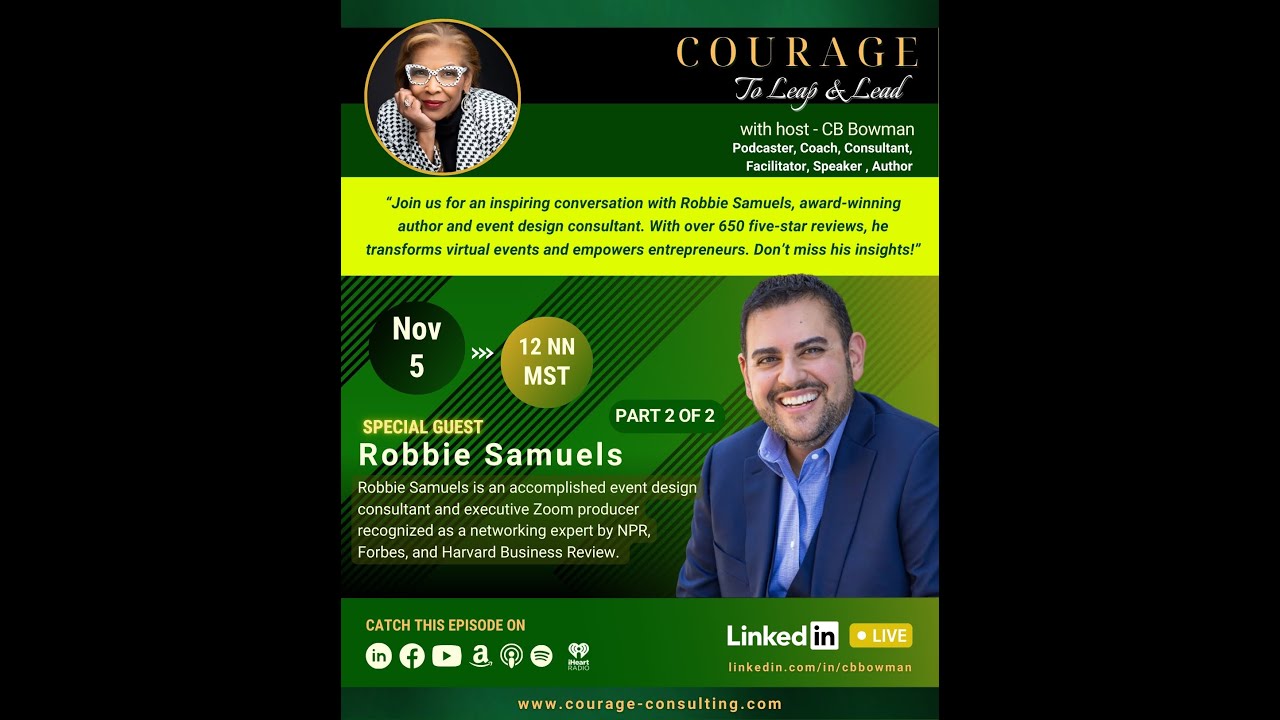
Robbie Samuels built a six-figure business by pivoting during COVID to virtual events and coaching, then wrote three books as platforms for his services. He emphasizes testing ideas with real clients, not friends, and using networking research calls to uncover what clients actually need.
Chapters
You've got courage to leap, courage to lead. Be brave and be bold.
Wow!
Let it roar. Welcome to the Courage to Leap and Lead podcast, where each of our guests share the stories of courage that helped them become powerful leaders. Before we start today's show, please remember to visit courage-consulting. Where you can find all the episodes and other excellent resources, all at courage-consulting.com. Now, here's your host, Leadership Courage Coach CB Bowman.
Hello, ladies and gentlemen. This is CB, and we are doing part 2 of an interview with my friend Robbie. Now, part 1 was an incredible interview where he Was absolutely one of the most generous souls I have met in a long time, where he took us through defining, explaining how to network, how to be inclusive, all about the— I lost the initials.
LGBT.
LGBTQ+ community. Sorry about that. My dyslexia went— And it is such a rich and heartwarming conversation. I hope that you'll— will tune in. Part 2 is about how this genius of a man has taken his knowledge and his heart and made this into a money-making business, made his life into money-making business. And what he likes to say is, this is another year This Is Another Me. And what he's doing now is he's helping book publishers like myself who've put so much time and effort into writing a book. And we all have goals in mind. Some of us have a goal to write another book and to become known as a writer in a particular field. Other— others of us want to use that as a platform to be a keynote speaker or deliver workshops. We all want something out of the work that we put in. Robbie helps you define what that something is and how to go about getting it. So I want to, I want to talk to Robbie about how he started in the business. Um, and how did he get to the point where he could actually make a difference in the lives of other writers? And, and maybe he'll reveal some trade secrets. about what he tells us. Ravi, welcome back.
Thank you for having me back.
So tell us professionally, what was your start in life after school? I mean, what did you major in in school?
So political science and sociology with a minor.
That's the answer. Okay.
And then I went on to get a master's in social work. And I worked in nonprofit for the next 15 years in various capacities, the last 10 I was organizing fundraising events and I was a major gift officer working with major donors who focused on giving through events. And I was running a meetup group that I founded for—
Oh, I remember those days.
11 years overlapping with that 10 years where I was running events. And so I was running events just like all kinds. And then I would volunteer to organize a conference or an unconference and So I got really into events, which is where I got to really practice and play with the, how do we bring people together in a way that makes them feel good? And I started speaking, uh, on the side initially pro bono. I would say those years were like 2006, 2007, 2008, 2009. I got approached by a friend who said, I know that you speak about networking and I know that you are a fundraiser. Will you come and teach this board of directors how to fundraise? And I said, uh, yes. And then I went and created a new curriculum and I went and did that. And that was when I, I sort of became a professional speaker. Um, they paid me a whopping $200 to go to DC from Boston, and they paid my airfare and they didn't give me a place to stay, and I had to stay in a bed with my friend. And then when I went to bill them—
We should fix that one, but go ahead.
I billed them $400 with a 50% discount, uh, referral discount. And then I spent a year saying that I charged $400. At the end of that year, someone said okay. And that's how I kept improving my prices over the next, like, I would say 5 years. The end of 2014, I left my day job to focus on speaking full-time, encouraged by my friend and mentor Dori Clark to finally jump ship from the relative safety or the imaginary safety of a job into the world of entrepreneurship. And I needed to come up with a new audience. So I had been focusing on speaking for nonprofits and foundations, and I knew I needed to expand. So I ended up building a podcast as sort of the launch point for that. And that started working that in 2015, aired in 2016. Subsequently, my first book was published in 2017 about networking at conferences. I had this talk that I'd been doing for 11 years called Art of the Schmooze. Um, so I was doing that talk and you, from the book, group coaching program, hired Dori. She said, write for Harvard Business Review, do a TEDx. Got that done. TEDx talk about networking at events came out in January 2020. And I thought that I was poised to be an overnight success, 10 years in the making. And then 2 months later, nobody needed to know how to network at events. We were all at home. So March 12th, 2020, I wrote a blog post, 9 Ways to Network in a Pandemic, which was fairly well received. It was very timely. And number 3 was host a virtual happy hour, which is how I came to host my first virtual happy hour on March 13th. So Friday, March 13th, 2020, I host an event Friday at 5 Eastern. This was not market research. This was, I had the idea Thursday at 8. The next logical time was Friday at 8, at 5. We ended up with people from 30+ countries attending for the next year and a half. I hosted it weekly for 2 years. 2020, both Christmas and New Year's were on Fridays and we held the event and people came. There wasn't anything else going on. And, uh, but within a month I had branded it the No More Bad Zoom Virtual Happy Hour, and I announced the pilot of a 4-week program to become more confident and competent using Zoom. And I went from being a person who'd only use Zoom to like do interviews and small groups to looking on the settings and figuring out how to set up breakout rooms. And suddenly I was the go-to person, and by the summer and fall of 2020, I had been contacted by companies, and I became a virtual event design consultant and an executive Zoom producer. I had a thriving 6-figure business based on all new revenue streams, and that program that I piloted quickly became a certification program that I ran for a few years. So it all happened very quick, and my second book kind of addresses some of the how I managed to do all of that. But that was a big, big inflection point in my life.
So audience, I hope you heard something really critical in what Robbie said. It's called the art of reinvention. Now, people heard it. But how do you do it? How do you, how do you manage to always be at the right place at the right time?
So part of the secret to my success is that when the pandemic was starting, I was working for a company part-time coaching about a dozen entrepreneurs a week. So I had a lot of information from them about what was going on and what they were working on. In April, that same company said, we have an overabundance of people signed up for our course on how to launch an online course. Which is a very like meta concept. Can you take on a cohort? And I'm like, well, I don't really have a business right now. Right? Like, sure. Well, that ended up being a more than full-time role. Um, cuz I ended up with 120 students in my cohort. So I have 120 students that I'm meeting with and coaxing and answering their questions in these online portals, plus the 12 students. And then I start hosting these events. So suddenly all my network realizes I'm a person who knows things. And so my calendar starts filling up and I thought, you know, my extrovert brain really just likes the fact that I'm getting to hang out with people. But as a coach, I would never tell a client, just fill your calendar randomly. I would tell a client to do research calls. So I didn't have to seek out people to talk to. They were seeking me out, but I was able to turn those calls, those pick your brain, can I ask you a few questions? Can you help my team with this thing or that thing? Into research calls. And the answer to how I keep reinventing is I'm sort of always pressure testing ideas. But at that time, I tried all kinds of things.
But Robbie, by the way, audience, we're both from New York, so we interrupt with love. How do you know what questions to ask? And why don't people say to you, Well, I know the answer to this. Go away, you're bothering me.
Well, you're asking people because you're saying something like, I'm thinking about doing this thing, but before I get too far down this path, I want to just check my assumptions. And you seem like the kind of person that knows something about this based on your XYZ experience. Would you mind just making sure, like, I'm on the right track? I think your lived experience would really help me understand this better. It's very complimentary of this person, right? I'm just like trying to understand. And what most people do is, as experts, we observe the world, we make a theory out of what we see, we come up with what we think is the response that's needed, and we go and build that. And then it could take months or years to do that, to build that. And then when we finally bring it to the market, the market goes, who are you? What is this? I don't need this. And we're devastated because we know people need this. The problem is people don't know they need this. So in my second book, Small List, Big Results: Launch a Successful Offer No Matter the Size of Your Email List, I talk about the difference between the little p problem, which is the problem they know they have, they're willing to admit it's what they type into Google or they ask a friend or a colleague versus the big P problem. Which is the problem that they don't even understand they have. But you as the expert are like, oh yeah, they, they need this. So like, we're out here selling surgeries to people who are looking for Band-Aids, and it's a mismatch in the marketing. So people think, oh, you're not talking to me because, well, we're not talking to them. So instead I'm like, take a step back, talk to the people in your world. First of all, do you have access to the people that you'd wanna sell to? Like, if I wanted to sell to astronauts, I don't know those people, so I better find another world that has similar issues where I could have an impact. So it's, I work with my clients to discover their likely prospects and likely referral partners, and I essentially put myself through those same paces and I iterated. I will tell you that those months of April, May, June were very freeing in the sense that nobody was looking at what anyone else was doing. We were all tending our own houses. And you could belly flop and no one, no one was gonna laugh at you for it. Because honestly, if they even noticed it, they thought, wow, you were really brave to even try. And so we were all just trying—
Wait, wait, wait, wait, wait. I have to push back.
Sure.
Because I know you, Robbie. If you wanted to write something on astronauts, and you didn't know an astronaut, You would figure out how to get to that astronaut. So the question—
Why would I, why would I sell to a community of people I don't have access to when there's so many people that I do have access to?
Because you might be using astronauts as an example for the community. Let's just say, for example, that you do sell to. So the question becomes, Robbie, what is your secret sauce for getting to know people that you have no connection with?
I don't. That's not where I start. My networking is based on the belief that we already know 80% of the people we need to know to be successful. I don't go out looking to just add business cards to my business card collection. That's not— I, I've done it. It's not, it's not immediately beneficial. Mm-hmm. I do put effort into building new relationships, but it's usually through people. So I might ask a friend to co-host a dinner with me. We each invite 4 people, so I meet people, but I'm not just cold calling through a phone book telling people I've got a service.
Okay. Fair enough.
So it's attraction-based. I host events where people can see what I do. Um, I make referrals easy. I give people referral text. And so I'm like, oh, if you know anyone who has this, if you hear this phrase, then here's how I can help somebody. And I make it an easy thing to do. So, I mean, it's— I, I think the mistake is we think of networking as new people, and I'm saying our largest untapped resource is our existing network. So I don't want to go and look for— I'm talking about when I say astronauts, I mean the communities that I don't have access to. I might instead have access to teachers, and teachers might have the same need. Like, it's like, go to the world. So part of what you're pressure testing ideas is you're just trying to figure out, can I actually get a conversation with a dozen to 2 dozen people in this world? Like, do I even know these people?
Mm-hmm.
Can I get introductions to these people? And sometimes I tell my clients, if within 3 months you discover that your big brilliant idea is not gonna fly, it's the best news ever because you've just saved yourself 3 years trying to sell something. And you probably in those 3 months will pick up on something slightly different that is the winner. And you'll have built this pipeline, or at that moment, it's not really pipeline. I call it the, uh, the runway, because to get a good idea to take off, particularly if you don't have, if you've got 80,000 people on an email list, I'm not talking to you. Like those people don't need my help. But for those of us who do not, We have, we don't have helicopters to just take ideas out into the stratosphere. We've got little baby planes that need long runways. So every conversation we have is building that runway so that by the time we have the best idea possible, there are all these people who either want it or would be happy to refer for it because they feel like they get what you're trying to do, that you really are of service. They appreciate how you listen to them and how, how you didn't sell them something they didn't need even. So that's how I do it. It's effort, but better 3 months up front than 3 years in darkness, and then no one cares.
You know, you said something critically important. Not that everything you said—
I hope so.
But I want to reiterate it for the audience because one of the things you said was If you have an idea and it's not working, move on. And a lot of people, including myself, get stuck in that one idea and digging our heels. I had an idea for my second book, and a couple of people said to me, it's kind of dicey. It's kind of dicey because people don't want to admit to this. And I thought, but it's so important. I see it's going on and blah, blah, blah, blah, blah. And all of a sudden, I was just sitting there thinking, all right, then why am I having trouble getting started on this book? It's like fake starts. And then it hit me that I needed to flip the way I was positioning it. And that my idea could be a chapter, but it couldn't be the book. And that was such a hard thing to— for me to release, because I was so sure that this was it. This was going to be my magic carpet ride.
I think something that you said that I want to build on— be careful who we get feedback from. So when I'm coaching my clients, and they ask my opinion, I say, well, I'm not your ideal client.
Mm-hmm.
So my opinion on this, this, or this is not as important as the people you actually talk to who, who are prospective clients. But here are some questions that I think they might want to answer, have answered in order to understand what you're doing. Um, you know, make sure you're not getting like a close family member to tell you you're a wonderful speaker. You know, work with a coach who can tell you if you're a wonderful speaker, right? Like if you're testing content, make sure you're testing with the audience that it's intended for. Um, so just being aware of that is part of it as well. But I, at the end of 2020, I had this amazing business and I worked every day from April to the end of November except for Father's Day and US Thanksgiving. And I joked that I worked every day that ended in Y, so then Thanksgiving didn't count. But I mean, the Friday night event was a gift because it was the only thing that happened that differentiated all the other days of the week. It was the rhythm. All the other rhythms were gone in life. There were no weekends, there were no vacations to look forward to, no conferences. So it was this rhythm of seeing this community of people that we built such connection to. But that pace continued into the beginning of '21, and I knew it was relentless and I could not keep it up. So I was trying to dial it back and I found a bit of a pace mid-'21. We actually moved and bought a home in another state. It was a big to-do that we were able to do that. Um, and I, I've been really fortunate to have these recurring event clients that I've worked with, some of them since 2020, who have me do between 1 and 4 or 5 events a year for them, mostly virtual. My biggest client is Feeding America. They support food banks and neighbors facing food insecurity across the US. And so they went back to some in-person events and I was like, oh, hi, I actually, I've spent over a decade with that. And they were like, you can help us in person. So I now design their in-person sessions. I work with each of the sessions, 75-minute sessions, 90-minute sessions. So I do in-person session design. I do virtual session design. And then for the virtual events I'm producing, but I knew that while that's wonderful, I have making an impact and creating revenue. I don't decide when these events happen and that my, my overall revenue was leaning too heavily into someone else deciding whether, whether it was a go. And I needed to kind of balance that out. I've always had coaching as part of my work, usually a minor part. So with my second book, I really ramped up me talking about coaching, but it was a lot to like convert people. It was a long conversation over many months. I lowered my prices, I adjusted my packages so I didn't have to work so hard. And then I got known for my book launches. And that's what you were just talking about, how I work with authors. But that wasn't something I sought out. It was something other people noticed that I had, which is something we all could be aware of. What do people come to us for?
Yes. And, and, and that's how I started in the courage area. Because somebody asked me to do a keynote on courage. And I said, I don't know anything about courage, got the wrong person. And they said to me, you're the most courageous person I know. All of a sudden, my mind went to all the years that people told me I was courageous. And I've been denying it. And I said to myself, now, what is that about? And I sat down at the keyboard and I started preparing this. And all of a sudden, and I thought, maybe you should be listening to people. So asking people, how do they see you? What do they see you doing as a really important part of your life?
Or what do people book calls to talk to you about?
Yeah.
People ask you for advice about what? So for me, my first book, I, I'm not a person who identifies as a writer. I have published 3 books. I regularly write a newsletter. Clearly I'm okay. I can, I can write. I don't think, I think I'm actually a good writer. I just, the writing process was not something that came to me very easily. So I struggled through writing a book. I got the book and a about the point that I was handing it off to the editor, I thought, wait, this is actually a good book. I want people to read this book. And then I started thinking about the marketing, and then I got excited because I happened to really like that part. And so—
All right, Robbie, before you continue, can you show the audience your books?
Yeah, I could definitely do that. So my first book is Croissants Versus Bagels: Strategic, Effective, and Inclusive Networking at Conferences. Bagels are those tight clusters, those shoulder-to-shoulder huddles. When you walk into an event, people are standing there. There's no way to easily break in. But if one person in this circle opens up their body language and makes space for you, now you have a croissant. And my TEDx talk is on that topic. My second book is Small List, Big Results: Launch a Successful Offer No Matter the Size of Your Email List. You know, it's part story, but also very hands step by step. How do you do these exercises that'll help you create your, your launch list, your, your network, who to reach out to for research calls and all of that good stuff. And then finally, on the 3rd anniversary of my first virtual happy hour, I published, uh, Break Outta Boredom: Low-Tech Solutions for Highly Engaging Zoom Events. And this is a manual. that you can go through, and it's about how to leverage design, quality facilitation, and understanding the platform to create these engaging, inclusive, transformative virtual events. And it works for any virtual platform. It's not, I mean, it's about Zoom, but even as Zoom keeps evolving, it's principles that sort of rise above. And a lot of that even works for in-person, 'cause These mediums overlap in a lot of ways. So quality design, quality facilitation, understanding the platform. So my third book finally came out.
Thank you. So I imagine you're working on your fourth book, which talks about the work that you are currently doing.
Oh my gosh.
Please tell us about it.
Yes, yes, yes.
I'm good.
So all 3 of my books have over 200 Amazon reviews. My latest book, which won a gold award from the Nonfiction Authors Association, just passed 250 reviews on Amazon, but it had 240 reviews within a month of the launch date because I build these big launch teams and I guide people through the process of writing and publishing their review. And people took notice. So over the last, you know, 6, 7 years, people have asked me for their support in different ways. In the last two years, I started to also host virtual book launch parties because I'm the Zoom guy, and because I'm a coach and a strategist. Everything I do and everything I work with my clients on is well. How does this go back to your business? So when people say I've got a book, I go okay. How does that book fit with your business? And if they can't, if they can't answer right, if they're like well, I'm like I mean do you want to dial that in before you go down that path any further? Like do you? Me, me, you know, like, and so I'm now attracting more coaching clients, not just for the launch itself, but for helping people figure that out. Who are they, who are they selling to and what are they selling? We don't make money from books. No one is retiring because we sold books. We definitely don't make money off of individual Book sales. If anything, it's bulk book sales that accompany a presentation or coaching engagement of some kind that you might start to see some movement in your book sales. It's about how that book leads people to the next offer. I'm agnostic about what the next offer is because I've tried everything and there are pros and cons to everything, but I will ask all the right questions. And so I was telling Dori Clark, who my friends tell me it's a drinking game when I mention her name, because I just am so fortunate to have met her back, I don't know, 2008, 2009. So I'm in New York 6 months ago in October, and I'm telling her in a community— we're at a dinner about the success of my latest book. And for the 3rd or 4th time in 7 years, she calmly says, Why are you not a book launch coach? And I remember why I wasn't, why I knew I didn't wanna pursue this, but now I was sort of out of excuses. It was suddenly all the things I knew how to do and like to do. And I thought, I don't wanna sell. I don't wanna push. I don't wanna do campaigns. I don't wanna do email sequences and open rates. I want people to be referred to me when they need me. And I, oh, I need a referral network. And so in November, I tested my access by 2 weeks before Black Friday. I pulled together a Kindle cross-promotion sales campaign where business authors lowered their Kindle books to 99 cents. We ended up in 2 weeks getting 60 books from 50 authors. So first question was, do I know anybody? The second thing that happened is in December, I ended with $15,000 of new revenue. I had this moment in November where I told my accountant what I expected my revenue numbers to be, and she told me my tax liability. And then I had to call her back in December and say, actually, she says, you do this all the time.
I can raise my prices.
So I ended up with 2 new 6-month coaching clients, 2 new book launch clients, and someone who wanted to spend a little bit of time dialing in their offer. And that was because I had started speaking up in this world of authors. So I started to do research calls in December and in January to answer 2, 2 questions. So you were like, what questions you ask? Here are my 2 questions. One was, was my approach to the launch process truly unique? And 2, did a referral network already exist? Could I just join something? And by mid— by mid-January, it became apparent. that my approach, while common sense, was not common and was actually very unique. And most people were told to go focus on bestseller campaigns, things that were not turning into revenue for them. And so then, uh, there was no referral network. Everyone was very excited by the idea that I would build one.
Mm-hmm.
So in January, I put up a Google Form, minimally viable, nothing on my website. I got a Google Form. I would meet people, we'd have a conversation, they'd fill out the form, blah, blah, blah, blah, blah. 2 months later, over 50 people filled out the form and I started to look through the data and realized that I could set a referral fee. I, I design, I imagined how we were gonna design this from the website. I decided it would be a free service and that the first 50 people who would be our founding Hub Partners, 'cause they said yes before it existed and I wasn't gonna—
Wait a second, I didn't get a notice about that. I would've signed up.
So it's there, it's out there in the world. So in, uh, in March we had our soft launch with just the Hub partners. And then, uh, in April we just had our community kickoff and nearly 100 people came. And so it was a virtual event for writers and authors, uh, to meet the Hub partners. And Hub partners do everything from writing, editing, publishing, marketing, all kinds of marketing. And I now am getting referrals for people who have a manuscript that are about to go to the editor. And they're like starting to think about their launch plan. And these other amazing people are like, oh, you need to go talk to Robbie now. Like we help you publish the book, but he can teach you how to launch the book. And so that's all starting to happen. And so I've committed to hosting a monthly event. Every other month is alternating between Private event for hub partners and a public event for writers and authors to meet us. So that's why I sunset— we're talking at your last half of this program— I sunset the No More Bad Zoom virtual happy hour because this is now my new monthly event that I'm committed to.
So audience, if you're interested in meeting Robby, contact me and I will put you in touch with this phenomenal person. Of course, you know, I'm on LinkedIn. And, you know, I want to give a little plug here. My first book came out January 18th. And it was like, it filled my bucket list, right? And I hired an amazing publisher. But I want to explain to you, and this was a one and done, it's a hybrid publisher. That the part that Robby is talking about goes unrealized in terms of its importance in publishing a book.
You—
I have had so many people say to me, I published a book and I'm not making any money. The first thing I say to them, you're not supposed to make money for your book. It's part of your brand identification.
Mm-hmm.
However, that brand identification needs to be managed, and Robbie is the person that can manage it for you. Because I can tell you from personal experience, you write the book, it's a success. My book hit number 1 in 5 categories on Amazon. And then there's that little piece that says, what next? Now, I specifically want to do workshops. I don't want to do keynotes. But that— there's a lot of work that goes in into that second part of getting those workshops. And Robby has 2 types of programs that are available. And I will just say the current price, which is the new— for new people. So next month, I'm saying it may be higher, is $2,000 for 3 calls. And if you wanna join his community, it's—
Well, let me just say, actually, it's that $2,000 is, has some pre-work, it has some calls, and I also design and emcee your virtual book launch party. The focus is on helping you build a launch team, filled with likely prospects of about 150 people. And the results are we're aiming for 50+ Amazon reviews. But the real purpose of this is that you're going to get into conversations with those likely prospects. And it's those conversations that will turn this into revenue. That too many of us are focusing on the bestseller. I've hit bestseller in 30 categories across 4 countries. That's not why I'm making money though. And that orange ribbon is here and gone, but reviews stay on the book sales page on Amazon. And it is social proof. When you're looking at a competitive category, it is social proof. And what you're about to say is if people are looking for additional support in figuring out who they're selling to and what they're selling, I have, I have 90-minute, 3-hour, 3-month, and 6-month coaching packages. And all of it's on my website, robbysamuels.com. my interviews, my books, my podcast, my programs, the Biz Book Publishing Hub. You'll find everything at robbysamuels.com. I'm a multi-passionate entrepreneur, so you might know me for one thing and discover I do these other things as well. But thank you very much, CB, for, for helping spread the word about this, because I really, really want to help people take their genius and put it out into the world in a big way.
Absolutely. And you know, CB does not endorse things that she does not believe in.
Thank you.
You know that, you know, I have a reputation for being connected. But that's because I connect people who can truly help each other, not just talk in the air.
So speaking of which, the bizbookpublishinghub.com is that free resource we were just talking about. So If anyone in your audience is considering writing a book or has a book that they're looking for new ways to market it, we've got so many amazing people that can help you do everything soup to nuts. So bizbookpublishinghub.com, it's free. You, you can download free resources from these hub partners or book a 30-minute complimentary chat. Um, check out who they work with, all that good stuff. And it just, I want to. Directly connect brilliant thought leaders with the people who will help them bring that out into the world. Um, I just, it's, we, it's just too many things unknown when you're starting out writing a book. I joked that I had to write a second book given how much I learned about it the first time around. Like, I was like, I'm gonna have to do this again because this was too much work to this be a one-off.
Um, so I hear you. And that's exactly why this weekend I started my second book.
Nice. Yeah. I declared this year the year of no books. I'm launching programs. Everyone keeps being like, what about your next book? Whatever. I'm like, oh, this year, I accidentally wrote 2 books in 17 months. I was like, I'm not gonna give myself a little bit of a break.
Yeah, well, we won't let you. So forget that. I love you, darling. Thank you so much for this 2-part episode of Robbie. Both parts have been so rich in conversation and your heart. Thank you.
Thank you.
Bye everybody. This is CB, and I always forget to name the show, but I figured you know it. It's called Courage to Leap and Lead, and it's on all podcast stations and livestream on LinkedIn. I will see you next Tuesday. Bye now. Thank you, Robbie.
More from CB



211- Courage to Leap & Lead with Louise Story part 1Courage to Leap & Lead







