Courage: Challenges of The C-Suite: Guest Layla A. Ramirez, Episode 81
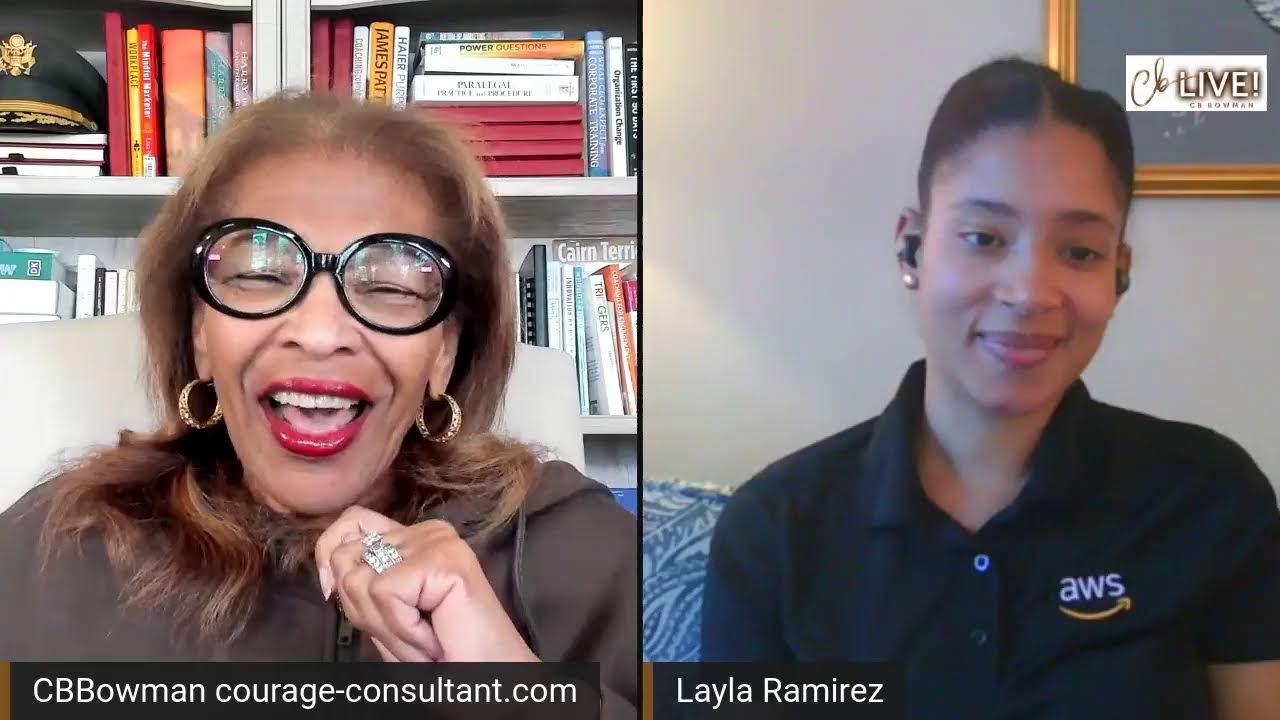
In this episode of "Challenges of the C‑Suite," host CB Bowman interviews Layla A. Ramirez, a senior program manager on Amazon Web Services' Inclusion, Diversity & Equity (ID&E) team. The conversation weaves through Layla’s Afro‑Latina upbringing, education at Smith College and Harvard Business School, and early career on Wall Street before pivoting to nonprofit work and finally to Amazon. Layla explains how mentorship shaped her trajectory, describing a "board of mentors" approach, reverse‑mentoring, and the intentional, strategic process she uses to select mentors and mentees. She details her current role at AWS, focusing on DEI‑focused onboarding programs that tailor experiences for different demographic groups, and how she disrupts traditional compliance‑heavy onboarding by adding personalized affinity‑group connections. The interview also covers her decision to leave Wall Street, the courage required to quit without a safety net, her certification as a professional coach, and how she applies coaching techniques to internal Amazon conversations. Layla discusses Amazon’s internal approval process for public speaking, the importance of brand alignment, and the balance between corporate messaging and personal authenticity. Throughout, she emphasizes persistence, the need for intentional breaks to recharge, and practical productivity tips for writing. The episode closes with Layla reflecting on her most courageous act—leaving a high‑paying Wall Street job—and both host and guest celebrate the value of aligning personal values with professional work.
Chapters
Hello everybody, welcome to a special show. You know, we're not on on Thursdays, but don't look at your calendar because it's Thursday. Uh, we used to be on Thursdays, but we are now moving to Tuesdays. So on Tuesdays you'll see Challenges of the C-Suite, you'll see Workplace Equity, you'll see everything under the sun. Most important, you're going to see CB Bowman, right? And you know, when you see me, it means— oh gosh, I forgot to polish my nails. Oh well, I'll put my hands down. Okay, it means that I have an incredible guest for you. And today we have Leila. She's with Amazon. Watch out now, we're gonna get the inside scoop about our favorite store. Well, you— I don't want to mislead. You guys know I have 2 favorite stores. I bet you know what they are by now. Costco and Amazon. That's it. And boy, do I wish I could afford stock at Amazon. So with that, um, we're gonna talk to Leila, who has a special role in Amazon, and that's in the DEI space— diversity, equity, and inclusion. And so without further ado, let me introduce Layla. Layla, how are you?
Hello, CB. So good to see you and so great to be here. I am so well and so blessed to be here to speak with you today.
You know, um, I have to watch my P's and Q's because she's part of the young blood, right? That means she's smart, and we have to just learn from her. Okay, Layla, tell us a little bit about your background. How did you grow up? Where did you grow up?
Yes, I mean, that's such a loaded question. I always, uh, like to start by saying that when folks ask, Layla, where are you from? Tell us about yourself. It's a loaded question, so I am someone who identifies as Afro-Latina. I am of Dominican roots. I am from New York. I also spent a considerable amount of time in Boston. And essentially, you know, we grew up— my parents— I'm first generation. And so my parents are from Dominican Republic. And so a lot of the similar sort of like some of the stories that you hear and the experiences are my own as well. And so I come from, coming from New York, great education. I went to an all-women's college. I went to HBS for business school, Harvard Business School, for folks who don't know the acronym. And education has really just been sort of like my ticket and how I've been able to see the world and experience the world and really navigate opportunities beyond what my parents even dreamed of. And so I like to start off there by saying that From Dominican roots, and then also like education is core in terms of—
Wait, wait, wait, too fast, too fast.
Okay, okay, tell me this. I'm also a New Yorker and the Spanish speaker in me.
Okay. I love it. I'm going to talk to you about some food later, right? Okay, we'll compare.
My favorite pastime.
Okay, we're ready. Okay, what did your parents do?
So my mom is an educator, and then my dad, I like to refer to him as a serial entrepreneur.
I love it.
And so, yeah, so both of them were incredibly like high on, we gotta make sure that, you know, our kids are— I have one brother and then 3 half-brothers. And so education, like all of us are well into our careers, different interests and different disciplines, but education is at the forefront. And I'm sure this is not new. You hear this all the time. with folks who come from my background as well.
Well, not so much, but I love the mix of the education push and the entrepreneurship.
Oh, yes.
I love the combination. And so an all-girls school? Where was the school?
So I went to Smith College, and it was in Western Massachusetts. And that was my introduction into what— well, not the school itself where it was, but like what rural America felt like. And I'm grateful for the experience. I have a lot of respect for people who come from places that are not like the city. And so, yeah, so it was a great experience. It was— I think without Smith College, I wouldn't necessarily be as, I would say, fierce, outspoken, and just, I would say, I mean, I like to say unbothered really about what folks think about my ideas and the way that I see the world. And so, well, here's the credit.
That is interesting about what you said. So I want to clarify for people, Smith may be in a rural part of the country, but it produces some kick-ass women.
Oh, yeah. I want to make sure I understand where you're going with this, right? Yeah, absolutely. And I should say that I wasn't necessarily familiar with Smith College when I was applying for college. I applied to like 10 different schools. And I asked one of my mentors at the time, well, you know, I feel like I've never heard of Smith. What is this? And she responded by letting me know the people who know, know. And so that's just a call to action, right? For folks who don't know Smith College, listen, you've been missing out.
I love that. Who is this mentor?
This is one of the women that I came across in one of my early internship programs that I did. So once upon a time, I wanted to be an attorney. And so this is one of the women who was managing the program at a law firm that I worked at.
Okay, so let's go. You skipped some important stuff here. Uh, so you wanted to be what? Okay, how did you come to wanting to be an attorney, and what side of law did you want to practice in?
Yeah, so that is, um, it's a curious question because I, you know, your environment reflects so much back of you to you. And so I was very inquisitive Um, I hesitate to say argumentative. I was more, um, I always had a perspective, right?
You were curious.
Curious, and I had a perspective, right? And I also didn't stop that.
Courage. You had a lot of courage.
Absolutely, absolutely. And my mom encouraged that, right? I was one of those kids who asked the 5 whys, and she didn't have to answer the question, but she nurtured that curiosity in a way that made it— that made other people feel like, well, Layla, you ask all these questions and you always have an opinion. Maybe you should be an attorney because you argue so much. And, and so I started thinking about it, and that was really the beginning of it. But then over time, and I learned through the internships that I did— so I, I worked at 2, um, law firms early, like I would say even before my career actually started. This was like one in high school, one in, in college. And I learned that, um, I really didn't necessarily want to read case law and that I really didn't care to read all the— to do all the reading that you have to do in law school to get through. And so that sort of turned me off. And then also it was very like, from a cultural standpoint in the law firm, Not to knock on any of these law firms or any of these places. Um, I think from a cultural standpoint, I was going to be, um, potentially problematic because I wasn't just necessarily willing to fall in line. Um, and if I thought that something needed to be addressed, then I would ask about it.
So I love how you work.
I had to switch paths.
Yeah. Awesome. And so you identified a mentor at that time?
Yeah, I have tons. I mean, not tons. I like to say I have a good solid, like, I would say between 10 and 15 relationships. Some of those that, you know, I've had since I was like 17, and these people are still in my life. And even if we're not sort of like in the same career path, like, my conversations around whether I need to transition or go to business school or if I should quit a job start with, you know, understanding what their perspectives are. And then ultimately I formulate my own view. But, um, you need the data points, right? You need to— I know that I don't— I, I know that I don't know as much as, you know, other people know.
So, Layla, can I ask you— I never asked this question, but how old are you?
Oh, I am 34. I'm so glad that I remembered because yesterday I forgot. Someone asked me if I was like— I was like, yes. I, I had to think about it. So yeah, I'm 34.
Okay, you look like you're probably 4 or younger.
It's because my hair is up. I think if my hair was down and it looked like the way it looks on my LinkedIn profile, that maybe, you know, you get a different feel. But, um, my hair has a personality of its own also, so sometimes you gotta get creative about taming it.
I love your wisdom. You know, um, one of, uh, my friends, uh, a colleague of mine, Dory Clark, who's all over LinkedIn and etc., etc. Um, she put out a blog post early this week about the importance of having a board of mentors, not just one. And you actually practice what she's preaching, and I love it.
Absolutely. And I tell everyone who'll hear me out that like, this is the way to go. And I should say, just for context, right, because I think you can't— you don't just like wake up one day and you've got these people like ready to roll. Um, it was out of of an abundance of respect and awareness, right, of the fact that my parents hadn't been to the places that I had gone and that they weren't necessarily— that I wasn't navigating paths that they had experience with, in addition to other folks that came into my life. And so it was out of an awareness of how under— I'm gonna call it how under-resourced and how under-connected I was as early as 15, right, that I said, well, I have to make sure that I continue these relationships. And it's something that my dad and my mom were both very— they impressed upon me that building and managing and nurturing relationships is critical because ultimately, you know, your experiences, your life is influenced not just by your own, but also by the experiences and the reach of other folks, right? And so I had plans to go places in my life. And so I knew that relationships had to be critical and core to how I got there. So kudos and shoutouts to all my mentors and those who have helped along the way. I definitely am standing on the shoulder of giants.
And how do you go about selecting your mentors?
Oh man, I would say it's like an art and a science. I think some of my friends might say that I'm a little more calculated. I like to say strategic. and thoughtful and intentional. But calculated was the first word that people came before we knew about the nuanced intentional, right? It was calculated. I would say the first is it starts more naturally from the perspective of if there's someone who— so my sort of longest mentorship relationship is this person who I met again at a law firm, and he's known me since I was 16, right? And so That relationship was— he was assigned to me as a mentor, but I knew that whether the relationship persisted beyond that was dependent on me and whether I could be of value and vice versa. And so the selection sometimes is structured in the sense that it's been a part of a particular program. It's been an educator that I respect tremendously and who I'm happy to do extra work for or with. It's been people who have had a timely message at a time where I wasn't willing to hear it from someone else and had the courage to just say, hey, look, this is something that you need to consider. And it's also just been folks who have said, hey, look, I want to invest in you and your success. Reach out to me if there's anything that I could be of service. And then I actually do reach out. And so it's— when I say that it's like an art and a science, the science of it is having a direction, right? And being clear on where you want to go and then asking yourself what people are connected to those places to those spaces, have an awareness and a knowledge of those environments, and then strategically finding ways to connect, right? And, you know, social media and LinkedIn and these sorts of platforms are really great for that. But like when we used to be in person, it was really going places that were new and where you knew that the people who, for example, if you're someone who really enjoys art, chances are If you're going frequently to museums and art festivals and galleries, you're going to meet like-minded individuals who can help you get there. And so for me, it's just been really strategic about where I show up so that I can meet people who, who can help me along my way and vice versa.
And so you've brought up so many good points. One of those is people that you can help give back to.
Yep.
And so how do you find out what help they need? And have you ever been in a state of concern that you would never have— not have the right thing to give back?
Well, yeah, that's a great question. So how to find out is really— um, so one of the things I think is important to, to just say up front is that I am— and again, credit to my parents and my family and all the folks who have encouraged me to just be myself I am someone who at the beginning of like starting a relationship, like I create and make as much space for myself as possible. And so it's not uncommon—
What do you mean by that?
It's not uncommon for me to go into a first interaction with someone and to say things like, I'm a bit more introverted and reserved, and therefore if I pause after you ask a question, it's because I'm actually thinking about it. And I also say things like, I'm insatiably curious. So if I ask 2 and 3 questions at a time, it's because I really do want to know all those questions, and I will pause as soon as I'm done just to hear the answers to all of them. And so because of that, I— and I also tell people that, you know, typically I'll say, you know, I give you, you know, you have my full permission to, A, tell me about myself in whatever way is most comfortable for you at any point and to give me that feedback. And then I'm going to ask some questions, and you always have the— you can always pass on anything that you don't want to answer. No judgment, no follow-up questions asked, right? With that being the case, right, it's very, I think, disarming for people. And it's also inviting in the sense that then now they feel like they can bring more of themselves to the conversation. And once we are sort of like comfortable, then it's just about really asking the questions that naturally are of interest. And for me, I care deeply and tremendously about people. I'm always on the side of the underdog and always whoever needs an advocate and is fighting the good fight. And so those are my people. And so I know that asking about the person is just as important as asking about their interests. And so it's always a balance for me, you know, getting to know people through their interests by asking follow-up questions around like, well, what was your intention behind that? And where do your thoughts go when I ask about this? And/or when you see, you know, when you think 5 years ahead, know, what's the story that you want to be able to be told about you? And so asking these— I mean, and I also should say, like, I'm a coach, I'm a certified coach, so I've gotten better in asking questions, um, like that. But that's really how I uncover what people need, really, is just listening, um, not just to what they say but also how they say it and where the energy is.
When you interview somebody to be your mentor, what's the first question you ask?
Well, you know, it's funny because I don't necessarily do interviews and I don't— sometimes I just stumble into these conversations. But if I had to, right, taking a step back, let me think about that. I would ask, I'd probably ask something along the lines of, what keeps you up at night? And then based on that, they would, you know, that gives you a sense of some of the things that, you know, it gives you a sense of what their values might be. It gives you a sense of where some of the challenges are. And then from there, it's just a question of— I mean, it's really, you're sort of like figuring out as you go. But I think that question is really insightful. And then also a really important question that I've been asking a lot more since I became certified as a coach is, what gives you energy? Because ultimately, I would want to be aligned to the things that energize people. I don't want to be a drain on people's energy.
So What would you ask them? What did you ask them before you became a coach?
Oh man, I think if I can be self-critical, right, I think a lot of the questions were about how— they started with a how do I, right? It was like, how do I get here? How did you get there? So those sorts of questions about like, how did they navigate their path and how should I approach navigating? Mine. It was also a lot of questions around—
I'm sorry, how should you approach what?
Navigating my own journey, right? One of the things that I think has been really impactful in these discussions is seeing essentially like people introduce themselves differently depending on how you frame the question. And so I often will say things like, I'm coming into this conversation, I didn't read your bio, I didn't look you up on LinkedIn, in because I want to hear the story from you, how you would tell it. So tell me what's important. Introduce yourself with whatever you think is most important and relevant to you. So that is a better question that I asked, whereas before it was just, yeah, tell me a little bit about yourself. So the questions are like, I would say, smarter questions now than perhaps before. They were just like what you could find on Google easily.
I think that the questions you asked before are stronger than the questions you're asking now as a coach. Oh, wow.
Okay, well, as a coach, it's different. As a coach, it's different. But in terms of getting to know people, I think as a coach, the shorter questions that start with what are much better, right? Then because you just let people go, they'll go wherever they need to go in terms of that. So as a coach, it's a different set of— it's a different framing of questions and thought process.
And you're right, as a coach you ask different questions, but I would be careful not to use your coaching questions with people that you want to support your journey.
Absolutely, absolutely received. Yep.
Yeah. And so that's— I didn't mean to go into coaching mode just now.
Oh no, that's good. Just listen, y'all. Remember I said people had a timely message at the right time? That's— that was one of them.
Thank you. Oh, thank you, thank you. And so tell me about why you went down the coaching road. Why did you get certified as a coach?
So, um, the journey or the questions that I started— I asked and started asking questions about becoming a coach really because my friends— I'm that friend that people came to for advice. I'm the friend that people came to to think strategically about, well, how should I play this? And so from there, I ended up— not ended up, but I forged a path into a career That really— and by this career, I mean inclusion, diversity, and equity— forged a path that really was about people and getting beneath the surface about people, understanding their motivations and understanding how to change behavior, right? We used to say changing hearts and minds. We can't really change people's hearts and minds. We can just help them be more intentional. And so because of that, there was a lot of work around coaching C-level executives When I was in my first job in inclusion, diversity, and equity. And I really just wanted to be good at what I was doing. I wanted to make sure that I was of service and that I was having a lasting impact. And so the coaching as a formal part of my role started then. And the training and certification really was just sort of closing the loop, right? And getting some tools, better language underneath my belt. And ultimately being able to earn the certification so that, you know, there's like a, you know, in the coaching profession, we want to make sure that there's a standard that folks are upholding as they become coaches. And so furthering that as well.
And so tell us about your role at Amazon.
Oh, yes. My role at Amazon changes every day. It's great. It's a— it's a— I am a senior program manager. On the inclusion, diversity, and equity team. And these days, the focus of my work is on onboarding programs. And this is as of, you know, a few months. And so I'm still coming up to speed there. But generally speaking, I like to think of myself as like an advocate, right? A corporate advocate with a strategic mindset that's ready to, you know, interrupt mechanisms and interrupt systems and where there aren't any, essentially introduce new ones. To help drive equity, inclusion, and diversity. And that's— my work is focused mainly on developing programs that could help us achieve those ends. And right now it's really, for example, in onboarding. And prior to that, it was really trying to understand how we could meet the needs of our Latinx population as they were navigating different levels of their career. So it's, you know, so your position is more internally focused versus externally focused? Yes, yes. And we have— I mean, our team is growing. We've got folks who are external-facing in terms of helping to drive, um, you know, creating pipelines of talent, pipelines of technicians across the globe through community activations. And we've got folks who are, um, working with our customers in particular, right, to drive inclusion metrics and messaging across their platforms as well. So I mean, I'm more in-house. Yes.
How does that work actually? Because we— people like myself think of Amazon as a store. And so you're talking about changing— well, we know you're, uh, more than a store, but generally speaking, the category is retail, right?
Yes. Well, I'm glad that you asked that question because it's an important, um, clarification here, right? So amazon.com That, which is what you and I know as the, you know, what brings the boxes with the smiley faces to our doorsteps, right? That's the retail side. I am in Amazon Web Services, which is the cloud service provider. And so I can speak for what we're doing on the AWS side a lot more, a lot better than I can speak for what the .com side is doing. That team is much larger and a bit removed.
Yeah.
But essentially, when we think the activate— the working with communities is happening a lot through partnerships, right? So on both ends, right, broadly speaking, at a big picture, at a big high level, we're working with customers and through customers, working with partners and through partners to essentially move the needle and push further the agenda around inclusion, diversity, and equity, right? So wherever there's a captive audience, Wherever there is an opportunity for us to, um, to, to set the agenda or to, uh, to deliver some messaging around why this is critical and important, uh, that's where we're essentially— we're showing up.
So what I was going to ask you, young lady, was how does Amazon ensure through its algorithms on the retail side That it is including DEI?
Oh, wow. So just to take a step back, right? So at Amazon, right, we are like customer obsessed, right? And so what's important to our customers, we are taking that and baking that into the way that we work and the things that we do. That particular— so to address that particular question, like, I don't think that I'm the right person to answer that question because we're talking about algorithms and the tech specifically. And so I'm a bit removed from that, but I can assure you that we have— our leadership teams are behind trying to have these essentially impact the work that we do at every step of the way and have that trickle down to all the different teams and all the different products that we're working on. And so it's a work in progress and it's top of mind, but I can't necessarily speak to the technology. I wish I could, or speak to the algorithm. That's like not in my wheelhouse.
So I noticed on commercials for Amazon, uh, you're doing work to— and this may be outside of your area too, but I'm sure you're aware of the commercials— um, there seems to be a link towards, or an effort to move towards, educating, talking about education and DEI. The messages are not quite clear to me, and I come out of marketing. And so what's going on there?
Well, I can speak for, um, on the AWS side of things, on the education piece. When we think about the next, um, the next economy, if you will, and the, the talent that we'll need and the opportunities and the problems that'll be before us, there's a need to develop a pipeline of folks who are familiar with the technologies and who are familiar with some of these challenges. And so the education is so critical, right? When we think about some of the disparities across our nation and across the globe, it's folks who have an understanding of these particular needs and these particular opportunities that are going to be able to bring the solutions. And to the degree that we can communicate, you know, here is something that you should sort of know about. And then here is Amazon showing up to help further that education, then we are positioning ourselves as a partner to all those who in the future may want to join in on driving ID&E or driving education as we think about how, you know, the cloud is going to change the world, right? And our CEO often says that this is really just the beginning. And so we've got a long way to go. And so we need folks to really beef up the education and really ignite those flames around solving some of these more complex, nuanced challenges so that we can ultimately achieve, you know, being Earth's best company and Earth's best employer, right? So that's what we're after.
You know, I like where you're going. I love where Amazon is going. I think that the message needs to be clearer from somebody on the outside. Because I look at that and I say to myself, what are they trying to say here? Are they trying to— I know it's education, uh, it seems to be education for young kids, you know, to derive that thought, but I'm not quite sure where they're going with this ad. And that's a hard message to make sure it's really clear, and it's a very, very important message. Yeah, very important. I love that Amazon is taking that road because coming from marketing, from the big guys, I was with General Foods and Kraft. I saw so many opportunities where the company itself could help move the next generations in terms of education and not dumbing it down in terms of cartoons or what the delivery about the food itself. We're starting to see a much better representation now, but that's why I particularly like the way that Amazon is going. But the message needs to be a little bit clearer, and so that we can, so that we can give credit to Amazon for the direction that they're going in.
Yeah.
So tell me, what made you decide to go with Amazon as a company? What drew you to them?
So I should say that I'm someone who thinks of— I think of my life and career as like a collection of experiments. And so there's always a question that I'm trying to answer. And there's like so much more. There's a lot more unknown than there is known. I just typically have like a conviction about a specific thing. And so the journey here really was— so I'm someone who I grew up in, I like to say I grew up in business, right? I was on Wall Street for 4 years. And at the time, you know, coming from humble beginnings, the question before me was, well, you know, Layla, you can make yourself more wealthy and you can make your clients more wealthy. Sure, you know how to do that now. Um, but is that what you want your life to be?
You're hired. Wait a second.
Yeah, thank you, thank you, thank you. Um, so, so the thought is, you know, I could do this forever, but also, is this what I want my life to be about? And the answer was no. And, um, I essentially quit Wall Street and decided that I was going to figure out what I cared about more. And what it was was really making an impact and driving some of the changes that I thought needed to happen in my community. And so I did some work at a nonprofit organization. And then during that time, this nonprofit organization is called Management Leadership for Tomorrow, which I drink all the Kool-Aid. I work there and also have been a participant in their programs. And it's really, I mean, this organization is changing. I like to say helping to change the complexion of corporate America, right? So connecting early talent as well as early mid-career and executive level talent to fast-track opportunities to excel and advance in their careers. And so having done that, that was sort of my first introduction into inclusion work. And then I went to business school.
What's the name of the company again? The organization?
Management Leadership for Tomorrow. It's a career development nonprofit, I should say. Sorry, it's a career development nonprofit. And so from there, one of their programs is a business school-focused one where essentially they're helping you figure out how to apply to business school and ultimately how to get in. And so I applied and wound up accepting an admissions offer to Harvard Business School. And at Harvard, the question for me was, it was a burning desire. I felt like I needed to be where the strategy was taking shape in relation to how inclusion, diversity, and equity was unfolding. And I interned with a company that's called Danaher Corporation in a talent acquisition project for the summer. And then my boss at the time, God bless her— Can you hear me?
Well, audience, it seems that we froze a little bit here. Um, it could be because of the snowstorms that are happening, but I'm sure Layla will come back on. Uh, meantime, thank you, Lisa. Um, you wrote in later, you are inspirational. Isn't she? Would you speak to your role at Amazon Web Services, and specifically, would you give us an example of how You might disrupt a process.
Okay, we are back.
Okay, so I was just reading a comment that came in.
Sorry about that.
That's okay. Um, so there's 2 questions I want to ask you. One is, why did you select Harvard versus a historically Black university? And 2, a question from Lisa who's saying, Layla, you are inspirational. Isn't she?
I love her.
Thank you.
I received that. Thank you so much.
It says, would you speak to your role at Amazon Web Services? Specifically, would you give us an example of how you might disrupt a process in onboarding to ensure DEI happens? Thank you. I wanted to ask that and it went from my mind.
Thank you, Lisa. Where should we start? Let's take them one at a time.
Take the first one. One about the selection.
Okay, okay. So the selection of the school, that process was, um, a fairly drawn-out one in the sense that, um, having been through— gone through the MLT program, you are applying to schools that you are a fit for. So that means you're meeting the GMAT requirements and you're also meeting the, um, the GPA requirements and all that. And then there's reach schools, and then there's just schools that you're like interested in. HBS was actually the last school that I prepared an application for, and I wasn't planning to attend HBS. But when the admissions offers came back, it was what really did it for me was that I was focused on how could I drive impact in the social sector. And they had an incredible initiative that really said to me, this is where— these are my people. Right. And so that was the decision for me. But it was, you know, there were, I mean, I was in a group of 250 other people applying to business school at the same time. Thankfully, I had a cohort of 250 and I had a class of 250 and a cohort of 40 people who I was closer to. We were all in DC at the same, at that time with the same coach. And ultimately it came down to, you know, HBS was was hitting the nail on the head in terms of investing in the areas where I was most interested in working, making sure that I was going to have all the resources that I needed from an education standpoint to succeed. And then ultimately, it comes down to the network, right? I would lie. I'd be lying to you if I said to you that I didn't consider how the network would work or not work for me. And I mean, HBS is one of the oldest of the MBA programs that exist, if not the oldest. And so it just made sense. Right. So it was purely, I would say, an algorithm. I put numbers in, I plugged numbers into, you know, weight things, and HBS won.
I love it. I love it. Okay, now Lisa's question. You want me to repeat that?
Yes, please.
So I'm gonna repeat the best part. You are inspirational.
Thank you.
Uh, would you— and you know, that draws a question. Are you mentoring anyone? So, of course, next.
Yes, let's get into it.
Would you speak to your role at Amazon, and specifically, would you give us an example of how you might disrupt a process in onboarding to ensure DE&I happens?
Yes, uh, so great question, and, um, I can give you at least one, the most sort of like relatable example that I have. When we think about what our onboarding experiences are coming into a specific organization, you know, we've got the compliance videos and we've got videos that tell us, here's the company, here's the culture. And we've got folks who we, you know, we have one-on-ones with. When we think about disrupting mechanisms or systems, for me, one of the programs that I'm going to be launching is one that's going to tailor some of those onboarding plans to the specific needs of folks from different demographics. Right? And so if that is, I need to connect with someone who can really tell me what it's like to be a Latina here, then it's going to be making sure that we're establishing those meaningful connections. So if it's going to be, I want to get a sense for which particular affinity groups are available and how to plug into being able to do some of the impactful work, then it's making sure that it's almost like I'm brokering introducing these people to some of the more nuanced aspects of Amazon or AWS that will speak to their experience and help them to develop more meaningful connections and establish themselves a lot more, a lot faster, right? So get them— the more included we feel, the more reflected and respected we feel, the more likely we are to contribute at a higher degree. And that's across demographics, across race, across gender. across all people. And so it's really just about beefing that up because, you know, a system can be built to be, you know, to do the job, but you need human intervention to be able to do that job well in a way that speaks to a specific person. And so it's taking a more nuanced approach.
I love how you are actually educating the people in— I shouldn't say educating, informing the people within Amazon about where they can resource people of color and how to resource them. I'm so tired of organizations saying, I can't find anybody. How do I do that? It's so hard. It's so easy. It's not difficult. It's figuring out where you can connect. And this concept of the The Great Resignation. It's like employers are just all of a sudden waking up because they have to. They're waking up to the fact that it's now become the employees' world. We've shifted in a volcanic eruption. That employees have a choice. And the choice is, I'm going to select somebody who represents my color. I'm going to choose somebody who represents my values and who can pay me what I'm asking. It boggles my mind that this is a new concept in life.
Yeah.
It's a new day. As a result, you have this escape from organizations that they have thought of, that employees have thought of as my home. COVID has helped so many people realize that they are in the wrong place at this time in their lives. So I see that we have people coming in by YouTube from other countries, and welcome them. Now let's go back to who are you mentoring?
Oh yeah, I mean, the list is, um, I would say similarly to like my first mentor, like the one that was assigned to me, I have one mentee who is like, I think she's gonna save my career as I think about how I want to elevate and go. And so we've been in a mentor-mentee relationship for like over 10 years. So that's sort of like the one that I think of. Like, I take my cues from listening to what she needs into showing up in the ways that she needs me to show up for her. So there's her. I'm mentoring through MLT, right? So Management Leadership for Tomorrow, that organization that I mentioned. There are folks who are trying to get to business school. There are folks who are trying to get into these fast-track jobs or careers. And so I'm mentoring folks who are trying to navigate, how do I show up as my best self? And then as we think about this generation of talent, because these are younger folks, as we think about this generation of talent, one of the things that inspires me the most about them is that they're not here for it. They're not here for what your best is necessarily. They're here for, I see you on your best and here's what I expect and I'm willing to walk away. And so I think they're challenging us to really step up our game. There are also a bunch of folks that come across my sort of desk in terms of needing some guidance and support from my personal networks. So anyone who— I don't know how I became the person that folks call when they have questions relating to HR. How do I navigate this tense situation? Then there are folks who—
I'll tell you how you got to be that person.
Pardon?
I'll tell you how you got to be that person.
Okay. There are those folks and then there are also— pardon?
I'll tell you how.
Okay.
Humility, smarts, and credibility. There you have it.
I'm gonna write that down. So yeah, so it's— I mean, they're all over. I really— I have a mentor, right? And I take, again, I take a lot of my cues on who I am as a mentor from— I'm a product of great mentorship. And so I essentially pay it forward. And I do the things that my mentors did with me. And I don't do the things that they didn't do with me. And so one of my mentors very early on was very clear about the fact that, like, he says yes to everyone. Anyone who reaches out and there's something that he can do to help, he is there, or at least he'll take the call. And so I take the call, right? I make the time, I make the space, I block time in my calendar to make sure that I can do this because it's important to me. And so I take that from that mentor. And then he also is someone who— there's no pressure. Right? I like to make sure that, you know, as a mentee, as a sponsor, as an advocate, as an advisor, that you feel energy when you're speaking, when you're connecting with me, and not that you feel drained. I don't want it to feel like this is a job. So there's a very, like, open, you know, reach out to me when you need. I'll send you a one-line message like, hey, how are you doing? Just to check in. If it's a one-word response back, perfectly okay. If you say back, hey, Layla, I need to get on a call. I got something that I really need to talk about. We're scheduling that time within 48 hours. So I have specific practices that I put in place to keep myself accountable because we know that when the going gets tough, some of these routines and some of these practices are the first things that go out the window because we just literally like, I can't access that better version of myself. And so I put these systems in place so that I can stay accountable to to showing up the way that I want to and not the way that circumstances allow.
So yes, Tuesday I interviewed Gina, who is the CEO of Mighty Networks and, um, on several for-profit boards. And I said to her, what's the thing that's influenced you the most about great leadership? And she said response time. So you're on the right track as you are. So let me ask you, are you mentoring anybody who's older than you?
Um, I would say so. We're talking about reverse mentoring, right? I would, I would be, I would be hard-pressed to call myself someone's mentor who's older than me, but yes, I, I do have— I can think of at least 3 people who are, and these are people who were like my former bosses For example, who do reach out to me, and it's really interesting because the nature of the conversation is you know this is going on with my child, or there's this technology how do I use it, or what's going on with the social media stuff. And so similarly to how they gave of themselves, right, with no filter, I give of myself, right? And so I give them I mean the best that I can. And so yes, the short answer to your question is yes. And those I find that those relationships I mean there's one person in particular. particular that I'm thinking about who's like— I call him like my work dad. I haven't worked with this man since like 10 years ago, um, but when I introduce him, you know, he's my work dad. And whenever he has any questions, um, and, you know, he's come to me with some really personal things, um, and I— it's just an incredible honor to be able to just, um, to pay that back.
Now, you've used the term I've never heard before, reverse mentoring. What does that mean?
That's exactly what— exactly what it— how it sounds, right? So I wouldn't call myself a mentor, but maybe like a reverse mentor. Yes. So reverse mentoring is this idea that folks that are of earlier generation than me have something to learn from me and vice versa. And so reverse mentoring is this concept, is when the relationship, when the— not the benefit, because it should be mutually beneficial all the time, but from a conceptual standpoint, when there is essentially mentoring that's happening in the other direction. And so to give you an example, let's think of folks who are serving Gen Z as a market, right? So you might be a very high-powered executive. You've been in your career for 20 years doing great things, but are you familiar with why TikTok is so important? Maybe not so much. And so you might spend the time to have a mentor, a reverse, essentially engage in a reverse mentoring relationship to help get some of those insights and to help develop a sense of empathy around things that might otherwise— like, you might otherwise just not get because you don't have an ear to the ground as it relates to those things. Similarly with, like, technology. And so when you think about values, right, when you think about values between different generations, right, it's different hearing what's important to someone from someone that you respect versus hearing it from someone who you don't know. Right? And so if someone tells you, someone who you respect tells you, here's what's important. I know it sounds crazy, but this is really what it is. It's the message lands well and it actually has an impact. So the reverse mentoring piece is something that I would encourage. I mean, I would encourage folks to really like look into and start to build some of these relationships. It's how we stay relevant across generations and across different disciplines. when we think about things going sort of like the other way than we expected them to go.
I think I have to have you as my reverse mentor.
Let's do it. Let me know how I can help. Let me know how I can help.
All right. We have a message from— I think it's pronounced Sienna. Hi, Sienna. And she's quoting me in terms of defining you. Humility, smarts and credibility. She wrote yes with an X.
Thanks, Sienna. I appreciate that. I receive it. Thank you.
Tell us, um, what do you consider to be the most important aspects of your work at Amazon?
Let me take a second. There's so many things. I would say The most important element is really persisting. It's really, you know, I hear you if the answer is no, it's no for now, right? And this idea that, well, okay, I'll come back. So being relentless and truly continuing to push and push and push. And sometimes you got to take a break, I'll be honest, I'm at that place right now. But if you can't necessarily be there in the fight all the time, it's how do I How do I enable others to persist, right? So there's always a way that you can contribute to the persistence that's necessary. And so I would say that's probably the most important thing.
I love the fact that you just said sometimes you have to take a break, because I think especially with the more senior generation, we don't know how to take a break.
Yeah.
So how do you take a break?
So it varies, it depends on the kind of break that I need. I think in my career I've taken breaks that look like taking a leave of absence, right, and I'm essentially spending 3 weeks just doing things that energize me and fill my cup, fill up my cup. I don't know if you're familiar with that concept, this idea that like you're— if you think of your life as like a cup, you want to make sure that you're doing the things that are filling your cup and that you are serving others from the overflow. So essentially the things that might fall on the saucer, right? And so spending time filling up my cup for 3 weeks, or it's sometimes it's been like, to be honest, school was a great break. A break where I— when the objective was to really determine what other things excite me, what other things could I be interested in, and really spending some structured time exploring with— I mean, within the comfort of there's a structure here that like, I'm just essentially, I'm going to graduate in 2 years. And so this is it's taking a break from one kind of work to do another kind of work. There's that break also. Then there's like breaks where it's just like self-care. So I mentioned earlier, I am an introvert. I'm also a highly sensitive person. And so what that means is that I need alone time. And it's not like, oh my God, I need alone time the way that like I need I need to sort of like— it's a— I guess what I'm trying to say is that it's a requirement. Like, I need it to survive and to function. It's like the equivalent to like not having water or not having like sleep.
To re-energize.
Right, it's essential to me re-energizing. So those are more— I would say those are more frequent, and they take the form of like blocking time in my calendar where it's like I know that 15 people want to meet with me right now, but if I can't show up for myself, I'm not going to be able to show up for you. And so just being unapologetic about protecting that time. And then there's also the fun sort of breaks, which I have a partner who I love to death and who is super energetic and extroverted. And so there's never a shortage of things that I could get into with him. We just got back from like a 16-day trip across the African continent. And that was pure fun. Pure fun. Also, with the COVID travel situation, it was pure, like, problem solving when it came to getting to the airport and out of the airport. And so I was fully plugged in and having a different focus in terms of where my energy was going helped to fill my cup up. So I came back to work energized. So those are different flavors of breaks, but I encourage folks to explore. You know, follow the energy, follow your curiosity, but really do take these breaks and be intentional about blocking the time. Yeah.
I love that you said that because I just took my calendar 2 days ago and I said enough, and I put in blocks of time because otherwise this book that I'm writing is not going to get finished.
I hear that. I am on the same train. There's a book that I started in 2020 that Still not finished.
So that's my greatest tip that I got a couple of weeks ago from a woman I interviewed about writing a book was don't try to do it like you're eating an elephant in one bite, right?
Right.
Keep Post-it notes in every room that you walk into, and when an idea hits, write it up on the Post-it note. And then at the end of the week or month, gather all your Post-it notes put them up on a board and go from there. And that's exactly how Harry Potter was written.
Wow, okay. Yeah, I'm gonna have to take that. I received that also. I'm gonna go ahead and, uh, implement that one. I'm supposed to be getting back on the writing train this month, but you know, yeah, I got 3 days left, 4 days left, so. All right, we'll see.
Also, a writing accountability partner.
That makes me nervous just to think about.
Come on now.
I'll be honest, I'm one of these people, like, I— and this is, y'all, I'm not advocating for this, but I'm just being honest and transparent here— I am learning to not let myself down in the sense that, like, I am that person who you can count on to, like, be with you to do a workout if you need to, if you're trying to lose weight, without fail. But don't ask me to sit down and write from a blank page every day. Essentially, don't ask me to show up for myself in certain ways that I just can't do it. So it's a growth opportunity for me to really continue to show up in those ways. I can find a million things. Are you familiar with the term boondoggling, which is— I mean, it's really just productive procrastinating.
Yeah.
So yeah, so I'll get rid of— I'll do the dishes, I'll fold the laundry, I will— I'll coach somebody, I'll do all these things to feel productive, but really I'm just distracting away from the fact that I essentially— it's— if traction is getting the book done, then it's just— it's a distraction, right? If we talk about it in terms of like the actual term. But yeah, that's what I'm guilty of, that.
So— Leila, you're a meanie. I don't know.
I don't know what to do, but we'll see. I'll get better. Maybe you can show me your ways.
Okay, let's do it as you said. Yes, yes. Now, um, oh, Sienna is writing in again. She said, powerful, every age and stage can teach each other. And then she writes in, you can do that something with the notes features on you, on your smart— I think she means your smartphone. So it's with you whenever. Whenever, and you can cut and paste it into your book, but a napkin works too.
Okay, whatever you got.
I like this. Productive procrastination is sometimes when you get the biggest aha moments too. I like that. Now I understand from, uh, my colleague that you needed to get approval to be on this show as an Amazon employee. What was that like? Why did you have to do that? I mean, I know the answer, but—
It's just, um, so it's a standard sort of standard process. Um, the general sort of impetus behind it is that Amazon wants to have a handle on where people are speaking on which days, um, to make sure that, you know, we're all sort of like on message and that we are, um, that they can handle, you know, if something goes awry. So in this particular case, um, they've simplified the process. I think historically where that comes from is, um, wanting to be very cautious around, you know, where we're showing up with, um, with competitors and things like that. Because— A competitor?
No competitor to Amazon. I'm sorry.
I mean, you know, it depends. I think we have— we, we do have competitors when we think about like Cloud and like other retailers and things like that.
that.
And so, um, there are some sensitivities there. And I, you know, thankfully, um, if there isn't— and this is something that I run into in other, in other areas, you know, if there are not competitors on, then it's, it's fair game, it's fine, right? Um, but we want to make sure that they're always wanting to make sure that they're being thoughtful and that we are, uh, prepared to, to represent well.
Did you feel put out by that?
Put out? What do you mean by put out?
Did you feel upset that you had to go and get permission?
No, I think that I understand from a broad standpoint that if you are— it's almost like if you're in a family, right? We want to make sure that folks are speaking on brand, right? And essentially that the message is clear and that it is from the source in a way that is that is beneficial to others and also to the family, right? And so it makes sense to me. I think it was different is what I would say. It was different for me and I developed an appreciation for that. It was different because in other companies that I've been at, I could just show up and it wasn't a problem and there wasn't any concern. But then I've also been in places where if you're going to show up somewhere, you've got to do some PR training. And it's like, I mean, how do you do this before every event? So I think it's a great sort of in-between from what I've experienced.
Did you have to do any PR training?
I mean, we have a general compliance workshops around messaging and things like that, but not like that I had to sit down with someone and go through the questions and role play or anything like that.
That's good because I never know what questions I'm going to ask.
I would have been wholly unprepared. prepared, right, for this one. So, and it's really the real sort of crux of why we have these policies in place is because, you know, Amazon and AWS are hosting like massive events. So we've got re:Invent, which happens at the beginning of the year, at the end of December of the year. And for those, we also wanna make sure that we have a good balance of folks that are speaking to different disciplines. and that are the timely person to speak to a specific audience on a particular message. And so it's just really very strategic. Like, it's a strategic organization, which I respect because I run my life that way. So I get it.
As we're closing, and I see we're out of time, unfortunately, what do you consider to be the most courageous thing you have ever done?
Oh man, I often go back to quitting a job without having one lined up and just trusting that I would figure it out. And that happened fairly early in my career. Um, so yeah, when I quit, um, Wall Street, it was because I was like, I need all the space and all the energy to be able to figure out what's next for me. And so thankfully I had the support support of my grandmother that I was living with at the time. God bless her, rest in peace. And, um, I had the support of my partners and all of my friends. I mean, some people did think I was crazy, but I would say that that's one of the most courageous things that I've done. Um, I mean, there's also other related things, but yeah, I think for me that's it.
Well, I think that you're an incredibly courageous woman.
Thank you. I see that.
It's been a pleasure to interview you, and you have brought my energy up because just before you came on, I said to my husband, I'm tired, I don't want to do this today. Yay! I am so glad that I did.
You know, we've been chasing each other trying to do this for a while. I'm glad we finally were able to do it.
I, I think my favorite expression towards women that I really respect is that they're a kick-ass woman.
Yes, I receive that.
Thank you.
And you're kick-ass also.
Yeah, that—
I'm taking notes, I'm taking notes.
If I can help you at all in your career, please reach out. But I also want to say that Amazon should be so proud that they have you to represent them. You did them good, as we said.
Thank you, I appreciate that. I receive that.
Yeah, it's an honor.
It's a privilege. It's a privilege and an honor.
I am so excited about Amazon. And here's the— here's what you did for me with Amazon. I buy something, my husband says, what did you buy today? That's his standard question each day from Amazon. You know, I don't know, the box comes, it's like Christmas, right? Right. Every time. Every time. So we're talking about taking down the Christmas tree, and I said, let me go on Amazon and get the things to hold the ornaments. And he's like, okay, you know.
Okay.
But what you did for me today is you told me that Amazon represents my values, and there's nothing better than shopping at a store that represents your values. So thank you to you, and thank you to Amazon.
Thank you. It is my, my pleasure, and I'm, I'm so grateful. Like, I'm here because they represent my values as well. So, um, and I'm sure you, you've experienced in this discussion that, like, if it doesn't align, then it's not a part of my life. And so I'm grateful that I could, you know, bring that to you and also to others who are watching us.
And I'm so grateful that you had the courage to think about what you wanted to do next.
Yeah.
Because you landed well.
Yeah, thank you. I appreciate that.
So with that, everyone, I know and you know that I, when I'm really enjoying a conversation, I don't look at the clock. I mean, what's that about? Time is just a measurement that's out there in space. So as a result, we're running 3 minutes late, and that's just okay, right? So I hope you'll You know, tune in on Tuesday. I have another guest. You know, I never tell you who the guest is, but there's a new way that you can find out.
Okay.
You read— subscribe to my newsletter on LinkedIn. It comes out the beginning of the month and it lists all the guests that I am going to be interviewing. So you have no excuse to miss somebody who's going to make a difference in your life through the courage they've displayed in their life, like Layla.
Thank you.
So everyone, have a great weekend. It's coming up fast. We've got snow like crazy here in Colorado, and it's a beautiful thing. I love you guys. Thank you so much for tuning in. Follow me on LinkedIn, subscribe to the newsletter, and we'll see you soon. Bye now.
Bye-bye.
More from CB



211- Courage to Leap & Lead with Louise Story part 1Courage to Leap & Lead







