Courage to L184- Courage to Leap & Lead with Brock Brown, part 1eap & Lead
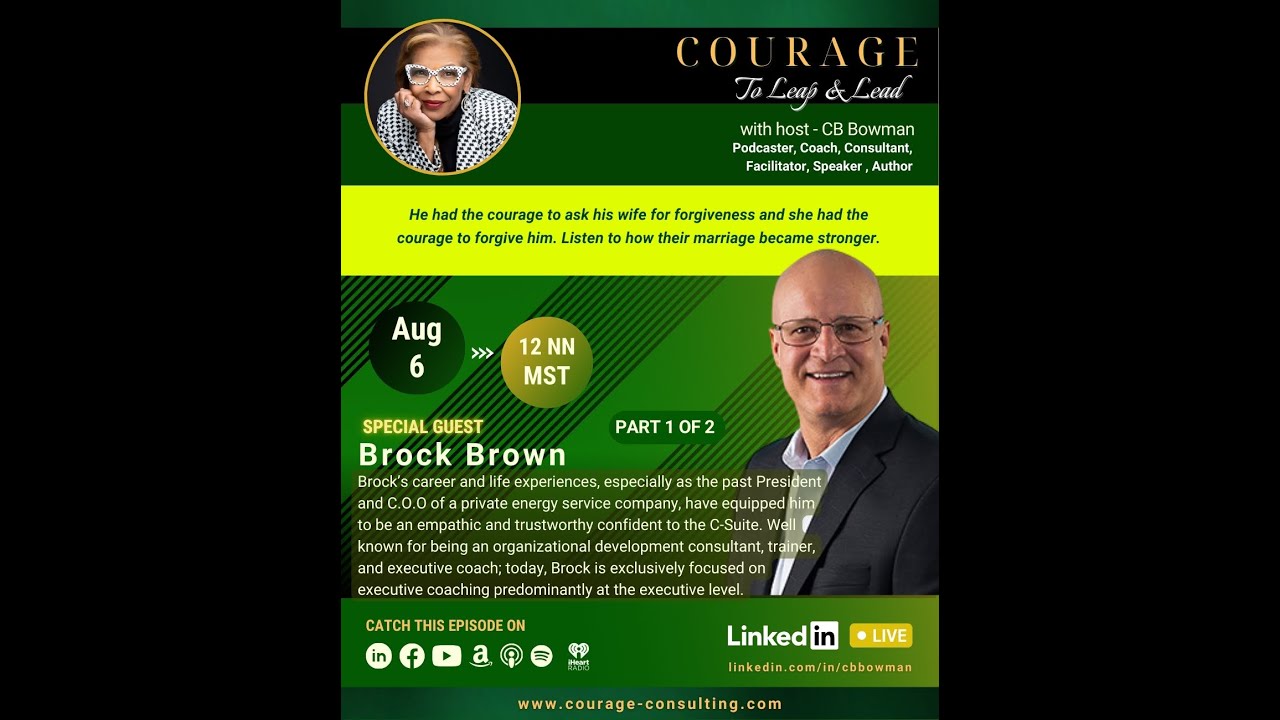
In this episode of the Courage to Leap & Lead podcast, Leadership Courage Coach CB Bowman interviews Brock Brown, a former correctional officer, law‑enforcement trainer, and safety manager who now works as a values‑based leadership consultant. The conversation begins with Brock’s upbringing as the fourth son of a decorated Air Force pilot, highlighting the family emphasis on integrity, teamwork, and standing up to authority. After university, Brock’s early work ranged from seismic crews and farm work to a summer position at a maximum‑security remand centre, where he quickly rose to deputy director of training at age 25. He describes his transition into staff training, developing realistic use‑of‑force curricula, and adopting the Police Safety System to make training mirror real‑world threats. Brock recounts his role in creating a First Nations police training program, where he refused to sign certificates for trainees who failed essential legal exams, ultimately resigning on principle. Seeking a new direction, he entered the energy sector as a safety manager, turning a poor‑record company into an award‑winning safety leader while embedding a values‑based culture. The dialogue expands to broader themes: the relationship between vision, mission, and values; the challenges of implementing values in hierarchical, command‑and‑control organizations; the prevalence of superficial corporate awards; and the ethical tension between profit pressures and integrity. Throughout, Brock emphasizes courage—both personal (overcoming mental‑health struggles in super‑max work) and organizational (standing up for ethical standards). The episode concludes with reflections on how leaders can foster courage, maintain ethical consistency, and avoid the pitfalls of empty accolades.
Chapters
You've got courage to leap, courage to lead. Be brave and be bold.
Wow! Let it roar.
Welcome to the Courage to Leap and Lead podcast, where each of our guests share the stories of courage that helped them become powerful leaders. Before we start today's show, please remember to visit courage-consulting. Where you can find all the episodes and other excellent resources, all at courage-consulting.com. Now, here's your host, Leadership Courage Coach CB Bowman.
Hello, ladies and gentlemen. It's Tuesday and I have a really special guest. And, you know, I say that about all my guests because my guests are just so good. I don't know what else to say here. But Brock, he's the love of my life. Don't tell my husband.
Anyway. Don't tell my wife.
I fairly recently met Brock at a conference that the Association of Corporate Executive Coaches had. A leadership conference. And he came across as, you know, basically kind of just learning the field of executive coaching. And I thought, well, he seems like a nice guy, and he seems interested in really learning, and something about me tells me that there's more to this picture. Well, lo and behold, he joined the association after the conference. And I don't know if it's aired first or if it's airing after, but I had him bring his— one of his clients on. And listening to him talk and listening to his clients talk about how much he's learned from Brock and how much the organization has benefited, I'm in awe of Brock now. I've become a Brock Koopy. He is just so humble, so understated, so knowledgeable, and so sharing. And he's the perfect, perfect model for members in ACEC. Brock, I am so glad you joined our organization. I am so glad that you're playing a role in our organization and that you are helping organizations Bring Humility Back. Thank you for joining us today.
Phoebe, thank you very much, and thank you for the very wonderful introduction. It's been very nice.
Brock, tell us a little bit, or a lot, about yourself, because I want to understand how humility seems to be at the top of your values. How did you grow up?
So brought up the, the 4th son of a military officer. My dad was a very decorated Air Force pilot.
Wait, wait, we can't talk anymore. I'm Army, you're Air Force.
There you go. Yeah, but we're just, we're just a little higher than you guys.
Oh, okay, it's hard now.
Oh, actually, I was at an event with my father and they did all the regimental songs from Army, Navy, you know, Air Force. And when it came to the regimental song for the Air Force, they all stood on their chairs and I reached over to Dad and I said, why are they doing that? He goes, because we're a little bit higher than everybody else.
Whoa, okay. My dad's gonna get you for that one. So, so you grew up in a very strict environment then?
Very strict environment. And I always said, you know, my dad had values and I have values and there's some overlap. How we interpreted them were a little bit different though. I think my dad had a strong value for integrity and he had demonstrated a tremendous value for sort of the ground crews that kept his plane going and fixed his plane at night. pack the parachutes. And he really celebrated those men and women. You know, and that taught me a lot about the importance of the team. And it's not just about the guy in the seat, but about the team that supports that person as well. And my dad and I didn't always get along, you know, and in fact, turned 18, it was like, I gotta get out of this house and quick. But I do attribute A lot of sort of the importance of integrity. My dad did a number of things in the Air Force which probably cost him his career. He retired as a squadron leader. He probably should have retired as a general. And, um, but he did some things including standing up for people. He would stand up to authority. And back then in the Canadian military, I don't know what it's like now, but you didn't do that. And if you did, your career was sunk. And my dad seemed to make a habit of doing the right thing at great cost. And I think that rubbed off on me a little bit as well.
Yeah. Well, yeah, it's the same here. You know, military is military. And, you know, you go with the flow or you go against the flow. And then there are those repercussions, right? Yeah.
Yeah, definitely.
But, you know, it's learning that you and I have experienced and Well, we left home early. You know, you can't, you can't uncover the skin that you were born into, right? Necessarily. So, okay, so you left home early, and then what happened? And by the way, what did your mom do?
So Mom was a home mom. She was a stay-at-home mom. She was a war bride. Dad met her in England after World War II, and she came over to Canada on the I can't remember, similar ship to the Titanic, but it was a little bit different. She came over to Canada on the ship and landed in Halifax.
Where was she from originally?
She's from Chesterfield, Derbyshire.
Oh, okay.
She was a war bride, came across Canada, left her mom and dad, never sort of been away from home, and came to this strange country with strange people.
Wow.
Actually, Dad wasn't here when she arrived. She had to go meet Dad's family, and then Dad came later. So that was them. And I have 4 older— or 3 older brothers and a younger sister, so a family of 5. And when I left home, I had just finished my first year of university in Vancouver and came out and joined the energy industry on a seismic crew. Just as kind of a grunt worker and, and worked at that for a while. And they were getting ready to go up north to winter operations. And I thought I didn't want to be that cold. So I, I got a job as a farmhand on a farm and had never operated farm machinery before. But I learned to operate farm machinery and, and get some— I got some work in a farm implement shop and, and then ultimately went back to finish my degree at the University of Calgary. My undergraduate degree is in physical education. At the time when I got to Calgary, I needed money. So a friend of mine said, you know, you should go apply at the local jail because they're hiring. And there was a— the remand center was a maximum security prison. And I remember going for an interview as a summer student. And the first question was, do you know how to play baseball? And, uh, I said, yeah, I'm quite good at baseball. They go, you're hired.
Wow.
They had a men's basketball team and they wanted people, people from the basketball team. Uh, so I started working in a super maximum security prison. All remands are defined as super maximum security prison and predominantly working actually in the supermax unit. And I thought, well, I'll just be here.
You were a physical Um, head person?
Well, you know, interesting. After my— in my second year, and I— when I left the, uh, the remand for the summer, I stayed working part-time. And my second year, I did my first practicum in the school. And, uh, I finished, uh, I think it was like a 3-week practicum. And I remember thinking, this is a zoo. Like, I've got way more control in the jail with inmates. than I do in the school. I came back and I talked to my advisor. I said, I don't think I want to go into teaching. But I thought, you know, I'll finish my degree. And in the process, I promoted up in the organization and then applied for a training director position and actually became the youngest deputy director and solicitor general General's history at 25 years old as a deputy director of training and went up and opened up a brand new jail in northern Alberta. And that's how I got— that's how I got into staff training and development, actually.
Holy Toledo. This is— this— I know this. Wow.
Yeah. So I did that. And then an opportunity came open at the academy, the Law Enforcement Training Academy, and I promoted down, promoted down there as As a sort of a curriculum design consultant, helping build predominantly curriculum for correctional officers. And then a position came open as the Director of Law Enforcement Training for the province, and I applied for that and got it and started doing work with police forces, training them. And I built, worked with an organization out of the United States called the Police Safety System and brought a sort of non-lethal use of force training program to Alberta and then ultimately took it—
Wait, wait, Brock, Brock, Brock. Brock, turn up.
Yeah.
Do you ever fear your life in doing all of this?
Uh, you know, interesting, working in the jail, um, you know, there's 40 of them and one of you.
Yeah.
And, um, I, I don't think I ever— I don't think I ever feared for my life. What I did learn was, um, and it was a hard lesson, Treat people with dignity and respect. You know, early in my career, sort of being a junior member of a team in the jail, I got assigned to the supermax unit and spent most of my day with some of the most vile offenders and child molesters and murderers. And it was hard. And I remember I started going home because I was spending one-on-one time with them. You know, sort of vile person at a time. And I started drinking myself to sleep because I was having a hard time sort of rationalizing what I did. And I sat down and talked with one of my professors at university. And, you know, he kind of looked right through me and he said, your problem is you're trying to rationalize your job, you'll never do it. So maybe you should quit or quit rationalizing and just do the best job you can. Um, pretty direct message that had an impact.
Wait, wait, wait, wait. Okay, because you're unpacking a lot. What did he mean by you're rationalizing?
Well, he says you're trying to, um, um, I was working with people I would have just as soon done harm to, um, because they were evil people. Uh, I always say I saw evil before I ever saw God.
Wait, hold on, hold on. My puppy wants to go out and—
Yeah, yeah, yeah.
Sorry, ladies and gentlemen, I didn't want her to have an accident inside the house. So—
What he was getting at, he says, you're trying to find meaning in your work, and you're going to struggle to find meaning in your work, given who you're working with. And he was right.
So what did that feel like to you to find, to try to find meaning In the work that you're doing? Were you trying to make them good people again, or as society would define good?
No, it was, um, I was quite conflicted. One of the things in this particular case, this type of criminal like to do, especially because they're generally living in isolation for 23 hours a day except for the 1 hour they get out with me, And so they live in isolation and then they want to talk and they have no trouble talking to you about what they've done and some very horrific stories. And, you know, and to them it's just the natural thing to do. And, you know, at the time, how old was I at the time? I think I was 23, 22 or 23. Just a young, to me, just a young kid, inexperienced and hearing stuff that I thought, boy, I remember thinking of my dad. My dad didn't tolerate stuff and the belt wailed in our house and I was like, I just want to take the belt to these guys.
Mmm.
When Al talked to me, Professor Al talked to me, it was like, you either need to quit doing that because you can't do that to those people. You're there to do a job which is to guard them and to make sure they stay secure. And then do your job and get out. He said, if you can't do that, then you should maybe quit. Or he said, change something. I sat down and went, I need to change something because I'm gonna— I wouldn't have called it that at the time, but clearly I was going through some mental health issues.
Mm-hmm.
I said, I need to change something. I applied to be a prison rec director or assistant rec director at a at a minimum security jail. And, uh, that had a huge positive impact on me in terms of I needed to get out of there. Um, I eventually went back to that jail in a different role. Um, but, but it was what I needed at the time.
Wow.
Wow. I don't even know what to say about that because, you know, it sounds like more of a question of you wanted to fix them. And I would probably want to fix the situation also. And how do you—
I don't think I wanted to— I didn't want to fix them. I wanted to eliminate them.
Well, I was being nice about how I phrased that.
Yeah, fair enough.
Okay, next subject.
Yeah, let's talk about Christmas.
Oh my goodness. So Were you married at the time that you were doing all this?
I'd met my wife-to-be. We had just started dating.
And how did she feel about the work that you did?
Well, I don't— you know, we didn't talk a lot about it. She was working full-time as well, and I was working and going to school too.
I mean, did she not feel that your life was in danger or—
Not that she ever communicated to me. You know, I, yeah, I don't think so. So it's just, we were living our life, doing our jobs and getting to know one another. So yeah, from her perspective, I don't think there was any worry.
So okay, so now we understand the tough exterior you have and the humility that you have inside.
All right.
Next, after this position in the jail system, in the jail system.
Yeah.
So I eventually moved out of security. I got into inmate recreation and from inmate recreation into staff training and development. And, uh, and then, uh, from staff training and development went to the law enforcement academy.
Okay. How did you learn about staff training and development from where you were?
Well, my initiation into staff training and development was I became a CPR instructor trainer, and that's the first time I started teaching adults. And I really liked the idea of teaching people who had life experience. I enjoyed it.
Mm-hmm.
And, uh, then the position as a direct deputy director of training came up because I had a degree, um, that helped me in my application for the position. And then It was all new to me. I had to learn. I had to learn what I was teaching. It was like learn it one day, teach it the next day.
How'd you go about learning it?
So, first you kind of sit in and watch other instructors delivering the program. That was a part of a big way. Sit in and watch a few classes. Any reading materials you could get, you did. You took the class as a student, you know, so it was kind of learning on the job and sort of teaching on the job and kind of make it work as you go.
And the reason why I'm asking these questions is, you know, many of us— the show is about courage to leap and lead, and many people listen to this because They feel stuck in what they're doing or what's happening to them. And you hear so many success stories like yours about how you started in one direction and then— and you were successful and then moved for some reason or another, felt that you wanted to move from what you were doing into something different. And people said, but how did he do that? How did she do that? This is all I currently know. And so it's not by magic, it's by work. And as you said, listening to other people and reading as much as you can and understanding where you are in the process. Is that correct? Yeah.
And I think, you know, what's the worst that can happen? The worst that can happen is I go back to—
That is the most important thing you've said then. It's lack of fear that you're going to be stuck if you're not successful in trying something new.
Yeah, I always felt that was the worst that could happen, was I, I end up going back to where I was and starting over again. And, you know, we'll make— we'll see what happens then.
And, you know, that's a unique mindset because, as I said, so many people feel like Oh, everybody's going to be looking at me if I'm not successful in trying something new, and I won't be able to blah blah blah. And you know the story goes on that we tell ourselves on and on and on. So I love the fact that you look at things like, let's go. Doesn't work. There's other options. So from there you went into training and development. You learned how to write courses and and how to deliver. Effectively. What next?
Well, I think one of the most important things I learned at the college, I sort of, 2 key lessons from college. One of my responsibilities for instruction was officer safety. So arrest and control, sort of anything but non-lethal force. So everything less than lethal force was my responsibility to teach. You know, I learned under the existing instructors and I realized I was teaching stuff that worked great in the gym, but didn't work in reality. Nobody could use this stuff in reality. And then officers were getting in trouble because they were starting to use excessive force because what they learned wasn't working in real life. So—
Can you give us an example?
Well, simply, you know, if you have a, uh, what's called an active resistive offender. So somebody is pulling away from you or working to strike you. These nice little slow blocks that work in the gym and do this with your hands and that with your hands, it's a lot different than when somebody's got a stick and they're swinging very hard and very fast to try to knock you out with a stick. So I needed to teach people in a dynamic environment where there was a little risk and people could swing hard and fast to try and hit the officers. So I found a system called the Police Safety System, which was invented by, um, the head of the Chicago Police Department Tactical Training Department and a U.S. Secret Service agent. And their use of force model had been court-tested. So I certified with them and it made this huge difference. And we put people into the, what we call red man suits, And they were heavily padded. And then if if you if I was teaching baton, we gave them a padded baton, and they had to go in and live fire, hit as fast and as hard as they could in a subject that was moving and trying to hit them. And and why that's important is it taught me the importance of training being as close to real life as possible. You know, oftentimes people learn leadership. And it's like, okay, now go back to work. And they go, I don't know how to do this. Worked great in the classroom. I don't, I don't know what to do. My employee's angry at me. You can tell they're angry at me, and I don't know how to deal with it.
Mm-hmm.
So, in our training, I, I've always integrated in real-life scenarios, conflict with emotion, and had people do case studies. I would try to get as close to real life in anything and everything we trained. as possible. And I think that was one of the things that helped us stand out with our customers a little bit differently than many training organizations who didn't just walk away from the classroom and say, see you later. It was about how are you implementing, coming back and talking about it, how can we help you improve, coaching as a way to take training into real life. And, you know, eventually we said to our clients, if it doesn't have a post-training coaching element, we won't deliver it because it just doesn't have the positive impact that adding that coaching to it does. So that's one of the key lessons I learned there.
I like that. I'm writing it down. Training as close to real life as possible.
Mm-hmm.
I think that's probably why we're moving away from academic reading For the most part, to reading stories. People love to hear stories because those stories are based upon real life that you can associate with.
Yeah.
Versus a bunch of research information. Right?
Yeah.
Yeah. So, okay. So you developed that. Next in your career? So Yeah.
So, uh, one of my responsibilities was First Nations police training. So the province had started an initiative to help First Nations, um, build and design their own sort of police departments, and they needed a centralized training.
For Americans, what does First Nation mean?
Uh, so your indigenous population.
Okay, explain that, please.
So when I grew up, I called them, of course, natives or Indians, but they're not. So our First Nations are indigenous population. There's a number of reserves around the province, and most of them were policed by our national police force. That's kind of a sideline. They didn't necessarily have a national police force office on the reserve. Those members responded from different locations. In our province, the government decided they wanted to help First Nations build their own police forces. So they're policing themselves and they needed a standardized training program. And I was asked to sort of work to build that program up. And one of my colleagues did all, almost all the curriculum design on it, which was just spectacular. And part of my role was Sort of working with other police forces and their training division to come in and help us out because we didn't have the capacity that some of those forces did. So I pulled in the National Police Force, some of the local city forces to work as trainers and put the program together. And we were— it was quite successful. I had some recommendations relative to development that was important upfront, and those weren't followed or weren't approved. So we had some issues with some students having passed— or excuse me, failed their law exams or failed their Charter rights exams, what you might call your First Amendment.
Oh, okay.
Exams on application of First Amendment, we call Charter rights. And, um, and so those students, those are compulsory. Passing that was compulsory. And I was asked to sign their certificates even though they didn't pass. So I said I wouldn't do that. I said I thought it put them in danger and I thought it put those living on the reserve in danger because we were putting someone into a position of authority with a gun on their hip who didn't know their Charter rights or law. And I thought that wasn't a wise thing to do. The story was they would train them by tutoring them, and I knew that wouldn't happen. So it became a point of conflict between me and the director of the college. I said, you want to sign them, that's your business. I won't put my signature on the certificate of a participant that doesn't pass. And I kind of realized my time there was going to be short, which was really a struggle because I love my job. I love working at the college. I loved working with those students. Um, I loved everything about what I did, about the politics. And, uh, so eventually I submitted my resignation and, and left.
So what we're hearing, ladies and gentlemen, is somebody who was courageous enough to support, to keep their values in place, even though The position was in jeopardy, and that's so admirable. Did you feel at the time that you had concern about what was going to happen next in your life in terms of career?
Yeah, well, I'd spent 10 years with government. And I didn't really know anything else. But I knew that the energy industry was prevalent in my province, and I thought, well, maybe I can get, you know, work in that industry. And I applied for a job as a safety manager in a well servicing company, which I knew absolutely nothing about.
Talk about courage. Yes.
Literally knew nothing about. But They hired me and I learned about safety very, very quickly. And, you know, back in that day and age, which was, oh heck, that would have been 1989, 1989, you know, the energy industry had a reputation for accepting employee death as a cost of doing business. And the safety industry— the company that, um, I started working for, uh, 6 months after I started, they got bought out by another company. And that company's record was they had killed 5 employees in 5 years, and they'd also killed a customer.
Ah.
Horrific safety.
program, but they had gone through a big change. They had completely changed out their management team. They bought us, and the CEO came to me and he said, I want you to be our safety manager. I want you to build an auditable safety program, and we're going to clean this company up. And And that was the start of a sort of an 8-year career with them. And we eventually took that company in 2 years from one of the poorest records in the industry to winning the CODC Class A Service Rig Safety Award 2 years in a row.
Wow.
Yeah, it was. And a big part of that, though, was the parent company had hired a consultant. To come in and work with us to help us lead by values. And he helped the leadership team, of which I was one, to create a vision, to create a mission, to create a set of core values, and to define those and prioritize them. And then he, he started teaching us how to lead by those values, and, uh, it had a significant impact on me personally. Uh, on professionally and on my boss professionally and personally. And, uh, was really the model that I had when I said I want to go into leadership training. It's because I wanted to do what Larry Mills, you know, did to me.
Um, which comes first, a company's values or their mission and goals?
Well, I think best it's done hand in hand. So, you know, and if you talk to 10 consultants, I always tell my customers, if you ask 10 consultants, they'll give you 10 different definitions of vision, mission, and values. But from my perspective is vision is why we exist. Mission is what we do. And values are simply the behavior we're gonna emulate when we execute on those 2 things. And that behavior is with our peers, with our customers, with anybody we engage with. Those values are behavior-based values. So as we pursue our vision, we have to come back and go, hey, did we achieve our goals? Yes. Did we do it in alignment with our values? If not, we've done something wrong. And that's so that whole values-based accountability process that we brought to our customers Is, you know, are you achieving your goals? Next question, are you doing them in line with your values? If the answer is, you know, no, then you need to do some corrective work. If the answer is yes, keep doing what you're doing. And that continuous and short-term accountability needs to be involved in the organization on a daily basis.
Mm-hmm. I, I'm gonna fast forward a little bit. Suppose you're working with a client who believes in command and control. Can they still incorporate values, a values-based system?
Well, no. One of the things we teach is various models where values-based systems work and don't work. And what's what you termed a command and control model, or we would call hierarchical, that model of leadership kind of came out of the late 1940s when predominantly men were coming back from World War II and going into supervisory or leadership roles in companies. And functionally in that role, it's everybody just do as you're told.
Mm-hmm.
Which in some ways is quite easy to do. Just come to work, do as you're told, and leave. you know, if you have any sort of inclination, motivation, you know, desire to improve, that's a terrible environment to work in. And I can tell you, I've asked tens of thousands of people what it's like to work in that environment. I get the same answer. It's boring, it's redundant, you don't grow, it's non-stimulating and a horrendous, you know, place to be. In a values-based organization, One of the ways I explain it is you, you probably don't need values in your company if you're this small little company where the CEO's values are so visible through their behavior and that CEO can reach out and touch all their employees on a daily basis. But as that company grows and that CEO is less likely to influence the daily behavior, of his or her employees. Like, I could influence their behavior when there's 10 of them, but now there's 300 of them. I can't possibly influence their behavior, and I need to communicate the values that I expect people to live by in this organization. So in a values-based company, you're giving people vision, you're giving them the mission, you're giving them their goals, you're giving them the values and saying, Now we're going to step out of your way and let you lead the work. Because management's done what management needs to do. And then management kind of stays on the outside and equips their people with whatever equipment they need and assesses, are they getting things done? Are they getting things done in alignment with the values? If not, how do we correct that? And let's keep moving forward. So in the hierarchical organization, it doesn't allow for it. People can't make their decisions because they're supposed to stand around and wait for somebody to tell them what to do. There's no need for those values to be, um, in place because nobody's going to make a decision on their, on their own.
What stimulates courage for an organization to become a values-based Leadership organization?
Well, that's a great question. And I remember a time in the energy industry when it didn't matter how you led. You never had a shortage of employees because there was a lineup out your door of people wanting to come work for you because we paid really well.
And then, and at that time, people join organizations for the name on the door so that they can boost their resume.
Sure, absolutely. And, you know, I think in the energy case, it was always about, you know, money. An 18-year-old kid could come out of school and be earning $80,000 or $100,000 in a year in sort of a frontline position on a rig. But, you know, it became quite evident and it was quite evident in industry. It's like when the lineup in the door isn't there anymore and your lousy leadership is leading to people leaving the company and now you can't backfill them because there's not this group of people, there's a problem. And I think for the longest time, We started or tried to pay our way out of that problem and you can't. And it's like you have to develop leadership competency in your people. And the number of times we've heard those, what I would call those bad leaders go, you know what? People only care about pay.
Yeah, not so much anymore.
Yeah. Well, and my argument was you're paying somebody with a grade 12 education $100,000 And they're quitting your company because you suck as a leader, not because they're not being paid.
Yes.
Yeah. Um, you know, and it took people a while to get that message.
So in this day and age, if you look at the Fortune 500 companies, how many of those companies do you feel, or what percentage do you feel, are values-based driven organizations?
I don't know the data on that. Um, I would, if I were to use surveys from participants and, and, you know, at one point, um, we have a course we teach called Values-Based Decision Making. And at one point, a number of years ago, we put over 10,000 people through that course. We'd ask them a lot of questions. And one of them was, what's your history with working with values? And the majority of people would tell us that values are simply pious words of intent on the wall. So whether they worked with Fortune 500 companies or not, but their history is if there's values on the wall, they're meaningless, which is fine. They bring a degree of cynicism to the equation. But if you're going to become, with all sincerity, if you wish to become a values-based company, You have to take that cynicism in stride because they earned it righteously. Your leadership predecessors, whether it be in your company or not, treated those values as pious words of intent on the wall.
Yeah, I would bet, could be wrong, that perhaps less than 1% of Fortune 500 companies are truly value-based leadership companies.
Yeah, if you actually— so many people don't read it. If you read Jim Collins' book Good to Great, it's a wonderful book. If you— when you finish the book, if you look at the information in the back of the book, it talks about the 11 companies he picked. One of the commonalities that he doesn't deal with in the book was that they were all values-based.
And yet, if I— I don't remember the percentage in his follow-up book where he talks about how many of those companies are still where they were then. Yeah, they're very few.
Yeah.
So, so what does that say about values-based leadership then?
I love that question. We gotta jump into this.
This is gonna be really important.
You know, put you in a hole, but I'm curious.
So there's this, this sort of argument in industry. And in fact, I'll never forget, I was asked to come up and do a presentation to the government after I left. And I was, I was now consulting. I was asked to go do a presentation of my old boss. And because they were interested in sort of doing ethics training for police and our values-based decision-making course is actually accepted as an ethics training course. Because we tie values and ethics. Anyway, I'll never forget, I was in there talking to them and, and, uh, and the, the director said, you know, I don't think we need to do ethics training. He said, I think we just need to hire ethical people.
I like that.
It was like, you know, do I say it or not?
And I thought, whose definition?
What the heck, you know?
And I said, um, great statement. I said, but you're the government. You can't afford to hire ethical people because Private industry will pay them a ton of money to come work for them because you're competing against private industry for people of integrity. And that's not to say government employees have no ethics, not at all. But it's just like people believe that you hire ethical people and then they just are ethical.
And that's a myth.
I've asked more leaders and executives in that group of 10,000 people Where is there more pressure to live by values or to make money? And in private industry, there is greater pressure to make money than there is to live by values. Now, with one exception, and you heard an exception when you talked to, you know, my old customer Mark Rossiter, and their company values are built into the daily conversation. So I would say the pressure is equal. But I can guarantee you the shareholders are not phoning Marc and complaining about his values alignment. They're phoning Marc and complaining about whether he's making money or not, you know.
Right.
So, there's this huge pressure. That pressure applies to ethical people and the temptation to step outside your integrity and values alignment is massive. What we need to expect is that those ethical people, those people of integrity, they're gonna slip up. Now, what are we gonna do? How do we help them recover? Do we help them recover? How do we work them through that problem? And it's not just fire them. That can't be the answer.
Mm-hmm.
Some circumstances it might be. In some circumstances, I had a customer where the mistake impacted their share value. And I'll guarantee you shareholders are gonna call for that person's head. But ethical people make mistakes. My mentor Larry Mills said, we're human beings, not perfect beings, and we're bound to make mistakes. And as a leader in an organization, you need to expect that there will come a time When almost anybody in your company is going to slip up under intense pressure and do something that may not align with your values or integrity.
Okay, but then, then the question becomes, when's the breaking point?
Yep.
Yeah, it does.
It bothers me immensely that there is a person in the executive coaching space that I would consider to be incredibly unethical, and that this person is constantly getting awards.
Mm-hmm.
How does that reflect— I'm asking you because I have my own opinion— how does that reflect on the companies that are— on the organizations that are giving this person awards? Does it say that they're not doing their research? Or does it say that they're ignoring this person's ethical, um, ethics? Because if you're holding this person up as one of the best people in the executive coaching field, where does that leave us?
Yeah, you know what it says? I, I'm not sure. I mean, there's lots of organizations out there that go, you know, I'm a top 50 company or I'm a top—
That's where I was going next.
Yeah.
You know, and I've seen people who have that sticker on their company vehicle, you know, I'm a top 50 company. And I've just come out of taking an in-depth look at their culture. And it's like, holy mackerel, What was the standard for that?
Well, you and I both know— well, you and I know that myself coming out of a Fortune 500 company, that most of these surveys are paid for by the company that gets the award. I recently wrote to one of these companies that gave the award in the coaching space, and I said, how does one get on this list? The response was, it's paid for.
Yeah.
They pay to get their names on the list. And then I thought, you know what, I think I need to remove any association with this organization that's giving these awards because it just didn't sit right with me. How do you say these are the top people when they've paid for that announcement?
Well, you know, CB, I think, I think there are those that do that, and I think there are those that have a reasonably righteous intent in terms of honesty and integrity. But as you know, if you want to get at sort of the, the underbelly of the company, you have to ask some very direct, uncomfortable questions.
That's a good point.
And I think that, you know, with all good intent, they, they don't necessarily have the courage to ask those questions, uh, or to maybe even hear the answer.
Um, what there is a focus on, as we've been talking about, the bottom line. Yeah, you know, we can make money by giving these awards. And so let's do it that way.
Mm-hmm.
Without looking any deeper.
More from CB



211- Courage to Leap & Lead with Louise Story part 1Courage to Leap & Lead







