Courage to Leap & Lead with Becky Robinson, part 2 - Episode 153
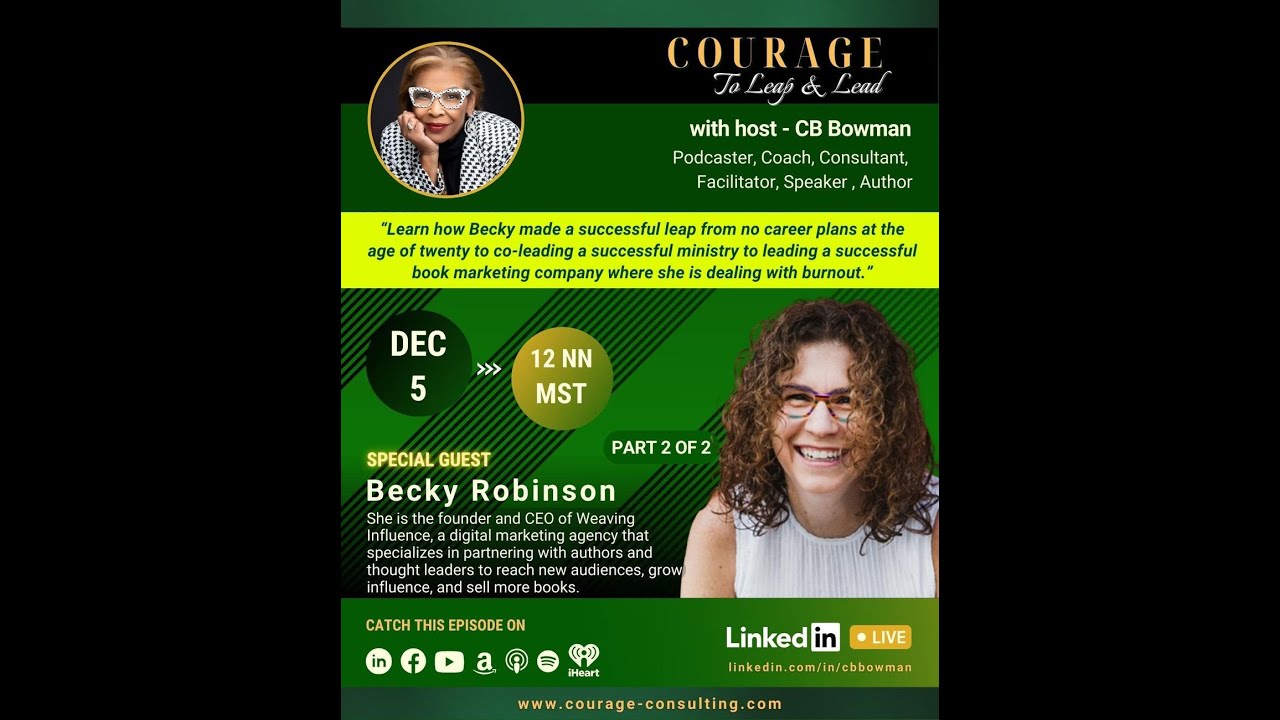
Becky Robinson built a consulting firm with 10-12 staff over eleven years while battling chronic burnout from poor boundaries. She now blocks an extra day weekly for personal time, runs 6-8 hours a week training for a marathon, and plays pickleball. Host CB Bowman shares how a functional-medicine practitioner helped her separate different kinds of stress after her husband's cancer diagnosis.
Chapters
You've got courage to leap, courage to lead.
Be brave and be bold.
Wow!
Let it roar.
Welcome to the Courage to Leap and Lead podcast, where each of our guests share the stories of courage that helped them become powerful leaders. Before we start today's show, please remember to visit courage-consulting. Where you can find all the episodes and other excellent resources, all at courage-consulting.com. Now, here's your host, Leadership Courage Coach CB Bowman.
So let me go here, if you don't mind. I imagine, and correct me if I'm wrong, that it was a fairly marginalized group group of people that came together. How did the children relate when they went back into the world, quote unquote, and met people of color, you know, people with different cultural backgrounds? How did that work for them?
Well, so at the time, actually, I lived in one of the neighborhoods in Chicago that's one of the most diverse neighborhoods in the world. So, you know, while you might think that we were all kind of the same, you know, like white upper middle class or whatever families that were coming together, we were, we were living at the time in a neighborhood where I would go to the park with my kids, and there'd be children from all over the world speaking all kinds of languages, people of all colors, people from lots of different backgrounds, and also like socioeconomic differences as well. So I think that One of the kind of upsides was at the same time that I had maybe a co-op group homeschooling that were like similar, my kids also took classes in the Chicago Public Park System where they would meet lots of different kids. You know, I can't speak for how it was for anybody else's kids, but I feel like, you know, one of the benefits of living in a city compared to where I live now is that our kids were always around lots of people. who were different from them and, and having the chance. Uh, at one time there was a little girl and her mother barely spoke English. She spoke Russian, and we befriended them in the park, and the girls would always play. Um, and it really wasn't unusual for me to be at the park with my kids and hear 5 or 6 different languages spoken at any, at any given time.
So were your children, um, very inquisitive? Because this is not An environment that they were educated in? Were they?
Hmm.
Yeah, you know, I don't really recall so much. In a way, I almost think like that was normal. That was, that was their first experience was being at the park with lots of different people. You know, I think unlike like living in the suburbs where we live now, there is not a lot of diversity where I live. And there's not a lot of diversity even in the public school systems that my kids are a part of. So there was way more diversity in our Chicago neighborhood.
You know, yeah, yeah, I understand that compared to where I am in Colorado. Yeah, I understand that. So, okay, so then after the homeschooling, um, were you working at the same time? Did I miss that?
I— well, so I only began to work toward the tail end of that. So, um, my youngest was maybe about 2 years old, CB, when my husband asked me, hey, Becky, what do you think you want to do for a career when the kids are all in school? And I kind of laughed, um, because Because I think I told you, CB, that when I was younger in my 20s, I didn't really have a vision for a career.
Yeah.
I wasn't super ambitious. I didn't really know what I wanted to do when I grew up. And so, fast forward to about 2008 or 2009, I was in my later 30s at the time. And having been out of the workforce for so long, it can be scary for women to think like, well, what skills do I have to contribute? I had certainly been working hard and learning things. In those years, but I wasn't sure how that would translate to a job. And at the time, the only thing that I could come up with was that I liked to write. So I decided that I would try my hand at some freelance writing. And one of the first opportunities I got was I wrote an article for Chicago Parent Magazine about the co-op, the preschool co-op that I had started.
Yes, yes, yes.
Let other parents know about that because it was something that I knew about. And that was really thrilling to be able to get that placement. I don't remember if I got paid for it or not, but, you know, just being able to see my story in the paper for sure.
Yay!
From that, I happened to get an opportunity through a Facebook friend, a connection from high school, incidentally. And I ended up getting some freelance work for a university in West Virginia. And I got the chance to write some web copy. And then, you know, partway through that journey, my contact at the university said, well, have you ever thought about writing a blog? So the background is that this particular university had a an online bachelor for organizational leadership and also a master's for organizational leadership. And they were looking to start a blog that would attract students to their program. So how do you feel about writing about something that you know nothing about? And I took offense to that. Like, what do you mean I don't know anything about leadership?
I remember that part of your book. Yeah. Like, what do you mean I don't know anything about leadership?
I know something about leadership. So at any rate, It was through that opportunity to write that leadership blog that I started to learn how to use social media marketing. I started to learn how to use— at the time, it was mostly like Twitter and Facebook. And of course, later on, I learned about LinkedIn and other channels. But that was really kind of the beginning for me on the journey that I'm on now.
Wow. So for people who have not read the book yet, you've had a fascinating life. thus far, and I know it will continue to be fascinating. You help a lot of people, a lot of people who are stuck from your book. You help a lot of people who spend a lot of time and heart writing their book. You help them get the word out, which is so important to authors. Tell us about how you're doing, because I, I know the answer to this because I happen to read your emails and blogs, but how are you doing?
Well, you know, today I feel great. Um, I had a 3-day weekend. I got a lot of sleep. Um, in general, I think when I look back on my journey as a business owner, one of the things I haven't ever really figured out is how to keep the right kind of boundaries and balance with work and home and making sure that I, you know, give enough attention to my own kind of rest and breaks. I've been in business now 11 years. And, you know, if I went back and looked at my Google Calendar over the last 11 years, I haven't taken enough days off. I haven't, you know, allowed myself kind of the space to refresh and reenergize myself. Funny story for ECB. Friday night, I was sitting, I can't even remember what I was doing, maybe journaling or something. And my phone rang and it was my stepdad and he was calling because he read my newsletter and he was concerned about me. Now, first of all, like, I didn't know that my stepdad was a subscriber to my newsletter. And maybe if I'd known that, I wouldn't have written the, the 2 recent newsletters that I wrote about feeling burned out and worn out because I certainly wouldn't have wanted to get the end result of my stepdad calling me on the phone to check in on me. I've had a few other people like send me text messages or reach out.
I must say, when I read the first one, I said, what is she doing? Yeah. And then the second one came out and I said, bravo, bravo. Yeah.
Well, I, you know, I guess more people are reading the newsletter than I thought. But here's the thing, like, I think that it's important to normalize the fact that we do need breaks and we do need rest. And building a business is a lot of work. You know, there's a lot of pressure at times there. You know, I remember maybe about 3 years into my business, I remember saying to a friend or a coach, like, I feel like I'm in a pressure cooker. Like, and, you know, for someone who, like me, who decides to build a business and when it's more than just a solo business where, like, whatever income I get is for me, like, I've built a company with employees. And of course, it's not huge, but we have right now 10 or 12 employees and about 10 or 15 more contractors. So, as the owner of the company and as the leader of my firm, like, you know, I'm responsible for a lot of people and their well-being, and I'm honored to be responsible for them. But certainly, like, part of my being open about burnout in this season is because if I am modeling to each of those people that we just keep working even when we're tired or that we keep working and we don't take breaks, they're not going to have the energy to serve our clients over the long haul either. So I hope by being open about, hey, I'm tired, hey, I need a break, hey, I need a bit more space in my life, hopefully that will enable not only my team who sees it, but also others to be able to recognize that it's okay and human to need a break and need rest. I had an email that I received from one of my newsletter subscribers, and she is an accomplished consultant and coach, and she wrote to me and said, for 45 years I haven't taken a break. Or how— I mean, so, and she thanked me for sharing that. So I, I'm sure that she's not the only one who, you know, needed to hear like, it's okay to admit that you're human.
So I will share with you that, um, what you did was so touching. Um, I recently— I'm one of these people that never takes a vacation, and, um, last year my husband was diagnosed with cancer.
Oh.
And so it's been A stressful journey to support him because we're newlyweds.
Yeah.
Amazing. 3 years. And I thought, okay, I can do this. This is just fine. You know, I can handle this. And then my body started to break down. And I couldn't figure out why because I've never had that happen before. I mean, I, I seem to flourish on stress, but it was a different kind of stress. And I think we, particularly as women and men too, we need to recognize the stress, and then there is stress. And I never thought about the difference. This stress brought me to my knees, and I just thought, Oh yeah, I'm gonna sail through this like I have done. And, you know, my own little business is not like yours and it'll be fine. And then all kinds of weird stuff started happening to me and I could not figure it out. My doctors couldn't figure it out. And finally, thank God for this podcast, I had a woman on who's very successful in business and she told me that she went to typical Western doctors And she had a medical problem. They couldn't figure out what it was. So finally she found out about a functional doctor, which, for those of you who are listening who are not sure of the difference, um, a Western doctor treats you from the top down. Here's the pill, take it, you'll be better. A functional doctor, which is an Eastern doctor, treats you from the bottom up. Let's look at the body system in total and figure out what part of the body is causing whatever it is that's happening. And I said, you know what? I am tired of, you know, going to people that don't have the answers. And trust me, I have an incredible Western doctor. I mean, he was able to tell us that my husband had cancer before Way before the male doctors. And one of the things she said to me is, CB, you have a lot of stress going on. And I said, there's nothing new about that. She said, uh-uh, different kind of stress. You're worried about somebody you love now and his ability to be with you for the rest of your life. And I stopped. And I thought, and I said, holy cow, you mean there's different kinds of stress and I'm reacting to this? And I thought I was doing quite well. She said, yeah, well, that's the problem. Now my husband, knock on wood, is in remission. And I said to him, so what do you think? What do you think would make me a better wife? His response was, stop working so hard. I was quite upset at that response. I thought, wait a second, when we met I was working this hard. So I mean, you knew what you were getting when I proposed to you.
You proposed to him?
I did. I sure did. I read that book from Steve Harvey. What is it? Think Like a Man, Act Like a Woman?
Hmm.
I knew on the second date this guy was it. So I told him he had a year to propose. That's another story. And so what I did, and I'm going to— I'm telling the story because I think it's something that women need to think about trying. May not work. And so I sat down at my computer, I took my calendar, and I closed off time. Now it is a bit stressful to try to manage the time that's not closed off, I will admit to it. But I said, you're gonna have to do some— keep your marriage, keep your health. I close off 3 days a week for 2 hours, and I'm learning to play pickleball.
That's fun. I've heard that pickleball is a blast.
It's hard as hell. I love it. It's hard. It's not something— so I'm the kind of person that I have to win. So does my husband, by the way. And I cannot master this because I am not athletic. And when I first was told about it, I said, but I can't even catch a ball. Now I find myself actually hitting the ball over to the other side. And it's, to me, it's just the most amazing experience. And I'm, I'm very competitive, but it's like, damn it, I didn't win. I didn't win. And my coach says, CB, it's about having fun. I said, no, it's about winning. So I have to move to the fun part.
Mm-hmm.
I absolutely am addicted to it now. And so I recommend that People, just take— even if it's an hour, half an hour. Now, it could be half an hour in the morning, a half an hour in the afternoon. Close your office at 3 o'clock, not 5 o'clock. And I mean end your last call at 3 o'clock. Because then you have the quiet time to catch up with what you've missed when you have your personal time, and you can go to 5, 6, 7 o'clock. And not feel like, you know, it's all there. So this is my advice for you and my advice for other women. We need to admit to our strengths. We also need to admit when it's time to take time for ourselves and for the people around us in a different way.
What I'm trying to do actually over the rest of the summer, CB, is I'm blocking an extra full day every single week. whether it's a full workday or whether it's 2 half workdays to give myself some space that I haven't had for a while. And I think this is maybe the 3rd week, although yesterday was a holiday, so I, I'm not taking an extra day besides the fact that we were closed yesterday. But otherwise, this might be the 3rd week in a row that I've done that.
So.
And how do you feel?
I'm starting to feel that it's going to make a difference. But honestly, there are so many neglected projects at my house even that, like, it's going to take me the summer and I probably still won't get them all completed. So.
Okay. It's fine. It's fine. That's why I said to my husband, housekeeper. We need a housekeeper. Can we afford one? No, but we need one.
Sure.
I'm so glad that you're doing this for yourself and take up pickleball. Take up something, you know.
I'm a runner, so I mostly use my exercise time to run. I am considering, I have not run a full marathon since before the pandemic. My last actual race in a marathon was 2019, but I'm considering training for a fall race.
Don't consider it, do it.
There's a lot of time in marathon training, CB, a lot. So, if I'm going to run a marathon, probably at the height of my training, I'll need to run 30 to 40 miles a week. And if you think that like a 10-minute mile is probably fast for me in training, that's like 400 minutes a week if I were running, you know, for 40 miles. So 400 minutes a week is several hours every week that I'd be devoting to training.
And so you're taking off a day a week?
Yes.
How many hours a week do you need to train for this?
For a marathon? Let's see, 60 minutes in an hour. I'm trying to do the math. Probably like 6 to 8 hours a week is what it would take to train for a marathon.
So that day you're taking off, it would be training?
Spreading it out, sure.
Yes. Not housework or anything else, But training. So I will be you. I volunteer, audience, to be her accountability coach.
Ah, for this marathon that I'm gonna run this fall. Okay. Well, the funny thing is, I think that one of the things that caused stress— and it, it was a joyful use of time, um, but this past school year, my daughter, she's been in school and it's 30 minutes away, and I would drive her to and from school. So Quite often I was fitting 2 hours of driving into a workday, like trying to fit in a workday plus 2 hours of driving to drive her there and back. It took 8 to 9 hours a week of my time. Happily, she now has a driver's license, so there is a break for me there, which is really helpful.
And she couldn't take a bus?
No, there isn't a bus for this particular school. We did have some friends that helped. So where normally, you know, to and from school, that would be 10 hours a week. Since it's 30 minutes away there and back. I didn't have to do all 10 trips. I would do like 8 or 9 of the trips every week. But that was something else that kind of added pressure, which is part of where I found myself, which is just a little bit worn out, or maybe more than a little bit worn out.
Yeah, I get it. But now on to next. Yes, he has a driver's license. You have the time, and I will be your accountability coach.
Okay. All right. I'm gonna take you up on that.
Okay. So we're gonna figure out how that's gonna work to make you happy and
More from CB



211- Courage to Leap & Lead with Louise Story part 1Courage to Leap & Lead







