Courage to Leap & Lead with Dr. Tony Alessandra, part 1 - Episode 144
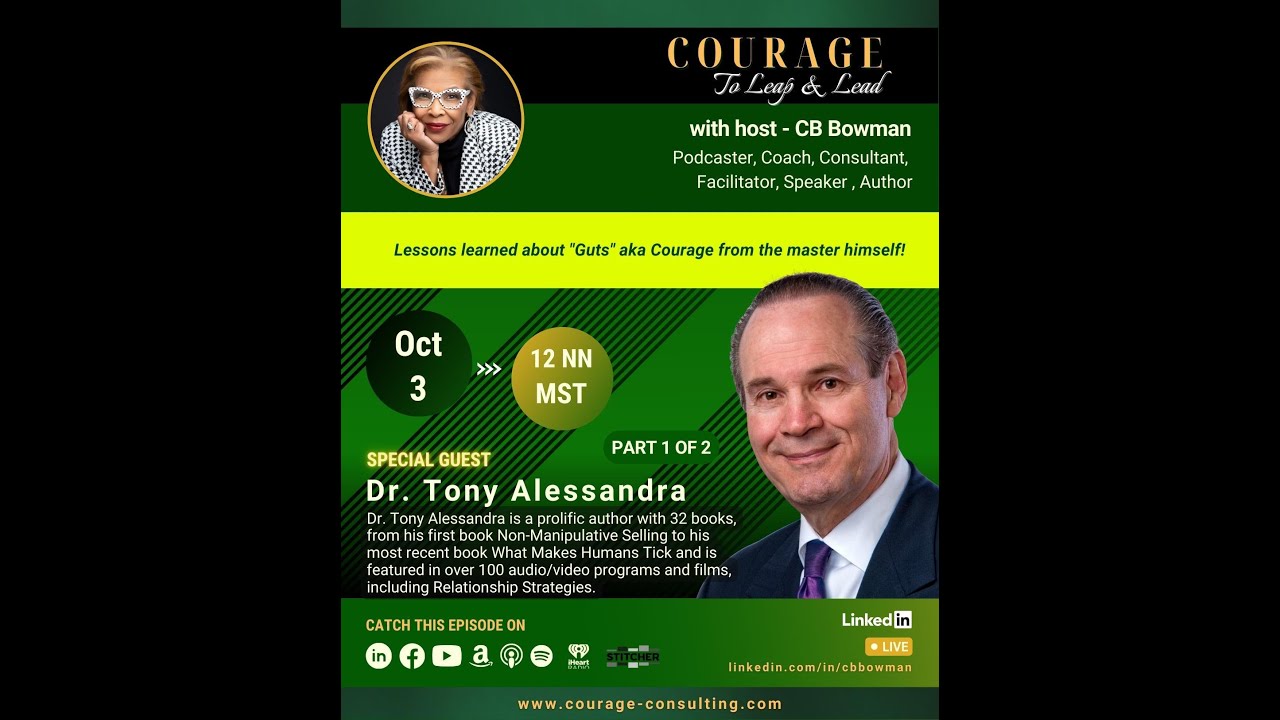
Dr. Tony Alessandra grew up in NYC projects and built a speaking career before burnout forced him to pivot. In 1974, he encountered the 4S model, which evolved into the DISC framework and his Platinum Rule platform, a multi-million-dollar business. His mother's "extra-inch" philosophy of incremental improvement shaped everything.
Chapters
You've got courage to leap, courage to lead.
Be brave and be bold. Let it roar.
Welcome to the Courage to Leap and Lead podcast, where each of our guests share the stories of courage that helped them become powerful leaders. Before we start today's show, please remember to visit courage-consulting.com. Where you can find all the episodes and other excellent resources, all at courage-consulting.com. Now, here's your host, Leadership Courage Coach CB Bowman.
Hello everybody! How are you? Welcome to Tuesday. And you know, on Tuesdays you have CB Bowman. with courage to leap and lead. And I'm so glad you're here. I am honored, honored to have the guest for today. I think you all know, and I hope I pronounce his name right. You know me and pronunciation, but let's try it. Dr. Tony Alexandra. How did I do?
You did, you did fine. Yeah, believe me, I've heard every imaginable pronunciation, you know, a la salamander, and, you know, you name it. So yeah, I pronounce it Alessandra, and that's it.
Okay, I was pretty darn close then.
Yes, you were. Absolutely.
I want you to know I practiced and practiced and practiced. So as you know, Dr. Tony is a guru Guru in the field of leadership and management and everything that we need to know about business. And he has assessment tools. But today we want to talk about how did he get to where he is? How did he get to be this industry guru? How did he get to be so famous? Was it just like— It just happened. Or did he have courage that he needed to use to get to the top? So hopefully we'll find some inside stories, some help on getting there. You know, um, many times people think that people at the top just flew there. It just magically happened. You snapped your fingers and it happened. And I have to tell you, I'm going through some courage challenges myself right now. In terms of getting my book out, I sit there and I go, hmm, is anybody going to read it? This— all this nonsense, right? It's not really nonsense. It's how you feel inside. And we all have to have the courage to figure out ways to get past it, to get to our goals. So today, Dr. Tony, we're going to find out some of the inside scoop about how did he get to be so well known? Did he skip over all those challenges, or did he confront them, deal with them, manage them, and use them as an experience? Dr. Toni, welcome.
Thank you, CB. Very honored to be on your show.
Thank you. You said the right thing. Dr. Toni, let's start from when you were young. As a child. I mean, you're still young, but I'm talking about when you were in your teens and preteens. Tell us about your parents and, and how you grew up.
Yeah. So I— my father was— my mother didn't work. My mother was a homemaker. My father was a New York City cab driver.
No way!
Oh, yes, yes. And, and I grew up in the projects. in New York City.
Really?
Did you really? Yeah. So we were on 26th Street between 8th and 9th Avenue. There's a series of 4 big projects, high-rise buildings. So we lived there. I lived there until I was 9 years old. Then we moved to sort of the Coney Island section of Brooklyn, then to Jersey City, and eventually to the Jersey Shore. When I was a teenager. So I went to a lot of high schools. And in fact, I went to 3 high schools in 3 days.
What?
So yeah, yeah. So, so when I was in Jersey City, I was at a high school called St. Peter's Prep, you know, really, really good, solid high school. Then we moved to Toms River, New Jersey. My mother wanted me to go to a Catholic high school, but there was nothing in Toms River. So she put me in Toms River High. So that was day 2, right? But a spot opened at a place in Belmar, New Jersey called St. Rose. And on the 3rd day, I went there. And I went there for the rest of my freshman year and all of my sophomore year, but then went back. It was just too much travel. It was about 30 miles each way. Uh, I would always get rides in the morning from other people who were in Toms River who were going to St. Rose in Belmar, but I, I participated in athletics, so, uh, we had to stay late. We had a practice out in Belmar, and a lot of my rides had already left and gone home, so I had to hitchhike home.
Wow.
Every day, 30 miles in New Jersey. You know, at what, 15 and 16, 17 years old?
Okay, stop, stop, stop, stop. Okay, first of all, let's go back to the projects. Jacob Riis projects, right? I love that. You know, that was actually the best child raising ever. We got to meet so many different ethnic backgrounds. And when I was in the projects, it was the Lower East Side, right?
Yeah.
So it was mostly Jewish. So I got to really learn immersely in the Jewish culture. It was so much fun. And then we moved to— where did we move to? We moved to the Bronx in an Italian section where people were growing their wine.
So, yeah.
You can fool anybody these days on the phone.
No, it was— I agree, it was a great experience. I really believe that that was sort of the foundation of who I became. It was a rough neighborhood, but as you said, ethnic— ethnically diverse. And, you know, you got along. You had to get along with a lot of different people.
Absolutely.
And of course, when I moved to Brooklyn, that was an all-Italian neighborhood. So that was a whole other experience. And Jersey City, Jersey City was like where we lived in New York City. Toms River was a whole other experience. It was really, you know, chicken farms and you know, a whole different experience, me being from the city, going to almost like the, uh, the country back then. Uh, you've, you've heard of Seaside Heights, Toms River, New Jersey?
Yeah.
That's where I was. But back in the early '60s, uh, you know, it was like, uh, what was that, that show, uh, something acres, uh, Green Acres. Green Acres. Yeah, it was like the city person going to the country. Well, that was me. It was going from, you know, New York, Brooklyn, Jersey City over to Toms River, which was a lot of farms back then. So it, it was a— it was good. So the, the beauty of that, CB, was that I got to experience a lot of different people and cultures.
Yes.
Uh, which certainly helped. Now, when I, when I graduated high school, I luckily got accepted to the University of Notre Dame. So I went there, uh, which again was a big culture shock for me. Uh, it— I had never been really out of the New York, New Jersey area. A couple of times in Philadelphia, just, you know, to buy records. I don't know how many of your, your listeners know what a record is, but— So, but as we used to call them, records, not records, records. Yeah, I'm gonna go buy some records. And, but in South Bend, Indiana, it was an experience. First of all, my 2 roommates were from families that were definitely more well-to-do than where I came from. So that was another experience, getting to visit where they live, going, you know, staying in their homes, you know, during breaks. Wow, you know, this is how the other half lives. I mean, one of my roommates, when we went to his home, they even had a live-in maid. Holy cow, I couldn't believe it. Uh, so—
Wait, did you go back and call your mom and say, where's our live-in maid?
Yeah, no, I— if I did that, I'd get a smack across the face.
Let's just talk about child rearing back in our day. I mean, you didn't get away with stuff. First of all, there was the look.
Remember the look?
That was the warning.
That was it.
And if you ignored the look, you found yourself on the floor.
That's it. It was an experience, you know. So going to, you know, to school at South Bend was a whole geographic awakening to me. seeing how people in another part of the country, the United States, lived and spoke. They even used different words. I remember when I— the first time I went to buy something in a store, somebody said, do you want me to put this in a sack? Me, I'm saying, a sack? No, put it in a bag. You know, I'm thinking of a sack, you know, where you put potatoes in. But that's what they call a bag, a sack.
Yeah.
When I went into a little coffee shop, I asked for— I forget what it was, like an orange soda. And what I get back is a scoop of ice cream in it, like it was an ice cream soda. No, I didn't want— I want a soda, you know. So that was an experience. But when I graduated there, luckily— and let me just mention that my mother, the one thing my mother instilled in me, and I mean drilled it in me, was education.
Yes.
So, and I really believe that's why I'm where I am today, is education. So right after graduating from Notre Dame, I went to the University of Connecticut for an MBA. When I finished that, I found a teaching job at a university level with an MBA, which is unusual.
Yes.
And I, I did that for 3 years, uh, and really enjoyed it and said, hey, you know, if I'm gonna stay in academic teaching at the university level, have to get a PhD. So, uh, I looked around and I found, uh, Georgia State University right in downtown Atlanta. And when I was a kid, there were a few books that really had an impact on me. big impact on me. You know, I really read a lot of books on positive thinking and success. You know, How to Win Friends and Influence People, Psycho-Cybernetics, The Magic of Thinking Big by Dr. David Schwartz. And at Georgia State, who was one of the marketing faculty? Dr. David Schwartz, the author of The Magic of Thinking Big. So I called over there, I got ahold of him, I asked him if he would be my dissertation chairman, assuming I got that far. He agreed, and I went there. Stayed there for 3 years, got my PhD in business administration with my concentration in marketing, moved out to San Diego again to become a full-time prof at the University of San Diego. But I was, I was doing some training and speaking on the side. And in 1978, the head of the, of the School of Business at the University of San Diego said, Tony, You have to make a decision. You're either going to be a full-time prof or a full-time speaker. You cannot be both. And being that I had taught for so many years up to that point, I decided, let me become a full-time speaker. I tried that out starting in—
Oh, wait a second, Tony. Why did he say that to you?
It— well, if you want my honest opinion, yes, it was jealousy of other faculty members. Mm-hmm.
That makes sense. Yeah. So limit, limit, limit your abilities, right?
Yeah. You know, hey, uh, you know, he's out there speaking, he's out here teaching.
Uh, who does he think he is?
Yeah. And, and that was it. And, and so I had to make a decision, and I made the decision to become a full-time speaker, which was a great decision. Uh, that was January of '79. In, uh, July of '85, I was inducted into the National Speakers Association Speakers Hall of Fame, and, and things happen, you know, just really skyrocketed from there. However, CB, as great as that was— and I was averaging about 100 speeches a year, actually right now I have 12.5 million frequent flyer miles on American— it was just too much travel, and it was burning me out.
And, uh, wait, Dr. I wanna— before you go there, first of all, I do remember, uh, your, your name was plastered all over when I joined NSA. And by the way, I will be going to the conference in July, is it?
Yeah, July, right.
Uh, are you gonna be there?
I'm not. No, I'm not, unfortunately. Yeah. Sorry.
I want to go back to something you said. Your mom, she clearly was a powerhouse, right?
Oh, yeah. Yeah. Oh.
The fact that she decided— and I'm still trying to get— I'm stuck in this in my head— that you were going to go to a better school, and she puts you in 3 different ones. I want to know, how in the world did she do that? Did she just call up the principals and say, Hey, where he is is not good enough, or— I mean, I've never heard of this before.
Yeah, she was, she was persistent, believe me. My mother was a force of nature. And when, when I had to go into— so from St. Peter's Prep, I had to go into Toms River. My mother was still making calls over to the Catholic high school in Belmar, New Jersey, and finally got them in one day. to open up a spot for me, uh, and, and that's where I went. Uh, my mother— one of my mother's really famous sayings to me was, uh, and she always called me Anthony, never Tony. Anthony.
Oh, my husband, same thing. So now I have to tell you a quick story. When I met my husband, who's Italian, um, I said to him, Would you prefer to be called Tony or Anthony? And he said to me, well, all the important women in my life called me Anthony. And I said, well, guess what? I will be calling you Anthony. And this is like before our first date.
Wow! Yeah. And so it's either Anthony or Tony. You know, the old joke is, why are so many Italians named Tony? It's because when, when our grandparents were coming over from Italy to New York, The, the, the sailors on the ship couldn't speak Italian, so to make sure they were, they were transporting people to the right places, they put on most of those Italian men to New York. T-O-N-Y.
No!
That's just a joke. Just a joke. Yes. So my mother, my mother would always say to me, Anthony, always go the extra inch, not mile. You know, the saying is, I want to go the extra mile. No, she always said, go the extra inch. Anthony, a mile's too far. An inch is easy. In every aspect of your life, every day, you need to go an extra inch to to improve yourself. Go an extra inch, learn another word each day from vocabulary. Go an extra inch, do one more exercise, one more rep, whatever it is. Go an extra inch and read an extra page in a book. And, you know, this whole thing was incremental, small improvement each and every day. And she said, Anthony, if you go enough inches— You've gone a mile. And so early in my life, everything was about self-improvement. How do I improve what I do, how I do it?
What did she say? What did she say? I'm so glad that I circled back to this, because what did she say if you didn't succeed at something going that extra inch? What was her advice?
Her advice was, this too shall pass. Don't worry about it. You know, uh, go 2 inches the next day, you know, whatever it is. But, uh, but, you know, going the extra inch was, was, believe it or not, it's hard to fail going the extra inch, uh, because it's so minute. It's just a little bit, you know, how could you fail learning one more word unless you totally skipped that part?
Yes.
But, but it really— going the extra inch made it so easy, so easy to grasp, right?
Uh-huh.
Uh, I remember when, uh, when I was in high school, I was a senior in high school, and I applied, I applied to many colleges. Uh, but you know, one of the colleges I, I had applied to, I hadn't heard from, which was Notre Dame. And I remember this vividly. Coming home from school and, you know, walking from where the bus dropped me off, walking to my house, my mother standing on the front lawn waving, you know, an envelope, and it was my acceptance to Notre Dame. And she was so unbelievably excited. And I said, Mom, you know, We can't afford me going there. She said, you know, look, your father and I have saved enough money that we can pay for your freshman year. And that, believe me, that's all they had. And she said, something will happen. You know, I don't know what it is, but at least you're going to go your freshman year. And so at my freshman year, uh, I, I'm done, uh, haven't paid any tuition for my sophomore year. I come back, I get a job. Uh, in construction. So trying to earn enough money, but you're not going to earn enough money in construction. Uh, the first week I am in construction, I'm on the roof nailing in, uh, you know, nails. And the, uh, the contractor came up to me who was the father of a friend of mine. That's, that's why he gave me the job. But I wasn't good at it. I really wasn't. And he came up to me. This is really— this is kind of funny. This is— he came up, he knelt down beside me, put his arm around me, and said, Tony, become a doctor. And that's how I got fired.
Yeah.
So I, uh, that night I went to a party. Uh, I was telling people at the party. And, you know, even at that young age, I was a storyteller, and I would, you know, elaborate on this story about how I got fired, that, you know, making people laugh. And one of the kids who was on the football team with me at Toms River High School, he was a year behind me, but now he had graduated, graduated. And he said, hey, you know, why don't you come work for my uncle selling cookware? Pots and pans door to door. You know, he said, you'd probably be really good at it.
Wait, Tony, is your family Italian?
Oh, yeah, yeah, very much so.
Because my husband is so great at telling these stories, he elaborates. I'm like, yeah, I don't remember that part happening. Okay, it must be a cultural thing. Okay.
But, but CB, you, you— I don't know if you heard this at NSA, but They say it's a poor speaker who cannot tell a story better than it actually happened. You know, so, you know, even if you start exaggerating a little and you start getting laughs, you build that into the story. But so anyway, I went to work that summer. Now, this is the summer between my freshman and sophomore year. Still don't have the money to pay tuition. And I start selling cookware. I don't know anything about selling cookware. I, I don't cook. But I went out and it was door-to-door selling. And listen to this, CB. CB, in 1966, I'm selling a 10-piece set of cookware for just shy of $300.
That's a lot of money.
A lot of money. But, but listen to this. In 9 weeks during that summer, I sold enough cookware, my commission and bonuses, etc., almost $5,000. I had enough money to pay my tuition, room, board, spending money.
Wow.
And I did it again between my sophomore and junior year, again between my junior and senior year. I paid for the rest of my tuition Even had money left over when I went to grad school at the University of Connecticut. I paid for that too. So, you know, my mother, my mother said, things will work out, Anthony, you know, when she was waving that, that letter to me. And they did work out. And here's another interesting thing, CB. When I was selling cookware in '66, '67, the cookware was called Saladmaster. One of the top salespeople in the country was some— yeah, so, so one of the top— not, not me, no, but one of the top salespeople in the country was from Texas. And you ready for this name? Selling cookware, the same cookware I was selling at the same time. Zig Ziglar.
No way!
Yes, yes. So it, uh, It was quite an experience, uh, uh, but you know, all these things helped develop, you know, my storytelling for speaking, my selling skills, uh, also for speaking, but, but especially for what I'm doing now. Uh, it, it, it, it just all built together. And, you know, going back to the speaking career So again, I had one career as a professor. I had another career as a very successful professional speaker, probably 79, probably 35 plus, maybe even 40 years. But in 2000, I went to my head of marketing as a speaker and I said, I'm spinning you and the rest of my staff off into a separate business. Uh, you're gonna take— you're gonna run the business. Her name is Holly. You're gonna run the business, Holly. Uh, you have all the employees, you have the computers, you have the office, you do everything. And I'm going to get a couple of other speakers like me. You're going to manage me now. I'm not going to manage you, you're going to manage me. And every time you book me for a speech, I'm going to give you a percentage. Every time you sell my product, my books, etc. I'm going to give you a percentage. And I got her people like Nito Cobain, uh, Jim Cathcart, uh, Sheila Murray Bethel, you know, people back then. So she had 4 key people that generated enough revenue for her that was similar to what I was paying everybody. Uh, and, and it was then that I said to myself, I'm gonna start this other business, this online assessment business. This was in, in, uh, 2000. And as that business grew, I will cut back in my speaking. So here we are, uh, many, many years later. My assessment business generates upwards of 5 times the amount of revenue I did in my best year speaking. Uh, I don't really have to speak anymore. In fact, last year, uh, April— let's see, April of last year, 2022, I gave a speech in Las Vegas, 500, 600 people. I was really sick. I actually— I was sick enough, you know, hoarse, uh, gravelly voice. I had to have a box of tissues up there with me, uh, to keep blowing my nose. I gave this talk, and maybe it was my adrenaline. I don't know what it was, but I mean, I really pushed. It was a 90-minute talk, got a standing ovation, and I said to myself, you know what? This is my mic drop speech. I will not speak anymore, and I have not spoken since.
Oh, wait a second, Tony. That's just not fair because you are hysterical and You are such a good storyteller. It's not fair that you have made this decision. So I'm here to talk you out of that decision.
Well, you know, it's funny you should say that because several, several years ago, I was part of a mastermind group. And I mentioned that to my mastermind group before I ever did this, before I stopped. And, and I— Nido Qubein especially said, you're just like you, this is a big mistake. You know, you have a gift. You, you know, you, you should not quit. But here's what I said to them. I said, I don't want to keep speaking to the point where people say, you know, he was really good when he was younger.
Oh, listen, can I just tell you, okay, I'm an executive coach. I'm here to coach you. Would not happen. I'm here. I have never laughed so hard in one of my interviews as talking to you, and we we don't know each other personally. But I feel like I can knock on your door, bring you over a cake, and say, "Hey, that's that's exactly you know that that's Italian.
You know how Italians are." Listen, I know. You ever listen to that comedian Sebastian Lattacasco? Yeah, and his whole initial routine about people knocking on the door when he was young versus today. When I, when I was young, people, people would, you know, come over, you know, even around dinner time. Yeah, come on in.
Yes, it's—
it was so different back then than it is today. But even today, even though I'm not married to an Italian, we have an open door. Not that—
Yes.
Not that we, we don't lock it.
We do.
But when somebody comes over, they're always welcome.
Always. You have the Edamame cakes on the table.
Exactly. Exactly. Yes. Yeah. So pull out the cake.
And my husband is a chef. So there you go.
Wow.
Wow. I mean, come on, it couldn't get better than that, right?
Yeah. Yep, yep. But you know, go, CB, going back to your initial, initial, uh, intro.
Yeah.
I did not come from success. Uh, I had to, uh, take advantage of every opportunity that I saw. Not that the opportunities were presented to me, but I'm always I always have my eyes and ears open for opportunity. I do a lot of talking to my friends over the years. You know, what do you know? What's different? What have you come to discover, you know, since we last talked? I'm always looking for where things are going, what doors are opening. And, you know, at this point in my career, you know, early on in in almost everybody's career. When you're starting out, you look for any opportunity.
Mm-hmm.
When you start getting more and more successful, the real difficulty is that when supposedly good opportunities come your way, which ones do you say no to? Because you cannot say yes to everything. So you have to be able to say no. And the example that I give going back to basically retiring from the speaking business is my favorite baseball player of all time, which was Sandy Koufax. And Sandy Koufax was one of the most gifted. In fact, many people say he was the greatest pitcher of all time, but he quit when he was literally at the top of his game, and everybody remembers him about how great he was. Uh, and really, that's, that's, that's what I want people to remember. And yeah, can I still speak? Well, last year was an example. Yeah, I, I can. Can I still generate a standing ovation? Yes, I can. Uh, can I still tell stories and stuff like that?
Yeah.
But you know, I really don't like travel, and I really love being home. I love my wife. All my kids live here. My grandkids live here. I just want to enjoy life with all of them. So, and I live in San Diego. How much better can it get than that, right?
Well, we talk about California these days. I think it would be much better if you moved to Colorado.
Yeah, well, believe me, if I could get my wife to move, I would. And we won't get into the reasons why, but she loves where we live. She loves San Diego. I talk about, you know, but the taxes, the this, the that. She says, Tony, you make the money, pay the taxes. This is where we're staying.
Whoa, are you sure she's not Italian?
She's not Italian, no. And she's not that assertive. But, but, but when it comes to staying here, yes, she is assertive. She said, I will not move. Now, who knows, you know, a year, 2 years, 5 years from now, who knows what the future holds. But right now we are here in California. I do love where we live. We live in a very nice area of San Diego. San Diego has incredible weather. So, and of all the California cities, the big California cities, we are not like what's going on in LA and San Francisco. We, we really have avoided much of that.
So, yes, yeah.
Who knows what's going to happen, you know, a few years from now, but right now we're settled here. I'm happy. She's happy. We just had yesterday, we, we all, all the kids and grandkids got together for a birthday for my son-in-law. And, you know, this is what life's about, you know. And, you know, in speaking, there's so much travel. You're away from home all the time. You're sometimes missing key birthdays or anniversaries or baseball games or whatever.
Well, you know, that's the reason why I love the age that we're in now. I like speaking by Zoom.
Yeah. Oh yeah.
Now, a lot of people poo-pooed it, but first of all, I'm an introvert. Second of all, I feel like when I am speaking by Zoom— uh, my little one just came to say hi to you. Hold on. Say hi, Paris.
Hi. Hi, sweetie. Hi. Hi.
You're going to go back upstairs to Daddy? All right. Go. Go. All right. The fact— here's what I feel COVID did for us. It allowed us to communicate to many more people from the comfort of our house. And you know, so many people poo-pooed it. But I loved it because I love being a voyeur. I can see what's going on in your house and I can connect with it. I feel like I connect better with you than seeing you sit in an audience where it's— there's none of you around.
Right, right.
So I, I am a full supporter of speaking By Zoom. And by the way, let me just put it on the table. You and your wife have an invitation to come to Colorado and stay with us at any time.
Now, where in Colorado are you?
And so, do you know where Fort Collins is?
Yeah, yeah, I do.
Okay, so there is a town that connects to Fort Collins. It's like the suburb called Windsor. It's a little golfing community, very sort of Lazy. We see pelicans, you know, we're just very casual. There's a couple of golf courses. One is a PGA golf course. There's places to fish. This beach, it's a very laid-back, beautiful community. But, and, and now we're all into pickleball.
Yeah. Oh, yes, yes, yes, yes. Yeah, my wife is into pickleball. I can't do it. I just had a knee replacement in January, so I'm still partially in recovery. I mean, I walk, no problem, but it's still not quite where it was prior.
Well, you'll be better soon, and then you can play pickleball. So come on out. We've got lots of courts, and we're really getting into it. Anthony and I are taking lessons.
Good.
He's very competitive, as you know, you Italians are.
Oh, yes, very much so.
Yeah. So, Tony, I want to ask you now, um, you had the courage to say to, um, somebody, you take this part of the business, I'm going to pay you commission, and you make it grow. How did you have the nerve to do that?
You know, I just I follow my gut and I, I just knew it was the right decision. And by the way, over a 5-year period, uh, eventually I gave the business to her, which is a very successful business right now. It's called Speaker's Office and she manages Brené Brown.
Wait, how can I get on this list? We'll talk offline.
Yeah, we'll talk offline. Yeah, you should go look up speakersoffice.com and, and see. She primarily now manages female speakers. Uh, she has me listed as an emeritus, which is really old and retired, but—
We'll talk, we'll talk. Okay, so you did that. All right, now I want to go into your assessments. What led you down that path?
We go back to 1974.
1974, I am—
I had just finished all the coursework and my oral exams for my PhD, but now I was getting into the dissertation part of it, right? And I had been invited to this little, uh, private session in somebody's home where they were presenting something called 4S, which was Social Style Sales Strategies. It was a Larry Wilson product, and I had never been exposed to it. And it was, uh, about behavioral styles, social styles. And I looked at that, and I, I gotta tell you, it was love at first sight. I said, this is what I want to do. So I went back to Dr. Schwartz And I said, this is what I want to do my dissertation on. Well, I had already written a dissertation proposal that was already accepted. The proposal was accepted. I had to do all the work. And I said, I want to change my proposal. I want to do it on this, on psychological aspect. And he said, absolutely not. He said, finish your dissertation. You're almost there. Finish it. and get out of here. And then if you want to pursue this other dimension of personality styles, do it then, which was actually great advice because supposedly 50% of all the people that finish all their coursework and their oral exams never finish their dissertation. They call them ABDs, all but dissertation.
Yeah.
Yeah. So, but it was that concept that I said, wow. So I started in my training and speaking talking about these 4 styles that then we called them the driver, the analytical, the expressive, and the amiable. And over a period of time, I started adapting it to me. I call it the director thinker, relator, and socializer. And then eventually got into the DISC concept, D-I-S-C, which is dominance, influence, steadiness, and conscientiousness. Uh, which was more— way, way more widely known and accepted than what I called my Platinum Rule concept. In 1996, I decided to put the Platinum Rule assessment online, had people take it for free. Uh, it won a, uh, what do they call it, they won a Webby Award. It was the USA Today pick the website of the week pick. 10,000 people a month were taking it. And it took me almost 4 years because, again, I was speaking very heavily, about 100 speeches a year. So I didn't have the focus that I should have. But it took me 4 years before I said, you know what, this could be a real business. And I hired this young kid. 20— let's see, how old was he? 23 years old. Yeah, it was 23 years old. His name was Brandon Parker, and I, I hired him to program the online platform for me. And, and that's when I said, as, as this grew, I would cut back. Well, my first customer was Ken Blanchard. Talk about, talk about, uh, you know, luck. Uh, but again, you know, I, I, I see where the opportunity is and I go in that direction. So I approached Ken, uh, and, uh, we started programming 1, 2, 3, and, and more of his assessments on our platform, which was a big— not only a, a decent revenue for us to keep us going, But, you know, you say, hey, Ken Blanchard's on our platform, that opened up, you know, credibility.
More from CB



211- Courage to Leap & Lead with Louise Story part 1Courage to Leap & Lead







