Courage to Leap & Lead with Dr. Mark Goulston, part 2 - Episode 155
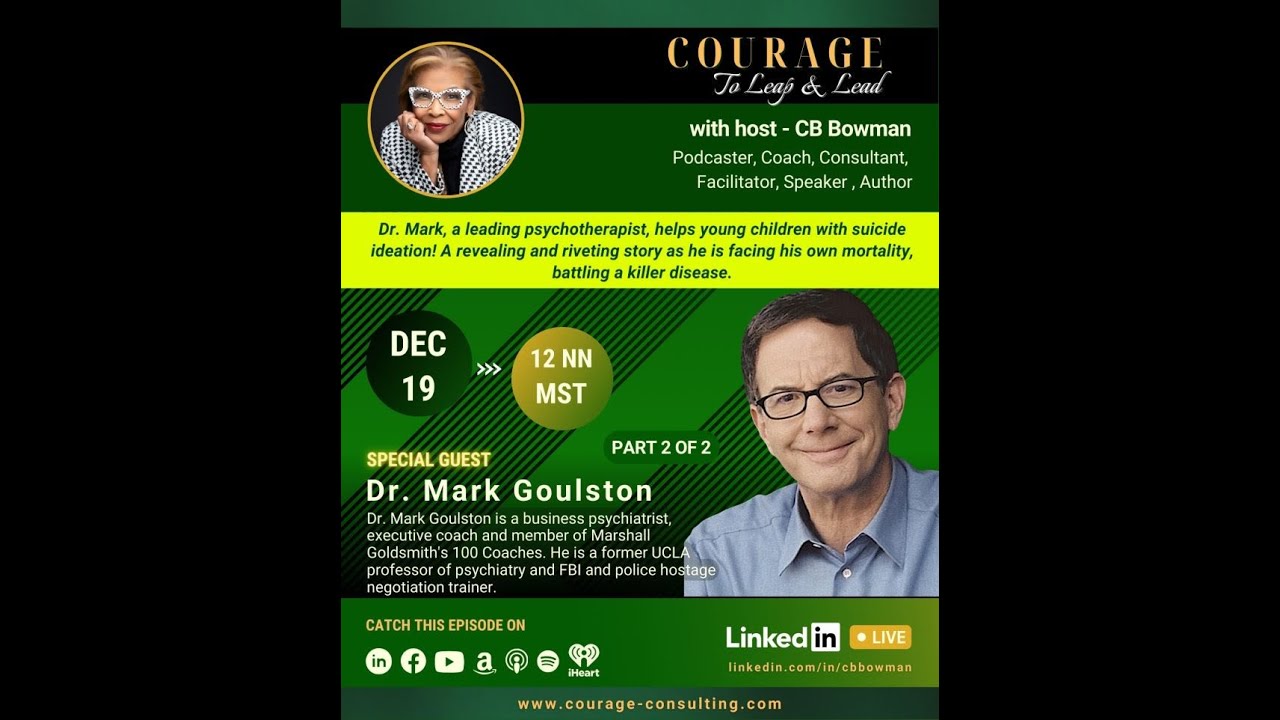
Dr. Mark Goulston explains why men avoid asking for help and how achievement addiction masks deeper needs. He describes the "7-Year Itch 2.0," where exhausted high-achieving mothers redirect frustration toward spouses, and offers concrete tactics: regular check-in dinners, power apologies, and structured dialogue to surface hurt and fear.
Chapters
You've got courage to leap, courage to lead.
Be brave and be bold. Let it roar.
Welcome to the Courage to Leap and Lead podcast, where each of our guests share the stories of courage that helped them become powerful leaders. Before we start today's show, please remember to visit courage-consulting.com. Where you can find all the episodes and other excellent resources, all at courage-consulting.com. Now, here's your host, Leadership Courage Coach CB Bowman.
And why do men not ask for help?
Because for men, what their value is seen more in their competence Whereas for women, their value is more often seen in their ability to connect to people. You know, I am competent, therefore I am worthwhile. You know, that's why a lot of men get so depressed when they get pushed out, because, you know, their whole identity is gone. And plus, you know, their career was their child. They didn't get close to their families emotionally because they were too busy being masters of the universe.
Mm-hmm.
And their families, you know, either resorted to drugs or alcohol, or they subbed in. If the families were healthy, okay, you know, dad's a workaholic, you know, let's find other friendships. Let's find other connections. Let's find dads of other of our friends, you know, who are more connected, and we'll go hang out with our friends' dads. Whereas for women, I think— go ahead.
Why do men not connect?
I think here's an interesting anecdote. I don't know if you know who Chip Conley is.
No.
You'll have to have— I'll have to introduce you to him. You know, he, you know, he's like a Seth Godin level of, you know, you know, A-lister. He founded something called Joie de Vivre Hotels. He sold to— and then he was one of the original people at Airbnb.
Oh.
You know, and he was an advisor. And but then what happened is he reached a point where he had all the money he needed. But 5 of his friends died by suicide. He reached a point where he was suicidal and depressed, so he pivoted to something called the Modern Elder Academy. And they have retreats for people, I don't know, 50 and up, I think in Baja California. And I think it's for people looking for more meaning. They were relatively successful, but, you know, they realize that success doesn't— does not make you a happy person. Wait, what's his name again? Chip Conley, C-O-N-L-E-Y. And I'll see if I can arrange an interview. And I had him on my podcast, and he was telling me that, you know, about how he was, he was down. And he, he got suicidal and he said, I was addicted to achievement.
Hmm.
And I, and I reached a point where it didn't make me happy. And I had security. I thought, as our friend Marshall Goldsmith would say, as he had ambition but not aspiration, I reached the point where I made the money that I thought would make me happy and it didn't.
Mm-hmm.
But I, I didn't know what else. And so he plummeted, and that's when he pivoted to this Modern Elder Academy, you know, for people who are looking for something similar to that. So I have him on the podcast and he, uh, and he talks about being addicted to achievement. And somewhere in the podcast I told him, I said, Chip, you may have the syndrome of disavowed yearning. And he said, what the heck is that? I said, you know, when we're, uh, before we're born, we're whole. Our wishes are, uh, is our mom's command. We're not hungry, we're not cold, and we're whole and we're omnipotent. We're masters of the universe. And then one of the reasons we cry so much when we're born is we go from masters of the universe to totally powerless. We scream, we cry. They don't know what— you know, they're changing our diaper when we're hungry. You know, they're feeding us when we need to get the poop out of our diaper, and we can't communicate this. And there's a desire in all of us, and it sometimes takes a lifetime, and we can talk about that another time. It sometimes takes a lifetime to feel whole again. Which has happened to me. It's taken my lifetime, and I feel completely whole. But that's another story. I don't know if we'll fit it into this. And, and I said, what usually happens is that ache to feel whole, and the world isn't, and our parents aren't connecting with us perfectly. If we disavow needing it, And pivot to achievement, especially if we're a boy. We get lots of pats on the head, uh, you know, and that feels pretty good, and all that accomplishment is pretty good, uh, but it doesn't take away the yearning to be whole. Now, women and girls—
Do you think that women don't have that yearning to be whole?
Oh, totally. But they have more of a capacity to communicate. They have more of a capacity to talk about stuff other than achievement.
Yeah. Yeah.
They have more, they have a more of a capacity to connect. Uh, although I'm worried with the current, you know, generations of women, I think, uh, I've seen women over the years who are high achievers, And and I drill down into people. What's going on? Well, I'm frustrated with this. Yeah, yeah, yeah. That's not it. What's going on? You know, I'm the co-founder of the Deeper Coaching Institute, and they talk about what they're frustrated about. I said, "No, no, that's not it." What's going on? And some of these women will look at me and they say, "I can't find my warmth or my patience." Really? Well, I drill, and they say I snap at my children, I yell at them to get ready, I snap at my husband. And I remember one woman said, you know, she was insightful enough, she said, just like a man doesn't feel like a man if he doesn't have courage, a woman doesn't feel like a woman if she doesn't have warmth. But I think a lot of women are kind of losing that because, you know, they're, they're working hard, they're juggling everything, they're losing their patience, they're losing their warmth. I just wrote an article in Newsweek magazine. We could go on for hours, by the way, in Newsweek magazine called The 7-Year Itch 2.0.
Mm-hmm.
Because I believe there's going to be an epidemic of divorces in young married couples with children. Because what's happened— happening is that a lot of young women who are working and getting exhausted are getting frustrated with those infants, but they can't yell at those infants because they'd be a bad mother. And they're thinking inside, just feed already, just get to sleep. But they don't yell at their kid, and they feel unconsciously ashamed of it. And what happens is hubby comes home like Bambi coming home from the forest, and, and they snap at their husband. They look for things that he's doing wrong so they can direct their anger at him away from the baby. What they need to do is bare their neck. which nobody's good at these days and say, I think I'm a terrible mother. I think it was a mistake. All I feel like doing is yelling at them when they don't sleep. And if they could take their husbands out of the crosshairs of blaming them, the husband would say, you're a wonderful mom. You're just a little tired. But people do, do not bare their neck. They bare their teeth. And so the 7, the 7-Year Itch 2.0, and you can look it up, Newsweek, Goulston's Seven Year Itch 2.0, which was a movie and a play in the 1950s. It's the famous movie where Marilyn Monroe's dress gets blown up, you know, in New York. And the Seven Year Itch used to refer to romance going away when you're married for 7 years. And I'm seeing it happen because what's happening Is— this is a tangent, but it's— I think it's a good one. Because what's happening is that women are just overwhelmed, and they're exhausted. And they're taking it out on their husbands, because they're looking for things he's doing wrong, so they can direct the anger at him and not at the baby. And what's happening is the husbands— and I'm seeing it, it's epidemic. We have grandchildren. I, you know, I go to the T-ball, I see the the wives snapping at the husbands, and the husbands are like, what? And what's happening is I believe that when they have children— so it's 7 years, if you're married and you're gonna have children, you know, that's a good chance you'll have a 4-year-old and a 2-year-old or something. And I believe what happens is husbands who, when they go on the road, are there with a an associate or a customer who looks at them adoringly the way their wife once did when they fell in love. And so on the road, they can do no wrong, and they're fantasizing or acting on it. And they come home, and then at about 7 years, they feel a bond to the children, because by that time the children are saying, Daddy, Daddy, Daddy. And they say to their spouse, You don't like me, I don't like you. We're not happy. You know, let's not make a mess of it for the kids. But we both deserve to be happy. Goodbye. And I feel for many of these working women, because if they're there with 2 kids, that's a lot of baggage to carry into another relationship. You know, it's—
So how can they use courage in something like this? I mean, do you tell your husband?
Oh, here. No, no, no. I have a solution. You got to go read the article. Yes. So cut. No. So courage is bearing your neck instead of your teeth. That takes courage. Takes no courage to snap at someone when what you're feeling is afraid inside that you're a terrible mother. But what Here's something else I suggest, which is another takeaway, I hope, from this interview. I believe that whenever we're reacting in a situation, there's close to 100% chance we'll make it worse. And so I coach all my clients, look for opportunities to be proactive, because when you're proactive, you can actually prevent things. So the advice in that article is, and by the way, you need to do this at business with your business partners and your executive team. So you schedule a dinner or a meeting with your spouse, you know, if it's really bad, every 2 weeks. So that's being proactive. And here's what you cover in that meeting with your spouse. If you don't look forward to seeing each other, you got a conflict. Because once upon a time, you look forward to seeing each other. This is also true with business partners and co-executives. You know, when you hire the person, you look forward to seeing them. If you don't look forward to seeing them and they don't look forward to seeing you, you got a, you got a conflict. So the whole purpose of that meeting is to air What is getting in the way of each person looking forward to seeing the other? One of the ground rules is if— is you try to be civil. But if someone gets a little bit agitated, one of the ground rules is if you're talking from anger, you have to keep talking until you're talking from the hurt and fear underneath it. So if one of the spouses gets really defensive, Keep talking, keep venting, get it off your chest. But you got to talk about the hurt and fear. What's the hurt? You know, I come home and I don't feel like you respect me or like me anymore. You know, and or I could— that could be what the husband might say. And the wife might say, well, you know, you come home and you're so sullen. You know, I say, what's going on? You say, I'm fine. You're not fine. And, and, and what I'm hurt and afraid of is we're just starting our life. And if we don't do something, we're going to get divorced. And I'm really afraid of it, because I come from a divorced home, and it messed all of us up. And so you keep talking until you talk from the hurt and fear. And then we do a Marshall Goldsmith thing. Going this going forward, you say to each other, "What do I need to do consistently, and what do I need to stop doing permanently that's observable that would cause you to look forward to seeing me again?" So you bring that out, and then you seal the dinner with an apology for something.
What do I stop doing? And then what?
What do I need to do consistently, positively, that's observable? And what do I need to stop doing that's negative permanently, that would hopefully get you to look forward to seeing me? And each person exchanges that. And And then, so that's a Marshall Goldsmith kind of thing, you know, sort of feed-forward coaching.
Mm-hmm.
And then what you do is you end the evening by looking into each other's eyes and you give each other a power apology. And the apology, you look them in the eyes and you say, I did this, or I failed to do this. I hurt you. I was wrong. You deserve better. I'm gonna fix that. And you each do that with each other, and then you seal it not with a kiss, but something better. You look into each other's eyes, because if you do this. CB, you're going to get rid of a lot of crap. And you look into each other's eyes and you tell them why you're still so glad you married them. And you tell them about something you appreciate that they've done. Then you schedule the next one. And then you check in. So how are we doing with the commitment to the positive and to stop the negative? And this may seem woo-woo, but you can do this with business partners. I'll tell you, I've seen a lot of small businesses fall apart because they were conflict avoidant and they were best friends who grew to hate each other. I've seen early-stage companies sell out to private equity because they didn't have the courage to deal with the conflict. And private equity would fire all the unnecessary people, keep the person who was kind of the keeper of the flame and the intellectual property. And then if that person didn't get on board, you know, making money and a return on investment, They give that person a second check and they get rid of him or her.
Mm-hmm.
So conflict avoidance is one of the— it's in the top 3 reasons that marriages, businesses, relationships with clients, it's one of the countries fail. And I have all kinds of tips for, uh, developing conflict mastery so that you can go from avoiding conflict to not seeking them out, but when they happen, chomping at the bit because you have a chance to demonstrate your mastery at conflict.
Wait a second, what are the other 2? Conflict avoidance, and what are the other 2?
Warren Bennis, I gave him a compliment. You know, he was one of my mentors and I gave him a compliment. This is a tangent, but I promise I'll reel it in. I gave him a tangent because he was sharing with me how he got a tribute for his 80th birthday and he leaned in and he said, usually I don't like when people make a fuss of me, He said, but Mark, I really liked it. And I said, Warren, something you don't understand. And he mentored Howard Schultz, David Gergen, and maybe Tom Peters. I mean, you know, he was the pioneer in leadership. Bill George, you know, Ken Blanchard. And I said, Warren, something you don't understand is The only thing people feel more than respect for you is love. And the reason they love you is something that I discovered in 2 minutes after I met you. People can trust you to never hurt them. And Howard Schultz, David Gergen, they don't trust anyone to never hurt them.
Mm-hmm.
And here's the tangent. Warren looks at me and he says, Mark, a lot of nice things being said about me, Mark. That's the 3rd best thing I've ever heard, and I can't remember 1 and 2. So I'll say conflict avoidance, and I can't remember 1 and 2.
Oh, okay. Well, when you remember, will you let me know so I can tell everybody?
Well, I think, uh, I think you, you— I think you can reach out to people you work with. I think you could do a survey and say, uh, um, how destructive to a business or business relationship or to your leadership is it when you handle conflict by either getting angry Or avoiding it. On a scale of one to ten, how destructive do you think that is? And unless they're out of touch, it's nine at least. What would you say? Would you agree with that? What would you say?
I'd probably go higher.
Yeah, CB saying Mark, Mark. You're being too kind. It's an 11.
At least. Okay, so let me ask you the $64,000 question. You're an expert in conflict. How many times have you been married?
Oh, I was married for a couple of years because we shouldn't have gotten married. Okay, so, so here's the— see, conflict was there. I couldn't deal with the conflict of living at home with my family, and she couldn't deal with the conflict of living with her family. So on paper, we both look pretty good for that summer.
Okay, that's marriage number 1.
45 years.
Marriage number 2 was 45 years.
And going and going strong.
So Denise is number 2.
Who is?
I mean, your current wife is number 2.
Yes, absolutely.
I'm thinking her name is Denise. What is her name?
Lisa.
Lisa. Lisa. Okay.
But I will share something that if I knew then, you know, we could have done a better job. And if you're listening to this, this is very important. Usually when a conflict brews up, there's often one person who tends to be the Overbearing one, the bully, and the other person tries to appease the bully. Calm down, it'll be okay. And so I'm directing this at the appeaser. You're gunny-sacking resentment. You don't think so, but every time you're appeasing the other person, you're building resentment.
So Yourself.
No, you're, you're developing resentment towards the person who's bullying you.
Right.
And, and that resentment, you run the risk of burning out on the marriage. And I'll tell you, it's also true in business, also true in executive teams. Every time that you, you are appeasing the bully, the raging narcissist, you're gunny-sacking resentment. You know, this hurt, fear, you know, I don't want to provoke him or her because they'll get even worse. So you try to calm it down, but it's going to, it's going to eat you up inside. I think Marshall even said this, you know, people leave jobs Because of bad bosses.
Oh, everybody says that.
Yeah. Yeah. And the point is, here's a little intervention, because I teach people about how do you deal with a difficult boss. So, and I, and I wrote a book called Talking to Crazy: How to Deal with the Irrational and Impossible People in Your Life. Here's the, here's a little tip on marketing. That's a pretty good title. Did okay. But it went viral in Russia because the Russian title was How to Talk to A-Holes. It went viral. I went to Moscow. I spoke with a— I was a lead speaker along with Daniel Kahneman, Nobel Prize winner. And I asked them, you know, why are you having me speak? I mean, he's a Nobel Prize winner. I'm a shrink from California. What's this? They said, His book did not go viral.
Boy, Russians take it straight to the point. Oh, they're—
and I'll tell you, and here's, here's my thing with dealing with big enterprises. So I, I come back and I said, hey, before it goes to paperback, Talking to Crazy, can we change the title to How to Talk to A-holes, and it's not a-holes, it's the real word. And they said, it's already in, it's already in the catalog. You know, we can't do that. We can't change everything. I said, you'll sell a lot of books. I should write another book, How to Talk to Corporate.
Yeah. Or just change the COVID on the existing book and republish it.
Yeah. No, no, I, I, I could do that. But here's a tip. Here's one of the ways to talk to— and it's in the book. You have an a-hole you're dealing with. So I'll give you a couple tips because those people drive us crazy. Also, here's a good way to take control of your life. Take out a sheet of paper on the left side and draw a line down the middle. And on the left side, write down all the people who who suck the life out of you, who just the sound of their name. And we're talking whiners and complainers too, not just yellers and screamers. And you write down their names. And on the right side, write down all the names of people who give you energy and lift you up. Because one of the biggest mistakes we make is we fail to thank the people on the right side because we get consumed with dealing with the people on the left side. Step 2, never expect the people on the left side to not be difficult.
Mm-hmm.
Now, if you have a conversation and they're not difficult, it's gravy. But never expect them not to. And hold a little bit of yourself back, because if you don't hold a little bit of yourself back when they do that, And they yell at you or they whine or they complain. Here's a little bit of my neurology background. They trigger an amygdala hijack, meaning they trigger a part of your brain to hijack, literally hijack blood flow from your thinking brain to your lower brain, you know, fight, flight, or freeze.
Okay.
And that's called an amygdala hijack. So always expect them to trigger it. But because you're expecting it, hold a little bit of yourself back. Let them say whatever they say. And they're using it, by the way, to manipulate you.
Mm-hmm.
To get their way or whatever. So here's one tip you can say after they do it. Pause, look them straight in the eye. Pause for three seconds. They're gonna get nervous because they're trying to provoke you didn't work, and they're gonna go, "What?" And then you look them straight in your eye, and there's a variety of things you can say. Can you say that to me again in a calmer voice? Because I hate to say it, the way you said it to me, it just reminded me of my uncle. so-and-so and Aunt— oh, they were, they were a real pain in the rear to the whole family. I mean, we, we couldn't stand— so could you run that by me, uh, in a, in a calmer voice? Because I think it was important and I wasn't able to listen to it because you reminded me of Uncle Joe or Aunt Betty. So would you do me a favor and do that? Because I don't want to miss it.
What's the second one?
Well, here's the second one. When you're trying to flip it—
So first is saying to them, can you repeat it in a calmer voice?
Yeah. Can you repeat it in a— could you please repeat it in a calmer voice? Because you reminded me of people from my past, and I spent my whole childhood trying to get away from them. And then they may get offended by that, but then you say, Please do that because I think there was important, something important that you wanted to tell me. And if I, and I couldn't listen to it, and I don't, I, I don't wanna leave missing out on that important thing was.
Mm-hmm.
So here's another approach with someone who's the, uh, the arrogant, condescending person. Uh, because a lot of times, I don't wanna get into politics, But a lot of times, arrogant, narcissistic people, you can disarm them with a compliment. Do you know how smart and wonderful you are? And so, and so one of the ways, one of the ways you can approach one of those people is you let them finish talking and identify something that they're really smart at. And what you say, and you bring it out specifically, do you know how brilliant you are with this ability you have, this thing that you do? And they're gonna go, what, me? Who, me? You know? I mean, you're so brilliant in it, I, I would say that you're gifted.
Oh, wow. Wow.
They go like this. You could say— and then you say, there's something I call the wince confrontation. And the wince confrontation is you wince, like to say, and it pains me to say the following. And you say, And I get feisty with people and I say, and it pains me to say the following. If that's a gift, it's almost the God-given gift. And you owe it to that gift to eliminate any and everything that distracts from people appreciating it. Because if you distract from people appreciating it, they're not going to be able to see how really brilliant and gifted you are.
Is this all in a book, Mark?
I think it's in Talking to Crazy.
Because we have a few minutes left, and I want to talk about, like, how many books have you published?
I've authored or co-authored 10 books. 500,000 copies. But you know, I'm an idiot. I'm the only person I know that has written or co-authored 10 books and created no courses.
What he's saying is we belong to a group that everybody creates a course from their books.
Well, that's funny. But what the point is, that's not my skill set. And there's lots of people. And look, I've never focused on money ever. I've never— and I'm going through something in which I'm discovering that a lot of the people, a lot of people in the world seem to care about me. And I think part of it is I've never hit on people for anything. I had 8 mentors, Larry King, Warren Bennis. I never asked any of them for anything. Just the gift of their time, and everybody hit on them for something.
Mm-hmm.
And so anyway, but that's another story. But, you know, look, I'll share something with you, but your listeners won't get it, but you'll get it. Win, lose, or die, I'm good to go.
Oh, you know, Mark, it's been such a pleasure talking to you. I love your stories, and I hope that you record them into a box to be with us forever.
Ooh, that's enough to make a grown man cry.
Love you, Mark. Thank you so much for being here. I really appreciate you.
Yeah, I love you. Love you more.
Oh, gosh. All right, audience, you've heard the fascinating Mark. He's just like— he's a genius. He really is a genius. And if you saw me going like this, I was just absorbing what he was saying. And to prove it, I've got all my notes here. I could listen to you all day. Thank you so much again for being here and sharing your wisdom.
Well, thank you for having me. It's a real privilege and honor. And, and Seth Godin, take that.
Send him a copy of this. Have you met him in person?
He wrote a blurb on one of my books.
Oh, dear. Okay, it's on. It's on, as they say.
No. Well, we'll talk after we finish this about something.
Okay. Well, audience, Sorry you won't be able to hear, you know. But if Mark has time, we will have him back to tell more stories and give us more great advice about how to deal with— I'll just say the American version— crazies. Thank you for tuning in. Thank you so much, Mark. Thank you.
More from CB



211- Courage to Leap & Lead with Louise Story part 1Courage to Leap & Lead







