Courage to Leap & Lead with Dr. Asha Rani, Episode 130
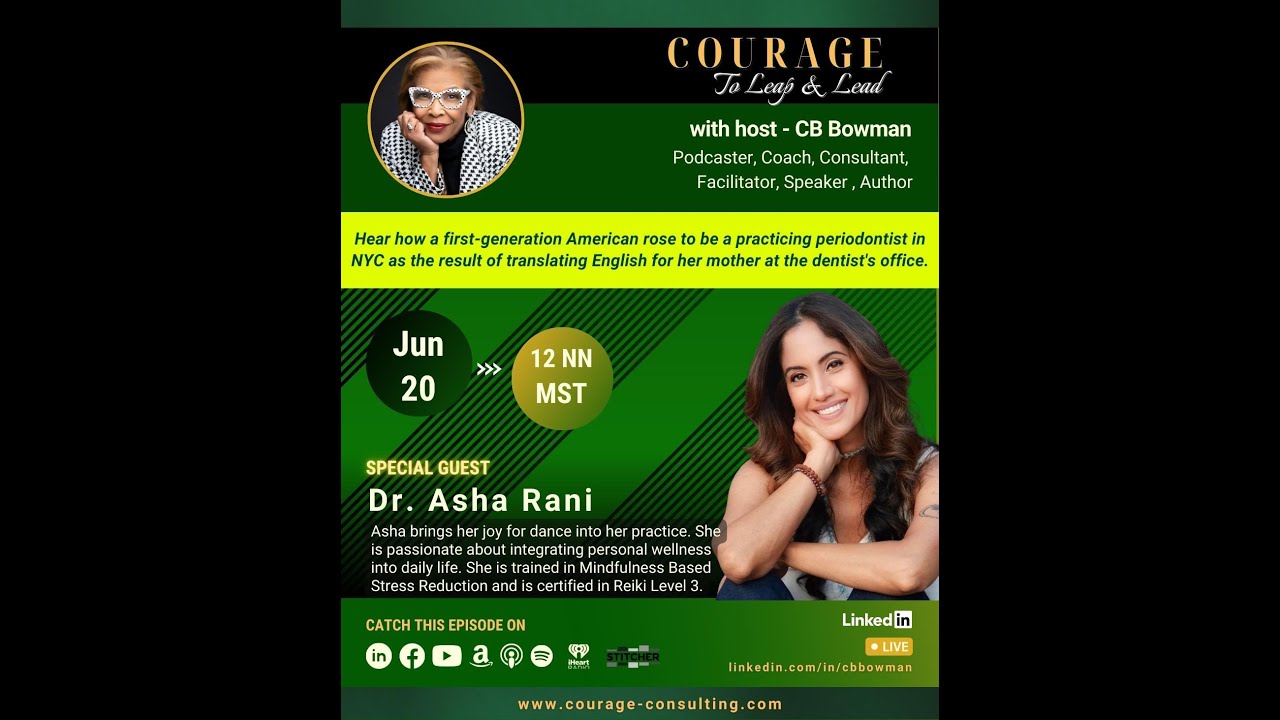
Dr. Asha Rani, a periodontist and author, grew up in NYC housing projects as the child of Indian immigrants. She rejected the expected path of buying a dental practice, went through a divorce she reframed as growth, and wrote Who Is She? to help others break free from gendered expectations and prescribed roles.
Chapters
You've got courage to leap, courage to lead.
Be brave and be bold. Oh, oh, oh, oh, oh, oh. Let it roar.
Welcome to the Courage to Leap and Lead podcast, where each of our guests share the stories of courage that helped them become powerful leaders. Before we start today's show, please remember to visit courageconsulting.com where you can find all of the episodes and lots of other excellent resources. That's courageconsulting.com. Now, here's your host, Leadership Courage Coach CB Bowman.
Hello, ladies and gentlemen. Oops, I've got to straighten out my little scarf there. How are you? This is CB Live. You know, today I've done 3 interviews in a row, and that's because when I'm away in Italy, hmm, you won't miss me at all. We'll be running the show. Isn't that cool? You gotta love technology. At any rate, this is CB Bowman.
Hi.
Courage to Leap and Lead. And we have another awesome guest today who's actually a podiatrist?
No, periodontist. Oh, it's another end of the body.
It's another part of the body. Oh my goodness. Okay, I've got to get all my Ps straight. Well, you guys know I'm dyslexic, so P is a P is a P, right? Yeah, well, at any rate, we're going to speak to Ayesha—
Asha. Asha Rani.
Asha Rani.
So that everybody knows, Asha means hope, so you won't forget that. Ah, I love it.
And what does your last name mean?
Queen. So in Hindi, Asha Rani, it's, it's, uh, both are Hindi, uh, words, names. So it means hope and queen. So there we go.
We're gonna be talking to the queen of hope today. Okay.
Yeah.
Welcome. Welcome.
Thank you.
So tell us about— first of all, we met because she has a coach.
Yes.
That has worked with her, who is a great person. And I said, hey, I would love to interview some of the people that you work with. It's a presentation kind of speech, uh, coach who does some wonderful things, and this is the result. Okay, so tell us about your experience growing up, but first tell us about your coach.
Oh, Tricia Brooks. She is amazing. Um, I met her several months ago, and I was in a place now in my life where there's a lot to talk about, so many stories to share, um, and trying to figure out a platform and how to get my word out and how to, um, share stories. So she has helped me in putting together, um, a better way to express what I want to say and to the most people effectively.
Fantastic. So you're my first guest from her cohort. So I, I wanna know all the secrets that she has given you.
I'm learning still.
Well, Tricia is a wonderful person. If you're looking for somebody who can help you focus in on what you wanna speak about and how you want to present it, reach out to me and I'll, as the children say, I'll hook you up. Okay. Tell us about you. Where did you grow up? And let me turn this off. Audience, as you know, um, we are live, and so life happens. So tell us about you and how you grew up, where you grew up. Tell us about that.
Okay. So I was born and raised in New York City. on the Upper East Side of Manhattan in lower-income housing, also known as the projects. And I come from an Indian background. So my parents came from India in the '70s. So, you know, this is a story of a little Indian girl being raised in the projects, and it's a very unique experience, I have to say. There is nothing like it. And it molds you, and it gives you a new perspective on so many things. So I'm grateful. You know, while you're in, uh, that type of environment, there are many times where you may not be so grateful.
Yes.
Um, but yeah, so my parents, they still live there because they call it home and they love it. So I go back often. So it's very humbling. to walk through those hallways that I was raised in.
You know, I grew up in the projects too, so I know exactly what you're talking about. Isn't it funny how when we grew up, they seemed so big and audacious, and now we go back and we go, yeah, okay, I was raised in this small space? Yeah.
And it's, but you know, it makes you appreciate so much So I'm, I'm really grateful. And, you know, I have 3 kids and we go back to visit my parents often. So they get to see where mom grew up and they— their childhood is also in that because they go see my parents often. So they're getting to see a lot of the world that many people don't.
It's a good thing. That is really a good thing. You know, I drive by there now because for me it was on the Lower East Side, the Upper East Side. And I just say, God, living in Colorado now where you see the mountains today— yesterday we had 6 inches of snow. The day before it was 60 degrees. It's so different. And you never thought back then that you would experience such a difference in the world, right? That you have a chance to travel to other countries and say, Wow, what a difference. Yeah.
Right. Sometimes we, we spend a lot of time trying to travel to other countries. And there's so much within this country, so much within these, the state, so much within a few blocks that we've never experienced. So there's always something new right around the corner.
Yeah, you really feel for people who stay in within their cocoon and don't have a chance to experience all because You know, I can understand wanting to be in your cocoon, but what richness you can bring into that cocoon if you have a chance to experience different culture, different life, different— just different way of being yourself.
Right. It's like eating the same food every day, you know, after a while, even if, even if it's your favorite.
Yeah.
Okay, let me try something else.
Exactly, exactly. So, okay. How did you get from there to where you are now? By the way, what did your parents do?
So my dad, as— this is amazing— was the only Indian man working in the Irish Mission to the United Nations. So, you know, we can call it luck, we can call it whatever, but it was his fate. So he worked for the Irish Mission, and he worked very closely with a lot of the diplomats. Coming from a really poor Indian background where when his first job in the United States was washing dishes, and all of a sudden now he's wearing a suit and walking into an office. That's a story. So that's what my dad did.
How did he get from one place to the other? I think I have to interview him.
Yeah, you know, he, you know, he had a family member that said, hey, I think there's a position open, you know, not thinking logistically that he probably will not get the job because he's not Irish. You know, something clicked. You know, when there's magic, there's magic. And that followed my dad. And so he worked there for 35 years until he retired.
Wow. How awesome is that? I bet he has some great stories to tell.
Oh, so many. So many. He even met Christopher Reeve.
No.
Yes. So my dad has a lot of stories because he met a lot of amazing people. He was in the bathroom. I mean, this is about my dad, but it's— I have to share this. He was in the bathroom using the urinal alongside Bill Clinton, President Bill Clinton. He was walking into the bathroom and Secret Service did not know there was already somebody in the bathroom. They thought it was all clear. They let President Clinton go in and all of a sudden my dad's looking over like, oh my God, like, who am I standing next to? So yeah, amazing.
I have some questions to ask your dad. Yeah.
Yeah.
So I miss that.
Amazing. So yeah, so I, you know, I studied dentistry mostly because of my mom. Oh, because she had a lot of dental issues. But her English was not so great back then. So she used me as a translator. So I would go with her often to her dental appointments. And I was a middle person. So as a young teenager, I was exposed you know, to a lot of dentistry. And to me, it was like art, watching them work with their hands and watching them speak with patients and wanting to help. So that's what catapulted me to this career.
So I have to ask you, back then, because I see it now with young children, young Latin children who have to translate for their parents, they seem so annoyed at the process. They're like, Really? Do I have to? How did you feel when you did that?
You know, honestly, as I'm sure you know, when you grow up in a different time, you know, you never show annoyance to your parents. Like, we did not get raised like that. There is no attitude to be shown.
Because otherwise you saw the back of your head. Boom.
Yeah. I mean, your parents tell you to do something, you do it.
So Yeah, you don't look that old, to be right back. I was.
Yeah, so when she said, come with me, my answer was yes. There was no reason for me to show any other, you know, emotion. But honestly, it didn't— it, it did not bother me. And I, I think it's because I could see the struggle for her to really get her point across, so I wanted to help her. You know, that was, um, it wasn't something that was a chore. And, um, you know, I really watched them adjust the best that they could coming from another country. And I watched people also treat them not so well. So seeing that, I knew that there were— that if I could help her in any way, even as a child, I would do it.
Were you born here or there?
I was born here.
And you had such respect for your parents for their traveling here. Why is that? How did they— how did they instill in you the courage they had to pick up and come to a different country?
I do think it's a generational thing because first of all, Your world is the only thing you see is the school and your home. We did not have social media. We were not interacting with the outside world in the way the kids are doing now. So that world was, was, was the only thing we knew. So you wanted to hold on to it. You know, the only thing I saw was my parents working hard, coming home, providing food, providing shelter, but providing a lot of love.
Mm-hmm.
And I didn't see anything different because I wasn't exposed to other things, um, on social media. TV was watching cartoons. It was so simple back then. So, you know, and we would talk. I would see, you know, their experiences. I would go with my dad to work when we were off from school. So I was, I was privy to the world that they were in, and I could see them as human beings sometimes, not just mom and dad, and just watch their interactions, watch where they felt uncomfortable in certain situations. So I, I gained that level of appreciation for them because I knew, yes, I'm speaking English without an accent, and yes, people may not know that I'm Indian. You know, I look a little different, but you know, I, I often got a pass. Meanwhile, my parents, who, you know, you can from the first moment they say anything, you know, there's a different struggle there. So I knew I didn't want them to keep feeling that because you can feel when it doesn't feel good.
You know, it's very interesting that you said this because I remember— I'm trying to remember the name of the store. It was a very high-level retail store. Let's say for the sake of it, it was Hermès, right? And my mom loved their clothes. And she would say— one time she's— I said, well, Mom, why don't you just go and buy more clothes there? And she said to me, I don't feel comfortable going in that store. And I looked at her like she was crazy. I said, what are you talking about? Because I was raised here like you. And she said, I I said, hey, one second, Mom. You work for your money. They are working for their money. It's no different.
Right.
You deserve to go in that store like any other person.
Totally.
And she just looked at me. And now I get. I get it now. To me back then, I was like, what are you talking about?
You know, but what's amazing with that is, you know, you correlate— your mom is from where? What background?
Here, from the United States.
Yes. And she found— so, so this is what I was gonna say.
But she's a Black woman. She was a Black woman. Right.
So there's always, um, something that you feel internally like I'm not, I'm not allowed to. Right?
Yes.
And I felt the same way, probably not too long ago, you know, where being raised in the projects, you feel like you're not worthy of certain things as other people, you know. So that took a lot of deconditioning and deprogramming of what worthiness means to say, no, I have a I make money. I can walk into that store and buy that purse because, like anybody else, because I earned it.
Exactly.
But that took a long time for me to get there.
Yeah. Yeah. I, you know, I never had the feeling until she said that to me. And then I started to watch other people when I walked in the store.
Right.
And it clicked. Right. But before that, because they raised us without looking at skin color, then when it became time for me to look at skin color, I thought, what the hell is going on, right? Let me move to Italy or someplace.
Let me get out of here.
And now, you know, my husband is Italian, and we go in stores, and I just have— we went to Where we live, a new golf course opened, much, much more expensive than the old golf course, and I wanted to see what it was like. So I went in, and the guy was on the phone, and he said, I'm gonna be a long time on this call. I said, no problem. I just came to check it out. My husband walks in. He hung up that phone so fast it wasn't even funny. Uh, can I help you, sir? And he said, no, I just— my wife wanted to come in. And he looked, he said, oh, miss, let me help you. I, I just said, when will this ever stop? When will it ever stop?
You don't even realize, um, these experiences that you walk into that take you back to that little child again.
Exactly. Exactly. So I feel so bad for people that when they come into adulthood, they don't know how or what to do about situations like this.
Right.
And I've seen so much of it. Now I'm at the point where I get enjoyment out of calling somebody out about it. I'll turn around and I'll say, Oh, so you're impressed by my husband, huh? I'll say it with a smile and a friend, and I watch the redness, you know, come over people. I'll be back next time without my husband. Maybe you can help me.
Yeah, you know, it's funny. I had a similar experience where when I was moving into the development that I live in now, there's like houses— there's 165 houses in this development. development. And when we were looking to buy, you know, we did this little tour on our own, and there was a clubhouse with a pool. So I was kind of peeking through, you know, just to see what was going on. And a woman who lived in the community said, hey, are you looking to move in here? And I said, oh yeah, I was just taking a look at the pool. And so she just proceeded to describe the neighborhood and describe the different ethnic groups that live there. And then she went on to say, she goes, yeah, a few blocks away, they're the projects, but it's a few blocks, it's down that way. And I looked at her.
Hey, girl.
You don't even know who you're talking to. You know, years later, as we became more friendly, I said, hey, FYI, that conversation, you know, it's, it's You don't even know what you're saying sometimes, because for many people— I mean, for some people, it's really just not an awareness.
Yes.
You know, um, and then I think it's for us on the receiving end, it's a matter of deciphering. Maybe this is a good time for me to just very gently educate a little bit.
You know, it's— I love that you said that, because You have to consider where it comes from, right?
Right.
When I bought my second house, it was in New Jersey, and I remember the woman across the street and her husband were Italian. Hold on one second. It's my neighbor, guys. Oh, my husband is getting it. And she was watching me out the window. And then finally she came over and said, hi, my name is Rosie, and we became really solid friends, right? But I remember going to her house, and you know, Italians, you all sit around the kitchen table all the time, regardless, right? And so she said to me, she had made me some tea, and her sister was there, and her other sister were there, and everything.
Ah!
And so, um, my neighbor just came in, guys. And so I was sitting there one day and we were having lunch because we made a habit of having lunch on Saturdays, right? And I looked up above her stove, above the kitchen sink, and there was a cabinet above that, and I see this little black Aunt Jemima.
Hmm.
I thought, holy crap, what do I say or what do I do? And you know, I chose not to say anything, but it's still in my mind because this woman was in her 70s, an Italian, and to her it was just a statue to— about cooking. Because she loved cooking. So you kind of have to, you know, decide who were you talking to and why and what's their background and what, you know, you have to quickly assess the entire situation. Right.
Because none of it is black and white.
None of it. And if I said something to her, she would have been so mortified. Because in her heart, that's not where she was coming from. Right? Right. So, you know, now tell, tell me about some of the things in your life that you considered as failure and you were able to flip it into success. Let's start with business.
So, well, I will say is, you know, as a dentist, you are pretty much ingrained to Finish dental school and then do residency and then buy your own practice. Be a business owner. Like, it's just a standard to be a business owner, um, as a dentist.
I did not know that.
I did not.
Yeah.
And I was saying to myself the other day, why are there so many business practices? Unlike going to corporate America, you know?
Yeah, right. I mean, there are certain areas like that in dentistry too, but, you know, be a business owner. And I studied periodontics, which is gum surgery and implants, which, you know, I enjoy the hands-on work. And then when it came time to the point where I was almost being given a practice to buy, my heart wasn't in it. And it was so out of the norm and out of the box. And everyone was saying, but this is how you do it. You had to make your own money. Don't work for anyone. And I said, but that's not my joy. So as everyone else was kind of looking at me as, this is a big missed opportunity for you, for your career, and for your financial gain.
Mm-hmm.
Which could have been perceived as a failure. I said, well, I can still be the owner of my business, I just don't have to actually run a practice. And so I decided to follow my heart. And I said, I'm not going to buy a practice, I just want to go into an office do what I enjoy doing, and then leave. But in that, I have learned how to be the boss without being the boss. You know what I mean? So there's a staff of people.
Yeah.
There's a staff of people that you have to work with, that even though you're not the one giving them the paycheck, they respect you, and they trust you, and they listen to what you tell them to do for the sake of the practice, for the sake of the business. So I have that full authority without having to do what I don't want to do. So for me, which in some people's eyes could be, she missed the mark in not buying her own practice, for me, it's like victory, because I get to do what I want to do. And I don't—
in essence, you were ahead of the game because now you see all these practices merging to each other, uh, in the medical field, in the dental field. It's like, you know, a magnet is drawing people together because the expense versus the insurance return is outrageous. And now you see even Franchise dentistry, right? Cousin owns like 4 of them, right? She's Aspen. But I, I get it. I get it.
Yeah. So I have the luxury of leaving work and not having to think about one thing about work, which is what I always wanted. I said, I enjoy, I enjoy what I do, but it's not my whole living. I didn't want to go home and live and breathe dentistry. That is not me. Um, so for me, um, whatever some may think is a failure, and it's a personal decision, for me it was a success.
I think it took tremendous courage, more than what you realize. It took tremendous courage from this perspective, if I may. You come from a minority background. You fought your way up to be a success in the dentistry field and then made a decision not to go with the flow, to go against the flow. But your decision to go against the flow actually started when you were a young kid.
Mm-hmm.
And then you just kept doing it and you made it so that you're happy in a holistic life. And that took a lot of courage. Bravo to you. Thank you.
The way you just summed that up, I'm like, wow, she is on point.
Yes.
Because, you know, it's funny that you said that, because at one point, well, for much of my young, young years, I wanted to be a doctor. It wasn't until high school when I started going with my mom to her appointments, That I realized my joy is helping people, that compassionate part, whichever way I can do it. And then as a teenager, I started to think about the life of a doctor and the life of a dentist. And I said, I don't want to be stuck at work. I don't want to be doing calls. I don't want to be stuck in the hospital all weekend. What teenager is thinking like that? I don't know, but I was.
It's amazing.
And that's when I said, no, I love medicine, but I don't love that part of it. So I'm not going to do it.
I think that's what my cousin finally decided. She was a dentist, had her own practice, and then decided to buy into this group. And it was very successful for her, this franchise group. And she raised her daughter, and her daughter has done the same thing. So between them, they actually own franchises of dentistry throughout Michigan.
Amazing.
And, you know, you've got to say, that took guts. It took guts to do what you did. And what I love is, as a woman, you made these wise decisions.
Right. Somebody was, was guiding me at the right time.
What does your husband do?
He was a neurologist.
A neurologist. Okay. So that's even more spectacular because somebody would say, okay, you've got a dentist, you've got a neurologist, they're going to both own their practice. I mean, it's just, it gets out of hand. The competition to do what somebody thinks you should do is so out of control in this country.
Right, right. And what I will say, you know, as a female, kudos to every woman that makes a decision that's authentic to them, whether it be— whether it's being the business owner who's running a staff of 20, 30, 50 people, Kudos to you if that's what you want to do, because you're working for it, right? And then to every woman that decides that they want a little bit of a career and then time for other things, whether it's children or personal ambitions or hobbies, whatever it is, but it's choosing something that you know is beyond, um, the checklist of life.
Yes.
You're supposed to be doing according to the standards of what everybody else thinks is successful. Like, enough of that.
Love it.
In the garbage. Enough of that.
Yes.
You know, we did that for a lot of our lives. We've seen our parents do it for a lot of their lives. Times have changed, um, and we need to give ourselves permission to step out of the box.
Absolutely. I love that. And so tell me, in your personal life— well, you actually did tell me in your personal life— but is there a single moment in your personal life that you felt that you flipped failure into success?
So what I will say on a personal level, um, I did recently go through a divorce. You know, that decision, um, was huge only because of what I just said about the checklist of life.
Yeah.
Um, what's considered a failure, like ending a marriage in society is generally considered a failure.
Yeah.
at least it's unspoken or spoken or whatever it is. And especially, it's really hard to allow change when we correlate the amount of time we invest into something. So, you know, a relationship of 25 years is not easy to say goodbye to. But it was something that I had to really dig deep and understand that the love that I have for myself has to be greater than my fear of judgment and my fear of change. And I should allow myself the opportunity to choose my happiness, especially as a female where we put everybody else first, you know, as a mother, as a wife, as a daughter. And so it took a while for me to get to that point where I knew that now is the time where I am in a better place within myself that this— I matter more than what everybody else thinks.
So beautiful. Wow.
So, and especially as the mother of 3 children, that's not a decision you take lightly.
How old are your children?
So they're teenagers. The 3 of them are teenagers. So, you know what, I don't look at it as a failure. I look at it as a journey that I had in time with a wonderful human being. We learned and we, you know, we grew, and then sometimes you outgrow.
Yes.
But you can easily— you can peacefully move forward and co-parent and honor each other with respect. Um, so that's where I am now. So I'm past the, um, that, that checklist where, you know, being married and having the career and having all of this is success. Being happy is where I, where I'm at. You know, and it's, and it's not, um, it's not a, I'm happy. It's, I'm, I'm living more authentically to what feels in alignment with me.
I love that. I know that you're a coach now. What are you coaching on? And it just—
I'm not a coach. Maybe one day I will be. Now that you said that, maybe one day I will be.
Oh, you know, they call me the good witch. I see things in people. So, Sorry, that slipped.
Yeah, you know, who knows, maybe one day. And it's been happening ever since. So I did write a book about all of this, and it's like a self-help memoir. And so many women have reached out to me, and even men, that thank you for sharing that, because there's so many things we don't discuss, so many things that happen so routinely and commonly in our life, but we're so afraid to share it. So then you think you're alone. So that's what I'm—
what's your book called?
It's called Who Is She? The Journey Beyond Being a Mother, Wife, and Daughter.
Do you have a copy to show?
To show? I will, uh, I could put it on my phone or you can see it on my screen, but, um—
Oh my gosh, we've— I, I think I have to pick up where Tricia left off coaching you.
Yeah, you know, and there is so much more that we, um, have to experience in life and Being a mother and all those roles is great, but who are we? You know, this is—
that's the COVID What a fabulous cover.
Yeah, thank you. So—
Oh my, how many pages is it?
Oh, it's really short. It's 133 pages. You can, you can read it in one sitting if you want to.
That's not short these days. That's a good length.
Yeah, so You know, I've had so many women share with me that, oh my God, I experienced a lot of what you did. Because I share a lot of things. I'm not just talking about my partnership in there. I'm talking about childhood stories. I'm talking about, um, being raised as an immigrant child. There's so many little facets that anyone can relate to anything. But sometimes we just need to say, hey, you're not the only one. Like, you're not alone.
I love the idea of you being a coach. Oh, just saying.
Thank you. From your lips to God's ears.
We can make that happen very easily.
We'll make it happen. Yeah.
I would love an autographed copy of your book, young lady.
Oh, that'd be an honor. You know, I, I recently gave a talk, um, the gist of what was in my book, and it was at an event. And when I got on stage, I thought that of course the women in the room are going to resonate with what I'm saying. What shocked me was the reaction of the men. The men in the audience were crying. And that to me was like, wow, this is more bigger than I thought. So as human beings, we need to give each other the grace to allow ourselves to live the life we want, free of guilt, free of judgment.
You know, we need to give men space.
Yeah, human beings. Yes, it's okay to cry. It's okay to share your feelings. You know, in the same way we discussed how women are raised a certain way, men are raised a certain way too.
Totally agree. Totally agree.
Yeah, so it's a matter of unlearning a lot of the things that we're supposed to think we're being—
you know, that we're supposed to fit into the mold. That mold needs to be smashed.
Done.
And I know, remember the old, old Apple commercial where they come with a sledgehammer?
Yes.
That's what we need to do to all these concepts.
Yes.
That we have. It's, it's enough already. You know, this is why men are having heart attacks at such an early age. And so often they keep it inside. And I, you know, I say to my husband, okay, enough with this nonsense. Because then you blow up and nobody knows what the heck you're talking about, you know. And, and it's— I could go on forever. I truly believe that women should allow men the space to cry and to express their emotion. And I think, quite frankly, they make better husbands, you know.
But, but you know, it starts with, with, with the parents at home when you're raising them, right? You can't expect the man who's married now To behave a certain way when growing up his mom and dad didn't allow that, or didn't—
Tradition. And yeah, yeah, yeah, I totally agree with you. Hey, we're gonna have to continue this conversation. I love it. I want a copy of your book. Thank you, CB. That's how I rope all my guests in. Well, I mean, I have to have an autographed copy of your book.
Yes. Definitely.
It's been a pleasure. I really think that coaching is your calling in addition to the work that you're doing. And I'm gonna hook you up to ask you a couple of questions about my implant, right? And why it didn't work.
Yes. Anytime.
Okay. Audience, this has been such a fun, fun episode of Courage to Leap and Lead. Please take some lessons learned from our special guest. Be what you need to be to be happy for yourself first.
Yes.
Crucial. Crucial. We'll see you next week. Thank you so much for being part of our community and sharing your thoughts. I love you. Thank you for having me. Thank you.
More from CB



211- Courage to Leap & Lead with Louise Story part 1Courage to Leap & Lead







