Courage to Leap & Lead with Greg Williams, Episode 133 - part 1
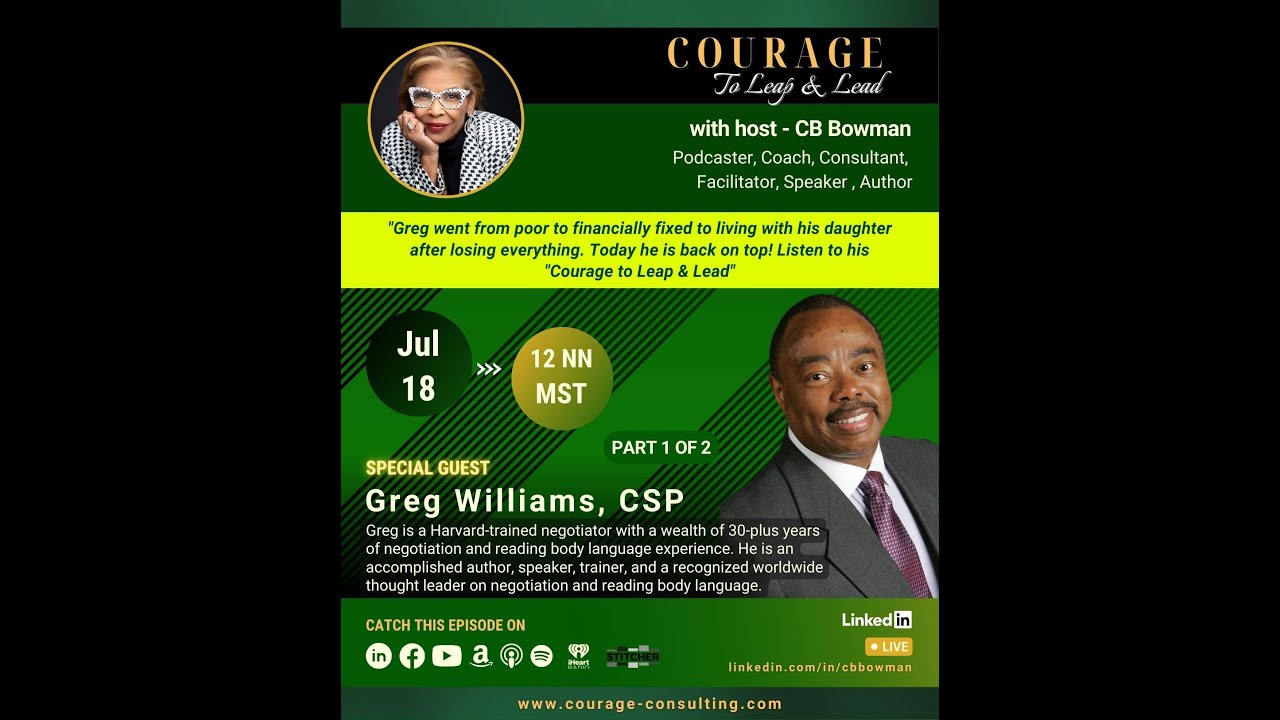
Greg Williams, a negotiation and body-language expert, started reading people at age four shining shoes. He built a career in TV news and politics, but spreading too thin led to business collapse and rock bottom. He found his way back through faith, learning that courage means rising after every fall.
Chapters
You've got courage to leap, courage to lead. Be brave and be bold.
Wow!
Let it roar.
Welcome to the Courage to Leap and Lead podcast, where each of our guests share the stories of courage that helped them become powerful leaders. Before we start today's show, please remember to visit courage-consulting.com. Where you can find all the episodes and other excellent resources, all at courage-consulting.com. Now here's your host, Leadership Courage Coach CB Bowman.
Hello everybody, it's your favorite, favorite person. Of course, it's CB Bowman, and we are here to talk about courage, our I'm so glad you're here today. You know, yesterday in Colorado where I am, we had 6 inches of snow. The day before, it was 60 degrees. Can you believe it? As they say, it's Colorado. Well, today we have a guest who I know through MG100. Gosh, we have a Most fantastic people in that group. His name is Greg Williams, and his specialty is— he is the master negotiator. He's incredibly successful, and he also works as a body language expert. So sit up straight when you're talking to this guy, right? He may call you out. So You know, when I read his background, I thought, here, this man is a person of color who's extremely successful. I want to know if he's dealt with any failure in his life, because people will look at somebody as successful as this and say, haha, yeah, he had it easy. Now, you know, this show is about telling the truth. And so I invited Greg on and I said, Greg, can you tell us, how did you get to where you are today? So let's start with the beginning. Greg, welcome.
Thank you, CB. And when you said, hello, this is your favorite person, I said to myself, now how does she know that about me? But anyway, I'm joking, of course. Oh, CB, thank you for inviting me to be with you today. And I'll tell you, um, I started my trip through life from a very early age. And when I was 4, 4 years old, my parents allowed me to shine shoes outside of the corner bar. And back when I was 4 years old, people didn't have to worry about things, about their kids being snatched or things of that nature.
Mm-hmm.
But I speak of that because it set the foundation for me being able to not only understand the mannerisms that people projected when they were in certain mindsets. But it also started teaching me a lot about negotiations and courage. And courage along with failure. Failure from the perspective of I observed if I asked somebody if they wanted to shine and I didn't smile in a particular manner that they'd say no. And later I'd ask the same person as they were exiting the bar if they wanted to shine now. I had observed also at that point, their whole mannerisms had shifted. And it taught me a lesson about being very attuned to the moods of individuals as you approach them. And I'll talk more about my experiences as I went through life. But that's the start of my trip through life.
I love that start because I was going to ask you, tell us about you as a little boy. But first, I want to know, I want to know, Why you agreed to be on this show? You had no idea what I'm going to say or do.
You know, I truly— and some people say it's corny what I'm about to say, but I believe God has placed me on Earth to give of my knowledge, my experience, to benefit others to the degree that he would have me do so. And that's why I agreed to be on this show. I've had a vast amount of experiences throughout my lifetime. Good and bad.
Oh, okay. Yeah.
And if somebody can learn something from any insights I impart, by all means, I feel as though I'm serving my purpose in life.
That's so beautiful. Thank you. Thank you for being willing to share that, share your life with us. It's so important, you know. And I, I'm not quite sure I understood All of the hoopla about COVID and being alone and not being able to communicate with people. Now, I'm going to put the caveat on that. I'm highly introverted. So to me, COVID was just fine, right? But I know a lot of people, my comrades, who were total extroverts went bananas, right?
Right.
So I love the fact that you are willing to come and talk to people about you yourself, not about business. We all know that you're powerful. We all know that you're a huge success. But getting there, a whole nother animal, especially as a Black male.
Mm-hmm.
Right? So with gorgeous dimples, by the way. So, oh, my husband. Did he hear that?
Oh my goodness, you're going to make me blush.
I love it. I love it. So tell us, as a child, tell us about your parents.
My mother was a very strong Black woman.
Of course.
She taught me from a very early age to respect women. That was number one. And she really was the leader in the house. She's also the one that I obtained a lot of my formative negotiation strategies and tactics from.
Love it.
CB, we were poor. I mean, let's call it what it was. And as a result of that, I observed my mother and to a degree my grandmother, her mother, constantly asking people, well, can you do better on the price? Can you give me a little bit more, etc.? And I remember one time I said to my mother, and I must have been again about 4 years old, I said, Mom, that's embarrassing. You're always asking people if they can give you more, give you a better price. It's embarrassing. And she said, to the degree that you keep your money working for you, you'll have more of it. And the way to do that is to make it work harder. And I thought, okay, now at 4 years old, I kind of understood what she meant but didn't fully grasp it. Until I got older and started learning more about exactly how one can improve one's plight in life, not just with money, but by negotiating. Because we're constantly negotiating, negotiating for every aspect that we engage in in life.
My gosh, I'm speechless. It takes a lot to make me speechless. Here's why I'm speechless. Coming up, I'm like you. Anybody who negotiated for anything, it was something to be shameful.
Yes.
You know, as a Black person, I didn't want to ask for a discount because, you know, it would show that I couldn't afford it or I didn't know better. Or, you know, that old J.P. Morgan, if you have to ask the price, then you can't afford it, right?
Mm-hmm.
And so I grew up with that philosophy. And It was not supportive of me, right? As an adult, I had to learn how to ask for discounts. And, you know, it got better each year with age. But I would rather take it back and have it when I was younger.
Yeah.
I'd rather have the savvy that your mother gave you because now I know, I say to myself, How much money did you waste in your life by not asking for that discount? Mm-hmm. Mm-hmm. And my husband now, who is Italian— so you know, like The Godfather— he will ask me to go to the store to return something because inevitably I'll walk out the store with a free item. How you do that?
But you know, you hit upon a very important point that I wish to highlight, and that is we all— and I know we talk about courage, we're going to talk about courage and the depth, getting into a deeper depth of it in this conversation— but sometimes we have to have the courage to understand, number one, Who we are. To what degree is who we are serving us? And what do we need to really do to pull more of what's inside of us out to become more beneficial to our opportunities and endeavors? And, and I'll tell you, CB, you spoke about being an introvert. By nature, I'm an introvert.
No way!
Ah, and you know what? So many of my close friends will say the exact same thing and have the exact same reaction. And I, and I tell them, you know, I'd rather be on the computer generating content or writing my next book or something of that nature than being with a bunch of folks. But knowing that I have to be in an environment where other individuals are in, I alter my perspective.
Yes.
Here's the thing, we really don't know what reality is because when we're asleep, we think a dream is our reality, and it's not. It's nothing more than a dream. We wake up and we go, oh, That was a dream. So if we can experience realism in our dreams, why can't we do it when we are actually awake? And we can. We just have to have the courage to do so.
You're scary.
Oh, CB.
Because that— my mind just went all the way to E.T. and back. I love it.
I love it.
Well, hey, we're gonna phone home.
I'm now sitting here thinking about my latest dream. Was that with Ossie or was it not?
Oh, wow.
Now tell us other pearls of wisdom that your mom sent your way.
Oh, she was the one that showed through example. Okay, my father, um, was actually my stepfather. And there were transgressions that occurred that when I was a kid, women were supposed to be in their place. Women were supposed to be in the home, yada yada yada. You know all of the nonsense.
Yeah, foot in the kitchen.
Yes, yes, yes. And I saw my mother actually standing up for herself when she was told, no, you will not do such and such and so and so. And you notice the finger pointing and everything else. And I remember one time she actually She actually said, you know, if you want to keep that finger, you better keep it out of my face. And I was like, uh-oh, uh-oh.
She nailed that sass. I love it. Yes.
So I used to just observe her, her mannerisms, and again, it gave me a lot of insight about not only how to— I'll phrase it as interact with women, but at the same time how to conduct myself as a man. So my mother was very formidable as an insight provider for me and someone that just gave me a lot, a lot, a lot of lessons in life. Now, I said we were poor, and yeah, we were. And again, I would watch her work multiple jobs at at points because it was like, no, I'm not staying home to my dad. And I'm not trying to say anything negative about my dad at all because—
Right.
In his own way, given his educational background and everything else, I believe he was trying to do what was right for the family. But he came up in an environment again where he was told the man is the man of the house and so forth and so on. And he tried to project that image, but he didn't know that he Also married a very strong-willed woman.
Okay.
But those were the foundations again in which I actually grew up. And CB, I wouldn't change a thing, to be quite frank with you. Even though we had very difficult times, those difficult times allowed me to become a lot stronger in life. And like I said, I could switch from being an introvert to an extrovert And a lot of that came from my foundation that I actually observed my mother and father engage in when I was a kid.
Now, are you an only child?
No, there are 3 of us.
Okay.
I'm the oldest. I'm the oldest.
Oh, okay. Okay. I knew it had to be either the oldest or an only child because imagine your siblings saying, uh-oh, brother is here. We need to behave.
Well, and I've always been overly protective of my siblings. My brother is actually 9 years younger than I am, and my sister is 18 months younger than I am. So, uh, my sister, oh my gosh, I remember when I was 4 years old, and this is just a real aside real fast, again, 4 years old, and I used to make money shining shoes, and I bought her a pair of play high-heeled shoes. And I just did it. Yeah, I did it because I just loved her, and it was my way of just, I don't know, showing her my love, I guess, for sure. So—
You're a good brother. Oh my gosh. Oh my gosh, I love that. She probably still has them.
Yeah, really, right? Yeah, well, I'll tell you, um, she and her husband got into it one time, and, uh, again, talk about courage. I jumped in the middle of that for dag on sure. He and I didn't for a whole year, and she was the one that had to pull us back together again.
I love it. I love your protection of women. You know, a lot of women— I said to my husband the other day, it was, oh, my car didn't start. And I said, oh God, and I'm in a tizzy, right? And I'm going, okay, I don't have AAA. I'm gonna have to call Acura. And he said, darling, You've got this insurance. It covers your car. And I said, I don't have to get upset or anything like that? He said, no, I'll make the call for you. I got up this morning. He said, they're on their way. What would you like for breakfast?
Aww.
And I said to him, you know, we were newlyweds. I said, you know, this feels really weird of having The dependency on somebody else. I'm not sure how I feel about this. He goes, oh, you can go ahead and get mad and get into a tizzy if you want to, to feel like you're doing something.
I don't know.
I've been an independent woman all my life. I don't know how to feel about this.
Let me ask you a question, though.
Yes.
2 things be true at the same time? Can't you be independent and have someone still look out for you?
I'm finding that out. Okay. Yes, Coach, I'm finding that out. It takes some getting used to.
And you know, you know what, CB? I see another lesson in that also. Yes, you got in a tizzy, and once you got in a tizzy, you forgot about the insurance that could actually Assist you.
Yes.
Which is a point that all of us should be mindful of when we are hijacked by a situation that otherwise would alter our thought process. We should be aware that we've been hijacked.
Yes, absolutely. Well, the full story is that he got this insurance for me, so I didn't know, because I hate dealing with this stuff. I'd rather deal with my work And he loves dealing with this and negotiating, getting the best price, as you said. It's not my cup of tea, but now from you it will be my cup of tea.
Okay, okay, okay.
I didn't know I had this great benefit, and I'm like, oh, okay, that's nice.
See, it's nice to have somebody to depend on too that's really looking out for you.
It is so true. So now tell us the work that you do. When it says that you're a master negotiator, um, and body language, that's an interesting combination. How did you get there?
Oh my goodness. I was a TV news contributor on one of the networks. I've been on all of the, the TV networks throughout the country, uh, in the U.S., that is, because I know you have an international reach. So I'll say in the U.S. and then some other, uh, countries too. But It was that organization that branded me as a body language expert initially because I knew so much about body language, how people react, the timing of the gestures they make when they're talking, so forth and so on. You see me gesturing with my hands right now. And I say all of that to simply say, though, I really honed my skills in the discipline of negotiation initially. And then I realized, wait a minute, I can add value to my negotiation process by being able to read body language. And so I studied a lot about body language, attended many, many, many webinars, and placed myself in environments. Even, even with clients today, I will sometimes pose as, in certain cases, someone sitting off to the side of a negotiation taking notes. Really doing is observing the body language gestures of people on the opposing side. And what I'm looking for are, who's the real leader? What's the ploy that this particular opposition team might be imposing upon us or attempting to impose upon the side that I'm working with in order to get us to move down a particular path? But reading body language is fascinating. We all have the ability To observe what someone says. Now, if I said, oh my gosh, I really love you, or something like that—
Oh, absolutely not.
Yeah, exactly. So you can see the body language going, wait a minute, those words are not matching the body language. And just as a cue to those that are observing this, watching this, if there's a discrepancy between someone's words and their body language, observe the body language. The body always wants to stay in a state of comfort. If a baby soils itself, it cries. And a baby— well, all of us come into the world with 2 aspects: the fear of falling and the fear of loud noises. So the body always wants to be in a state of comfort. If you're holding a baby and you just move your arms down and the baby senses that it's falling, it'll flinch. Why? Because it's out of that state of comfort. When we emit certain signals through our gestures, we actually are thinking about something other than what it is we're going to say, have said, and the body's reacting to our next thought or what it is that we just did. And the more people observe how someone uses their body to emit their inner thoughts, The more perceptive people will become of other individuals.
Fascinating. Well, I remember reading when it first came out, Julius Fast's book called Body Language, and that was back then, it was the Bible, right? And I started observing people, and it was just so much fun because back then I was an interior designer working for architects. And I would have to literally, even though I was working for an architect, I'd have to sell my design concepts, right? And I, I was notorious. When I tell you some of the things that I did, it's just— I remember one where I wanted a particular design accepted, and these were bunch of really tough bankers.
Mm-hmm.
We designed the bank. And I thought to myself, okay, how am I gonna get this done? So what I did is I went and I had 3 designs. And the 3rd one was the one that I really loved. And I said to them, I have 3 designs. Number 1 is the one that I think you should go with. I said, it is the best. And I went on and on and on. And they said, well, what else do you have? And I said, Well, this, this next one is the second best. It's, you know, it'll do just as good. I said, this third one is, is not quite what you're looking for, so I, I don't even want to present it. They said, oh, let's take a look. Now you have to imagine this was a group of starchy white male from a bank. And here I am, this little Black woman, this kid presenting this work. And I showed it and they said, number 3 is exactly what we're looking for. And I said, no, no, you really don't want this because this and this and this and this. They said, no, we want number 3. I said, don't you want me to make some changes to it? No. We like it just as it is. Do you have a problem with that, Miss Bowman? I said, no, if it's, if it's you, if you want. And I turned around, I walked out, I went, yes!
Now, CB, now it's my turn to interview you. What was the whole strategy that you were employing? I'm almost 100% sure that I know, but tell the audience what the strategy was.
It was that I knew that going in there was some trepidation about me doing their work, number one. And number two is just from my color and age and everything. And number two was, does she have the experience? You know, she's an interior designer. She graduated from Parsons School of Design, but she's working for architects, for goodness' sake.
Mm-hmm.
It's a different level. They had no idea my background was working on construction sites to design. So I said, I need to let these men feel like they win.
Mm-hmm.
They lead.
Mm-hmm.
And I said, if I want what I want, then you can't go in selling what you want. You have to know the mindset of the people that you're dealing with. And these were great guys, don't get me wrong, but stubborn. And they were men.
You know what? I mean, you just ticked off so many negotiation tactics and strategies. And by the way, give yourself more credit as a negotiator too. Because what you just mentioned about the fact that, okay, understand the mindset of those with whom you're negotiating, number one. Number 2, understand how they perceive you. Number 3, you used the, the, oh well, oh, what's your idea? You, you tell me what you like. Oh, you like that? Okay, well, this is your— okay, I can go along with that. Excellent, excellent, excellent.
Thank you, thank you. I accept that. Now, Greg, tell us Were you successful all of your life? I mean, everything you touched was success?
No, not at all. Wow. As a matter of fact, I hit a financial level of success is the way I'll phrase it. And I've been in politics for a number of years. And the reason I entered politics was because I wanted to help a lot of people. And because I had been so successful at that point financially, and CB, Again, growing up poor, I learned to do without. So when I had lots and lots and lots and lots of money, I gave it to people. I— that was just my nature, you know. If you needed it, I gave it to you, period and point blank. And the politicians came after me because of that. Well, you're such a great guy, would you love to run for political office? And I'm like, well, yes. And I took my eye off my business, to be quite frank with you, because at one point in time I was on 12 or 13 different boards while running my business. I had received an appointment by the governor to actually do more for small minority and women-owned enterprises statewide, and I was just out there. I was constantly in the media, and I just took my eye off the business. Next thing you knew, I lost the race, and the business that had been going like this all of a sudden went like that. That was one of the worst times in my life. And all the friends that I had, I turned to for help and support—
Not there.
Nobody. Yeah, yeah, nobody was around at all. And Truth be known, that was a time when I hit rock bottom. I even lived with my daughter for a period of time, my oldest daughter, because I was at rock bottom. And I seriously contemplated just— I didn't want to be in life anymore. I didn't want to be in Part of life I didn't want to live. I just did not want to live. And 2 things she did for me. Living with her made me realize, and I had guns at the time and everything else because I had been a hunter, but I said, well, I can't do it here. Meaning in her house. I can't do it here. And I thought, wow, okay, so I can go out and do it somewhere else and then I'll be found. And then I started thinking, well, what's she going to think about me? That's my oldest daughter. My youngest daughter is a psychologist. And I thought, oh my gosh, what's she going to think? Well, you know, here I am helping other people, couldn't help my own dad. And my oldest daughter got me into church. She said, Dad, you know, let's go to church. And I had always resisted church because I was forced to go to church as a child. You know, my mother and father did not go, but they made me and my sister go, and I didn't understand what it was all about. And I ended up going to church and really found my savior, and that savior was in God. And I built up what I had lost, and I said to myself, that was God's lesson telling you, you're not paying attention to what you should be focusing on. And I just stayed within myself and explored what it was that he was trying to tell me. And I came to the conclusion, yes, help people that want to help themselves, but be mindful of those that would only help themselves to me, to their benefit. And now I'm at a point in life where, again, I feel very comfortable with who I am. I've had the courage to hit rock bottom, hit rock bottom, not give up, and instead Climb painstakingly, one rung at another after another after another, back to where success has waited for me to reach. And I'll tell you, CB, that's why I tell a lot of people, it's not— it doesn't matter how far you fall as long as you get up again. And if you can get up again, You will learn the lessons that your experience has afforded you, and you can become a lot stronger as the result of the mishaps, the missteps that occurred in your life. Never, ever, ever, ever, ever give up on yourself or life.
Ladies and gentlemen, I invite you back to part 2.
More from CB



211- Courage to Leap & Lead with Louise Story part 1Courage to Leap & Lead







