Courage to Leap & Lead with Greg Williams, Episode 134 - part 2
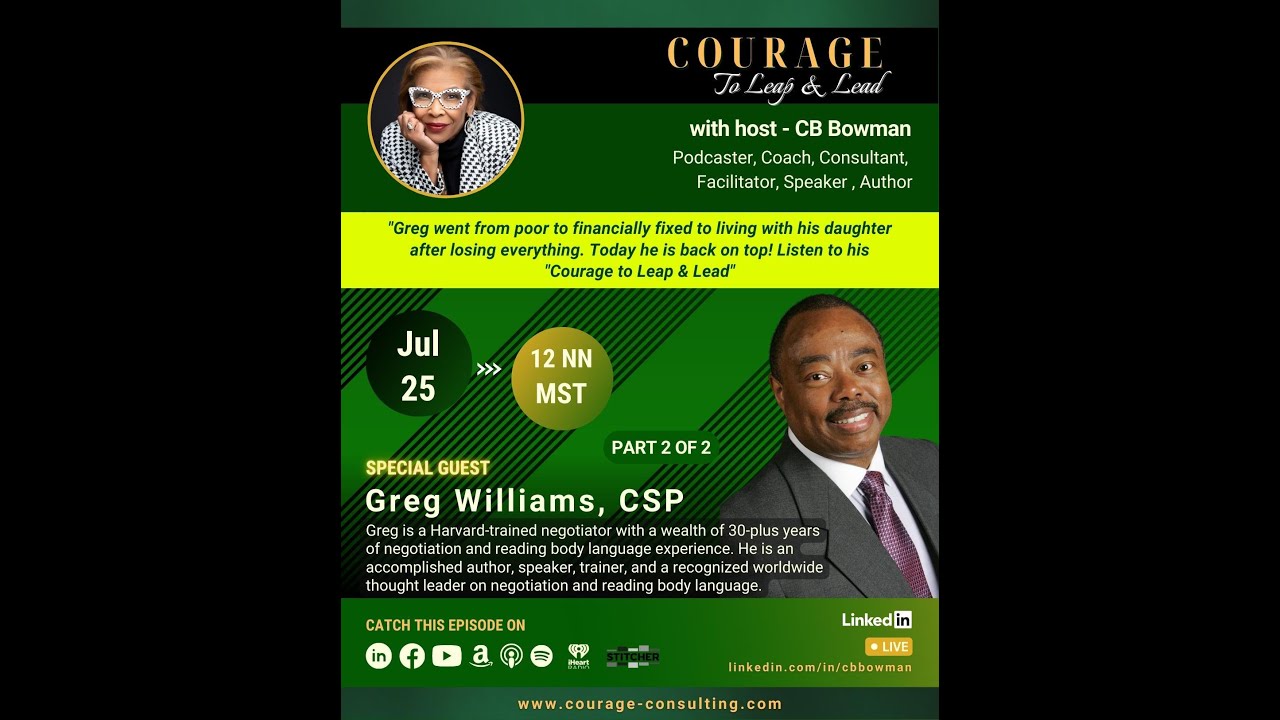
Greg Williams built a $30 million IT consulting firm, ran for office, then lost everything and moved in with his daughters. A church moment and their support redirected him toward professional speaking and negotiation training. He learned that asking "How can I help you?" and listening to your gut matter more than the wins.
Chapters
You've got courage to leap, courage to lead. Be brave and be bold. Let it roar.
Welcome to the Courage to Leap and Lead podcast, where each of our guests share the stories of courage that helped them become powerful leaders. Before we start today's show, please remember to visit courage-consulting.com. Where you can find all the episodes and other excellent resources, all at courage-consulting.com. Now here's your host, Leadership Courage Coach CB Bowman.
Ladies and gentlemen, this is part 2 of my interview with Greg. I, I don't know if you saw part 1, but it was filled with love, Laughter, fun, and then intensity. Intensity because Greg was brave enough to share with us his experience when he hit rock bottom. All I could say is those of you that are at rock bottom, listen very carefully for what he has to say. Because from there, he went to the top. And it's possible. It's possible. Greg, welcome back.
Thank you, CB. Thank you. Thank you. Thank you.
I am so proud to know you. And, you know, I'm so glad that you found what you needed at that time. Thank you to your daughter.
Mm-hmm.
Mm-hmm. Thank you to both of your daughters, because think of how many people would not— would have not benefited from being in your circle. Mm-hmm. Mm-hmm. And when I first met you, I thought, I don't know if I really want to get to know this guy. He is like all over the place. I mean, you know, he's in my fame space, right?
Right.
And then you reached out to me on LinkedIn. And I said, oh, God, I am going to have to pay attention to him because he reached out. And I cannot be in our group and say I ignored somebody. So let's, let's go, CB. Get over yourself. And then I heard you again on the show. And I thought, ah. This man is just getting on my nerves here. He's taking all my fame away. Well, you know, that's a stupid thought because nobody could take your fame away. I'm like, all the attention is going to him. Uh-uh, uh-uh, uh-uh. This cannot be. And I thought, okay, so let me find out more about this guy. He's getting in my way, right? And so I invited him. My way of finding out? Go straight for it, right? I invited him. Let me see what this guy's got, you know? Guess what? He's got a lot.
Oh.
I am so glad I had the courage to move through my stupidity and get to know this man. Because this is quite a man.
CB, thank you so much, number one. And number two, the reason I wanted dearly to connect with you— you spoke about your fame, and I saw it again by being able to read body language and nonverbal communication. I can see how people react in certain situations, and I can start assessing who they really are, what they're all about, etc., etc. And I said to myself, now there's a woman that's got it going on. What did the kids used to say? She's all of that and a bag of chips.
I like that.
Definitely, definitely. And truth be known, all I wanted to do was to shine more light on you.
Okay. Thank you. I, I appreciate that so much. You know, we all work hard to get to where we want be. So I want to go back and I want to talk about those days for you. And audience, in case you missed the first part, what Greg was telling us is that he was invited into the political space to run for office. And at the same time, he had a very successful business. And he switched his focus to the political space because you, you all know that could be So draining and so energizing at the same time. And his business started to slip. And then he lost the race.
Mm-hmm.
And that just spun him out. And we're talking about how he was able to stop that Ferris wheel, get off, and come back. And A lot of it had to do with his daughters.
Mm-hmm.
He was at the point financially where he had to move in with his daughters. And we all know for men, that's hard because men, we place on this platform of having to take care of their family. And now his family, his children, his daughter is taking care of him. You know, that was a heavy lift. And so let's go back to what happened when you moved in with your daughter.
Well, I'll tell you, one of the things that my daughter said— and my daughter was always— the oldest one was always extremely family-oriented. And I remember saying to her one time, you know, I really don't think I want to be here anymore. And she said, well, where are you thinking about moving? And I said, no, I don't mean that. I mean, I just don't want to live anymore. She said, Dad, stop being silly. I said, think about something. I raised you and your sister, and I also have a son too, but I said to her, I raised you and your sister to be strong Black women, and here I am at your doorstep now asking you to take care of me. How do you think that makes me feel? She said, Dad, get over it. I love you. I'll always take care of you. You know what? We turned it into a joke because I said, even if you have to change my diapers like that? She said, even if I have to change your diapers. I said, oh my gosh. It was really her strength that she lent to me To allow me to become—
correction, correction. It was your strength that she raised the way she was.
Okay, thank you.
He was just lending it back to you.
Yes, thank you, thank you, thank you, thank you. And, and you know, I'll tell you, CB, that was when my whole career shifted as a result of being in politics and politics and running for office and being in the spotlight, being on TV, so forth and so on, I learned to speak in public a lot better. And that was when I really became a professional speaker. So the whole business model shifted at that particular point also. And a lot of your listeners, viewers may know the name Les Brown.
Awesome.
And okay, one time I was speaking at an event and Les came up to me afterwards and he said, you know, you're kind of good like that. And I said, kind of good? Did you hear me speak? The ego just rolled right in on that one. And he said, well, you could learn to speak a lot better. And I'm like, really? You know, uh, but he introduced me to the National Speakers Association.
That's where I heard him speak. Yes.
Okay, okay. And sure enough, I learned to speak better. I learned more about the profession of speaking as a business also.
Yes.
And I just built myself back up. And I'll never forget, there was an individual that was part of one of the chapters that I belonged to within NSA, the National Speakers Association, that said, Greg, if you want to be known for something, You have to be known for something specific. And he said, what do you speak on? And I said, well, I talk about small business owners and marketing and sales. And I ran down a litany of things and I included negotiation in that. And he said, okay, but what do you like to talk about the most? And I cut the list in half. No, no, no. Yeah. He said, no, no, no, no. If there's just one topic that you really wanted to hone in on that you're also knowledgeable about, what would it be? And I thought for a moment and I said, negotiation. I've been doing it all my life. I have a foundation that came from my mother. I've learned a lot about it, etc., etc. Even when I was in corporate America, I had the president of one of the companies that I worked for actually ask me how was I getting margins that were substantially greater than the other people within the company. And I told him what I did, so forth and so on. So he asked me to train the other folks about how to become better negotiators. So when I learned more about negotiations and then tying that into speaking, a whole new world opened to me. I've actually trained and/or spoken in 14 different countries. And I grew up in Philadelphia, North Philadelphia to be exact. And from a little kid coming up in North— from North Philadelphia where you were always told you were not good enough. Even when I went to my high school counselor to tell her that I wanted to go to college, she said, well, she came right out and said, you're not college material. And, you know, as a kid you hear things and you start to believe what grown-ups are saying. And it took me years to overcome that. But—
Wait, wait, wait. How did you overcome that? You know, let's talk about that. And also I'm going to go back to, What did you do when you were in politics besides the politics? What was your business then?
Oh, information technology consulting.
Okay.
I had 86 people working for me throughout the U.S. in all aspects of bringing consultants into different corporate environments, taking consultants into different environments. And that one, I'll tell you— well, I don't know if I should say it or not— we hit $30 million in sales one year. $30 million in sales. And again, I've always been a people person, and when the business started going down and I had to let them go, I felt as though I was releasing part of my family that I could not provide for any longer. So again, that was part of what sent me into such a deep, deep, dark space. But hey, like I said, I bounced back. And the political aspect of me running for office was one whereby I thought I could help more people. So, and, and I had an ego about me too. My ego said, hey, you could do this and this and this and this. Oh, what the heck, you sleep 4 hours, you can get away with sleeping 3 hours.
Wow.
I had a model that said, Greg shall live forever. Silly boy.
Love it. Yes. And so I could see where you were hit double whammy, you know, taking care of family, taking care of others that were working for you. Then you had the politics, and then all of it just disappeared. Like water.
Mm-hmm. Mm-hmm.
And you went to your daughter and you said, I need help. And she said, Dad, I'm here for you. And she suggested that you go to church. What is the link between church and your rising up again like the phoenix?
Oh my goodness, and that's a great metaphor that you just created, rising up again like the phoenix. Because in church, I saw people that were looking for something. They, they were seeking some sense of purpose, some sense of survival. And what I mean by that is there were people with faith, and I had faith for sure. faith that I could do something more than what I was doing, but my faith had slipped.
Mm-hmm.
And I saw it within the church. And the pastor said to me one day in front of a bunch of people, I can learn a lot from him, meaning me. And I thought, interesting, I'm here learning a lot from you. And You're flipping the switch, saying you can learn a lot from me. That taught me a little more about humility also. Don't think you're all of that and then some, because there will always be people that are not only better than you, but if you think you're all of that and then some, you'll miss the opportunity to learn from them that which could have been of benefit to you. You know, so church was what opened the doors To allow the sunshine to come into an otherwise dark, deserted life.
And so how did you get from— you realized that, you realized you had something more to give, something different to give. How did you get from being penniless to starting that something else?
Remember I said I was an introvert?
Yes.
Yeah, well, politics drew me out more because I learned to be a different person when I was in different environments. And CB, before politics, if you asked me to stand up and speak in front of 3 people, my knees would shake so hard you'd think my heart was jumping out of my chest. Really. I remember when I was first asked if I'd run for office and I said, well, you've got to get me some speech training and you got to tell me what do, how to do it. And I was told, follow your heart. And I never forgot that. I remember the time that all of a sudden a switch did flip in me per following my heart. I was speaking at a VA event, Veterans of Foreign Wars, VFW I should say. And I was standing in front of people that I knew. Because of their sacrifices, my life was better. And I actually spoke about just that. I said, because you were the ones that put your bodies in harm's way, you made life better for me and a lot of other individuals. And for that, I truly do salute you. I appreciate you, and I love the valor that you've displayed. And, and I, I felt myself, it was like light coming from me. And I thought, whoa, so that's what's meant by speaking from the heart. Then—
But wait, wait, wait, wait, what were you brought in to speak about to these veterans?
Vote for me.
Get out. Okay.
Yeah, vote for me. Yeah, vote for me. It's all about me, me, me, me, me. But I realized, no, it's not about me. It's about them. And like I said, I spoke from the heart because I truly felt it. I truly felt it. And now, transferring back to how I started climbing back up the ladder of success, I realized I had a message when it came to negotiations. Excuse me for a moment. I have a slight cold.
I have allergies going on, so—
Okay.
All good.
Okay. I realized I had a message in negotiations because a lot of people, as you indicated even earlier, they're not sure what to do, when to do it, how to do it, afraid of doing it, lacking courage to do it in certain environments, yada, yada, yada. And it was, wait a minute, you could speak about negotiations. And now I'm not— at that point, I was no longer afraid to speak in front of people. And I thought, I'm delivering a message. And as Marshall Goldsmith— both of us are in 100 Coaches— says, you know, if, if you're delivering a message and you don't deliver it, are you not harming the people that could benefit from the message? And I thought, even with that that he said, I reflected back on my time when I was climbing back up again Yes, I wanted to give them this message because it would be of benefit to them being true to myself.
Sure.
And that's how I actually did it. I started learning more about public speaking as a professional speaker. I became more knowledgeable about negotiations. And the news organizations started reaching out to me to assess the negotiation strategies that those that were in the news was actually using. And like I said, the body language aspect came about as a result of them asking me questions about what body language was displayed. It was one step after another.
What was the exact moment of trigger where you flipped the switch? Do you remember that?
Well, I felt secure within myself. I'll go back to that Veterans VFW.
Right, but in church. Did somebody come over to you and say, I want you to speak before my group?
No.
What was the flip?
No. Well, and again, I'll go right back to what I said a moment ago. I think it was at that VFW event that I spoke at because—
So your mind went back to that.
Yes, yes, yes, yes.
You have something. When the pastor came to you, you thought back and brought it forward.
Yes, because even when the pastor said that, He knew I was involved in politics, and he wanted to get the church involved more in the political realm so that he could get more proceeds from the state, etc., etc. And I, I would tell him from time to time, nah, you want to be careful. That's a short-term gain at what might be a long-term expense, because politicians come and go, and unfortunately enough, politicians will sway the way the wind is blowing based on circumstances, as we all know. So I, I do attribute it back to that moment when I was at that VFW event that gave me the courage to realize, okay, I'm all right. I'm, I'm okay with myself.
Yes. Yeah. You know, oftentimes I think when we get into those spots where we have failed at something, We tend to look forward and say, okay, therefore I can't succeed. Instead of looking back, which I like this idea I'm coming up with, before the failure and say, what were the strengths that got me to the point of failure? I can go back to those strengths and leapfrog over the failure to get to the future.
Let me build upon that because I love the analogy. Okay, let me build upon it.
But you can't use it because it'll be in my next book.
Okay, good enough, good enough, good enough. Oh, I love it. Uh, here's the thing also that I suggest to people: when you've been successful, you have left breadcrumbs from the success you had. Take note when success took a detour and all of a sudden something, something happened to cause your success to go astray. Learn from it and note the mile markers that you cross as you move through life to assess, wait a minute, am I where I'm supposed to be? Has success started to take a detour immediately? And if it has, can I pull it back right now? And a lot of times, one, one reason why people lose their focus of success is because they're out looking at something else, and success is going, hey, whoa, whoa, whoa, whoa, you're off track. And there are times when we don't realize that we're off track. If we took time to observe the times that we have, we'd have more times to be more successful.
I agree. I agree.
And I love your analogy.
So now tell us, since then, has it all been easy?
No, there, there, there have been ups and downs. Tell you about one particular situation. I had a client that flew me to Greece. Uh, I flew in in the morning. Oh, but wait a minute, wait a minute. I flew in in the morning, made a presentation that evening, and flew out the next morning. My body was like, uh-uh, you do that again, we're gonna make sure you don't do it again type of thing.
Yes.
Yes. So the, uh, the pretense though was for me to make a presentation, but at the same time, this individual that was the CEO of that organization Knew that I was engaged in a negotiation with a competitor and offered me a substantial-sized contract if I let them know what was going on. Yeah, exactly, exactly. And I'll tell you, CB, it's— first of all, oh, truth be known, When I was probably in my 20s, possibly 30s, I may have gone for that deal. I may have gone for it. But knowledge, age, and wisdom taught me the value of loyalty, number one, because this other organization had been one that not only had I established a very close relationship with the CEO, but at the same time, he and I bonded around loyalty. So I— it was almost like, I can't do this to this person. And this other deviant— well, I shouldn't call him a deviant because in corporate America, oh, you know, strange things can happen from time to time.
Right.
Uh, I didn't know if he was trying to test me, number one, but Lord knows I was not buying what he was trying to test me with. And I have a lot of clients now, CB. They, they view me as their secret weapon. whereby they don't want other people to know that I'm working with them. I work with some aspects of governments, and again, they try to keep me down low so that it's like unseen. So what's the resource you have to do this, that, or the other? Where are you getting your knowledge from? Well, we don't know. You know, then they just don't. And, and I could get more business if I allowed myself to be seen more, but I'm comfortable with where I am. And that's another thing about courage. Know yourself. Know what really motivates you. Know what you need. Know what your purpose is in life. And then be true to yourself. Be true to yourself, because if you're not to thine self be truthful, you're really truthful to no one. And you really don't serve a purpose.
I'm gonna ask you a question about that. So we know that one of the ways to get new business is word of mouth. So if people are keeping you as a secret weapon, how do, how do you get that word of mouth going for new clients?
I've had my reputation. I've been in business over 30 years, and, you know, I like to tell people, I know I don't look that old. People go, yes, you do. But anyway—
No, you don't.
Okay, thank you.
God bless you.
Um, but my reputation has preceded me in a lot of situations because way back before I started getting this level of clients and doing government work, uh, people knew about me. I've written 7 books. So people know about my background. I've been on TV all over the place. People see that also, and some people will reach out to me and just ask and inquire, can you do this, that, or the other? See me. Another thing, you and I, um, have received awards from Global Gurus, uh, Leaders Hub. Is it pronounced H-U-M, Hub, or—
um, yes, yes, yes, yes.
Okay. And, and I, I've received these announcements from these folks that are saying, oh, we'd like to give you an award for this, that, or the other. Why? Uh, because we saw your profile. Yeah, okay, thank you, but I appreciate it, but that's okay. Oh, but you know, this would really help your career. How will it help my career? Uh, well, you'll get a minute. But I say all of that to simply say, know where you are in life.
Yeah.
Know what you seek to achieve. And a lot of times all I want to do is help. And here's something, I won't mention the individual's name, but you'll know exactly who I'm speaking with. It's an individual within 100 Coaches. And when we first become members of 100 Coaches, he's the one that will usually reach out, set up a call with you, etc., etc. And he and I had a conversation and he said, well, what do you really want? from this organization? And I said, the ability to help people. He said, okay, but what do you really want? And I said, the ability to help people. And he said, but you're not looking for anything? I said, yes. He said, what is it? I said, the ability to help people.
That's because this person's mind doesn't compute that way.
There you go. Exactly. Exactly. So that's my purpose in life. I found myself— I feel very, very comfortable being who I am at this stage in my life. And again, coming up as a kid that was told, no, you can't do anything. And I grew up in an environment where, uh, what was the cliché? Kids should be seen and not heard.
Yes.
Yeah, yeah. So it was like, why? Why? When I got older, I couldn't ask enough questions. Couldn't ask enough.
Why is that darn sky blue?
Yes, exactly. Shucks. Boy, why is there air? Oh my gosh.
I love it. Tell us, you know, we're running out of time, I think. Well, really, because I could talk to you all day now. But tell us about another time where you had to have a stiff upper back and say, okay, This is just not working, and let me do this to make it work, or let me extrapolate this.
Well, you know, it may sound, um, small, but it was when I had to fire someone. She was stealing from the company, and me being—
How'd you find out?
Yep. Ah, that's the other thing too, because I was always a trusting individual, as I learned not to trust any longer past this particular incident. So I would write out checks with my signature— well, I should say I would sign checks and just have her make the payments and so forth and so on. But then, lacking the insight of, hey, you can't trust everybody, I'd also let her reconcile the books. Oh yes, yes, yes, yes, yes. Now I know a lot of you that are watching this are going, he's not that smart, you know.
It's, it's so much easier on the other side, but when you get to trust somebody before they break that trust, it's a time saver when you're trying to build a business. You look for people that can help you save time.
Exactly, exactly.
And I get it so much.
Well, I'll tell you, uh, once I actually presented the situation to her, she denied it at first. And I said, you can't deny it. And I said, I have proof that you've been subverting some of the funds that was supposed to have been for X, Y, and Z, and apparently putting it in your own pocket. And she started—
You know about canceled checks?
Yeah, really. I mean, my gosh. But see, she thought she was covering herself because she was the one reconciling the books and everything else, and yada, yada, yada.
Okay.
So when I confronted her, I asked her why did she do it. She was telling me about the troubles she has. Truth be known, my heart was always soft, and it's hardened to a degree now, but it was soft back then. And she told me about the challenges she had financially, so forth and so on. And I gave her her last check. And I'll tell you something though, CB, I later found out that she went around telling friends Boy, did I ever sucker him. Not only did I sucker him while I was working for him, I suckered him into giving me my last check. That's when my heart started hardening. It was like, okay, fool me once, shame on you. And, and others had to pay for her transgressions as a result of it because I was no longer as trusting and as open as I was. Even now, CB, I'm extremely guarded about my environment. I've opened up to you to a degree that I have not opened up to people in a long long, long, long time. And I attribute it to you and the great conversationalist that you are, for sure. And I've been watching you for a while anyway, so I trust you.
You're so kind to say that. Thank you.
Oh, you're more than welcome. And I'm truthful too.
Yes, I, I don't know what to say. I'm very fortunate in people knowing that I come from the heart.
Mm-hmm.
Mm-hmm.
I am—
I really want to help people to use their strengths and not their weaknesses. Mm.
Mm-hmm.
And don't forget, those strengths will get you through every single time. You know, when I was younger, I went through a lot of racism in corporate America. And at one point I thought, it's me. You know? And I went to a therapist, a psychologist, psychiatric psychologist. And I said, what am I doing wrong? I can't take this anymore. And he said to me, he smiled and he said, the only thing you're doing wrong is you're not following your gut. Mm-hmm.
Mm-hmm.
Because you are wickedly smart. And I walked out there and I thought, oh, he's just saying that to a Black woman. I said, well, okay, I'll try this out. I'll try listening to myself. Do you know, Greg, since that day, the only time I've gotten in trouble is when I didn't listen to myself.
There you go. There you go. There you go.
There you go.
Very much so.
The minute I start listening to other people, and I don't say— you know, it's fine to listen to other people. Don't get me wrong, audience. But then you have to say, is this what I want? Is this where I'm going? Is this for my benefit? And you have to be really honest because it takes courage to answer those questions. You immediately want to say either this person is full of it, or you want to say I'm all wrong. I should be following what this person said. When the courage place is, there may be a little of this and there may be a little of that. And you have to figure out which of this and which of that is going to get you to where you want to go.
100% in agreement with that. I, I always say you can take advice from people, but remember, it's your life.
You have to own that advice.
That's right. That's right, for sure.
And, and so, ladies and gentlemen, as I started this show today, I said, I don't know about this Greg guy. But let me just tell you what he did to flip the switch. He wrote to me and he said, how can I help you? Please tell me how I can help And I thought, okay, CB, you've been a class A idiot. You need to get to know this guy and let him know how much you appreciate that question.
Oh.
Because so many of us are so focused on self that we forget the other person right next to you.
Mm-hmm.
Needs help and support, no matter how well-known, how famous, I don't care. At some point, at some time, those people are going to need your help.
Mm-hmm.
So I'm going to end the show today reminding people to ask somebody, how can I help you? And mean it and do it. Because you know what the Beatles said, it's all with a little help. Greg, thank you so much for sharing your journey with us. It's a powerful journey.
CB, thank you for the opportunity, number one, to be on your show, and even more importantly, to get to know you. A lot better. It's been a pleasure.
My pleasure. Ladies and gentlemen, aren't we lucky? Aren't we lucky to know people like Greg who will tell us the truth about hard work and success and having that courage? Tune in next week and hear more. Bye now. Thank you, Greg.
Thank you.
More from CB



211- Courage to Leap & Lead with Louise Story part 1Courage to Leap & Lead







