Courage to Leap & Lead with Jen DeVore Richter - Episode 143
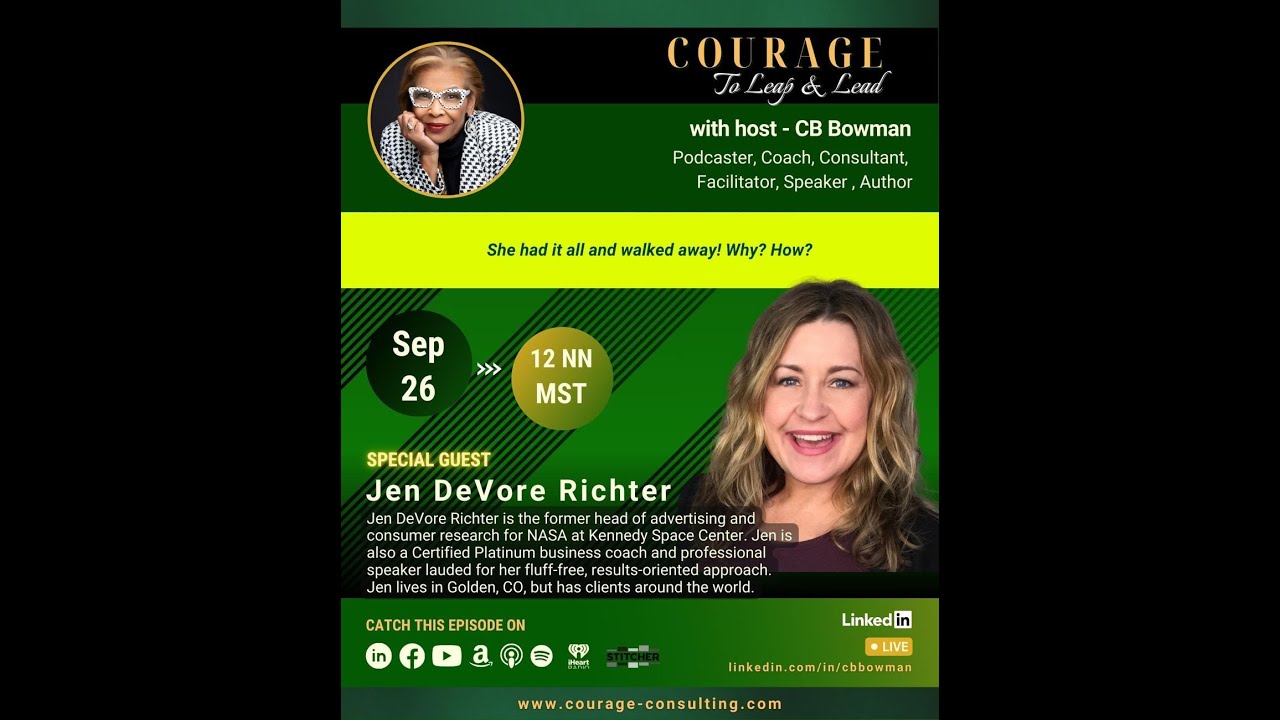
Jen DeVore Richter went from NASA marketing to burnout, divorce, and a uterine tumor. She rebuilt through photography, then a marketing agency, now runs a YouTube-driven consulting business with no-meeting Mondays and outsourced teams. She's writing a book on outsourcing marketing while keeping mandatory date nights and women's ministry non-negotiable.
Chapters
You've got courage to leap, courage to lead.
Be brave and be bold. Let it roar.
Welcome to the Courage to Leap and Lead podcast, where each of our guests share the stories of courage that helped them become powerful leaders. Before we start today's show, please remember to visit courage-consulting.com. Where you can find all the episodes and other excellent resources, all at courage-consulting.com. Now, here's your host, Leadership Courage Coach CB Bowman.
Hello everybody! Hey, it's your favorite host, your favorite podcast host. It's CB Bowman. Live. Aren't you lucky? I'm lucky to have you. Hey, we have a very interesting guest today. I met her as part of the National Speakers Association here in Upper Colorado versus Lower Colorado. And you know, I just connected with her. She had such, such energy about her. And the things that she's doing are really on the outside of what you think speakers do. And it's just a fascinating conversation. And I thought, you know, we talk about courage to leap and lead. And many of us get stuck in one frame, just like a cartoon frame. We get stuck in one frame and we think we have to be successful in that one frame. And the reality is that successful people are not successful in one frame. They're successful in multiple frames. It's just that one of those frames bubbles up to the top, and that's the connection we make with people. But if you look underneath the blanket, there's a lot of stuff that we do. And so I wanted to ask Jenn to come on and talk about Her Rolodex. Of the things that she does and how she went from failure to success. And did it just happen one time or multiple times like myself? And by the way, great news, I think my book will be out by the end of the month. And you'll see the many, many times that I had to pick myself up And dust myself off, as the song says, and start again. So without further ado, let's talk to Jen. Jen, welcome.
Thank you for having me, CB. Appreciate it.
Oh, terrific. I'm so glad you're here. Okay, let's start from the very beginning. What did you start your career doing?
I started my career working in television. I was working at a local ABC station up in the panhandle of Florida. It was like a really small TV station. But it was such a great experience because it was small. It gave me an opportunity to really get my hands on a lot of aspects of television production, both behind the scenes and in front of the camera. And that was just really valuable experience. And then I left.
I want to stop you there because you just said something really important. A lot of people today— I don't want to pick on the younger people, But I am. We're going there. I'm going there. They feel like their first job has to be their last job. It's panic. If they're asked to do something that's outside of their job description, all heck breaks loose, right? I'm leaving. I'm finding a different company. This isn't it. When in fact, that, that experience is the roots for your future. And the fact that you are able to see that and enjoy that and remember that in terms of your success now is so important. So I want to say to people, don't be afraid to start at the beginning. Yeah, if it's the second or third time around.
Yeah, absolutely.
I—
when I was working for ABC, I was doing everything from designing t-shirts to writing video scripts to doing on-camera work, not on the news or anything, because I was just— had just, um, gotten out of college and I wasn't prepared for that. They were trying to train me to be an on-camera person full-time. But within about a year, I realized that I wanted to work for, uh, one of the theme parks in Florida, because when you live in Florida, the theme parks are where, where all of the Really attractive and fun-looking jobs are. It seems more glamorous. And so I landed a job at Kennedy Space Center working for NASA, actually. Yeah.
To land that from oh so this is fun.
I so the the movie this is how long ago this was, but the movie Armageddon had just come out with Ben Affleck. Remember that?
Yes.
And I was watching E one day entertainment news, and they were having the movie premiere for Armageddon at Kennedy Space Center. And I saw it on television. I was like, well, you know what? That's just like an hour from where I live. I wanna try to get a job there. It just looks so fun. They had movie premieres and they had the tourist attraction. Kennedy Space Center is one of the top 5 most visited tourist attractions in the state of Florida, competing with Disney, Universal, SeaWorld, et cetera. And I was like, that is the job that I want. I wanna work there. And my background is marketing. And I did it just, I just, Took a chance and was courageous and believed in myself, and I just had my one job working at the TV station. But I had my degree, and I had had done an internship and things, and so I applied. That was was really pretty simple. I applied, and the interview process was crazy difficult. I had five interviews. It was just really very it's a very. challenging, to say the least. But I made it through the interviews and they offered me the job, and, and that's how I started working there. But it all started by watching Armageddon on E! News.
And having the courage.
And having the courage, right?
And as a woman, having the courage to do that, I applaud you. Fantastic.
Yeah, it was awesome. I felt really comfortable there. My dad was a military officer my whole life. I grew up as an Air Force brat, and so You know, being on base or around, you know, space and technology, and that just felt really natural for me. So, um, but it was just really exciting. So that's how I started. That's where I got my start.
So thank you to Dad.
Yeah, yeah.
And by the way, that experience just helped you push through anything that others might have thought, oh, I can't do this.
Yeah, yeah. That I always say, CB, I'm like, that's funny that you say that because I always say That was my, if I can make it here, I can make it anywhere job.
Yeah.
Like working in New York City, it was so challenging. And my responsibilities were managing all of the paid advertising programs. So I was producing TV commercials, radio commercials, billboards, managing the NASA brand, working with community partners and strategic partners, and just, you know, chipping in with PR and special events and all that. It was the lessons that I learned about marketing and advertising working for NASA have really come far over the decades.
But you learned that on the job?
Yeah, well, I went to college for communication arts and public relations.
Right.
And then I did, you know, internship and worked at ABC TV. But most of what I learned, I learned on the job. Yeah.
Yeah.
I had a great boss.
There goes another secret.
He really poured into me.
You know, but, but on the other hand, we have to realize that great bosses come from great students, right?
Yes.
So he or she obviously knew that you were a sponge for information and a quick learner. So there you have a perfect algorithm, right? Okay, so what happened next?
Well, then I burnt out because the hours were so long. And this is in the early 2000s, late '90s and early 2000s. When I was there, we were launching a lot of space shuttles. The space shuttle program was like at its peak, and we just had long hours. And the really the just the day-to-day of having to work 12 hours plus, I was going to night school and getting my master's at the same time. And it just became where I had no life. I didn't have a person. All my friends were the people that I worked with. My whole entire community was everybody that I worked with. And my first— I was dating— I started dating a guy that one of my coworkers introduced me to as a friend of her husband. And I— this was my first husband. And so I started, I started dating him, and he said, I'm not going to marry you if you have this job working at Kennedy Space Center, because the hours were so long. I just wasn't available. Like, I couldn't. be in a relationship with someone. And so he kind of like gave me kind of like a threat, I guess you could say. And I fell for it because I was like 30 and I felt the clock ticking and all this pressure. But I was like, you know what? You're kind of right. I've been here. I've done that. I've put in the long hours. I've earned my stripes. I've done it and met amazing people. I used to work with astronauts. Buzz Aldrin and I were on a personal relationship. And I just was like, you're right. It's time for me. To move forward and build a life for myself. And so I quit to get married. That, that was step 2.
Okay, ladies, we won't be talking about that.
No, it was the choice that I had at the time. Then I ended up divorcing him 7 years later.
But hey, it was a sign.
It was a sign.
I love that story. And so you got married.
So we got married. And then, you know, fast forward, everything in your life happens for a reason. And if I wouldn't have met him and married him, I'm— he and I moved to— moved out of the city that we were in, we moved further up the Panhandle, up into North Florida, up into the Jacksonville area, where I met my now husband, who I call my forever husband. I've been with for 12 years.
So, you know, I—
if all of that wouldn't have happened, I never would have been where I'm at. So I don't regret it.
So your first husband got you back into society.
Got me back into society.
Take care of yourself.
Yeah.
Arranged for his replacement. Yes.
That's one way to look at it.
I love that story. So you got divorced and married.
And yeah, a few years later, after my divorce, a couple years after my divorce, I met my now husband, and both at the same time. Like the lesson that I learned there was, you know, having a really cool glamorous job working with astronauts and going to movie premieres and all those things. Those are really cool. But you also have to, you also have to weigh the personal sacrifices that you make. And for some people at some certain points in their lives, those are, those are good things to sacrifice. Like the, you know, you have to. Experience things, and I wouldn't change it for the world. But on the same hand, you know, now that I'm older, you know, 20 years has gone by. Now that I'm older, having a— having more freedom in my life, having room for personal relationships, having a strong, healthy marriage, that is really important to me. And that's why I decided to become an entrepreneur and work for myself, because I thought, oh, you know, I'll be able to set my hours. Little did I know how much work goes into being an entrepreneur, but at least I can do it on my own terms.
Yes. Yeah. You know, I, I love, I love what you just said because many people feel like they have to have it all.
Mm-hmm.
Because all is so glamorous and wonderful. And surprise, when you get there and you find out not so much, mm-hmm, that's when the tower crumbles and you think, I've worked so hard to get here and sacrificed so much to get here. And now that I'm here, I'm looking around and I'm stunned to see there's nothing. There's nothing.
Mm-hmm.
Right?
Yeah.
And the problem is when you realize that, you go into this free-floating not knowing where or what to do next. And I remember— I won't say how many years ago, but I wrote an article for the Wall Street Journal that talked about having parallel career paths. And it's insane to think— it sounds like you're working harder, but the fact is that you have Plan A and Plan B. So Plan A doesn't work, you replace it with Plan B. Plan B moves up to A, and then you've got C coming in.
Yes.
Is survival techniques.
That's key to resilience. Definitely.
Exactly. And so I encourage all of the people that are listening to please always have your Plan B and get ready with Plan C, because then you don't feel the sting as much. Or you learn— you read my book and you learn how to turn failure into success.
Yeah, absolutely.
So having decided to open your own business, how did you figure out what you were going to do and how you were going to do it and when you were going to do it? And did you determine first that you had your husband's full support to do this? Yeah.
So I, so I turned my, my Plan B became my Plan A at first when I transitioned from working for corporate or, you know, working for the government. I, my Plan B was that I was studying photography in my free time and I was doing it as a hobby. And actually my, my wedding photographer from my first wedding was my mentor and he was kind of taking me under his wings and showing me the ropes of photography, and I got involved in the Professional Photographers Association and went through certification and all of that and, and started picking up, I guess, like side hustle clients. And then when I decided to make the leap and take the courageous jump from working for someone else to working for myself, I turned my Plan B photography hobby into a full-time business and I opened a studio. And I was shooting mostly weddings, but like, you know, babies and engagement photo shoots and families and things like that. And I ran a very successful photography studio for 7 years.
Wow.
And had my, you know, my husband was pretty supportive at the time. It was my— that was my first husband, but he was pretty supportive of it. There was the financial challenges at the beginning when you're making a shift from a steady career that has benefits and, you know, a steady paycheck no matter what. Even though it was a really small paycheck, but he, you know, it was still— he was concerned, I think healthily concerned. But I just treated it— I went all in and I treated it like a business, and I didn't treat it like I was a starving artist willing to work for nothing just because I loved photography. And I really kicked in with my business, you know, acumen that I had, my marketing skills, and was very, very successful for for 7 years. But the lesson that I learned there also was that I burnt out, and I— most of my business was on nights and weekends. You know, weddings take place on the weekends, and people want to do family photo shoots on the weekends and at night. And again, I felt myself back into the trap of having created success for myself, but also at the same time at the sacrifice of my personal time and my free time.
And, you know, um, sorry to interrupt you, but I think it's important in terms of something you just said. Most people don't think when you have your own business that you can face burnout.
Oh yes, you definitely can. I'm, I'm a living testament to that.
Yeah, I mean, they think, okay, you can write your own hours. Pretty much write your own check.
Yeah.
And it's so not that.
A lot of things, you know, were great about it. It was, it was my first true entrepreneurship experience, and I had amazing clients because I had worked really hard to be very good at what I did, with what I did technically. And so I had amazing clients shooting in wonderful, you know, locations, shooting weddings in the best locations in town, and And for what I had tried to achieve with it, I feel like I did. The lesson that I learned was I can't build a business only around myself and me showing up for work. I have to build a team. I have to have processes and systems in place. This is my NASA geek coming out, but processes and systems in place and teams. And instead of just hire me to show up and photograph your wedding, there has to be more to the business than that. And that was, that was another key lesson that I had to learn the hard way when I was like, okay, I'm not gonna, I'm not gonna spend my weekends and nights working anymore because you're also working during the day, working on your clients, working on your editing, working on your accounting, working on your marketing. And so I was just, I fell into the trap. And, um, and but the lesson that I learned from that experience was how to build a business that was scalable, that didn't require me to work nights and weekends, that I could work from anywhere. And the only other thing I know how to do is marketing. So the next— so when I closed out the photography business, my last wedding that I photographed was on a New Year's Eve, a night New Year's, and it was late night because it was a New Year's wedding. But I came home and I was just exhausted and I said, I'm going to take like a 6-month sabbatical for myself and I'm just going to stop. And I'm going to regroup, and I'm going to think about what could I do? How could I build a business that I really love, that gives me the freedom and gives me free time and has all the benefits of entrepreneurship, but minimizes the things that I didn't like about working for someone else or, or being trapped in a, in a business? And the only other thing I know how to do is marketing. So that's what I've been doing since then. I've owned agencies. I've got another, uh, got a horror story about that. But I've owned agencies, and I've— and now I work for myself with my team as a marketing consultant and YouTuber and professional speaker.
So tell us the horror story.
Another lesson learned.
Yes, was—
so I had the— I was like, okay, so I know I wanna work in marketing again. I just don't want to work for someone else. I'm going to open up a an agency, and I got an office at the beach. It was— I lived in Atlantic Beach at the time, and I had an office right at the end of the road, right out in front of my neighborhood. It was super cute. I had one employee who's— I was best friends with her mom. I had photographed her wedding, and she became my first employee. Her name's Erica. And so Erica and I were just, you know, going to Chamber of Commerce events, going to all the networking events, trying to get clients fast and furious. And, um, and we were on our way. We were within the first year, um, we were, we were doing all right. I didn't know anything about YouTube at the time. I didn't know about, you know, spreading your message, like marketing one-to-many versus one-to-one. And I was at a networking event one day. I was actually in front of the room giving my elevator pitch. You know how we'd go to the network events? You stand up, give your elevator pitch. And I got this really terrible pain in my side.
Oh, no.
And I was like, this isn't right. Something, something's going on here. And then all of a sudden it became debilitating. Like, I couldn't even, I couldn't even stand there anymore. I said, I'm sorry, excuse me, I've got to leave. And so I put myself in the car, drove myself to the emergency room, and come to find out I had a tumor in my, in my, um, on my uterus, actually. And the doctor said, you need emergency surgery. This is bad. We don't, we don't know what this is, but it's a big tumor and it needs to come out now. And so I ended up suffering from endometriosis over the next 2 years, and I had a series of 4 surgeries in 2 years— no, 3 surgeries in 2 years that took 4 of my organs. And so there was this really long recuperation period, and it cost me my office at the beach. Actually, it cost me that startup dream because I was just so Physically, I just physically couldn't go to networking meetings. I physically couldn't. I didn't have the energy because I was so focused on healing. And so even though that was one of the worst things that ever happened to me, CB, at the same time, it was one of the best because here was just another opportunity, another learning lesson, another hard experience to learn from. And I said, okay, well, how could I create a market? How can I create a business that I could literally run from anywhere that doesn't require me to get up and go to networking meetings and doesn't require me to have have an office with the overhead, doesn't require all of these physical demands. And so that's when I decided to start looking at building more of a, like they call it, the laptop lifestyle type of business.
Yeah.
Where I didn't have to go to networking meetings. And I just really started applying everything that I had learned. It came full circle, all of the lessons that I had learned, all the skills that I had learned. working in television, the market, the scalable marketing lessons that I learned working at Kennedy Space Center, and I decided to apply them to myself as an entrepreneur versus just relying on networking and showing up and being physically present. That's where we are now. That's— here we are.
That is an amazing story in so many ways, and I thank you so much for sharing. Um, with our listeners, because you talked about things that happened to you that would be considered failure multiple times. And I— not once did I hear you say the word failure.
No.
It was all lessons learned. It was all moving forward. It was, I will take this from that and make it this. Even during the days of your being ill and having— I mean, applause to you.
Thank you.
Applause to you. And a fantastic example of how the— I always say the beginning is really the next step, and it's not the end, regardless of what No. Yeah. And a testimony to women. Just keep going.
Keep going.
Yeah. So tell us about your experience. First of all, let's go back to your medical situation. I hope you're well now. I am.
Yeah, perfect. It's been about 10 years since that all happened. And, you know, I have to take hormone replacement therapy for the rest of my life. And I go to my regular doctor's appointments, and I have to just really be on top of all my scans just to make sure that it's, you know, not cancerous, God forbid, or, you know, anything life-threatening. But I'm completely fine. Completely fine. I just take really good care of myself. And that's why I'm so appreciative to have freedom and flexibility and a business that I can, you know, take time to, to focus on my health. It's real. You know, my personal life is very important because I've come very close to losing it. And my marriage is important. My health is important. My relationship with God is important. All of these things are the most important thing to me. And so my goal is to build a business that allows me the freedom to focus on the things that matter.
How do you do that? You know, we've heard a lot of people that are— I'm going to say super successful because that's, that's beyond success. The fact that you can manage all of those balls at once, the things that are truly important to you, and congratulations for being able to identify what's really important to you. That's a struggle that a lot go through.
Yep.
But then having realized that, how do you manage all the balls? Do you say, okay, this day is dedicated to— it's going to sound stupid— is dedicated to God? So Sundays dedicated to God, you go to church. This day my husband and I go out to dinner on these days. How do you manage all of that?
That's a great question. Mondays and Fridays on my calendar, I do not do meetings.
Hmm.
It's very rare that I will take a meeting on a Monday or Friday. Those are my days to— Monday is when I set up my week and I'm communicating with my project manager and making sure that she has what she needs to communicate to our team of developers and designers and tech people. And then I'm— and that's my thinking time for clients to think about what we need to get done, what our, what our goals are, what the most important activities are for the week. Tuesday, Wednesday, Thursday is a grind. That is meetings, production, just really working to make sure that everything is going to get done. And then Friday is another day for space. to reflect, refine, and think about, okay, what can we do better next week to improve the experience, to improve the outcomes, and to improve the process for everybody? And so those 2 days are really key just from a business perspective to give me time to think and time to reflect. Those are key. And I think the problem, the challenge that some entrepreneurs have If you're, if you're like me and you're kind of a go-getter person that likes to get a lot of stuff done, is that you feel this need to constantly be doing instead of being. And it's— I think it's more important to be, to be versus do. And to, and to really give yourself permission to have that time to think and reflect. That has just been the key. But then the other thing is, I have people that I trust that help me run the business. My pro— I have 2 project managers, and, um, I have one that's like an internal to me and then one that's kind of an outsourced consultant. And then, and they help me manage my design and development team. And I'm also really— I really have dedicated myself to creating systems for marketing. Actually, I have a book coming out this summer too, just like you, called Outsource Your Marketing. And I've I've just gotten really good at thinking through processes and systems for everything so that we're not just— we're not winging it.
I can't wait to get your book. I want to be part of the launch team.
Great.
My hands. Yeah.
Sign you up. Um, yeah, so yeah, Wednesday I have a meeting with the interior designer, so we're done. We're, we're through copy editing and now we're going into layout, so we're really close. But, um, yeah, but that's what I do is I think about Everything is a process. Each step in the process has a person that's assigned to it. I'm very clear with the deliverables, with my communication with them, making sure they have the resources that they need. And my goal is to run this business and it not run me and it not run my team ragged either. We don't work nights. We don't work weekends. We don't do that to ourselves. That's just— that's how I run it.
And what about time with your hubby?
Mandatory date nights. We go out at least twice a week, usually every Friday night we go out, and then maybe we'll go do something maybe with another couple on Saturdays. But yeah, my husband and I— my husband also works from home. He's in sales, so he travels a little bit, but we're home a lot with each other, and we're empty nesters now. Kids are in college. And we have a lot of time to focus on being with each other and, and we make ourselves, we make our relationship a priority.
Yeah.
And then my, then my, my other passion is women's ministry. I work in women's ministry at my church. That's an every Thursday night dedication. So all of my partners, all of my clients, all of my professional associates, like I'm on the board for the National Speakers Association for Colorado, which is how we met. And everybody knows Jen doesn't go anywhere on Thursday nights. That's my women's Ministry stuff. And then of course church on Sunday. But, you know, God's a part of my life every day. Those are just— I'm very— I'm clear on where I can show up the best and how I can make the most impact. And I just really just— I set that time aside and I don't let anything move it.
And you know what, ladies and gentlemen, I have experienced her. In this way. And so now I have my answers in terms of what's behind the way that she shows up. It's a fantastic story.
Thank you.
Okay, so now, after you— um, I just want to drill down a little bit on this. After you came out of your medical crisis, how did you get started again?
Baby steps. So I really focused on my physical healing first. And I had a period, CB, where I spent 30 days— this is before COVID lockdowns— I spent 30 days in the house because I couldn't barely move. I couldn't walk from the surgery recovery. And so I just started like walking around my kitchen and walking around the house and then walking down to the end of the driveway, walking around the block, and then, you know, and then just building myself up physically to where I had— I'm a pretty healthy person normally and just kind of started building myself up and then started, you know, taking easier exercise classes and then intermediate and then back up to where I am now. But really just focusing on that strength. If your health is— if your health is a challenge for you, I mean, I hear you. I know how tough it is. But instead of just saying, I can't do it, I'm just— I'm too far gone. I just said, what can I do? Can I walk around the kitchen? Can I walk to the end of the driveway? Can I make it around the block today? And I just took it one small goal at a time.
You know, it's interesting because my husband and I just had this conversation yesterday. We've decided that we needed to get more outside and energy in our lives.
Yes.
We're doing pickleball. Oh, that's awesome.
Pickleball's fun.
Yeah, but that's starting at the top.
Yeah.
Baby steps. We thought we got, we got hooked because we thought, so we started going to our rec center to exercise and I popped my head in and saw these people playing this game, this racket sport. And I sat down and I said, to the guy, what are you guys doing? And he said, this is pickleball and it's great for older people because it's easy. I said, oh, okay. Not that I'm going to admit that I'm older, but let me try this. It is the hardest game in the world. Yeah.
Yeah.
Not easy by any— I don't know what they're talking about for older people because You get your heartbeat up in a second. And, and I said to him, you know, we were both— we went out to play together and we played for half an hour and it felt like we were playing for 3 hours.
Well, that's when you know you've got a great workout.
He said, I don't know if I could do this. And I said, let you know, it's baby steps. Yes.
Yeah.
So, we're going to continue to go for it. Yeah.
I bought a Peloton recently. So now I'm like, even— and then, so my husband and I ended up moving to Colorado a couple of years ago because of that outdoor lifestyle. And that's really been helpful. I think, you know, most people think Colorado's under 4 feet of snow all the time. It's not true.
We can put our secret.
Yeah, it's our secret. But I mean, sometimes we have 4 feet of snow, but not all the time. We have 4 seasons here.
But summer we have it.
But that's been really, you know, moving to a climate that is more conducive to exercise, even if it's walking around the block. And we live in the foothills of the mountains, and so we can go on a hike. You know, there's a beautiful hike in the— in South Table Mountain is right outside of our backyard. So, we can go on a hike whenever we want, and we just walk the dog all the time. And now I ride my Peloton. I try to ride 6 miles a day on the Peloton.
Wow.
You know, and do exercise, different exercises classes as a drop-in. I do Pure Barre sometimes and things like that. But yeah, sometimes it's like—
Pure Barre?
Pure Barre.
What's that?
It's like if ballet met Jazzercise, I guess. It's based on ballet, so it's like really small micro movements. You use a ballet— kind of like the room is set up like a ballet studio, but you're not doing ballet. And the music is more aerobic. And it's a lot of isometrics, a lot of push-ups, sit-ups, using your own body weight to build muscle.
OK. I've learned a new one. Oh, it's so fun. I have to see if they offer it. OK.
Oh, it's everywhere here in Colorado. There's lots of them.
And so, OK, so you did your baby steps. And I want the audience to listen to this Because she didn't go from 0 to 100 overnight, right? So first you worked on getting your health back and you were okay with that?
Yes. And then I just started working, um, with my, you know, with my business to— so then my husband and I— this, that all happened like 10 years ago. And then I owned an agency with 2 business partners, 2 guys that were wonderful human beings. But again, we had fallen into the trap of having employees and business partners and just having so much just emotional stress on it. So when my husband and I moved from Florida to Colorado a few years ago, 3 years ago, I really was like, okay, I'm going to rebuild the business the way that I want it to be built. I don't want business partners, number one. That was, that was priority one, even though they were wonderful human beings. I don't, I don't operate with business partners well. And so I didn't want business partners, wanted it to be a solo act. And how, you know, how we met each other was through the National Speakers Association Colorado. The first thing that I did was I said, I'm going to be a professional speaker. I want to be a keynoter because I had— my agency was successful and I had started landing speaking opportunities at women's leadership events, a lot of Chamber of Commerce things because they just wanted to hear my business story and and how I had built this 7-figure business from scratch, basically with my business partners. And so I had kind of just accidentally fallen into speaking and I wanted to take it really seriously. So when we moved to Colorado, I joined NSA and kicked off my keynoting business really very seriously. And that was great. That was in 2019 before the pandemic hit. And so I was doing a little bit of traveling, not too much, because I don't want to, you know, interrupt my lifestyle, that my beautiful life that I've built. But I was doing a little bit of traveling, doing some events locally. And then when the pandemic hit and live events got canceled again, here we go, another curveball. Everything changes. And my business was so— it was pretty brand new at the time. It was only like a year old. We moved here like April 2019. So this is March of 2020, just a year later. And my entire business model basically had to shift. It had to pivot. And one of my clients at the time is a famous plumber on YouTube. His name's Roger Wakefield. And I was working with him. He was one of my clients. And he, at the time when I met him, he had 40,000 YouTube subscribers. Now he's got over a million, not from anything that I did. I wasn't working with him on his YouTube business. He has a whole team for that. I was working on different aspects of his business, but he was telling me when I, when I met him, um, he was telling me, Jen, you need to get on YouTube. Even before lockdowns came about, he was like, you need to get on YouTube. YouTube is life-changing. And I was like, I don't know, Roger.
I don't know.
I'm not sure if I'm really gonna want to make you, you know, make YouTube videos. And he says, no, you're perfect for it. And then when lockdowns hit and live events got canceled, I again was like, okay, I've got all this experience in television, I've got all this experience with video production, and I'm gonna do it. And I just decided, and I did, and I committed. And I— he introduced me to his fabulous YouTube coaches, and he gave me some hacks and some tips and things that helped me really jumpstart my, my YouTube business. And, um, I'm so thankful for that because Now I have a business that is almost 100%. It probably is about 90% YouTube driven now and only 10% live events and keynoting and speaking. So it's kind of like, again, the lesson of everything that's happened in the past, even the challenges, even losing my keynoting business and being forced to go to YouTube, even though I didn't know anything about YouTube, I did know about video production. I did know about Scripting. I did know about editing. I did know some things, and I just had to figure out and hire coaches and get experts to help me on the things that I didn't know.
You know, um, I want to give an endorsement here, which I'm not supposed to do according to LinkedIn. So LinkedIn, please don't kick me out. Um, I turned to Jen because my YouTube channel wasn't going anyplace. And she was so incredibly kind to spend 30 minutes with me to say, CB, this is what you need to do. Boom, boom, boom, boom, boom. Very precise. I mean, I tried to do some of it. I have to get more done. But this woman is a dynamo. So if you are looking for somebody to support you in YouTube, in marketing, reach out to her. She's the real deal.
Oh, thank you, CB. I appreciate that. Yeah, I'm just— I'm, you know, I'm a big proponent of passing on what— passing on what I know, you know, and that's why I make YouTube videos. I give away all of my best ideas. All of my information is on the internet. It's You know, it's available for free for those people that need to DIY it and do it themselves. And maybe they're just getting started, or maybe they're— they don't, you know, have the ability to have a team working for them. And so all of my best ideas are on my YouTube channel. And if you're trying to grow a business where you're trying to position yourself as a go-to expert, a thought leader, a leader in general in what you do, I'm a big believer that the best way to do that is to demonstrate it. And to show people what you know versus just telling them, wait, you know, oh, I'm an expert in this. Well, show us. Demonstrate. Share your ideas. Share your brilliance. And I think a lot of reasons why people don't take the leap and have the courage to try something new like YouTube or whatever it is, pick whatever new marketing thing, is because of the tech. That's usually the thing that makes people go, never. I'm never going to be able to do that, Jen. I didn't. I didn't study broadcasting. I don't know anything about video production. I don't. But those things can be outsourced out. The strategy is what's the most important thing. And once you understand the strategy behind what type of content people are looking for, what's helpful, what questions your people are asking, I say ASQ, answer specific questions. This is from one of my YouTube coaches, Sean Kennell. He says answer specific questions, ASQ. So if you don't know what to do, if you don't know what to create, if you don't know what videos to produce, whether on LinkedIn or Instagram or YouTube, just start by answering specific questions that your audience has and keep it simple. One question per video.
I love it. I love it. You know, um, follow Jen is the best advice that I can give you because I just don't even know what else to say to add to you. You have been a remarkable guest today. Thank you, CB. You've shared so much. And notice we did this in record-breaking time because she's very clear on her goals. She's clear that she's never had failure. She's clear that each experience that she's had has been used to benefit her and her specific goals in life. And that is courage. That is everything that we can all hope for and inspire, inspire ourselves to do. And she shares it.
Yes.
So I encourage you to follow her on YouTube. Follow every place, you know, Google her, Become a LinkedIn buddy and you will be rewarded.
I'm here to help.
Jen, thank you so much. Oh, tell us how people could get in touch with you in terms of marketing other than by LinkedIn. Do you— is there a website you'd like for folks?
Yeah, my website is jendevore. Uh, j-e-n-d-e-v-o-r-e.rocks. So not .com. You can get my— there's a website on .com, but the .rocks is the one Is there anything else you would like to share with us? I would say share your story, share your ideas, and take the challenges that happen to you and think about the lessons that you can learn to move yourself forward.
Awesome. Hey, Jen, hold on one second. I don't want to just let you go. I noticed, guys, I noticed that my plug wasn't in all the way. And so my energy level was going down on my computer. Jen, it's been such a pleasure. I am so fortunate to know you. And I thank the National Speakers Bureau for that. Thank you, NSA.
Yeah, absolutely.
Is that— I see something behind you. Is that a magazine or a book?
Yeah, that's— I have YouTube's number one channel on magazine publishing. That's one of the— one of my business models. I do marketing consulting and outsourced CMO services, marketing management, but I also help entrepreneurs publish magazines. And that's my magazine. It's called Media Mogul. You can actually subscribe for free on my website at jendavor.rocks.
Can we see it close up? I love that.
And, um, what I've done is interviewed—
What does it do? Do you have— do you focus on one person or company activities? Tell us about the magazine.
So this one is content creation business tips for entrepreneurs. So I've interviewed all of my famous friends from YouTube, TikTok, LinkedIn, and people that make money with their content and how they— like Jennifer Darling is from NSA. She's really a LinkedIn expert. Desiree Martinez is a YouTube expert. Austin Armstrong is my buddy. He's got over a million followers on all his social media accounts, and he shared his ideas on how to grow a business on TikTok. So all my famous friends are in here sharing their ideas on how to grow a business. This is Scott Simpson. He's the owner CEO at Video Marketing World, which is a big conference for video creators. And he wrote an article about thumbnail design and how to, how to really make your YouTube thumbnails pop. So I know really, I know a lot of really awesome creative people. And so my magazine spotlights them.
Wow.
And I give it away for free. This is free. I don't even charge for it on my website.
Okay. You didn't tell me about that before.
Yeah. Yeah.
So this is—
and that's the other— the issue before this one. So they're same, same thing, but just different, different issues.
How many issues are out?
So this one has 3 issues that were out. And then I have another— before this one, I did a magazine called Boss Women Rock when I was on the female empowerment circuit, speaking at a lot of women's leadership conferences called— so that was Boss Women Rock. I did that one for 2 years. I produced that magazine for 2 years. And then now I'm doing Media Mogul, which is For men and women, just content creators in general, and people that use thought leadership to grow a business.
Can you just run down how many things you do for the audience so that they know where to contact you?
So it sounds like a lot. Everybody always says that, but I'm like, it's actually really not that much. It's just I'm good at— I'm good at media, right? So Just like at Kennedy Space Center. My first magazine that I ever published was actually at Kennedy Space Center. It was called The Orbiter, and it was for our— I called them armchair astronauts. It was our, like, people that wanted to know what was going on behind the scenes, um, like our member— like our members, I guess you could say. And, um, so I learned the lesson of video production there. So I create a YouTube video every week that goes on my channel. I think in the last 3 years since I've been creating content, creating videos. I've only missed maybe 2 or 3 weeks of creating a weekly video. So there's hundreds of videos on my YouTube channel that range every— it's all about marketing and media, really. And then it happens to be YouTube's number one channel on magazine publishing. And so I do that every week, and then I send out an email every week to my list of subscribers. And then I publish a magazine quarterly. So it's not like a monthly thing or anything, but I publish it quarterly and I give it away for free. And then I also do live events. I speak and I just, I do virtual speaking. I just did a, last week on Friday, I did a virtual keynote for some of the world's best business coaches. There's over 900 coaches in this program. I was one of their keynoters speaking on AI and marketing. That's the future, AI and marketing. And so, and I've got another presentation coming up at the end of the month for Golden Women in Business, which is where I live, Golden. So I'm doing So that's really what I do. I do a video every week, I do magazine publishing, and I do speaking occasionally, and then, um, serve my clients.
You know, um, have you read the book Reach?
Uh, I don't think so.
Okay, we're gonna talk about that, and I'm going to introduce you, both of you women, together.
Okay.
Both of you are power packs.
Yeah.
I'm gonna be interviewing her in a few weeks.
Okay, great.
So I'm not giving any more information out. You will just have to keep following me. How about that for a teaser?
Yeah.
Jen, it has been an incredible pleasure interviewing you. Thank you so much.
Thank you, CB.
Audience, see you next week. For another great guest. Bye now.
More from CB



211- Courage to Leap & Lead with Louise Story part 1Courage to Leap & Lead







