Courage to Leap & Lead with Joel Garfinkle, part 1 - Episode 128
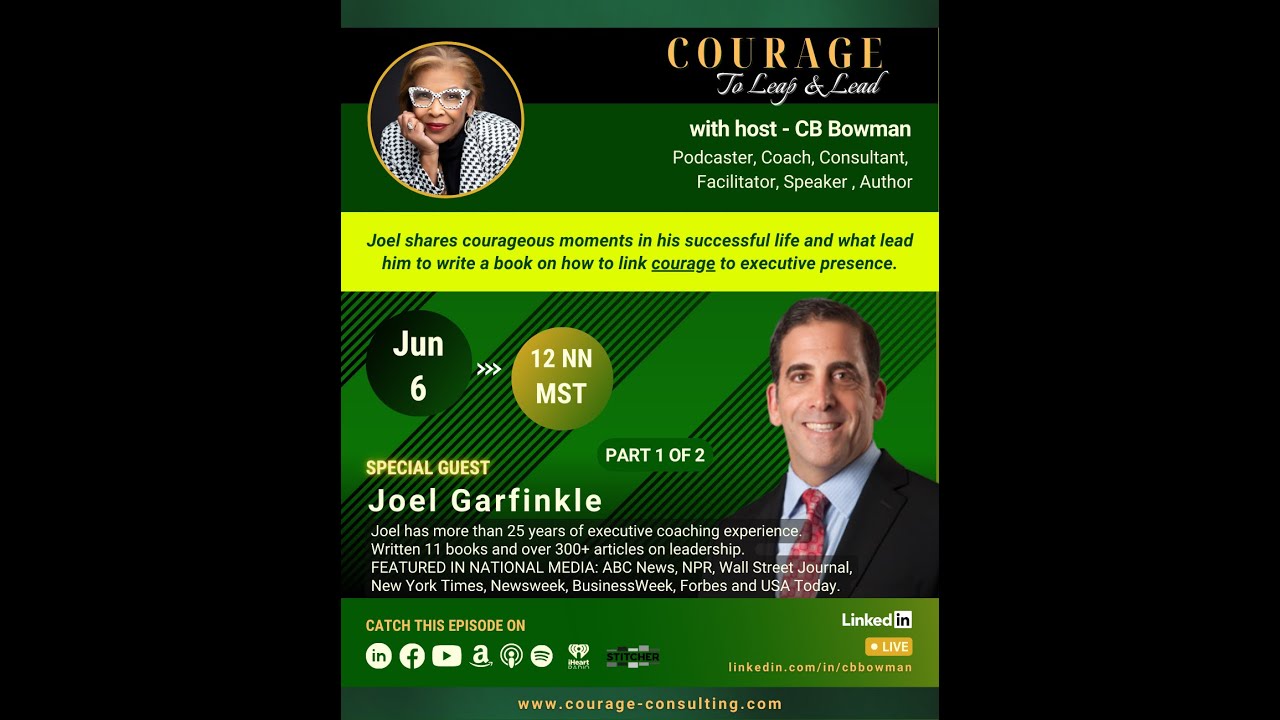
Executive coach Joel Garfinkle talks about building executive presence, the confidence and gravitas that gets you heard in the room. He's noticed over 25 years that women, people of color, and introverts are often overlooked, and shares tactics like speaking with weight and using "show-stopper" moments to reclaim ignored ideas.
Chapters
You've got courage to leap, courage to lead.
Be brave and be bold. Whoa, let it roar.
Welcome to the Courage to Leap and Lead podcast, where each of our guests share the stories of courage that helped them become powerful leaders. Before we start today's show, please remember to visit courageconsulting.com where you can find all of the episodes and lots of other excellent resources. That's courageconsulting.com. Now, here's your host, Leadership Courage Coach CB Bowman.
Hello everybody! Don't you love my new song when you tune into the show? I feel like I'm a contender now. Well, today we have a coach on the call. And, you know, we haven't been doing a lot of coaches, per se, but my friend Barbara said, you must have this guy on the show. And I said, I don't know. I don't know. He's just gonna want to promote his book. And she said, no, no, no, he's really a good guy and you want to meet him. I said, okay. Because nobody could say no to Barbara. It's like trying to say no to me, right? So I'm really excited to know more about this guy who I don't know, who is a big friend of my friend. And I feel like I'm the one who should know all my friends' friends, right?
That's right.
Without further ado, I'm going to— oh, but wait, wait. It's a secret. The Association for Corporate Executive Coaches is coming back in terms of conferences. So watch for the conference. It's going to be in September. And you have the inside scoop because the website is not even launched yet. So keep an eye out for it. It's gonna be a good one. It's called Expanding the Possibilities. Mm. I won't tell you anymore right now. So now we're gonna talk to Joe, Joe Garfinkel. Garfinkel, I think that's a famous last name of singer or something. Yes? No?
Simon and Garfunkel.
Oh, so it's spelled a little differently.
It is, yeah.
Okay, well, we'll let you get away with that. See, I was—
And I'm not going to be singing on this, on, on your show today, I promise you that.
Great aura for you. Well, Joel, it's a pleasure to meet you. Tell me, why should I know you?
Well, you know, so much of your show is about courage. And I find that every client I work with as an executive coach and all the leaders I work with, so much of the foundation to the changes they need to make require courage. And I think even as humans, I think of myself and the situations I've been in certain times in my life where courage was necessary and needed. And to be able to overcome any fear I might have, or see that leaders I'm working with have to overcome certain fears and part of their development and growth, that courage is a key part to all of that. And I know that's something you really care about.
I really do. And thank you for saying that, because I think too many people that are established like yourself don't want to talk about courage. And even myself, when I wrote the book, which will be out soon, um, there was a lot of things that I revealed, a lot of things that I found out about myself that I thought I already knew. And so I'm glad that you're talking about this, and we're going to get into it more, especially in relationship to clients.
Mm-hmm.
And look, everybody, nobody gets to where Joel is without having some failure and figuring out from that failure how to be successful. Nobody does. So anybody who tells you, oh no, I've never failed at anything, can I just tell you, they're full of you know what, right? Because it's kind of like being in love. If you haven't experienced the pain, How do you know that you're in love, right? So let's— first, I want to find out about Joel himself, OK? Joel, why did you want to be on the show today?
Well, our connection with Barbara. She is someone who did say, you know what? You got to meet CB. She's someone you have to know. And so, I mean, pretty much my draw to that was to be on your show and be able to talk about some of the things my experience I've had with especially, you know, I've been doing executive coaching for 25 years and I've worked with over 1,000 leaders. So I've seen a lot of things that leaders deal with. And to be able to share with your audience and people out there who are either in the workforce or are possibly even coaches, how to deal with some of the situations and clients that they have to deal with and how leaders can more effectively, you know, get better at what they do and who they are and how they're showing up. So I was really drawn to that piece. Yeah. Good.
I want to start at the beginning because you are one of the great coaches, and there's not many out there. There's a lot of people that call themselves coaches, but there's not a lot of great coaches. So tell us, how did you get— tell us about you growing up. Tell us about your parents. Tell us, talk to us.
So, you know, it's interesting. I, um, I, I have my, um, I have 2 parents. Uh, one passed about 5 years ago, but my mom's still alive. And I have 2 siblings, um, both older. I'm the youngest. And it was interesting. I was, uh, at a young age, I, um, I remember it was about— I remember not having as much hope and feeling like I was struggling. And I remember watching the movie Rocky when I was like 6 years old. And I was inspired and said, you know what, everything that this is about is about inspiration, courage, motivation. And I was drawn to the concept, and I was drawn to those ideas. And I felt like my life, that there were things that I was struggling and not— things weren't coming as easy to me. And I felt drawn to the idea of kind of the strength and be able to show up with more kind of power and having the courage to go after what you want and And I was really struck by that. And I just remember that as a distinction in my life of something that before that— and I always struggled in school and struggled, and I'll tell you more about that. But at a young age, I kind of knew that there was something about that movie and Stallone. And just at an early age, I was like, wow, I want to be able to achieve what I want to achieve in my life and not be held back by anything. and was really taken by the message and felt like there was hope and inspiration in something that in my life I didn't feel it as much and felt kind of held back and limited. And so I really was struck by that. And ever since then, kind of have been drawn to a level of kind of burning determination and strength and power and trying to be inspiring to others and, and for myself at times when I needed it.
So that movie helped you determine that you were going to be a contender?
Yes, yes, exactly. And that, and that, and that I needed, I needed to be inspired and to be— and I felt like that movie represented something that said you can do it. And no matter what challenges you have in front of you, no matter how hopeless things feel, how much you struggle, And even at a young age, I felt some of those things. And so I was like, there's a level of like, I can do it. I can get through this. I can do whatever it takes. And it led to a period of time when I think about like a failure or something I struggled with. And it was in high school. I was failing high school. I was getting mostly Cs and Ds. I was thinking about dropping out of high school, and I was really struggling and having a hard time learning and listening in the classroom and being able to retain information. it wasn't how I learned. And I was experiencing a lot of failure. And I remember really, one, I had a very dear cousin of mine who's close to me today, 30 years later, where he is someone who I speak to weekly. We support each other. We're an inspiration for each other. We're confidants. We're really there for each other. And at this time, about 15 years old, I— he started tutoring me. And we— I remember him saying to my mom, you know, I think he could be tutored 2 or 3 times a week. And she's like, well, why can't we just do once a week? And he's like, no, he really needs that support. And we started tutoring, my grades started to get better, I started to believe in myself. Even though academically, I wasn't drawn to the classroom environment, and it wasn't suitable for my type of learning, more of experiential learner. It's like I got through high school, made it to college, and then in college I was starting to get Bs and some As and started to get better at it. But I also didn't love the classroom environment, didn't know what I was going to do. And I took a class on leadership and there wasn't many classes on— I just was drawn to it. I was drawn to like understanding how business leaders think and how how leadership operates and how do people— why is one person more successful than another? And what makes someone achieve the level of success that they have? And I started to be drawn to that and curious about it. And I remember thinking to myself, you know what? I want to do something. I like helping people. I like working one-on-one with people. I want to do something, I thought, possibly in psychology. But then I said, I want to deal with people who are more healthy. And that was my thought. I was telling someone this and they said, oh, that is called coaching. I am like, coaching? It was very much in its infancy back then. I am like, that is interesting. So, I went and did some corporate jobs, but in the back of my mind, I always thought about this. At some point, I left the corporate world and started, signed up for a 3-year coaching program, started to coach. The minute I had my first coaching session, I said to myself, and my ability to coach, I said everything that I was, all those all the studying, all the learning, all the schools, all the jobs I had, every time I felt like I was a fish out of water. I felt like I was struggling. It didn't come easy to me. The minute I started coaching people, it was like I was a fish that found his ocean.
Yeah.
I just felt so natural and at ease and intuitive. And I knew exactly what to say, when to say it. I knew when to listen. I knew when to hold back. I knew when to inspire. Everything just clicked. And I felt a tremendous amount of passion and alignment to that field and do the art of coaching. And so ever since then, I have been doing it and I love it. And I feel like it is remarkable for me to feel like I struggled in so many places where careers and academia, where that is the only place you could define your success. So then all of a sudden, I found something of that, like, oh my God, I'm really good at this. And I'm aligned to it, my gifts and talents are aligned to it. And I have a passion for it. And so everything clicked. And I was like, oh my God, this is— I was, I was put on this earth to do this work.
I love this story. I love this. Tell me why you struggled when you were younger. Because I think I know the answer.
You know, I think some of it was, uh, I had a, I had a learning disability, so I struggled in school.
I knew it. I knew we are soulmates. I am highly dyslexic.
I have a form of dyslexia too.
Yeah, trouble in school. Yeah, go ahead.
Well, and what's the shame about that is, I mean, nowadays, you know, they're identifying the struggles and trying to get help more proactively. But back then there wasn't much support. And, and so then all of a sudden you're looking at yourself in the mirror saying, am I a failure? Like, yes, the only thing I can measure my success from is my school.
Absolutely.
So it's difficult to sit there and say, well, how can I be confident in myself and what I'm capable of when what I have in front of me is something that feels like I'm failing at this? So that was a struggle. And I am— yeah, you know, you've written books, you've been incredibly successful in your career and your life. It's like, you know, things work themselves out.
Yeah.
And you got to have faith, and you got to trust, and you got to realize that, you know, your talents will rise to the top. It does for each of us. How do we get in contact with what those talents are, and be able to exercise those talents and align our gifts to work that we can feel some fulfillment from?
You know, I think I agree with most of what you said. I think For many people, it doesn't align itself. And they don't— there isn't this synchronicity that happens. They don't have a cousin or a friend or somebody that says, you're okay, it's the rest of the world.
It's— and having— I mean, sometimes that can be a parent, sometimes it could be a teacher, sometimes—
Exactly.
Me, a cousin. You know, someone who believed in me and said, you know, this isn't all you. And yeah, and even though it feels like, well, that's the only data I have to go from, is to have someone believe in us and really take an interest and care about us and see the goodness and greatness that's inside us, despite what some things might be telling you differently.
So true. I mean, I remember when I found out I was dyslexic, it was through a tutor in It was like in grad school. Yeah, was in grad school. And but, but I will say I was very fortunate when I started to— after grad school, when I started to get into various business environments. Somehow I always found— this is going to sound really weird— but I always found a man to support me. And I don't mean financially. I mean by saying, you're good, keep going. I remember when I— you and I probably know the same person, Bob Lee, who's since passed. And he founded Lee Heck Harrison.
Right.
And I remember when I first met him was at a SHRM conference. And he was speaking. And I thought, gosh, I would like to know this guy. And so I went up to him after, so nervous, I can't begin to tell you. And I said, I was wondering, and I stumbled over my words. And he said, you would like to have lunch with me? I said, mm-hmm. I could barely talk. And he said to me, No problem. And he called me. It's really a hysterical story. And he said, I don't have time for lunch, but how about dinner? And I thought, that sounds a little suspicious. And then he said, I'll meet you at this hotel. And I thought, what am I getting myself into? And it was so on the up and up, it wasn't even funny.
Yeah.
So met at— it was in North Plainfield at a hotel. Across from General Foods. And he said to me, so what do you want to do? And I said, I want to buy a house, and I want to be successful. And he said to me, that's never going to happen. And I looked at him, and I thought, who is this jerk? And then a couple of years later, I had forgotten all about him, and I was working during the day, and I had like 3 jobs, right? I was writing for newspapers at night and everything, and I get a card in the mail from him, and it simply said, I'm watching you. Keep going.
Mmm.
And I thought, what? Well, what? And then every couple of years I'd get a note from him. And then one year I got the note from him and I said, and I've just purchased my first house. He wrote back and he said, well, what took you so long? He challenged me so much. I'm not sure I appreciated his style. But he knew my style was, don't tell me I can't do it because I'm going to do it.
Right, right.
And I was just very fortunate to meet some very powerful men who just said, you can do it. Keep going. And I had just— I remember right before he passed away, he called me up and he said, so this association you've started, I think I should become a member. And I said, who said that you qualify? Think of the fact that he said, I knew one day my words were gonna come back. And I said, hey, I'll just make you an honorary member. You don't have to do anything else. And shortly after, I think it was about 2 weeks later, he passed away. And he said to me before He hung up. He said, I just want you to know I'm proud of you and I knew you could do it. And then he passed away. And I'll tell you, he's one of many men in my life that are so fortunate that really made me like a tough woman to go after what I wanted to.
Yeah.
But to, to your point, there are many that are not as lucky as we are.
Right.
As we've been. Tell me, this show is about helping those who feel like, okay, maybe I've been successful, but it's not where I want to be, or I haven't been able to break the code. All these people, they're just success, success, success. They never had the problem that I had. We're here to say that's not true. That's not true. So tell me about, other than school, what's the experience that really stood out for you that you flipped around to make it successful?
I mean, that school one is definitely a dominant one of turning failure to success. You know, when I, when I left my corporate job, I, so I moonlighted for a year as an executive coach in the evenings. And I worked my corporate job.
I did the same thing.
You did? Yeah, similarities here.
Yeah.
And I was working for, at the time, Andersen Consulting, which is now called Accenture. And I was doing that during the day, and at night I was doing the executive coaching and trying to build the business. And I remember saying, okay, now's the time, and I was going to leave. And I had about 7 clients. And within, within a week of deciding to leave, I, that I, and I set this all up, I was going to leave the corporate job. And I was going to go on a meditation retreat for 2 weeks. And just be able to kind of take, be my, be grounded and take some solitude and time for myself and really think about this this defining moment in my life where I'm leaving the corporate world to go do my own thing. And I tell all my clients this is happening, I talk about the transition. And when I come back, the 7 clients goes down to 2. And they're like, for whatever reason, because I took 2 weeks off because of transition. So now all of a sudden, I'm like, oh, You know, I just left the corporate job. I have 2 clients. And so from there, it was, it was a difficult challenge to like, okay, I have to build my business. I got to start, you know, creating opportunities. I had to really have the, the dedication, the commitment, the wherewithal, don't feel defeated, even though I felt like disappointed and somewhat defeated, and really have the determination to make sure I was going to do whatever it took to make this happen. Slowly started to build the clientele, um, and, and the business became successful. And I look at it, you know, I've done this, like I say, I've done it for 25 years, this work. And I look at it and say that I never have been an overnight success. Um, everything feels like it's been a slow— like I got my 5th client, then I got my 7th client, and then I got my 8th. It wasn't all of a sudden I had 25 clients or 20 clients. It wasn't all of a sudden I wrote a book and the next day my business turned around and it was successful. Um, everything feels like it's just plodded along the whole entire time. I cannot contribute one thing like, oh my God, this happened and everything turned around. Um, and I just think that's a— it's a good lesson because sometimes from the outside looking in, it could seem like, oh my God, this, this person's really successful because they have books and they have clients and they have this and they're doing really well. And it's like, it, it's always been a continued progress of dedication, commitment, and, and things took their turn, but nothing ever seemed fast enough for me. Um, but success has always been sustained.
Mm-hmm. So how did you go from the 2 clients you had? How did you get your 3rd client? What did you do?
I started to talk to all the people I was— I was doing Toastmasters at the time. I was talking to people from like the former job I had and letting people know what I was doing. And I was amazed when I left the corporate job, so many people came up to me afterwards and said, I wish I had the courage to do what you're doing.
Oh, yes.
I didn't expect that. And I was surprised by it. And, and I told people what I was doing and how I was doing it and what my process was. And, and slowly but surely, you know, the third client came because of my networking and putting myself out there and reaching out to people and letting people know, here's what I'm doing, and here, here's, you know, here's an opportunity for you to work with someone, um, and be able to get the support you might need. And I get to be able to kind of grow my practice and be able to show my value. in what I can do in the world. And so things started to click and people started to kind of come to me and the practice slowly started to grow. Yeah.
So my next question to you is, at the beginning, you mentioned that some of the leaders that you work with really have displayed courage in what they do. And you've supported them in doing that. Give us a couple of examples.
Yeah, you know, um, sometimes it, it's, you know, a lot of times my area of expertise is, is executive presence. And so—
And wait, hold on a second. Didn't you write a book with that name? That sounds kind of familiar. You did. Can we see what it looks like? Oh, up higher.
Well, there.
Well, hey everybody, you know that we just roll with the punches. That's the, this magic screen.
There we go.
That's a thick book.
Oh yeah, it's very thick.
How many pages is that?
330.
Oof.
Yeah.
Tell us, what does it mean, executive presence?
Executive presence is really about how you show up and how— and it's about showing up with a foundation of confidence and command and gravitas. And it's really about coming across as someone who— you deserve a seat at that table. You have that presence and power that people want to see in leaders. And so What I found, and it's interesting because what sparked my interest in this concept of executive presence was about 20 years ago, I saw a pattern to the clients I was working with. And, and they had a similar issue. And oftentimes the people I saw when I worked with these clients were women, people of color, and introverts.
Oh my God, I see the pattern for all 3.
And they're being held back. They're being held back in their careers because they lacked an executive presence. And oftentimes, what I noticed is they came across as too tentative, quiet, too deferential to others. And I look at that, and they really like lack the courage to step more into their power. Convey more confidence, be less quiet, be more outspoken, be less tentative, and instead be more decisive and clear. And so—
Wait a second now. Do you know why that happens to us women?
I don't know directly, but the pattern I've seen is sometimes— I've seen many clients tell me this— that they'll be in a meeting and women clients, and they'll say— a male— I will speak up and say something, and a male client will say the same thing I just said 5 minutes later, and everyone says what a great idea that is. And I hear that story, and I've heard it many, many times.
Me too.
And I often say to women I'm working with is there's something about the male presence of how they shared it and what they said and how they show up that has a little more weight to it. And I said, you know, it's like you're dropping a little pebble into a lake and you see a slight ripple. And I say, someone else could take a boulder, throw it into the river, and you see major ripples. And I— what I say to them is I say, when you're showing up at these meetings, how can you come across with your voice, with your presence, with your body language, with how you're communicating, um, and with your idea? How do you share it in a way that has a gravitas, a weight, a heaviness, a, a, a spark of some charisma, more command, so that when they hear your idea, they're not deferring to the guy, to someone else who says it later. They actually hear your idea and they hear the weight and they feel the weight of it. And they feel the strength behind it, that they're like, oh, I just heard what you had to say. And it like, bam, it like, there's the impact. And so I think there is something to be said about how do you show up with more power and presence so people can feel you, experience you, And realize, oh, this person has something to say and I want to hear it.
Yeah, you know, this, this is a fabulous subject because it talks to stepping out of failure and stepping into success. And a lot of females don't know how to do that for fear and because of experience. The experience— the fear being told you're not good enough.
Mm-hmm.
Experience being when they did do it, they didn't know how to do it. And as a result, they were chastised.
Mm.
So when you put together that combination, which is a powerful combination, it really holds women back.
It does. It does. And then all of a sudden, they become tentative, hesitant, unsure, lacking confidence. And so then they show up in these meetings or running a project or running a situation. Every single employee in the workforce, if they feel like they're not good enough, if they feel like they're going to be chastised if they're doing it wrong, if they have any sense of imposter syndrome, Then what they're doing is they're going to be holding themselves back. And so then their power and presence isn't being felt. And so then other leaders don't see them in positions of greater leadership. And so they're holding themselves back, and then the company doesn't get more out of their talent. They're being underutilized and overlooked and undervalued.
Same thing in their own business. Look, I'm a member MD 100. I see this a lot with the women there, and these are all fairly successful women. And I remember, you know, Marshall has these power calls, and I remember when I first came on power call, and I had gone on now a couple of them, and I had women calling on me, actually call me up and say, why is it that you're the only woman that Marshall really pays attention to? And I said, that's a good question. Ask him. But I knew the answer. A great deal of the problem is that women get so nervous thinking about what they're going to say and how they're going to be perceived, they're not paying attention with their ears.
Hmm.
Not paying attention to What men particularly are really saying. And if you pay attention, a lot of men are saying, I need help, I need support, I need recognition. And if you offer that up, by doing that, you escalate your status in the crowd.
That's good. That's fascinating. That makes a lot of sense.
So whenever I came on the call, as I got to know the men, I would say, How's it going? You look great in that color. You wore that the other day. And by the way, how's your wife doing? I know that you mentioned that she wasn't feeling that great. I had everybody in my head, right? And so the men would then get on the— hey, CB, how's it going? What's going on? And the women would say— But she just joined this group and like everybody knows her because I listened to what their needs were, paid attention to what they were saying, and was able to quote it. And so when I spoke, and I didn't speak often, and that's another trick that I learned from a very powerful woman, when you speak, make sure you have something to say. Not something to say that's general, but that's a showstopper.
Because then you'll stand out and you'll create visibility for the insightful viewpoints that you bring forward.
Exactly. So like when I was trained to sit on boards, the first class, the first lesson was when you go into a board meeting for the first time, shut up. But listen, don't try to prove yourself. Listen to the need and listen to how other people present solutions to needs.
Mm-hmm.
learn the proper communication style. And a lot of women particularly get stuck in one communication style instead of understanding that there's a whole variety, and you have to be able to have a portfolio that you can pull on to use depending upon the style that's being used at that particular time.
That's true. And I think what— one thing I hear from your lesson that you learned is you really worked on building those relationships. And what it did is it allowed the men to respect you.
Yes.
And, and with that respect came, um, appreciation and acknowledgement for you as a person. And then it made you feel like, I feel equal to them.
Absolutely. And stand tall. So I always say to women, if You've said something in a meeting and it wasn't heard, and a man repeated what you said, say something. Don't sit there and think like the shrinking violet. Say, I believe I just said that. Yeah. And you'll be surprised the attention you get.
Right. That's a showstopper. I mean, that will—
Showstopper.
Yes. And, and that takes a tremendous amount of courage to do that. Because in some way you'll be shaming that person, but you're also taking back your power.
You're taking back your power. And you could say it gently and you could—
Of course.
—laugh after, and the person doesn't feel that shame. And you could, you know, in a way, depending upon how you say it, it can contribute to have more dialogue between you and that person who did that.
Absolutely. And I bet, you know, I know that most of the time I've seen situations like this, they don't even know, they're not even aware they do it.
Absolutely. Absolutely. I've had men say, you're right, I thought I heard that someplace. I was like, yeah, just now.
I really think that it is important to like, how am I— how do I be more conscious on how I'm showing up? Even how I lead a project? How do I write an email? How do I handle a certain situation? How do I show up in all these meetings? All of it is, can I show up with a power and a presence and a confidence that allows other people to see that my presence deserves to be here and I have something to share? And when I share it, people are going to really lean in and listen to me.
Absolutely.
It's so important because you're not— you want to earn the respect of others, but you're not going to earn it by being quiet.
More from CB



211- Courage to Leap & Lead with Louise Story part 1Courage to Leap & Lead







