Courage to Leap & Lead with Marjorie Ngwenya - Episode 141
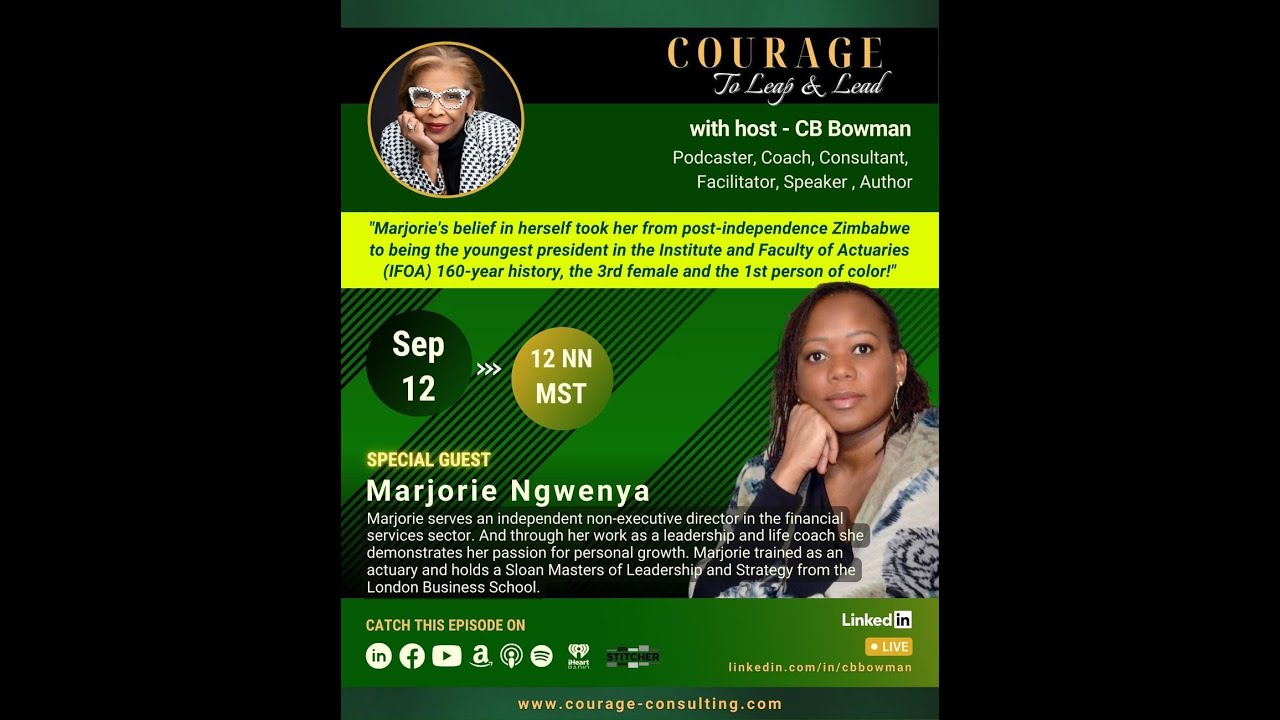
Marjorie Ngwenya, a Zimbabwe-born actuary, dropped out of university during her country's economic crisis, worked as a casino croupier, then joined Deloitte without a degree. She passed 15 exams to qualify as an actuary, became the first person of colour to lead her professional body, and now runs a consulting and coaching practice.
Chapters
You've got courage to leap, courage to lead.
Be brave and be bold.
Let it roar.
Welcome to the Courage to Leap and Lead podcast, where each of our guests share the stories of courage that helped them become powerful leaders. Before we start today's show, please remember to visit courage-consulting.com. Where you can find all the episodes and other excellent resources, all at courage-consulting.com. Now, here's your host, Leadership Courage Coach CB Bowman.
Hello, ladies and gentlemen. How are you today? It's CB Bowman. And by the way, Don't forget to subscribe to my newsletter. We're putting together a bang-up newsletter that'll come out probably twice a week, maybe once a month, and it has some fantastic articles. So you simply go to Courage Consulting— no, you don't go there, you go here, courage-consulting.com. And you'll see a link to sign up for my newsletter, and I look forward to hearing from you. Today we have a special guest from Africa. Marjorie is joining us. Marjorie is a coach, and she can't wait to tell us some stories, some inside secrets about how she became so successful, because I looked at her LinkedIn profile. And she's always standing before a microphone. So I wanna know if this lady has ever failed at anything. I'm, I'm looking at this AIG 100 books that look like they're in a library, and I'm like, even her photograph on LinkedIn has her with a microphone. So we know we're gonna be hearing some really good stuff. Welcome, Marjorie. Thank you.
Thank you very much.
What country are you in, in Africa? What part?
So I am based in South Africa. I'm currently in the U.S., however.
Okay.
Yeah.
Why are you here instead of there, or there versus here?
I am in the process of a relocation, having recently gotten married to my husband who's American. American and African and Brazilian.
Wait, wait, say that all again.
He's a blend of American, Nigerian, and Brazilian.
You have your hands full.
I sure do, in a good way though.
Yes. And how did you guys meet?
We met online in these modern times and went on a number of dates and got to know one another. And it was magic.
Oh my goodness, I met my husband online too.
Oh, fantastic.
Yeah, it really works when you, when you really figure out how to do it. It really works, right?
Yes, I was a big skeptic. I was very hesitant about being on the platform, and I gave myself one week and said that if I didn't meet anyone worth going on a date with, that was it. I wasn't interested in pursuing anything else.
Wow.
I count myself very, very lucky. And he's the only person I did go on a date with, actually.
Wow.
Yeah, you know, the same thing happened to me. I said, yeah, my husband picked up within a week and asked me out, and that was it.
Wow, beautiful.
Which platform did you use?
We were on Bumble.
Really?
Okay.
I was gonna say I have to check it out, but my husband is sitting right here. And one is enough.
You can refer it though.
Yeah. Okay. What does he do for a living?
So he's a neuroscientist by training, and he works for a pharma company.
Fantastic. You did good.
Yes, I did.
Did he reach out to you first or you reached out to him first?
So on that particular platform, the women do the reaching out first. So you see somebody's profile that you like and you match with them. If they've liked you, then it's an instant match, and then it's up to you to decide whether you want to start a conversation. So I put out the feelers first.
I love it. Yeah, I love it. Well, I proposed to my husband Oh wow, love that.
And clearly he said yes.
No, he said sure. So young lady, tell us a little bit about your childhood.
I was born in the UK to parents who were studying there at the time. My parents are from Zimbabwe, So not long after the country's independence, we moved back there, and I spent most of my childhood years there in junior school and senior school and left at the age of 18 to return to the UK to study. So my childhood was very, very wholesome, small community. I grew up in a tiny little town called Gweru in the middle of Zimbabwe. in a very Christian school and community, and in a place where there was very little shock factor. So moving from that little town to the capital city, Harare, when I was 16, I think, was a big shock to me. And then after that, moving from Harare to London was an even bigger shock.
Wow.
I moved to the UK to study So my ambition was to do a BSc in Actuarial Science at the London School of Economics, and I'd been accepted into the program. However, about 6 months into my studies, the Zimbabwean economy was in real difficulty, and my parents were funding me from Zimbabwe. So I had to drop out and to start working. And so I had to figure my way out in life as a young adult, deciding which job I was going to do, what career path I was going to take, whether I was ever going to return to university, to this path that I'd chosen. And yeah, it was a tough start to adulthood, but lots of great lessons learned.
So how did your parents bring this subject up? Did they say, you're out? Just like that?
No, it was actually me. They were very unhappy with me. They thought that they could ride the storm, that this was some kind of temporary economic situation that they would do everything they could to keep things going. My concern, however, was that my siblings would suffer if I allowed them to continue that path.
How many siblings do you have?
I have 5 siblings. There's 6 of us, so 4 girls and 2 boys. And I was very concerned that my younger siblings in particular wouldn't be able to complete their studies on account of my parents having depleted their financial resources. And I felt that I was grown up enough to go out into the big bad world and figure it out, particularly because I had been born in the UK and had the right to reside and to work in the UK. So it wasn't as if I had to leave and go somewhere else and make a new start. I could just transition into the working world. And my thinking at the time was that I would save up enough money to go back 3 years later when I'd become a resident and when the fee terms would be lower. My parents were mortified at my decision. They felt that if I stopped studying, that was going to be the end of that. I was never going to return. I was not going to amount to anything in my life, and that it was a path they really did not want me to attempt. But I was an adult at the time, so I was able to make that decision for myself. Much to their dismay.
You mean that you went against mommy and daddy?
I sure did. And that's a big thing coming from an African family, a pretty conservative one at that. And they were upset with me for a time. It all worked out, however, I would like to think. So much so, in fact, that they now take credit for that decision.
You've gotta love it.
Yes, exactly. So I went on to start working at Deloitte as a tax associate. And my thinking at the time was, I just need a job that is vaguely in the financial services field to gather some experience of working in an office and understanding corporate dynamics.
Well, wait a second. You hadn't graduated from college, right?
Correct.
And you got a job at Deloitte?
I got a job at Deloitte as an entry-level tax associate. So They needed somebody or people who were conversant with numbers, and you had to interview and prove that you could handle the work. And then we were offered the opportunity to do the examination. So I actually undertook the tax associate exams in my first couple of years of working.
Wow. Wow. That is really, really impressive, especially for me, because numbers and I don't get along at all.
Numbers were probably very easy for me, and I was really good at maths at school, which is probably why I chose the actuarial profession. And prior to joining Deloitte, I'd been working in a casino as a croupier, so I was very, very conversant with numbers and comfortable in that environment. But I'd always wanted to try out working in a corporate environment.
Wait a second now, that I didn't see coming.
That was my university job.
What in the world? And your parents weren't disturbed that you were working in a casino?
They were just happy that I was working at all. So I took Well, a forced gap year, I'll say, because in Zimbabwe, the schooling system concludes its year in December, and in the UK, the schooling year starts in September. And so I had these 9 months where I was at a loose end. I was staying with family, and they were giving me pocket money, my parents were sending money, but I wanted some money of my own. I wanted a job. And so I tried various things until I landed in this role as a croupier where you had to train for 6 weeks to be licensed, and then you got put—
I didn't know that they had to be licensed. What, what's—
what's the training? It's very, very formal. So you basically have all kinds of ethics and police checks, and you have to be registered, and you have to undergo this rigorous training. And then it's even stricter because then they ask you to not gamble at all in the UK because it is against your licensing provisions. Just as well I'm not a gambler, so that didn't bother me much.
Yeah, but you know what, I, I think like many people never gave that particular, uh, job much thought in terms of the requirements for it.
Yes. Wow, it's pretty fun. It's, it's intense as well. It involves a lot of shift work and a lot of working under pressure, so the stakes can be very high. And of course, you're representing the house and you're trying to do your best customer service job while trying to do quick mathematics and remain professional at all times. Very enjoyable though. I remember those times fondly.
Okay, so now I need to ask you, did you ever meet anybody who was cheating?
We had a few customers that came in who were suspected of cheating. I'm not sure that they were ever confirmed as cheaters in our casinos, but they had been blacklisted from other properties in the UK. And so there's a network and a community of casinos that they would ask each other whether this person has been blacklisted. Because they were counting cards or something. And there were a couple of instances of that for sure.
You know, I never could understand why counting cards was illegal. I mean, if that's a skill set you have.
Yes. I guess it's not particularly ethical. But I was always obeying the house. It was my job.
It's not ethical. It doesn't make sense to me. I mean, you're going in, And you have a skill set, why not use it? I mean, I don't gamble, so I don't understand the—
Yeah.
Morale.
Neither do I.
Yeah, but, um, heck, isn't that the name of the game, is that you're trying to win? Indeed.
But then the house will lose, and the house doesn't like that. I suspect that's the issue.
I see. Well, I mean, then get in another business. It's almost like the insurance business, right?
Indeed.
So, okay, that had to be so much fun doing something like that.
It really was. Yeah.
And so you did that in England?
Yes, I did. So I did it up north in Stoke-on-Trent to begin with, and then I moved to London to prepare my— for my university and did it there for a while in the West End. And then I left it when I left university. I stopped doing that work. And went into full-time corporate work.
I can imagine your university application. I work at a gambling house.
Fortunately, I'd had to apply to university before I left Zimbabwe, so none of that appeared. It was all based on grades and motivation.
That would be at the top of the applications. This is an interesting gambling house.
I'm good at the numbers.
Okay, so then you went to university and what happened next? You got a job in corporate in Deloitte. Was that your corporate—
That was my first corporate job, and it was very, very intuitive to me to take up any training that was being offered. So I was quite happy to undertake this qualification in as a tax associate, and when I was coming towards the end of that my manager approached me and said, I remember that you were studying actuarial science before you left university. Did you know that we have an actuarial science department here? And would you like to talk to the partners there and see if they'd be willing to take you on? And I thought, wow, that would be marvellous. Yes, please introduce me. And so they did that very kindly, put me in touch with the partners in the actuarial department who very generously were able to entertain this young girl without a university degree and offer me a place. So they said that they'd not taken somebody on who didn't have an undergraduate degree, but they were willing to give me a try based on my recommendation from my former manager. They would want me to pass the exams, and if I was unable to do so, they would have to let me go. So the true test was, could I pass the professional exams without a degree?
Mm-hmm.
And so for the first few months of that job, I was terrified that I was not gonna be able to meet the standard, that I was at some kind of disadvantage. I had a handicap because I didn't have this degree, and all my peers, so the people who were at the same level as me, had all graduated from university, so they were a couple of years older, and they had this background that I didn't have. So it did feel like a bit of a chip on my shoulder for the first couple of years. But fortunately, I passed my exams, and as soon as I passed my first couple, it was all forgotten. The agreement that we had that if I wasn't going to pass, they would let me go kind of fell away because I'd already proven that I was capable of doing it. And so it was a tough slog for the next 5 years passing those exams, and I qualified as an actuary a few years later. Wow.
How did you— because I know people and I've coached people that had to pass those exams, and it's hell. It's hell. One person I coached was dyslexic, and she had to pass. Like, I'm dyslexic also. And the pressure the company was putting on her to pass was just horrific. Absolutely horrific.
Yeah.
And in fact, she ended up leaving the company, taking on another position at a different company, and she passed because they said, well, you know what? If you don't pass, there's still an opportunity here. And removing that pressure was all she needed. You know, it's like them saying, we believe in you.
Yes. Yes.
So how did you get past the fear of your taking that test, those series of tests?
I just had to believe that I could do it. I had to believe that this was not impossible. So going back to the very reason that I had chosen this profession in the beginning, It was because while I was at school, I was contemplating what I would do as a career, and my parents had been very clear that it could only be a formalized profession. So take your pick— doctor, dentist, accountant, engineer, whatever it is— but it needs to be a profession. And my sister was studying to become a doctor, and I really didn't want to go down that path. And my friends were becoming accountants, and that seemed really boring to me. Ironic, given I'm an actuary, I know. And I thought, well, I've recently heard about this thing called the, uh, called an actuary, and I was told there were only 5 of them in Zimbabwe. And I thought, well, 5 means it's possible, even if it's very, very hard.
I love your thinking.
So I thought, well, you know, if they could do it, I'm sure I could do it. And so when I went into the exams, it was with that mindset that this is not impossible. And if I apply myself, if I work really hard, I'm going to do this.
Mm-hmm.
And sure enough. And so I didn't pass all of my exams first time. And I think that was to be expected with my background in particular, but not unusual for the exams in any event.
Yes.
But I qualified in what I would regard a quite quick time, in 5 years, and the rest was history. I didn't look back on my missed experience in my undergraduate. I'd always thought that I would work for a few years, go back and do my undergraduate studies, and then re-enter the working world. But as it happens, once I'd gotten about two-thirds of the way into my professional exams, I'd already covered the material that I would need in an undergraduate, so it didn't make sense to go back and do that. And so I never did go back and do that BSc, but I did later go into a master's, um, for fun, as one would say.
Some fun, right? Okay, I can think of really fun things to do. That would not be on my list. No, but I want to go back to something because many people who are in professions, quote unquote, that require licenses give up after either being in school or being in that profession for a long period of time. After they fail, they just have no energy to go back and try it again because they put all this energy into passing the first time.
Hmm.
How did you get that energy back? I know you, you said to yourself, well, I could make this happen, but there's a difference between saying I can make this happen versus getting the energy. Yeah. To make it happen. How did you get that energy?
So the failures were really demoralizing. There were times when I thought, I really don't want to be doing this. It's a lot of investment in time and energy to come out with a grade that I'm not happy with. And I decided that I really, really, really wanted that prize at the end. I wanted to qualify, and therefore I was going to put everything I had into doing it. So it's kind of asking yourself why you were doing something. Now, at the time, I only had that frame of thinking. I only had the frame that said, I'm not successful unless I have this qualification. I'm not successful unless I climb the corporate ladder. And so because of that narrow definition of success, it really helped me. It spurred me on to keep going and to keep trying. And, um, I also had really, really great colleagues and mentors who encouraged me throughout the process because they themselves had been through it and understood exactly what it involved.
So you had to take what, 5 exams?
I took 15 exams. 15?
15?
1-5. Yep.
Is that the same in the United States?
Roughly. It's a slightly different structure, but I think it works out to a similar number of modules.
Ah, okay.
The exact structure of the, of the US exams. I know that the earlier exams used to map quite well, and then they diverged when we got to the later exams. But, um, the systems are comparable, so even if it isn't sliced the same way, it probably is covering a similar amount of content.
Sure, sure. And so how many of these did you fail?
Gosh, I would say 3, maybe 3 or 4 of them. And how many times—
Yeah, I was gonna ask, how many times did you have to take— oops— um, the same exam over?
I think one of them I took 3 times. Really, really, I struggled with stochastic modeling. And I think just not having that kind of background in the university sense, and even in my A-level mathematics, we hadn't covered anything near that complexity of maths. And so—
For our viewers, tell us what, what kind of math is that?
So it is mathematics that involves statistical distributions and applying those to the real world and trying to understand how things behave when compared to a statistical distribution. So something like investment returns and how variable they are and trying to model those. But I was really stumped. So conceptually, I love the application of the maths, but it was the actual understanding of the theory that just boggled my mind to begin with. And eventually the penny dropped and I passed. But I think that was one of the toughest subjects I ever did.
Well, to me, if I'm thinking the right thing, it— that kind of statistics, it's like, it boggled my mind in terms of where do you start? Because There's this, like, it's infinity. And so how do you all of a sudden pick a set of numbers? And then from there, say, this will happen in the future?
Yeah.
Who made that number God?
Yep, it's pretty difficult conceptually.
So I never quite got that. Because I was always bought— I'm a military brat. Show me. Let me see the evidence. I don't see evidence in how you're picking a number from nowhere out of the sky, and that's gonna become the truth of your life for the rest of X number of years. It just does not work for me.
Yeah, I can understand that.
Okay. So, so you have the ability To come back 3 times to pass this exam?
I needed it. I couldn't move forward without it. And this particular one— so back when I did the exams, the exams were tiered in 3 levels, and that exam was a first-level one. So I'd passed all the other ones except for this darn one. I just couldn't get it. And so it felt really restrictive because I thought, well, how am I going to qualify if I can't pass this? What I thought in my mind was basic, it's clearly not basic. But, um, I did have issues about not passing it and had to talk myself into just focusing on the concepts that were really troubling me. Because I think when I was preparing for it, I was focusing on my areas of strength. And so when I got to the exam and something stumped me, I would really, really struggle to recover. And so I started focusing on the things that gave me difficulty in understanding, and I do what I call reverse engineering the process. So I would go to the exam papers, pick those difficult questions, and learn from the solution. So understand what it was the examiner was looking for in that answer and use that as my learning material. rather than starting with the theory.
And lo and behold, that is absolutely brilliant. I love it. I love the idea of focusing in on the fear to eliminate it. Yeah, that is absolutely brilliant. Was that advice that you got from your mentors or what?
Not so much. I think it was just having that level of frustration that I did to think How do I do this differently? I keep going into this exam with the same level of preparation and getting the same result. So something needs to change. What's that going to be? And so I went at it the wrong way around, some would say, by looking at the solution first and trying to figure out how to get to that from the question.
So you picked a number from the universe and decided to make the number make sense.
Exactly right.
I think you were busted just now. I love that idea. I think I will write about that in my next book. That is a great philosophy. Okay, so you got through your exams and you stayed at Deloitte for what?
I was at Deloitte for about 3 years, I think, and then I moved on to a reinsurance company. So when I started at Deloitte, I was working in the pensions area, and I remember when the penny dropped one day. I said to my manager, I finally understand what we're trying to do. Trying to make money. I understand the cost of funding these pension liabilities for people who will retire in years to come based on some broad assumptions about how long they'll live and what the economic climate will be inflation-wise, interest-wise, etc. Ah, that's what we're doing. But I really didn't enjoy the fact that it was incredibly complex trying to value these liabilities with a backdrop of so many legislative changes. So you had to know when the rules changed, in which year, and what they implied. And it just seemed so detailed and so, could I say, so meaningless to me that I wanted to explore a different area of work that I could relate to a little better. So I moved on to a reinsurance company to work in life and health insurance and thoroughly enjoyed that exploration. So learning about how those products are priced and what the reinsurance market is about and using my experience from Deloitte in client management to work with reinsurance clients as well in business development. So I really, really enjoyed that adventure. And then I returned to Deloitte under the insurance umbrella this time, and was fortunate enough to enjoy secondments to the Netherlands and to Canada. So expanded my horizons a little and really enjoyed working internationally, which is something that became very much a theme in my career after that.
I love—
actually, what you're telling me is the theme was carried on And just kept broadening and broadening so that you became— it all centered around the same thing, but it expanded immensely.
Yeah, that's right.
And then what next for you?
I decided— so I qualified while I was in Canada. I was on my way back from my secondment when I qualified, and I was now thinking, well, what's next? Now, by way of backdrop, I was thinking throughout my studies, what is the point of all this? What is the point of working in this formalized environment? What is the point of taking these exams? What is the point of any of this that I'm applying myself to? And every time I had those thoughts, I put them aside because I didn't feel like I had the permission to ask those questions.
Mm-hmm.
It felt as though I needed to just be done with it. I needed to push through, qualify. I needed to climb the ladder as I'd been taught, and that was that. But when I—
Why did you feel that you couldn't ask those questions?
Because I'd been raised in this environment where education was everything, and here I was in this privileged position where my employers were paying for me to study and I was getting this really valuable qualification And I had a great job and I was being paid well, and I'd been taught that climbing the corporate ladder was the Holy Grail. So who was I to be questioning this Grail? It just didn't seem legitimate, and I couldn't convince myself at that time that I had a valid question that I was asking.
Mm-hmm.
And so I just kept at it. I started to question whether that life was a really good fit for me. at the time I qualified. Because it was a, okay, so now what? Now you've been chasing after this thing for so long. What are you going to do post this? You know, does work hold the same meaning for you? What else will you do? And I decided that I would—
You know, I'll interrupt you here, because what you're saying is what we're seeing here in the United States right now as a result of COVID Yes. Is that people become— you know, it's one thing when you're in the rat race. You get up, you take a shower, brush your teeth, get dressed, get in your car, you go to work day in and day out. It's—
Yeah.
Now you get a break and you're forced to stay home. So you may— you get up, may not take a shower, may not brush your teeth, and you go to work. You got your coffee in your hand, you got your pajamas on, you know. And then what you're finding is all of a sudden I've got time to think.
Yep.
I have time to think whether or not I'm really happy doing this, this rat race every single day like a robot. And it says to me, hold on one second. Well, my puppy is crying for some reason. You say Well, is that all there is? Is that all there is? And there was a great song by that title sung by one by the name of Peggy Lee. And it— you say, I've been on this treadmill.
Yep.
And I, I think, I'm not sure, but I think there's something better for me.
Yep. Or different.
And I don't have to be like, you know, a hamster going around and around and around in a wheel, but I don't know what to do about it. So COVID ends and you go back and you still— you're feeling this unrest even more. And now we're faced with the Great Resignation.
Yes.
And we're faced with all kinds of resentment that's coming out and you know, this, uh, being on strike while you're at work, you know, kind of thing. Because there's something in me saying I'm unhappy and I can't figure it out.
Absolutely. And I think that for many people, they awoke from their slumber. They were sleepwalking and they woke up. And it's really, really hard to go back to a bad dream. So it's that inner questioning of, I know what I was doing before doesn't work for me. But how do I shift that? Yes, comes back to the topic of courage, actually comes back to really devoting yourself to what you believe you'd like to do with your life and making it work, experimenting, trying, failing, succeeding.
But that, that word courage, you know, is my favorite word. And it is probably one of the scariest words that we have in our dictionary because it means so much. And, and we've built it up to be more than it is, and that's when it gets to the dangerous point, right?
Yeah.
So then tell me what happened with you next.
So I ignored that little voice for a while that was telling me that I needed to try something different, and because I couldn't imagine what that would be, and it just didn't seem legitimate. It didn't seem possible that I could go into life and not be in the corporate world. I just really could not see it. And so I decided that I would take up some volunteering activities within my profession. I started as the editor of the actuary magazine and really, really thrived on that. So I got to write an editorial every month and express my creativity in writing. I got to meet lots of wonderful people and interview them. I got to learn about how publishing a magazine works and the finances of all of that, you know, the advertising revenue and the production costs and so on. Really had a great time doing that. And then I decided that I wanted to be more involved in the running of the profession. And I was going to volunteer to join the council, so the body that essentially oversees the governance. And I was second-guessing myself because until that time there hadn't been somebody with my colour skin on council. There hadn't been somebody in my age group. I think I was in my early 30s, or maybe I've just turned 30 at the time. And I remember—
So you were a young upstart.
I was, and I wanted to change the world, and I didn't know how to. And in fact, I was intimidated by the idea that I would be joining a group of older, somewhat paler people, and, um, and mostly men actually. There were very, very few women on council at the time. And I spoke to a president former president of the organization, or he might have still been the president at that time. And I said to him that I was considering running for council and being part of the election, but I was worried that I wouldn't make it because I didn't look anything like the other people on council.
Yeah.
And he said to me something that really stuck with me. Marjorie, if people like you don't stand up and put themselves forward, how do you expect it to change?
Hmm.
And he was absolutely right. And so I put myself forward in that election and I won. And I thought, this is fantastic. And slowly— it's interesting what happens when there is some kind of change, because slowly we got more women And slowly we got more people of color. And I was really honored to be the first president of color and the third woman, I think, and the youngest president of my profession a number of years later. And all because of the words of a really wise man who had said to me that I needed to stand up and represent, or it wouldn't happen by magic, essentially.
I love it. And was this a white male?
Yes, he was. Is.
There you go. I love that story. And so you had that experience. You obviously taught them a lot.
I would like to believe they taught me more.
Well, I'm not so sure. But, um, and so what next? Now you're really at the top.
I don't know that I felt that way. I'd always been trying to chase significance. So how do I add value? How do I make a difference? How do I make my time on this planet count? And that felt like one way. Then you start asking yourself, well, in what other ways can you be impactful? And around the time that I became president, I'd been contemplating— so I'd now relocated to South Africa by this point.
Yeah.
And I was really contemplating what was coming next in my career. I was double-hatting as the chief strategist for an organization in South Africa and doing my presidency, which meant flying between the UK and South Africa, sometimes for one night, sometimes for no nights actually, sleep on the plane, have meetings, get back on the plane, and it was just not sustainable. And I had to ask myself whether now was the time to honor those questions I'd had all along about, am I going to take that leap of faith and leave this really structured, comfortable environment where I get a paycheck delivered every month, and I'm part of a bonus pool, and I understand how everything works, because it's all, you know, structured and safe. And I decided that my presidency was something I really wanted to devote myself to, and I needed the capacity to do so. So I would step away from my day job. And a number of things were happening around that similar time that made it the obvious choice. So I had a change in bosses, and I also had some health issues that I was grappling with. And I told myself that if I didn't make that decision, I was going to burn out, and then I wouldn't be able to do anything. So it was in my interests to take that leap. And so I left my corporate job, much to the dismay of the people around me, except my father, who really surprised me because I thought that I was following in his footsteps. He was the career guy, the corporate animal. And when I told him that I was leaving, he said, oh, good for you. What will you do next? He was really optimistic and upbeat, and he just believed that whatever happened, I would make it work.
Wow.
But I had a number of other people going, what are you doing? Why would you walk away now? Like, you're— you were chasing this pinnacle.
You're there.
Why would you step away? Well, because it didn't hold that much meaning for me. And after all, they were just labels. And that's not the only way to make a living. And it certainly wasn't a fulfilling way for me to make a living. And I was going to believe in myself and do for myself the things that I'd been doing for these organizations in making them great and promoting their names and their brands. And so I started consulting and doing a few assignments while I was doing the presidency.
Consulting in what?
In insurance. So I was using my actuarial skills to do that. and also strategy, because my last role in corporate had been a strategy role. And so for a while I was doing an assignment with Africa Leadership University, setting up the School of Insurance, which is a really exciting venture. So I was fundraising, I was meeting great people, developing curricula, really fantastic fun time. And then I was thinking more broadly about what my future would look like. And I'd always had this idea in my mind, I guess, still beholden to this climbing the corporate ladder idea, that being a non-executive director was kind of the end of that journey. And in my 20s, I'd imagined, well, when I get to my 60s, that's what I'd like to be doing, because I'll have built up to that. Well, as it happened, I was able to start exploring those opportunities much earlier. And so I started picking up a couple of board directorships and found that I enjoyed the variety and I enjoyed the flexibility, and I was able to use the skills that I'd acquired in these environments but without necessarily being an executive or a consultant. And then I decided that I wanted to be even more impactful in people's lives in personal development, and coaching had been something that I'd dabbled in. It was something that I'd done informally for a number of years, and I decided that I would pick up some qualifications in that and understand how it was done more formally, and to start taking on clients that way as well. And that has really blossomed into something quite beautiful. So I'm doing all of these things now simultaneously.
Well, you know what, I'm not surprised because you are the real deal. You know, you have pushed your way through family circumstances. You convinced your parents that your way was better than their way. And I know with African parents, man, that was something else. It was tough.
Yeah.
Yeah. Yeah. That— wow. You had some persuasive skills going there.
Indeed.
And guts.
Yes, I'm still alive.
Exactly. And then, you know, going into the university, then coming back out and going into a top 5 firm and going through those exams and blossoming and all, all along being challenged. It wasn't like, you know, you did this, you proved yourself, and then it was all easy sailing from there. You're the one person that constantly questioned whether or not this is where you wanted to be, and this is who you were. And that takes a lot of courage, a lot, a lot of courage, a lot of courage for a woman. One, of color. Two, of three, not going to finish her schooling, to push through this kind of company that I can tell you, as you know, the number of people of color there, you could probably count on the back of one hand, right? To decide in your life what's making you happy, not going to what the world is saying you should be happy about.
And the world is loud. Yeah, really now.
Yep.
If you don't tune it out, you will do what the world insists upon.
Trust me, I know. Trust me, more than what I'd like to admit, I know.
Yeah.
And I just think that you make such a great example, and I, I think that your coaching is in your wheelhouse because you've been through it. I, I find that it amazes me at people that want to have a coach that has no personal experience of moving through challenges with success.
Mm-hmm.
They talk about, you know, even when they're coaching, it's about, well, what do you think you should do? And This is, this is the question to ask yourself about your success. And there's no discussion. There's no, there's no leading. There's no leadership.
Yeah.
Coaching has to include leadership. I disagree with all of the associations out there that say coaching is coaching and should not be touched by anything else. That's such baloney. Because if you can't coach through leadership, then you can't coach your way out of a peanut bag. It's the saying, the doing, and the experience that makes it real.
Yes.
I'll use a word that I hate these days because I'm tired of hearing it, but it makes it authentic. Like, you are the real deal.
Thank you.
Look, you know, it's been such a pleasure to have you on the show. I was hesitant at first because I thought, I don't know, this is a life coach. I'm not sure that that's the right person for my audience. But girlfriend, you're more than a life coach, I'll tell you that much.
Thank you. This has been so wonderful.
Thank you. And I'm so glad our friend put us together. So I have to now bow down to him to say, you did good.
Brilliant.
Yeah, he kept saying to me, well, did you call her? Did you call her?
And I'm like, okay.
But I'm so glad. Thank you so much for being on the show.
My pleasure. Thank you.
Well, audience, I, um, I don't even know what to say because I'm stunned. I'm so glad to have been wrong. To have this very special guest on because she talks about so many of the things that I've been through in my life, especially in terms of the world saying no. And you have to have the courage to say, put that no someplace else. Because for me, I'm going to do what's best for me. And what's going to make me happy. And ladies and gentlemen, that takes all kinds of courage, all kinds of belief in yourself, all kinds of way of saying, get out of my way, I'm here to play. This is CB Bowman and my dear friend Marjorie. She just became my dear friend.
Love it.
I have now a dear friend in another part of the world, and I just love accumulating friends in other parts of the world. So please visit my website, courageconsulting.com. Don't forget the hyphen between courage and consulting. Sign up for the newsletter and you'll receive lots of wonderful articles on courage that are gonna spur you along. This is CB Bowman. I will see you next week. Bye now.
More from CB



211- Courage to Leap & Lead with Louise Story part 1Courage to Leap & Lead







