Courage to Leap & Lead with Mark Fujiwara - Episode 138
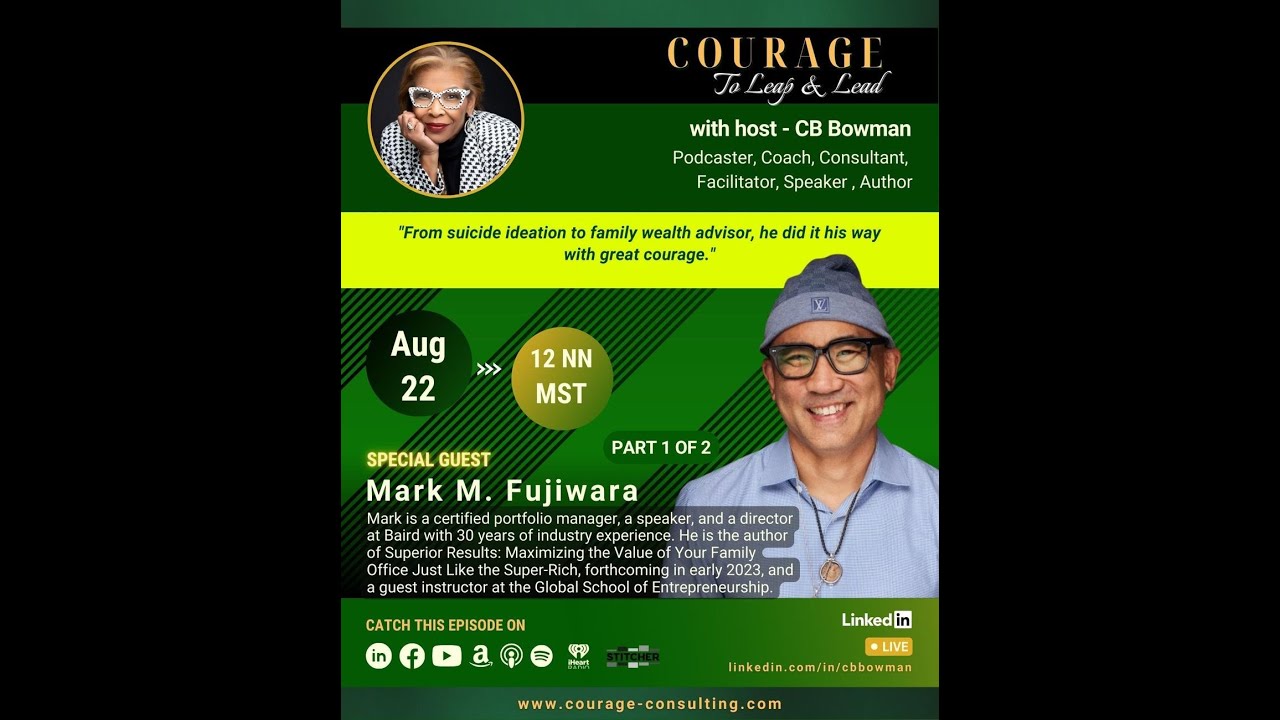
Mark Fujiwara went from panic attacks to public speaking by doing rejection therapy, cold-water immersion, and marathon training. His multicultural Asian-American upbringing made mental health feel shameful, but he broke that cycle by going to therapy and telling his family. Now he builds wealth-management relationships on personal stories instead of financial data.
Chapters
You've got courage to leap, courage to lead. Be brave and be bold. Whoa, let it roar. Welcome to the Courage to Leap and Lead podcast, where each of our guests share the stories of courage that helped them become powerful leaders. Before we start today's show, please remember to visit courage-consulting.com. Where you can find all the episodes and other excellent resources, all at courage-consulting.com. Now here's your host, Leadership Courage Coach CB Bowman.
Hello everybody, this is CB Bowman. Hey, I have a very interesting guest today that I'm going to be interviewing. His name is Mark Fujiwara. Fujiwara. I knew I was gonna screw that up, and I was so confident. Oh well. Um, he is a very interesting person because ironically he had nervous attacks about speaking, and our dear friend Tricia worked with him, and, um, he is now an amazing speaker. So he had the courage to hire somebody to help him become a fantastic speaker. And I wanna hear about this journey. And in fact, he's now in a documentary. So let's talk, Mark. Welcome. Welcome to our audience.
Uh, honored to be here, CB. Thanks so much for having me.
Oh, you're welcome. You know what? I see a lot of books on your shelf and they're all organized by color.
Yes, yes. I have to admit that is not my doing. My wife is, my wife is the chief designer of our house and probably of this town. And she surprised me during pandemic. This is my home office, and I came home to a bookshelf painted in the exact color I wanted. And then all the books are color-coded. You might see a yellow book right up here. That's my Doom, by the way. And sometimes I get a little nervous and I'll take out one of those white books or dark books or blue books or red books, and I'll put like a file folder in there just so that I don't forget where it goes. So, but anyways, I love it though. It gives me a sense of order in my busy life.
You know, she did an amazing job, as wives do, and we'll have to congratulate her on the look because it is great. I love the color. What is it? Is it like a navy blue?
Yeah, yeah.
Love it. I absolutely love it, and I love the colors there and how she arranged it. It's really good stuff. Yeah, and please take that yellow book and put it on the shelf with the yellows and oranges. Yes, you're destroying her mojo there.
Right here, right here. Okay.
Yes, absolutely. You've got it.
Now we can talk.
Now we can talk.
Now I can let her in my office without fearing.
Is your wife an interior designer?
She is. She actually is. She got her degree in journalism and the historical of decorative arts. So that was kind of our first— our second date. I asked for her manuscript. She's writing a book on that. And I tell you the truth, I know there's not a lot of interest in decorative arts, but I remember reading it and just being like, holy moly, like, I want to marry this woman now.
This is good. I love— I have never heard that way of catching a guy. That's fantastic.
It was like, I mean, I already, I already was spitting. I mean, she, there, there's everything. She was checking all the boxes. And for her to share that with me, and it, the book was about 60% done. And, um, I read that in one night and I was just mesmerized because of the fact that I have no interest in the history of decorative arts. But she got me to be interested, like the, the how the bath bathtub came about, or how The napkin, the cloth napkin came about and all the history.
Tell us that story. Do you remember that story about how the napkin came about?
It's, you know, everything stems back from royalty actually. It's like any, everything from the bath, you know, it was almost like, it was kind of like the idea factory back, you know, way back when. It's just like, okay, we're at the table and like, You know, we need something to wipe our— so I think they developed it from instead of using the sleeve, we'll just cut some cloth out and then there it goes.
Wow, I love it. Well, I'm gonna have to have her on the show and find out more.
Oh yeah, yeah, yeah.
So tell me, what intrigued you about being on this show today?
Well, it's all about courage. CB. And I feel like, um, over the last several years, I, I've been a lot more courageous. And, um, we talk about speaking, as you brought it up at the top of the show with Tricia. And speaking was probably my number one fear because I had this immense anxiety panic attack when I was 24. And I remember it vividly. You know, we go into this room and it's like a mini mastermind group and there's 8 of us and we're asked to sit down and the door closes. And all of a sudden I feel this shut-in feeling. And then they say, well, each of you has to go around the room and talk a little bit about who you are and what you do. 30 seconds, 60 seconds max. I remember I was 4th in line and I just thought, oh my gosh, I feel like I'm gonna die. And, um, I felt like the room closing in and I was trying to figure out a way to get out of there without people knowing that I, I had a panic attack, right? And here's the tough part too. So like, um, I also had a fear of, um, I had a fear of looking foolish in public.
Yeah.
I also had a fear of vomiting, and I felt like I was going to vomit. I just had a fear of letting my family down because of, you know, in this instance, a panic attack. So, okay, I had 3 options here, which were all 3 things that I thought would happen. One, I thought I was going to pass out. So I can't pass out because That's looking foolish. And I have this fear. You can't vomit because, you know, you have a fear of vomiting. So third option, I feel like I'm going to die. Okay, I'll take the third option, right? And so it was like this, this, you know, and it was, it stuck to me, right? I ended up, I don't know, I just got up and said something and it was almost to the point of just like, I'm Mark and this is what I do. And, you know, sit right back down. And I always remember that because I remember I also was supposed to speak at a group of high school students about what I do and why I love doing it. I'm, you know, I'm a multifamily office, private wealth professional. And I actually thought of ways to get out of speaking in a group of, you know, it was like a small group too, 15 15 high school students. And I just— it was the scariest thing. I knew I had to do it in the afternoon, and I was just anxious the whole day. I was trying to find ways, and it's like, oh my gosh. And finally it's just like, okay, you just have to do it. I took a Benadryl beforehand just to kind of numb myself.
Did you fall asleep during it?
Yeah, yeah. So I could kind of calm my nerves down. Now, I took Benadryl because I have hay fever, and I was like, whoa, when I have hay fever, I took Benadryl, I'm sleepy enough for just kind of numb myself out. But I remember that and I'm like, okay, this is kind of scary because I actually have to get in front of people for what I do. And, um, and whenever I got in front of people, more than 5 people, it would just be this torturous, um, anxiety that, that led up to it. So finally, um, There was a time in my life in 2016, it was, and I'd been through a divorce and it was a tough divorce 2 years prior. And when I say tough, it wasn't my idea at all.
Mm-hmm.
So I was going through some PTSD. I kind of swept the pain of the divorce under the rug just so I can be the present dad with my kids at the time. And so now I have a little bit of room to feel this stuff coming on. I had PTSD, um, felt like I was in a downward spiral. Uh, I felt like, um, I was in a rut every part of my life. In my business, it was just like I had this shame that I wasn't growing in my business and I was putting in so much work. The other thing was my health was going downhill.
Hmm.
I was, uh, pre-diabetic, you know, my, my glucose levels were going up and up. That was concerning because of the trajectory that it was going up. My doctor said, you're going to have to do something about this. It felt like depression was coming loud and clear, suicidal thoughts. I had enjoyed running before, but I got out of running shape because I would run until I would feel no kind of sadness. And so I would run like 20, sometimes 30-something miles in one, in one shot. And what happens with that is that that's, that's horrific for your body, of course, but it also injured me. So I wouldn't run for a while. So I was completely out of running shape. I was, you know, starting to just feel low energy. And I had a, um, I talked to my business coach, which was a godsend. And I had heard about an individual who is, who did a TED Talk on rejection therapy named Jia Jung. And he came to speak at my mastermind. I never, I didn't meet him at the time. Now Jia and I are like very good friends. It's interesting. But anyways, he did 100 days of going outside or excuse me, of getting rejected. So he would go out and seek ways of getting rejected. And it had such an impact on him. And so I knew I had to do that 100-day check-the-box Jerry Seinfeld method because, you know, I'm ADHD and that's the only way I'm going to get things done. So what I did was I went to Starbucks and I drank a big pot of coffee and I listed off like 250 different ways of getting out of my comfort zone, everything from health to mental health, to my relationship with my kids, to my business, to, to, to dating. Um, and amazing things start to happen. So I remember the first day I jumped in a cold body of water for 5 minutes because a guy named Dave Asprey told me about it. And, um, yeah, I'm, I'm part of the, uh, I— It's almost like a Dave Asprey cult. He says to do it. I said, okay, I'm gonna do that my first day. What was interesting, CV, was that things started to really happen. I called the—
Yeah, you froze.
Yeah, the CEO, you know, that, that had the billion-dollar company. I gave him a call and everything was like— I felt like I would seek out these things. I learned— I'm not a dancer, but I learned how to hip-hop cardio dance. I took this class with a bunch of very experienced dancers and Oh, and, you know, so this is a good one. I went out and hired the toughest coach, Coach Case in Marin. Everyone knows him as a tough marathon coach. So I not only finished the marathon, again, I wasn't in running shape, but I ran it so fast that I qualified for the Boston Marathon. I met my wife, actually.
That is a big deal.
Yeah. Oh, yeah. And it was just because it was like I was just Training, I would train for races on my own. But when I was— when you're training with a guy, I love this guy, by the way, who is, you know, who's gonna ride his bike next to you and sometimes yell at you for inspiration. That's, that's a big difference right there. So it's interesting though, I was online dating and I would only date women that were 10 miles away from me and 2 years younger, 2 years older. So then, like, towards, you know, towards the middle, I said, okay, let's get uncomfortable. Let's go 10 years younger, 100 miles. Why not? Because I was starting to, like, know everybody on, on this, these dating platforms. I was like, oh, oh, you again and you again. And so I ended up the next day on eHarmony, this picture of Amy pops up and I'm like, holy moly. She's got everything in terms of what she likes. And, you know, she's just a very productive person. She has a charity, um, to, to build libraries and, uh, uh, books for, for Uganda. And we went on our first date, and that first date lasted 4 and a half hours. Um, I drove 3 hours to go see her, and I'll never forget how, like, But this is like so much preparation for this. And I'm talking about, okay, it's like, if she says this, this is what I'm gonna say. And in the car, I'm like—
This is like Seinfeld for sure.
CB, I'm like, I'm like just going, you know, it's like, okay, so if she starts asking about fitness, this is how you're gonna say it. This is what you're gonna say. I also had like, so I had a bunch of these things that I was gonna, gonna say to make, to, to really shine, right? And I also had these questions. So if the conversation lulled, I'm Plug in these questions. I had about 18 of them, right? I'm just gonna— okay, it's a conf— we talk about this, we talk about that. I am so prepared, CB. And I, and I say this in my talk, it felt like Michael Phelps before that Olympic event. It's just like, I got this, right? She walks through the door.
I love about this— I have to interrupt you. Yeah, because women never think that men get nervous and prepare for a date. Never do we think that. We always think it's us. Yes.
So everything that I was wearing, you know, I know women do that. They change outfits. Oh, I was changing outfits and I had like a pocket square, no pocket square, pocket square, no pocket square. What color socks? Oh my goodness. And so she walks through the door and just like, so in the online dating world, you're typically going to run into people that aren't The profile picture is probably as good as it gets. She's like better in person, right? I'm like, holy moly. And like, I'm just like, I give her a hug. And so the first thing I say is, and I've never said this on a first date, the first thing I say is, hey, I love your toes. And I'm like, oh my God, no, I have a foot fetish.
No, no, you didn't.
Well, they, they had orange. They were my favorite color. And thankfully she didn't think anything of it, but—
She turned around and walked away.
Yeah. So I said, well, you know, orange is my favorite color. And she had painted her toes orange. And it was, I felt just like, oh my gosh. Yeah, exactly. I'm glad, you know, she didn't walk away. And so, you know, all those cool things that I was going to say and all those questions, you know, prepared like Michael Phelps, I couldn't remember a darn thing. But we talked like to the point that we, you know, we talk about this a lot. It's like anytime we go into a restaurant and we're like, remember that time we spent 2 and a half hours talking and finally the waitress kept coming back and she's like, just flag me down when you're ready. And the conversation was amazing. And so off, off to the races we went. Now, the interesting thing part is I ended up marrying her.
Wait, wait, wait, wait. How long did you date her before you proposed?
Okay, so I dated her, um, 2, 3, 4, 5, 6, 9, 10, 10 months. 10 months.
Okay.
But I kind of knew pretty well in advance, um, and, um, you know, I felt just a strong connection on the first date. I mean, it was 4 hours and 20 minutes. Second date, longer. Third date was like, we got in there, we were like one of the first tables. This is— I'll never forget this. And it was like 5 o'clock, and then it's like 1 in the morning. So this is a— this is an 8-hour date. And our waitress was like so sweet. She finally came up to us and was like, I just love like the energy between the two of you. And we're like, we're so sorry, we're the last. And she's like, stay for as long as you want. You know what we do here afterwards? We just drink whiskey. And anyways, let's pour you some whiskey. So, you know, after that, I was kind of like, all right, I'm, I'm just hooked. And we just, you know, so we did a lot. We went to Uganda together, we went to Italy. And, you know, there's so many different experiences that, that Amy and I did before, before we got married, you know, and of course, after that.
Is she from Uganda?
No, she's Italian. And part of her dad's church actually has a lot of people from Uganda. And so she went on a mission trip. And this is the part where it just touched my heart. She saw that there was a problem, and she is a voracious reader. She was one of the head librarians over in the New York Library. Books are her passion. Writing is her passion. And she got to see some of the schools and she saw this gap and she saw the fact that the kids were using books that were 50 or 60 years— the textbooks were like from before I was even born. And so she came back and she said, I want to start this charity and just got it up and running. So we went back to deliver books To, to some of these schools. Um, such a— so, so impactful there. Um, but yeah, she's, she's, she's part Italian, part German. Um, so that's, um, that's Amy. And the interesting thing was, was that there was something on that list, CB. Well, first let me back up. Every time I go down that list, after about 20th day, I'd look on there and be like, oh, I can do that. Yeah. Oh, I can do that. I can do that. That's like part of my comfort zone. But number 5 on the list, talk to somebody. Talk to a family member about your mental health struggles. And I would go through that and be like, no, not today. Not today. Not today. Because I'm part Japanese, part Chinese. On the Chinese side, if I show sickness, That's a weakness to the parent. So now if I show sickness that I'm supposedly making up in my head, whoo, don't even bring that up, right? Now on the Japanese side, the males on the Japanese side do not show any signs of weakness, right? Break your arm, just complete— just use your arm, just shrug it off, right?
Yes, put it away.
In fact, my dad, my dad has gout. And gout causes your— his big toe to flare up where you can't put any weight on it. He still put weight on it just so that he's like, it's not that bad, right? So I, you know, my upbringing, my cultures were not in favor, you know, just not in favor of me having mental health struggles. Seeking help.
Yeah.
I called a cousin of mine who is just this amazing woman named Gail. She's like the matriarch of our family. I called her because, well, she's 20-something years old, my senior. I just felt like I could really trust her. She was the first one that really came to mind. And I feel like I have another cousin who I'm super, super close with, and his name is Gary. And it's almost like I didn't want to burden Gary. He's like my best friend. He's like a brother to me.
Mm-hmm.
And I was like, I tell Gary everything, but with this, it's like, I don't want to burden him about my depression and have him worry. Gail is older, so let's call Gail. And I call Gail up and I tell her, and I tell her about the panic attack I have and the repeated panic attacks I have, the anxiety.
Is Gary younger?
Gary's my age. He's a few months older than me. So, okay, Gail, you know, I tell her about like how I have all these fears. And I have anxiety and I have depression. In fact, we had a cousin that died from suicide about 30 years ago. And I tell her that when, when Carson died from suicide, no one understood. And I felt like I was the only one that understood because I've had just depressive episodes as well. And so, um, Gail then tells me that she has anxiety, she has panic attacks, she has depressive episodes. And, and now I, I truly understand because of the fact that she has this mask that she has to wear. We all do.
Yeah.
Of how we can't show weakness. Look, she's the matriarch. She's the glue that holds this family together. And that was the most powerful conversation I ever had, just because I had never told anyone up to that point about my depression and my anxiety and my panic attacks and my phobias. And it just gave me that permission and the knowledge that, oh, if she has it and I have it, at least another person is with me on this ride. At least another person is with me, and I'm not lonely anymore. And so it was like—
She felt the same. She felt the same.
She felt the same. And I started to talk to people about this. So a couple of keys here. I talked to my doctor, who's a friend of mine. And I told her what was happening. She says, Mark, you just need something, some bridge. You need an antidepressant bridge, really. There's no shame in that. A lot of people go through this. You have PTSD. You have a lot going on right now. So—
What was your PTSD from?
Oh, the divorce. The divorce that I had a few years prior. And so, um, the other thing is interesting. So I'm in, I'm in the business where You're talking to wealthy clients all the time. Part of this conversation is always because we want to utilize their causes. If we can incorporate charity into it, there's some good tax strategies. So I always ask them, what are your causes? All the clients have causes and for, for very good reasons, whatever, whatever their causes, they have a personal or family or close personal friend experience with that particular cause. And they would always ask me every single time, what's your cause? And although I've donated a lot of money to the American Foundation for Suicide Prevention, I never told them mental health because I thought, well, if I say mental health, they're going to, they're going to know. They're going to know about my struggles, or they might ask, and I don't want to lie to them. So I would never, ever say mental health. I would always say various things. I do have a cause of cancer because it's affected a lot of my family members. And so I would always lean on that or say various things. And after that, it was almost like I couldn't wait. to share that with them and to tell them about my own mental health struggles and to tell them that it runs rampant in my family and to also tell them that I had a cousin that died from suicide. And I understood, and I understood my own struggles and how keeping it inside for 46 years was, was the toughest thing in the world. And, and, and What's interesting, CV, is that, and I talked to Tricia about this, and this is like an extension of what TED Talk is going to be on, which is the fact that whenever I reveal that to clients, whenever I reveal that there's a Japanese word called shoki, which means showing up as your true self, your true heart, your true soul. And that is to me the trueness, as true as I can get. When somebody asks me a question on mental health and I never shared it with anyone, where I can tell them, this is my cause and this is why. When I reveal that to them, it deepens the relationship. And so my job, CB, is, you know, I'm always like, people in my business always go right towards the investments or the money, right? Tell me about your money. So if you come in to meet me, That typical investment advisor is going to say, tell me about your money, your asset allocation. Tell me about your financial goals. Tell me about— centered around that product that they're trying to pitch. I never ever do that. I always say, tell me about you. Tell me about your business. Tell me about your family. Tell me about what results you want. Tell me about some of the goals that you have. And then when I find something, I love to dig. And I usually do a pretty good job at digging.
Yeah.
in terms of why that money means a lot to them or why they're trying to sell their company for this price. But then that goes 3 layers down. When I tell them about my mental health struggles, they usually drop it more deeper and deeper, deeper down.
Of course.
So we get to the root of everything. And if I know all the information as honest and as raw as possible, Then that makes my job a whole lot easier in what I do. So I notice every single time that I, and I say that it's one, they always say, I suffer from the same things. My wife, my, my husband, my kids, my uncle, my aunt, my grandma, my grand— grandfather, multiple people, best friend, um, uh, business partner. They all are affected by mental health. And it's almost like this relief that they can, they can share that with me. And it's interesting, they will start to search things in their mind. It's like, what can I share with Mark? Oh man.
Yes.
You know, I, I once cheated on the SATs, right? It's almost like, it's like, wow, he shared something so deep with me, I gotta return the favor, right? Because you can almost see this turning, right? But what I love about that is that these relationships I have with my clients, after I share that with them, after I was open about who I really am, got so much deeper, so much deeper. And that just, you know, that makes my day-to-day just so much more enriching and so much more fulfilling. And so interesting enough is that sometimes I coach financial professionals. And sometimes I coach financial advisors, and one day I was sharing this thought, this very thought with a financial advisor. You know, I said, Shoki, you show up. He wasn't Japanese, but I said, you show up as your true self. You show up as who you really are. And I'm against scripts. I don't like when people use them on me and they have this script that they're kind of reading off or They've memorized in their head. So I'll list off points I want to cover, but never, ever, ever use a script. And so I always told these advisors, don't use a script. But I said, when you could share something with you about yourself that's a bit intimate— now don't just go share it with people, but if they ask you, tell them what you would tell a friend. Because that will make the relationship deeper. And I gave that example. I always give that example about mental health struggles. And this one advisor who sometimes doesn't think before he says anything said, why would you share your mental health struggles and the fact that you're depressed and the fact that you have panic attacks? They're gonna think that you— oh, Mark's gonna go off the deep end one day, so I don't want to use him as an advisor. I'm like, that's the best thing in the world. Because if they view my mental health struggles as that much of a weakness, then we shouldn't be having any more conversations together.
Yeah. Yeah. So I'm going to ask you a couple of questions. One is really deep. It's why you feel that in your family there's been significant A significant number of people who have suffered from mental health illness.
So I feel like it has to do with culture. And I do want to say this, not because they're going to hear this podcast, but It's just what I feel. I've always felt that my mom and dad have done just an amazing job to, to, to just parent me in just an incredible way. What they did as it relates to mental health is what they learned from their parents.
Of course.
So here's, here's what I think is, is going on here, is that the parents of, of like my mom in that generation, they would all— they would view their kids as like a scoreboard almost.
And what do you mean? What do you mean?
What I mean by that is if, if I'm doing well, That looks good on, on my parents.
Mm-hmm.
And that would be a big basis on that, right? And I even, I have 2 older kids, a 19 and a 17, and, and, and also a 4. With the older kids, I noticed that in myself, like I would feel self-worth if Izzy scored a goal. I would feel self-worth if you know, Parker, you know, got the, the, uh, student of the month. It was just like, okay, that fulfills me. So I noticed that about myself, but that's a big part of it. And part of that too, again, going back to sickness, like if you have a sick child, well, mom and dad, they didn't do their job in making sure that child isn't sick.
Yeah.
It's the duty of the mom and dad to protect that child. And so I feel like Just to go down the road of mental health is almost like I'm not even going to go there because I know what's going to happen. Now, it's interesting enough, CB, because as I'm having more of these conversations, um, I just had one with a gentleman who, um, whose wife— and, and he's of Asian descent too— his wife, they have to like sneak around to go see the therapist because mom and dad are watching the kids. Her mom and dad are watching the kids, and like, they've brought up therapy before, and they're like, oh my gosh, no, you don't. Like, no, no, that's— it's all in your head. And it's so common with all the different Asian cultures out there. And I think that that is a big part of it, which is that they can't— they can't really wrap their hands around this. And it's almost like, you know, here you're— it's almost like you're making this stuff up in your head. Don't make it up in your head, because if you say you have this mental illness, then that looks bad on me. And I think, you know, it also— oh, go ahead.
You're talking about it in relationship to the Asian culture, which I knew that was going to be your answer. But what's interesting is it's the exact same thing in the Black culture. Exactly the same thing. So I wonder, and I haven't done any studies on this. I know when I went to Asia, I began to understand the culture. When I went to Japan and China, I began to understand the culture, and I began to understand that there's a lot of similarities.
Mm-hmm.
between your culture and my culture. And I don't think— not much has been done to study that.
Yeah.
But I also took it a step further as I was listening to you, and I wondered if this was not a view, a concept, a discipline in all cultures of people of color. Because we're always struggling to survive. We're always struggling to be equal or better. And in that struggle, what you end up doing is ignoring the mental health. You know, it's pushed aside because you have to succeed, you know. And as you said, if it— if you don't succeed, it's a negative reflection on parents, and it's also a statement in terms of about you, right? And so I just had that dis— that connection between mental health and people of color. Now, I know that current studies are saying health-wise that people of color do not get the same care as people who are white. That's been proven. And of course it makes sense because the density of population of where people of color live, there's not a lot of quality medical care nearby. But this whole concept of tying it into mental health, I think is very interesting.
Yeah, I, Yeah, I do see those similarities in our culture, CB. I, you know, I also, from the standpoint of my own family too, I feel like there was always pressure on my generation to succeed.
Yeah.
And the, and the You're— so the definition of success. So if I succeed, then the parents, you know, the kid succeeds and the parents succeed. You know, the golden ticket, I guess, if you will, or the gold medal was if one of your kids becomes a doctor. Right?
Yeah. Oh, I do remember that. I do remember that. And the competition between siblings in relationship to their children. I mean, can we talk? My mother would be on the phone to her sisters. Do you know what my daughter gave me? My daughter— I would always make sure to give my mother a gift from Tiffany's because that was the crowning jewel. Oh yeah, my daughter gave me— And I'm like, okay, if it's that important to you, Mom, I'll make sure that you get it.
Exactly.
So it's not only outside pushing out, it's also this entanglement of— and of course my cousins all became doctors and dentists, and so I was just like this low man on the totem pole in terms of accomplishments.
Oh, exactly. And I think the occupation was such a big deal.
Right. Yes.
And then, so what, what does that mean as a kid? You have to get really good grades. You have to get really good grades. The other thing in our family, because it's super competitive, I have like 90-something cousins, really large on my Chinese side. So, and this served me well and, and it led to me being, you know, a 3-sport athlete in high school and just always being, One of the best athletes on the field is that athletics. So there there there is always some sort of game going on—a football game, a basketball game, a baseball game, a soccer game, whatever. You're just doing some kind of. So if you can succeed, I think my cousin there's a one cousin actually my cousin Eric. My cousin Eric was a really good tennis player, and he got a Division 1 scholarship, all in, right? And that's like the equivalent of being a doctor. So you're saving mom and dad all this money for 4 years, you know, plus you're high on the athletic side. Mm-hmm. So there was that pressure always to be to be as athletic and as dominant as possible with the other cousins. So I think along with that pressure goes some of these mental health struggles. So you're taught at an early age, perform, perform, perform, perform, which serves you right, you know, which served me right in a lot of capacities. But it also put a lot of pressure where I would, you know, find myself putting pressure on myself.
Yes.
Where others were, were just not at all putting pressure on themselves. And I think that buildup happens, and, and then you're firing off at all these different mental health struggles.
Yeah, yeah, yeah. I, I remember that since I was not going to be a doctor, the sight of blood, just forget about it. But so I had a seat at the top of everything I did. So I became an interior designer. I had to win those awards because then my parents could say, well, yours may be a doctor, but they're still in school. And my daughter won an award for her interior design. And, you know, she's going to Europe. And I was, oh my God, the pressure, the pressure. And finally I said to myself, stop, do your own thing.
Yeah.
Be your own person. step into your own power, you know. And it's funny now because they're all retired and I feel like I'm just getting really into my power and to myself. Oh, really? You're publishing a book? Wow. You? Yes, me.
That's, that's like my, my own family too. It's, it's, you know, I'm, I'm a little bit different on that side. Which is, again, I can completely relate to that. It's like, okay, speaking and going on stages and TED Talk and writing a book. Whoa.
Who are you to do that? Really? You're doing that? I love the story. I love it. How did you get into wealth management?
Oh, wow. You talk about upbringing. So my parents were really good on career choices. And what they would do is they would expose me to different careers through different ways and talk to me about what a doctor did. And it's just like, it can't be all about money. My dad has a saying that he says, and I remember this at such an early age, he says, never ever go into a position Just thinking about the money. Because if you go into position thinking about just the money, it doesn't last long. But if you go into a position thinking about, whoa, I love this ikigai, another value. Ikigai is a high level of purpose, something you're great at, something you love, something that makes the world a better place, something that brings you some sort of capital. Doesn't have to be financial, it could be emotional, right? So I always want to play in that space. And so my parents would talk to me because I said, oh, you know, early on I said I want to be an attorney or doctor. Doctor, because mom, you know, mom and dad or all the aunts and uncles would, would like crown me the king of the family. But my parents were different. You know, mom, mom didn't care if I was a doctor, actually. Mom and dad were just like, you know, and I think they were very stringent on just, just do what, do what you can. But on the second note though, I didn't mention that I said, oh, you know what? Being a garbage man looks like fun, right?
But they did.
So the description of a garbage— oh, you got to like take stinky stuff out and sometimes there are dead animals and this and that, right? Okay, that's fine. But at an early age, they would, they would, they would, you know, really expose me to, to different careers. And it's the way I got exposed to the stock, um, to the stock market and investing is my mom, when I was 8 years old, took out a, a newspaper, you know, back in the day when the newspapers would list out almost every stock that was out there.
Yes.
And so You know, we weren't wealthy by any means, but she had, you know, a little bit of money in these different stocks. And she goes, I'll tell you what, I'm gonna— you're gonna buy a stock. And I said, really? And she said, well, run it by me first, and I'll have to call in. This is back in the day where it was, you just call, you have to call the stockbroker, right?
Right.
And so I'm looking at these, and so she You know, I said, oh, Mattel. I remember Mattel. There was Disney. And then there's this one stock, Caesars. So mom and dad and all the family, they love to gamble. They go up to Caesars and everyone's like losing money at Caesars. And so I was like, wow, to be on that other side, to get all the money that people are just throwing in these machines.
Right.
So the stock did well. And I've just loved it because I love numbers. I love math. I love probabilities. I love just figuring things out through numbers. I even have an algorithm that figured out that I was going to marry Amy, but that's for a different, different story. But I'm just fascinated. I learned how to figure out division and multiplication because I wanted to learn, like, what are those numbers on the baseball standings? Like, what does this percentage mean? And so that's the way I would learn. And so with the stock market, I was just fascinated by this stuff and just fascinated also with how a business worked. And so I also have a great upbringing because our family owned this big Chinese restaurant and I had some great mentors along the way. My mom was definitely one of them. And I asked, I was like, how in the world Do we make money on this? And so she talked to me about like, you know, at the age of like seven, she taught me like a profit and loss statement. But in her, she was a great teacher. She was a teacher for thirty-five years, and she told me about you know what comes in and what comes out. But one of the things that that stuck in my head was that she said said something along the lines of you you take you take a big banquet. So in Chinese culture. Whenever something dies, someone dies, you know, 30-day-old red egg ceremony or someone passes away, we invite everybody. And our top floor held about 500 people. And she said, you have one of those, everything is like profit after that. Oh, wow. So who does that? And so she said, your Uncle Park does. I'm like, the Uncle Park that smokes cigars? And he— I love this guy. He would drive me to school every single day because mom had to go off to school and, you know, He would drive me, you know, I get to read the sport page in the car and it was, it was just a good time with Uncle Park. I'm like, he, he goes and finds these banquets. And so I finally saw how he does this, CB, which is fascinating. You know, there's no like presentation of like, here's our restaurant, here's the food, here's some samples. He just stood in the middle of this coffee shop. And he's just like talking to everybody, but he's not actually talking. He's asking questions and he's listening to everybody. He's listening to questions about them, about their business, about their family, about everything under the sun. So when it finally came time for anybody in that coffee shop where they needed a big banquet, they just went straight to my Uncle Park because he knew so much about that family. He knew about— and it was always customized. It's like, you know, do you want speaking? Do you want this? Do you want that? What kind of alcohol? What kind of food? What kind of, you know, how many guests? Who should be seated at the table and kind of thing. He already knew that, but he was doing very little talking. It was all about him just building these relationships. So that just fascinated me. And I carry that over into my practice when I started, which was, again, I go back to it. don't ask questions about investments. That's not how Uncle Park did it. He doesn't say, hey, what's your favorite food on the Chinese menu? He asked questions about them. He asked questions about how's that daughter of yours doing? You know, she's 3 months pregnant, 4 months pregnant. So it was just interesting how that was the way I was taught on how to succeed in business, which is to learn about people. And that's right up my alley because I'm number 2 on empathy on that 35, I forgot, with a Gallup StrengthsFinder score.
Yes.
And it just, it was amazing to see how it's so different than how Uncle Park did it in my industry. It is so different. And that really stuck to me. And I just love both of those lessons in terms of my mom and learning about how to build a business. And I said, I want to build a business When it comes to making money for people.
So with that, I'm going to stop and say to the audience, join us for part 2 of this fascinating conversation next week. This is CB Live.
More from CB



211- Courage to Leap & Lead with Louise Story part 1Courage to Leap & Lead







