Courage to Leap & Lead with Michelle Johnston, part 1 - Episode 157
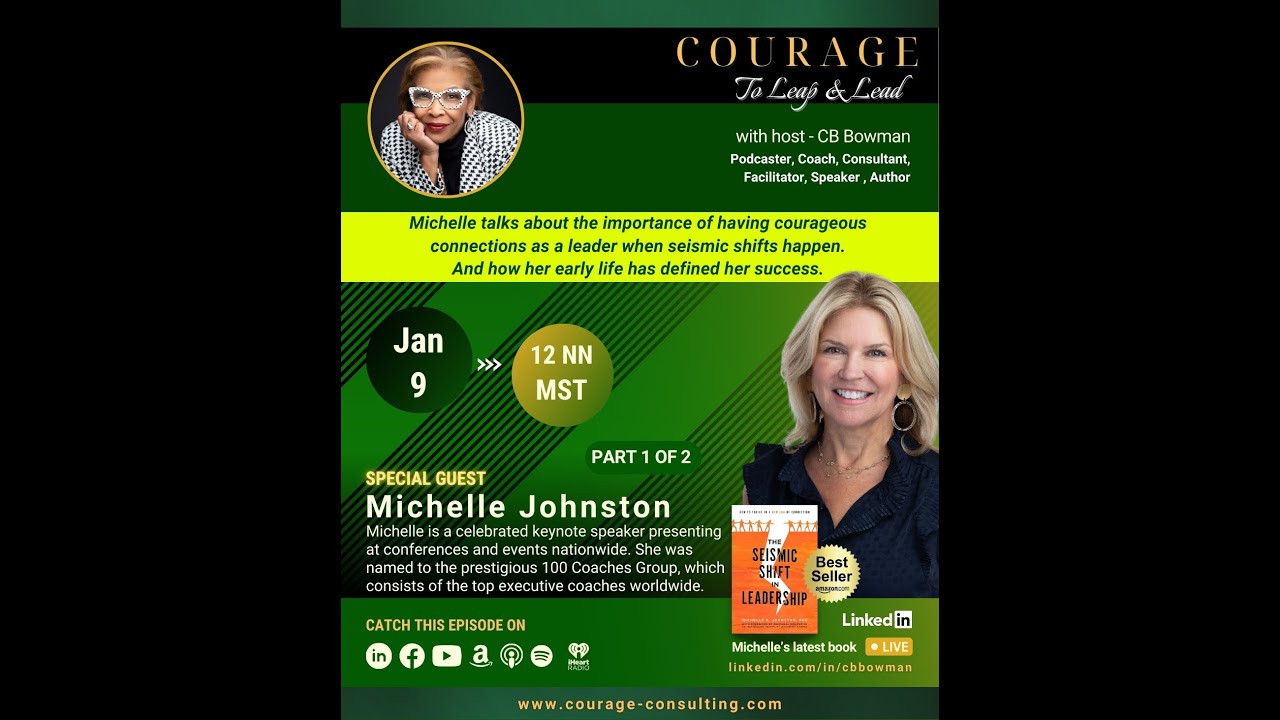
In this episode of the Courage to Leap & Lead podcast, Leadership Courage Coach CB Bowman interviews Michelle Johnston, a professor, executive coach, and author of The Seismic Shift in Leadership. The conversation weaves through Michelle’s childhood as a tomboy, her family’s frequent corporate relocations, and the formative influence of her father’s charismatic leadership style. Michelle recounts how moving every two years made her adaptable but left her questioning her identity, leading to a later‑life quest for authenticity. She describes her academic journey—earning a PhD in organizational culture, navigating a tenure‑track role that felt like wearing a mask, and eventually embracing consulting work. The discussion highlights her involvement in the MG100 coaching community under Marshall Goldsmith, where she shares stories and seeks peer feedback. Michelle explains the core of her book: a five‑dimension model of connection (being seen, heard, valued, respected, appreciated) and shares a practical assessment she uses with leaders. Real‑world coaching examples illustrate the model, notably her work with Pete November at Ochsner Health, where she helped shift his speaking‑listening ratio from 80/20 to 20/80, leading to higher employee engagement and his promotion to CEO. She also reflects on personal setbacks—divorce, a difficult marriage, and the loss of her mother—to illustrate how vulnerability fuels growth. The dialogue explores the tension between authenticity and professional expectations, especially for women of color, and how Michelle and CB have each learned to “shut up” and listen more deeply. The episode ends with both hosts emphasizing the importance of genuine connection, the need to move beyond transactional leadership, and a teaser for part two.
Chapters
You've got courage to leap, courage to lead. Be brave and be bold. Whoa, let it roar. Welcome to the Courage to Leap and Lead podcast, where each of our guests share the stories of courage that helped them become powerful leaders. Before we start today's show, please remember to visit courage-consulting.com. Where you can find all the episodes and other excellent resources, all at courage-consulting.com. Now here's your host, Leadership Courage Coach CB Bowman.
Hello everybody, happy Tuesday! And of course, you know, since it's Tuesday, it's CB, Encouraged to Leap and Lead. And we have another, yet another— where do I find these fabulous people? Fabulous, fabulous guests on today. And you know what? I can't wait for you to hear her story of how she went from zero to fame. In case, just in case you've been trying to do the same thing and you've made a little error that you consider a big failure on the way. We're gonna talk about how do you maneuver your life around so that you become what you want to be, in your words, your own success. So today we're gonna start with Michelle Johnston. Now, I wanna be sure I'm pronouncing Michelle's last name correctly because I see a T in it. Is it Johnston?
Correct.
Okay. Now, in fair disclosure, Michelle and I are part of MG100, which means we're under Marshall Goldsmith's tutelage. So you're in for a ride today. Michelle, welcome to the show.
Oh, CB, thank you so much for having me. I've been really looking forward to our conversation on courageous leadership. Let's go.
Okay. Well, first of all, so that we have a well-rounded picture, tell us, when you were a baby, how did— what were your parents like? What did you do? Were you a tomboy?
You know, I was. It's interesting. I just got off the telephone with my 78-year-old dad, who's still alive, who can run circles around me energy-wise and humor-wise. He's hysterical and fun and full of life. And I think I'm going to nominate him for the next Golden Bachelor.
I can't wait.
I just adore him. And he was in town. I live in New Orleans, and he lives in South Carolina. And he was in town for Thanksgiving. And I was kind of under the weather. And we just spent the entire day on the sofa really talking about my childhood. So it's interesting that you're asking me about this. So yeah, I was a tomboy because my dad was a huge sports guy. So I definitely was a tomboy and played every sport, including like skateboarding, you know, anything. I had an older brother. Anything that my dad and my brother did. So they played baseball, so I played softball, you know, I played soccer, any sport, whatever. But then when I got into high school, junior high school, I definitely was a gymnast. And so that was something that came quite naturally for me. So I did that in junior high. And then in high school, I was the head cheerleader and loved it. And that just brought everything together, kind of. We were on a competitive— squads. And so I could tumble and, you know, tumble my way across a football field. And I loved pep rallies, and I loved getting the crowds involved in the game and making a difference and harnessing that energy. And I've thought about that a lot recently, that there are some parallels between what I do now, right? I really love trying to bring out the best in people, and I love speaking to big crowds and harnessing that energy. So I think there are a lot of parallels there.
So, you know, what you just said brings to mind that, you know, often when we're on this road of designing our success pattern, we forget to look back on our childhood and remember the things that made us happy, number one. And 2, how did we get there? And what did we do and what did we learn? And I have to tell you, I know we've discussed this before. But somehow I just knew you were a tomboy because just the way you handle yourself, nothing is too large, no crisis you can't handle. And the way you communicate to people is very inclusive. And so— Thank you, CB.
You know, I love that question that you just asked, like, what did you love doing as a kid? I'll never forget, what show was Kathie Lee Gifford on? Was it with Her partner.
Regis.
Regis and Kathy Lee. I will never forget watching that, obviously, years and years ago. And she was raising her kids and really public about that and talked about that a lot on the show. I'll never forget she said, think back to your childhood and what's the activity that even when your mom called you in for dinner, you didn't want to leave? And you know what's interesting, CB, is the thing that I loved is we had a basement. And I'll never forget, in, I guess, kindergarten or first grade, I got my first chalkboard and And I taught any neighborhood kid who could come into my basement, and I was always the teacher. And it's interesting for those of you who are listening because I'm a professor and I teach. And you look back, you go like, oh, okay. Yeah, I wanted to be a teacher at age 5 and whoever would sit in my audience. And I wanted to flip my way across a football field and be in charge of a pep rally and the energy. And I'm a speaker in front of large audiences. So it does make sense, doesn't it?
Absolutely. Absolutely. And when you think of yourself not succeeding in something, go back to your childhood and pull out that strength that made you go forward and brought you to here. So I love that. So now tell us, tell us a little bit about your parents, your siblings. We want to—
Yeah, I just told my dad this. So as you shared with your audience, CB, CB and I are in 100 Coaches group, and Marshall Goldsmith is our mentor. And he's done an incredible job putting together the top coaches around the planet, really. And every other week we're on calls together, and we also participate in what's called Connect Group. And the purpose of these groups, about maybe 7 or 8 of us, once a week we get together and each person shares their story. And we've learned that by sharing our story, we really connect with one another. And then we ask each other at the very end, we ask for help. Here's what I'm working on now, and here's what I would like to like to get your help with. So, last Friday, I delivered my story to my Connect group, and I just shared that with my father right before our podcast interview. And I didn't know how he would handle it. So, let me share it with you.
Yes.
And he handled it very well. So, my dad was incredibly poor from a very, very poor family in the District of Columbia in D.C., and he ended up marrying because they had to, wink wink, His, his high school sweetheart right after they graduated from high school. And that's my mother. And then they got married and they lasted 50 years. But it was not an easy marriage because they, you know, she couldn't go to college. They had, you know, very young parents. And, and he was so poor, but he was just mesmerized with my mother. And she was from this very privileged family, the Carters of Virginia. And they all thought that was a big deal. And so he was motivated by that.
Wow.
He was very smart, but nobody had ever talked to him about going to college. Now, all of a sudden, again, he's 19, married with a little kid who was my older brother, and then they had me. And he applied for a job with General Motors in the finance division, and he beat out hundreds and hundreds of applicants because of his aptitude tests. And so when they hired him, he held on for dear life. What do I mean by that? Well, my childhood, I was a corporate brat. So back then, When a big company promoted you, they didn't keep you in the same market. They shipped you to a different market to manage different people and different products and services. So we moved every 2 years. And growing up, I didn't know that that was necessary. I mean, I knew it was uncommon. I was always the new kid, but I didn't suffer from anger or resentment or how are you doing this to me or anything like that. I was like, okay, my dad always made it an adventure. He was an incredible leader, a great communicator. super positive, a motivator. So every night at dinner, we'd hear about his new job, the new city, the new people. And I learned so much about culture. So it's no surprise that I ended up getting my PhD and concentrating on organizational culture and development and people. So this makes sense. But I'm sharing this with you all because I didn't realize until later on in life that that does come with a cost because Just moving around so much, I was really good at fitting in, but I didn't know who in the heck I was.
Yeah, that makes sense.
I was a real slow learner. It took me a long time to figure out what my story was and what my strengths and gifts are because I just wanted to adapt and be like everybody else. And that doesn't work. And one of the other things that CB and I can speak for CB, we've learned in this 100 Coaches group is that, as she's already shared with you all, Your struggles for years when you're younger, you think, oh, my struggles, I really don't want to talk about my struggles. And yet they're what defines you and how you recover and grow from that. And then that's what makes you a great teacher, a great coach, a great friend, a great parent because of your struggles. So now I own it. I used to hide from all that. Oh, yeah, yeah, no big deal. Now I'm like, no, I did. I moved around every 2 years. I went to 4 different high schools. Was it tough? Yeah, it was tough.
Did—
but did it make me resilient? Absolutely. So I learned a lot. But then later on in life, I really had to work hard on figuring out who I was so that I was comfortable in my own skin and not continuing to try to adapt to others.
So what did you say to your dad specifically?
So I said, Dad, I love you more than anything in the world. You're my best friend. So please hear this in a way that I'm not angry or resentful. With you. I said, but I have learned that moving around, although it did give me lots of wonderful gifts like resilience, and I'm very independent, I can walk into any room and meet friends. I said, it definitely, you know, took me a while to figure out who I was as a person. And so I've had some challenging times because of that. He goes, I totally understand. And he also gets now that corporate America doesn't do that anymore. They must have had psychologists come in and study all the families and the effects of moving around every 2 years. on the children because they don't do that anymore. I don't know any of the corporate leaders that I coach who would ever move their kids in high school, 4 different high schools. It's just not done, you know, in corporate America.
You know what I'm hearing, which is— I'm gonna tear up and I can't do that. Your relationship with your dad The fact that you could have that kind of conversation with him is so priceless.
I'm so fortunate, CB. He's the best. And he did say, he goes, wow, what an interesting analysis. He's a good listener. He didn't, he didn't, you know, defend and say, well, Michelle, you realize what she's done in the past. I had to do it. I had to do it. I had to keep my job. If I would have said no, I'm not moving because my daughter's a sophomore in high school, they would— that would have been the end of my career. I would have been stuck and I wouldn't have been promoted anymore. I said, Dad, I totally get it. So in the past, he would say that. But now, at 78, he's much more comfortable in his skin. And he's like, I understand, Michelle. Of course, I get it. And that's an interesting analysis. And I love you. And I'm here for you.
That's so beautiful. Somebody's calling me. Let me decline it. All right. You know, many of us— and I'm going to harp on this for a second. Many of us have parents we love, but— or maybe it's an and, I'm not sure— communicating with them on our level is extremely hard to do. It's connecting. It's connecting on our level and not their level. But in a way, in, and in a way that makes the relationship stronger. You obviously appreciate it, but I'm not sure that many of us who are listening can really hear what you're saying. It's much more than just the words. It's the heart and emotion that is, and I'm not saying that people don't love their parents. But being able to say what's inside is so difficult for so many of us, because we're afraid to help— to hurt our parents or to have a backlash or not be heard.
Gosh, you just hit on what I've, what I've spent years now. When I wrote my book, The Seismic Shift in Leadership, I realized that the seismic shift is all about connection, what you keep— what you refer to. And I had to, I had to really research and interview and figure out what in the the world is connection? What does it feel like? What does it look like? What does it sound like? What is the definition? And I've learned that it is about reciprocal conversation. It's the giving and the taking, the give and the take. It's no longer one way. It's not transactional. Connection is when you feel seen, heard, valued, respected, appreciated. And that's a lot. I came up with that 5-dimension assessment last year for the leaders that I coach, and I asked them if I could give it to their direct reports. And it was interesting, CB, because at this one particular organization, we didn't know that 6, 8 months later there'd be a layoff in the company. So this was around Christmas time last year. And I said, well, let me just see. We've worked very hard in our coaching on how well you're connecting with their people, with your people. Do they feel seen, heard, valued, respected, appreciated? So just on a scale of 1 to 5, let's just do a little assessment. And I shared the results and And so then 8 months later, the people, the leaders who ended up either leaving or getting laid off were those with the low scores. I didn't share it with— they weren't decisions made on my little assessment. But I went back and I thought, oh, that's interesting. All the leaders who kind of had the lower scores in connection were either the leaders who voluntarily left or who were let go. Whereas the leaders who had the highest scores on really that reciprocity, reciprocity, that beautiful connection with their people. They're still there and they're figuring it out. And their people are still there because they make their people feel seen, heard, valued, respected, and appreciated. My dad does a darn good job of that. I can call him and he just listens without judgment. Listens and loves.
So my question to you on that, we went out to a different direction than where I was going, but that's good. That's what this show is about. In your observation of the leaders that were no longer there, were they missing one of these elements, or were they missing more?
Good question, because I ended up just doing a cumulative score saying, you know, 5 times 5 is 25. So your assessment score on connection, you're a 20 out of 25, right? And most people didn't get really lower than, than a 20. But Yeah, that's good. Most of the leaders who I really worked hard with who needed help on connection just struggled with showing appreciation. They had very high expectations. They met with their people one-on-ones. They had team meetings. They did all of that. But man, for some reason, it was hard for them to say, man, good job. I appreciate you. I value you. So, so they would show up and they would see their people and they would hear their people, but a lot of times their people didn't feel appreciated.
You know, it's very funny that you said that. I can't believe how we're on the same path here. Here in Colorado, and I, I could not understand this for eons, and it's still kind of fuzzy in my head. You buy something or you walk into a store, it's always, how's your day going? And I'm from New York, New Jersey. You don't ask those questions because you get a smart-ass answer, right? So here it's like, how's your day going? Any plans for the weekend? Yada yada. And I get to the point where I say, well, why is it your business? Why are you asking me those questions, right? Are you trying to be invasive? And then finally, after being here 3 years, I started to take a deep breath and say, first of all, it's part of the culture, CB. So if you can't grasp that, then you don't need to be here, right? So I started to chill out about that. And then I said to myself, you know, they're probably trained to ask that either in their personal life or in the store. And I started to say, when people have really been great in those stores, instead of saying thank you, I started saying I appreciate you. And the response is mega difference.
That's beautiful. That's beautiful.
And it's just, you know, here also youngins are— their parents train them to be so gracious. So last night, my husband and I were playing pickleball, and we were in a league. I'm at the bottom of the league, but that's okay. And so one person was missing, and they sent in this kid. He must have been— I'm gonna say 8, 9 years old. Knee-high to a tadpole, right? And I have seen him play before. And I said to my teammates, do not underestimate this kid. And I said something to him and he said, yes, ma'am. And I'm like, what kind of upbringing is that? That's beautiful, right? And others were around me and I said, and don't take that as he's going to be light. Well, this kid beat us like No tomorrow, right? And I'd seen him play, and I knew he was really good. I mean, at that age, he's probably a 4.0 player, and you can't get much higher than that.
Wow.
So I said to him at the end, I said— this is deviating a little— I said, does your girlfriend play pickleball? And he said, yes. I said, are you teaching her? He said, yes. I said, are you teaching her to be better than you? And he looked at me. He said, well, ma'am, I don't want her to be better than me. What a kid. What a kid. What a lesson learned, right? From the mouths, babes. You're going to teach, but not to the point better than me. So in your upbringing, Your dad has taught you a lot. What did you learn from your mom?
Oh, my mom was tough. She, you know, it's interesting. My dad and I were very much, and are to this day, we're the same person. We're so similar. And my brother and my mother were so similar. So they were introverts. And my dad and I are loud. And we say everything that's on our minds. And we laugh really loudly. We just like to have fun. And I think it was hard growing up because she didn't know what to do with me.
Yeah.
So the messages— seriously, the messages I got from her was, calm down, calm down. You're all over the place. Your feet are always in the air. We'd go for a walk and I would just start doing front walkovers and cartwheels. And I was just all bouncing off the wall. And that was hard for her. Her biggest pleasure was to come home from work And to read a book, and I would come bounding in the door from school. Mom, mom, mom, mom, mom! She's like, I'm reading my book. So I think that was just hard. Our energy levels were different. The way that we processed the world was different. So she died from ovarian cancer eight years ago. We were very close. She always said I was her best friend, and we we were very close when she died from ovarian cancer eight years ago. almost 9, that allowed my father and I to finally truly— because my marriage was over at that point. So now I'm separated, he's alone. And we were able to truly be ourselves, I think, for the first time in our lives without somebody saying, you're too much, calm down, turn it down. And so these last 8 or 9 years with my dad and I have been pretty special, I must say, CB. It feels so good to be just accepted for who you are, you know, and just to be. And I just love it. I'm so grateful.
And yet you wrote a book and your mom loved to read.
And I ended up writing a book. Not real— you're gonna be fascinated by this. So I did, as I said, I've kind of been slow to learn about how to be connected with myself. And how to truly— I realized I wasn't necessarily connecting at a deep level with others because I wasn't connected with myself. Like I said, I just kept moving and adapting, adapting, fitting in. So when I became a professor at Loyola, I looked around, I saw what everybody else was doing who was successful. So I did what they did. And then my students were like, who are you? That's not you. And it just took me a while to try to figure out, well, who am I? What are my gifts? What's my story? So that I could lean in with those gifts and be me and stop pretending to be somebody else. So when I realized Well, hold on.
Hold on. Yes.
Yes.
I'm going to interrupt you here.
Yes.
One of the things— so, audience, I adore Michelle, and we barely know each other. One of the things that attracted her to me out of all the women that I've met is she has this sincerity about her. She delivers what she says she's going to deliver. And so even though you were finding out who you were in the past, man, you nailed it.
Oh, CB, that means so much to me.
Thank you.
And I've worked hard, right? I've worked hard.
But I'm hard on evaluating people. As a Black woman, I had to be. And your sincerity— what I said to Michelle Will you sponsor me? And I don't even know what made me say it because I didn't even know her this well then, an MG100 for the release of my new book, January 16th. She said, I'd love to. And she said it with such spirit that I knew I could count on her.
Yep. Yeah.
So this finding yourself, I think that you had this way before. Way before.
Yes. Yes. And that's interesting you just said it like that because I was very good at being myself personally. But I felt like from the messages I had received from my mom growing up that I couldn't be myself professionally. I was too much. And so in the MBA classroom, I wasn't myself. And that almost was the downfall of my career. I had a dean who brought me in and said, I know you're in a tenure-track position. You want to get promoted. You need really high teaching evaluations. What's going on? I know you're a great teacher. And I said, well, I'm just trying to act like all of the mentors around me who are older white men and were military drill sergeants. And so I'm a military drill sergeant. He said, well, it's not working for you. Wow.
Wow. I love that.
So, yeah, that's interesting you picked up on that. So I was very authentic with my friends, but then I would march into academia and put on this mask of perfection and put on this armor and put on a hat. And, you know, and finally, thank goodness that dean recognized and said, I will invest in you. Go to whatever conference you want to go to, figure it out. And it wasn't until I read Brené Brown's book, The Gifts of Imperfection, did I truly understand what my problem or what my opportunity was. And it's that you— she said in her research, First of all, there's no such thing as perfection, right? So I had to figure out how to stop trying to be perfect. And she said, and if you search your whole life trying to, or if you live your whole life trying to fit in, you're never going to belong. So my whole life I was searching for belonging, but I wasn't getting it because all I was doing was trying to fit in. So she said, the first step is to own your story. And that's when I started to truly do the hard work of spending time with myself. Owning my story, figuring out who I was so that I could be successful professionally and personally, be one person. Because students pick up on like, wait, I see you in the hallways, or I bump into you at Mardi Gras, or I see you in the supermarket. You're this one person. Then why are you a military drill sergeant in the classroom? Right? There was a disconnect. So that's what I coach my leaders in now, is that it's no longer work-family balance. I mean, it's just— it's called life, and it's figuring out how you can show up as the best version of yourself.
Were you aware that you had this dual personality?
No. You know, I, you know, I thought that's what it took to be successful. So by gosh, I was going to be a serious academic. Honestly, CB, if I had gone into advertising or communication, which is what my major was— my major was public relations communication— and if I had gone into that field, I think I would have been my true self. At work and at home. But I think, you know, when you ask about family life, my mother's family, the Carters of Virginia, um, my grandfather's name was Carter, and he had a PhD from Georgetown and wrote books and was an economist and, and came up with, um, Section 8 housing, which is subsidized housing.
Wow.
Mm-hmm. Under President Johnson.
Yes.
And so he went on a letter-writing campaign to me as his granddaughter while after I got my undergraduate in public relations and communication. He said, you know, I have a PhD, you should get a PhD too, because I was always a 4.0 student. He said, you're smart, you should get a PhD. I said, ah, I don't know. He goes, no, you should. So he went on this letter-writing campaign. I don't think I would have gotten my PhD if it had not been for my grandfather. Who pushed me. However, he was—
A letter writing campaign?
Meaning once a month he would write me a letter. Michelle, you are smart. You should go to graduate school like I did. You need to pursue this. You can still be a mother one day and still be a wife one day. You can do it all. Yes, I had a grandfather who did that.
Mm-hmm.
Yeah, Carter.
Drop the mic.
Right? How influential that was. Now, how I loved that, and I probably wouldn't have a PhD if it weren't for him. However, When I was getting my PhD, I always said, well, I'm not going to be an academic. I'm going to be a consultant. I'm going to be a consultant because that fit more with my personality. I want to see people thrive. I want to help people. I want to coach people. Yet when I got married in New Orleans, I married this lawyer who was from New Orleans. And he's like, you know, just become an academic. It's better. It's better. You're home at 5. You get the summers off. You'll be able to have a family. And so I ended up in academia, which just didn't necessarily fit my personality. So I think that's why I ended up becoming who, you know, trying to be somebody who I wasn't, because I just was, I was really good at fitting in. I was like, oh, okay, I'm now in academia. I'm in a tenure-track position. I really don't fit in. I'm definitely a square peg in a round hole, but I can succeed. I'm an achievement junkie, so I'm going to go after it. I'm going to win. But at what lost, right? And so that's been hard for sure. Academia is fantastic, and it definitely has a lens of judgment. You know, you're kind of required to find fault in your students. You're kind of required on committees when your colleagues are coming up for tenure is to find fault in their research. You know, it's just, it's a lens that doesn't come naturally for me.
So it's interesting because I see a direct correlation between being a consultant and being in the academic world, um, in the fact that you're sharing knowledge, you are evaluating, you are respecting, and you're teaching greater than, right? So the label is different. One, one is more I was going to say one is more user-friendly, but I'm not sure because I'm a graduate of the New School for Social Research.
Wow.
Yeah. And there you really experience the consulting world mixed with the academic world. You were taught to look at everything from all lenses. And so I think for me, That was the greatest education I had. Those teachers were beyond teachers. They, they looked into you and pulled out the best, which is what a consultant does. So I think it depends upon the capabilities of the teacher, and I love that you found you and you're blending the 2. That's new school quality.
I love that. I love to hear that perspective. Yeah. Yeah. When I finally lifted my head up after I got tenure, you know, you publish or perish. So I put my head down and published, published, published, and published, and then earned tenure. Then I felt like I could take a big deep breath and then go back to consulting. So in my 20s, that how I got to New Orleans is I was recruited when I was in graduate school. I was getting my master's at Auburn, and one of my professors Taught, I think it was team dynamics, interpersonal communication. Larry Barker, he was the most prolific communication author at the time, and he was my professor at Auburn, and he's deceased now. And I went up to him after class. I made an appointment. I said, "I want to work for your consulting firm," and his consulting firm was based in New Orleans. He said, "Would you like an internship this summer?" I said, "Yes, sir," and I came to New Orleans and fell in love with the city. I loved how It was cool to be an individual. It was not cool to be a cookie cutter and to look like everybody else. It's a city of soul. I loved that and I fell in love with consulting. So during my 20s, I was a consultant. I mean, in my 20s, I wasn't necessarily a consultant. I was working for a consulting firm. I was more a trainer. I was sent off and I would deliver meeting management workshops and presentation skills workshops and those sorts of things. And I loved that. And so, yeah, once I then committed to academia and then lifted my head up, then I went back. And so now I am— I can do a lot of executive, still affiliated with Loyola. I only teach one MBA course a semester. I have so much freedom. I haven't worked a summer in years and years and years. I'm about to go on sabbatical and write my second book. So the university life does give you lots of beautiful opportunities.
Michelle, you are somebody I can be jealous of. You're a white woman. You are very pretty. You're exceptionally smart. You had wealthy grandparents. You've gotten this well-researched book out. You're the kind of person somebody looks at and says, they never failed at a damn thing. Is this true?
You know, I'll tell you a story. I remember when I finally came to terms that I couldn't make my marriage work. And boy, was that a giant— at least at the time felt like an enormous failure. And I remember one of my girlfriends said, we're just going to get you a furnished place in the French Quarter for a couple months until you figure things out, but you have to get out. It's an unhealthy relationship. So I got out. My daughter was 10, and I'm in this alone, you know, this little one-bedroom furnished place in the French Quarter where I— where French Quarter is super cool, but it wasn't exactly where I wanted to live. But it was— but it was good. It's, you know, you were in a very different part of the city full of creativity and music. So I look back and I'm like, okay, those 3 or 4 months, that was good for me. I wrote a lot in my journal, but I remember sitting on the floor of my apartment one day just thinking, how in the world am I going to be the executive coach that I want to be? When I couldn't get my marriage right, I couldn't fix it. I couldn't figure it out. And I got a call. I just delivered a big presentation to the YPO group in New Orleans, the Young Presidents Organization. And I got a call from a member who had not been in the audience, but he had heard about my presentation and he worked for Ochsner Hospital, 40,000 employees, and he was an executive. And he said, Michelle, it's David Gaines. You don't know me. He said, but I heard you did a really great job, and I love what you talked about— communication and connection and listening. And he said, I would love to bring you and work at Ochsner. And at that point, I remember being so grateful to him because I felt like I was at my lowest, and he knew I was separated, and he didn't see me like that. And I realized that because I had stumbled, And, and I had struggled and couldn't figure it out. I had this humility that I had never had before, right? And I wanted to learn so much about connection because I felt like I wasn't that good at it. And because of those 2 things, I was— my career took off, CB.
It took off.
I lived when I was married for 15 years trying to please I lived below the radar because my— I wanted my husband to be happy in his career as a lawyer, partner, law firm, to be the primary career. And I just lived under the radar. And then finally, when I realized—
Wait, what does that mean exactly?
It means that I just, I just was— I just allowed and wanted him to shine, and I just kind of took a back seat. You know, I was, I was a mom for 10 years at that time and, and had a lot of demands. So I just kind of, you know, I was a good professor and I did what was necessary, but I wasn't ready to shine because I didn't feel comfortable enough at that time in my own skin and in, in the dynamics of my relationship and my marriage. But the second that I was divorced—
What does shine mean to you? What does shine mean to you?
That's a great question. I all of a sudden was more comfortable, um, being all that I could be and just going for it. I hadn't gone for it yet.
And so what did that look like inside of you? Did you say, I want to be a famous author, I want to be part of the NZ 100, I want to, I want to go on a big speaking tour? What did that What did it feel like? Did you want people to recognize you in the street?
What—
how did you define that?
God, these are such great questions. I remember thinking, okay, I really didn't feel like I could be my true self in that marriage. So it's time for me to truly live authentically and laugh as loud as I laugh and feel comfortable with that. and have this kind of a lot of energy and feel comfortable with that. So I gave myself permission to truly be me. And then when I thought about shining, I all of a sudden thought, you know what, people have been telling me for years to write a book and I wouldn't do it. People have been telling me for years to give big speeches and I wouldn't do it. I just kind of lived under the radar, just did what was, you know, what was, you know, necessary, I guess. but not in a risky way. So around that same time when I started working for Ochsner, when David Gaines called me and said, you're great, we're hiring you, we want you to facilitate workshops, we want you to be a leadership coach. Now all of a sudden I'm on the front lines of a 40,000-person company, seeing for the first time in my life that that old command and control style of leadership was no longer working. And I saw the leaders who were really succeeding, who now Pete November, I was coaching, and he's now the CEO. He leaned in with meaningful connection. He leaned in with this very different leadership style. And that's when I realized, as I was alone, divorced, that I was going to write a book called The Seismic Shift, all about connection, and learn everything that I could about it so that I could help others make sure that they didn't stumble. So I was able to take my stumble and turn it into something to ensure that others wouldn't.
Was there a specific example of how he leaned in? See, you're, you're, you're giving big words. You're using big meaning. And that's good. We all understand that. But we don't know from your mind what that means.
Gosh.
So I just was ready to, to fully embrace and be okay with who—
No, no, I'm sorry. The, the leaders that you saw that were really good, you said they leaned in.
What does that mean? Oh, yes. So because I was Pete November's executive coach, who's now the CEO of Ochsner, I was a part of his team meetings. So I would see how he turned the whole speaking-listening equation percentages upside down, or the inverse. So most executives would talk in a team meeting 80% of the time and listen 20% of the time. He's an introvert. who also loves people and loves execution, getting things done. So we talked about, you know, I have a communication preference profile assessment and it categorizes you. Are you a people communicator? Are you action? Are you content? Are you technology? So I knew he was high people, high action. I said, you know, it's interesting. I would watch him speak on stage and he was trying to be like somebody else, the CEO at the time. And I said, this isn't working.
So what did he demonstrate?
So the current— so I was Pete's executive coach and he was the chief administrative officer. And the current CEO, Warner Thomas, was high content. So he would get up and deliver these presentations that were full of data and graphs and charts and research. So Pete would get up on stage and do the same because that's what success looked like. And I would say it's interesting that works for Warner because he is all about content. I said, but you're high people, high action. So when you give your executive presentations, let's begin with a story about your childhood so people know who you are. And then you can talk about your people and their successes. And then at the very end, you can give them a call to action. And that's going to fit with your personality. So we got him to present in a way that was much more authentic, which was great. All of a sudden, people were he was more credible on stage and they believed him. And then in his team meetings, we said, well, why talk the whole time? In the beginning, he would talk the whole time. He'd say, Michelle, I'm exhausted. That's not how I want to run a meeting. I don't want to just be directing and commanding and controlling. He said, I want to be listening. Why don't I sit back and for 80% of the time, we'll do updates and everybody collaborate and give me updates. And at the very end, I'll talk. So we did the 80/20. We turned it upside down, 80% listening, And 20% talking. And so I wrote about this in my book and boy, did it work for him. And then when the CEO decided to leave, the board chose Pete November to be the new CEO. And it was a very different skill set. He is a very different leader than Warner Thomas, who's now the CEO of Sutter Health. Pete had to figure out his strengths. He, like me, had to stop trying to fit in and be like other people. He had to own his gifts. So I looked back, CB. And again, I was able to be a great coach to Pete because I had already gone through the same struggles of trying to fit in, not showing up authentically, and then finally giving myself permission to truly be me. And that's when I became a great executive coach, right?
I thank you so much for those real-life examples because oftentimes we hear the terms But we can't quite connect it to real life. That was terrific. Thank you. Michelle, I hear this word authentic all the time, and it's driving me crazy.
I agree. I want a new word. I want a new word for vulnerability. I want a new word for authenticity. So now I'm just saying, just be real and be genuine. Just be, be human. So, so at Thinkers50 in London with the top thinkers in the world, My biggest takeaway of listening to these top brilliant global thought leaders was now's the time to humanize work. So when I think of authenticity, I'm now thinking of just be your best self and be human. That's how I'm looking at it. But I agree.
Yeah, I like that. But does being human mean that you Reveal everything about us.
And authenticity. One of the things Brené Brown says about authenticity is not self-disclosure. And I try to tell my people that we need you to be professional. We need you to show up as a professional and also know who you are, know your story, know your gifts, know your superpowers, know your blind spots so that you can be real again. So the language I'm using is Be real. Be true to yourself. Stop trying to wear a mask of perfection and stop trying to be like somebody else. Just be real. Marshall feels the same way about authenticity. I had him on my podcast last year, and he said, if we told every leader just to show up and be authentic, would they really, particularly as young leaders, would they really get promoted? That's a good question. We need you to, as young leaders, scan the environment, figure out what the culture is like, what's expected. We need you to be professional. We don't want you to show up and self-disclose everything. So to me, authenticity is about really self-discovery, doing a lot of reflection so that you know who you are as a human and how to bring those best talents to work.
So I'm gonna challenge you a little bit, respectfully. This notion of being real. When I was in corporate America, I faced incredible racism and discrimination. When I opened my own association, the Association of Corporate Executive Coaches, I said, I'm not going to let that happen. And I'm gonna talk to people in a real way. And this is all unconscious thinking. I'm gonna be myself. I'm tired of being somebody else, much like you, in order to survive in corporate America.
Mm-hmm.
I can't be this sassy Black woman. So I opened my company and I was me, what I thought was me. That didn't work.
Really?
I got called out on it.
How so?
So I have this wonderful guy by the name of Terry, Dr. Terry Hildebrandt, who's a member of my association. We had a conference, uh, the association did, and I spoke to a couple of people. And he called me up after and he said, CB, people are talking about you and not in a good way.
Oh, wow.
Oh my God, the knife. I had to struggle to pull it out and not break down in tears.
I bet.
And I thought, I've tried so hard. What, what, what is it? And he said to me, he gave me some, you know, tips. He said, well, you know, you can say things to people, but you have to say it in a way that they don't feel broken.
Hmm.
And I said, you mean I have to care about their feelings and mine at the same time? I was just upset to no end. And he said, you can do And I said, well, give me some examples, because I was just like so shocked at this whole thing and so upset. And I started thinking about it more and more, and I thought, you know what, you've been acting to people like you don't want people to treat you. So there's got to be a way where you can be you And allow people to feel whole when you talk to them, when they walk away.
And that's beautiful connection. You're absolutely right. Making sure that you can show the person that you care about them. So in reflecting, looking back, CB, I'm so curious, because I never would— the CB that I know, I never would think those things. And I thought that that probably was really hard to hear. Do you look back and And think, were you too direct at the time? Were you? What what was going on? What do you think?
Wait, did you just flip my interview to interview me?
I totally did. Thank you for noticing. I'm so curious.
Okay, ask me your question again.
I was like, when you look back, do you think that was valid? What he said to you? Do you think you were super direct and it was hurting people's feelings and they didn't think you cared about them? Did you? Were you able to tweak in a way that showed them that you cared also in, in a way that was effective? Like, tell me, how did you grow from that?
Yes to all of the above. I was so hurt. I was devastated. Because in my mind, I was responding to people and talking to people the way that I wanted to be recognized. But in fact, I wasn't. I was holding an anger.
Mm.
How I was treated.
Oh, wow. That's powerful.
And I had to let go of that anger because that was getting in the middle of my trying to be authentic.
Mm.
And I didn't know how. And I just did not know how. And I thought, well, you need to figure it out.
Did you?
Yes.
Beautiful.
But the old me still slips in. You know?
I get it.
You don't spend all these years of your life being one way and then like that, it shifts. And what allowed me to do that was to know that people Mm-hmm. About seeing me improve.
Mm.
And so I've learned to ask permission to talk to people when I'm gonna be straight. And then I've learned there's more than one way to talk straight. One is just to hear yourself talk, and the other one is to talk with love.
Oh, that's beautiful. To talk with love. Yeah, that's connection because then people feel that you care about them. Yeah.
And that's what it turned to. It's like people saying to me, I know you're saying this because you care.
Oh, isn't that beautiful? So that's one of the big shifts that I, that I was seeing that I wrote about is it used to be as a leader that the communication was just transactional. I need you to do this. Don't do that. That was stupid. That was a stupid move. Why did you do that?
Exactly. Yeah, that's not the way I would do it. That's not the way I would do it. It should be done.
Exactly. And now, I mean, we're asking quite a bit of our leaders, right, to really, when you have those conversations, to do it in a way that your people know that you're doing it to help them. You're acting more as a servant leader. I'm here to help you develop Um, improve your skills, be the best version of yourself. I'm here to remove barriers. What can I do? Rather than the old do this, do that, do this, do that.
And the other thing I learned, which was very helpful, is I learned to give people permission to give me feedback.
Oh, and did they? I would never have given my boss feedback.
But I added to that because I'm an introvert. I said, But do it kindly.
Oh, did they? Do you remember some of them giving you kind feedback?
Yeah, yeah. I remember when I had my executive committee meeting for my association, they said to me, CB, what's our job being on this advisory committee? And I said, what are you talking about? We've been meeting for like 5 years and you're asking me this now? And they said, yeah. And I rattled off, you know, a whole list of advising me of keeping, you know, your eyes on the organization and making sure that, you know, things are being implemented the way we discussed, blah, blah, blah. And then it was silence. And finally the person said to me, when are you gonna let us do our job?
Wow.
And I said, what are you talking about? And they said, each month when we meet, you come here and you give us a report of what you've done, and you do that whole thing, and you do it over and over again for different things, and then that's the end of the meeting. And I said, are you trying to tell me I need to shut up? And they said, yeah. And I said, well, And again, I was so hurt. This is my organization. This is my baby. How dare you tell me to shut up in meetings? So the next time we had a meeting, they— I shut up, but in total silence mode. And they asked me a question. I said, well, wait a second, you tell me that I needed to shut up, so I'm not answering. They all broke out in laughter. And they said, we've hurt your feelings. I said, yes, you have. And they said, we want to hear from you, but we want to speak first. We want you to listen to us. And I said, oh. And shortly after, I heard Marshall interview Alan Mulally, and they— and He said— for listeners, the former CEO of Ford— Marshall asked him what was the greatest thing he learned being coached and being a CEO. And his immediate response was, I learned to shut up.
Powerful.
Because when I speak, everybody marches, and I don't get to hear anyone but me. And I heard that interview and I said, oh my God, I'm in good company. I get it.
Powerful.
My organization has grown so much since I learned to shut up. So yeah, I'm still learning. I'm still listening. I'm learning to hear people. I'm learning to go back to my learnings at the New School where we were taught to listen to not what's being said, but what's not being said.
Gosh, that's beautiful. I was on a webinar this past weekend that Marshall put together, and Hubert, Hubert Joly, the former CEO of Best Buy, was on there and the new Kraft Heinz CEO. And then Aisha Evans, the Amazon— what is it— self-driving cars, Zoox. She was on there as well. And Mark Thompson and Marshall Goldsmith were moderating. And it's interesting, a lot of the CEOs referenced Alan Mulally, like you were just saying, is that they learned a lot about how to do things differently, how to not just speak the whole time, because whatever you say is a marching order, because the whole The purpose of the call was, what are your lessons learned from being CEOs? And they would say, not to not speak as much. They said also, you've got to— Alan Mulally's philosophy is working together and you have to sit around and hold each other accountable and say, we're going to rise together, but we're going to fall together. We're going to be together. We're going to work together. And he was one of the first CEOs to actually talk about love them up. And that was his motto. Love them up. And he made it okay to even use that language, love them up. And I love how you said you learned in your shift from more of the talking and directing to connecting is you spoke, you talked with love.
Absolutely. Absolutely. It doesn't hurt you. And it helps the other person.
Yeah. Yeah, I had a big shift. Again, it happened after when I really became an executive coach, I realized, wait a second, for years in academia, I was just the professor who was known as the expert who directed and who lectured and who told. And, and my big shift was—
Wait, wait, you know what? We have to break and then continue.
Okay.
So audience, stay tuned for part 2.
More from CB



211- Courage to Leap & Lead with Louise Story part 1Courage to Leap & Lead







