Courage to Leap & Lead with Sharon Melnick, Ph.D. , Episode 131 | part 1
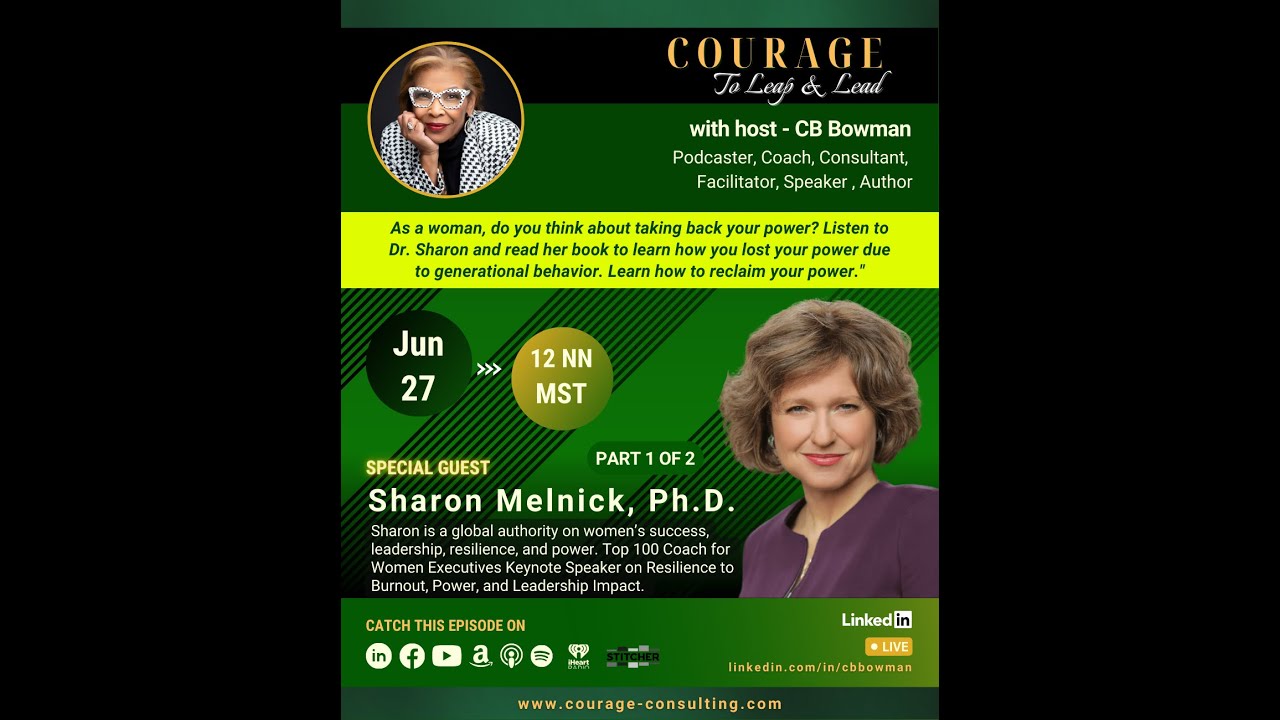
Sharon Melnick, a psychologist and executive coach, discusses how women can reclaim personal power by shifting from reacting to external conditions to setting their own emotional temperature. She shares how self-doubt cost her a White House invitation and introduces practical tools like moving emotions through the body and shifting from "small game" to "big game" thinking.
Chapters
You've got courage to leap, courage to lead.
Be brave and be bold. Whoa, let it roar.
Welcome to the Courage to Leap and Lead podcast, where each of our guests share the stories of courage that helped them become powerful leaders. Before we start today's show, please remember to visit courage-consulting.com. Where you can find all the episodes and other excellent resources, all at courage-consulting.com. Now here's your host, Leadership Courage Coach CB Bowman.
Hello everybody. We are just laughing away here because I'm sort of coaching my friend Sharon, who's brilliant, on how to look in front of the camera. And I said to her, bring the ladies up. Let them fill up the screen. She's gonna kill me.
Well, you know, isn't it all about sisterhood? So I'm just showing the sisters right here. Yeah.
Oh, you know, Sharon is a brilliant, brilliant coach, a brilliant woman. And I said to her, you know, we laugh along with discussing serious stuff. So I had to get her going before the show. Hey, everybody. Welcome to Courage to Leap and Lead. This is CB Bowman. And today we have Sharon on the call, and I'm so excited. Sharon is really a lot of fun, but she comes across very serious. So we have to break that. And that happens when you're talking to smart, brilliant people, right? So we're gonna go for it today. And she's written a great book called In Your Power, and it really stands for what she believes in. It's women particularly standing in their power. And you know, we love that subject. Sorry, men, but we love that subject.
Well, it's universal. Men need to stand in their power too, but it's just women have more situations in which we can be kind of like, you know, kicked out of our power and we need to step back in.
Exactly. Exactly. Hey, so everybody, please let me introduce Sharon Melnick, Dr. Sharon Melnick. Sharon, did I pronounce your last name correctly?
Yeah, we're good.
Okay, we're good. And so the first question I'm going to ask her is, why did she want to be on this show?
Well, that has everything to do with being able to have a fireside chat with you, CB. And, you know, I want to learn to be even more courageous. And But really, you know, being courageous, I think, has a lot of resonance with being in your power. I think the more you have one, the more you have the other, and one comes from the other. So I think we're gonna have a lot of simpatico here.
I totally agree. Hey, Sharon, let's start with, because you are a woman of outstanding knowledge, a lot of women wanna know, well, how did she get there? Because we're still wrestling with that. So take us back to your childhood. Tell us about growing up.
Yeah, well, you know, I felt very fortunate to grow up in a family with— my mom is actually like a total role model for me.
She's—
I'm not allowed to say her age, but she's still, you know, working full-time. My dad is 89, and they run around the world, you know, traveling and still kind of, you know, living their mission. My mom still runs her business. I really had role models of resilience and perseverance. And for me, women could do anything, you know, right? And my dad was a doctor. And I also felt that I was very well kind of cared for, especially materially, but I didn't always feel that I was attended to emotionally. And so for me, that set me up at some young age, I made some conclusion, you know, that that was going to be the purpose of my life really was to make sure that, you know, children feel seen and heard and able to make the impact that they're here for. And so I went on to become a psychologist, like a business psychologist and executive coach I've been doing for 22 years. And I did postdoctoral research at Harvard, and it was on intergenerational issues. So it was on what you bring with you from your own experiences in childhood into your parenting in the next generation or into your work, you know, we could just say. And then especially for parents, you know, kind of like how do you not repeat the mistakes of your own parents or how do we break those intergenerational cycles? And what's interesting about it and how I think it relates to our work these days is that, you know, I think a lot of what we are experiencing these days, and I say that, you know, kind of collectively, is Is kind of beyond coaching because people are traumatized on some level, big T, small t. Like, when you don't feel heard, you don't feel seen, you don't feel that you can make the impact that you're here for, it affects you and it feels uncontrollable and it kicks you out of your power is what I call it. And so in some ways, my early career has kind of come back full circle in terms of coaching. Like, how do you handle these situations when you feel— Whoa, whoa, whoa.
Timeout, timeout, because you just threw so much at us. Okay, I have to go back because it's, it's fascinating. First of all, how did you— what did your mom do?
Yes, so my mom owns, uh, like a luxury travel agency, and all the boldface names, um, kind of, uh, are her clients, and, um, she loves it. So that's where I became mission-oriented because I just saw her loving it to this day.
And then how did you recognize that there was something missing in your childhood? How did you identify it? How did you know?
Yeah, well, I think, uh, that I was someone and, and still am someone who kind of struggles or has to be conscious, uh, about being in my power. Like, I can, I can easily, uh, feel, you know, kind of look to other people in order to know how to feel about myself, or, uh, kind of wait for permission or try to get other people to think well of me. I think I, I think I grew up with that pattern. And—
How did you know that? How, how did the— how did you recognize those feelings?
Yeah. Well, you know, when I was— I'll tell you a story, and then I'll come to the conclusion of it with that. When I was early in my career, I went to a rock concert. It was in Washington, DC. And it was one of those like multi-artists where like they were all your faves, you know. And I flew down from Cambridge, where I was, you know, doing the research at the medical school. And When I entered the stadium, people were just starting to fill it. And there was a cluster of people over to my left. And I looked over and there was one person who I recognized. It was Tipper Gore. She was the wife of the then-Vice President Al Gore. And she was known to be like a champion for women's empowerment and families. And, you know, this was a moment of courage, CB. I went right over to her without overthinking of it. And I stuck out my hand. I said, hi, I'm Dr. Sharon Melnick. And I do this research, you know, at Harvard. I've been helping people from difficult childhoods, you know, sort of have confidence and resilience and make the contribution they're here for. And so she's like, her interest is piqued and we like get into a conversation. And at a certain point in the conversation, she says, she turns to her chief of staff and she says, Melissa, would you get Dr. Melnyk's contact information? We wanna bring her down to the White House to share the policy implications of her research. So we wrap up our, like, our little estrogen fest, you know what I mean? And I go home, I write up a little something, I send it off, and I don't really think of it. You know, several weeks later, I'm tying up my sneakers to go for a run. The phone rings. Melissa. And we start talking and she's telling me about the initiatives that Tipper—
Wait, this is her speaking directly to you?
Yeah. So Melissa calls me and she follows up with me and she's telling me about these initiatives that Tipper is doing that's serving millions of families around the country. And, and I'm getting so excited, like I'm just thinking about like, this is the coolest thing, and she's affecting all these people, and I could help them, you know. And at a certain point she pops the question, and she says, will you come down to the White House to share the policy implications of your research? So I picture myself around that table at the White House, and what do you think I say, CB?
Please don't tell me you said no.
Well, of course I say no. Well, I didn't exactly say no, but I did say like, well, I'm still figuring out what the research says. Let me get back to you. And as you know, history never afforded me that opportunity. So I had the courage kind of on, you know, I, I had what a lot of, a lot of us had. I had that disconnect where I knew in my mind I was really good at what I did, and I was award-winning, and my clients and, you know, patients were getting so much better. But I didn't feel in my bones when it came to the moment. And I pictured myself around that table at the White House, and you know what I thought? I thought they're gonna think I don't know enough. And so I prioritized my own evaluation of myself over the contribution I could have made for millions of people. And this is where that courage comes from, right? I mean, so I had that, like the first level of it, like the role, like I'm good at my role, I can do this. And that's what, you know, I went over and I shook her hands and I introduced myself. But when it came down to the moment of courage, I didn't think that it had what it takes, and that moment affected the rest of my life. I gave my power away. Right now, the good news actually is that 15 years later, I was invited back to speak at the White House. But, you know, you get a second chance when you come into that courage, and when I started living my life in my power. But really, That was a moment, you know, we can deconstruct that moment. But the way that I think about it is I gave my power away because I saw myself through their eyes, not through my own. So when you say, how did I know? It's because, you know, when you're not in your power, or when you're giving away your power, you, you feel very vulnerable to how other people might think about you, and you can live in that insecurity or in that fear, or you can exhaust yourself trying to get— trying to control how other people think about you so that you can think a certain way about yourself. So it's very mental, it's exhausting, and when it comes down to the moments of truth, you don't feel like you can count on yourself because you're kind of Tracking how other people think about you.
I'm speechless because as you were talking, I went through my head and I thought, how many times have I done that? And I don't know whether to be angry at myself, angry at others for allowing me to do that, Or happy that I see it now and can do something about it now.
Or all of the above.
Thank you, Doctor, because I, you know, audience, you know, it takes a lot to make me speechless. That just did it. Not fair. And you did it in front of my audience.
It's so universal, you know.
So, but I want to go back to my question of how did you know this when you were so young?
Yeah.
Because that was the original shift in your life.
Mm-hmm. Yeah.
I just knew that, um, Was it something your parents did or didn't do? When you talk about intergenerational, what was the defining moment?
Yeah, I think there were just ways in which I felt very vulnerable and felt like I knew that I was kind of looking to other people and I didn't have some sense of security in myself. When I would hear about, you know, stories or situations of other people who didn't feel like they had control or couldn't live up to their potential, you know, I identified with that.
Mm-hmm.
I felt like I know how that feels. And I wanted to grow the strength in myself to be able to see myself and count on myself. And to so that when others loved me and others empathized with me and saw me, it would be the cherry on top of the ice cream sundae. But for me, it was it was the thing. I didn't have it. You know what I mean? Without looking to other people, and it just it I was leaking my power. You know what I mean? And suffering. It's suffering. You know because you're you're always tracking other people, and so I would hold myself back or decline invitations like to the White House. the house, or I would be perfectionistic. And if I wasn't enough, then nobody around me who loved me could ever be enough to, you know, for me to feel enough in my own self. So there was a lot of pressure, you know, on myself. And so I lived my life in that way. And it wasn't until I did the research that I realized that that came from kind of a conviction that I had about myself, you know, where I didn't really feel good enough. And then I just started to see how it was, it was like everywhere, you know, in my behavior, everywhere in my life, and it was going to hold me back until I could be in my power where I could source my confidence from within. And I, I learned, you know, then as I started getting into personal, you know, relationships that At the beginning, maybe I was trying to get love. And then I started to try to be love.
Mm-hmm.
And I could see that I was trying to get love, as we do in our personal relationships or in our workplace. And instead, I started to feel lovable because those I could control. And when I showed up in that way, you know what I mean? I started to be able to connect and have more of the contribution that I'm here to make. So those were some of the realizations. And then I, you know, this was borne out by the research of like, where does that negative voice come from? You know, and I started to learn how we internalize it. from, you know, we come to know ourselves through the eyes of people who are important to us, and we'll act in certain ways in order to try to get that emotional oxygen from them, or in order to try to prevent them from, you know, harming us emotionally or physically. And so really, I learned the answer, you know, was to be able to not seek confidence from others, but when I could source it From within, then I could give it to others, and and not really until then. And so, you know, that's that's when I started to shift my life, and and you know I started to have the energy and the renewable sources of energy to give to others. And you know people started to relate to it. And one thing that's kind of interesting, just as an aside, I was giving a talk a few weeks ago, and somebody actually asked me about the research, which isn't usually the case. And so I'll just say as an extra. You know, emphasis, an extra dot on the i, is that, you know, if you asked me like, what's the one thing that would enable someone who had a difficult experience growing up to not repeat that with their own children? Do you want to know this? Does everybody want to know this?
Yes, yes.
So there's a lot of things, and I could tell you some pretty interesting things from the research. But if I just had to put like a thought bubble high level on it, It would be to be— when you have empathy for yourself, then you can have that and you can see your child as separate from you and not have to project your own stuff onto your child. Your child doesn't have to be any certain way in order for you to feel okay in yourself. So when I'm queen for the day, the day after you're queen for the day, that's the ability that I'm going to give to everyone is to have that deep empathy. Because when you don't have that empathy, what we heard when I was doing the research, it's kind of interesting, you know, from parents as we'd interview them, we knew about their own childhood. We'd interview them and a lot of times at the beginning of the interview they would talk about how they had very difficult parenting. You know what I mean? That it was their parents were kind of abusive to them. And then by the end of the interview we'd be asking them about their own kids and they'd say something like, Oh, I'm just like my mother or my father, which really showed that they, they, they still were not resolved inside of themselves. They still didn't have empathy for their own self and what they went through, which is what set them up and enabled them to treat their kids in the same way.
Sharon, I want to go back to something. Uh, When I first interviewed you versus my interview of you now, it's like talking to 2 different people. When I first interviewed you, you were quiet, resonant. I kind of— I had to almost like pull information from you. Now you're effervescent. You're sharing. Openly, you are teaching, you're eloquent. What happened? Because this is only within 2, 3 years. What happened?
Well, first of all, I have to say, this is the first time anyone has ever told me they experienced me as quiet. So this is really fun. And, um, and I think it's great actually, because I think we should like wear all our shades and we should play all, you know, 88 of our emotional keys of our piano. So quiet is maybe one of my keys. But you know, I wrote a book about being in your power, and I really have made that my filter for how I look at everything in my life. And I am so on top of myself when I see myself not being in my power. I'm like, girlfriend, you know what I mean? Like, you are not in your power in this situation. Then I'm like, what page is it on? I know, I know the answer is in here. Which, which chapter is it? You know what I mean? So it's, it's given me a higher bar. And it's given me a lot of appreciation, you know what I mean, for, you know, when, when, when you go through hard times, like any of us, you know, have and are, you know, I think we're all like much more in tune with that now, that it helps. It has helped me. And I think it's helping all of us to, you know, to kind of have empathy. And it's— and we really need tools. for moving emotions through our body and to, to be able to get back to good in you. And, uh, 'cause we're, we're all, you know, we've, it's been kind of a hard time in any, everyone in their own way, you know what I mean? Has had challenges, uh, whatever it looks like for you. And that's really why I wrote the book and do what I do, because I wasn't so able to kind of get back to good in me. And now I know how to do that. You know, I'm much more tooled up on that. And I think that that's— I think that's what we're hungry for. I think that that's what all the mental health issues are. I think that this is what we're seeing in the workplace when people are, you know, quiet quitting or being fearful or getting reactive. Like most— that's the number one thing I get asked. How do I stop reacting all day long? You know what I mean? Is that there's, there's things that are the— are we— are the way that we think they shouldn't be. And we don't feel seen, we don't feel heard, we can't feel safe, we can't make the impact that we're here for. And so that's what's going on is people just getting kicked out of their power. And then we get into that mental swirl, you know, should I stay? Should I go? Why are they doing this to me? And so I think that this is like a toolkit for our times. And It's interesting because, you know, this idea of power, a lot of us are uncomfortable with this. We're like, power is like— you want to like get into this?
Yes.
Because, you know, a lot of us are uncomfortable with this idea, and we think immediately of power as like negative and manipulative and narcissistic and selfish and all the things, you know. And I think that's because we think of this word power as when you're in power, but not in your power, because that's when people get abusive. You know, when they're in a position of power, but they're not in their power. The word power actually comes from the Latin root posse, which means to be able. It's an ability that you have to stay good in you. And show up in a way that, you know, is actually more effective at getting the outcome that you want. But not only that, but making it better for everyone around you. And we all have that ability. So I'm here, I'm here with you, CB, to redefine power. You know, I'm a woman in your power like yourself. You raise everyone around you.
Why is it— I want to make an outrageous statement— that women particularly feel like power is a dirty word? Why?
Well, because the way that we've thought about power is force. It's power over others. And no one, and especially women, don't want, you know, we would never want to think of ourselves as that. But also, we've been subject to being forced. You know what I mean?
Yeah.
And so we would— it makes us totally uncomfortable. And that's why I think we have to redefine power. Because it's really about an ability to be good in yourself, which every person wants, and every woman wants, and to make an impact. So Ginni, you know, Ramady, the former head of IBM, just came out with the book called Good Power.
Good for her.
Yeah. So we're— this is the train that we're on. And why it's so important is because when you're not in your power, and you try to make a situation better, like you feel friction, or you don't feel seen, or someone's all about them, and they're not giving you what you need. When you're not in your power, the way you try to make it better makes it worse. You come across as defensive, and you're not effective. And it's only when you're in your power that you shift the power dynamic and can make it better.
Okay, I'm gonna go there. Bring it on.
Bring it, bring it, bring it. Yeah.
Women of color.
Yeah.
Women of different sexual persuasions. We come out with our power and other women attack us. What the heck is that about?
Yeah, we can't stand for that anymore. Um, and you know, women judging other women happens when we're not in our power because we're coming from scarcity, we're coming from judgment. And, um, so again, Then we're— then we are not locking arms and in sisterhood because we're out for ourselves and we're in our individual reaction. And we have to come from sisterhood.
And it forces the women with power to retreat and then become angry because we can't stand— we're not standing in our truth.
Yeah. So I think sharing your powerful truth being courageous in the way that you model and write about in your new book. This is definitely— I have a whole chapter on sharing your powerful truth, you know, in my book, In Your Power. So, this is definitely— and the thing is, is that I think that we can talk about like displaying emotion in the workplace. I mean, the workplace emotion is sucked out of the workplace. That's the value is that like there's like no you know, emotion. And I think the strategic display of emotion is a very powerful tool that we have.
Mm-hmm.
It really— when you're really authentic, and you're not— it's clear that you're not coming across in a way that is seeking validation from other people, then you compel engagement from others. Like, you're showing an aspect of your humanity that is riveting to other people. Now, I'm not saying, like, you know, sort of out-of-control emotion, because that, that's kind of not helpful or constructive for anyone. But I'm saying, when, when you display emotion strategically, and I think, you know, we, we could give examples of this, but when, when this is the case, I actually write about a couple of examples of this, and one of them is Alexandria Ocasio-Cortez when she was on the floor of the House of the Representatives when the representative from Florida said some very nasty words about her, and she got up afterwards and on the House of our US Congress, you know, and she talked about— she made— she didn't take it personally to her, but she made it about our collective hurt. And she showed a little bit of how it affected her, and she showed her righteousness about how we can't do this towards one woman because it's happening to all women. And these were just, you know, that was like a watershed moment. It wasn't the only one. There's many, many examples of women expressing emotion, but it's just one example of— it changed the conversation. And so I think we can do this, and I think we ought not shy away. I think we, we need courage, as you teach us.
Do we need— what do we need to do to say to another woman, get out of my way?
Yeah.
It's really as direct as that.
Yeah. So, um, you know, I, I think if there's, uh, a way of connecting that woman to the bigger picture vision of what you have, because it's not only good for you, it's going to be good for her as well. Um, so that's like an inspiring way of doing it. But really what's going on with a woman who is getting, um, you know, who is judging or who's in scarcity and trying to, you know, block someone is that she's not connecting with her own greatness and magnificence. So she's threatened by yours because she's not facing it in herself. So I think the more that we give one another permission and we create spaces where we can be in our full expression and we can raise each other— like, for example, when I do women's leadership development programs, We start every coaching call with a round of brags. And in the first call, you know, the women are kind of like, okay, I've never said anything like that, like appreciated myself or, you know, showed pride in what I do because that's completely counterculture. What, you know, all the different subcultures that she's in, you know what I mean? And, and she doesn't usually embody it. Usually she'll say something that's very kind of stiff and like, I did a good job on my presentation, like totally not owning it. You know what I mean?
Mm-hmm.
And so I'll usually, you know, coach her to go from a 2 to a 10 in terms of like really owning it. And then everyone else, you see when she does that, everyone else is like, I'm so inspired. I wanna do that too. It creates a ripple effect. So I think we need to change the whole narrative and reflect one another and give one another permission to be in our feelings. To move them through our body constructively. So we're not in the raw when it comes time to strategically display that emotion. We can be really sharp, and we can connect the dots, and we can bring people along in our vision, and we could connect people to the way it needs to be so that we all are better off for it. So these are some of the things.
So I'm reminded of— what was his name? What is his name? The guy who plays Jay Leno. Whatever. When Floyd happened, he said to a Black female guest, what are your thoughts? And she said, well, it's not my job to teach white people how to think and to appreciate people of color. And I thought, bravo. And then the next morning I woke up and I said, well, that was dumb, because if people can't ask you questions and can't connect, then they're off, you know, in another world visiting E.T., and then there's no connection, right? There's no bonding. Is it the job of women of power to teach women of scarcity? How to behave?
Such a good question. I mean, I think it's, um, you know, if you're a woman in scarcity, you don't know, like, you don't, you don't know how to get beyond because that, that's all you know. You know what I mean? So I think it's, um, yes, to teach, but I think more to create spaces and to create norms and to role model. I mean, the best thing that you can do is to role model. You know what I mean? And then you don't have to do any extra energy for anyone. You just have to like walk through your life. You know what I mean? And like, again, that's that whole idea. When you're a woman in your power, you raise everyone around you simply by the way you show up. When I got onto this, um, uh, Zoom call with you, just like boom, you know, just the very first, your energy and your presence and your role modeling, they like, it just lifted me right away. It's such a small example.
Yeah.
But, you know, we can be doing it. So every woman who acts with courage, every woman who acts with power, you know, can be doing this. And if you see it as your mission, then you can go beyond walking through your life in this own way, and you can create. And we see this a lot. There's a lot of creating women's, you know, networks. There's a lot of, you know, women funding other women. I mean, there's a lot of, you know, energy around this. And when it gives to you as much as it gives to other people, Well, then it's just, you know, win-win, right?
Yeah, I love it. I love it. So now, all right, going back to my original question now of when you knew this. The reason why I'm harping on this, and I don't mean to harp on it, is that there are so many men and women who don't know that they're in a quagmire. They're in quicksand. Which is the first step in my COURAGE program. You said that when you started doing research, you became a different person because it— your research actually validated what you were thinking, what you were feeling. There's so many people that don't get to the research point. They just know that there something not quite right, whether it's quick anger or whether it's what— they just know it's not their normal. Some people don't even know it's not their normal. How can those people who are listening understand that there's an opportunity for them to create their time their sense of being, their power? How can they understand what's been happening to them? And how can we help them realize their aha moment?
Yeah, it's such a good question, CB. Thanks for like really tapping into what people are feeling these days. You know, when you have an emotional reaction, And it's kind of strong, and you might even recognize that it's disproportionate to the situation, or you might not. But you know, if you're living in that mental swirl or that emotional hijack, and you are rehashing things in your mind, so it makes you not be able to focus. When you when you have the awareness that you might be showing up as kind of a diminished version of yourself. And when there's really a gap between who you want to be and who you're showing up as, and when you find yourself in your mind talking to the other people like, you shouldn't treat me that way, I wouldn't do that, that's not the way you should do it, this isn't the way that it should be, and all of that, when you're— when your inner soundtrack is talking to the other people or about the other people and justifying it in your mind, it's a good sign that you are not in control. Like, you're more the casualty than the creator of your situations. And a really simple metaphor that's like such an easy, like, assessment, you know, for your question. is that when, when you, you want to notice as you're going through the day, are you more like a thermometer, meaning like your mental and emotional state is kind of going up and down according to other people's actions or the circumstance that you're in, or are you more like the thermostat? Because if you're more like the thermometer, you want to shift to be more like the thermostat. When you're the thermostat, you set the tone. You decide who you are and what you think about yourself. You know your yes and your no. You have a vision of how to make it better, and you can bring everyone else along. Like, that's what the thermostat does. It's like, what's the air? What's the temperature and the airflow and the motion of people moving in? Like, takes all the factors into account and brings everything into like, it's going to be 72 degrees. And that's what I mean, like, we all have more power than we think. And we can be the thermostat, but most of us go through our lives being the thermometer. So that's a question that you can ask yourself.
I love that answer. Absolutely love that answer. It's— it makes it crystal clear. On how to evaluate yourself. Okay, Sharon, let's go there now. Tell me about what you consider to be in your personal life first, your greatest failure, and how did you turn that into success?
Personal life. Um, well, let me talk about 2 things. So I would say overall it wasn't like just a moment, you know what I mean? It was like many years of being out of my power, you know what I mean? It's like it was just a movie frame after movie frame, you know what I mean, of kind of being out of my power. And it's been a long journey, you know what I mean? And it's still to this day is, you know, something that I notice in myself. And I think it's been, you know, the biggest thing that has held me back from having even more of the impact. And now I'm again, from having written a book and, you know, teaching many programs and clients, you know, about this, now I'm much more observant of myself when I see myself being the thermometer. And I now can connect with my vision and what I'm here for to get me back on track, or I can use tools. I mean, it's, you know, the whole, the whole book is, you know, an overstuffed stocking, you know what I mean, of tools, you know, to sort You know, to to change my emotional state and to own the narrative that I'm telling, you know, about the situation or to reconnect with my purpose and and and to to play my big game and not my small game. My small game is those personalized momentary concerns where I am, you know, I am so quick to like anger in my own mind, not so much on the outside, but like in my own mind, and I will just. Pinball that, you know, round and round and round. And yes, I am so convinced of how wrong the other person is, and I have dressed them up and down like they have no idea. I mean, I really should create some videos about this. And then I've wasted that half an hour or, you know, whatever it was when I could have been doing something, you know, for my own mission. So I would say there's many moments of that that I really have become much more observant. And that's why when I talk, people are like, you're in my mind. It's like, yeah, because, you know, I've lived that, you know, I've really lived that. So I think, and that's why I have so much conviction about it, because if you really want to live the purpose that you're here for, you have to be in your power. And, you know, when you're not in your power, you're leaking your power, you're giving away your power. You're overlooking, not owning the power that you do have. And that's why it feels like your life isn't the way that you want it to be, that your leadership impact is not what you wanted, and the world around you, really the culture, is not. Because when you're in your power, you appreciate the power that you have, and you are compelled, you know what I mean? And you will stand up, and you will act, and you will share your powerful truth, and you will set boundaries, and you will turn a no into a yes, and you'll bring everyone else around you, and then you, you live in delight. You know what I mean? And you're just—
Yeah, because you're an expert and you've written this wonderful book, I'm going to ask you to give us a very specific example so that people can resonate, resonate more with you.
Yeah.
So Wow, I just have so many examples of this. Let me, let me just think for a minute. So I can give you an example from my personal life. And I actually wrote about this as a coda in the book. So, you know, as you know, I was in a relationship where we're really the love of each other's lives, and, you know, the kind of love that people wait their whole lives for. And, and, but we really, really want different things. And, you know, my ex-partner, she's retired and she just wants a full-time companion to travel the world. And she wants to travel the world and I want to change the world.
Yes.
Really, we really want different things on a day-to-day. And we decided at the end, you know, right after I wrote the book actually, that we weren't going to be together anymore. And I was— we were both, but really I was devastated. And I was so tempted to feel helpless and to blame and to all the things that would have been playing my small game and out of my power. And I was tempted to be paralyzed in my feelings, but, you know, I knew how to move those emotions through my body so that I could get back to mental clarity. I knew how to really own what I was here for and to tell a different story about it rather to tell the story like What a total gift to experience unconditional love, you know, for this time during our lives, and especially during COVID you know, when we had each other. And, um, and that this was a gift that was given to me to— and, and, and our separating was a gift that was given to me to release each of us to live more deeply into the desires and the soul-given purpose, you know what I mean, that we had. Uh, for our lives. So it's like, even— it doesn't mean that things will be easier, that hard things won't happen. It just means that you can be in your power, you mean, as you go through it.
I love that example because so many people are crippled by relationships that end instead of celebrating the time that you spent together and that power that it gave you to move forward and to be a wider person, right? To be able to bring more into your life. Love it. I love it. Yeah.
Can I say one more thing, Ashley? You asked about times that I wasn't courageous or in my power. And I want to bring up something that you and I have talked about before, which is showing courage as a white woman. And so I was a part of a community of entrepreneurs for many years. And I was also a part of a women's leadership, like, industry-wide association. And both of these, I had spoken at their conferences many times and been a part of leadership and had deep friendships. And, you know, when it came to the Women's Leadership Association, for a few few years it started to become in my consciousness, you know, this is several years ago. I was like, there's a sea of white faces here. This does not feel right for me. This doesn't feel safe for me, and you need to do better. And I was whispering in their ears, and I was giving them— like, I told them they needed to bring in Minda Hartz as soon as her first book came out. And, you know, and I was like, you need to do better. And I—
it—
I showed some courage in speaking up, but I didn't—
it—
there wasn't that much on the line for me, because whether or not I did it, there wasn't any consequence for me. You know, but it was just something that I felt and that I knew was right. And they did, and they've gotten much better, and they're very integrated, diverse, and bringing support to a lot of women across the industry. But I was a part of this group of entrepreneurs, and it again, it was a sea of white faces, and I knew it. And I decided to stop going to their conferences and really kind of just bow out a little bit of the community because I just thought they don't get it. And I did not show courage. I should have gone to the leadership because I knew these people, you know what I mean? They were friends of mine. They were mentors. They were friends. And I should have gone to them and I should have said, like, you are totally missing the boat. You are failing, you know what I mean, so many entrepreneurs of color. And I should have really, like, shared my truth. And instead, I didn't. I played my small game. I just sort of, like, I didn't speak up and I just said, I'm just going to participate in this because it doesn't match my values. And then a few years later, or, you know, whenever it was, I guess it was— I don't remember exactly the timing, but it was probably during 2020 when we just, you know, grew a lot more consciousness than we should have been having all along of diversity and inclusion. And people in that community really called out— people of color in that community really called out the leadership. And they do much better now. And it's a very thriving community. But at the time, they were kind of blindsided. And, you know, they were wrong and they got it, but they didn't have the greatest response at the beginning, like, because they were defensive about it. And it's just like, I didn't show courage. And I just felt very kind of ashamed of myself, actually, you know, afterwards that I like, I mean, I could have— not that I could have changed the whole community, but I could have stood up. I could have said something. And if I was going to not be a part of the community, I could have made a stand and I could have said why. And I just kind of, you know, just slunk out the back door or whatever the right word is, you know. And I'm not proud of it. So, and there's, you know, there's examples of that. So it's— that was an example where I didn't show courage. And, you know, it eats at me.
Well, so, you know, what I feel in situations like that is it's not a question of looking back. It's a question of looking forward.
Yeah.
So realizing how you would do things differently means that you've had the courage to look inside yourself and say, I could have done better, and I will do better.
Yeah. And now I run women's leadership development programs, and they're very integrated in my whole faculty. And I co-coach always with a woman of color. And every time that I'm talking to the company, I'm presenting them with statistics and telling them they need to do better in terms of advancing and retaining women of color. So I've devoted my life to this now. But it was a growth experience. I'm just saying, for the moments you show courage and for the moments you don't show Yeah.
And I remember when we first met and I heard that you were doing a group— this was after the killing of Floyd— to support white businesswomen in talking—
A reflection and action process.
And I said, how can she do this without any Black women there? And you gave a response and I said, yeah, okay, that's not really working for me, but it's her thing. And I could easily sit here and say I should have called her out stronger on it. But, you know, we all have moments of modified courage.
Well, CB, I always want you to call me out. You can call me out right here, right now. But I guess the thing is, you know, um, I— what I learned from that, for, you know, for what it's worth, is that I think it's important to have both. I think it's important to have spaces for same races to share their own experience. And it's very, very important to have cross-race or cross-ethnicity discussions. And I think it's important to have both because just back to what you were saying earlier, where Black women are exhausted at having to do the, you know, all of the education, I think it's important that white women not bring our process of reflection and feelings to you, but yes, to engage in sisterhood for, you know, how we can understand each other and how we can lock arms and do things together. But you, you shouldn't have to be responsible for the things that I need to unlearn and deal with and my own sense of, you know, shame and helplessness in myself.
Now, I'm going to disagree with you there.
Okay, well, bring it on. I love it. Yeah.
I really feel that if you don't have a trust partner where you can talk about Your power, your true north, and what's really going on in your head, and be able to discuss. So, so what does the opposite side look like? Then there's no togetherness, because then there is that break in allowing 2 people to have that true respect for each other's process and the way they've raised and what the way they were taught, etc., etc.
Mm-hmm.
You know, it's— and I'll give a really good example. You know, being from a family of color, my parents never taught me anything about racism. So when I grew up and started dating white men, my father was very upset, and I could not figure it out. Well, there was no conversation that allowed me to figure it out. Right? So instead, I became angry with my father. If he had said, we brought you up without racism because we want to see a different world, but these are the things that we experienced as a result of racism, I would have understood a total picture more. Right?
Context is everything.
It's the same kind of scenario. You want to protect me from what you've had happen to you, but you never explained, so I didn't understand. And I got angry.
Yeah, yeah, totally. Well, thank you. Thank you for telling me about that. I just, I just think we— and again, I'm totally, you know, open here. And, and always want to be called out by you. But I just think we need all aspects of the conversation. You know what I mean? We just need all of it and more of it and more transparency and mutual respect and, and, and, and safe spaces, you mean?
I don't think it's much different than in your personal community, right? You know, I was very fortunate that I went to art school. So to me, regardless of what your sexual orientation is, what your color is, what your, what your background is, Parsons School of Design, we were all one. When I got out, I heard all this nonsense about, well, you're in that bucket and you're in that bucket. And I thought, I don't know if I could deal with this bullshit, right? Why, why isn't everybody like we were in school? You know, all together.
To be for president. Yeah. That's, that's the world I wanna live in.
Exactly. Exactly. So I get it. I understand it. And we all struggle with what's the right answer. And the right answer is simple. It's like simple solutions to complex problems. It's just listen. Yeah. Listen here. It doesn't mean agreement. It means listening, for goodness' sake.
Yeah.
Well, and I, I was fortunate to grow up in an era of the coffeehouse and the teahouse in Greenwich Village where you sat and you argued with each other. I mean, argued for hours and hours. And you came out, you didn't change your mind, but You heard another perspective and you felt energized knowing that you knew more. And whether or not your opinion was validated, the bottom line was you knew more and it gave you more energy. Right? So going back to courage now, tell us about in your work life an area where You would consider failure, and without referring to your book now, failure, and then from that you were able to extrapolate success. Hmm.
Well, you know, One of the things that I think I'm doing right now actually is I think I'm trying to change the conversation. And that I think I'm trying to say, you know, when we consider burnout, for example, it's, you know, one of the main things that people are talking about these days. What I observe is that we've traditionally thought about burnout comes from like too much to do, you know, not enough time, like too much to do. And I don't Yes, I think everyone's like, you know, circuits are overtaxed. Like, I think that's the case. But I don't think burnout comes from too much to do. I think it comes from too little power. And— Oh, whoa.
That's a concept.
I—
wow.
I hadn't thought about that.
So I think what's really burning us out is not—
Oh, Sharon, timeout. I wanna break this conversation 'cause I could see this is going on, and I wanna come back and complete this conversation.
Okay.
So audience, stay tuned for part 2.
More from CB



211- Courage to Leap & Lead with Louise Story part 1Courage to Leap & Lead







