Kevin McCarthy From CEO to Chief Leadership Officer
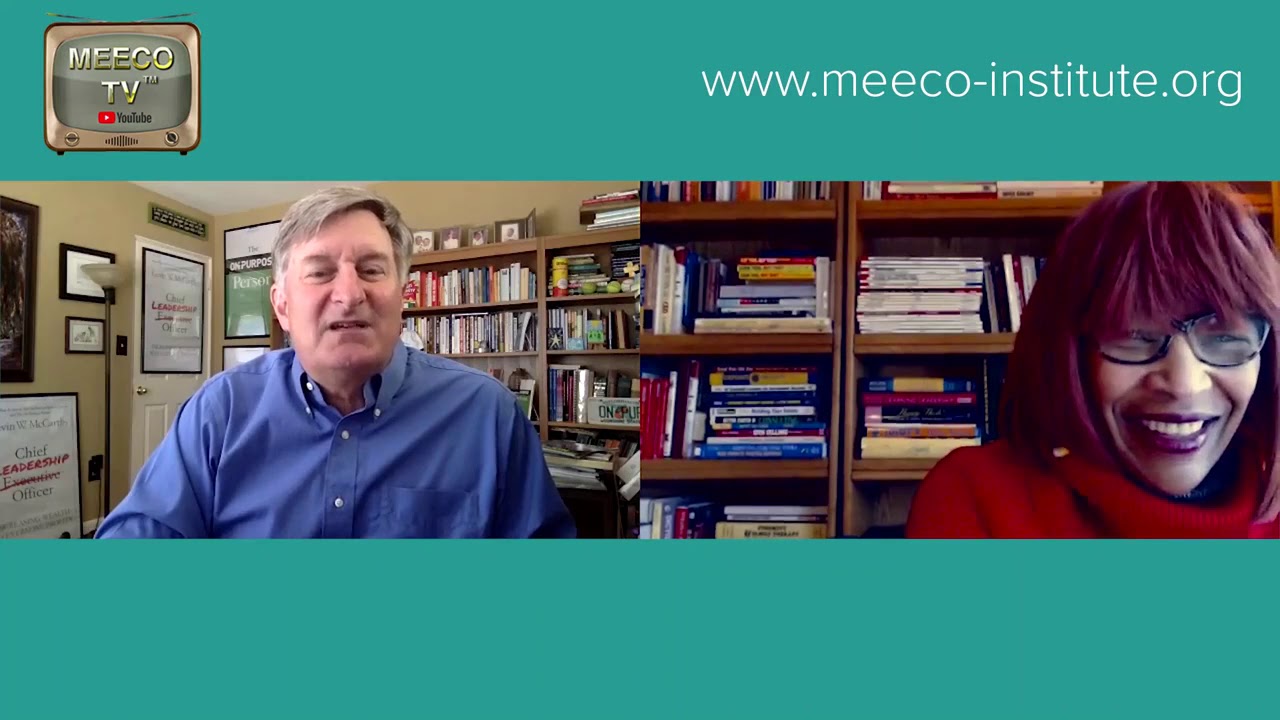
Kevin McCarthy argues that companies should shift from CEO to Chief Leadership Officer, ditching dehumanizing language like "employee" and "human resources." He points to Costco and Apple as models that treat staff as team members, and says a two-word purpose statement drives both personal fulfillment and organizational performance.
Chapters
Kevin, thank you so much for being willing to be interviewed on MECO TV, which is a channel on YouTube that's designed specifically for thought leaders that are colleagues, executive coaches and their clients, the stakeholders, to listen to, to learn more about executive coaching, leadership development, All in the space of enhancing employee enrichment, corporate culture, and executive coaching. And so your book, Chief Leadership Officer— here, I hope everybody could see it— is an incredible, incredible read. Thank you so much for sending it to me.
Thank you.
I have to tell you, That I opened it up, and I don't have a chance to do a lot of book reading these days because I'm on the computer constantly. I probably suffer from red-eye reading so much on the computer. But I opened it up to the table of contents, which I cheat, and the chapter 5, which I want to get to it specifically so that I give the correct title.
Okay, watch your mouth.
Watch your mouth.
Okay.
For somebody who is an INTJ with— who's been accused of being an Angela Davis of her generation, um, who is a Black woman, I said, what the heck is this guy talking about? And how does that relate to being a chief leadership officer? I said, this chapter I'm reading first.
Okay, golly, I'm gonna have to do a quick refresh here on that. You know, when people ask me specifically about a chapter, I'll have to make sure that I'm prepared here.
Well, it's the chapter that tells us that the term management was a derogatory term.
Yes.
And the expression of I'm taking care of my people is the worst thing you could say in your life as As a leader in your organization.
So, well, I mean, that's one of the things that certainly is in this book that's kind of controversial and sort of in your face a little bit in that regard. So I mean, it is a— it is an in-your-face sort of book because the people that I'm trying to reach, if you're not in their face, you're— they're not going to catch their attention. So it has a lot of, you know, I'm not an impolite person, but I am a person that has strong opinions. And I will express those. And I express those often to my clients who are typically CEOs. They pay me for my honesty. In fact, I actually have in my contract, I tell them, um, the company is my client. And if you're part of the problem, I'm going to tell you you're part of the problem.
I absolutely love it.
So be prepared for that.
And you look so genteel too.
I'm actually a really nice guy, but I can't— but they hire me to help them. I mean, so it's called, you know, somebody has to speak truth in love.
Yes, yes. Uh, you know, I've been called the good witch, and I've also been called a kick-ass coach.
So there you are.
I get it. I am so in-your-face type. And yet if somebody does that to me, I'm in tears, right?
Right. That's so funny.
So first, let's start off with tell us about you so that you can offer credibility to what you're going to say.
Sure. I mean, I mean, in terms of my background, I mean, I've been a small business owner for really all of my life. I've been 50 years— I'm 63 years old, but I've been in business for over 50 years. So, I started off very young in age selling candy on the bus and getting lots of cavities as a result of my profits. My parents helped underwrite the cavities and I just kept selling the candy. So, I think they were on the losing end of that proposition. And I've just had a series of businesses since that, everything from teaching tennis professionally, having a tennis pro shop to Then going off to graduate business school at the University of Virginia, the Darden School, where I actually taught tennis as part of the way to pay my way through school. Worked 4 different jobs when I was in business school as well. And then came out of that and started working for a company for— I'm not a very good employee, so I worked for a company for about a year and a half. And then I started my business back in 1982, ostensibly doing commercial real estate. Then I left that to start a greeting card company for I created the first ever corporate-related greeting card company and then got into publishing and was continuing to do commercial real estate work. Um, then I finally realized I needed to do that. There was a problem in business that was bigger than what I saw that was happening. It was a consistent problem that I saw. And part of that led to the writing of my first book, which was The On-Purpose Person, which was the absence of purpose and meaning in life and work. and in businesses. And so I began in the late 1980s talking about purpose. And so I pioneered that. I've been pioneering that message really since the late '80s, early '90s. The On-Purpose Person came out originally in '92. The On-Purpose Business came out in 1998. Both books have been updated in 2009 and 2013 respectively. And so the Chief Leadership Officer book is really almost a continuation of that message, but very specifically targeted towards those in the C-suite.
Mm-hmm.
And certainly along the way, we've had a business advisory firm for really the last— really about 1984, '85, '86, somewhere in that timeframe. I really moved— well, let's see, no, is it 1987 is whenever I went through an AFGI. An AFGI is an acronym a friend of mine calls Another Okay, hold it.
I need to write that one down.
Another friggin growing experience. It's an AFGE. Once you learn it, you'll love it. It's just so explanatory. But anyway, I went through a business divorce. And at that point, I regrouped and said, you know, what am I going to do with my life? And really, I was looking deeply at these areas of purpose. Who am I? What do I want to do with my life? What do I want to do with my work? And that began sort of the genesis of some of the On Purpose Person work and research that was going on. And so since about 1988, '89, I've really been a business advisor to CEOs on overall business strategy, corporate culture, marketing. The integration of all of these things, that really the only person that's really charged with integration is the CEO, hopefully in the future the CLO. They have to make the P&L work, they have to look at the income and the expenses and end up at the end with a profit on that side of the equation, the financial side of the house. But it's— and then they have to make the people integrate. with the strategy and so on and so forth. So they're the integrator, and I've always been an integrator. So in that sense, that began that work, and then I just realized there were some real problems in business that I just wanted to address.
So, you know, we have the Association of Corporate Executive Coaches, which is made up of only master-level coaches. You have to be coaching at the C-suite And out of that came the MECO Institute, which is now the MECO Leadership Institute. And our focus is on identifying thought leaders like yourself, which we call the quiet changemakers.
Mm-hmm.
So you're not over-marketed, but you're making a significant difference in the fields that we're talking about. which specifically is corporate culture, executive coaching, and employee enhancement, all embracing leadership.
Mm-hmm.
And what we do is we have, have a designation which organizations apply to, to prove through standards that they are making those 3 areas happen for their organization, right? And it's an application that they have to apply for every 2 years. And so far, the organizations that have received the designation include the Mayo Clinic, Mm-hmm. Ford Motor Company, L3 Technologies, Roden Fields, MD Anderson Cancer Research for the University of Texas, And we just announced the 2018 designees, which include UCLA, Rice University, and Ermes Airport out of Cyprus.
Wow.
These organizations are doing remarkable work because their applications are evaluated by a team of really kick-ass thought leaders, right? And so when I saw your book, the first thing that occurred to me was This is remarkable, just the title alone. But, but I want you to tell the audience, please, how you came up with the title and that your goal is to replace the name Chief Executive Officer with Chief Leadership Officer.
Yeah, well, actually what's interesting about it is this is something that I came up with, uh, began because I'm a forward thinker and I just, I don't, you know, I see things in patterns. I actually bought the domain name for this on October 1st, 2001. So I've been Chief Leadership Officer since then. If I've learned anything over the years, it is that I am often 10 to 15, 20 years ahead of curves. And so I bought this literally 16, well, 17 years ago.
Yes.
And sat on it until just within the recent years to write this new book, the Chief Leadership Officer book, because I knew that if I released that book in 2001, 2002, that it would just— it would fall flat.
Yes.
Even now, I'm ahead of its time. I mean, that's— if there's a hallmark to my career, it's been that I'm ahead of its time. I'm ahead of my time. And so this is one of those trends that I'm not anxious about this book, if you will. And everybody keeps saying, Kevin, gee, you know, the release book a year ago. And I'm going, yeah, we've done almost no promotion because we're doing other things. And we send it out periodically and we have conversations. It will find its time when it's supposed to. And I'm not going to be anxious about it. Now, we're not going to just sit on it, mind you, but we've got some other projects that are ahead of it. But this is a really important message that I think in the future is going to come along. So what really came about with it was, again, I was looking at what's What's working in business and what isn't. And there's— and I have to say, first of all, I am a business capitalist, love it. Think it's— I think business is one of the most creative places for people to be. It's a different kind of creativity than if you're doing artwork and so on and so forth, but it has that same sort of capacity to bring an idea to life. We may not be using their film or paints or, you know, macramé or whatever, you know, materials or things, but we are creating something from an idea. And so I love the creativity of what that is about, but along the way business became business as opposed to— it's kind of lost its place in society in my view.
It seems to have lost respect, especially with Tyco and Enron leading the fray.
Yeah, and some of that is because we've become such— so specialized. So one of the ways that I often describe it to people is that if you ask the average person, why does a business exist? What is the purpose of a business? And invariably, if you're talking to the average person out there, they say it's to make money. Okay, and that is actually a true statement if you are in the disciplines of economics, And accounting. So those are very specific disciplines, and that's true, but a business does not live in a discipline. A business lives in a society. And so within a society, we have a very specific role, and those of us who are blessed with the ability to make money, to, to create ideas into things or into services. We have a rare and unique privilege, which is that we are to raise society rather than simply enrich ourselves. And it's really interesting because, you know, we talk a lot in the industrial age about the robber barons, you know, the Vanderbilts and the Carnegies and all of these. But, you know, the truth is I've read a lot of Carnegie and Tom Watson, the original founder of IBM, Who else have I read? Henry Ford. I mean, Henry Ford had his controversies and everything, but one of the things when you read— Thomas Edison was my boyhood hero. Okay, that was— I mean, Edison was my big deal when I was a kid. And what you find about all of these people that were the quote-unquote robber barons is they actually understood that their role was to improve society. They had no doubt about it. They were trying to do maybe in a often flawed ways. They may have been just— the ends may have been justifying their means at times.
Right.
But when you look at what was going on, they almost invariably were looking at how do we raise the standards for fellow mankind. And over the generations, we've kind of lost that, that we see business as this place of self-enrichment. Now, there's a whole generation— this is kind of why the CLO concept is coming back around, because we now have a society that looks at things like sustainability and human rights and social justice and so on and so forth, which are just simply ways of saying that we need to play our correct role in society. Now, so does that sort of give you a sense of how some of this was coming about and some of the, some of the things that I was trying to do? And for me, ultimately what I'm trying to do is eradicate meaninglessness. And so I believe that meaninglessness sits at the root of a whole lot of what goes wrong in people's lives. And so if we can eradicate meaninglessness, maybe they don't do drugs, maybe they don't misbehave, maybe they don't They treat somebody with respect. Maybe they care that they want to do a better job. They engage in something that's meaningful. So for people to have meaningful lives, they need to know their purpose, but they also need to be working in places where their purpose can be given expression.
Oh, I love it.
So this is part of the, you know, whenever I'm not a social justice environmentalist or, you know, I'm not against those things, but that's what is motivating me is this sense of eradicating meaninglessness from the planet. So that every person knows their purpose, and then they can, instead of wasting or spending their time trying to look for it, they can know it. And so we have real simple tools that help people do that.
So, but it still doesn't tell me how you got to the word leadership versus executive.
Okay, well, executives— would you sooner be led or executed?
Okay, that's sort of put it very succinctly.
So again, the executive is— again, I want to make sure that we're understanding there is an executive function that needs to occur. I'm not saying that there isn't. There's a business administration function that needs to occur. So I— what I look at is I see that the CEO title is an incomplete title, that it is looking primarily to that chapter that you talked about where, you know, about your keeping your mouth shut or watch your words, watch your mouth, or whatever this. It's really one of these things where what I'm attempting to do is have people really understand that if you have a narrow scope that you're looking at, um, and you're missing the larger picture, if you're doing business incompletely right, then you're going to get a less-than result for what you want. So leadership really wraps more around that, where I see the executive functions more management Leadership is there. Now, I do a lot of work with some fairly large companies.
Wait, wait, wait, wait. So let's just go back and talk about the basics first.
Okay.
What is the difference between leadership and management? Because I, I love, uh, Coffey's definition of the two, but I want to hear your definition.
Well, I think it, it goes along the lines of that Management is the stuff that you're doing and you're tracking it and you're accounting for it and you're organizing it, you're doing project management and all of that. And so it's more about the things, where leadership is more about the people and the integration of people and things into a productive whole. So I see it, and again, I look at leadership as It starts with personal leadership. And if we're not leading our lives well, then we're going to be flawed and fall. And we all are flawed. I'm not sitting here holding anybody out as a pinnacle of perfection, mind you. At least nobody alive. How's that?
Okay. That's acceptable.
And so what What I look at is if you can't be real with yourself, and again, I keep going back to purpose as your identity rather than purpose as something you do. So it's this ability to lead your own life well, and then in turn being able to lead other people in their lives. Now, that doesn't mean that management goes away, but, you know, to your point, that was really in doing my research for writing this book, it was fascinating for me whenever I discovered that 200, 300 years ago, the term manage meant to con or deceive or trick. And that I believe that what happened is during the Industrial Revolution, we had a lot of people who were really hard on other people. You know, people have been mean for a lot of decades, a lot of centuries, a lot of millennia, whether it's the Egyptians treating the Jews poorly before Moses's time, and whether it's slavery, whether you— whatever you want to call it, we've had mean people and we've also had good people. I think we probably have more good people today than we maybe we've ever had. It doesn't mean that the mean ones aren't still with us, but that what happened is those people who were mean, you know, were— became called managers by those people who were being mistreated because they were treating them poorly. They were conning them, tricking them, and doing all that sorts of stuff. And then eventually the term management began to stick, and we whitewashed it over the years to where management is now a word that is just something that we all accept and we don't understand the roots of it.
You know, when I read that in your book, I was totally blown away. And I sat back and I said, no wonder why I've had such terrible managers. They were con artists.
Actually, what's interesting is I found in a lot of the client companies that I work with is they punish leaders and they reward managers.
Oh my God. That is so well said. And why is that?
Because a leader threatens a person's position and point of view, where a manager will do as they're told, is maybe the best way to describe it.
So, you know, that leads me straight to— that is the reason why we called it human resource management.
Correct. Okay, and that's another one of my bugaboos that you have in the book. Um, this is one of the— yes, again, part of the reason that we have the CEO to CLO transition is that CEOs are increasingly obsolete because they come out of the Industrial Revolution. And part of the Industrial Revolution— in fact, I have the book right here. Do I have it? Oh, where is it? Here it is. This book, The Principles of Scientific Management by Frederick Winslow Taylor. This little tiny book revolutionized our world. And Frederick Winslow Taylor, anyway, I won't get into all of him, but anyway, what happened is he was the one that did the original time motion studies. He almost, he really almost invented industrial engineering. So what he began to do is dehumanize people because they were the labor inputs into the assembly line. And whenever he looked at them and measured them against, you know, if we were in— he was working in steel mills, so he would look at coal as a resource, iron ore as a resource, and the steel mills, the crucibles, and so on and so forth, the rolling machines, these were all resources. And he began to call people human resources because he put them on the same level as commodities. And so today, you know, every time I talk to a CEO and they go, well, I'm not obsolete. And I said, do you have a human resources department? They go, yeah. I said, you're obsolete. You know, they go, what do you mean? I said, I tell them the story. I said, this is what's going on. You know, you're treating, you're seeing people as a resource or worse. I mean, some of the things that are going on, like, I recently wrote to the head of a very large consulting firm and said, you know, you're calling your people human capital.
Yes.
And, you know, yet you're trying to say we treat— we have this wonderful work environment, but you're human capital, which is basically saying we equate you to money. You're fungible.
You know, and we thought we were so sophisticated when we started using the term human capital.
Correct. And if you understand what capital is, it's money.
So what, what is the correct nomenclature?
You know, I'm in Orlando, Florida. One of the great institutions around here is Disney, and they call their— they have casting, so they're their cast members— is an example of a company that has done a very unique sort of thing. I believe that certain airlines, they have them as crew.
Yes.
Specific role. Again, if nothing else, call them people, call them talent management. There's all these other words that we can use that are actually humanizing. Now, again, the reason I say all this is not because I'm trying to be touchy-feely. I'm actually trying to help my clients be more profitable financially as well as societally. So this is actually good business is what I'm describing, because people don't want to be treated like a number or like a cog in the wheel. And so what this is doing is when you have a human resources department or human capital or, you know, whatever else you want to call it, human assets. That's the other thing is, are people your most valuable asset? And they go, of course they are. Well, guess what? Assets are on the balance sheet. And so we, you know, again, I have these conversations with them. I say, you don't realize it, but you're actually diminishing the people. And it's the people and their purpose that you want. You want them to innovate. You want them to think. You want them to come out and be. And yet your language is speaking something very different.
Mm-hmm.
Um, so it's very difficult to engage people If you don't have their hearts, and their hearts are where their purpose lives.
Well, I think also, you know, we as a society, we work so hard to get to using new terms. And then once we find out those new terms are the wrong terms, then you have to go through a whole thing in your mind, in your state of being. To change the language, but first you have to understand what you're changing it to and why it didn't work in the first place. And that's just a lot of work to ask people to do in a VUCA society, right?
True, true. But language is the ultimate of creativity. You know, you can go and, and, uh, depending on one's perspective, um, the— in the beginning, in Genesis 1 in the Bible, it says, in the beginning God spoke the word and the world came into being. So if you think about it—
Yes, but God had one word to speak. We've got too much now with the digital era that we're in.
But my point is that words are acts of creativity. Okay? Whether it's written or spoken words, they are acts of creativity and they carry weight and meaning and significance. And if we're not— if we don't watch our mouth, to use the title that you like so much, if you don't watch your mouth, you're going to end up creating something that you don't really intend to. And again, I think it's just sloppy use of the language. I think if we— when people understand it, they're like, oh, Man, you know, it's like there's certain words that I just won't use. And, you know, hey, I slip and I'll talk about human resources because a lot of my clients have a human resources department. So I have to talk in their language.
Yes.
I mean, I even look at the word employee as a pejorative.
Tell us about that.
It's a team member. It's an associate. It's a, it's a person. Um, again, to be employed is a, it's, it describes a state of work, if you will, but I would almost prefer the word vocation or occupation. You see, where to employ is much— again, we tend to employ assets, we tend to deploy assets, like in the military, there's a deployment. Now, there are times where, again, I I'm not, I'm not real dogmatic about these things. I'm just trying to make people aware of them more than anything.
So, okay, so now you— my mind is just in overdrive right now. So I want to get to the part about, I take care of my people. And you— I want to tell you that I heard— my mind was like fireworks, and then I was falling on the floor laughing. I didn't know which to do.
Okay, and what were— tell me what was going on in your brain.
So you hear so many, uh, managers, and I'm trying to think if you really hear leaders say it, but when accused of Behaving badly, their comeback is, yes, but I take care of my people. And in your book, you make reference to the fact that that statement alone is a negative statement.
Well, no, if you, if you look behind it, I mean, I understand the paternalism or the maternalism that's behind it, that they're saying.
Yes, that's what you talk about in your book. Yes.
Correct. But, and I think that they're attempting to be noble and kind and good and all of those sorts of things. So I don't misattribute to them. What I do look at it is say, you know, if you, you want to treat people adult to adult, not parent to child. And my people is like saying my children. And so, and it also implies ownership.
Oh, yes, it does, because I read that and I thought slavery.
Yeah, this is my glass of water, right, as opposed to a glass of water. And so it does have this sense of indentured servitude or slavery that's there. Again, that's— that is the Industrial Age mentality that is there. And again, I'm really not trying to create microaggressions. I mean, I'm not a micro I mean, I'm just saying, look, just be aware of it. Don't be offended by it. Just watch your language and you'll find that you're going to catch yourself saying, wow, I may have some attitudes here or some things, and it's not that I actually have the attitude. It's that it's so ingrained in our culture of business that we have— and that's why I'm not anxious about CLO, because I realize it's such a monumental shift of language, thought, and implementation that it is going to take time for it to work its way into the system. But I do believe it is the right way that is going to— what the future is going to hold if we're going to succeed, because there's a lot of societal shifts that are going to be there, and it's a different way of doing business. And we need a different way of doing business.
So let me just go back to your book cover here. And so you say here, emerging business leaders will be known as Chief Leadership Officers, CLOs. They carry 3 clear charges. One, position the organization to be a leader in its chosen field. Isn't that something that we've always tried to do? Because that's tied to being number one, your equity. Are you saying that we have not done that?
No, no, I think that we have. That is, you have to look at the 3 together.
Absolutely. I was going to take them apart, but— Okay.
Yeah, but yes, I would agree that every, every CEO is probably at some level looking at how do I position my company to be a leader in its chosen field.
Okay. So the next thing you say is position each person to be a leader in his or her life and work. Clearly, we have not done that.
Clearly, we have not done that.
Right. And then 3, you say meaningfully integrate the 2 above so everyone profits, remembering that financial gain is but one aspect So, can you tell us about the other aspects of profit?
Okay, well, profit is a word that we generally, again, in the business world, we understand profit as financial profit, but the aspects of profit that are really important— means to add value is maybe another way of looking at it, and there's a lot of ways to add value. You add, you know, companies understand that they add value through customer service. They add value through better marketing perhaps, or people understanding what they're purchasing better. Communicate— better communications adds value. A better user experience creates value. There's a lot of ways that you can profit your consumer or your customer or your team so that they are able to profit, and generally speaking, We— if we only look at profit as a financial equation, it's much like looking at business as only about making a financial profit, only about making money, as opposed to understanding its larger role in society. So again, what's happening is there's, there's big, there's big misunderstandings that then get translated into these little misunderstandings.
Mm-hmm.
And these little misunderstandings Unfortunately, or have major implications.
So don't, don't dispel my, my, my thinking here, because to me as a consumer, my go-to organizations for best in class are Costco and the Apple Store. Right. What makes them— and so I'm looking at, if we look at profit as the consumer experience part, so for me, the most positive consumer experience I have is at the Apple Store and Costco.
Mm-hmm.
Are they doing something right that, that results in this happening. I also had a very positive experience in most of my visits to TD Bank. And I said the other day to one of the officers, I said, TD Bank seems to have a good spirit when it comes to their customers, meaning I enjoy coming in here. Right? And I don't have much time in my schedule with being responsible for G4 leadership group of organizations, but I kind of like going into that bank.
Hmm.
And I said, I'm trying to understand why your bank is different from other banks, which I would dread going into. Now, I knew intuitively what I was asking. I said to her, why do you, as the team person— I don't want to say employee— team person, what makes— what allows you to treat me as though I feel I want to keep coming back? And she said to me, well, you have to believe in our mission, which is we want to make bankable your banking experience a positive one. And she said, I've been at other banks where we weren't taught that. We were not taught how to respond, be part of the customer experience, right?
Mm-hmm.
The other day when I walked into my Costco, I told them I was They immediately— they said, where are you moving to? And I said, Fort Collins. Well, the manager at that Costco, who I've known and followed from other Costcos, immediately sent a text message to the manager at Costco in Fort Collins and said, our best customer is coming by. Now, clearly—
I love it.
I know I am not the best customer because there are stores that go in there and buy pallets of stuff, but I feel As though I'm their most important customer. Who does that? Costco? Seriously, come on now.
Well, you know, one of the things that's interesting about Costco that it's— and I don't know about Apple. I mean, I'm an Apple person. I bought my first. In fact, now you can't see it in here, but I've got a, an, an, uh, the second ever Macintosh ever made sitting up on top of my bookshelf.
Congratulations. Yeah.
But anyway, uh, Costco has a prosperous wage strategy.
A prosperous—
Wage strategy. They pay their starting people— it's been a while since I looked at it, but I think they pay their starting salaries are $19 an hour no matter what, or somewhere in that range, $19 or $20 an hour and on up. And so what they do is they retain their employees. If you notice about Costco, you see the same people there year after year after year after year. And I'm a Costco fan as well. And it's because of that prosperous wage strategy that they're able to do that, that they believe that you get good people, you pay them well, and they will take care of you. Now, I did some work with a client of mine years ago, and he also used a prosperous wage strategy in a retail business. And he could see that when he could keep a team together, There were 5 people on a team that led a store. If he could keep those 5 people together, literally that store's revenues, he could track it, would go from maybe making $100,000— I don't remember the exact numbers, but $150,000 a year, $250,000 the next year, to $350,000 the third year, to the point where that store would produce $550,000 a year in in net profits to the business. But as soon as one of those team members left, that store went right back to year one.
Wow.
And that because the, the nature of teamwork and people knowing one another, trusting one another, and their customers getting to know them and work with them is— it was a very interesting dynamic. So it's that sort of a thing. I mean, I mean, I've watched— anyway, I've watched kids grow up at Costco who, you know, it's kind of like, you know, they come in as a teenager and, hi, you know, they're doing whatever, and now they're a manager.
Yes.
And it's fun to watch.
It is. And it's, it's not— I mean, I've seen the managers there and they're not lightweights. I mean, they are strict, their expectations are high, but they, they reward support beyond just the monetary value that we're talking about.
Right.
And I think it kind of fits into what you're talking about in terms of leadership. Let me give you an example, and it's kind of a sad one, but I was, I was so proud to be a Costco member. One of their young members passed away, 23 years old, was in a car accident. And I drove up and I saw the bunting outside of the store and I thought, what the heck? And I walked in and I said, you could feel the somber. And I said to one of the guys, I said, what's going on? And they pulled me aside and quietly said, we lost one of our members and it's unexpectedly over the weekend due to a car accident. And I don't know how to express it, but everyone in that store was appropriately— and I'm saying that in quotes— somber.
Hmm.
In other words, they went about doing their business in the same quality of excellence, but you could feel in the air that there was a sense of a team member loss. The day of the funeral— she was a cashier— the day of the funeral, they put roses on her register.
Wow.
I walked in, I saw that, I almost lost it.
Wow.
And I said to the manager, kudos to you for allowing this to take place. And he said, we lost one of our own.
Wow.
And he said, and customers are saying exactly the same thing. And we didn't do it for customer recognition, right? We did it to help heal. And so I'm getting misty just thinking about it.
Yeah, no, I'm tearing up too. I mean, it's, it's What an amazing— what an amazing— see, that's— this goes to the basics of human need, which is we want to belong and we want to have significance, period. And when you have, you know, he is doing that as much for the living as he is for the dead.
Yes.
And he understands that this is family. This is a place where we care about you. You know, we're not family in the sense of blood family, perhaps, but we are, we are a team. We much— we're a unit that works together. We are— the military understands that band of brothers or brand of brothers and sisters, so to speak. And, you know, it's kind of like at my church, we talk about church family. It's that sense of belonging and that whenever one is missed, it is a significant loss. And so we have that because that way every other person there understands that they also are significant.
And does this, this kind of action, does this kind of define leadership in your mind?
Um, it defines a competency of leadership, which is, uh, there also is a business competency of leadership, but there is a human or a people Competency of leadership, which is why, you know, oddly enough, I find some of the best leaders are actually formerly athletic coaches.
Interesting. Why?
Well, because they first had to understand that you can't force a kid, you know, there— I mean, I've got friends of mine that are professional athletes that have played pro football and stuff like that, and I've asked them, who's the best coach you ever had and why? And generally speaking, they'll say, well, If you want to talk about the best record or something like that, I go, no, the best coach. Who got the most out of you? You know, they'd say, well, I had coaches that instilled fear in me, and I had coaches that brought out the best in me. And the teams that— the ones that brought the best out of me, we had the best team, we had the best environment, we had the most cohesiveness, we pulled for one another. Where the coaches that instilled fear in me, we got the job done. But it was a job and it wasn't fun. And we were paid. It was an exchange of money for services. And that's the way we lived. And in much the same way in the corporate arena, we have that same sort of dynamic, which is we have somebody— A person who runs with fear will often be managing to minimum expectations. Where a leader is trying to bring people way beyond their minimum to their higher, greater potential, or to rise into what can be. And in order to do that, you have to know the person, and people are messy. So it's easier to sit behind a computer and manage the human resources than it is to get involved their lives. Because if their lives are messy and our— if our lives are messy, we— I mean, I remember years ago I had a client of mine who said, we put together this amazing strategic plan for this organization to double, triple, and quadruple in size. He loved it, the team loved it and everything. And the guy who was the— it was a not-for-profit— the guy who was the executive director of this not-for-profit Prophet said, I have to resign my job. And I said, why is that? He said, I can't lead this team there. And I said, whoa, wait a minute. I mean, he's a really good guy. I mean, really, really a lot of respect for this guy. Why do you say that? And he said, because I can't lose 20 pounds. My life is so out of control that I can't lose 20 pounds. How can I expect a team to follow me?
Wow.
And I was like, wow. So that's exactly what I said. We can help you lose 20 pounds. That's easy. That's, that's just bad choices and different things and all of the sorts of things that are going on. We can get you a health coach. We can get that solved real fast if you really want to lose those 20 pounds. Well, he lost that 20 pounds and actually more. And that team actually quadrupled their revenues in about a 3-year period of time.
Wow.
But see, he saw himself as failing at something, therefore he couldn't lead his team there. And it was the most visceral connection I've ever seen between what's going on inside of us and our ability to ask somebody else to do something when we know our lives are perceived to be in chaos.
He had tremendous insight.
Yes, and we had tremendous trust for him to convey that to me too. Yeah, it was, it was very And that's what happens. I think for those— you've got a lot of coaches here. We as coaches, we get these inside sort of peeks, these little glimmers that if we listen, we pick it up and we understand. Because again, if we're as coaches caring for that leader, then that leader is caring for that organization. So we have to understand that we're working through it. And so that's why coaches— that's why I said athletic coaches often are best because they have the human, the people perspective— is I've got to work through other people because I can't play every position on the field myself. Where a lot of us who come up through the technical side of it, we're the authority on finance or accounting or operations or technology or whatever it may be. Therefore, nobody is as good as we are at it.
And so we— I think I could talk to you forever because you just, you just put the nail on the head of an experience that I recently had. This is synchronistic, which is watching an executive coach spin out of control personally. And I thought, okay, how can I support this person? Because if they're not aware of their behavior and they're going out there and they're coaching senior leaders, we have a problem. And so I think that— I mean, I am just amazed at this leader that you talked about who had the insight and trust to say, I can't lead this group because I have Something going on in my life that needs to be cleaned, and could you help me? And then this is the positive results. I think that oftentimes, you know, I know we're going a little bit off subject, but you brought it up. Those of us that are in the helping space, we have to watch to take care of ourselves. We have to be leaders in ourselves. Yeah.
And see, that's why the first book I wrote was The On-Purpose Person, because I said, if you're not on purpose as a person— and then the next book was The On-Purpose Business Person, and then the next book was Chief Leadership Officer. So I've been working on a 30-year plan here of doing this. And then behind all of that, there's tremendous amount of support. But at the core of being a leader of your life is being on purpose.
Yeah.
life, if your life doesn't have purpose or meaning, then you are adrift and you feel alone and lost. So whenever I talk about eradicating purpose, eradicating meaninglessness, the way you eradicate it is you inoculate with purpose. And so I use 2-word purpose statements to help people understand their purpose in life. And by doing a 2-word purpose statement, now there's a filter that everything can go through.
Okay, let me turn my page here, my note page. Let me get those 2 statements.
Well, no, no, there's not. I mean, well, there— I don't have— everybody's is unique. Everybody's 2-word purpose. Now, in the Chief Leadership Officer, I say if your business doesn't have a purpose statement, a 2-word purpose statement, use the word, um, which is on the front cover of the book, which is, this is increasing wealth. And what's interesting about increasing wealth, again, this is one of those things where I'm going to— it's almost like a repeating pattern. Wealth is a word that most people think of as money or finances or a big bank account. Wealth comes from the word— at the beginning of it is the word wheel. Okay, so if I hold it up, W-E-A-L, that's, that's a word that none of us have ever probably used much. And weal is a word that translates into well-being.
Oh, I just got it!
So if you are increasing weal or wealth, you are increasing well-being. So that if you're increasing well-being so everyone profits both financially as well as material, you know, health-wise, and so on and so forth. Now all of a sudden you have a— you have the spiral is upward. Okay, as opposed to when it just all becomes about the money or the ROI and so on and so forth. So again, this is a very holistic view of what business's role is in society. And how it needs to be led differently and how it starts with the individual leading their life differently, starting with knowing their purpose in life and that their life has meaning, significance, and purpose. And therefore they then give it expression, which is to be on purpose. And they give that expression then into an organization where they can be on purpose and they can invite other people to come and be on purpose. So again, it's a, it's a, it's a very holistic, big picture sort of thing, but we drill it down to individuals knowing their 2-word purpose statements and organizing their lives so they can lead their lives around what's most important to them. And I don't, I don't judge what is most important to them because I believe that they have an innate understanding about what is healthy and right and good. And noble for them. It is this meaninglessness part that comes in and pollutes their understanding. So at times I may, as a coach, I may be reflecting on them and saying, what do you think the roots of that thought are? Or how are you making that decision based on that? And then they have a conversation and you realize that they, they, they self-diagnose that, wait a minute, that doesn't work, does it? You know, and that's, that's really whenever we've done something good. And, and I do that for individuals, but for also for, for organizations, it's the same thing.
So, you know, I know we're running out of time, but I have so much to ask you. So let me ask you these 2 final questions, and I hate for them to be final. One is, I am noticing— so, so I'm a pretty hard-nosed person.
Exterior-wise.
And that's a big caveat in there. Um, and, and so when, when coaches start talking to me about mindfulness and purpose and meaning, all the softer skills, I go hogwash.
Hmm.
And so, however, I am learning that that hogwash may be in my head and not externally. What I'm finding, though, is more men are starting to look at these quote-unquote softer skills and talk about it. Is this a revolution that's happening?
Yes.
How is it that men are able to maintain quote-unquote respect Because they're supposed to be the football players. And, and I also asked this to somebody else that we interviewed who is a COO and who teaches yoga at his company, which is a technology company. And I'm like, what?
Well, I don't know that I speak for all men. In fact, I know I don't speak for all men. All I can tell you is the absence of purpose has very practical implications. It's not— it's— I always say the soft skills are the hard skills. And, you know, it's a lot of people say, well, it's kind of like, you know, if you don't know your why, if you don't know if, you know, and mindfulness is— I mean, all of these things, they're all sort of saying the same thing that I'm saying. I'm just saying be be on purpose. I'm much more like you are in that sense, in that I'm trying to find very practical application of these things so that, you know, for instance, you know, we have a checklist for CLOs that they can go in and say, have I written my purpose statement? Have I done, you know, have I done— Begin to understand that it has— it's kind of like I describe purpose as kind of like spiritual electricity that's flowing in through a building. And so if the building is cut off from the power source, you've got this beautiful edifice that's there that has no electricity in it. Nothing can run in it. People can still, you know, be sheltered and everything in it. It doesn't lose its function altogether, but it's not fully what it can be, what it's designed to be. And so in many ways, when you take that kind of spiritual energy out and you only leave a shell of a building or a shell of a person, then you're going to get a less-than result. And this is why employee engagement is at such low levels according to Gallup. This is why— because we who lead organizations are failing to grasp the importance of what this means to the, the the performance of the business or the performance of our lives. So this discontentment that people have that makes them want to take opioids or illicit affairs or whatever it may be that's going on, that's unhealthy behaviors or eating themselves to obesity.
Mm-hmm.
It sits at the root of this meaninglessness that's there. And when you turn that, when you turn that corner, I often describe it, it's kind of like purpose is, it's like people who don't know their purpose and purpose is very, this is where I am dogmatic. There's very specific meanings to it. And we've got this little guy right here. We talk about the difference between purpose, vision, mission, and values. And they can download this for free. People can download that for free.
Where can they download it?
download it for free at clonow.com, clonow.com. And that comes with— they also get the checklist and stuff that's there. But see, the problem is the language of leadership and strategy is confused. So whenever you look at purpose and things like that and you go, hogwash, I used to be the same way. I get it because it was, it was a bunch of stuff we, you know, people would get in a room, they'd talk for a day, they'd write up all this stuff and then they'd put it aside and then they'd go do business. Yeah.
Yes, exactly.
So it was meaningless to them. But whenever you're able to actually take it and have a person— the purpose of the person aligned with the purpose of the organization— now it's get out of their way. You don't have to manage them. They're on fire because they've been given an opportunity. And I believe that that's what Apple does well. That's what Costco does well. That's probably what TD Bank does well. We say we, we search and we look for the people who want to do what we want to do, which is to, to perform in a high and noble manner in such a way that they are able to give expression. And we are simply a vehicle for that, and our customers are the beneficiary of that because they want to be treated with respect, significance, and a sense of belonging as well.
Exactly, exactly. Right.
So—
So, okay, my final question— I'm not committing that's final though— is how do you feel— I just interviewed a thought leader on millennials. Do you think that millennials have a better handle on leadership versus management and on leadership in terms of purpose?
Now here's my take on millennials. Millennials just have a better— they are at the right time more than they are any different. Okay, you know, I believe that everybody longs for purpose and significance. The difference is society. Again, you have to look at the wave of society. We've come out of being hunter-gatherers where we were just struggling for food and survival and everything. And today, if you want to eat, you have about a 99% chance that you're going to find something in the refrigerator or pantry. So you're not having to look at it. And so what's happening is they are at the unique position in history where they actually can indulge their self-interest. Where, you know, you're probably of a similar age to me. When we were growing up, our parents did not have that much opportunity to indulge their self-interest and profit from it. Where now, the ability for people to have a business, to do something that's creative, to give expression to it, it's never been better. And so that is the shift and the benefit that the millennials have And that's the perspective that maybe they don't have also, which is they don't realize how good they have it. And, and, but I think a lot of them do. I mean, I actually am very high on the millennials. I've got 2 kids of mine are millennials, but it's, it's so they're just in a better place in, in time and space and the ages of mankind, if you will.
That's a great perspective. You know, I hadn't thought about it that way. I think that I'm fortunate also in that I have a lot of exposure to millennials and I'm learning so much. I feel like, oh my God, what was I doing sleeping all these years? But I'm also running into the fact that they, they command respect. And they give respect. And I think a lot of people are missing that point.
Mm-hmm.
As I said in my previous interview, one of the millennials that I'm working with said to me, when, when I charged her with starting a committee and actually owning, running that committee, and she said to me, well, what does that actually mean? I said, it means you do whatever you think you need to do to be successful in leading this committee. And she said, well, does that mean that I— very specific questions, right? Does that mean that I need to report into you? And if so, how often? And how are you gonna be satisfied? And I said, so what it means is I need to know enough to know that you're continuing on a path of success. And she said, whoa. And I said, so, so that's all I need. And she said, whoa, I get to report to the CEO? And I said, is that important to you? And she said, you're absolutely right, it's important to me. I could use that panache. And I said, go for it.
There you are.
So it's, it's exciting to see their agility. It's exciting to see their purpose. They have very strong and clear purpose with things that we may have previously sort of danced around. They go right to it, and it's very refreshing.
Yes.
Yeah, are there any last-minute things that you would like to tell us about your work and what you're doing? And I am just kind of putting your book right here. It is, it is just one of the most powerful books that I have read.
Well, thank you. Uh, yeah, I mean, one of the things I would encourage people is we actually have a website where they can go and find their 2-word purpose. And it's very inexpensive right now because we're still in the beta. There you are, you're making notes all over it.
I love it.
I am! But if you go to onpurpose.me, and there you can do in about 3 minutes, you can find your 2-word purpose statement for life. It may not be perfect, but it'll get you 80 to 90, maybe 100% of the way there. And then there's 10 emails that you're going to get that are going to help you refine it. Market it to yourself, understand how to put it into play. Again, that's part of my way of, of helping people understand their purpose in life and understand really what purpose is, because that's part of the confusion around the language is in that regard. So anyway, that onpurpose.me is where I would send people as well.
Well, I can't wait to go to it because I need my 2-word statement. And I'm looking forward to you accepting an offer to be a keynote speaker at our MECO Leadership Conference in 2019.
Well, that sounds like fun. Okay.
Thank you so much, Kevin.
Thank you, and congratulations for the wonderful work you're doing with MECO. And, and just, I, I think it's really neat that you've got this organization that I was not aware of until you reached out to me. And I'm excited to know about it. So keep—
We're doing terrific things, and perhaps you'll even consider coming and joining our stakeholder circle.
Okay.
It is for those organizations that have actually received the designation, but where we want to move to is having guest speakers talk in that small community. So look for more from me. The website is MECO. That's—
I've got it here. I've got the website up.
Well, I want to just say it out there for those that are listening in. It's MECO, Mary Echo Echo Charlie Oscar, dash institute dot org.
More from CB



211- Courage to Leap & Lead with Louise Story part 1Courage to Leap & Lead







