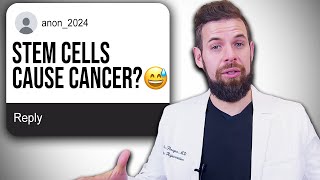
In this video, Dr. Charles Pereyra addresses the most common questions about stem cell and exosome therapies for hair restoration, erectile dysfunction (ED), and joint pain. He explains that stem cell therapy, while researched for over a decade and used by elite individuals, remains classified as experimental by the FDA. He outlines typical result timelines: hair growth often appears between 3–6 months with full results by 12 months; joint pain improvement commonly occurs within 3–6 months; and ED may show changes within weeks, though patients are advised to wait 3–6 months for stable outcomes. The doctor contrasts stem cell treatments with traditional medications, lasers, and finasteride, emphasizing convenience and addressing root causes. Pain mitigation methods include numbing creams, lidocaine, and microneedles. Safety concerns are discussed, noting no published malignancy cases linked to adult mesenchymal stem cell (MSC) lines used in his clinic, while acknowledging some reports of cancer with progenitor or fetal cells. He describes the therapeutic mechanism: MSC-derived exosomes and trophic factors act as signaling molecules that stimulate the body’s own repair processes, compensating for the age‑related decline in endogenous stem cells. The video concludes with a call to view additional detailed content via links in the description.
Chapters
In this video, I'm going to go over the most asked questions when it comes to stem cell therapy for hair restoration, erectile dysfunction, and joint pain. So how proven is stem cell therapy? Stem cell therapy is something that's been done for a decade, but really only accessed for the ultra elite. So people with a lot of money, celebrities, athletes, and it's been used for quite some time. It's been researched throughout the world and even at major institutions here in the U.S. Still considered experimental. Here, and the FDA does consider it experimental. However, it is something that a lot of people are using throughout the states, and you can see this in professional sports. And there's been a lot of documented cases from people talking about how their recovery has been after getting a stem cell procedure. So how long does it take to see results after getting a hair treatment with stem cell exosome therapy? A lot of our patients are reporting seeing results in 3 to 6 months. However, the average we tell everyone is really to wait 12 months. The hair goes through different phases and cycles, kind of like sleep and wake cycles. And this may not happen until like an 8-month or even 12-month phase, uh, when you're helping to rebuild hair. And this is true even with our FUE or microsurgical procedure. When you're implanting the hairs initially, you may have something called shock loss where the hairs may fall out, and then you'll start to see growth around that 3 to 6-month ratio, with the full result happening in 12 months. So how long do results typically take for joint pain? When it comes to giving stem cells for joint pain, joint therapy, again, it's important to note it's experimental, but with our protocol that we're doing for our patients, a lot of them are seeing results in the first few months, up to 3 months, and the majority of patients are seeing some kind of result around the 6-month range. And it's really important to note that everyone's different and everyone's results may be different. But in the most common stay, it's about 3 to 6 months. So how long does it take to see results for patients who get stem cell or exosome therapy for ED or erectile dysfunction? The answer for this can vary. A lot of patients, because it's already such a highly vascularized area are seeing results in just a few weeks. But again, because it's a process which may take time, we do tell patients to wait the 3, even 6 months, but by then there should be some type of change in the function of the organ. So what's the difference between old school treatments when it comes to medications and herbs like finasteride or Propecia, or even equipment like lasers and stem cell or exosome therapy? For me, the biggest difference is convenience. With a lot of these therapies, which I've used, you have to take them one time and sometimes multiple times a day, and you may build up a tolerance to the point where you need to take more for it to work, or it may even stop working. Whereas if you're doing something like an FUE transplant or stem cell therapy, that's something that lasts, in my opinion, much longer, and that our patients are seeing results last without having to do something every day. And so it's a convenience thing, but it's also something which I believe addresses the root cause of the issue. How much does this hurt? Does this hurt? Again, that depends on the procedure, but with the majority of things that we're doing here at Springs, we utilize a very strong application of a numbing cream along with some lidocaine to the affected area. So you really don't notice any pain at all for a lot of the procedures. And the ones where we're unable to use lidocaine because it may damage or interfere with the treatment, we use very, very small microneedles. And so the pain is really mitigated and quite small for most of our patients. I've heard people say stem cells cause cancer. So here's the deal on that. So when you're looking at the specific cell line that that we're using, which is an adult stem cell line, really. It's a mesenchymal line, which is really what all the athletes and celebrities are using. It's what we're using. We've yet to see a published study with that cell line showing an incidence of malignancy or cancer, to my knowledge. We've searched literature on PubMed and CBI, and I personally haven't found anything. However, when not using this line and using progenitor cells, even fetal cells, there has been a couple studies which I've seen published which show malignancy. But when you're using something that's already kind of differentiated, which is what an MSC is. I've yet to see some, any in our clinic, and certainly see publications where it's showing instances of malignancy with stem cell exosome therapy. So why is stem cell therapy such a big deal? What the heck's going on with it? Stem cell therapy is kind of a broad term for treatments being done with a number of different things. So patients are receiving PRP at some clinics, a lot of patients are receiving bone marrow or adipose, and some are receiving the umbilical cord cells, which I believe are the true stem cells, the youngest ones, the most effective. And the way we're seeing that these work, particularly with the MSC or mesenchymal line, is they're actually not becoming a new cell in most instances. What they're doing is creating these things called trophic factors, secretosomes, or exosomes. And these contain packaged materials such as mRNA, protein, even growth factors, which help signal other cells to, hey, turn on again and start repairing and start doing your normal function. And so it really works kind of as an intermediate signaling molecule. And what's cool to notice is that as we get older, we have a huge drop-off in the available stem cells we have in our pool. And what we also see as we get older is it's hard to heal, right? Like, if you fall down the steps when you're 5 years old, you're probably likely to heal a lot quicker than if you do it when you're 95 years old. And a big part of that is the way you signal for healing and healing factors. And So as you rise them up, it makes sense theoretically that you should have a greater healing response. So I can only answer a few questions in this video. Click the first link in the description below and I'll go in detail on exactly how this works. Also, if you want to check out more content from this channel, click the video on screen.