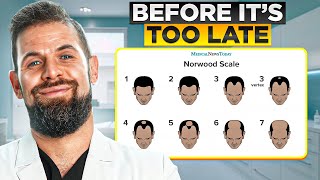
In this educational video, board‑certified dermatologist Dr. Charles Pereyra walks viewers through the seven clinical stages of male pattern balding, explaining how to recognize each stage and outlining the most effective interventions for each. He begins with a disclaimer that the content is not medical advice. For early stages (1‑3), he emphasizes that light shedding can be addressed with a combination of topical minoxidil and oral anti‑androgens (finasteride, dutasteride), and notes emerging stem‑cell exosome solutions that may target root causes, though he mentions personal side‑effects. In mid‑stages (4‑5), where balding becomes obvious, he introduces surgical options—FUT strip grafts, FUE follicle extraction, and newer NeoGraft 2.0/micro‑FUE devices that reduce bleeding and follicle transection—illustrated with a single‑patient case showing rapid regrowth. For advanced stages (6‑7), he states that non‑surgical therapies are largely ineffective and that surgery is often the only viable route, though donor‑area limitations can preclude it. Dr. Pereyra discusses why he now combines stem‑cell exosome therapy with transplants, arguing that exosomes promote angiogenesis, improving graft survival in poorly vascularized scalp areas. He shares anecdotal evidence from his own experience and a friend’s rapid hair restoration, acknowledging the lack of long‑term studies but expressing strong optimism. The video concludes with a call‑to‑action directing viewers to links in the description for eligibility screening and further information.
Chapters
In this video, I'm going to talk about the stages of balding from 1 all the way to 7 and what people are doing with a relative degree of success. And by the end of this video, you'll be able to tell which stage you're in and what may be a potential remedy for you. So for context, my name is Dr. Charles and I'm a board-certified doctor, but this is not medical advice. If you're looking for medical advice, please speak to your primary care doctor. This is for educational and informational purposes only. So with that being said, Let's dive right in. So we have patients who are all the way from 1 to 7. So what should you do from stage 1 to 3, or even if you just want to prevent hair loss in the first place? So there's a lot of common modalities being pushed out there, from laser therapies, from herbs, certain supplements, even scalp massages. So what have we seen to be the most effective? Now, personally, I've tried everything, and I went from looking like this here to having the head of hair that I do today. And believe me, I've tried all the medications, all the supplements, all the injections. I even had a laser comb. And so what I find to be the most effective, even though for me it had side effects in the stages from 1 to 3, having some kind of mixture of minoxidil, finasteride, dutasteride, and these have really shown the most promise in the beginning stages. What's interesting is some people are actually using a stem cell exosome solution, which actually has the potential to get to the root cause in this stage. Now, the important thing to note is that stage 1 all the way to 3 is the point where you're starting to get this light shedding. Shedding or maybe even not notice most shedding at all. By the end of stage 3, it's clear that you have a balding issue. And so this will lead us into stage 4 all the way to stage 5. The balding is fairly pronounced. Most of your friends and your family are now noticing your hair loss and it has become clear that you need to do something about it if you want to keep your hair. Now, while medications, foams, and shampoos are also still the mainstay in here, this is where people are beginning to look into hair transplants. So, an FUT, we do a strip procedure, which is essentially cutting a strip out of the back of your head, putting it under a microscope, plucking out the follicles, and then putting them on the top of your head. There's also something called an FUE, which makes little injections to cut out your follicles in the back of your head and bring them over to the top. A newer device from NeoGraft 2.0 and the micro-FUE do similar versions of this but have a sucking mechanism, which much less bleeding, and enables you to actually bring the follicles from the back to the top of the head and potentially avoid the most scary thing when you're doing an FUE or your micro-FUE, which is transecting or killing the follicle. And this is a case study from just a single patient. Again, it's still in the early stages, but in this single patient here, this person who had pattern baldness in this stage actually was able to get hair all the way looking like this in just a few months. Now what we can see here is we can go to stage 6 all the way to 7. In stage 6 to 7, you're pretty much shiny bald. There's not much going on here. And so if you're in this stage, it's relatively unlikely that any shampoos, any medications, or even a stem cell exosome solution will work at all for you. You likely need a surgical procedure at best, and in some cases, if you've already tried procedures before, had a botched procedure, or don't even have a good enough donor area, you might not even be able to get this kind of surgery at this time. Now, what I've seen in our clinics after treating thousands of hair patients is a lot of people who do opt to do the surgical procedure will end up coming back in after a second or even third hair transplant, sometimes within the span of just a few years. And now what we think is happening here is that they're attempting to transplant follicles that are healthy from the back of the head to the top of the head where there's not a great blood supply and possibly even inflammation. So look at it like this. If you have a healthy, well-irrigated field of grass and there's a lot of soil, there's a lot of irrigation with water and nutrient supplies, and that grass is doing great, and now you want to transplant that blade of grass to a place which is barren, there's no nutrients, and there's no flow of fresh water or irrigation, likely the follicle or the grass may do well for some time, but if it's not getting good blood supply and it's a very inflamed area, it may actually end up falling out soon. This is what we think may be happening. So, Why do we like to combine procedures which include a stem cell exosome solution in addition to a transplant for this stage? Well, as we already talked about, and which is seen in this study here, here, and here, is that stem cells and exosomes may actually induce a process called angiogenesis, which simply put means new blood vessel growth. And why that's interesting is because new blood vessel growth can be like putting new irrigation and a new flow of water and nutrients into that field of grass. So now what you can actually see is if you implant the follicle or a blade of grass from a place that's healthy to a place that now may also be healthier, you're likely not going to lose that blade of grass anytime soon. And so we've seen with our cases, including my own case, is that this may last 5, 7, or even 10 years. Again, this is all anecdotal based. There are no long-term case reviews or studies to support this. This is just based on my experience and what I've seen with some of our clients. But it's something I believe shows extreme promise. And for me, if I was going to do it all over again, would definitely follow this step. The fact is what we did for this patient here, who's a very good friend of mine who had a head of hair looking like this, and then just after a few short months, his hair looked like this, which is unheard of with any surgical or stem cell procedure alone. It's pretty incredible. So if you're interested and you'd like to learn more, just click the link down in the description below. There'll be a short video to watch. To see if you qualify for any of these types of procedures. Also, there'll be a video you can click on screen now if you'd like more information. So click the link below and we'll see you soon.