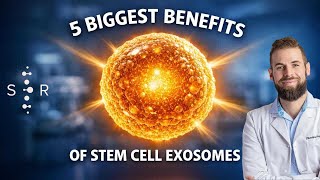
In this YouTube monologue, board‑certified physician Dr. Charles Pereyra explains five emerging benefits of mesenchymal stem‑cell (MSC)‑derived exosome therapy that are gaining attention among elite athletes and the broader medical community. He first clarifies that MSCs and their secreted exosomes are closely linked, with exosomes acting as the active, cell‑free therapeutic component. He then outlines: (1) cardiovascular advantages—including promotion of angiogenesis, regulation of apoptosis, anti‑inflammatory effects, and potential post‑myocardial‑infarction regeneration; (2) brain‑health benefits after stroke, citing a meta‑analysis of >300 patients that showed improved NIH Stroke Scale scores and evidence of neurogenesis and reduced fibrosis; (3) pulmonary improvements and possible VO₂ max gains, referencing the START trial in the Chest journal that demonstrated better outcomes for ARDS patients receiving MSC exosomes; (4) systemic anti‑inflammatory effects across multiple chronic inflammatory diseases, supported by findings in the Journal of Biological Engineering; and (5) an exceptionally low risk of allergic or anaphylactic reactions because exosomes are acellular vesicles lacking immunogenic surface markers and are naturally present in the body. Dr. Pereyra concludes with an enthusiastic call‑to‑action for viewers to explore further resources.
Chapters
What's up, y'all? I'm Dr. Charles, and as always, I'm a board-certified doctor that's going to break down the latest research and the latest events in healthcare and medicine. Just so you know, this is for informational purposes only. If you're looking for medical advice, please go to your medical doctor. Today I'm going to discuss the 5 surprising benefits of stem cell therapy that most people don't know about. So to jump right into this, I'm just going to start with what stem cells and exosomes really are. Stem cells and exosomes are really one of the same part. See, stem cells are the part of progenitor cells, or the part between progenitor and adult cells, that are specialized to form essentially every organ in our body. And when you're looking at a particular stem cell type, the most popular one has been mesenchymal, or MSC, stem cells. The reason why they're so popular is likely because they're secreting this small factor called an exosome, specifically an exosome from an MSC or a mesenchymal stem cell. So let's jump into the 5 surprising benefits that these likely offer. Number 1, which is emerging pretty heavily in the research, is the benefits on cardiovascular health. Now, when looking at the most recent studies for cardiovascular health and stem cells, we found 4 surprising benefits. One was that it helped in a process called angiogenesis, or forming new blood vessels. This may mean, for instance, if there's a blocked pathway, that stem cells and exosomes could have the potential to help reroute this and form new bloodway pathways or angiogenesis to help support the heart health. Now, the second way is apoptosis regulation. Apoptosis is a programmed cell death. Now, it's shown here that stem cells and exosomes may have the potential to regulate the whole programmed cell death process when it comes to cardiovascular health. Now, the third, and this is something that's actually global as well, is they're exhibiting some anti-inflammatory effects. And we all know more inflammation can lead to more damage and even ischemic or damaged arteries over time. And the fourth interesting reason for heart health here is that this study is actually showing that cardiovascular regeneration may actually be possible post-heart attack. Yep, that's right. They're showing that there may be some potential that after a heart attack, meaning a part of the heart muscle is dead, that stem cells and exosomes could potentially regrow this. So very interesting. Now, the second thing here is cognitive or brain health, right? And this is an incredibly interesting study because we just talked about heart health and heart attacks, whereas this study here is talking about strokes and the potential for stem cells and exosomes to actually regrow new neurons, also called neurogenesis. The other part of this that's really interesting is it's showing that it may help with a process called fibrosis, or scar tissue formation. Now, when this happens in the brain, particularly after stroke, it would be almost impossible for any neural pathway to lay down new circuits, which is very interesting here. Now, what's really interesting is this meta-analysis, which looked at over 300 patients post-stroke, evaluating them on something called an NIH Stroke Scale. Now, when looking at this stroke scale, patients who received stem cells had better functioning post-stroke. This is something that's incredibly interesting and has the potential to completely alter how we look at strokes and how we look at brain health and neurogenesis in general. Now, the third, and this is why you may see your favorite athlete going to get stem cell therapy all over the country and abroad, and this is because VO2 max may actually increase. And there's some studies to suggest that this may actually be a real thing. So to understand why this may be potentially helpful for lung health and ultimately VO2 max, which some are calling the indicator for how healthy you're likely to be long-term, for quality of life, and possibly the number one predictor of longevity in general, I think it's helpful to look at the worst lung condition, which is called ARDS, or acute respiratory distress syndrome. Now, in this syndrome, the lungs essentially shut down and death is almost inevitable. However, when looking at this START trial published in the Chest Journal, mesenchymal stem cells administered to patients had moderate to severe ARDS actually fared better than those who did not have any stem cell exosome treatment at all. So this is a heavy indicator that there may be something happening downstream, maybe in the alveoli or in the small pathways of the lung itself. And why this is interesting for athletes and why some are claiming that VO2 max may go up may have a direct correlation with this. And this may be some of the reason that athletes are claiming to have better cardiovascular performance and are coming in to get stem cells for their overall lung health. However, more research needs to be done, but this is an incredibly interesting trial, uh, published in the CHEST journal. Now, number 4, chronic inflammatory conditions. So this includes any condition where inflammation is going on for a long time, whether it be autoimmune, chronic damage, or any other condition that leads to a buildup of inflammation, which lasts for a long time in the body. Now, why this is incredibly interesting is cuz in the Journal of Biological Engineering, they actually showed benefits across multiple morbidities, meaning multiple diseases that cause chronic inflammation were showing benefit across the spectrum when administering stem cell exosome therapy. This is something that's incredibly interesting because chronic inflammation is responsible for a wide array of conditions. So having this study here in the Biological Journal of Engineering is incredibly promising to show that stem cells and exosomes may potentially decrease global inflammation. So number 5, one of the most surprising things about stem cell exosome therapy is that they have a very low comparable risk profile to cause allergic reactions or anaphylaxis. Now, this may be because they're not actually cells themselves at all, but rather small vesicles without the antigenic cell surface markers or the markers that can lead to anaphylaxis, cell rejection, or even just a simple allergic reaction. Also, in looking at the natural component of exosomes, is that exosomes are secreted naturally throughout the body with multiple cells, not just stem cells. So the body is most likely looking at these exosomes as being a part of self. Again, most cells in the body secrete exosomes as a way to communicate with themselves. So when administering an exosome from a mesenchymal stem cell, it's very easy to see why it likely has a lower profile for allergic reactions or immune reactions. Additionally, exosomes also have anti-inflammatory properties, meaning inherently that their job may be to decrease inflammation as a whole. So these 5 reasons are what's getting me incredibly excited for the field of stem cell and exosome therapy. This is being offered across the country and across the world, and some patients are seeing profound results. So if you're interested and you want to learn more about stem cell and exosome therapy, just click the video on screen now or click the link down below in the description. We'll see you soon.