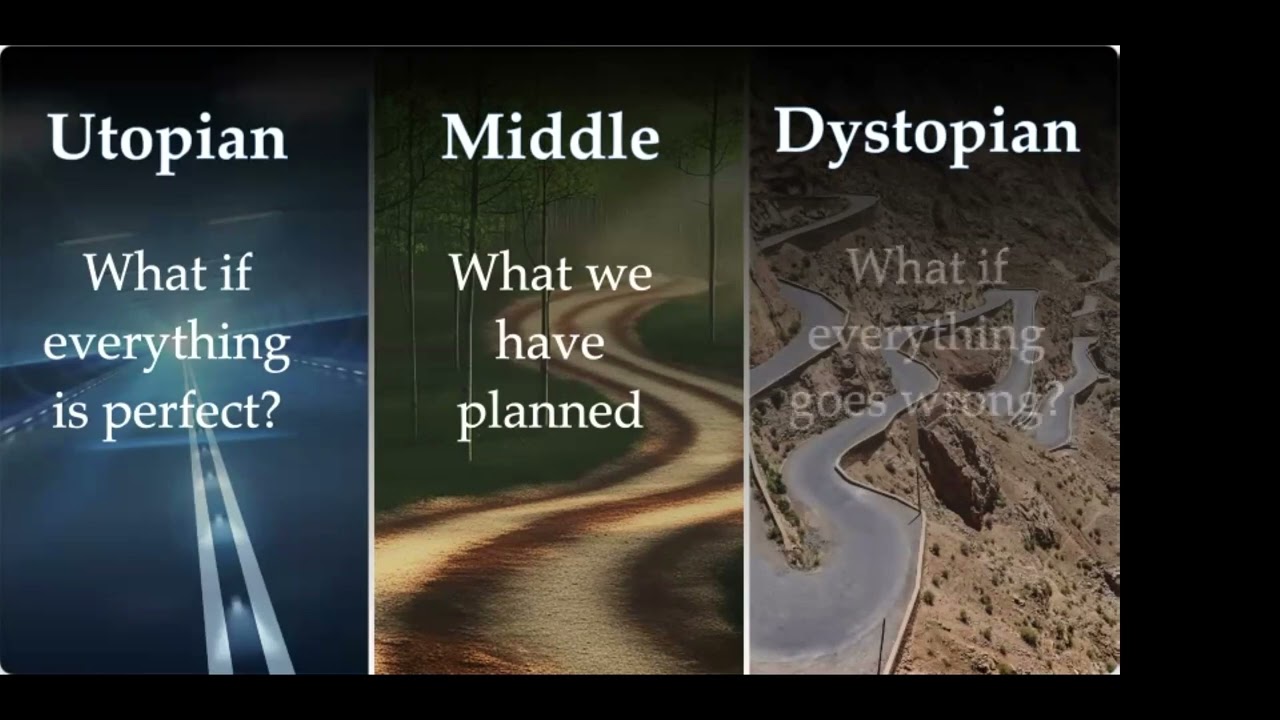
In this instructional talk, the speaker introduces a simple three‑scenario planning framework that leaders can use to navigate uncertainty in personal or professional contexts. The framework consists of a middle‑of‑the‑road (expected) path, a utopian (perfect) path, and a dystopian (worst‑case) path. Listeners are prompted to sketch these three scenarios on a notepad and apply them to a current challenge. The speaker explains how each imagined scenario triggers distinct brain chemistry—excitement for the utopian view and anxiety for the dystopian view—and advises viewers to acknowledge these emotional responses so they can later make more rational decisions. A concrete example is given using annual blood‑test results: data points become "flags" that indicate whether the current trajectory is moving toward health or danger, and the three‑scenario lens helps decide which actions (e.g., dietary changes) to take. The talk concludes by emphasizing that the scenario‑flag system can be shared with teams, families, or doctors to align on priorities and guide collective action.
Chapters
And if you happen to have a notepad with you right now, then sketch out these 3. And as we're going through, just think about a situation that you're dealing with in your personal life or in your work life and look at these 3 scenarios. So the 3 scenarios are this. In the middle, we got the middle of the road, the thing we expect, the strategy document as it stands, the business plan as it stands. Then we have a utopian version where everything goes Perfectly. Beg your pardon. So we got a path there in the middle which is meandering, but we know kind of where we're going. The utopian path, everything moves smoothly and it's automated and electronic. And on the right-hand side is the dystopian path where there's lots of danger, where there's lots of going backwards and forwards. Now I know my audience, there are some of you who are thinking that those 2 should be the other way around because you'd much prefer a winding path that looks exciting, that is natural, than something that is too electronic and modern. But just play with me for this because these are my scenarios. You can make up your own scenarios later. So once you have these 3 scenarios, you can start to play around with them and explore them in different ways. So here's what we have. The middle path is what we have planned. The utopian path is what if everything is perfect, everything just works brilliantly, it's wonderful. As you start thinking like that, your brain is producing chemicals which you, you need to deal with, okay, because you can't make a decision during this chemical cascade. But that's the utopian path. The dystopian path is what if everything goes wrong? What if this year something happens that's worse than COVID? How do you deal with that? And if you spend any time doing that, then immediately your brain starts to feel that anxiety because it feels threatened. It doesn't know that you're playing a game. It doesn't know that you're imagining this. it thinks that the threat is real. Allow yourself to experience that, to go through that, so that you can make some more rational decisions on the other side of your brain's chemistry. So here's one that I often use because it's so personal that it helps us to kind of imagine it. What if you went to the doctor and you got some blood tests because it's, you know, just regular annual checkup, you get some blood tests and there's blood pressure results and cholesterol and, you know, all the other things. That is data. It's just you've gathered it. But you go for your annual checkup again next year and all of a sudden the results are different. The doctor says, no, listen, your cholesterol is way up, your blood pressure is way up, this is a problem. Now you need to start doing certain things. So now that flag is indicating the data, comparing one set of data to another set, is saying there is something wrong here. You need to do something. You need to take action because the consequences of not taking action are these dire consequences. So you take action. For example, your husband makes you a salad every second day for 4 months, and then you go to the doctor and you take some more blood tests and they go, wow, brilliant, your results are much better. Let's keep that up. So now you've got data, you're comparing actual results, and those flags indicate which direction you're going in. which actions you need to take care of, what things are urgently, like an emergency that you need to respond to, what other things can you address over time and kind of change in a different direction. So the scenario process allows you to develop those flags so that you can have a conversation around it, and you and your team can know, or you and your doctor, or you and your family can know which direction you need to move in.