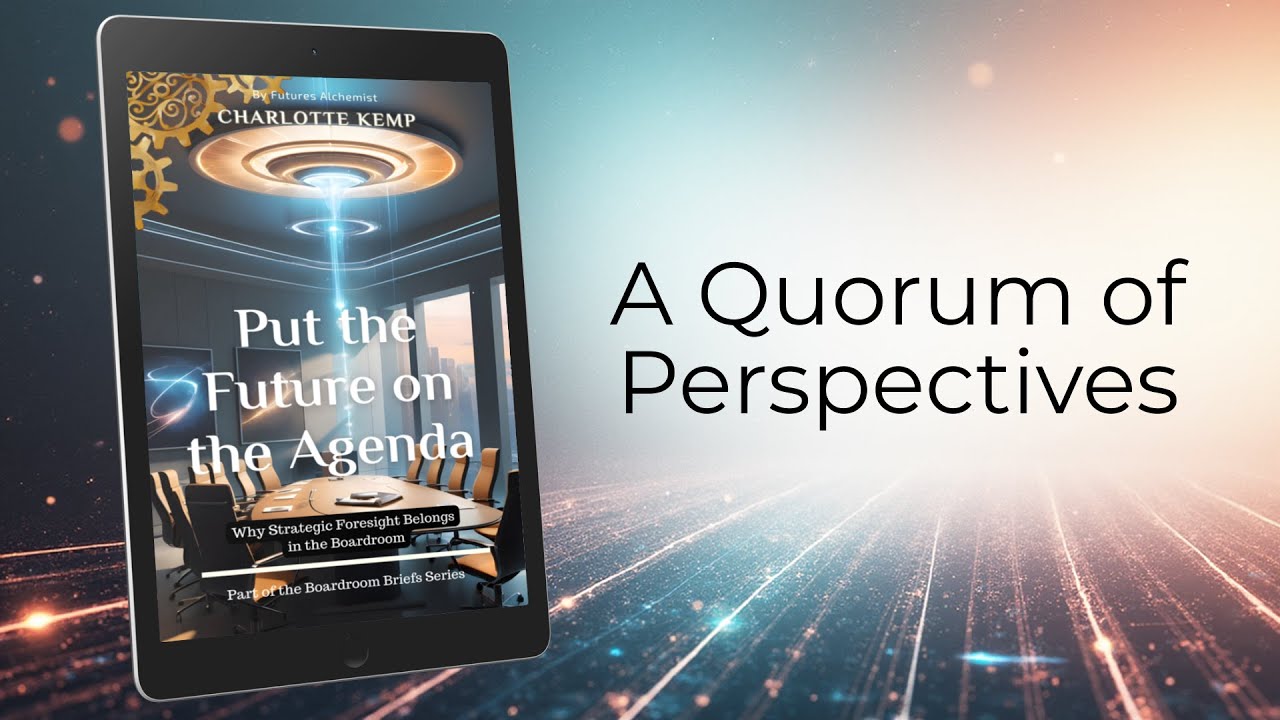
In this monologue, the speaker shares a personal story about Millie Mulvey, an elderly immigrant whose community honored her memory with an empty chair at a restaurant, illustrating how we can appreciate and consider people who are no longer present. The narrative then introduces the concept of a "quorum of perspectives" from the book Put the Future on the Agenda, explaining that just as a formal meeting requires a minimum attendance to be valid, decision‑making should require representation of all stakeholders—including those absent today, future generations, and even parts of the environment that cannot yet be named. The speaker argues that many organizations and politicians ignore these absent voices, effectively robbing future descendants, but asserts that humanity has the creativity, resources, and moral imagination to make inclusive choices that benefit both current and future stakeholders. The talk ends with a call to remember the "empty chair" when making decisions, urging a shift from selfish, exclusive futures to inclusive, ethically sound ones.
Chapters
I never met my mother-in-law. She passed away before my husband and I married. Her name was Millie Mulvey, and she immigrated to South Africa from the UK in her 80s and discovered that she could do a lot more with her British pension here. So she used to go out regularly for lunchtimes with her friends. She had a favorite restaurant and a favorite wine, and the restaurant owner bought cases of this wine for Mother Mulvey because she came in so often. And And when she passed away, the restaurant closed for the day to have a memorial service, and they had a long table, they had her wine out, and they had one chair empty with her walking stick on the back of the chair, and they celebrated her life. And I love that story. And it reminds me of how we can pay attention to and appreciate the people who are not there in our lives. I appreciate Mother Mulvey, although I've never actually met her. But obviously she has done things in her life that have impacted my life ultimately. One of the things we explore in the book, Put the Future on the Agenda, is that of the quorum of perspectives. A quorum in a business meeting, in a board meeting, means that you have to have a certain percentage, a certain number of people who represent the board, who are at a meeting to make that a valid meeting and to accept those decisions as representative of the entire board. So if you can't get 100% of the people, but there's 85% attendance, then it's a valid meeting depending on the rules. But when we look at a quorum of perspectives, we are metaphorically looking at decisions we make, not just for those of us in the room or those of us represented by this group of people, but also those people who are not there or not there yet. When we look at a quorum of perspectives about the business that we're doing, the decisions we're making, are we looking at all of the stakeholders, all of the people, organizations, the environment that will be affected by our decisions? And are we thinking about future generations? Are we considering how the work that we do, the values we promote, the decisions we make, the resources we extract, the money that we invest, How does that benefit the children, the grandchildren, the great-grandchildren, the descendants who are not here yet? Are we robbing from them to enrich ourselves? Because we don't have to consider them. We don't have to consider the empty chair. We don't have to think about anybody else other than ourselves. And there are lots of organizations and lots of people and lots of politicians who do exactly that. But we can do better. We really can do better. We are clever enough, creative enough human beings with enough resources in this world, enough access to innovation that we can do better, that we can make decisions now that are good for us, that benefit us, but also honor and benefit generations yet to come and people and organizations and groups and parts of the environment that we can't even name. We can do better. We can create inclusive futures, because to create an exclusive future, a selfish future, is a failure of morals and a failure of imagination. So think about who's in that empty chair when you make your next decision about the future.