Crafting Positive Futures for Africa with Yelang Prue Jinka
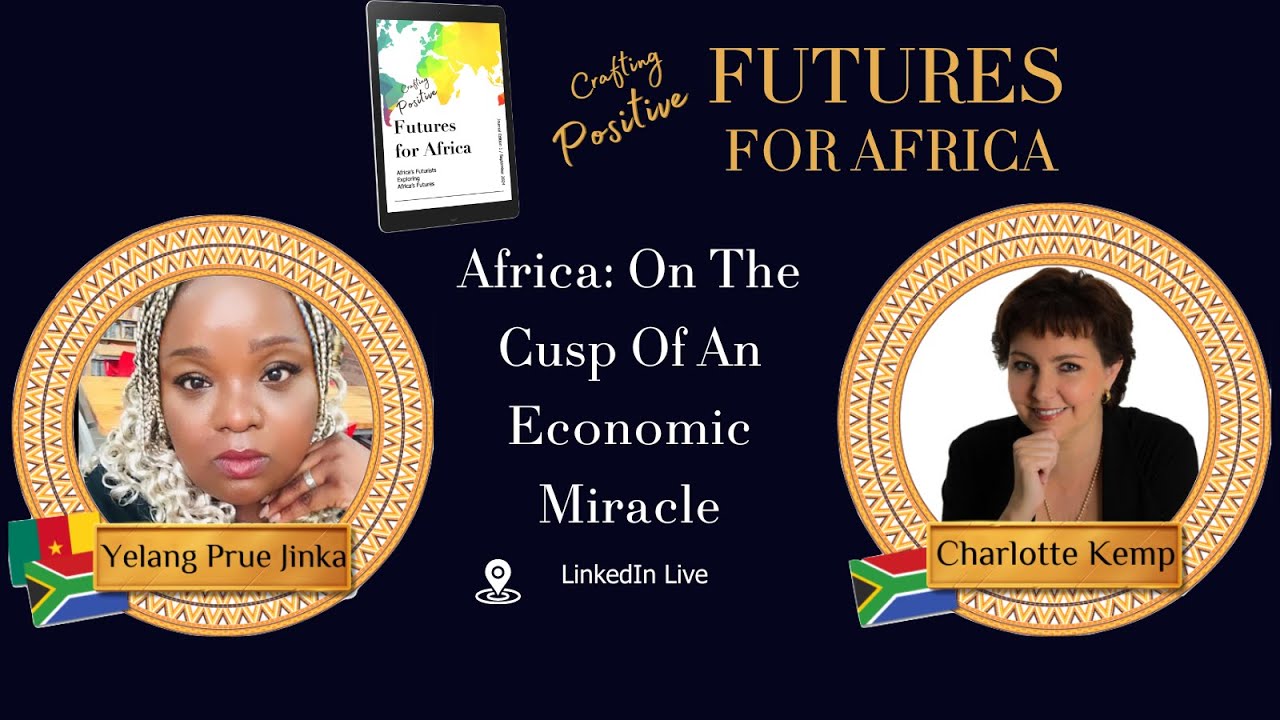
In this interview, futurist Charlotte Kemp talks with Yelang Prue Jinka, founder and executive producer of Access Africa Channel, about Africa’s emerging economic miracle. Yelang outlines the seven‑point framework from his white paper—young population, rapid technological advancement, improving living conditions, infrastructure investment, post‑pandemic optimism, the African Continental Free Trade Area, and Africa as a global growth frontier. He emphasizes the demographic dividend, using Rwanda as a case study, and highlights how rapid 4IR tech adoption is unfolding across the continent. The conversation showcases concrete stories that counter negative stereotypes: the partnership with South Africa’s SciBono science centre, the Cybono Discovery Center’s STREAM programmes, and a student‑led AI‑enhanced wheelchair project in Gauteng. Charlotte reflects on the scarcity of positive African narratives in global media, the wealth of untapped talent, and the need for ambassadors who can share these stories. Both speakers stress the importance of shifting the narrative, celebrating Afro‑optimism, and collaborating to amplify local innovations. The interview concludes with calls to connect via LinkedIn and AccessAfrica.tv.
Chapters
content that we do so that people can fall in love with the content that we create and that we work on and possibly take it further and make it their own and have so much come out of it, which is exactly what you've done. So I'm honored to be a part of this journal, and I'm excited for, um, what will come of this endeavor. Um, so just to speak a little bit about myself and what I do, I am an executive producer at heart. I am a founder. I founded Access Africa Channel, which is the company and which is one of the companies under which I do a lot of my, um, uh, visual work, work that you can actually see. Mm-hmm. So currently we are doing quite a lot of work behind the scenes, um, working with a fantastic institution called SciBono. It's Southern Africa's largest science center, and we are marketing and sharing what it is that particular institution is doing on the African continent, and they're doing quite a lot. So that's brilliant work that we've managed to to, to be involved with. It keeps us busy and keeps us excited. And obviously in the background I'm doing other work bringing Africans from the diaspora back to the continent, those who are interested in purchasing whether it be land or businesses, you know, facilitating those sorts of projects. So there's quite a lot that I do on a day-to-day basis, but I'm passionate, absolutely passionate about Africa being on the cusp of an economic miracle. And I think the reason I'm so passionate about that is because I am a part of that economic miracle, as are you and all the other Africans who, um, have undertaken this work. And I think the white paper was so important to me because we needed, um, a framework, an understanding as to why one would believe that Africa is on the cusp of an economic miracle. And it's so interesting that the 2 pointers that you would choose, uh, you know, it's point number 1 and point number 7. So it's— all the other points are couched in between those 2 points, and I'll touch on them, uh, quite briefly. So the first one is the youngest global population.
Mm-hmm.
The second one is the rapid technological advancement. The third one, uh, the improving living conditions on the continent. The third— the fourth would be infrastructure development and investment. Uh, the fifth is post-pandemic lessons and the optimism which you can find on the continent. The sixth would be the African Continental Free Trade Area. And the seventh is, um, what I consider the most important, the fact that Africa is a global growth frontier. So I'll expound on Africa being a global growth frontier and the fact that, you know, all the growth markets globally have been exhausted to some point, you know, whether you look at the West or the East, or— but Africa hasn't been exhausted. And then I'll jump to the first point, which is the youngest global population, and that tells you perhaps why Africa hasn't been exhausted as an— as a global growth frontier because you've got all these young, um, this young population on the continent in every single country. So once you look at the fact that Africa is this massive continent and with these many countries, then you start to see that there can only be growth in such an environment. Nothing but growth. You know, my favorite country to bring this point home with will always be Rwanda. You know, obviously the fact that they have such a young population comes from a tragedy, a global tragedy, which we all know and remember.
Yeah.
But that doesn't change the fact that right now we're sitting with Rwanda being the youngest population in Africa. You know, so considering that globally you've got aging populations, Rwanda's population hasn't even peaked, you know. So we're looking at young families, we're looking at opportunities where, you know, the rapid technological advancement, which is the second point that I speak about, takes place in an environment such as Rwanda, you know.
Yeah.
So So, and the fact that all of these African countries are having to deal with and grapple with their socioeconomic challenges as well as their geopolitical issues at the same time tells me that we're headed somewhere and it's possible that we are headed towards an economic miracle.
Yeah, I want to pause a little bit there on that one because As a futurist, I love looking at— I found like a little hobby of mine, a side quest, looking at the different demographic profiles of countries around the world. And, you know, we can talk about it, and it's interesting, and it makes for a good conversation. But when you actually start to see the numbers and the visualization of the demographic spread in different parts of the world, it is It is absolutely mind-blowing. And I've had an opportunity this last year as president of the Global Speakers Federation to visit some different countries. And at a certain point they started asking me, oh, your work is interesting, but tell us more about Africa. And that for me became very challenging. How, how do you in a 25-minute mini keynote do justice to a continent of 54 countries and over a billion people and all these languages and religions and It's a huge range of things, but I found some interesting points, and one of them was looking at the demographic spread in Africa versus other parts of the world. And if I picked up something in Germany, I said, this is your spread, or Canada, this is your spread, and this is what Africa looks like. It blew their minds. That and the relative size of the maps, because their countries always look a lot bigger up there in the Northern Hemisphere. But when you actually give proper comparisons of the geographic space. It was amazing. But just to kind of like, with my hands, demonstrate, there's a platform I love looking at called populationpyramid.net.
Yes, absolutely.
And if you go there, yeah, so many of the countries in Europe have this picture that looks like this. So down at the bottom you've got a few young people, then middle-aged people, and a few old people. And And that's concerning for some countries, especially Japan and the Scandinavian countries. They are not having enough children to actually replace the population, which some people could think of as good or bad. It's a thing, you know. It doesn't matter how we evaluate it. But for the country, you know, there's tax and workers, and you know who's gonna take care of the old people. So they got some real issues to deal with, but they all look like this little bubble. And then when you get to Africa, it really is a pyramid with so many younger people being born into the continent. And in the space of looking at futures thinking, this would— could be called a— what do we call it— demographic dividend. But only if we can put those younger people to work, if they can do something. If they're not employed, if they're not trained, then there's a problem. But because of all the other opportunities, the other issues that you're talking about in your white paper, there really are those potentials there for that population of younger people to grow up, learn, do things, contribute, and, you know, enjoy the potential opportunities that are available across Africa. So that's just the visualization is always the thing that really, really entertains me.
No, absolutely. So the current work that we do with Cybono Discovery Center really drives the point that you have made home. Because if you can imagine it, we've got buses and buses of pupils, learners coming into this science center where they are now exposed to, you know, this, this other realm that is not just STEM but STREAM because, you know, we've included research into what the offerings of Cybono are. So you're looking at science, technology, research, engineering, Arts and Mathematics Center. And when you see how these young people come into that space, you can only but imagine what each and every one of them— what the future holds for each and every one of them. And, and that is what makes what I do exciting. You know, my excitement stems from that, knowing that these are people who know, in the next 10, 20, 30 years could very well be discovering cures for all manner of diseases, could, you know, be launching enterprises and that sort of thing. So it becomes very exciting, you know. The future for Africa is truly an exciting one, especially when you, you, you have a paradigm shift, you know. You don't look at the continent through the lenses that we were, but through a different lens, a futures lens. And I think that's what draws me to the work that you do and the work that the co-collaborators that we work with do. It's, it's that kind of thinking.
Yeah, yeah, absolutely. Um, the, the stories though, um, we don't always hear the stories. All right, let me try and put that a different way. Uh, when we search for any topics like the future of artificial intelligence or what kind of technologies are being developed or what the trends are around the world, very often the searching that we do just online, just as an example, reflects the stories that we're hearing from the Northern Hemisphere, from Europe, from the North Americas. And we get those stories and we think that those are the realities. And I love the addition of research there to, to stand, because we, we do not have enough media literacy anywhere in the world. But when we look at that, we think that is what is happening. And if we search for that in Africa, we, we get very often the negative stories, the— beg your pardon— the negative stories, the, the things that are going wrong, all the traditional stories of, you know, poverty and disease and, and those old tropes which While that happens in Africa, happens in other parts of the world as well. But it's an easy story to tell about Africa. But when you sit down very intentionally and start looking for the, the actual stories about what is really being created in Africa, then you come up with some amazing things. And, you know, I know in Nigeria there's a whole lot of really great technology tech work being done, and artificial intelligence work coming out of Africa. Not just out of other parts of the world. There are some great innovation hubs in Kenya, and then of course Rwanda's story always comes up as such an example of very intentionally changing the narrative around the country and going in a new path to really pull the population together again and to achieve something for the country. And these stories, these are the stories we want to hear. These are the stories we want to share so that we know that there are other things happening in Africa other than just the old stuff that we've heard in the past.
No, you're absolutely correct. You are absolutely correct. And I'll tell you that whilst the old narrative still lingers, there has been a really, really big shift because people realize that perhaps that narrative existed to serve other purposes, and perhaps those purposes no longer hold true in this new dispensation, right?
Yeah.
So when you think about, you know, the youth that are coming up, they have to find their place on this continent. And in finding their place, they will have to have improved living conditions. And we're seeing that in, you know, in, in every single African country. Um, because I visited— obviously I haven't been to the continent, uh, after COVID, post-pandemic, but pre-pandemic already we could see that the infrastructure development and the investment in infrastructure development was already evident in changing, you know, the, the, the lives of people on the ground. Obviously with the numbers that we're looking at, it's not going to be immediate. That we know. But is it happening? It definitely is happening. And in time, I believe that for those of us who aren't already part of, you know, co-creating this future, everyone's going to wake up and go, what happened? Africa's suddenly, you know, the place in terms of growth and in terms of the, the, the economic growth global economic growth, and it's just a matter of time that that whole narrative shifts, you know. Yeah, so still very positive.
It is good. In preparation for one of the talks that I did towards the end of last year, I came across this visual that just kind of demonstrated how much value is taken out of Africa by other parts of the world. So the graphic was really quite powerful because people often talk about the amount of aid being sent to countries and to organizations in Africa, and like Africa is poor and Africa doesn't have any resources. But it's because of the narrative that is shared that there is so much wealth in Africa. A little bit of aid comes in, but then so much gets taken out in terms of physical resources and labor resources and intelligence and money and corruption leaving the continent, going to other parts of the world. And, and I think that is— that was one of the first— well, for me, one of the primary kind of images that I have in my mind that tells me that the story is almost intentionally shared, that, you know, Africa's poor and Africa doesn't have anything. And if, if we believe that within Africa, then we're not going to try. But there, there is actually so much wealth here. and so much wealth of value and intelligence and experience and wisdom in the people of Africa. And I know we, you know, we want to bring some of them back, but I love it when I hear people from Africa living in other parts of the world really sharing some of the realities of this continent instead of just kind of reinforcing the stereotypes. And that's something that you and I were looking at, trying to find some of those stories that can go into, you know, expanding your white paper into a book, sharing the stories of of people from Africa doing amazing things here and in other parts of the world. I don't know if you've got any other stories or anything to share from your All Access Africa channel as well. Anything to share about that?
I've got stories, and I think that's why my smile is so huge and my laughter is so full, because I do have those stories, and those are the stories that, you know, Keep you believing. You've got to have something to believe in, and I'll tell you one of the most recent stories that isn't yet in my book, but it's recent because it happened as early as last Saturday at Cybolo at Cybolo Discovery Center. So what we had was so the MEC, the the the the minister in in in the current party that runs Gauteng, which is where I live. Um, the MEC has 100 days in which to set the tone for his government, and one of the things that he is very, very passionate about is education, obviously, since he's the MEC of Education, Arts, Sports, and Recreation. So we had this event, it was the 4IR, um, mini festival And what that sought to do was to shine the light on what these young learners are achieving in terms of 4IR themselves.
Yeah.
Now brace yourself for this, Charlotte, when I tell you that there was a group of learners who took the concept of a wheelchair and re-engineered this wheelchair with 4IR components to solve issues in their communities. So they, they recreated this whole functionality for a gogo, which is a grandmother in our context, a grandma who possibly couldn't, you know, get to go get her pension or anything like that. And they brought this wheelchair and they broke it down into components, all of this with AI, right?
Yeah.
These are youngsters and learners who are studying electrical engineering and what have you, and they put this onto the components of what is an existing wheelchair, but they made it solve the issues that they were seeking to solve for this granny. And I thought to myself, How fantastic that we have the brains and the people right here who understand what the challenges are. And in this case, it would be grandchildren who understand that, you know, their grandmothers have this problem, and then they come up with the solution. I mean, what a story.
Yeah.
What a story. And these kids come from, um, Rhodes Field— Rhodes Field, um, um, High School. And these stories never make it onto, onto the mainstream media.
Yeah.
Right? So when you give me the opportunity to share what the stories are, a story like that comes to the fore. Um, we've got some fantastic, um, young women who are into real estate, women who are into furniture manufacturing. It's just there is a wealth, which is what we're saving for the book, by the way.
Yes, yes. Good. All right. I'm not going to promise what day or year that book is coming out, but we— yeah, it's a wonderful project working on that with you. Thank you. And one of the reasons I love working with you, Yelangi, is that you are— and I said in one of my descriptions, you are an Afro-optimist. You were not under any illusion that that there aren't things wrong in Africa. I mean, that would just be foolish and naive. So there are things that are wrong. But, but we know that when we find those stories as evidence of what is happening, as well as what could be possible for more people, when we start to talk about those stories more, it can change the tone. So I love what you said, the 100 days for him to set the tone. Is that what you said of his— Yeah, of his leadership. And that's what we're trying to do as well, is we can change the tone of what it sounds like to talk about Africa when we start telling more positive stories, just to demonstrate that, you know, it's not all negative. And I, yeah, I just love that about you and all the stories that you have shared with me. And I've gone and done additional, you know, homework and come back and gone, wow, this is amazing. The Nigeria, the whole Nollywood area where they create movies, that are just incredible and rival Bollywood in India and some of the other technology and advances. Really amazing work.
You know, Charlotte, speaking to you now really gives me such hope because I remember when we started having these conversations and I loved how you— your curiosity. But now what I'm liking even more is your authority because you have gone out and you have done the research for yourself, and you know that stories exist, and you are speaking with the authority of an African who says, this is my continent, I need to know what's happening on my continent, and I need to be prepared. I mean, you get some amazing opportunities. I know that you were in Germany and you were in Canada. We need ambassadors who leave this continent, and when you are in other spaces, in other parts of the world, you confidently can tell these different stories, you know. So when people, you know, present the negative, you're able to say, oh, hang on, it's possible, it is true that this does happen. However, this also happens, you know. Yeah.
Yeah.
Good.
All right, as we round off, I'm going to share one thing which is kind of personal, but here I am just putting it onto a video for anybody in the world to hear. And hopefully many will, because this is a good, good series that we're looking at here. I'm a white woman in South Africa. When I finished school, I was still in a segregated school. And then we voted and we had our first democratic elections. And then, you know, the country changed. But I have a history according to how I was raised. And as a white woman from South Africa, I have hesitated often to speak about Africa in other places, which was why this last year was quite a challenge to me. But, Jelani, again, it was something that you said that really gave me the authority and permission and hope to say any of this when we were having a conversation one day. And you said, Charlotte, African women like us need to do something. And that's the first time anybody has called me an African. And it just, it just really did change my, my perspective, and it kind of gave me a bit of a shove out of the whole kind of unpleasant self-pitying. I'm a white person and I don't know what to do kind of space that I was in for a while. And rather saying, you know, I don't need to prove anything to anybody. I just need to tell the stories that I am loving discovering and share about the work with people like yourself that I'm loving meeting and engaging with. So thank you for that, for recognizing me as an African woman. It has made such a huge difference in my life and my career.
You're welcome, Charlotte, and you could be nothing other than African. Thank you. You are too passionate, too real. Um, you are, you are an African. And I've always said to people, the color of your skin should mean nothing. Your physicality should mean nothing. Um, what have you put in? And you've put in the work. You have. And you continue to. And that's what's important. So going forward, I know that you have this authority, and we send you out all of us Africans sent you out there to be our ambassador and to work with us because you started out this conversation with, you know, that tone saying we, it's a collective, you know, if this narrative about the continent is to change, we are going to have to do this together and that means all of us.
Brilliant words to end on, Yelang. Thank you very much. I know people can connect with you on LinkedIn. Is there any other way that they should connect with you or anything that they could if they wanted to pursue something in a conversation with you?
Oh no, that's fantastic. LinkedIn is great. AccessAfrica.tv. So it's www.accessafrica.tv. That is our website.
Fantastic. Thank you again for your wisdom and insight, what you shared in your original white paper. We've taken a bit out of that to put into the journal and we'll explore doing more with your white paper as well in the future. And once again, thank you very much for everything we've done together, and I really look forward to seeing what else we can achieve. Thank you, Yilan.
Always a pleasure.
More from Charlotte






Unlock the Power of Thresholds_ What Ancient Wisdom Teaches About New Beginnings



