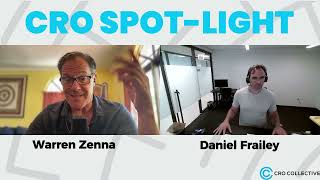
This is a YouTube video titled "Reality of the CRO Role and the Importance of CRO Training with Dan Frailey" created in May 2025. It features a conversational interview hosted by Warren Zenna, founder and CEO of the CRO Collective, with Dan Frailey, discussing the challenges of the Chief Revenue Officer role, the need for formal CRO training, and the development of a CRO course at the University of Chicago. The conversation explores the ambiguity of the CRO role and the market demand for better CRO education and hiring practices.
Hi, I'm Warren Zenna, founder and CEO of the CRO Collective and welcome to the CRO Spotlight podcast. This show is focused exclusively on the success of Chief Revenue Officers. Each week we have an open, frank and freeform conversation with top experts in the revenue space about the CRO role and its critical impact on B2B businesses. This podcast is the place to be for CROs, sales and marketing leaders who aspire to become CROs and founders who are looking to appoint a CRO or want to support their CRO to succeed. Thanks for listening. Now let's go mix it up.
As some listeners know, I have a couple affiliations with some conferences. One is, you know, Gerhardt Schwander's Sales 3.0 event, which I do some stuff there and frequently Gerhardt has me moderate panels and speak and stuff. Anyway, one of the panels I recently moderated, Daniel was on the panel and turns out that we have something very interesting in common, which is we both lead Chief Revenue Officer courses. And that was great because, you know, there's more of them popping up. As you know, I have one, Pavilion has one, and then Daniel runs the one at the University of Chicago, which is a great institution. And so aside from doing something that we're both obviously like minded on, we also had a great time together. We ended up spending like 2 hours, 3 hours talking and we ended up just really seeing eye to eye on a lot of things. I think he's just a super person and, and then we hung out a little bit and I thought it would make sense to have him join me on this platform so we can discuss this because I think we're both in agreement that this is needed at the CRO. Training is necessary and I thought we could be have a discussion. So to that end, Daniel, welcome to the show and thanks for being here.
Happy to be here, Warren. Thanks for having me.
Great. So why don't you give everyone a little background, like how did you end up teaching a CRO course at the University of Chicago? How did that sort of happen for you?
Sure, sure. So, you know, my, my career in sales really started I guess in earnest at Groupon, but you know, kind of like yourself, long time before that, growing up in a entrepreneurial and sales family. My, you know, my, the, the family business that put all the kids through college was a distributorship of electronics assembly equipment and supplies called Midwest Tech Services, based out of Willowbrook, Illinois. Spent nine years working there doing customer service, a little bit of sales, carrying boxes, packing boxes in the warehouse as a kid. So I spent a lot of time growing up around a sales environment. I also came from a big family with 32 cousins, 16 aunts and uncles. And literally to a person, almost every single person is in sales, one kind or of another. And so it's kind of the environment I grew up in, but it's also one I took for granted. You know, I started my, my professional career in hedge funds and, and did that for five years and then went to business school and got into management consulting. But then I had a friend, almost an acquaintance really, who was aware of an opportunity at Groupon. He actually wanted to do this job, but they told him they wanted to stick where he was and knew me and just said, hey, you should check this thing out. I think you'd be a great fit for it. And it was really insightful on his part because I had no background in technology or in sales, no interest in technology or sales. But I said, yeah, I'll take the interview, check it out. And it just felt like I had come home. I just felt like I was in the right place. And what the role was was a general manager role for a region at Groupon, but it was largely sales management, which is kind of ironic to be a manager of salespeople when you've never really sold anything in your whole life, you know. And so it was a strange position to be put in, but I found a lot that I could do a lot by, by listening to my employees and just finding ways to support them. But then kind of take what I learned from them and, and use that to, to guide the success that we had. And we ended up having a lot of success at that organization. And that led me to running another company when one of our finance guys went back into private equity and pulled me over there and then went from there to the head of sales marketing, basically CRO at one of our biggest clients. And that was an agency at Omnicom, part of bbdo. And from there I left there to go to Boston Consulting Group to be global topic lead for B2B, go to market for private equity held companies. Which is a very long way of saying basically the CRO topic. And so at that point I had been, you know, more or less the CRO role or something equivalent three times and was working with a bunch of the world's leading technology companies and non technology companies and especially the funds that owned and invested in these companies. And that was a great jumping off point, you know, after a couple years doing that to, to actually work on starting my own business. But while I was in the course of doing that, that's when the University of Chicago said, hey, you know, we're thinking about a rev ops program, would love some of your input on it. And we talked about that for a little bit. But I said, you know, from working with a lot of these funds at University of Chicago, or excuse me, at Boston Consulting Group, one of the things I've seen is that they really struggle to hire first time Crosby and identifying who would be good CRO talent because it's a bunch of finance guys and gals who are great at what they do. But there's a big experiential sort of cultural component to identifying who's going to be a great leader of sales and marketing if you've never done that job. Very few of these folks have hands on experience being salespeople or being marketing people. And so that was sort of what I saw as the demand side problem, is that the funds that do a lot of the hiring of first time CROs struggled to identify the right talent and they kind of knew this. So they would basically recycle the same people through a limited number of CRO roles as a result of that. But then on the supply side, very few folks are, are put in a position to succeed based on their background the first time they become a CRO because they've got to be responsible for the full customer life cycle from SDR teams to customer success teams and account management and account execs closing new deals and all the above, as well as rev ops pricing strategy, all these topics that very few folks have exposed to but then have to be responsible for once they get that first CRO gig. And so they have to learn on the job a lot of. And so in this conversation with the university, basically what we identified was there's a really big opportunity to create a university program that has all of the heft and substance and weight that you would expect from the University of Chicago and would help close this gap in the market. Give the CROs, you know, the would be CROs the skills that they need to be great at the job as the first time or even if they're a repeat CRO at this point, if they want to get some real high quality professional education and also make it easier for private equity and venture capital funds to hire first time CROs because you know, it's, it's kind of speaking their language to put a big university symbol on, on top of a resume, so helps that stand out there and then obviously provide the network to find all these opportunities. For, for the folks in the program.
Got it all makes sense.
And was that enough of an answer for it?
That's great. I mean, you know, I agree with everything you said there. I mean, we almost came to the same exact conclusion in different ways. Certainly, both recognized a real hole in the marketplace, which is not only just your observation that hiring CROs is hard and it doesn't work a lot. And even more so, I think, in from you and I talking, it's. It's also just the role is not defined. I mean, people don't really know what one does most of the time. CROs don't do the right thing when they get hired in the first place. And so the role is too ambiguous. It's almost, I think, in a way, it's a bit of an avatar that people can make do anything they want.