The Most Overlooked $13K/Day Business Anyone Can Start
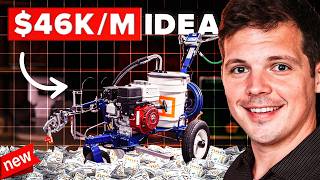
In this interview, Chris Koerner talks with Hunter, who built a line‑striping and seal‑coating business from virtually nothing. Hunter describes how he started with a $10 roller and a bucket of paint, landed his first free job through a local Facebook post, and then grew his client base using cold‑email campaigns and purchased lead lists. He explains his pricing structures – $4.50‑$7 per line for striping, $0.30‑$1 per linear foot for crack filling, and $0.15‑$0.25 per square foot for seal‑coating – and shows how these rates translate into real‑world revenue: $2,800 profit in month 1, $46,825 in month 2 (about $20k net profit), a $13,000 one‑day seal‑coating job, and a $26,000 large contract. The conversation covers equipment choices (rollers, Graco striping machines, stencils, seal‑coating tanks, crack‑filling units), cost of acquisition (used machines $2.3k, new $6‑7k, paint $100/5 gal), and the trade‑offs of starting cheap versus buying up‑front. Hunter shares operational tactics such as subcontracting labor, invoicing with QuoteIQ, payment terms (50% upfront for seal‑coating), and profit‑margin expectations (60% gross, ~50% net). Chris emphasizes the importance of forming an LLC (using Bizze), tax write‑offs, and protecting liability. Marketing ideas include Facebook group posts, yard signs, on‑site barricades, and leveraging satisfied customers for referrals. The interview ends with resources for aspiring entrepreneurs (tkowners.com, free guides, in‑person training) and contact information for Hunter.
Chapters
Did you know you can make up to $13,000 per day striping and seal coating parking lots and driveways? Someone could literally start this business with just a roller and some paint.
Yeah, that's what I did.
Better yet, you can get started with a $10 roller and a bucket of paint. Today I'm meeting with my friend Hunter who did exactly that, and in his second month made $46,000.
We did $46,825.
So we're going to talk about how you can start this without any equipment, how you can find customers.
I showed up in my minivan You had the $26,000 job with the minivan? Yeah.
That's amazing. How to price jobs and what equipment to buy. So without further ado, let's go meet Hunter. All right. Of all things, why line striping?
Yeah, I, so I listened to your podcast where you talked with Cinco and he was talking about making $18,000, $20,000 the second month. And I thought, okay, this is interesting. I like how visual it is. I like how you can get started with very little money. And I, uh, I like how— what one of the things I like most is how I can grow. So I've done $200 jobs, I've done $20,000 jobs, and it doesn't take long to get to that point.
Yeah. So how did you go from zero to your first dollar, your first customer?
Yeah, so, so I did practice a little bit. Uh, I, I went down to just an old parking lot. Here's the machine, I put some water in it, and I just tried to run, follow along the lines and see see what that—
just with water.
Just with water. Yeah. Yeah. I wasn't ready to mess up.
Yeah.
And see how hard it was. It was not hard at all. And then I ended up doing one little lot for a nonprofit just for free. Just wanted to help them out and actually try it. Yeah, it was just 5 lines, super small. It took a long time, but, but we did it. And then I started looking for jobs. So I, I went door knocking. That was hard. It didn't feel like it was the best use of my time. So I, yeah, jumped into email.
So people don't have to go door knocking to be successful here.
I, I have heard so many people who do it and they crush it, but that's not me.
Yeah.
Yeah.
You're using emails, right? Yep. All right. We'll get into that. I also want to get into the equipment because that's probably a big part of this, like picking the right equipment.
Yeah.
But before we go there, what did your first paying job look like? Or didn't you go to, like, you were on Facebook. How did you get your first job? Because I think that's the hardest part for business owners, even if it's an unpaying job.
Yeah. Yeah. So I went on Facebook, made a post in our town's page. And just said, hey, I'd love to help out a business. Vote below for, for who you want to see have a new lot.
What, like what business needs or would like a new parking lot? Yeah, new lines.
Yeah, exactly. We got great engagement and that was part of the strategy was I want to get my name out there. I want people to start thinking about it, try to reach as many business owners as I could. And then I don't remember how many different businesses were nominated, but I wanted to reach out to all of them to see if they would pay after. Yeah. For, you know, we'll choose the winner and then see if anyone else will pay.
What were your costs on that first free job? Like your hard costs?
So I had bought the machine. So materials was just paint and I spent $5.
$5 on paint?
Yeah. I mean, it was small. It was a small job. Yeah.
Yeah. Dollar a line.
And that's, I mean, I wasted some. We'll see. You have to dial it in a little. So I wasted a little, but yeah.
Super cheap learning.
Yeah.
Okay. What did your second job look like? Your first?
So, so second job. So I went from 5 lines to 250.
250 lines.
250 lines.
Wow. Okay.
Yeah, I was nervous.
Yeah. Did that come from that post?
No, I sent some emails and this was a church nearby and they reached out and they wanted, they wanted a quote for sealing and for striping. And I didn't know anything at all about sealing at all. And so I said, hey, I'll quote you for striping.
Yeah.
And gave them a quote. I think it was $1,190.
$1,190. How did you land on that?
So I used ChatGPT, I watched some YouTube videos, and it seemed like I was in the range.
Like, is that like for a line? Is that how you price it?
Yeah, I think I was at $4.50 per line. And then there were some arrows, some handicap signs that bumped it up a little.
Okay. Do you still price at that range?
I've bumped it up, so I'll start at 5.
Okay.
And then if I'm, if I'm traveling a little bit or if the lines are really hard to see and we're going to redraw them, we're like, reline, line up the lines, then I'll, I'll go up to like 7.
Okay. How many cold emails did you have to send to find that customer?
I sent, I think my first day I sent around 50.
Okay. Just manually?
Yeah, manually. Yeah. Yeah. Yeah.
We're going to get into your cold email strategy too, because I mean, that's kind of the secret to all this, right?
It's worked out.
Yeah.
Yeah.
Okay. So second customer from cold emails, make $1,100. You're almost to break even. What did your third customer look like and how did you find them?
Third customer came from that same email blast.
Okay.
So it really started to pick up. I think, I think I did 3 or 4 quotes.
Okay.
Within that first week and I sent out maybe another 250 emails. I think it was around 300 total. Okay. After that, it was That was it. I was just following up with all these quotes.
Yeah.
So we had another church that we did. It was a similar, similar amount. It was like around $1,000 or $1,200.
Okay. All right. So what did your first month look like as far as revenue is concerned?
Yeah. So first month started a little slow. It took a while to get those quotes approved. And that was one thing I learned about the churches was they have to go through their board. It takes a couple of weeks. But first month I did just over $2,800.
Okay. $2,800. Any profit in that?
I mean, it's, it's like 75% profit because I was doing it all myself.
Wow. Okay. So $2,000, let's say.
Yeah.
Cool. Were you happy with that?
I, for me, it, it showed that it could work.
Yeah.
But I was happy because I knew that I already had a couple of jobs lined up for November that were big.
You were happy about the promise that it showed.
Yeah, exactly.
Revenue.
Yeah. I could see it growing. Fast.
Okay, so $2,000 in profit the first month. Second month.
So second month we did $46,825.
I'm like expecting you to say $46,000. Yeah, you doubled.
But like, no, we went crazy. Yeah.
Is that just because you had filled your pipeline in the first month and then it started paying out the second month?
Yeah, exactly. So I was not sending out any new quotes. I was not doing anything different. Yeah, I was just trying to keep up. We hired some people to help out.
Yeah.
And there were, there were a lot of 10, 12-hour days, 6 days a week for, for a couple of weeks.
Were you thrilled with that?
Oh yeah, I loved it.
Yeah.
Yeah.
That's like, that's product market fit. Like, yeah, it's so much demand that you can't even sleep.
Yeah, literally. Yeah. Yeah.
People talk about, oh, I need to focus. I'm worried I'm not focused. Shiny object syndrome. Like, in months like that, you don't have shiny object syndrome.
Yeah. No, I wasn't thinking about anything. It was like, just get these jobs done. We were up against the weather too.
Yeah.
We were just trying to get it before it got too cold. So.
Okay, now on this channel, we don't only talk about revenue. That's misleading. How much of that $46,000 was profit?
So I, I went home with just under $20,000 in profit.
Like you took $20,000 home.
Took $20,000 home. Yeah.
Because sometimes profit, it's not true profit. It's profit on paper. It stays in the business. You're putting it towards growth, but you're like, I paid myself. Like, yeah, I mean, I took home, like took home.
Yeah. Yeah, exactly. So, so I, I started this business with, uh, just over $3,000. But then I did buy some more equipment during this, those 2 months. And so yeah, profit would've been higher. I had to sub out some of the work, but I was still really happy. That's the most I've ever made in a month. Yeah.
Now you may have already heard me say this a million times, but I've started over 80 businesses and you're not really a business until you have an LLC. An LLC protects you from liability. If you own a business with no LLC, then they can sue you personally. So I use Busy for all of my LLC registration needs. It's insanely user-friendly and easy to use. I would not work with them as an official sponsor of this channel unless I actually use them and love what they do. You can file an LLC yourself on your state's website, but it is confusing. It's complex. Oftentimes you can't even like find where to go or what to click on. And you're calling the 800 number. I don't recommend that. The thing with Bizi is you don't actually pay them. You just pay your state filing fees. You use Bizi for their interface, and then you can use them for other things like your registered agent service. They will get you your EIN. Which is your tax identification number. They just help you get fully incorporated and set up so you can be protected. Because once you're officially incorporated, you can start writing off all these business expenses, your paint, your equipment, your mileage, your truck, everything. If you want to write those things off to save money on taxes, you got to be official. You want to be incorporated. They don't have sneaky subscriptions. It's one-time payments. They're extremely affordable. So I highly recommend for all of your formation needs, registered agent needs, LLC, EIN, all of that, check out bizze.com. That's bizze.com. Why? Churches, why are they more likely to say yes to you?
So I don't think they're more likely. I'm glad I chose them because there's a few advantages. One, we're here, it's— what's today, Thursday? Thursday at noon and it's empty. And so it makes it really easy to go do. The first job I did, I did at night because they were— they had cars coming in and out during the day. And so this is really nice because I don't have cars coming in and out. I can block it off really easy. And, and then the other thing is, so this lot has 82 lines and that's a good size.
Okay.
It's, it's easy to do in a couple hours. And but it's still you're going to make good money.
All right. What does a job like this pay? And for the viewers, we're standing in a church parking lot with 82 lots.
Yeah, 82 parking stalls. So I priced this one competitively. I wanted to get this on the schedule. If it's in the summer, I would have charged higher because we're busier. But right now I'm happy. So this lot is going to be $760 total. So each line we priced at $5.
Okay.
And so there's a couple of things here. One, like we're not going to reline them. They're straight enough. Okay. So we're just going to stay pretty standard, $5. And then we can see it's over here. There's a no— there's no parking hatching.
Yeah.
So with this, I basically just double it. I know it's not super scientific, but I just say for every, every area like this, $10.
Yeah.
So there's, there's some more over there like that. With this, I actually— so I quoted this from satellite and from like Google Earth.
I use a different—
I use a different software, but I missed this on the satellite.
Okay.
I didn't see it. So, so they got a freebie. This I would have charged at $50.
$50?
Yeah.
Okay.
And I would have bumped it up, but it'll be easy to knock out, so it's fine. So the rest of the lot is super straightforward. I mean, it's very basic. We have, again, another area of no parking, so that's another $10. And then over here, we're going to see there's some handicap areas, which I, which I charge a little differently, as well as some directional arrows.
And you charge differently for the handicaps just because it's more work. It's a little more complex.
Yeah. Yeah. So I have to use my stencils and we're going to do these ones blue. So you can see, I don't know who did this, but they, they didn't put, put any handicaps in.
They did a crap job.
I don't want to say that, but I'll say it. Okay. There, there are some areas where it's like, okay, what happened here?
Yeah.
What's going on here?
Yeah.
So, so I like that though, because that gives me a chance to look really.
Oh yeah. Yeah. Yeah.
So what, what I'll do is I just use black paint and I'd cover that up.
We fix it.
Yep.
Go a step further. Okay.
Yep. And, and if I mess up, I'll do that. But so, so these, the handicap symbols, uh, I think I quoted it at $25, $25 each.
Each.
Yeah.
So $760 for this whole parking lot. How many hours will it take you to do it?
2, 2 and a half.
So $370 an hour, give or take. No employees needed for this job. Just you.
This is small enough. I can do it. Yeah.
Okay. And how much in materials will you use for this?
I'll use, so it's, it's mostly just the white and then we'll have a little bit of blue. And I would say like $130.
$130. Okay. Plus gas to get here and back.
Yeah.
So you're looking at conservatively $200 in cost or $550 in profit.
Yeah.
That's awesome. For 2 hours of work.
2 and a half. Yeah.
Okay. $250 an hour.
Yep. Not bad. So there's, there's the one arrow we have here.
Okay.
But it's straightforward. We're not— one thing I like when there's a fire lane, I mean, that adds another couple hundred bucks. So, and what you see a lot of people do is they're going to charge you to switch over the paint because we have to run it through the machine.
Yeah.
So that's like another charge for that. Sometimes it depends.
You have to waste some materials for that.
It's mostly just time.
Yeah. Okay. From what I understand, your eyes were open to seal coating and crack filling at some point, right?
Yeah. So I started when I would go meet these, these people to give them quotes, I would try to always go in person. And they always wanted striping and sealing. I only had this machine. I wanted to just do the lines. That's what I had, you know, heard on your, your podcast, watch some YouTube on, and that's what I felt comfortable doing. But everyone wanted a seal coating quote as well.
Yeah.
And so that, that got my wheels turning.
Would you have done that revenue your second month without seal coating?
No way. Yeah. Yeah. That's, that's a big part of it. They're, they're It's a, it's a bigger ticket job.
What's the best day you've ever had? How much revenue in one day?
Yeah. So, so for a one-day job, we've had some, some jobs that lasted longer, but for a one-day seal coating job, it was, it was $13,000.
$13,000.
Geez.
No line striping in that at all?
We did that. We broke it up. So we did that the next day.
Okay.
I think that was $1,700.
Okay. Geez. What's the biggest job you've done regardless of how long it took?
So we did one job that was $26,000.
What was that, a church?
That was a big church. Yeah.
What did payment terms look like? Do you get paid after or before?
Yeah, that's a good question. So, so when I just did the striping, I was okay getting paid at the end.
Yeah.
For it all.
Because your costs are low.
Yeah, my costs are low. It's $1,000 or $1,500. And it's also, it's like a church. They're not going to run away on me.
Yeah.
For seal coating, the material costs a lot more. And so we'll charge 50% up upfront.
Okay. $13,000 and then 50% upon completion or 30 days later?
Upon completion.
You're not waiting 30 days to get that? Yeah.
I mean, we'll give them 7, but yeah, they've all been good.
It's crazy to me that like a guy rolls up in a beat up truck with this and you hand him $26,000, but it's beautiful.
So I wish I had—
Oh, the seal coating, you have a trailer for that?
Well, I didn't show up like that. I wish I had a truck. I showed up in my minivan. And you want to talk about beat up. We had a raccoon go through the front. It looks terrible.
You had the $26,000 job with the minivan?
Yeah.
That's amazing.
Yeah, I did not think he was going to do it.
Oh, that's so— you know how many people are just too insecure to even quote a job like that with a minivan? Like, oh, who's going to say— and they—
oh, I was insecure.
Yeah, but you still did it.
Yeah, I did it.
Right? We do it anyway.
Yeah.
Right? We do the hard thing despite the fact that we're insecure. We don't avoid it because we are. $26,000 to— what is that minivan worth?
It's priceless. As in, I couldn't sell it.
It's like a $2,000 minivan we're talking.
Oh yeah. Yeah. I mean, maybe $2,000. It's— I did a couple of jobs in it for striping and I spilled 2 gallons of paint back there.
That's a lot.
My wife was not happy.
That's a lot of paint.
It's a lot of paint. That one—
you're still married?
Yeah. And we still have the van. Yeah.
You still have it?
We still have it.
Oh, that's amazing. All right, so talk to me about crack filling.
So I started with striping and then everyone wanted those quotes for seal coating and crack filling. So I landed my first job, had no equipment. I drove 3 hours to go pick up a machine, spend another $1,500 on it, and yeah, got started the next day. Everything we do is about making this look good and last longer because to replace this whole parking lot You're talking probably a couple hundred thousand. Well, if you had to dig it up and redo it. So, so we want this to last as long as we can. So if we can, if we can fill in these cracks, the pavement is going to last longer. It's going to look good and it won't keep— it won't develop the potholes and the larger cracks over winter. Yeah.
How do you quote that?
It's, it's by the linear foot.
Okay.
So I've got, I've got this. I've got a wheel that I'll push around. If it's this big, I think I've gotten to the point where I'm willing to just say, hey, this is what I'm thinking.
You don't want to measure every single crack, you're saying?
There's no way.
Yeah.
Yeah.
There's a lot going on.
Yeah. So that's, that's tough. And but we'll charge $0.30 to $1 per square foot or per linear foot. Yeah. So we can measure this. Yeah. Let's run down there. Let's just see if you go to the cement. Right here we're at 38 feet. So I'd be like, okay, this is $38 and there's— you can just see how many lines there are.
Okay, let's pretend this was the only line, the only crack in the parking lot. $38. How long does it take you? How much materials?
So it's going to take me probably 20 minutes to warm it up. We've got a tank of propane. We're heating the material up. Okay, so 20 minutes to heat up and then to actually do this. 2 minutes.
Wow.
Yeah. I mean, I'm just walking and you're never doing just one crack. No, no, I think, I think the smallest crack filling job I had was over $400.
Okay.
But most of them are $2,000 or $3,000.
Okay. And then how much materials for like a $38 crack?
Yeah, for this, $5, $10.
Wow. So 90%.
Yeah, it depends how deep they are. It's going to vary quite a bit. And I've eaten it before. Where, where I did a job.
It'll kill you, dude.
I know.
Yeah.
Don't eat it. Right. But I did a job. I worked for 2 days. I walked away with nothing.
Why?
Just quoted it wrong.
That happens.
So, so the cracks, they look like this, but then they were 6 or 7 inches deep.
6, 7, huh?
And so it just ate up the material.
She's okay. So generally, if you quote it right, 80 to 90% gross profit margin before your other overhead and cost.
I'd say 70.
Okay.
Yeah.
Okay.
70 is probably pretty safe.
Yeah.
It does depend because like, I mean, you see these cracks.
Yep.
Those are going to be— that takes nothing.
Yeah.
Right.
So to film this video, I had to pay thousands of dollars in editing and videography. I had to drive 2 hours stuck in traffic. It's a lot of work. So to say thanks, please just hit subscribe, maybe share it with an entrepreneurial friend, maybe comment. Let me know if you like this. Let me know how it could be better if you don't like it. I would really appreciate your subscribe, engagement. Thank you. Now tell me about seal coating.
So seal coating is my favorite. I'll quote a lot of jobs from satellite, right? So it's easy to measure and I can take measurements if I need, but this lot is 46,900 square feet. Just about when it's just about, yeah. Seal coating, what we're going to do, we've got, we've got a big tank that I, that I tow behind the truck. It's 275 gallons and we're just going to, we have a spray system where we're just spraying out this, this asphalt, a thin layer of asphalt. So for, for this right here, I have to do the math, but it would be just over $9,000 for this parking lot. For this parking lot, less than a day. It would be, it would be a day. Yeah.
Like a full workday.
Yeah. Full day.
If you were to hire that out to an employee, what would you pay him to do that?
So the, the going rate's $25 or $30 an hour.
Okay. So let's say it's $30, 10-hour day, $300 in labor. How much in materials for the seal coating job for this job?
Yeah. So where, where I get it from my asphalt supplier, it's about $0.06 a square foot. Okay.
46,000 square feet. Okay. So 4,600. So we're like $3,000.
Yeah, around there. So, so I mean, when I'm quoting, it's going to be between like $0.15 and $0.25.
Yeah.
And so you can do the math. It's, it's triple or quadruple.
Okay.
The material basically.
So for a job like this, assuming you already have the equipment, You're going to pay $9,000, right? That's, that's what you're charging. You're going to give 3% of that goes to your labor.
So, so I've got 2 guys. They're each getting $300.
Okay. 6% of that.
Yep.
Okay. 6% of that. And then 30% of it goes to costs.
Yeah.
Right. So let's call it 10% to labor, 30% to cost. That leaves 60% for profit. And then your insurance, your gas, your any overhead. So yeah, it could be like a 50% net profit job, even if you don't do it yourself. Yeah, that's amazing. $4,500 profit in a day for outsourcing the work. Yeah, that's incredible.
If we seal it, which I would love to, because the lines are going to look just so good after. But if we seal it, we are going to charge more for the lines because some of them, they're so faint.
Oh, you got to do more measuring.
And yeah, I've got a chalk line and not all of them, but the ones that are hard to see, we got to snap the chalk line.
And that's a pain, probably.
Yeah, I honestly I hate it. It's tedious. I'm not the most detail-oriented, so I've got this OCD guy who is amazing. Yeah, every single line is, is perfect. And you can see some of these lines on that side. They're not at the right angle.
Yeah.
And so if we could sealcoat this, then we would line those up to be, to be correct.
Okay. You love sealcoating. If you could do sealcoating, it'd be that.
Yeah. I mean, the church doesn't just want that, right? They want the striping, but yeah.
Is it important that people do all three? Because you get your foot in the door with one of them and then you upsell the other or vice versa.
So, so in my experience, and I did, I got my foot in the door with the striping and it led to other stuff so I could sub it out. But, but what I found was there's too much demand and not enough supply. And so if I—
for striping, for, for all of it. Okay.
And so if so, I wanted to sub out the seal coating., and I would talk to these other companies and they would say, yeah, I could do it in a month.
Which means they're making a lot of money. They don't care about you.
Yeah. They don't have time. And if they do have time, it's the companies that are just terrible. Like no one, no one wants to work with them. Yeah. And so I just said, okay, I have to, I have to learn. I have to figure this out.
So in this industry, there's just like, there's way more people that want to pay for it than there are people doing the work like you are. Yeah, way more demand than supply.
That's what I've seen.
Yeah. So what are you doing right now?
Okay, so we've got our tip guard here and then the tip. So this is what's actually going to spray. You can see that little hole. Just the tip. Yep. So we're going to get this ready to go. Now crank it up here. Pressure's off.
It looks like the same motor as my pressure washer.
Or a lawnmower, yeah. Yeah. This is all water-based paint. If you're doing concrete, you need oil, but this is great for asphalt. And you can do oil for asphalt too, but if you've seal coated, it'll turn yellow and hazy if you stripe it with oil. Okay, move this guy out of the way.
So these machines are meant to be used with just a 5-gallon bucket. Yep. That's very convenient.
Yeah. So what, what I'm checking for is just to make sure it's about 4 inches. I mean, 4 inches is a lot. Yeah, that is a lot. And it doesn't have to be exact. I mean, these guys did probably 3. Okay, that's pretty good. So one thing I've learned is I want to start with the farthest part away because sometimes it's still right at the start, it's a little watery and I want everything up close to look— Yeah, exactly. So what's your secret of finding customers? So my secret to finding customers is the email, but my secret to getting clients and customers is to just be professional. Even with the minivan? Yeah, even with a minivan.
So professionalism is more about how you act than what you drive?
I think it helps. My close rate increased once I got the truck. We're getting company shirts this winter. But yeah, just being respectful helps a lot. Being nice, it makes you stand out. Yeah.
Tell me about your email strategy.
So email, I, I work with a guy overseas just on Upwork, found him, and I pay him $5 or $6 per list that he provides.
So you just buy lists. Of leads from him.
Yep. He just scrapes it. I could do it. I could figure it out, I'm sure. But it's, it's not worth the time. Yeah. So he does that for me. Yeah. So the email just says, hey, I'm new to this. I will give you a good price. Let's make your church look good for Christmas.
And then you go out and try to quote everything in person.
I try to. Some of them just want it. They don't want to meet me.
They don't need to. Yeah.
Yeah. And so my close rate is better in person, but yeah, it is what it is.
What is your close rate?
It's like 40 to 50%. And so what, what I'll say is, hey, I'm new to this. I'm going to take my time and do a good job. And yeah, I would love to do the business for you.
Yeah. So you get up and you're going to quote about $5 a line. Yeah. Like $5 to $25 per stencil. Yeah.
Okay. 10 or 25.
Yeah. 10 to 25. Okay. How do you invoice them? What software do you use?
So I'll send them a quote with the software. I use QuoteIQ. But most, most everybody wants to pay with check for churches. Okay. Which I love. There's no fees.
Yeah. If someone wanted to start this business without equipment, what would they do?
Yeah. So I know some people will start with rollers. Just paint rollers, $20, 4-inch rollers. And it's tedious. You're going to have to tape a lot of the lines to do a good job. But when this machine's been down, we've done it. Yeah. And you can save up money for a machine. Yeah. Okay. And another thing that I like is like, I mean, you can see this line. It's not perfectly straight. It's not, it's not a standard, you know, there's, there's some variation, but I'm the only one who knows that. No one, no one else looks and is like, oh, that's, that's a little off. Yeah, they just want to see it. Yeah. So, so I mean, I want to do the best job possible, but it's not too hard.
So get your first $3,000 in revenue with paint rollers and then you buy a machine.
I mean, I would get a machine sooner than later, but yeah, if you need to.
Now, if you remember, Hunter started this line striping business because of my podcast episode with Cinco, who also has a line striping business in Waco, Texas. If you want more accountability, more partnerships, more learning, check out tkowners.com. It's my private community where I answer questions via Zoom on a weekly basis. I'm like your personal consultant for a fraction of a fraction of the price. You also have other people in there starting businesses based on my content. You got exclusive guides, courses, growth hacks, discounts, virtual meetups. You can learn about AI tools, everything you ever need to know to start a business, you'll find at tkowners.com. So go check it out. So how much were these stencils?
Yeah. So, so the only things I bought to get started were the machine and then I bought a pack of stencils. Okay. And I knew I wanted to give this a real shot, so I bought the contractor grade, the heavier, thicker material, and it was $800 for all the stencils.
Or what?
I got these two. I got some arrows. Okay. I got like no parking, fire lane ones.
Does this go right in there?
So we'll do the blue layer first. And then we'll move, we'll let it dry, and then this will be white. Okay. So I'm trying to just like line it up more or less with that.
I imagine there's like regulations on this, right? Like this has to be a certain size. It has to be visible enough.
So I'm not an expert.
There probably are, but the manufacturers probably sell them big enough so you don't have to think, even think about that.
Well, I mean, this one doesn't even have them, right? And so my, my understanding is you have to have the sign that says handicapped. And then this is just aesthetics.
It's just, yeah, redundancy.
Yeah. Like in Missouri, a lot of them are just this. They'll just have a yellow or white guy. They won't have the blue square. But what I do, because I think it looks so much better, says this was just redone. It looks so good. And so I don't charge. I, a lot of people charge like $40 or $60. I just want it to look really good. Like this is my, this is my Like your statement piece. Yeah, this is, this is like my freebie to them to just say, hey, it's going to look good. Yeah. I mean, this is honestly pushing it where I have 8 of these. If I, if I have 10, I'm going to spray it. But if I've got 3 or 4, it's just so much faster to do this than to worry about changing the paint and, and all that. Yeah.
So let's do it.
Just roll it out real fast. So this— yeah, I mean, you have to have some sort of stencils. You could tape it off, but, but realistically, it's probably going to look pretty bad. Okay.
If you do that, someone could literally start this business with just a roller and some paint and an email address.
Yeah. I mean, it's, it's going to be slower, but you could do it.
Yeah. So start with some paint, a roller, email some customers.
I'm oversimplifying it, but you're not though. That's what I did. I mean, I bought the machine, but But in retrospect, yeah, if you don't have the money for a machine, you start with this.
It's tedious, but it's cheap.
It's $20.
Yeah.
Build your portfolio. I mean, you— if you could get a couple of jobs with this, knock them out, then you could go get some big jobs. And when you get the big jobs, buy the machine. You don't need to buy it beforehand. Yeah.
All right. So once someone graduates from the $4 roller, what should they do regarding equipment?
So if you're doing striping equipment, I like Graco. That's what I use.
Okay.
And I think it's the best out there.
Is there like a model you would recommend?
I have two. That one over there is the 3400. Okay. And it's the beginner model, I guess. It's the smallest. Okay. But it's still super durable and it's painted America. You see it everywhere.
Okay.
So that one's good. And then if you want to upgrade just a little bit, I have a 3902. Okay. And that's got, it's got two guns on it. So it's a little fancier, a little bulkier, but both are great.
What is— what do those run you?
So I bought mine for $2,300.
Okay.
New or used?
Used.
Yeah. Yeah. I saw it on Facebook.
Would you do that again? Buy used first?
It's been a pain because I've had to replace some parts. Yeah. And I've had to learn. But at the same time, if, if you had said, hey, it's going to take $10,000 to start this business, would I have done it? I don't know. Yeah. So I think it's, it's been good enough. Do I want to buy new? Yeah, I do.
What, what would a new one cost of the same model?
So that same model is about $6,000, $6,000 to $7,000.
Okay. Any other equipment tips or tricks that you'd recommend?
Yeah. So, so paint's a big one because we buy so much of it. So, so this right here is, is from a company called PPG. Okay. And it's, and it's Flint. Fast Dry is the brand name, and, and it's been great. So the, the yellow and white, it's about $100 per 5 gallons, which is great. The other big company that sells it is Sherwin-Williams, and, and it's going to be more. It's going to be more like $150, $160. So that's, that's some real savings right there. And I don't think— my experience has been, and I've talked to a lot of people, it's not quite as good. The Sherwin-Williams stuff, so it's going to clog more. You have to strain it 2 or 3 times sometimes.
So what would you recommend for the crack filling and the seal coating equipment?
Yeah, so I wanted to buy used for both of those. I think that's easier because it's more durable, so you're not going to have to replace as many parts. I couldn't find anything and I had a job, so I bought the crack filling machine new from a company called Sealrite. In Missouri. It was $1,500.
Oh wow, that's not bad.
No, it's not bad, and it's been great. Um, no issues at all with it. And then the seal coating— yeah, seal coating. I bought a trailer with a tank and a pump, and that cost $6,000, and that was used. Okay.
And you do the same thing again? Yeah. Okay.
Happy with both of those?
Yeah.
Okay.
Someone wanted to start this business, what advice would you give them? Yeah, I would say first off, just door for it.
It's, it's a low risk. There's, there's a lot of people who need the service. You'll find jobs. Yeah, it's not hard.
Do you think it's realistic that someone could start this with $20?
I absolutely. And I don't think it's hard to work your way up to buy a machine either. Yeah, it's just, it's just a couple of jobs. Yeah.
Now you got your first free customer from posting on Facebook groups, your local town's Facebook group, right? Would you suggest that other people do the same?
Yeah, absolutely. And what I would do, what I wish I had done differently is just own being brand new. I wish I would have said instead of, hey, I'm here to help out, which, which I was, but I'm brand new. Yeah. And I'm here to help.
Well, people want to help you. Like, people are good. Yeah.
Right. And my minimum now, it keeps going up. I'm not going to get out for less than $500. And so you have a lot of small parking lots around that are 5, 6, 10 lines. They, they're not going to pay $500. They would love to have someone come out and do it.
Yeah. I'm kind of wondering, is there any marketing you could do, like, while you're on the job to get other business owners?
Inquiring. Yeah. So we're going to do yard signs. And then one thing, one thing our main competitor does, they're, they're a bigger company.
They have these big barricades that has their name just everywhere, like blocking off the parking lot, but really just advertising.
Yeah, well, it's helpful because like with these cones, we've had people, they just drive right over or try to drive, they move them, they drive through them. And so it's helpful just to keep the lot blocked off, but then also to just say, hey, This looks good.
We're the ones who did it. Yeah.
Give us a call.
With everything we've covered today, do you think this is enough for people to start this business?
Yeah, I think so. I mean, this is— hopefully I've shared some good tips and this is more than I knew starting out. That means you can absolutely just go for it. If you're looking for more, for more help. Yeah.
Where can we find you?
Free guides that we can link below, as well as an option for in-person training if that's something you're interested in. Yeah, we'll link that below. Otherwise, feel free to contact me on, on my website, 417striping.com, or on, on Twitter. Okay, onto it. Bye, Chris.
Thanks for hanging out on the Koerner office.









