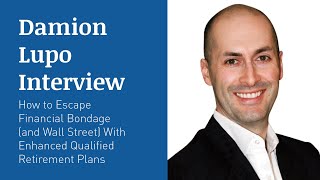
Damion Lupo, founder of EQRP, discusses retirement account strategies during market downturns. He covers the Enhanced Qualified Retirement Plan, CARES Act provisions for loans and distributions, and how to hold physical assets in retirement accounts.
Welcome to the Next Level Income show where it's our goal to take your income, your investments and your life to the next level. I'm Chris Larson.
And I'm Caleb Welborn.
Today's show is sponsored by the Multifamily Investor Nation Summit. It's June 11 through 13, totally virtual summit. You can go to our website, www.nextlevelincome.com to find a special discount code and learn how to register there as well as get our free book@nextlevelincome.com we're really excited. On today's show, we have Damian Lupo, who's the founder and CEO of the EQRP company. Damian began his career as an entrepreneur at age 11. He's the son of an army vet and from an early age he had a strong work ethic and inquisitive mind. He didn't just learn. He also consumes information, embodies it and circulates it with a dedication for empowering others. I was very fortunate to meet Damian out in Colorado and I asked that he come on our show to share this knowledge that he has. And over the last quarter century, he's not only owned and operated several businesses, but he's also written five books on various topics. And with all this knowledge, he helps others now achieve financial freedom with a goal of helping 1 million people unleash the shackles of financial, what do you call it?
Bondage.
Financial bondage. Thank you so much. And the result of, of this is his company, the EQRP company. Damian, welcome to the show.
Hey, guys, it's good to be here. Thanks for having me.
Oh, yeah, no, I'm really excited. We are recording this in the midst of, as we were just talking about the COVID crisis and you and I were, I should say I was fortunate enough to meet you in Colorado just a couple weeks before they kind of shut everything down. So I really appreciate you being on the show today. You have some really timely information. So we're going to try to expedite the release of this show. But for the audience that doesn't know you like I do, please share a little bit more about your story and what your company does today.
My story is interesting in that when I started the story, really when I started, when I left Alaska growing up and I went out into the real world, the rest of the world with, you know, civilization, I went out and started doing real estate stuff after I got thrown out of college for starting a bookstore that competed and put out, put the other bookstore out of business. So So I decided, okay, that's not where I should be. Ended up getting involved in real estate because a buddy of mine pitched me a deal, and he said, hey, I got this thing. I said, cool. What do you want me for? He said, money. And I said, I don't have any money, but I have a credit card. So I ended up buying a house with my credit card. And it was kind of an interesting thing to charge. Use Visa to be your partner. That led to me going out and buying houses. And the funny part is, 20 years ago, that's when I had hair.
And.
And when you go through the process of real estate and you spend, you know, five, six, 10 years, whatever it is, I spent five years had hair, and then the next three years watched my millions go away and the hair went away. So it was like, goodbye. Like, this is what happens.
I've been there. Whether you pull it out, whether you pull it out or it falls out.
Well. And you know what? I bring that up partly because it's valuable in times like right now, when we're going through this meltdown, to have people around you that have perspective. Like, I went through that thing. I lost $20 million. I had 150 houses and made millions, and then my ego took over and I lost 20 million, had a negative $5 million net worth. And having gone through that, at the time, I thought it was the world, and then it wasn't. You know, like, we process this stuff. Right now is so important to keep people around you, whether it's podcasts or mentors or whatever that are balder, grayer, older, white, experienced than you are, because they can give you perspective. And they'll say, yeah, I've literally seen the meltdown three times because I'm 70 years old or whatever it is. And so that's what I'm seeing now. I'm seeing great opportunities on the other side of this. And I'm also seeing an unfortunate reality where a lot of people, and I'm just going to call it out, a lot of millennials have no clue because they've never been through anything before. And so they go, oh, it's like business as usual. It's not. We're going to go through something, and there's some ways to do it that are responsible and honest, and then there are some ways to do it. Like, I see people doing it. I'm like, you're an idiot, and I wish you would stop. But there's two things. There's survival, and then there's the opportunity, and there's tools and ideas and ways to go through both of those process, but they're different and you can't just do one or the other or you're going to screw yourself over.
Yeah, no, I think what you just said is spot on. Like I talk about in my book how I saw my parents lose both their jobs in the real estate industry, in the savings and loan crisis. I, I lost my internship when the market crashed after 9, 11, 2000, 2001. Like you, I had a ton of real estate in 08 09. I was fortunate. I didn't lose $20 million. I also didn't have 20 million.
That's why you still have hair.
Yeah, it's all right. A little bit. And then right now. So it's, you know, if you look, I got a great book I'm looking at on my bookshelf. It's called the Secret Life of Real Estate and Banking. And, and it's interesting because, you know, the economy follows cycles. You can look up Ray Dalio, he's got a whole series on it. Economy expands, it contracts, it's healthy. It's like seasons.
Right?
Like nobody freaks out when the leaves fall off the trees every year because we know they come back. And I feel like right now we're in that period where some leaves are falling off the trees. And like you said, it's great to have people around you that can say, hang on, it's okay, they're going to grow back. Yeah, it's going to be cold for a while. You need to put a jacket on, maybe stay inside. Literally. Right. But yeah, there's hope out there. So, Damie, what are you. We were talking before the show and we'll have a link to this in the show notes here. What are you teaching right now with your company? Aside from I'd love to get into the eqrp, which is why we were having you on. But kind of talk about what you're teaching now and what the EQRP is.
So the entire essence of what I do and what the company is all about, all the organizations that I run, it's about financial literacy and it's about breaking financial bondage. Everybody's got shackles on in some form or another. What we didn't realize was the shackles that were actually there that we didn't think were there until all of a sudden we can't travel, we can't. Like our doors are closed and there's these shackles and called money. We don't have control of money. So the work that I do with the EQRP company to help people with their retirement accounts. That's about having control. And some major changes happened last literal week that we're going to talk about. And so that's one thing, it's helping people control their money to invest and get off this Wall street roller coaster, casino fraud, whatever you want to call it. And then the other thing is giving people different ways of operating. And this is kind of personal development mixed with martial arts and a little bit of financial wisdom, having gone through a few things. So I spend a lot of time teaching these things. And right now all that stuff is literally just going out onto the Internet on my site so people can. We did a program recently called Thinking, and It was the 11 ways of thinking how to move from chaos to certainty or from chaos to clarity. In times of uncertainty, it gives people something other than the body count. And the body count just debilitates us because we sit there and we go, oh my gosh, the sky is falling. And yeah, it's real. It's not the only thing, though. And so the work is really to lift people up and help them stay up and see beyond this and give them practical, pragmatic approaches to going through it.
I love it. I love it. And I love your motto. Trying to. What is it? Helping a million people release themselves from financial bondage.
That's it.
Excellent.
Wow, that's a great motto.
You know, there's. I got that. It was an idea that came from Ted Turner talking about his father, how his father made a bunch of money and ultimately died. And Ted said, you know what the problem is? My dad didn't have goals that were bigger than his lifetime. And so he said, it's important to have goals that you're never going to accomplish because it keeps you going for something. And if you finish, if you go, okay, I have my 10 million bucks, or I've got my apartments, or whatever you're doing, you better find something or you're going to check out. It's why the average male in America typically dies within three years or less of their quote, unquote, retirement. It's a death sentence.
Yeah, I hate. I hate the word retirement.
I'm with you. These are the things that are important for us to think about. In addition to being safe, we've got to start thinking longer term. I think what people realized recently was that there was a lot of short term thinking and a lot of hedonism, which I'm a world class expert in, because that was my Life in the 2000s. Like, I was good at consuming like a madman. Like, hedonism was my middle name, and I was good at it. Problem is, when you lose your money and your money was your. When your self worth is tied to your net worth and your net worth goes negative 5 million, you're like, ooh, who am I? That's where a lot of people are going to find themselves now. And in coming months there. You know, unfortunately, it's going to whack a lot of people. And the truth is, it's just money. And the great thing is, when you go to the other side of this thing, you're going to have the experiences. That's the wealth. It's not your balance sheet. The wealth is the experience you have going through what you already went through because you'll be able to recreate or go beyond it once you blank slate it. And that's a huge thing for people to think about so you don't get stuck.
So good. That's so good. Great advice.
Absolutely. And we're diverging here a little bit before we go into the enhanced qualified retirement plans, but because actually, before the show, we were talking and saying, we're going to move your show up in the queue because of how relevant it is to what's going on right now. So what you were talking about now with the chaos to clarity and hedonism and what people are going through right now, I was actually on a zoom call the other day with a few friends of mine who are also business owners, and we were just kind of talking about everything that was going on. And I was saying I feel very fortunate because I think. I'm just saying it's like, when did Noah build the ark? And it was before the flood, and then so myself and then those friends, like, we each kind of have our own, like, arc to go through the flood because we've, like, built a business. But there's a lot of people, like, say, like the single mother who's a. You know, she's in her early 30s and she's a server, and she has three kids. And, you know, people are going through some tough times right now, so. And you're like, I haven't gone. I'm a millennial. I haven't gone through that. When I was. When it was 2008, my parents, luckily I had parents who were, like, hardworking, responsible, and they found a way through it. But what advice would you give to, say, someone who's more my age now, but then also someone who, like you said, maybe had their Self worth tied to their net worth. And then they're kind of wondering how to deal with this at this time.
Well, there's two things. It's a really good question and it applies to everybody especially, unfortunately, a lot of 20s and 30 somethings are being a little reckless. Like, we watched Spring Break and we watched thousands of kids going out there and being stupid and reckless, and now they're getting other people infected because they got infected. So the first thing is, look, we're all in this together and we've got to look at it that way. It's not saying that doesn't mean we're socialists and we've all become fans of Bernie. What it means is that truly everything that we do impacts other people. And so love him or hate him, when he said that, actually, Bernie did say that recently. He's like, look, we're all in this together. And people are saying that it's true. So first thing is, start being more kind and more compassionate to other people, including thinking about how if you approach everybody and think in your mind, I've got this virus, it'll make you do things differently. Like, you're not going to go right up to them and like, hug them. And that's really important right now. Let's protect each other. Because surviving this thing and moving past it is about looking out for each other. So that's, that's one of, one of the things. And that thing that, the perspective here is that we're so instant gratification and everything has been a button every. We have a new phone every six or 12 months. And so the perspective needs to be that, hey, patience is a virtue and you're going to have to learn how to deal with it. And it's something that's powerful sitting still. I wrote about this in Reinvented Life. It was the last chapter of the book I wrote after I lost all my money. And the chapter was called Stillness. We're doing a lot of stillness right now, or we're trying to with kids in a house. It may be a little hard, but there's a lot of stillness that we have in terms of we're not leaving, we're not going very many places. There's no going out to dinner, there's no traveling. So it's understanding how to breathe and sit still. And this may be a new thing for a lot of us. Like, how do we sit still? We're used to running around like a bunch of drunk squirrels with all these shiny nuts. And so I think we have to be really conscious.
That's a new one.
That's what it looks like. You ever seen a bunch of millennials together? Freaking drunk squirrels.
Caleb, you know what he's talking about.
I know.
I'm a drug squirrel. I'm a drug squirrel. So, I mean, look, the shiny nuts are going to be out there. You're going to have plenty of opportunities to go chase those things. It's going to take some time to filter through this process where we shake out the stuff. There's a lot of naked people running around that everybody was claiming had clothes. So there's a lot of naked. The tide's going out. We're going to see the naked. The opportunities are going to be epic. Right now, the most important thing you can do is look out for each other and continually to nurture your network. I mean, nurturing a network right now is vital for a lot of reasons. It's possible that we have a black swan that we're currently experiencing that has another black swan land on it. It's called Black Swan Squared. This could happen. We could have something else happen with the derivatives market or something later this year. So this is like you said, Chris, this is a season. This is winter. This is not a storm. This is a fricking season. And Jim Rohn said it best. If you want to go back to the philosopher that influenced everybody, his name is Jim Rohn. He died a few years ago. That's the guy that I'd be listening to. I studied him for years and he talks about this stuff. What do we know for certain that after winter, there's spring. What do we know for certain? After night there's morning, there's a dawn at the end of this darkness. So if we can start thinking about that, it gives us perspective, even if we're 20 years old or 25 or 30. And for people that are sitting there going, I don't know how I'm going to pay my bills. One of the things that the government just did, and I'd love to share the CARES Act a little bit with.
Everybody else, dive into that, please.
So the CARES act was the $2 trillion stimulus. It's like stimulus number three, I think, and this is the big one so far. There's going to be more probably 10 trillion in 2020. Just remember I said that because I think that's what we're going to be landing at by the end of the year.
Look, man, I think we're going from 20 trillion deficit to $30 trillion deficit. And it's not going to take the decade it's going to. No, half that or two years. Spot on.
Without a doubt. We have to, because we're, I mean we're going to be in a place where we're going to have 20 to 30% unemployment easily in the next three months. In quarter two of 2020, these things are coming. You can see the trend. People are laying off. One of the things that's really cool though, in addition to everybody's going to have basic universal income, which is what part of this thing was 1200 bucks to everybody in unemployment. The CARES act gave everybody that has any type of retirement account the ability to pull up to $200,000 out of it today. So there's two pieces of that. One, you can just take up to $100,000 as a disbursement and say, okay, I need 100,000. Literally write me a check. And whether it's a trustee at your job or it's a custodian at your ira, you can just ask for it. If you have an eqrp, you just write yourself a check. So if you're smart enough to have control of your money, you can get your money in about five minutes. So that's the first hundred thousand bucks. That money can either be paid back over the next four years until the end of 2023. And so there's no tax or anything, or if you want to pay taxes, you can pay the taxes on that disbursement over the next three years in 21, 22 and 23. So it gets added to your income. Lots options. That's 100,000 bucks. The other hundred thousand, if you have an EQRP or a 401k. It used to be you could borrow 50,000 bucks out of the plan and then you had to pay it back over five years. Now they've changed it. So it's up to 100,000 for a loan or 100% of what you have. So whichever is less. So if you had 80,000 bucks, you could literally borrow 100 or 80, all 80, and then pay it back over five years. But they said, hey, I know times are tough. So you don't have to start paying until a year from the time you take it out in 2020. So it's technically a six year loan with no payments for a year. This and you get to pick the interest rate in EQRP, it's like 3% money. So you've got access to money now. So if you're thinking, how do I get an SBA loan? Which is another thing that they passed. That's interesting and that's there. But you may be sitting on all the money you need just sitting inside of a retirement account right now that you can get a check for. Literally probably inside of a week.
Yeah, I mean, we just. I did a seminar, small business seminar last week with a local group here in town. And we talked about high cash value insurance. And the topic was like, what are some things that you can do? So if you're in the situation. Again, this is all new. Since we did that, we're gonna again, we're put this in the show notes. I think this is terrific. Caleb and I were just on a webinar. Was it last night or the night before? Caleb with John Heyer. Two nights before. Yeah, yeah, two nights before. So if anybody wants to get that info, we can put that in the show notes as well. These are things that can not only help people get through this and weather this storm, but also potentially take advantage of some great opportunities that are going to be out there.
I think actually to that point, it's unlikely that most people. If you have a couple hundred thousand dollars in your plan, you're going to need a couple hundred thousand dollars to deal with your life. And if you do, the other thing I would do is say, okay, let's figure out how to stop spending as much money right now because cash is king and you do not want to be doing your same patterns. So if you can look at this as an opportunity, you have to be affected by the coronavirus, by this thing, CV19 to be able the money. It's not hard. We're all impacted. Our lives have been disrupted and it's you certifying it. So having access to that money, think about the opportunities later in 2020 or 2021 that you may have an opportunity to get involved with with a couple hundred thousand bucks. This is a huge opportunity, you guys, if you just start thinking, what are my resources?
Yeah. And I mean the worst. I guess the worst case scenario is you pull that money out, it sits in the bank, you pay a little bit of interest on it and you reinvest it.
Right.
I mean, that's it.
That's kind of the worst case scenario.
If it's in cash or you have control. So speaking of that. So Damian, you helped my wife and I set up a QRP plan a little over a year ago. I'm sure that 99% of the audience that's listening right now is saying, what is an eqrp? And just so you know, this is book this is brand new. I just got this from Damien here after I saw him in Colorado. Updated for 2020. So you can read all about it. But if they don't have the book yet, can you kind of go into what a QRP is and also why we don't know about this?
Yeah, for sure. And if you guys want a copy of the book, go to qrpbook.com and you can get it. We'll send you a copy out. We're going to FedEx it out to you. So it's on me. And it's just a way for you to get educated. Plus, the book, when you do that, you're going to get a 15 page summary of the book that's going to be emailed to you so that if you're trying to figure out what's. What do I do right now? It'll give you some information. Right now, basically, QRPs are retirement plans and an EQRP is the Enhanced Qualified Retirement Plan. It's giving you total control of your, of your retirement money. So you have a checkbook. It allows you to do almost anything. And if you want to buy stocks because you're Warren Buffett and you're really good at that, that's fantastic. You also have the option to do all the other stuff, which I think is smarter because you can actually control it. You can, can buy real estate, precious metals like gold and silver, take possession of them. You can be, you can invest in notes and you can be the bank. I mean, it's better to be the bank than to borrow from the bank. I mean, it's pretty awesome when you are the bank. So it basically allows you to take all these orphan accounts, these old 401ks and 403s and IRAs, roll them into a place where you have a checkbook. So like right now, if that was the case, like you, Chris, you guys, you can write yourself a check if you want to. Very, very easy. No strain. I mean, just boom, it's happening. The reason we don't know about it is because of fees. Because the Wall street system has a thing called aum. It's called Assets Under Management. Every dollar that you send off to a financial advisor or a mutual fund, there is a little chunk of it that comes off every single year and it just keeps getting peeled off. The reason that when you look over 30 years, you actually maybe made 2 or 3% and you thought you made 6 or 7 is because of those fees compounding against you. We don't realize that's happening. Because the system is set up to feed on you, not to feed you. That's the opposite of what you've been taught. So this is taking you out of that system and putting you in the driver's seat versus being in the trunk going off a cliff in the Tesla that you thought was taking you to the promised land.
It's like the scene in Wolf of Wall street. And we may have to edit this out, but you know, they're sitting there having lunch, drinking the martinis and he's saying, you know, money goes in, money goes out. And he's talking about, and he goes, we get paid in cold hard commissions and that's, I mean, that's what it's all about. So again, you may want to edit that out, Caleb, but to your point.
I'll tell us in a bleep maybe.
There you go. There you should. To your point, Damian, let's say you make 8% in the stock market and you pay 1% in your 401k and fees. Let's say you have an Advisor, you pay another percent, that's 2%. So the average person's paying somewhere between one and one and a half percent if they're investing the stock market. Let's say it's more like 2% if you have some help. If you're making 8%, that's 25% of your return that you're giving up. Another thing that people don't realize in the stock market, and look, I think the stock market is a great opportunity to invest in. But if it goes up and down and as it goes up and down, you have what's called a variance drag. So people say, oh, you average 8%. Well, that's the arithmetic mean, that's not the geometric mean. So the geometric mean is actually a lot lower because of the volatility. And that's why I'm such a big fan of real estate, because I would much rather have a 10 to 15% sure return than a potential negative 20 or what did we just experience a negative 35% drop and a positive 30%. You're going to come out ahead with that smaller. But let's touch base on one thing that you mentioned. Two of the features that sold me on the qrp, Damian, were the ability to invest in precious metals, like actual physical precious metals, and the ability, like you just said, to actually write yourself a check in the form of a loan if you wanted to. You dive in a little bit more about how you can actually one, invest in a physical asset and then two the ability to write yourself a check. I'm sure a lot of people don't realize that either.
Yeah. And it's interesting because when people first, first go, people will say, well I can, I can invest in precious metals. And if you talk to most financial advisors like there, I think there are a few good ones out there. I haven't met them yet, but most of them are idiots. And because they're just like, you know, it's, hey, you know what, everybody's got work to do and we may make money, but we're not being honest. A financial advisor is not a advisor, they're a salesperson that's pitching you stocks, bonds, mutual funds and insurance. And you know what, maybe it has a place. I know insurance has a place. I don't know if stocks and bonds have a place for most people. What has a great place. It's a choice. One of the choices is do you want to have gold and silver to hedge and paper. Gold and silver, which is what most people are pitched by their advisor, is called GLD or slv. It's an etf, an exchange traded fund. And what that means is that you've got a paper thing, it's called a derivative and it basically represents physical gold or silver that is not real. Those are manipulated markets. And one of the, if you want gold and silver, you want gold and silver in your hand where you're holding it and it's to avoid having a counterparty risk. Now if you've never heard of that term, which you probably have on this show, it's something that, where basically somebody else can manipulate the value of your stuff because of something they do. When you have physical gold, nothing can manipulate it because you're holding it. So I like it a lot. And you can as when you have an eqrp, you can say I want to buy some gold and silver. You order it from a dealer and then you literally have the gold and silver shipped to you. You hold it and it's that simple. But people, oh, you shouldn't do that. I'm talking about those great advisors out there, the ones that are just trying to sell you paper. Why? Because they get fees. They don't get fees off the gold and silver. You cannot do this with an ira. An IRA doesn't let you buy gold and silver and keep it yourself. You have to put it somewhere else. So having the ability to hold assets, to be able to go buy property and hold it and direct it, you know, like physical property, whether it's gold and silver or dirt Or a house or something. These are the things, those two pieces are life changing for most people when they realize it. Like, wait, I can actually do these things. And then I remember in 2008, and it's happening already, where credit cards are being cut back down to the whatever you owe, that's your new limit. It happened to me in 2008. I had over a million dollars in credit cards and in like one week, a million. And I actually had over a million that was outstanding when everything went down. So beyond that, you know, I had an American Express black card, should be unlimited. And I remember the time when I tried to use it, toilet paper, of all things, at Costco. And they said, your card's been declined. How is this possible? It's a black card. I can buy a jet. They're like, well, you can't buy a pallet of toilet paper. And I was like, well, you're right. I guess it's like the point that what happened is the credit card companies saw that they were going to start taking losses.
They.
So they froze everybody's credit lines to whatever their balances were. So imagine that whatever you owe 3,000 bucks, that's your new line. And with your, with an eqrp, if you've got cash in there, you've got a line that can't be frozen, can't be changed, can't be taken off. You literally can write yourself a check anytime you want for any, any reason you want. It doesn't have to be an investment. It could be, you know, it could be toilet paper. If you could find toilet paper, like whatever you need.
No, I mean, I remember again, we were talking about going through the crack, the last crash, and I had lines of credit on all my properties. And the bank sent me a message and said, yeah, we know. You got a $30,000 line of credit that's now zero. Even though, even though I had the equity and great credit scores, you know, didn't know anything, it just all my lines of credit, boom.
So, yeah, it's, there's, there's something about that's happening right now. I got a notice on my Apple card. It's kind of interesting, and I think this applies to a lot of people. It says, if you need to skip your payment this month, go ahead and skip it. There's no interest, no penalties, no adverse credit impact. So here's the consequence of doing that. You're like, oh, good, that's cool. Here's the problem. If you have a $10,000 line and you have a $2,000 balance, watch your $10,000 line turn into a $2,000 line. They will change it because they'll go, okay, that's a first indicator that you're in trouble. And so just be careful about doing that. It may seem it's like the strings attached to an SBA loan could be a great thing. Just think about the consequences. You're going to have a lot of disclosures and things you're going to have to do. So it's not just a free lunch necessarily.
Yeah, that's a great point, Great point.
So a bit ago you hinted on IRAs and could you go a little bit more into what makes the EQRP different from then a self directed ira? What the benefits are over that as well as who, who is this a good fit for, as far as their profession, desired lifestyle, all that, whether they're a business owner, a doctor, going into that a bit so people can see if it's a good fit for them.
Yeah. So what's interesting is the IRA industry is actually bigger than the self directed 401ks, the EQRPs, all these things. The IRA is the default where somebody leaves a job and they're basically told you have options, you can keep your money here or you can turn it over to an ira. They generally are not told there's another option. And so that industry has become big. It was about 10 trillion worth of assets about 60 days ago. Now it's probably a little less, but that's the default. So most people have heard IRAs. And why have they heard of it? Because IRA companies have unbelievable high fees. They make a ton of money. Every time you sneeze you get coronavirus and or you give it and you get charged something. It's like the sneeze tax. So I mean this is what the IRA companies are built on. Lots of fees, lots of transactions. 25 bucks for this, hundred bucks for that. We charge you fees for holding your assets, we hire, you know, whatever. So the IRAs give you options to do things outside of a traditional 401k, but what they do is they hammer you in certain things like UBIT tax. This is a big difference between having an IRA investing in real estate. Because a lot of people, if you're listening to this, you're like, okay, what am I going to do differently than just the conventional wisdom? I've got an ira, bad idea. If you invest a self directed IRA in real estate, you're going to likely pay UBIT tax, which is up to 37% tax on most of your gains. Very, very bad. Nobody wants to pay 37% tax. That's because the IRAs are under a section of the code called 408. If you go to the 401 section, which is where the EQRP lives, you can do the same exact investment and no tax, you get to keep all your returns. So that's a massive difference in an ira. Can't hold physical gold, has to be at a depository eqrp, you can hold your physical gold. You don't have a loan in an IRA. You have a loan option in an EQRP, that's $100,000. You can write yourself right now for anything you wanted, including investments. Like, you can kind of do what you need. So there's massive differences between these two. And bottom line, you have control and speed. Like, you get to do what you want with your money. You do it when you want. You're not calling somebody and saying, hey, whenever you guys can call me back, maybe help me out in three weeks when you'll get around to it. That's what happens with IRAs. Very, very typically, it takes weeks to get anything done. So speed, control options, like they're night and day because they're not the same thing at all.
So, Damian, there's a lot of people's eyes just went like wide open when you just talked about ubit. Okay, so let's say you're an investor because we probably have, you know, a quarter of our investors in our multifamily deals invest through self directed IRAs. And this is news to a lot of people. It was including myself when I learned about this. So if you're invested in a self directed IRA right now, you have an exit coming up. Is there anything that you can do to avoid ubit?
It's a great question. And the beauty is that you can do something called an in service, sorry, an in kind rollover. And what that means is you're, you're rolling your asset from your IRA into your eqrp. So logistically what this means is we set up an EQRP and then you're going to, we're going to help you with this. You're going to contact your custodian with your IRA and say, I'm moving my asset, I'm doing a rollover. You're moving the asset before it's sold. And once it's moved over, you're not subject to UBIT tax, literally no tax. So you don't have to go, oh crap, I'm screwed. You can say, oh, thank God. I actually heard the news. That's going to change my life. You get to keep a third of your profits. So it is an option if you do something. We don't know if you're going to have that option after the asset is sold. It's possible, but there's no proof yet with the code or the IRS that you can do that. We know you can do it beforehand. So like in your case, the investors, whether they're in your deal or any deal, if you're using an ira, you got to get that thing out of there or you're going to have a nasty tax. As an example, one of our clients came into me and said, we're about to sell our property that we did a flip on. Our IRA is the investor. We have a lot of debt. And this sound kind of familiar. Like this is what a lot of people are doing.
Yep.
And they said, our accountant told us we had the numbers. Our accountant told us we're going to owe $20,000 out of our $58,000 profit. And I said, this is an IRA. And they said, yeah. I said, you want to fix it? And they said, I do. We do, yes. What do we do? And I said, we set up an eqrp, we rolled it over and they did not have any tax. So that 15 minutes telling you, man, that was better than Geico.
Awesome, man.
Yeah. This has been fantastic and totally timely with everything that's going on. I like what you brought up earlier about that Jim Rohn quote of. I don't remember exactly the phrase, but basically there will be spring after winter. And one thing I've been thinking about a lot lately is the Socrates quote of the only true wisdom is in knowing that we know nothing. So kind of on that note of kind of going deeper into things like that, the one question we always ask at the end of the show is if you could go back in time with everything you know now and Talk to your 25 year old self and give, give him one piece of advice, what would it be?
That's easy. Make sure you've got somebody that you trust and respect and likely ideally that you're paying, that's around you, that you're listening to and you're asking what am I not seeing? What are my blind spots? And then follow their freaking advice. I can't tell you how stupid it is to watch people ask for advice and then not do it because they go, oh, what do you know? And I look at it that it's why most of the time I Don't like working for people for free. And I spent a lot of time just helping people, not on the clock, not being paid. But the reason that I generally want to charge and I want to charge a painful amount is so people will do something with it. And that's the thing. If you're getting free advice, you generally are like, eh, if I throw it away, it didn't cost me anything. If you had to pay a price for it, you're likely to pay attention to it. And so find somebody that's older, balder, grayer, that's been through stuff. That's what I would've told myself. I started doing that in my 20s, had mentors. One mentor I paid $400,000 to over two years for his guidance and his advice. A lot of money. And then I thought, oh, well, I'm so smart. I don't need anybody. I'm the wise one. I wised myself right off a cliff because I didn't see the blind spots. And so always having people that have been around an extra couple decades is incredibly valuable. Always, always have that in your life. No exceptions.
Damian, thank you so much for being on the show today. For those that have been listening and their interest has piqued one, how can they find you? How can they learn more about not only EQRPs but also what you're doing in the other areas that we talked about.
Best thing to do is Visit me@DamianLupo.com and you can spell it any way you want. You're still going to end up in the same place. And so go there and you'll see the videos that I've been doing on the teaching. It'll take you to the YouTube channel and such. And if you want a copy of the QRP book for you or for somebody that you think you know what somebody just got, like, if you lost your job and you have a 401k, a lot of people are losing their jobs. You get a copy of the QRP book and have that as a resource. You're going to be Superman or superwoman if you share that. And that's@qrpbook.com just down get a copy of it. I'll send it out to you. I want you guys to be educated. So get those things and then reach out to me if I can help you. I am here for you guys.
Awesome, Damian. And like I said, we're going to have everything in the show notes. We're going to make sure it's easy to get a hold of Damien, learn about this, and we'll be sending out some announcements. We're going to expedite this show, get it out in a couple of weeks. Damian, thank you so much again.
All right, Chris, thanks so much.










