Engineering Great Returns in Notes with Chris Seveney
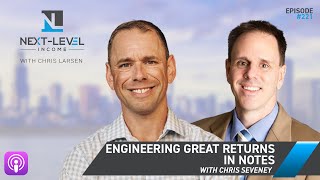
Chris Seveney of 7E Investments explains how to profit from non-performing mortgage notes. His firm has bought over 500 notes worth roughly $25M and purchases $1–2M in assets monthly. Non-performing note prices have climbed from 40–45 cents to 75 cents on the dollar since 2018.
Questions this video answers
Over 500 notes totaling over $25 million.
Overseeing property projects worth over $150 million; handled $750 million in new construction products.
About $1–2 million per month.
Approximately $15 trillion.
Typical default rate ~3–5%; COVID-era rate ~1.5%.
Their insurance, their taxes, their food, their gas, their car payments, everything's gone up. Guess what they've done now? Max out those credit cards. But all of a sudden there's no more equity line to pull. So we're starting to see that hit the market. And again, I may sound gloom and doom. This isn't a 2008 thing.
Welcome to the Next level Income show where it's our goal to take your income, your investments and your life to the next level. I'm your host, Chris Larsen. If you haven't yet, get a copy of our book for free. For free at our website, nextlevelincome.com. that's www.nextlevelincome.com. just click on the book link and I'll even send you a copy if you put your address in. On today's show, we have Chris, 70. Chris is the CEO and co founder of 70 Investments. And he brings over 25 years of real estate know how. And he's going to talk about what he's learned during this period from doing fix and flips as a real estate engineer developer, as well as what he's doing today. And his journey with 70 started in 2016 when he jumped into a quantum, acquiring and trading mortgage notes. Chris has since built a portfolio of over 500 notes totaling over $25 million spanning many different states. And before diving into mortgage notes, as I mentioned, he had a standout career managing a multi million dollar asset portfolio overseeing property projects worth over $150 million. Throughout his 25 year career, Chris handled 750 million in new construction products. And at 70, Chris is a beacon of real estate excellence, known for his commitment to honesty and professionalism. His passion and determination make him a trusted leader, earning respect from partners and colleagues outside work. Chris is a father and an avid Boston sports fan, which adds a personal touch to his journey. Chris, welcome to the show.
Chris, thanks for having me. Excited to be here today and talk shop.
Absolutely. How many times can we say Chris, Chris. We could go back and forth, Chris, Chris, Chris.
Yeah, I know. Really, really get everyone to tune us off very quickly.
That's right. Yeah. They'd be like so. Well, this will get him interested. Chris, so you and I were talking before the show, we're talking shop and I was like, we just got to hit record because this is what the podcast is supposed to be about. I'm definitely a financial nerd. We're going to dive into kind of the macroeconomics about what's going on in real estate right now, how your Firm is taking advantage of some of these trends and specifically in the note space. But before we get into that, I'd love for you to share with our audience a little bit about your background and what your business business really is all about.
Yeah, so I am a nerd as well. I'm a numbers nerd. Start with my business today is we run a non performing note mortgage fund is what we do for accredited and not investors. So it's a little bit different where most people just do the accredited but we went through that regulation A plus process. So I feel like I have a degree in SEC qualifications for having to submit to the sec. I got into this space actually I'll say accident and I thank or blame my wife. I've been in real estate since the age myself the late 90s. I went to college, got a civil engineering degree, spent 15 years working for a commercial general contractor, working 60 plus hours a week. The W2, the grind, you know. Then I moved over to what's called the dark side of the industry. I went from the construction side over to the development side and everyone on the GC side you had a dark side. And what was interesting is people on the development side are much more entrepreneurial. And my boss at the time joked, he's like what are you doing for retirement? I'm like my 401k. And he's like oh, so you're a 40, 40, 40 guy. I'm like what do you mean Those you work 40 hours a week or actually 60 for 40 years to get 40% of your income that you're never going to be able to retire? And I'm like yep. So it flipped the switch because he owned a lot of rentals.
Okay. And that's a great, you know what, that's a great 40, 40, 40. You know, that's something that I imagine if somebody said that to me that would just stick in the back of my mind and we just eat away until it made me do something.
And it did. And for me, you know, he had rentals and I was looking in the rentals but at the time I had gone through, you know, several years out of a divorce, gotten remarried. But for anyone who's ever gone through that process, it can be, you know, imaging from a financial picture going through that. And my wife and I, we bought a piece of property in the Washington D.C. area to build a house. So we built a house. I acted as a gc, which really my wife acted as a GC more than probably I did. But we house and it was in 2013 and we had a ton of equity when we finished it.
Yeah.
So we took our equity and we started doing back at the time the bigger it's brrrr strategy which is line of credit, pay cash, renovate it, get all our money back out, pay off the line of credit and then it was cash flowing or close to cash flowing because what we did at the time was my son at the time was about 3. We put on 15 year notes and we did that because they'd be paid off right when my son goes to college. So you know, and these, I think we still have them. Rates are 2.5, 2.75. So it makes zero sense to pay them off. Um, so we started doing that but our young and my wife was like, we can't do this anymore. I mean our, our date night was renovating properties. Which you know, cool for a guy, not so cool for the other side.
It's cool for you. Yeah. Which if it's not cool for your wife, it's not cool for you.
Yeah, exactly. So she's like, we gotta do something else and highly competitive market.
So.
So I stumbled upon note investing and I heard about private lending, but I didn't know there was this noteworld and this is like 2016 timeframe. So I was fascinated because I am a numbers nerd like you and you can do note investing anywhere on the planet as long as you have Internet and buy loans pretty much wherever you want. So I felt it was love at first sight.
Yeah, no, I, and look, I heard about it. I were chatting before the show. I invested in, in a note fund and actually bought some of my own about 10 years ago before I got into the multifamily space. And yeah, I was like, oh this is so cool. You know you can, you can buy this. It's just financial engineering. And we were buying non performing notes as well. Chris, you mind sharing? So first off, you know, I think some people, if they're listening, they're like, I'm going to invest in a non performing note fund. Is the fun not performing? Is the note not performing. You know, it's one of those things, it sounds funny where it's like, oh yeah, like that's, that's like I hear it now knowing what it is. It's a great opportunity. But the first time you hear it you think why on earth would I do that? Like what? I like to equate it to kind of like a foreclosure in a home, you know, how would like how would you describe A non performing note. And. And how is it different than a performing note?
Yeah, so great question that what we get asked all the time is why would you buy something when someone's not paying you? And what we like to use the terminology is we fix and flip loans.
Ah, there you go. That's a great. Yeah, great.
So a lot of people fix and flip houses, which is you fix it so you're buying it dilapidated and when you're buying it dilapidated, you buy it at a discount. Then you put in the sweat equity of getting it fixed up to then turn around and do something, whether keep it or sell it. And we do the same with the loan where we don't own the house. So if their toilet breaks, they don't call us. You don't call, you know, Chase or Bank of America or whoever when toilet breaks. So we'll buy that loan. And I'll use rough numbers. Let's say the borrower owes $100,000. We might buy it for 70,000, $60,000. So we're buying it at a discount, which gives us the ability to then go back to the borrower, say, let's work on some new type of payment plan. But we also have, you know, can dangle, you know, the foreclosure if they come to play or you can't work something out with them. And then if you foreclose, typically you want equity in the property. So you want the property to be worth like 150. Because if they don't work out some payment plan, then you get whatever they're owed, it sells at auction. So that's the difference between non performing is they're not paying. Now I'll add one caveat to this and sorry for doing all the talking now.
This is great. This is. Yeah, that's why we have you on. People can listen to me talk. I just do a solo cast at that point.
You know, most people think that if you miss a mortgage payment, you know, you get 50 phone calls, somebody come beat down your door and drag you out kicking and screaming. That's not the case. They may call you a lot, but they never take action. Or rarely because banks are typically not in the business or have the infrastructure to deal with this.
Yeah, they don't want to do it.
Yeah. So the average delinquency on loans we see is usually like two, usually about three years, not months.
Three years. Yeah. Yes. Yeah. Now that's to be fair to the audience, if you're thinking, oh, I can save some money by not paying my mortgage, that's not good for your credit to do that.
No, I don't recommend that. And you know, we're record, you know, this is the time where I saw this item come up this weekend about the whole chase glitch. I don't know if you heard about that.
Where I think I saw it. Yes. I didn't read, I didn't read deep, deep into it. I saw it come across the ticket.
Yeah, but people basically creating bank fraud to get an atm. But yeah, I don't recommend you try and take on banks. Just you know, I always, I, I, I joked today somebody this morning, I said banks and cartels are two types of businesses you don't want to mess with because they have lots of money and they have lots of power.
Yeah, absolutely. Absolutely. Yeah. So that's a, that's a great explanation of, you know, why, why a non performing note versus a performing note. And to your point, you know, if you're buying it at a discount, Chris, then your returns are, can be significantly higher than if you have have a performing note. And just to give, give an example, so we bought an office in downtown Asheville from the bank. It was a foreclosure, it was 50% occupied. And because we got the property at you know, similar type discount, say 30, 40% off, we were able to market it. I was able to get people to come in at lower lease levels than other offices of similar quality. Because my numbers worked. I could, I filled it up faster and then I was able to kind of slowly raise rents over time. So if you're kind of, if you're kind of thinking about it in a numbers perspective, you know, it's, it's very similar, but you don't have to, have to do as much manual labor necessarily like a fix and flip and do it that way. So before we get into kind of what we're seeing in the market today, you know, you mentioned something, Chris. You guys started a reg A fund and I know that, you know, some of our listeners are familiar with, with reg. D. So you know, there's reg. D, there's 506B offerings, there's 506C offerings. So with 506C offerings, only accredited investors are, are allowed to come in and you have to have a third party basically prove that you're accredited. You know, that could be an accountant. You could go to certification service that shares that. The nice thing is, so we have, we have a 506c fund and I can, you can say, hey Chris, you should talk to my neighbor, my friend or family member about that. And even though I don't know them, they can invest in it if they're accredited. The nice thing about our 506B offerings that we've done in the past is that if you introduce me to another family member that's not accredited, then they might not be able to invest in our current offering. But the next time we have one that comes up, after we have that established relationship, you know, once we've, you know, talked, seen if it's seen what their goals are maybe met in person, they can invest in that. And there's limits to that. So I won't go into all the specifics. So 506B for you know, as a summary you can allow some accredited investors, some non accredited and accredited 506C only accredited. And how is rig A different than that, Chris? How does that work?
Yeah. So you know, I joke as the math nerd, you know, A equals B plus C meaning.
Or, or yeah, it's funny, I was just talking about my son's in, in geometry, A squared plus B squared equals C squared, right?
Yeah. So you can take essentially the best part of a 506C and a 506B and almost combine them. And what I mean by that is regulation A came out during the JOBS act And this around 2017 is when the regulation A offerings really started rolling. But it allows you to advertise to raise from accredited and non accredited. Non accredited Is I think 10% of their net worth. Everyone self certifies themselves so you don't need third parties.
Okay.
Okay, so that sounds like really, really good. Our minimum offering is $5,000 is a minimum investment. So everyone's like wow, wow, wow. And then you know, here's the side of things.
Yeah.
One is it is a lot more scrutinized because of that non accredited side.
Sure.
Your PPM gets submitted to the sec, what's called an offering circular. So it has to be reviewed by the SEC and the SEC will give you a qualification. They don't approve anything, they qualify it saying you're good to go. Okay. Then every year you have to submit financial statements and a semi annual unaudited report. So it's kind of a quasi IPO where have to do like 10k statements and everything. But there's significantly more reporting so there's a lot more costs involved in getting it. Hey, I can go spend 10:15 and have an attorney put together a PPM for 506C. Yeah, get a reg A started is about, you know, cost 75 to 100 grand. Give people an idea.
Yeah, is that, is that evergreen? Like is your fund going to be evergreen for that much money or do you have to close and open them every three years?
You have to, basically. So every year you have to get requalified, but after the third year you have to stop it completely but re it again. So you have to go through almost like a brand new process. So as an example, we use broker dealers to raise money as well on the institutional side. So people familiar with that space, you have to get selling agreements with them. So we, every three years we have to get new agreements with them essentially to, you know, but other than that, it's, we just change the class of whether it's a share or a bond, it's just, you know, this is a, you know, say next one's class B. So for the investors, they really don't see much of a difference.
Yeah, gotcha. That's interesting. I think that's going to be new information to a lot of investors that, you know, may be familiar with some of the offerings out there. And you know, the thing that I love is that this just gives more investors the opportunity to get into the alternative investment space, which is, you know, hey, we just, we want to give more people the option to achieve financial independence. I'm all for that.
And one thing we like to, you know, teach people too is, you know, how to invest in syndication funds. Because a lot of people will just go throw 50, 100 grand at something and they might not have the experience or like, oh, let me just go try it. Well, the reggae world, most of these offerings have five ten thousand dollar minimums. So you can either A diversify or C, oh, this is the questions I should ask. Or you know, I see certain things from, from me. So I'll sense like, oh, well, Chris, you know, Larson just came out with a fund. You know, people are more prepared a lot of times to ask better questions. Like anything after you go through something, you realize, oh, I have more knowledge. Yeah.
And I found that, yeah, if you go through something, it's like coaching, right? Yeah. If you do something, it's free, you process it. If you have to pay for it or you have your own money involved, things get real, real fast, you know, because you're, you got buy in with that, you know, just like, just like with having kids. We were talking, I was having a conversation this morning with somebody about kids. It's like, oh yeah, it's like once you have kids, you start paying a lot more attention to Certain things in life like school systems and, and, you know, and all those sorts of things. So again, 10 years ago, Chris, I remember seeing these tapes, you know, so, you know, for the audience, a tape is, it's like a, it's like a ticker or a list.
Fine. Spreadsheet.
Yeah, it is. It's a glorified spreadsheet. Right, thank you. I love my spreadsheets. But yeah, so you get these tapes with, you know, you know, tons and tons of loans and then things started to dry up, you know, about, you know, five or so years ago. Share a little bit about kind of what you've been seeing in the note world and you know, what do you think? You know, we're talking a little bit about some of the, some of the stuff you've seen here recently, but kind of like historically what you've seen over the last 10 or 20 years and then where you see things today and where they may be going for investors and opportunities that may be in the forefront here. Are you a high income business owner or professional earning 2, 300,000 or even more a year, but still, still feel like you're living paycheck to paycheck? Are you comfortable working until you're 65 or 70 to retire, or do you want to achieve financial independence and live life on your own terms? You could join myself and Matt for and learn how we both became financially independent in our early 30s. We will teach you how to make, keep and grow your money, teaching you strategies to maximize your earnings, keep your income that you've earned through tax strategy and legal structures, and ultimately teach you how to grow it by determining your personal investing strategy, as well as teach you how to analyze investments so you can grow your passive income to the point to live life on your own terms. Our coaching clients reliably do this in seven years or less. To learn more, check out our coaching program at nextlevelincome.com forward/coaching. That's nextlevelincome.com forward/ coaching.
Yeah, so I'll first use a caveat. You know, 2008-13 was its own separate animal because of everything that went on. People were talking about, oh, buy loans at $0.10, $0.05 on the dollar back then. Well, they could because there's a lot of fraud and there was so much default at that point in time.
Tons of tons of shaft in the. Yeah, in the, in the tape. Yeah.
So I always joke, people who are doing notes 15 years ago are no longer around because they're retired because they made so much Money back during that time. But you know, take that aside, you know, for us we've always seen, you know, a consistent flow and right now we're between 25 and $30 million company. We're buying let's a million to $2 million a month in assets. Now when you think about the mortgage market, it's $15 trillion.
Wow.
So it's big. At any point in time there's usually 3 to 5% default rate but because of COVID that has gone down to like one and a half percent. So the numbers have gone down significantly. And just like real estate, lack of inventory causes what prices to increase.
Yeah.
So in 2018 I could buy a loan at 40, 45 cents on the dollar. Today I'm probably paying 75 cents on the dollar.
Okay.
Now what's interesting though is and I don't pay too much attention to mainstream media because I don't believe a lot of what they just like the jobs report, they just had 800,000 jobs magically. So it's.
Yeah, it's yeah. Bizarre. No, yeah, that's a good rule. If you're listening, let's underscore that. Turn off your tv. Yeah. Read a lot. Not, not just, not just on, on X but, but read, read, dig, dig down to the bottom of stuff. So you don't. Yeah, because yeah, the news is entertainment or propaganda in some cases or there.
Are some experts out there who are nonpartisan that are good to listen to. But I look at what's in front of me and during the summer it's usually historically slow and again numbers I historical data for last 8 years of how much we see and when there are the peaks and flow, ebbs and flows. During a year between the end of last week and this weekend, there was about close to a billion dollars of non performing loans come across my desk to bid on which we see about 200, we usually see about 200 million of assets but usually about 20% of those are non performing. So we went from like 40 million to a billion in a week. It was like wow. And on top of that, Ginnie Mae, literally right before I you hit record sent that they've got 250 million coming out and then HUD has 750 million coming out. So all of a sudden there's you know, all these loans that are starting to hit and for us we're starting to you know, finally I think see people being more flexible or starting to feel sense of pricing starting just like homes right now people you're starting to see softening and stuff. We're seeing a little bit with the notes as well and being on the front lines of things. When we start looking at this stuff, what's interesting is we look at when these loans were originated and what we're starting to see is a lot of loans originated 20, 20, 21, 22 are also a lot where we're seeing defaults. And excuse me, it somewhat makes sense because you know, people got these low interest rates. But people have a spending problem in this country and people, you know, including our country, but credit cards and credit card rates have exhausted. I have a friend who does a lot of seconds which are. He invests in lines of credits.
Yeah. So you have a primary, just real quick. So you have performing, non performing. You have primary, secondary or like a home equity line of credit. Yeah, most people. Yeah.
So what were a lot of people who bought homes in 15 and 2016.
Doing during COVID They're probably drawing on their equity.
They're drawing on their equity to go buy a property, whatever the case may be. But now what's happened is a lot of them were doing it to pay off a lot of their credit card debt too.
Interesting. And if they had a home equity line of credit, credit, typically that's a floating rate loan. So it may have been 3% today, maybe say 8%.
Correct. And guess what those people did since with their credit card because their insurance, their taxes, their food, their gas, their car payments, everything's gone up. Guess what they've done now. Max out those credit cards. But all of a sudden there's no more equity line to pull. So we're starting to see that hit the market. And again I may sound gloom and doom. This isn't a 2008 thing.
No, we want, listen, we want, we want, like you said, we don't want fluff. We want what you're seeing out there. And it's true. Like this is the, the real estate market ebbs and flows and we want investors to understand what's going on out there. And I think this is a great perspective to come to it, Chris. So thank you.
Yeah. And when things are historical lows at like one and a half percent, that's everything always goes back to a norm. So, you know, everything goes back to its mean unless there's some life altering event or catastrophe or whatever the case may be. So for it to get back to 3%, 4%, it's most likely going to happen. Just people in today's world think everything happens overnight because the stock market can move very quickly. Overnight. But real estate is such a slow play that go back to 2008 when you look at when everything crashed. The best time during that time, I think to buy a house was like 2011, I think, you know, or 12.
Yeah, yeah.
It wasn't nine or 10. It was actually let things play out a little bit longer. And it's typically what happens that people forget.
Yeah, no, exactly. People do forget. I was just having a conversation at an appointment today with the, the nurse was, she's 27, super smart, was in the military, Gen Z, very open minded. We were talking about the differences between, you know, her generation, millennials, and how things go in cycles. There's a great book out there, if you haven't read it. You're listening today. It's called the Fourth Turning is here by Neil Howe. And whether you believe in what he's talking about with what's going to occur, he talks about how generations go and four generational cycles over about the course of 80 to 90 years. And what's interesting is he talks about how, you know, kind of the third in line of those generations are typically the ones that start wars because they forget because they haven't seen war in so long. And you know, if things go in cycles, like the real estate cycle, if you're a millennial today, you may kind of remember, you know, the housing crash, but you just think the market goes straight up, you know, because you weren't, you weren't in the market, you weren't in the real estate market or that was a, that was an anomaly. But I lost, I saw my parents lose their jobs during the savings and loan crisis in the early 90s. I saw what happened during 9 11. I saw what happened during, you know, 0708. I saw what happened during COVID And you see the cycles repeat. You go Back to episode 100 of my podcast and I talk about these cycles. So, Chris, I think, you know, this is why it's so important not to erase history, but learn from history. Because if we can study and learn from history, then we won't be doomed to repeat it.
Yeah, My first house I was actually supposed to close on, I think, you know, 911 or a day before, and it got delayed.
Yeah.
And I remember at the time the, my parents, the interest rate was, you know, around 6% and it was floating. And when they came back and said 6%, they're like, lock that. You will never beat that.
Yeah.
You know, and dropped.
Yeah.
Yep. And at that point in time, you know, I bought my house in 2001, my house, I lived in there for four years and it appreciated about over four years, like 10%, you know, like, you know, a few points per year, but not anything crazy. I mean, it went with kind of what the economy did. And you really had to live in a house four to five years to sell it and make anything because of your selling commissions, you know, that you were paying. And then, you know, 2005, 6, 7 was crazy. Where prices just started, jack, getting insane. And it was easy money at that point in time for loans. But, you know, I go back to, like you said, learn from it that houses don't. And I see people today thinking, oh, I'm going to think this house is going to appreciate $150,000 house. And it's like, oh, it's going to appreciate 8% per year. And I'm like, over the last 50 years, it's pre. It was 100, you know, it was, you know, 30,000. Like, it's acute. The lower value homes appreciate much slower than the higher value homes. And like, people think that, oh, well, it's going to keep going. I'm like, probably not.
No. Over time, it's, it basically equals out to inflation, you know, so you're kind of, you're kind of keeping up with inflation. But, you know, that's one of the reasons we love real estate, is that you can leverage it. Right. And you can have someone else pay it off if you're, if you're doing that, or you can do a fix and flip. You can buy at a discount. You can negotiate and do those things. So, Chris, you're starting to see some opportunities pop up, share with the audience, you know, how they can get in touch with you, how they can learn more about what you're doing. If they want to learn about the business and ultimately learn about potentially investing with you guys.
Yeah, they can go to our website, which is 7e Investments.com the number 7 the letter E Investments.com. i'm sure you'll put that in the notes.
Absolutely.
And you know, can reach out to us at Invest at seven Investments. So that's the best way to reach out to us, get in touch with us. I love talking real estate. So whether it's notes, as we mentioned, I've been in construction development. You know, I built. My favorite thing to build, I think is like an MRI suite, which is really cool.
Getting the machine wild. Yeah.
And you know, the, you know, the types of lead in the walls and stuff and so forth.
Yeah.
But, yeah, so I just love talking about what I've been through, my life, my journey. And I like to try and just keep it real with people. You know, I'm not there to try and convince people that you're going to become famous or a millionaire overnight. It takes a long time. But you can also start in 22 or 52. It doesn't matter when you. Well, it matters when you start. But there is no. It's. I'm too old getting a real estate.
Yeah, I love that. Great, great philosophy. I think us engineers and nerds need to stick together and we'll, we'll continue this conversation for sure, you and I. But if you want to talk to Chris and continue this conversation with him, check out 7E. That's the number seven, the letter E investments dot com. You're right. We will have that in the show notes. Chris, we wish you all the best in business, all the best health to your family going forward here. And thank you so much for sharing your story and what you got going on with the audience. If you're listening today, please like and subscribe and share this with somebody that you think may find value in our podcast today. Hey Chris, here again. I hope you found this episode valuable. Now I have one more thing to give to you. We have a page for my coaching clients where you can get a free copy of my book as well as much more from previous guests on the show. Just check out next level in income.com coaching to get a free copy of my book, audiobook and much more. I'll send you a copy of my book and cover all the shipping costs as a thank you for listening to the podcast. Also, please like share and take just 90 seconds to give us a rating on Apple Podcasts.










