Entrepreneurs Will Save the World with Jeremy Delk
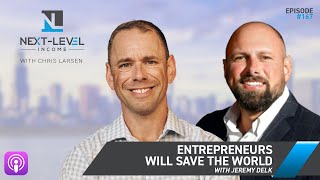
Jeremy S. Delk talks about his path from day trading losses to building Delk Enterprises, a coaching and investing firm. He emphasizes financial literacy and learning from failure as keys to entrepreneurial success, and discusses his book Without a Plan.
We've just got a great commercial project downtown. Commercial building. No one's buying commercial buildings. You know what that commercial buildings next to the most ultra high end residential property in this town.
Welcome to the Next Level Income show where it's our goal to take your income, your investments and your life to the next level. I'm your host, Chris Larson. If you haven't yet, get a copy of our book for free at our website, Next Level Income.com. that's www.nextlevelincome.com. just click on the book link and I'll even send you a copy if you put your address in. On today's show, we have Jeremy Dell. Born and raised in a small town and from a blue collar household, his parents worked for the post office. However, Jeremy always held much bigger dreams and he longed to experience the world outside his small hometown of Bardstown, Kentucky. By the age of 19, he was earning 30 to $50,000 a day as a day trader. From the desk of his college classroom, he felt invincible. But as quickly as the money came advantage just as fast. After amassing almost $2 million in his early 20s as a day trader, he it took him only four days to lose it all. Moving on to Wall Street. Eventually he decided to go out on his own. Today, more than 20 years later, Delk Enterprises has holdings in biotech and healthcare, consumer brands, technology, building materials and real estate development. One of our favorite, Jeremy now focuses on investing in and advising entrepreneurs through speaking. Jeremy, welcome to the show.
Thanks for having me. Excited to be here.
Yeah, I'm excited as well, man. We're going to have a great conversation. We were talking about Asheville and you know, you, you have a little experience coming down here to, to Asheville, North Carolina. And one of the things is, and you may know this, but you know, the Biltmore was built by George Vanderbilt. And you know, unfortunately the Vanderbilts have, they have a unfortunate family history about making a lot of money and then losing a lot of money over a period of time. And one of the things we're passionate on this show is, is teaching young not only the current generation but also the next generation how to earn money, how to keep money and these financial skills. And I think your life story is just going to be a wonderful illustration of that. So maybe you could start off by sharing a little bit about your story, how you got to this point, you know, for sure.
Just Sidebar. So was it George or Cornelius? Right. I did the, I'm a big architecture guy, so I did the architectural thing. So Was it Cornelius the one that blew it?
So George built it. Cornelius, I believe, was his father who had the. The. The. The. Was it the shipping empire? And then George. And then the succeeding generations are the ones that. That ultimately blew it, unfortunately. So I'm gonna go and double check all my facts here.
Yeah, yeah, but. But it's so true what you. What you said. I. I was. I've got. I mean, I look at deals every day, right. And I've got a group that's come to me to. To do a hospitality project. And we're in Lexington, Kentucky. So a bunch of university Kentucky athletes. Right. So some big ones, right?
Yeah.
Mainly from basketball, but we've got some football guys now. And so now these groups are now wanting to kind of come back. And they just. They don't know. It's the lack of education sometimes in advisors is crazy. Yeah. But anyway, one of the guys, like, I was like, well, does he even have. Because it's not a project, but, you know, it's not a small project either. And I'm like, does he have any. Does he even have that kind of money to go through? Talking about this particular athlete and like, man, in a massive contract, I mean, I think he's made a lot of money. I'm like, it's not what you make, buddy. It's what you keep. Right? And I think that's just kind of. Exactly to your point. And that financial literacy, that just isn't taught sometimes. And then you. And also doesn't always come in that whole idea from saving for a day. And I think it's about. It's raining out here, literally, and I think probably figuratively here. Here soon, too, so. So, yeah, just definitely can't. Can't agree with that more. I'm a native from Kentucky, to answer your question, about an hour south of here in Bargetown, Kentucky. So we're the Bourbon County.
Oh, yeah, I know. Yeah, I got support. Yeah.
Jim Beam. I mean, those are, you know, Blanton's, obviously really hot Woodford Reserve down the street. But, um, small town, usa. Small town, kid. And, you know, growing up, I always had this kind of yearning, kind of like a big fish, small pond mentality, where I always wanted to kind of go and do more, see more and be more. And that's led me to a very windy road book that defines my life. It's called Without a Plan. Because where I've kind of journeyed, there's never been any kind of beacon, but very windy road. I always had this mission to, you know, get to Wall street. And I ended up there for a pretty successful but short lived career on Wall Street. But the path that got me there was very windy and tumultuous and filled with massive ups and massive downs. But that's kind of what shapes us. And I think, you know, that level as you go through life in general, whether you're an entrepreneur or not, but especially entrepreneurship, worship the, the, that's actually probably a silver tongue with tree sometimes. But as you go through it, you know, if you can just keep moving forward and not dwell, but look back at some of the, not the good times, good times come and go, but really the bad times, that's really what shapes you and it gives you that confidence to take the next bet, to take the next step forward.
So yeah, that's, that's such a good point. And you know, I was, you know, I like to say like with adversity comes, you know, durability comes resiliency. Right. And that's one of you mentioned, you mentioned sports and athletes. And you know, we, we learn this as athletes, right? We see that, you know, we watch athletes, we, we know anybody that's been experiencing it, but it's almost like we've forgotten it as a society. You know, we want to shield our children from pain. We don't, you know, we, we want to say, oh no, we're going to, you know, we're going to, you know, give, give this person something so that they, you know, they can get, get to where somebody else is. And I think what we learn as entrepreneurs, what we learn as athletes is that if you don't learn about those pitfalls, this goes back to the Vanderbilt story. If you don't learn about the losses, if you don't learn about the pitfalls, if you only know the upside, then you, you're not only are you not going to appreciate it, but I think you're going to be doomed to lose it ultimately. Yeah. Yeah.
I mean it's, it's probably one of my biggest series. I don't know your background, but just on the, you know, that, that whole adage, I'll mess it up, but you know, hard times make great men, easy times make weak men. Right?
He said, oh, that's even better. I gotta write that down.
That's my, that's my biggest fear, right. Is, you know, is up my kids, truthfully, right. Is they, they're growing a different than I grew up. Which I'm, I'm. Oh yeah, but, but like also they're not having any because we protect and insulate. You try to give them lessons that are different, but they're never going to be as hard charging crazy. And maybe that's a good thing. I don't know. But that's something I, I truly struggle with and I've come to peace with. Eventually they're gonna. Humans, they're gonna be who they're gonna be.
Yeah.
No matter what you do.
Yeah.
But just trying to be a loving, supporting component and just kind of steering them. But I gave up a few years ago through some really good counsel and some advice from friends and stuff that like, you just got to let them go. Right. Because. And I'm trying to. I know your boys are a little bit older than mine. You're 11 and 13, I think you said, right?
Yeah, yeah.
I've got a 9, 4. The 4 year old. My dog is going to be me. We're all scared of her. She's an animal. But like, they're probably not going to be that way and that's okay. But you know, just make good people. Right. That's the piece that's kind of tough and like, you know, just Jack, you know, with your kids, you know, hustling and working a little bit at holiday parties and making a few hundred bucks to try and if they want to be entrepreneurs, I can really be helpful to them. But I don't know if that's, if that's their path and.
Yeah, yeah, that's a beautiful thing. I want to come back to that because that's really something that I think. Like you, Jeremy, I've spent, I spent a lot of time thinking about because our life is way different than mine. Growing up. My mom was a. Now I say she was a teacher, but she was really an assistant teacher, you know, so she was making like 30 grand a year. My father passed away when I was five. I had a stepfather, he was a contractor. He did fine. But you know, I made more the first year I got out of school than either of my parents ever did. And you know, it's just, you know, that, that helped teach me a lot of stuff because I had to, I had to grind and do different things. Um, but I, you know, in, in your intro, you know, I talked about, you know, some of the, some of the things that you've gone through, but maybe you could tell us about some of those early, early losses and you know, what it taught you and then ultimately what you, you like how you use that in your next stage in life.
I'm laughing. So you definitely got to listen to the book on the way up to, to Maine because like we're kindred spirits. I mean very similar. Like yeah, both my, my mom and my stepfather worked at the post office, so I had that blue collar type of upbringing. Yeah, I lost my dad seven. So like very similar stories. But like, I think the, the piece that you go through is just that resilience because you have to go through. Like we have all experienced trauma, loss, defeat, failure. We've all experienced it like as humanity. What, what I found personally, and this is a lot of introspective stuff with, you know, sitting on a couch with the therapist for a long time and then analyzing deals that went well and deals that didn't go through, doing that autopsy.
Yeah.
What, what I've analyzed is that if you have the courage to look back and not dwell or be a victim, but understand and learn from it, you've never really failed. Right. You, you've learned, making the same mistake because you haven't educated. That, that's, that different mentality. That's the definition of as long as you're kind of going through and, and, and learning, you def, you don't know what's, what's, you know, behind door number two, just that level of kind of keeping ongoing and that's, you know, that's kind of what's done it for me. So just quick tidbit story and because you made more money like so I had like a $30,000 inheritance when my dad passed away and my mom thankfully always just let me kind of go do my thing right. I was always that kid that's kind of going through. So I, I dreamed about going to, to New York, only wanted to go to New York because, you know, my education. This is, you know, Internet did just kind of come out. This is, you know, 96, 97. But my only, you know, understanding of New York was like the Godfather and him is Delkin the Mob.
Great movie like, dude, those movies are so good.
And, and Wall street, like that was like, that's what New York was. Right. So that got me interested in my, my mom had put some money in like a mutual fund and, and I just started reading, I was reading like Raging Bull newsletters online. I was Investor Business Daily, Wall Street Journal, et cetera. So I just self taught in a variable market, started day trading and I turned that 30 grand into a couple million bucks and about two years, which was a huge accomplishment, huge feat, A lot of luck. And, and thankfully, and I say this in retrospect, it happened, it was horrible. But Thankfully I blew it up in four days. I lost everything.
Wow.
And it was probably the best lesson that happened to me for multiple reasons. One, I mean 19 year old kid, full testosterone, you're not gonna tell me to weigh anything, right? I was at school in Providence, Rhode Island. You know, decent looking kid. I mean like I, I was going down a path like, like a fake world, right. That just doesn't, everything just doesn't go that well for you for that forever. So it taught me it's not about humility. And you're never, you know, too smart to learn. You always like that's, that's why I love entrepreneurship and I've been industry agnostic in what I invest because Businesses, businesses, business. So I love that learning and discovery phase. That's, that's what I really enjoy about it and the creativity. But the biggest taught me is like you have a choice, right? And we all do. Like I had a choice when I blew up 2 million bucks. My story could have been young kid lost his father, went to college on a scholarship and I wasn't a good student. But I worked my ass off my in high school day traded, made a couple million bucks, went bust because everyone did. It was a dot com era, so it's just bad luck. And I went back home to Bartown and became a successful fill in the blank. That would have been an okay story, but it wasn't going to be my story. I was like, I was besides the money, I like I squandered what my dad left me. I was just self hate, I was, it was, it was a disaster. I bought a condo by that time on my first summer, like every freshman does, right. I bought a 20 foot tall ceilings, double fireplace. I mean I was living the life of a mid 30 year old bachelor at 19. So I had these liabilities even though I'd acquired them. You got HOA fees, rent, you know, HOA fees, mortgages, you had all these things that go through and your, your, your, your mom, the assistant teacher, you know my parents were both making you know, money at the post office. But you know, middle class upper is a stretch I think. Middle class. So yeah, while she would, while they, not my mom, my mom would give the shirt off their back. They didn't have the ability to, they couldn't bail you. So yeah. So if, which was great because if I had it, if I had a, if I had a safety net, it wouldn't worked out so I wouldn't be who I was. Which is back to the point of up your Kids because it's just that knee jerk reaction to go through and help them.
Yes.
And the fact that I had my back against the wall, that's how I've lived my life is like this is on you buddy. Figure it out. Like that level of pressure has kind of pushed me to, to be where I am. So you know, I had that choice that I went out and started hustling odd job to odd job to odd job. Renting apartment. We're coming Fitch. Doing landscaping which I had no clue how to do. Lasted like week.
But you look like, you look like you can swing a shovel.
But I was, I was renting apartments and just to happenstance in my fourth job, started meeting this guy. I got a commission every time I sold a rental unit. And this guy relocated to Boston and was in temporary corporate housing with a company called Fidelity Investments. And I'm just talking to him. It's this 19 year old kid who had a pretty good breadth and market knowledge but no technical skills other than, you know, long and short. I wasn't doing any option strategies but I just had a pretty good understanding of two Qualcomm and JDS unifies because that's what I was doing.
I traded those. Yeah.
And this dude's like who the fuck kid, right? Where are you? And then he's like, you know, we consider a job on Wall street. Meanwhile like no path how to get there. But that's what I always wanted to do. But yeah, that's great. But I'm from Kentucky. You know, before I moved, like more of a Kentucky accent. Like you know, I'm from Kentucky, I don't have a college degree. Like yeah, it's just not for me. And he's like well what if I gave you a chance and you know, a three month process of background checks, all the stuff that you've got to go through. I got the job and, and I still finished but I converted to nights night college and started working full time. And that's so. And then, and then I rebuilt myself. Ended up moving to New York, got transferred in New York on Wall Street. So like at 20, I was the youngest trader at Fidelity Investments. History 7 63, all those things at 20 years. 17 year old me had no way. And you couldn't script that. You couldn't script that journey for three years. But then I was back. I'd made it back in three years and then 2021. Yeah, 2021 I resigned from Fidelity. Similar to you, making twice as much to both of my parents. Right. My mom and my stepdad. And they're like, what the fuck is wrong with you, kid? You've just blown up 2 million bucks. You finally stabilize yourself, now you're giving it all expensive city in the world and you're gonna fucking quit. I'm like, but I wasn't like, I just saw myself dying and you know, dying creatively and musha. You know, corporate America is for probably a big part of the population. Entrepreneurs don't really throw.
They don't fit in there.
Yeah, they don't. But I think a lot of them, a lot of them are very scared and maybe some of your listeners have, can relate to this. It took them so long to take that leap because they were so scared of the outcome. And I guess this very long rhetorical component to like that two, that's why 2 million bucks blowing up was the best for me because like I'm not losing 2 million bucks. I'm just losing an income. I've proven that I can come back and make the money at 20 years old, 21 year old to myself. So like I didn't have to wait till 40 when I actually have real responsibilities with kids and mortgages and houses, all that stuff. So that blows is what gave me the courage to say it. It's the worst can happen, lose it, can go again.
And that's so. And that's.
But you wouldn't have, you wouldn't have that if you didn't have that experience and take those chances. Now I'm a sicko and probably not normal. I don't recommend you do. This is not advice, by the way. But there's, there's all lessons you can learn and it's all about how did they happen, you know, to you or they happen for you? Right. I think that's, that's the piece.
Today's show is sponsored by Money Insights and their investment optimizer strategy. In my book, I share how I use this same strategy starting over a decade ago to invest my money in two places at one time. This strategy has been used by the wealthiest for generations for estate planning, minimizing taxes, preserving wealth and increasing stability for their investments. Now you can do the same thing. In addition, you can build a plan to build an emergency fund, pay for college fund a business plan for retirement, and ultimately our optimize your total financial picture. To find out more information, check us out at the banking link@nextlevelincome.com yeah, and that is so important. I think there's, there's a lot of things. And you mentioned the kindred spirits. Like we can, we can trace back a few things. One of the things that I've come to realize is, and I love this expression, within itude comes gratitude. When you realize something's finite and it might end. And unfortunately for us, Jeremy, when you lose a parent at such a young age. Malcolm Gladwell writes about this. He talks about how there's this uncanny correlation between US presidents, CEOs that have lost a parent. And I didn't realize this until I read this 10 years ago. And I said, wait a minute, why is that? Now as an analytical guy, as an engineer, you know, I look at it and I think I thought of it like an equation. I said, well, yeah, if you defied anything, I'm sorry, divide anything by infinity. Like when we're young, right, you think you're invincible. Like, you say that in your bio. Like, you know, you have like invincibility. Most of us do when we feel young, we think we're to live forever. We don't have a concept, you know, of mortality. So if you divide your time, you know, by infinity, the value is it's, it's hard to put a, put a place on it as soon as you know that life is finite and you might not live another day. And really, when my best friend died when I was 19, it really defined that because, you know, as a 19 year old, he was 18, I was like, well, I might not live to see tomorrow now what? Whereas when I was a kid, I knew deep down that I needed to do something with my life. But I think it's one of those things that you would never wish on somebody, yet at the same time it gives you this perspective on your life that makes it so important. And you also mentioned, I forget how you said it, but my boys, they make mistakes, right? And I say, listen, it's okay to make mistakes. I said, but you got to learn from them. That's what you were talking about in the context. Do you learn from your mistakes or do you go and repeat them? And I said, look, you're not stupid if you make a mistake. But I will tell you what, if you keep making that same mistake, now you're stupid. Like, you've got to learn from that mistake. And when, when you don't learn from it, you know, it's, it's kind of, it's kind of pointless at that point. And you know, I was, I was chuckling at your story of walking away because my buddy, when I left the med device space, I was in a, in a leadership role, and I was making quite a bit more than he was. And he was in a. In a good spot, too. And I told him, I was like, hey, man, yeah, I'm leaving. I'm leaving, resigning. He's like, do you hate money, Chris? What's wrong with you? I said, no, no, dude. Like, I. But there's. There's this opportunity that I'm giving up and, and doing that, so. So you walk. You walk away from Wall street, which, again, it's. It's crazy, right? I know a lot of people are like, shaking their heads that are maybe earlier on in their journey, but as, as entrepreneurs that have been somewhat handcuffed in corporate America, right? We can, we can relate to this. But, you know, what was the. What was the thought process that went through your head as you did that? And you know, what are you up to now after you've left that role now? What, almost two years on, right?
Yeah, well, 20 years now.
Talking about this is 21, 2001. I apologize. I heard. Yeah, so.
So, so it works. It was the right move. Twenty years later, it's still. It's still Delk Enterprises, just Malcolm Gladwell. I want to check that out. I didn't know that stat, but that, that makes so much sense about the lost parent thing.
I'll pull it up. I forget if it was outliers or it. If it was David versus Goliath, but I'll.
Yeah, let me know because I just googled it why you said that. So for me and I. I want to kind of just went through because I know we are short on time, but you know, for me, why I left and why I don't sound like I'm from Kentucky anymore. I had so many ideas, convinced myself I knew they were good ideas and they just fucking wouldn't listen to me or like, you know, like, hey, man, just keep your head down, kid. And I thought, like, maybe they just think I'm. I'm an idiot because I sound like I'm like a hillbilly, right? I didn't have a strong accent. I was like a preppy kid. I wasn't even like a hillbilly kitten, but I was a prep kid by that accent. So I even tried to change my dialect and how I speak to maybe see they would listen. And then what I realized is there's a different game. Like, all you need to do and especially big multinationals, don't up, like, don't expect, you know, don't get canceled. Don't like, but just, just keep this Quo and you know, you know being outside the box is not a good thing in that world. And that's why I like doing this guy. I was driving, I was driving. He was driving a Bentley but he was 40 years my senior. Like that I couldn't do it. So I was just like I. I won't be happy. I have to have that creative stuff. So last 20 years has been. I started a real estate development company building materials. We've done a lot in healthcare, regenerative medicine, animal health. Health. We've got a company we started March 2020 which is a great time doing biological age and epigenetics.
Love that space taken from.
From 0 to like 15 million bucks in top line in a very short period of time. Just published a great study with Harvard. I'm doing these podcasts kind of coaching and like I wrote my book just to full circle it. I wrote my book with which is without a plan. Hit that one point that you just kind of talked around with going to Malcolm Gladwell and, and that it's. We don't have a finite, finite amount of time. And you know what I do with most. Most coaching and consulting clients is just make that real. Like you know I've lived a pretty successful life. I've taken companies public, taking them, you know Inc. 500. No top 24 companies in in the U.S. top four in health care. I've done some really cool things and none of it has been with a 200 page multipronged step plan. I had a direction of where I wanted to go and just started that was a big part of my messaging is that you're not promised tomorrow if. If it makes sense to. And that's everything. Ask the girl to marry you to buy the company. Make the hire, do the deal, expand the product line, buy the company, whatever that is. Just do it because you know, you know everyone. Some people suffer from this paralysis by analysis.
Yes.
Right now let's go to real estate. I know you got a bunch of real estate guys. Let's go to real estate. Everyone's scared dude. I've just bought three multimillion dollar deals leaning in because everyone's scared. Like we've just got a great commercial project downtown commercial building. No one's buying commercial buildings. You know what that commercial buildings X do the most ultra high end residential property in this town. It ain't going to be a commercial building very long can be it's going to be condos. Like so like yeah convert. Look, you got to look at things in a different lens yes. And, and the deal still, this deal still kills. It's going to be a massive IRR at 7%. So like, you gotta look where real money where, where things are going, not what you're getting fed in the news and the media. Right.
Wayne Gretzky, skate door. The puck's gonna be where it's gonna go, man.
Exactly.
Yeah, yeah, the media, yeah. Unfortunately, the media doesn't help you, you know.
Well, it does help me. It doesn't help the most. It helps me because whatever the, they're saying, just do the exact opposite.
Yeah, well, there you go.
It doesn't help most people.
Yeah, yeah, yeah, well, they don't help with the, you know, they, they prey on people's fears. Right. And it's like, oh, be scared. Like, look what happened. Look at that. But yeah, it's, it takes a special person. I think that's what's different about entrepreneurs. As you look forward, you say, okay, what is, what's possible? You take the risk. You know, corporate America, it's about not taking risk because if you take too much risk, you're going to get fired. And that's not, that's not helpful if you want to maintain that role. But the people that I love talking about this on the show, which is, I am so optimistic about the future of this country, the world. People talk about the environment, to talk about energy crisis, population crisis, I mean, you name it, there's a crisis going on right now. But entrepreneurs seem to always come up with solutions and do that. And that's what's amazing about America is that we have this culture, this resiliency, this ability to do that. And, and if we don't fall prey to the news cycles or even some politicians that tell you, hey, you can't do that, or you're destined to fail because of this, or you're in the spot you are. But if we look forward, not backward, and look at what's possible and use our strength that we've gained from the past, then it's amazing what's possible.
Yeah, I think the best kind of just easy rule of thumb that you can do, whether that's media, third party politics, you said, and unfortunately, more times than that, it's the friend, it's the spouse, it's them and us. And I think the best thing I always kind of do is like, whenever they say you can't be done, they're talking about themselves, not you.
I love that. Yeah, yeah, yeah, because, and that's a great point because as the ego comes up to the surface. If. If they say, oh, yeah, you can do it, what they have to do is look in the mirror and say, well, they can't. If Jeremy can do it because it's a choice he made, that means I'm not doing it because it's a choice that I made. And people have a really hard time doing that. That's why it's so important to choose your spouse, to choose your partners, to choose your friends so carefully in this space. Right? Absolutely. Yeah. So. Okay, so now fast forward to today. I know you kind of caught us up to that point. Who are you working with? You mentioned working and coaching entrepreneurs. We're going to have a link to your book in the show notes here, and we'll give you a chance to tell the audience where to get that before we sign off here. But are you working with, like, you got your own stuff going on? You said you also coach and help others grow their businesses and get to the point where they can take the next step.
Yeah. So I'm an investor playing. It's a. I'm a capitalist investor that likes to make money. But secondarily, or actually that's secondary to the primary goal is like, I like learning and I like winning to disrupt something I love. I love being told you can't do it. Fucking great. Tell me I can't do it and then watch me go. Like, that's the biggest, like, motivation to me. So I also like figuring out complex problems. So I'm, you know, yeah, I'll talk about mindset, talk about other things. But, like, I'm not the guy that you call if I want to grow my business 7% year over year and kind of go through, like, I like to come in when there's a dumpster fire going on or you've just been at $10 million a year every single year, and just can't get to 20 or, you know, whatever those. Those pieces are, I like to kind of come in and help because that's where I can really add the most value. So it's. It started with, I get deals and decks all the time. And, you know, it's. It kind of helps me. You know, it lowers my due, diligence, cost. But a lot of times it gets me to know the entrepreneur more. And if I just add value to them and there's not an investment opportunity, that's okay, I'm happy doing. But a lot of times it's led to me being a partner and investor because so many people that are struggling and doesn't have to be a, you're doing 10 million, you could be doing a million, like wherever they are there or doing a billion, it doesn't really matter. But where I'm able to add the most value is kind of just helping them, you know, get out of their own way and look at it from a different piece because I've been in so many different industries like from that agnostic approach. So that's been kind of the, the most fun for me.
Yeah, I love that Sam Zell in his book, which, God rest his soul, it's a phenomenal book. If you haven't read it and you're listening today. Am I being too subtle? You know, he's like, Jeremy, he's agnostic. You got to start in real estate. You know, can, can, can relate like that. But he was a businessman, he looked at things and he was big on relationships. He was big on forming those relationships, those connections, but also on, on the long term trust of the people that he worked with. And yeah, I love, I love what you said. You know, when you coach people and you work with people and you look to help them, you get to know them in a very, very personal way. And if you can add value, then a lot of times those, those partnerships can arise out of that because most.
Of the time they come in and they, I need to raise a million, five million, ten million.
Right.
But that doesn't solve their problem. That gives them resources to then solve the problem. So like to get a little bit deeper. So Delk Enterprises, you get the website, it's strategic capital. Yes, we have cash, but most of the time we can get you to a quicker result because we have the shared surfaces. Right. You need, and you need marketing, you need regulatory. What is it that you need? Then you can get that because just giving you the money, then you have to go and deploy that capital. So I try to shorten that, that, you know, value chain and that's whether it's human resources or software or you know, just looking at perspective.
Yeah, I love it. So if somebody's listening today, got a business owner, they want to scale to the next level. They want to get in touch with you or they just want to read a copy of your book, get some more inspiration from your story. What's the best way to get in touch with you? Jeremy?
I'm Jeremy S. Delk. On all socials, Instagram's probably the, I think a bigger Facebook, but I actually have Instagram on my phone. The rest of it's my team that will respond to you and you know, jeremydelk.com so you know, reach out. There's, there's links, there's free things on the website you can kind of download that are great tools that I've used to scale multiple hundred million dollar businesses. The book is everywhere, you know, Amazon, Barnes and Noble, Target. So you can get the book anywhere. We did release on Audible early part of this year and David Goggins publisher, same, same publisher's eye. So if you've listened to Goggins book. Yeah, we had a professional narrator do the whole book similar to Goggins. Like we had this like podcast interview kind of thing after each chapter.
Oh, I love that. That's a great idea. I'm gonna buy your audiobook because I want to, I want to hear that.
I love it because it's more like behind the scenes. So I'm trying to shift.
Yeah.
Because it kind of gives you that other perspective of things. Things that are just, you know, you know, it's good. Hopefully Goggins didn't beat me up for it, but I thought I found so much value for it because you hear the narrator's voice and that's what you hear it. But then you go in to hear David talking about what was that really like? So I try to do something. So I'm not comparing my book to Goggins for the record, but that's what we did.
It's okay. That's a good book to compare it to. And yeah, it was really. I loved, I loved his books and, and the, I just listened to his last one on the way up to Canada with my family between Christmas and New Year's here this, this past year and yeah, it really, it sheds a different light on. It gives a real heartfelt sense. So I look forward to. I'm going to listen to your book so if. Yeah, without a plan available on audio jeremydelk.com, we're going to have all the links in the show notes here. Jeremy, I look forward to connecting with you and thank you so much for sharing your story with the audience today.
No, thanks so much. I'll definitely look you up when I get into Asheville. Appreciate it.
Hey Chris, here again. I hope you found this episode valuable. Now I have one more thing to give to you. We have a page for my coaching clients where you can get a free copy of my book as well as much more from previous guests on the show. Just check out nextlevelincome.com coaching to get a free copy of my book, audiobook and much more. I'LL send you a copy of my book and cover all the shipping costs as a thank you for listening to the podcast. Also, please like share and take just 90 seconds to give us a rating on Apple Podcasts.










