From Homeless to Quantum Physics & Psychedelics with Palveshey Tariq
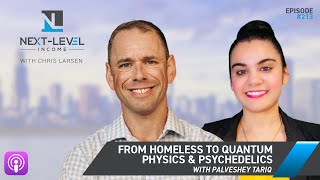
This YouTube interview (2024) features Chris Larsen conversing with Palveshey "PV" Tariq about her remarkable arc from adoption and homelessness to elite academics (University of Florida triple major; Harvard dual master’s; doctorate in quantum physics), entrepreneurship (crypto hedge fund, blockchain/metaverse initiatives), and later struggles with addiction and a near-fatal health crisis. PV describes a turning point catalyzed by psychedelic experiences and a sustained meditation practice that led her to build a psychedelic integration coaching practice focused on high achievers (typical engagement: 12-week minimum; core work: mindset assessment, inner-critic reframing, psilocybin ceremonies, and post-ceremony integration). The conversation also covers spirituality, values, responsibility vs. system-level change, practical exercises (gratitude/peanut meditation), and the evolving legal and clinical landscape for psychedelics (decriminalization in places, ketamine/MDMA clinical acceptance).
I think this is why prayer is said before meals, because you're recognizing and acknowledging that life sacrificed itself to give you life. How willing are you in your life to sacrifice what you feel or think for the greater good?
Welcome to the Next Level Income show, where it's our goal to take your income, your investments and your life to the next level. I'm your host, Chris Larson. If you haven't yet, get a copy of our book for free free at our website, NextLevelIncome.com that's www.nextlevelincome.com. just click on the book link and I'll even send you a copy if you put your address in. On today's show, we have Pavel Shea, Tariq, or PV as she is known. PV is a psychedelic integration coach who helps the greatest leaders from all walks of life transcend trauma and transform into high performers. Previously, Pavel Shea served as an AI researcher at the Massachusetts Institute of Technology. Prior to this, she served as a lecturer at the University of Florida's World bank program, as in an adjunct lecturer at Harvard University. Her on digitizing solar panels or micro grids in developing countries received her a Nobel Prize nomination in physics, Peavey has an exemplary academic background ranging from graduate studies in financial technology from Harvard to postgraduate studies in quantum physics. She has taught subjects from blockchain technology to block universe theory. After an extraordinary journey of her own, Peavey has now geared her mission towards helping to spread consciousness and self awareness. While she's received many accolades, ultimately the biggest challenge she faced in her adult life was realizing that her race to receive titles and wealth left her depressed, addicted to drugs, and unable to face severe trauma from her past as a homeless youth. Now, Pavlocha is on a mission to help others do what she has done. Take ownership of their life by transmuting their current pain, suffering and limiting beliefs into freedom. She believes that the most advanced technology in the world is the human body, and if it can truly be harnessed, a person can do anything that they set their sights on. Join us to discuss this with pv, her amazing journey and what she's doing today. Pv, welcome to the show.
Thank you for having me.
Yeah, we've had to reschedule this a couple times, but I'm super excited to have you on. We spent a lot of time talking about financial matters, real estate, different investments on the show, but one of our favorite topics is also how to maximize performance, whether that's physical performance or mental performance. And we're really going to dive into that today and talk about some of the things that you and your company do on that end of the spectrum. But I would love for you to share a little bit about your business background and your education before we dive into that.
Sure. Okay, So I will start with my academic background, since it came first. So I went to the University of Florida and I did a triple major in mathematics, political science, and linguistics. Then I went on to Harvard and did a dual master's in finance and software engineering. After that, I created a crypto hedge fund for all intents and purposes, and that went pretty well. I ended up selling the algorithm for that company and then also created a blockchain think tank, which I've recently repurposed into a metaverse think tank in hopes of raising the next generation a little more consciously. Once I was done with that, I went and pursued a doctorate in quantum physics, which led me into work around blockchain technology and AI research. And of course, that wasn't enough, so I somehow found my way into the realm of psychedelics and mental health. So here we are.
Well, that was if, if you can pack more into a little 30 second elevator pitch. You know, with, with respect to background, I don't think anybody on the show has done it yet. That was, yeah, your, your background, it's, it's interesting. It's awesome. And you and I met about a little over two years ago at a retreat in Costa Rica, and we're, we're hiking up to this waterfall and I just remember you sharing a little bit about, you know, what you're doing. And I, I just remember looking at you and thinking, like, who is this person? Like, you know, this is very wild. And, you know, I think, I think background is important, pv, but I think our experiences in life, you know, really shape us. And, and you know, I, I, I tell my story a lot of times on different podcasts about losing my father and my, my best friend at a young age. Um, and Malcolm Gladwell, you know, he, he has something he likes to call desirable difficulties in life. And, you know, I think those, those early challenges that we face in life really, really help shape, shape us and make us. Um, and I know your early life wasn't, wasn't super easy. I don't know if you don't you mind sharing a little bit about that with the audience as well?
Yeah, absolutely. So I was born in New York, and When I was 8 months old, my family decided to put me up for adoption. I was adopted by a family in Pakistan, and I spent the first six years of life there. And when I was six years old. My biological parents found me and brought me back to America. And that transition was not easy. It was a new culture, a language, new people, new land, new family, all together. And it was very, very difficult to become adjusted to that. I was. The values that I was raised with in Pakistan were very different from the values that my biological family believed in. And so as time went on, I just couldn't get used to them. So when I was 17 years old, I ran away from home, and I spent most of my senior year of high school sleeping on park benches. And it's during that time that I worked incredibly hard in order to get a scholarship. And it was then that I received a scholarship to the University of Florida. But fear had been driving me. And fear was a great motivator because I triple majored. I was a straight A student. There was no safety net. So here I was like, it's this or nothing. But that fear ended up becoming my default mode, where I was constantly in survival mode. And that while it allowed me to do what would be considered. Considered incredible things by typical societal standards, fear ultimately stops serving me at a certain point when, after my doctor, I really started to question, wait, what am I doing in life and why even doing it if it's not bringing me joy?
Yeah. And I think that's, you know, I think so many of us go through life, and first off, you know, your story, it's. It's like the. The American dream in a lot of ways, but it's also kind of backwards because not a lot of people are born in America and then are adopted in Pakistan. You usually hear, you know, people in America adopting. Adopting children and doing that. Maybe I'm. Maybe I have that wrong. But coming back full circle, you know, and being reunited with your family and then. Then leaving again, this is like, you know, I hope. I hope you write a book one day about this, because it's. And I say that. I say that with sincerity, because I know you and I have discussed this in the past. You know, oftentimes when. When you're able to go through challenges in life, I think a lot of us look back and they. Those are. Those are moments that really define us where we look back and say, oh, wow, like that moment. I was very fortunate to have that moment in my life to. To, you know, to craft me, to shape me, to harden me, to kind of polish me and put me into the position I am now. And that could be a physical moment, you know, where you. You push through, like in a bike Race. Like, if I, you know, you're like, oh, wow, I can. I can keep going, or life and that sort of thing, I guess. How. How did those moments kind of. I know you mentioned you were. You were being driven by fear, but how did. How did your early life really drive your early success in business?
I think early on yet, because that fear was the main motivator. I kept going and going and going. And, you know, Harvard, for me was this castle on top of the hill that I needed to go towards. That was the only goal. In fact, someone recently asked me, like, hey, have you ever experienced discrimination in your life? And my. As a woman of color, my answer to that was, I'm sure, because I was so focused on my goals that nothing, nothing else penetrated that. Even if I did experience that, it was almost as if blind to it because I was just working on that one goal going towards Harvard. And yet, at the same time, it was that same fear that started to break me down in a way that. When that was the main motivator, at a certain point, once I had ached all my goals, I really started to ask, like, well, what is. What's the purpose of life if I've already achieved these goals?
Yeah. And I think, you know, it's the. The. The skill sets that we have, depending on how they drive us, you know, can push us towards success. You know, a lot of those, you know, a lot of people like, you know, that are narcissists can be very successful. You know, they're not. They're not driven by healthy means, but they're. They can be very successful because, you know, they want to. They want to show that sheen of success. But ultimately, those things don't always serve us in life and do that. And, you know, I think it's interesting, in America, we have this thing that we call, you know, midlife crisis. And I thought a lot about this. And there's a happiness curve, which is. I think it's written by a gentleman that was a professor at Harvard. His last name's Anchor, if I recall. But it's interesting. Happiness, it kind of peaks in college, kind of early 20s, and then it slowly descends down into your 50s, which happens to coincide with having children and doing things. And then that starts to turn around, and as you get older, you get happier. And my wife and I talked about this, and, you know, my wife Jessica, you know, a few years back, and it's like when you realize that, hey, you know, there's this. This curve that we follow through life. It. It helps you Identify and say, hey, there's going to be challenges. Not like it's the end of the road, but I really want to know what. What drives that curve? And. And I think part of the reason that we have that in America in these midlife crises is we don't stop and reflect. You know, we just push forward. We're driven by material goods. Um, and as. As you mentioned, you know, having that success doesn't necessarily, you know, lead to happiness. Can you kind of define that moment, pv, where you said, wait a minute. This is not. This is not really what I want to be. You know, continuing in this direction. This is not the direction I want to continue in. There's. There's more to life. There's more that I'm meant to do.
I think that moment for me, definitely came where, by the end of my doctor, I was drinking quite a bit of alcohol. I was taking prescription medication, Adderall in this case, which ended up becoming such a severe addiction that my left kidney failed, and I was in the hospital. My system became septic, and I was. You know, I was close to what you would call death. And yet, at the same time, even after coming out of the hospital, I went back to doing the same. Same exact things. And it wasn't until a year later where I really started to ask myself, you know, I'm still unhappy. Everyone around me was like, good job, pb. You're doing amazing stuff. And yet, at the same time, inside, I was basically having an existential crisis. So the way I like to describe this is kind of like a. We all have a plate. Some of us have paper plates. Some of us have porcelain plates. But that all depends on what we've been through in life. So, for example, I had a plate, and a lot of shit was piled onto it, and that plate was almost like paper. It started to collapse. This might be what most people would call a life crisis. Their plate begins to collapse a little because there's too much on it. In fact, we even use this term like, no, I can't take more on because my plate's too full.
Yeah.
But at some point in life, I began to sit in silence, and that silence began to really force me to reflect on, why does my plate feel so heavy? And my plate felt heavy not because of all the things I was doing, but it was because of all the things I was avoiding. So all those experiences from early childhood, trauma, addiction, homelessness, those are things that I just did not want to pay attention to because I was brought up believing that feelings and Emotions, those things, we don't talk about those things ever. But when I began to resolve that, let's take things off my plate one by one, and even the bigger things that were on my plate, you know, I had to take them off bite by bite. Eventually. What up happening is this, this idea in psychology called post traumatic growth, that you come out on the other side of trauma being having awakened to what was really going on inside. And that made my paper plate almost titanium. And that shows up in my work today where I'm able to do quite a bit of work in a very short window of time and even have experiences where my clients, for example, in the midst of a psychedelic experience, if they begin to swing at me, that doesn't necessarily phase me or push me into survival mode because physical dis is something I've already experienced. And so it's, it's not something traumatic for me. I think another reason why we tend, our plates tend to collapse is because there's a lack of meaning or values in particular in our life. So in human history we used to have what would be considered good Christian values. We as a whole of humanity believed in something greater than us. Somewhere along the 70s or 80s that began to shift, especially in the Western world, and we became more and more independent and individualized. And what I'm finding today is a lot of people don't necessarily have those values. So as you, and you and I have done this activity as well, where the first thing we start with is what are your core values? Because those are going to be your guiding post.
Yeah, absolutely. Yeah. We do that with our coaching clients with their three year vision. You know, mine ends with, you know, what is your life's mission? What are your values, you know, that you want to share? We've even done this experience with our, with our boys who are now 12 and 14. And that's, that's a core part of our estate planning process, which I think is really important. I want to, I want to get back. You know, you mentioned something and I wrote this down here, you mentioned post traumatic growth. And I also kind of linked it back when you mentioned your, your kind of lack of, of let's say, awareness if there was discrimination. And you know, I think this is, this is one of the things that I think you as a, as a middle aged white male, you know, a lot of times people are like, oh, you're lucky, you're fortunate. And look, I think I am fortunate in a lot of ways. But you know, as we mentioned earlier, a lot of times it's those early challenges, those traumas that you mentioned that turn our paper plate, you know, into titanium, that hardens us and allows us, you know, to move forward. I talk about how, you know, my emotional childhood with my parents allowed me to be in. In the medical device space and be in the OR and have, you know, chaos all around me, patients crashing, surgeons yelling, things being thrown, just. Just really bad challenges. And my wife says my superpower, as I get calmer, the. The crazier things get, because to me, it's like, well, this isn't that big of a deal. So I think, you know, you're. I wanted to link that back because we can choose to use these things as an excuse and say, hey, we. This is. This is why I'm not successful and. And just say, hey, you know, I had a. I had a bad childhood. I lost my father. I was homeless. I was. You know, I was. I was adopted. You know, this is. This is just. This is just who it is. I'm a woman of color. You know, it's like, of course I'm going to be discriminated against. Or we can say, as I did with. With the doping that was prevalent in cycling in the 90s. I just said, well, this is how it is, and I can't really change that necessarily. So I'm just going to continue to move forward and make. Make an impact. Um, how do you work with your clients today and help them kind of identify those traumatic experiences and help them, you know, either leverage or transform those, you know, from weaknesses or excuses into strengths.
You know, you said something there where you said, you know, I can't really change that. That being perhaps the system. And it may seem that way, but I think the best way to change a system is to start with yourself, because you are part. We are all part of a system. And so often we're like, no, this is me. I'm great. But the system needs to change, because that's what's wrong. And yet, at the same time, no, we're part of the system. We can't separate ourselves from that. Now, when it comes to how to help clients move past that, say they have some experiences, I think so often when we, perhaps we as human beings have experiences, we apply perceptions to those experiences. Those perceptions then create our belief systems and our thoughts and our emotions that then show up in our actions, creating our results unconsciously until we go back to the original perception and change it. That everything else staggers, because experiences are just experiences. Yeah, they. We add this layer of perception or meaning to them. But I genuinely believe that life is a process of friction that's constantly pushing us to be the gems that we already are. And it does that by presenting us with situations in life to show us where we're not free. So moments or areas in our life where we triggered or agitated, those are signals that, where we're not free. And I think that's where we need to lean into. Whereas I do find that especially in our culture today, there is a lot of. Around, no, you hurt my feelings or you triggered me, and that's why the system or you need to change, not me. I don't need to address anything issue in me. Like, that's not a signal at all. Whereas I think the best way to get to the root is actually lean into the discomfort.
I love that you, you push back on that, because as soon as it came out of my mouth, I said, I don't, I don't know if that's actually, that's actually true. So I'm really glad that you, you mentioned that. And, you know, we, we've seen this. It's like, you know, start with, you know, start with yourself, like Michael Jackson said, which maybe people don't love Michael Jackson, what they used to, but the man in the mirror, right? And that's, you know, that's. I think that's one of the things that I always used to try to push with my, my reps that I trained was, you know, I'd hear, I'd hear this thing, you know, I noticed that successful reps would always say, hey, what, you know, sales representatives, what. What could I have done to affect this? You know, even if it's like, hey, I didn't do anything wrong, you know, the successful ones would say, you know, what. What could I do to. To affect this situation, you know, going forward? And then the ones that weren't successful would basically stick their head in the sand. They say, why did I do anything wrong? And it's like, well, okay, well, if you, if you feel like there's nothing that you can change personally, then you're, you're basically acknowledging that you have no control at all over the situation. And that's a very, that, that's a very frustrating, you know, situation. And it also, it really freezes you, right, because you say, well, hey, you know, I'm not gonna, I'm not gonna do anything. I'm not gonna, I didn't do anything wrong. There's nothing I could have done differently. Well, then what are you going to do? How can you do that going forward? So it's defeatist, but it also, I think it could be very frustrating when it comes to that. So I love, I love that you, you kind of, you know, mentioned that with, with respect to the changing the system, we all can all can be a little part of the change in that.
Yeah, definitely. Even what you're saying, like when someone's like, oh, I, no, I don't have anything to do with that. Even the lack of reaction is a reaction in its. Not until we shift from reaction to response, which in that word is rooted in response. Yeah. That even that word is rooted in responsibility. That when we take responsibility for our part and maybe even others part because thinking that we don't have, we shouldn't take responsibility for other people's actions is inherently flawed. Because the core belief is there is, you are separate from me, and that's just not the case. We're not separate. In fact, that I think the most stubborn illusion of the human experience is illusion of separation. And so when we start thinking you're different from my, from me and I'm not any responsibility for what you did, that's when I think we start entering into a stalemate and the systems don't change. But as soon as we begin to respond and take responsibility for not just our actions, but perhaps in ways that we could help others improve theirs, that's when things actually begin to change.
I love that we gotta, we gotta put that in the highlights. Reaction to response. That's a, that's a fantastic kind of point to highlight. And you know, you also said something, you know, else that is, I think is very profound. You know, you mentioned like in, you know, coming out of the 60s, 70s, 80s, we started to get away from, you know, these core values. And you know, there are Christian values. I was raised as a Christian. There's, there's, there's a lot of positive. I was just listening to a podcast the past couple days here on our drive back from Colorado with my son. We had about 22, 24 hours in the car. So lots of, lots of books and, and podcast time and conversations and, and one of the things that the, the gentleman brought up, and he's not a Christian, but he, and he's got a very different take on the Bible. But he said there's so many good lessons in the Bible. And you know, whether you call yourself a Christian or not, there's a lot of good values there. And I think, you know, one of the things I've noticed, I'd love to get your take on this PV is that, you know, when. When we remove religion, it still seems like there's a desire inside of us as human beings to have spirituality, to have religion. And it's almost as if some of these other, you know, cultural phenomena, if you will, have moved in to take the place of religion. You know, it's so, you know, instead of being, you know, a Christian, it's like, okay, now I'm going to, you know, you know, work towards, you know, trans rights or those sorts of things. And it's interesting because people make fun of, like, CrossFit and how it's a cult and these sorts of things, but it's people looking for a community, looking for purpose, looking for a meaning. And I think we have this desire for that. So I'd just be interested to get your take on what you think about kind of as we've lost some of those, not just values, but also that religious identification. Have you seen, you know, you know, humans in the United States kind of replace that with other things? What's your take on that?
I think now more than ever, we're seeing people identifying as spiritual but not religious just because the word religion even has some dogma attached to it. We're also seeing this resurgence of science religion in a way where science is almost God in many communities.
Science, right. Like we've heard.
Yeah, right. Science. Yeah. At the same time, I think we tend to believe that we are human beings. And every once in a while, maybe that's through meditation, maybe that's. Maybe that's through prayer, we have these spiritual experiences, and that brings us closer to God, one own universe, whatever you want to call it. And. But I genuinely believe that we're actually spiritual beings having a very human experience. And it's not that we've lost connection to spirit, it's just that we've lost sight of that connection. And so much of the work, even in high performance, I found the highest performers actually have a spiritual connection to some kind of purpose or something much greater than themselves at the core of everything that they do.
Yeah, I love that you said that. Um, and I was at a. Actually kind of a version of the retreat where. Where you and I met. And the. The guest speaker was David Meltzer. And David Meltzer, he's. He's kind of. He's like a real life Jerry Maguire. Super successful, you know, nine figure, you know, business person. And I was able. I was sitting across from him at dinner the night before he presented and just listening, you know, to him. And I was like, wow, this, this is an intensely spiritual man who has been tremendously successful. And he really, he really impacted me. One of the things that he said, and he said, happiness comes from being productive, accessible and grateful. And I thought that was, it was really interesting because it was at a time where I was not being as accessible as I had been in the past. And I felt like a slight, you know, a decreased amount of happiness. I thought, wow, that's, that's interesting. You know, as humans and especially Americans, you know, we, we've really put forward productivity. It's like, hey, you know, oh, pv, you're being, you're so successful. You're so productive. You're. You're amazing, right? But here you are in the hospital, like, facing death, but you're, you're quote, unquote successful. You know, that doesn't. That's, that's not happiness. Being accessible. I think, you know, those second two, though, accessibility, you know, that connection with other people and then being grateful, you know, being appreciative, whether it's to God or the universe or, you know, however you, you want to define that. Those last two pieces have a very spiritual component, you know, to them. And I've, I found myself going back, you know, I sought performance back when I was 18, 19. I started doing visualizations, which ultimately led me to meditation and yoga, you know, at that point in my life. And then I kind of drifted from it as I sought success and, you know, found some imbalances. And when I went back to a performance based doctor, a genetics based doctor, in 2016, we did our, all our initial evaluations, did. I think it was seven different tests, you know, mental tests, physical tests, blood tests, genetics tests, all these different things. And he said, all right, come on in. I got some recommendations for you. And I sat down, I was like, what's he going to prescribe me? What's he going to give me? Is he going to put me on this? He's going to put me on that. Because I wasn't taking any medications or any supplements at the time. And he goes through everything. He says, here's your brain, here's this. And he goes, all right, here's what I want you to do. I want you to meditate for 20 minutes every day. And I was like, what? I was like, meditate. And it was shocking. It was shocking to me. And you brought it up as well. Pv, you said, you know, being able to slow down allows you to achieve a lot more in a small period of time. How does that balance work? How does that work in your life and how have you seen it in your clients impact their performance as well? Are you a high income business owner or professional earning 2,300,000 or even more a year but still feel like you're living paycheck to paycheck? Are you comfortable working until you're 65 or 70 to retire, or do you want to achieve financial independence and live life on your own terms? You could join myself and Matt Foer and learn how we both became financially dependent in our early 30s. We will teach you how to make, keep and grow your money, teaching you strategies to maximize your earnings, keep your income that you've earned through tax strategy and legal structures, and ultimately teach you how to grow it by determining your personal investing strategy as well as teach you how to analyze investments so you can grow your passive income to the point to live life on your own terms. Our coaching clients reliably do this in seven years or less. To learn more, check out our coaching program at NextLevelIncome.com/coaching. That's NextLevelIncome.com/Coaching.
In the Bhagavad Gita, which directly translates to song of Life. It's a book. It's a spiritual scripture written in Sanskrit, some of the oldest scripture we found in the world. They say that your five are the your five unruly horses that are just running around in different directions. And the chariot is your body and your consciousness is the charioteer. But for most of us, the charioteer is asleep, so the horses are running the show. So in many ways we're constantly going, going, going, distracted by what we see, what we feel, what we face, what we hear. But it's not until we actually close our eyes in silence that you can hear what's going on inside, which can be pretty scary for a lot of people. I find that the biggest fear most people have is the fear of being seen, even with them seeing themselves. And yet at the same time, it's also our biggest desire. Most of us want to be seen. That's constantly why we're getting into relationship. But I think that's part of why so many of us have trouble finding that how can we possibly allow someone else to see us when we're too afraid to see ourselves? I hear a lot of people say things like, you know, I, I don't want to do psychedelics, don't know what I'll find. And what you'll find is likely yourself.
In that, yeah, that's interesting. And I, I've had this discussion with some people. And it, it is, it's scary, you know, when you think about, okay, what is, you know, what's the challenge if you're, if you're spending your life running from, you know, some of your past challenges or traumas that you've had. And especially if that's fueled you and, you know, you and I have talked about this, if that's helped fuel your success, it's like, well, maybe, maybe you don't want to steal that fire. You know, that's helping to fuel you. But just like my doctor said, he said, hey, Chris, you need to slow down, to go faster. You need to have that introspection, you know, to do that. I think it's, I found it to be very powerful. You know, sometimes I take kind of an informal route towards meditation. For me, a lot of these moments of clarity. Come on my bike. So, you know, if you're listening and you're like, well, I don't know if I can handle sitting there for 20 minutes in silence. Well, one, you could start with a minute or two or, or just start with a 20 minute walk where you put your, you know, you leave your phone at home, you know, you're able to walk in nature and, you know, allow, allow yourself to be free. I think, you know, I mean, I see it in, in children these days, you know, spending time with my boys and their friends. They're constantly inundated with social media, with music, with tv, entertainment, you know, their friends texting them, you know, doing different things. I mean, we're starting off at such a young age now, and it's just constant stimulation, you know, no time to sit, reflect and, and be silent. What, what advice do you give to people that, you know, have a challenge, you know, sitting there, you know, with just with their own thoughts?
That's a great question, and I think you already alluded to this. So I've. I now have a meditation practice that's two hours every morning. But that's not how it started off.
Incredible.
It started off one minute at a time. Literally. I remember some, I sat down, I was like, okay, I'm going to do 10 minutes. And I couldn't do it. It was hard because. And it was hard because I realized how hard I was being on myself in my mind. And that was too difficult to sit with. So I did start off one minute at a time. But meditation can take many forms. It doesn't have to be just in silent and reflecting. I think gratitude is an incredible way to begin your meditation practice. So One meditation that's been really helpful for me and my clients is taking a peanut, holding it in your hand, and just. Yes, a peanut. Yes, a peanut. And hold it in your hand, just look at it and realize that this is life. Really, this is life. It is. Took so many different aspects of life and earth to even grow that little peanut. And then it took so many different hands, from the farmers to the delivery truck, to the grocery stores, to the people who need petroleum for those trucks to even drive, for that peanut to be in your hand and just really realize that the whole universe is in this tiny little penis. And then I dare you to put in your mouth and chew on it. It's going to change your whole perspective of gratitude and life. And so in that way, I think gratitude can be incredibly powerful.
I'm going to go grab a table. That was, that was cool.
And this way, I think this is part of my prayer is said right.
Before me that I'm sorry, say that one more time. Why?
I think this is why prayer is said before meals, because you're recognizing and acknowledging that life sacrificed itself to give you life.
Yeah.
How willing are you in your life to sacrifice what you feel or think for the greater good? Not many of us are willing to do that.
No, that's a great point. And that's one of the things, you know, we started early with our kids, taking them to, you know, we're fortunate to live in an area here in Asheville, North Carolina, where we have, you know, a lot of farms and, you know, agriculture, you know, around us. And we started taking them to farms early and, you know, just sharing with our children, hey, this is, this is where meat, you know, meat comes from. You know, if you eat beef or chicken or, you know, fish, this is where it comes from. You know, we have a garden, you know, making them aware of what happens. I think again, kind of getting to that where we're getting into a derivative of what food used to be. You know, going to the grocery store, you know, it's like, oh, Whole Foods, you know, it's. It's like, it's like a museum of food. It's incredible, you know, it's just, it's just incredible, you know, when you walk in there. So I love that. So if, yeah, if you're struggling, grab a, grab a peanut or a piece of fruit or anything and just, just hold it and just think about, you know, what, what went into that. I. In conversations like this, I wish that, you know, I had like, Joe Rogan style podcast where we could sit and talk for two or three hours because I feel like we're just starting to get into the meat of some stuff. But, you know, at what point, pv, did you start to take an interest in psychedelics? Because I. I've listened to Tim Ferriss for years, and Tim's really, really interesting, really interesting human has talked a lot about, you know, kind of his. His thoughts and experience with psychedelics. And then, you know, Joe Rogan was probably my second, you know, favorite podcast for a long time, and then he started to talk about it. I was like, this is really. This is really interesting, you know, to kind of get this perspective and I'll share just a piece, you know. You know, you and I were reintroduced by a mutual friend after I lost, you know, one of my best friends, Caleb, that started this podcast with me. And I was looking at that point in my life to remove, like an emotional block that I was. I had. And it was really an impediment not to my everyday happiness. I mean, I was struggling to get out of bed at that point in my life. But also it was. It had a massive impact not on my personal happiness, but on my health, of my family and in my business at that point. And I was. I was open to anything, which is what led me to start to investigate, you know, psychedelics and other options that were out there to help me move through that. At what point did. Did you become interested in psychedelics? You know, what kind of inspired that?
So I was first introduced to psychedelic mushrooms in undergrad. So this was around 2010. Yeah, 2010. And that was just recreational use once or twice. And I remember it being lots of colors at the beach and stuff. I do remember my first experience ever completely changed my perspective of my mom. I remember before that point there was a lot of anger and resentment for, why did you give me away? Just to take me back and then treat me the way that you did. And it wasn't until my first psychedelic experience where I really began to cultivate space, a compassion for my mother and her life experiences, and even a sense of gratitude for everything she sacrificed in life to the life that I now have. So that was already life changing. But I only did that maybe a few times. It wasn't until I was. I quit all of the Adderall, alcohol and nicotine. I did that all at once, once. And I went through some severe withdrawals because I did ask my psychiatrist that to help me get off them. And he said, well, I've been trained to get you on them, but I Don't feel confident in helping you wean off. And so I was left to job on my own. And so I quit them all at once. And I remember going through some severe withdrawals like shaking, sweating. And I reached for mushrooms as an escape because of, of mine had recently given me some just as a gift. And I reached for them as an escape because I remember them being a good time. And this time around, that's just, it wasn't a good time. That's just not what happened. In fact, the mushrooms were like, you're going to pay attention to everything you've been avoiding for the past 20 years. And so that five hours I just sat on the couch crying. And something within me started saying, all right, now that you've gotten all of that out, what are you going to do? Sit here and cry about everything you can't change? Or are you going to get up and do something about it? And that was the point at which I started meditating because I noticed part of why I was crying was I sitting in silence, no tv, no music, eyes closed, alone. And I had never done that before. And most of the people that end up doing with me during that psychedelic experience in the same thing, like, I don't think I've ever taken the time to just sit in silence. And it ended up being 20 years of therapy in five hours.
Wow.
And that completely changed the trajectory of my life because I started meditating and then based off of neural rewiring, I created a coaching program and that's how it started to expand. Just word of mouth. Wow.
And how do you work with clients today? Because you still have, you have, you know, a couple different businesses, but specifically with your, with your coaching, how does that work and who do you typically work with?
So I typically work with high achievers because I, I mean, it's really easy to relate to and I definitely understand that mindset because most achievers, something happened in childhood that's driving them and yet at the same time they've hit a wall because it's no longer serving them. So I do typically work with CEOs or entrepreneurs of large companies and we usually start off with a minimum of a 12 week commitment. Change takes time. And we'll start off with a mindset assessment if the individual is interested in it. Because I know, for example, you and I bypass that. You're like, not for me, I did.
Well, to be fair, I've been through a couple different mindset assessments, but yeah, I don't want to detract from, from that.
Then as you know, we go into the inner critic. That's the guy that's constantly judging us or trying to make sense of the world through the lenses that we've accumulated. Then we do the psilocybin ceremony. And that afterwards is actually where the real work begins because that's when we're rewiring, limiting beliefs.
Yeah, I know. I mean, there's, there's documentaries on Netflix now. Michael Pollan has a great book called how to change your mind, which I highly recommend. And I think, I think actually the documentary on Netflix is called the same thing. Paul Stamets is, is featured in one called what's. Do you remember what it's called? Like incredible mushrooms or something fun.
It's about fantastic fungi.
Fantastic fungi, yeah. Way, way better. Little, little alliteration there. I actually just bought Paul Stamet's mushroom blend at Whole Foods. He's got a wellness out now as well that I just saw. I think, you know, probably people that are listening may say, well, wait a minute, are psychedelic mushrooms legal? How do you know? What's the landscape in America and different states pv, when it comes to those.
Sorts of things, it really depends. Ketamine and mdma, the most legally recognized. There are even some insurance companies that cover treatment for ketamine and mdma. Now, psychedelic mushrooms, for example, they're decriminalized in many areas. Oregon has completely legalized it and Colorado is decriminalized as a whole. But in other areas of the country, it's mostly city by city. There are other countries, for example, Jamaica, where psychedelics are completely illegal. But I think this is a battle that we've been fighting for almost 50 years at this point, that what do we really consider drugs and really consider medicine because drugs are lab created, they usually only cover the symptoms and they don't necessarily get to the root cause, whereas medicines get to the root cause and you don't need to be dependent on that. And yet at the same time, things like mushrooms that get to the root cause are considered drugs and things like psychiatric medication that may not necessarily get to the root cause are considered medicines.
Yeah, it's really interesting. And I mean, there's even, there's even, you know, reading different studies now like through Johns Hopkins, and even with CTs with traumatic brain injuries and the ability for, for certain types of mushrooms to help, you know, reestablish those neural pathways, we really see that the power that, you know, these plants or these fungi can have, you know, versus, you know, some of the medications that are out there and doing that. So I think it's an exciting time in the field. If people want to get in touch with you, learn more about your coaching program and how you work with them, with people, how do, how can they get in touch with you?
PV so I'm the only pelvis sh on the Internet, so pal vashe.com Pal Vashet on Instagram hello vishay.com it shouldn't be hard to find.
Now one thing, the Pavel show. Sorry, yeah, your podcast.
Yeah, which is my podcast, which you can find on Spotify. Now one thing you just mentioned around CT scans like we see that psychedelics are helping neuroplasticity, but in my own research I've also found that they actually help the cardiovascular system as well, where individuals who do have the psychedelic experience for up to an average of 3 weeks afterwards, heart rate is consistently and HRV is consistently higher.
Wow, that's amazing. We've talked a lot about HRV with Dr. Doug Lucas, who I work with. Also Justin Rolfin, the chauffeur who you know quite well, who did his thesis, his master's thesis actually. Was it a PhD that he did on HRV? I'm trying to remember if it was master's or PhD, but you can check out those podcasts as well if you're curious about that. And if you're curious about learning more about what PV or Pavolche does, you can check her out@pavloche.com I will have all of her links in the show Notes. PB thank you so much for joining us and sharing your story with us today. Hey Chris here again. I hope you found this episode valuable. Now I have one more thing to give to you. We have a page for my coaching clients where you can get a free copy of my book as well as much more from previous guests on the show. Just check out nextlevelincome.com coaching to get a free copy of my book, audiobook and much more. I'll send you a copy of my book and cover all the shipping costs as a thank you for listening to the podcast. Also, please like share and take just 90 seconds to give us a rating on Apple Podcasts.










