Helping Neighbors Monetize Their Unused Space with Joseph Woodbury
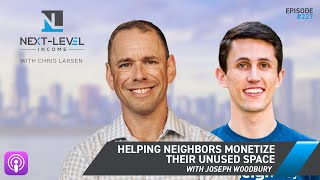
A long-form interview (Next Level Income) with Joseph Woodbury, co-founder and CEO of Neighbor, a peer-to-peer marketplace that lets homeowners and commercial owners monetize unused space for storage and parking. The guest describes Neighbor's origin, how the platform works (listing in ~10 minutes, ML pricing plus human review), use cases (residential, vehicle storage, REIT portfolios), monetization examples for investors, security and insurance features, funding and growth (national expansion and commercial push), and plans to become a one-stop marketplace for all space needs.
Questions this video answers
2017
Yes — the company has listings in all 50 U.S. states ("every city in all 50 states").
Over $65 million (raised from investors including Andreessen Horowitz, Airbnb, Uber, StockX and DoorDash).
Up to $50,000 in item protection while items are stored.
Hosts receive a $1,000,000 liability guarantee as part of using the platform.
You could buy somewhere between a 1 to 2 acre lot in Utah with that amount of capital and you could yield $100,000 a year on neighbor. And so you see these individuals where they start using it and then they're like, wait a second, I should just be deploying capital over here into neighbor specific properties.
Welcome to the Next level income show where it's our goal to take your income, your investments and your life to the next level. I'm your host Chris Larsen. If you haven't yet, get a copy of our book for free free at our website, nextlevelincome.com. that's www.nextlevelincome.com. just click on the book link and I'll even send you a copy if.
You put your address in. On today's show, we have Joseph Woodbury. Joseph is the co founder and CEO of Naver. With his expertise in real estate, his platform helps property owners achieve full property monetization, earning more money from underutilized spaces. Under his leadership, neighbors expanded to all 50 states, offering more storage and parking options than any other company in the industry. Joseph is successfully disrupting the $500 billion self storage industry, having raised over $65 million from top investors including Andreessen Horowitz, Airbnb, uber StockX and DoorDash. And today we're going to dive in to how Joseph has done this. Joseph, welcome to the show.
Hey, thanks for having me.
Yeah, absolutely. For those that are watching, you may be looking and saying, Chris, you look like you're, you have a new studio and this, this is not a new studio. This is a friend's studio. As I was sharing with Joseph here beforehand, A lot of people know I live in Asheville and we were just a mile from downtown when the storm hit. Fortunately, my wife and I were out of town in laws made it safely through the storm and we relocated temporary to Charlotte. So I'm recording here from a friend's studio in Charlotte and I just want to take a quick moment. We started a non profit to aid directly those people impacted by Helene in western Carolina, eastern Tennessee. It's called the Western Carolina Emergency Network. You can find us online@westerncarolinaemergencynetwork.org I'll put that in the show notes but it's westerncarolinaemergencynetwork.org and these funds, there's no overhead at this point. These funds go directly to to those that are helping those in the community that have been impacted. We've been fueling our frontline workers, our Special forces, charitable trust members that are out there running recon and search and rescue missions. We're supplying both potable and non potable water to the communities. For us in the real estate business, Joseph, you know, it's kind of wild. You forget. It's like, you know, you're home for a week, you got bottled water, but you can't flush your toilet. So a lot of these things, things that pop up. But I'll tell you that everybody on our team is safe. So far, our properties have made it through relatively unscathed. So we count ourselves lucky. But if you have a moment, if you have the resources, check out western carolinaemergencynetwork.org to learn more about us. And you can donate there as well. But on to some fun stuff. Joseph, let's talk about how you are changing the landscape of real estate in a lot of ways. And I'd really love for you to share a little bit about your background and how you started your business. Neighbor.
Yeah, so neighbor, you know, as simplest form, we're a peer to peer storage marketplace. So we let people monetize property they have for parking or vehicle storage or self storage. We got started just by having the need. Very similar origin story to other companies like Airbnb, if you've heard those before. My co founder, he needed a storage unit because he was going to be leaving the country for four months or so and looked into getting one. He couldn't find one with any availability. They were all super expensive. And so he found a friend that let him store in his garage. Similar to what I imagine is happening all over the country already. I can't imagine individuals trying to get away from events like you're seeing down there in the south Southeast right now. You just got to find a friend, you got to find a solution. And that's how he was. He was like five days away from leaving. And then fast forward four months later, he went to pick his items up and he just thought this was such a better experience. I felt so much more peace of mind knowing my items were in a nice clean garage and I saved a ton of money. Why doesn't everyone do this? There's got to be empty space in every neighborhood in the country. Why isn't there a way to look it up?
Yeah, no, I love it. And like I had, I had this first idea and actually I forget what company came, actually brought it to fruition. But you know, like reselling your old college textbooks, it's like you pay 200 for this college textbook. What a racket you know, and then obviously Airbnb, you know, everybody listening. If you're not familiar with Airbnb, then stop what you're doing and go look that story up. But my wife and I have a couple of those. You know, I think as the country becomes more dense, you know, we have. We have a housing crisis, and the influx of. Of new immigrants is certainly going to continue to propel that into the future, in my opinion. You know, as you just mentioned, the event that we were just talking about, you know, if you have people displaced, especially in the Southeast, we're going to have a need for that. And a lot of people, you know, like, we have a sprinter van, as I was, as we were talking about before, they're going to bring. Take. Take skiing this, this winter. Well, if we're not using it, why not rent it out, make a little bit more revenue and help make it financially feasible? So I think it solves two problems, Joseph. It solves the need, but it also gives you, if you have the capacity with, whether it's your building or whatever it may be, that you have to earn some additional income. Right?
Yeah, exactly. It's monetizing passive space and so many actions. Even marketplaces take work you look at, like Uber or Doordash or Instacart, you have to drive around to make any money. But there are some categories like Airbnb, like Neighbor, even like Turo, if you've heard of that, where you can rent your car.
I've done that, too. Both.
You just don't do any.
Yeah, yeah.
So we love those passive opportunities.
Yeah, no, it's fantastic. And it's doing something. You can either walk into it. I know people that have started Turo businesses where they've bought a car with the intent to put it on Turo as a business. I know people like myself, we were gone for a month on a road trip this summer, and my friend has a Turo business and he manages it as well. So I gave him my car for a month, and he ended up running out. Actually ended up being about two months, so. So we made a couple, two, $3,000 during that period of time. And then my friend, he is jumping in the middle, and Detroit platform has allowed him to start a business and actually employ somebody that manages that. And those of you that are listening, with the family, one of the challenges is you go to the airport, you're like, hey, I want to get this SUV or this minivan. Sorry, sorry, Mr. Woodberry, we're out of those. And you're like, out of those, like, how am I going to transport my family of five? You know, so Turo kind of eliminates those. It's a pretty cool solution. So how does neighbor fit into all that? You mentioned storage. Let's talk about kind of how it works in process.
Yeah. So you take about 10 minutes, give us all the features of your home. We help list your space, and once that's listed, we bring you a renter. And that renter, if you listed your RV pad or your garage, we could be storing a car or a camper trailer or a boat on the side of your home. If you listed a shed or an interior space, we could be storing boxes in that space, items, furniture that someone needs to store. And we're nationwide now, so we have. We have people renting out space in every city in the country at this point.
Wow, that's impressive. And when did you start?
Officially, it's 2017. So it's been about seven years now.
Okay. Yeah. So I love the concept, and, you know, as an engineer, my brain starts to think, okay, so you have this concept. You're effectively a digital matchmaker at this point, right, Joseph? And so what were. What were some of the initial challenges you had in getting this platform up and running?
Well, you know, you hit it on the head whenever you're starting a marketplace. You don't have enough renters to make it worthwhile for people to list their property, and you don't have enough property to make it worthwhile for renters to find what they're looking for. And so you have to convince people to use the product and service until there's a critical mass on the supply side and critical mass on the demand side. The beauty of that is once it gets going, then it really is this virtuous cycle where the more supply you get, the better experience it is for the renter, because they're finding cheaper, closer, better quality, and then the more demand there is, the better experience it is for the supply, because they list their space, they get reserved like that. They're always reserved. They're making lots of money. And so it's been awesome to see it grow from Salt Lake City, from where we're headquartered to we have, you know, our largest markets are Florida, New York, California.
Oh, yeah, that makes perfect sense. Yeah.
Yeah.
Awesome. So I'm. I'm thinking now again, starting to think about this. So I. I give you the dimensions of my space, my garage, my. My driveway. I should have gone on the neighbor platform and tried to try to try to do this, but it's challenge. It was challenging because I haven't been at home for a little while. I should rent my. Let's see if I can do with the Airbnb. We've got run. I'll rent out the garage ware with the Airbnb. Right. So a couple questions. One, do you use AI? How do you analyze the space and do that? Because we're not talking about like the self storage facilities we own. Oh, it's a 10 by 10, right? 10 by 20. You know, we know that, we know the dimensions. It's very easy. I don't, you know, I don't need to take pictures of anything. I don't need to go measure it because that's how they're manufactured. I don't even need to walk the spaces as long as I know they're clean. How do you solve for that piece of the problem?
Yeah, so we use, I call it two types of intelligence. When we're looking at pricing, we have all this great pricing data all over the country. And yeah, we're using machine learning AI type models where we're looking at all the spaces that get listed and how fast do they get rented when they're listed and what's the right price in downtown Baltimore versus in rural West Virginia. But as far as reviewing the actual spaces, every single space that's listed on our platform is reviewed by a human before it's pushed live. So we'll call that ri, Real intelligence.
There you go. Yeah, and maybe, I don't know, at some point we're gonna have to develop new sayings, you know, enhanced artificial, you know, what's it going to be? Yeah, no, that's great because you can kind of a human can come in and override it. And that is, you know, it is interesting. I was having this discussion with a mastermind group that my wife and I are a part of a couple of weeks ago. And you know, it really is amazing what the human brain can do when it comes to, you know. Yeah, I can do things very well. But like at the airport if you got, you know, a bottle of baby shampoo, that's what, 4 ounces instead of 3 ounces or whatever the difference is. Do you let it through? You know, AI, machine robot's going to say no, can't do that. But, but human can discern and decide on those things and figure out what makes the most sense. Now you said storage and my mind just went to storage space like you said, storing furniture, boxes, that sort of stuff. But you also said cars, RVs, parking pad. Okay, so when you say storage, Joseph, kind of define that because I've heard a few different things here.
Yeah, we're in the business of storing anything. So if you need to store a vehicle, we've got space for you. You need to store items, we've got space for you. In fact, vehicle storage I'd say is one of the most popular products on our platform. And it ranges the gamut from people that are renting out space at their residential property all the way up to we have small businesses like gyms, nail salons that rent out parking around and it helps pay their lease. And then we have multi billion dollar REITs that own properties in 100 cities, retail REITs, office REITs, multifamily REITs that will rent out space across their portfolio and earn seven figures in ancillary income on an annual basis through the platform.
Yeah, I like that. So you can, yeah, you have the ability to, to incorporate both commercial as well as residential properties on that. It's funny you mentioned cars. I'm in this studio and my friend's office is part of this facility and they've got a, they've got car storage like classic and sports car storage in the back. It's pretty, it's pretty wild. So, and I imagine that depending on what type of car it is that that's probably, it's probably quite a recession proof industry as well.
Are you a high income business owner or professional earning 2, $300,000 or even.
More a year but still feel like.
You'Re living paycheck to paycheck? Are you comfortable working until you're 65 or 70 to retire or do you want to achieve financial independence and live life on your own terms? You could join myself and Matt Foer and learn how we both became financially dependent in our early 30s.
We will teach you how to make.
Keep and grow your money. Teaching you strategies to maximize your earnings, keep your income that you've earned through tax strategy and legal structures and ultimately teach you how to grow it by determining your personal investing strategy as well as teach you how to analyze investments so you can grow your passive income to the point to live life on your own terms. Our coaching clients reliably do this in seven years or less. To learn more, check out our coaching program at nextlevelincome.com forward/coaching. That's next. All income.com forward/coaching.
That's right. Yeah, we, we see a lot of classes of car storage happen on the platform. Proximity being a big value there. You'll have an individual that may live in a nice part of town, they, they have, they buy another car. They don't have room for it, but their neighbor three doors down has a six car garage. And being able to use neighbor.com to store their classic car with their neighbor three doors down is a huge value prop as opposed to having to go across town to some car garage. And so we love the proximity. That's why we're called neighbor.
Yeah, no, I like that a lot. So, you know, we've kind of talked about the solution. You know, I was talking about Airbnb and you know, my friend that, that has this air, this, I'm sorry, Turo, my friend has this Turo business. How can investors, and I'm thinking, you know, maybe investors that are looking to have their first passive investment. Yeah, how have, or how can an investor that's looking to get started utilize the NAVER platform to generate passive income for themselves? What are some, what are some tricks or best practices that you've seen specifically?
Yeah, there are a couple ways I've seen individuals look at it. I'll use in this example, maybe someone that owns two or three or maybe five rental properties. On a rental property, maybe you pay $2,000 on the mortgage on a monthly basis and you're able to rent that out for $2,300. So on a net basis, you're earning about $300 net cash flow each month. Well, that, that owner of that rental property, they'll discover neighbor and they'll list some of that excess space that the tenant is not using. Maybe it's a shed, maybe it's an RV pad. And now all of a sudden they're earning another two or $300 a month on that property. They've just doubled their net cash flow on that property.
Because it's pure. Yeah, it's pure profit on top of that. Right.
Is pure profit. And then they start to roll that out across, you know, 2, 3, 5, 10 rental properties. And it makes a big difference across that. The other thing I, I've seen is after discovering the power of that income, some small owners will actually invest in neighbor specific properties. And I'll give you some math on this.
Yeah.
If you're in Salt Lake City, Utah, which is where we're based out of, and you have $500,000 to spend, you could buy roughly a townhome here.
Right.
And you can maybe make 2,000 to $2,500 in monthly rent. Call it 25,000 to 30,000 a year. If you were to list that townhome on Airbnb or a short term rental platform, maybe you'd earn 30 to $40,000 a year. A little, little higher margin. But instead, if you were to take that 500,000 and go buy a vacant lot in Utah, you could buy somewhere between a 1 to 2 acre lot in Utah with that amount of capital and you could yield $100,000 a year on neighbor. And so you'll see these individuals where they start using it and then they're like, wait a second, I should just be deploying capital over here into neighbor specific properties.
Yeah. So for a lot like that, are they just doing parking for instance?
Just doing parking? Yeah. You throw up a cheap fence, 50 cents the square foot.
Yeah, that's a great idea. Yeah. I got a, I got a friend, he's, he owns a lot of, a lot of parking lots and mobile home parks, Parking lots, those sorts of things. Yeah, yeah, it's great. You're just renting out. Rent out land.
It's management too.
Yeah, no, it's fantastic. I'm curious, Joseph, what's your background? You know, you talked about how you kind of came up with this idea. What's your background, what's your team like that has helped you build this?
So we started this right out of school. So my background all comes from my undergraduate. I was kind of headed on the investment banking track. Worked for an investment bank and then a private equity firm and then ended up at a consulting firm called Bain & Co. And I had interned for them.
Stuffed the dollar bills all over your.
Yeah, like the Mitt Romney picture.
Exactly.
Yeah, that's right. And I was, I had interned with them, accepted a full time offer. And then my senior year of school we started Neighbor. And so I never ended up showing up full time for that role. And then along the way, as we've raised rounds of capital, we've raised 60 or 70 million dollars in venture capital for the company. We've hired amazing people to our team. So the guy that runs marketing for us, he helped transition Netflix from DVDs to streaming and stood up their first marketing program for that. And then he built another billion dollar marketplace from the ground up. And the guy that runs our engineering has built several billion dollar tech companies before, is excellent software engineer, leads a great team of software engineers. So we've been able to add, we were the visionaries with the idea, but we've been able to add those subject matter experts that really crush it at their specific field of expertise.
Now. That's fantastic, man. I love the Story too know, coming out with that vision of going and getting that, you know, that high paying kush ish white drop. But I mean, you know, investment bankers, you work your butt off at first really to really get going. I don't, I don't think a lot of people really appreciate how, how challenging it is when you get started. But yeah, that's why I always, you know, I tell my boys they're 14, 12, soon to be 15 and 13. If you really want to make money, you really want to have freedom, you really want to contribute, like owning or starting your own business is really, really the way to go. So I absolutely love that. Tell us a little bit about the future of neighbor, what your plans are for growth and where you're going to go from here.
Yeah, well, current focus for us the first four or five years or so we focused exclusively on the residential side. So homeowners, we grew that to all, every city in all 50 states. And then around 2020 is when we really started leaning into this commercial side of the business. And that's, that's the fastest growing component right now. So we're investing a lot there. Every month we're adding new rates, billion dollar multifamily, office, retail, REITs. So that's going to be the, a large focus for us over the next couple of years. But ultimately we want to be the one stop shop for all types of space. So right now that doesn't exist a unified platform. We want it, we want you to be able to store as small as a box of clothing and as big as business inventory in a large warehouse. We want to be the place where you can come to neighbor and you can find any type of space for any reason and deploy that on the platform.
That's fantastic because now that's a totally fragmented market or not non existent for some of the smaller needs that are out there. So no, I think that's, I think that's phenomenal and we'll certainly be talking after the show about how we can, we can plug this opportunity into some of the properties that we're out here managing. Joseph, excuse me. If people want to learn more about neighbor and it's, and share the website, share more if they want to learn about Naver and both if they want to get started as on either on the user side or the provider side.
Yeah, so we try to make it as easy as possible. It's just neighbor.com and you can go to that website, you can list your space in about 10 minutes. If you have a residential space if you do have a larger portfolio, Maybe you own 5, 10 properties plus or even 100 properties plus, you can go to neighbor.combusiness and we can help you list that there. You can see different resources for whether you're a retail or a multifamily owner or anything like that. We're also on the App Store, so you could just go to the App Store, the Google Play Store, search neighbor or RV storage or whatever you want to search and will usually pop up number one. So, yeah, pretty easy to find.
I love it. I love it. Now, we're going to be following your story. We're going to be talking to you after this podcast. And Joseph, thank you so much for sharing your story with the audience. Like I said, I love it. I love to hear people like you, entrepreneurs going out there solving a problem that in my opinion, the country really needs today, but also giving people the opportunity to make some more money. And one question I meant to ask and I forgot how. How do your users prove that it's actually their property they're trying to rent out?
Yeah, so we one, we do ID verification of every user, so you cannot create an account unless we've verified you are the person that, that you say you are. And then we ask for all the details of that property and especially if you're listing, you know, many spaces, we'll actually reach out and ask for a electrical bill or some sort of proof of residence.
Yeah, there we go. I like that. And no, no storing illegal substances either, I'm sure. Right?
Yeah. In fact, renters have to submit a full list of everything they'll be storing host goods.
Oh, wow. Oh, there you go. Yeah, I love it.
Very safe. We're also the only storage platform in the country that offers up to $50,000 in item protection.
Oh, wow.
While they're being stored. So it's just. And then our host, we offer them a one million dollar liability guarantee on the platform for their liability as part of using the platform. So it's just all around, marketplaces are just the way to go. This is what Airbnb did to the hospitality industry. This is what we're doing to the storage industry.
I love it. I love it. Well, like I said, we're rooting for you. Joseph, thank you so much for sharing your story and look forward to seeing you next time I'm out in Salt Lake City.
Awesome. Likewise.
Hey, Chris, here again. I hope you found this episode valuable. Now, I have one more thing to gift you. We have a page for my coaching clients where you can get a free copy of my book as well as much more from previous guests on the show. Just check out nextlevelincome.com coaching to get a free copy of my book, audiobook and much more. I'll send you a copy of my book and cover all the shipping costs as a thank you for listening to the podcast. Also, please like share and take just 90 seconds to give us a rating on Apple Podcasts.










