How to Achieve Financial Independence by 32 with Matt Fore
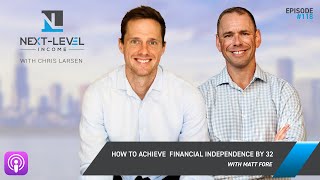
Podcast interview (host Chris Larsen) with guest Matt Ford, a Nashville-based sales leader turned part-time real estate investor who achieved financial independence by age 32 in roughly three years. The conversation covers Matt's trigger events (lost commission in 2017; family loss in 2018), discipline from endurance sports (Ironman triathlon), transition from single-family rentals to multifamily syndications, and his F.O.R.E. investment evaluation method (Financial liquidity; Ownership; Returns; Effort). The episode also discusses lifestyle trade-offs, risk management, routines, and practical tips for pursuing financial independence.
Being financially independent for me doesn't mean that I'm flying first class to Dubai. It means that I have my base needs satisfied, roof over my head, food over my table. And Kris, there's no time that I found that more impactful than in 2020.
Welcome to the Next Level Income show where it's our goal to take your income, your investments and your life to the next level. I'm your host, Chris Larsen. If you haven't yet, get a copy of our book for free at our website, nextlevelincome.com. that's www.nextlevelincome.com. just click on the book link and I'll even send you a copy if you put your address in. On today's show, we have Matt Foer. Matt is a part time real estate investor based out of Nashville, Tennessee. In his professional life, he has spent over a decade in sales and sales leadership positions at one of the largest technology companies in the world. But after finding real estate, Matt was able to achieve financial independence in only three years by the age of 32. Today, Matt has invested in over 750 multifamily units as well as various real estate debt. When he's not working, he enjoys read Ironman triathlons and convincing his brother that he is the favorite twin. Matt, welcome to the show.
Thanks for having me.
Absolutely. My friend. Man, we have known each other for, oh geez, it's been well over a year now and for those that don't know you, Matt's really become a close friend of mine. We've done a lot of stuff together. But I'd really love for you to share a little bit about your story, Matt, specifically as an investor for those in the audience who don't know you.
Yeah, absolutely. So Matt Ford, based out of Nashville, Tennessee, almost close to Asheville, North Carolina. But as a way of background, I've spent over a decade in sales and sales leaderships at some of the largest technology companies in the world as part of my W2 career. How we got connected was I got involved in real estate back in 2017 because my backstory is I was supposed to receive a life changing commission at one of my former employees. And as I was looking at different ways to invest this money, I heard everything from crypto to stocks, options, bonds. And then I finally had a mentor at the time that said, hey, you should check out this real estate stuff. Gives you cash flow, it gives you tax benefits. You get some appreciation. And then I got faithful call the week of Christmas from one of my former VPs who said, hey, you're not going to get that commission check. You're actually going to get 2 cents on the dollar. Remember asking him like, hey, how did we come up with that money? And he asked me at the time, haven't you made enough this year? And it was at that point where I realized if I wanted to give to the call I cared about, if I wanted to pursue the passions that I had in life, that I was going to have to find a different way to take my financial life into my own hands. So that started this journey down real estate and happy to take it from there.
Yeah. I'll tell you what. There's. There's. We both know a lot of people in sales, and I will tell you, I remember every single conversation I ever had, specifically the negative conversations that revolved around compensation. You just don't do that to salespeople.
Yep, yep. I mean, we got into sales cause we're money motivated. Right. I mean, I had a VP at one time that said, hey, if you're not happy with the money you're making you, you can give yourself a raise every year. And that really inspired me to kind of pursue sales and go down this rabbit hole. But yeah, that was a life changing event for me.
Yeah, it certainly is. It's like going to your favorite restaurant and you're like, I'm going to have this dish. And you place the order and you put it in and you're there and everybody's food comes out and they come out and tell you. They're like, oh, sorry. Not only do your. Is your meal not ready, but we're out of that. Is there something else you want? And you're like, wait, wait a minute. Like you just. You just. That's like the worst bait and switch ever. I'm so hungry and I've been waiting all night for this.
You're hitting a sore spot for me because I went to a restaurant here in Glen street the other day for my favorite dessert and they did exactly that.
There you go. Yeah, yeah. No good. No good. So. But it led to. I love how you turned it into a positive. And look, it's. We're so comfortable in this, in our society, in our world. I think it's really challenging for a lot of people to not only come up with. With, you know, a reason and a plan, but also have the discipline. Matt, now I mentioned in the intro, and this is something else you and I have in common. Addition to sales is. Is endurance sports. You, triathlon, me, cycling. Lots of overlap. There um, do you think that being a triathlon, I'm sorry, being a triathlete really gave you the discipline and the motivation to stick to this plan. What do you think?
Yeah. Percent so I started my triathlon, triathlon career back in 2014, and I'm big into Ironman triathlons, which are the long distance. Um, for those of you out there that haven't heard of an Ironman, it's a 2.4 mile swim, 112 mile bike, 26 point my run. Yes, it's all on a single day. Yes, it's all in a single event. I don't know. Do it. It's just I'm a glutton for punishment. But one of the things that triathlon has really taught me about is getting clear on your goals, but also the little efforts. And I think it is a very humbling sport. And I phrase it like this, like LeBron James was born to be an athlete, right. He's 6, 715 pounds of solid muscle, could jump out of the gym and he's put in a lot of effort, but there's no doubt about it, with that kind of genetics, he was going to be an athlete. If you're Ironman and competing in endurance sports, it just takes that day in and day out, effort and that grit to get you there. No one shows up on race day not having trained and can outcompete anybody out there. So it's a, it's a special sport for that reason.
Yeah, no, it is. And endurance, it's, it's, you gotta, you gotta be able to suffer. You have to be able to plan, you have to have the discipline. You ultimately have to be able to suffer. I think a lot of people will be surprised to hear that it only took you three years to become financially independent. You're only 32 years old now. I'm gonna, I'm gonna rib you a little bit and say you're cheating because you're single, don't have any kids, but when you were 32, it took me a few years longer, but I had, I was married and had kids. And they're kind of like, you know, they're kind of like anchors. You gotta drag along towards your path to financial independence, but walk the audience through your plan, how you did it, you know, step by step, how you had that discipline.
Yeah. I think it first comes down to clarity on what you want.
Right.
So I think we've had this conversation a bunch. There's two ways of investing. There's investing in appreciation and there's investing in cash flow. And while it's great that you can get these outsized returns by sticking money in the ground, and 30 years from now, it's worth a lot more. Your bills come due every single week or every single month. So one of the things I sat down and did was try to understand what I needed from a finance standpoint to be financially independent. And I'll clarify, being financially independent for me doesn't mean that I'm fine, first class to Dubai. It means that I have my base needs satisfied, roof over my head, food over my table. And Chris, there's no time that I found that more impactful than a 2020. Right. There's a lot of people on me that were losing their jobs, that they were getting their commission checks cut or their, their salaries cut and things like that. And that's when it finally clicked for them. Like, hey, wait a second, what is me doing? What it gave me more is an intentionality on life. Because what I found is that when you take that subconscious burn of financial needs and knowing where your next check is going to come from off of your shoulders, then you can live a more intentional life.
I think that's so important. And you know, a lot of people that knew me, they knew I was investing in real estate and I was doing these things, you know, friends and, you know, when I hit the point where I didn't have to work anymore, a lot of people were like, chris, what? Like, why do you still work? And so I enjoy it. I enjoy, I enjoy doing what I do. After the pandemic, as things evolved, I couldn't do both anymore and have, you know, be the father that I wanted to. But I know my personal belief, Matt, is that when you are financially independent and you're able to work and do things for the right reasons, actually became more successful. What has your experience been over the past several years?
So in my today and my W2, I'm a sales leader and I felt that I could be more intentional with my people and making the right decisions and thinking the long term versus, you know, being in sales. The 90 day shot clock of are you going to get to your number? Are you going to hit your quota and doing unnatural things there at the end of the quarter to make things happen. But all, not only that, but also with the people that I care about and the passions that I care about. So being an ironman triathlon, triathlete, giving back time houses, I care about my family.
Yeah, I think that's so important. Now you started, you started with Single family, Is that right? Single family rentals. Yeah. Just like I did. And that's evolved over time, you know, walk us through kind of like where you started, you know, with, with respect to real estate, what some of your favorite asset classes are today.
Yep. So I started in single family and I bought the townhome right around the street from where I lived. And my thought was eyes and ears on the property. I'll get experience all this kind of stuff. What I quickly found out is I am a terrible landlord in terms of managing the property. And also if something breaks, I can't swing a hammer. I don't know how to swing a hammer. So I scaled my single family portfolio up to 10 units. And it was at that point where I had two incidences that happened and 20 I had an H vac go out. And then right after I fixed that issue, I had a flood in one of my triplexes that wiped out the cash flow for the entire year on both of those properties. So what I thought was, hey, how can I get scale? How can I be more passive in this investment so that I can give back more time to my team and my friends and family around me, but also continue to grow? And that's where I turned on to multifamily and syndications.
I love it. I love it. And what I love even more is you actually have a method around how to evaluate deals now. And it's look, I'm going to let the cat out of the bag. It's the four method, the F O R E method, which is brilliant. Right. Walk us through F O R E and how investors that are listening can use this method to help them evaluate deals that they're looking at.
Yeah, absolutely. So a bit of a financial nerd. It's funny looking back on it. I grew up dyslexic. Yeah. Yep.
Really?
I grew up. Yep. And my. I remember the first book I read was in seventh grade and it was about stock investing. And I just thought it was the coolest thing ever for some reason. And because of that, I developed this, I don't know, nerdness around financial assets. So what I think's important is when you're looking at an investment that you truly understand the investment is. And what I find out is that when people come to me like, hey, is this a good deal or bad deal? Should I invest in this? Should I not invest it? They don't even know what they're looking at. Right. So the four method is a way to understand any investment. And I'll just Walk you through it. F stands for financial liquidity. And liquidity is how fast can you sell an asset at the market value and not at a distress state, but how fast can you sell it at the market value? So when we're looking at like development deals, for instance, there's not a lot of liquidity there because they are developing a property. When you look at real estate, real estate's not a very liquid asset. That's not necessarily a bad thing. But you have to understand how liquid an asset is before you can truly understand it. The next one is O, which is ownership. And when I think about owning assets, I think there are two different ways that you can own asset. You can be the debt or you can be the equity. Debt gives you some benefits because it's risky and you're in a senior position on the capital stack. But equity allows you to multiply your, your investments faster. And I'm not here to you whether you should be one or the other. I just think it's important that you understand what ownership stake you have and where you sit in the capital stack. The R is returns. And when we're thinking about returns, we think about when, how frequent and how much. And then that are when we, once we understand that there are two different types of return. There's return on capital and there's return of capital. Return of capital is like owning a mortgage. You're getting some of your capital back in terms of principal and you're getting some on. On capital which is in interest. Again, I think it's important when you're looking at an asset or a syndication or any kind of investment that you understand how much are you getting, how frequent? And then am I getting distribution of my capital or distribution on my capital? And then the last one is the one that we don't talk about enough is effort. And it's the most important part, because when you look at any type of investment, there's active investing and then there's passive investing. You can typically earn more returns in an active position. But going back to my thing that I preach the most is where's your return on intellity? So understanding how a asset is going to get its return depends on the effort. And it's important that you either know you're an active investor making the deal work, or you're a passive investor and offering the capital.
I love that. And I always tell people, people are like, well, Chris, what are your criteria for returns? And. And if I'm active in a deal, I want to see two times the return than if I'm passive. And that may surprise some people, but we have short term rentals, we have, you know, our syndications that we're both general partners in. And then we have syndications, we're limited partners and we have syndications where we're both. And a lot of people, you know, they say, oh Chris, my returns are 30%, you know, on this property. And I'm like that's pretty good. You know, 30% annual, that's pretty good. Well, what, what type of management fee are you paying? Oh, I self manage it. Okay. You know, you like make a little note. What, how much are you setting aside for, you know, maintenance and repairs? Oh no, no, it's a new property. Okay, you make a little note, you know, what about vacancy? Oh, it's, it's never been vacant. So you make a little note. A lot of individual investors, Matt, I think make the mistake of, of not analyzing and treating a property like a business or a bigger commercial property. And you know, your, your F O R E, your four methods really helps people to illuminate those different areas and break it down. And you're right, a lot of people don't, don't realize the effort, the management. And I'm going to add something else in there. Maybe you could add this to your, your risk part or your return is risk. A lot of people don't realize that. Hey, you know, like Matt, you're in syndications now. That's not a recourse debt. You're not on the hook for it. A lot of people, you know, they don't realize that, you know, there's a lot more risk with that. Do you mind diving into that a little bit? Like why you now prefer syndications to going out and buying your own properties.
It comes down to risk. Yes. So there was a scale factor that I came across in my single family portfolio where we call it a single point of failure in technology where one tenant, one door, one H Vac unit goes out, wiping out the cash flow for an entire year. That incident happened and that got me thinking a little bit. And then the second part is really around the effort part. So there's active effort in terms of physically managing a property and things like that. But then there was that mint effort that I had on top of that thinking about when's the next issue going to happen, do I have enough cash flow set aside, all of those sorts of things. So I really got into the syndicate because it allowed me to A be more intentional with where I was going, but B the effort didn't cause me anything. Once I wired the money into citations, then I'm starting to receive those cash flow and those tax benefits.
Yeah, now you get, you get the benefits of both. Now if you could go back and start over, would you start with single family again? Would you jump right into syndications? What advice do you have for people that are listening or saying, well, I want to, I want to be financially independent like Matt as quickly as possible, you know, what is your advice to those people listening?
It depends on where you are. I hate to give that answer, but if you're not an accredited investor, an active role makes a lot more sense. You can scale your wealth faster. You get to know the systems, you get to under underwrite deals and really, truly understand the properties. But if you're already a high income earner, have a family, are an accredited investor, I think passive is probably the best way to start again. Tax flow, cash flow, tax benefits, appreciation, and not having to give that extra effort and time.
Yeah, no, I agree. I think, you know, it also depends on, you know, like if you can, and I have, I did a podcast on this, like, what's your time worth? If you can evaluate and understand what your time is worth and then look and like what Matt was saying, what your effort is going to be in a property and say, okay, here's my, here's my profit. If it is a multiple of the time you put in, where you could be putting that somewhere else, great. But if you're a surgeon and you're making a thousand, $10,000 an hour in a very highly specialized skill, you may want to consider letting somebody else do it. Right?
Yeah. You've really helped me come to my realization around that because when I started evaluating my time, I was realizing that I was spending a lot of my time on low value tasks that weren't moving the ball forward and giving me that monumental leap forward. So I would say, what's your highest and best use of time? And to your point, if you're a high credit net worth accredited investor already, chances are doubling down on that skill set or doubling down on that work stream will get you there faster.
Yeah, and it's, look, it's, it's been a, it was a process for me. I think anybody that has the mindset that you do, Matt, which is like, hey, I'm going to, I'm going to be disciplined, I'm going to lower my expenses, I'm going to save a lot, I'm going to invest a lot, I'm going to get to this point, it's hard when you've always been doing things yourself, like, oh, I'm going to wash my own car, I'm going to mow my own lawn, I'm going to do my own laundry, I'm going to do all of these things. The thing today that a lot of people, if you're listening, you haven't listened to my podcast on that there's so much technology out there. You can order your groceries and pay a five dollar delivery fee. You don't have to go shopping, you can go wash your car for $10 at a car wash. There's a reason we love car washes. A lot of people are realizing, hey, it's cheaper and better for the environment to go wash their, you know, you could take it up a level. You can hire a nanny to help, you know, drive your kids around as we have done. You know, you can hire an Assistant, do those 10, 15, 20 an hour tasks and guess what? They can be in the Philippines. They don't even have to be in America. It's, it really is amazing what you can do today.
Yeah. I think also knowing where that luxury that you're going to expend on. So I think too much in the fire financial independence community, they talk about cut down to the bare bones, don't go get Starbucks and things like that. I think it's important if you're on this journey that you do find those areas where you're gonna give yourself some grace to spend money on. And I'm smiling because mine is going to the grocery store. I hate going to the grocery store. And I know I pay more by ordering on Instacart and I know I pay a delivery fee, but getting that extra two hours back in my day or hour back in my day and taking the mental stress of having do that task off of my mind is worth every penny of it.
I love that. That's. Wow. So you, you just jogged my memory. There was a great podcast I listened to by Ramit Sethi and Ramit talked about, you know, you have to choose the areas that you're going to live a rich life. And I may be paraphrasing him, I might not be saying it, but in that, in that podcast he said, I challenge you to take. I think it was $100 to go spend it on something that you enjoy, like guilt free. And that week my best friend invited me to go to the World Series and I was like, oh my gosh, it's so expensive. And you know, but he was a lifelong Atlanta Braves fan. And that's kind of our home team here in Atlanta in North Carolina. We don't have a baseball team. I grew up watching the Orioles great Cal Ripken, Ironman Cal. And I ended up pulling the trigger, buying tickets, taking my two boys down to the World Series with my best friend. Had an amazing time and getting to travel. And for me, it's traveling my family, and I can't remember exactly what I spent on that. I know it was a lot, but I'll always have that memory. My boys always have that memory. So I think that's a great point you make, Matt. And if. If you spend your entire life scrimping and saving and not having experiences you like, what is it all for? Right?
Yep.
And, you know, that is one thing that I realized. I lost my father. He was 41 years old. Even more impactful, and I talk about this in my book, is when. When I lost my best friend. And he was. He was 18, I was 19. And I know you had. You had a big loss in your life with. With your sister. How has that shaped kind of your mindset around all this? Your investing your why behind everything?
Yeah, so my sister passed in 2018, like you mentioned, and Whitney was special needs. So it hit like, double A hard there. I think it really put into perspective time more than anything. And that may sound cliche. I was a young, healthy guy and never experienced anything like that in my direct family. And it happened overnight. It wasn't like a gradual, you know, created state. She went to sleep and never woke up. So it really put that time aspect off it on it. But also, to your point, around living a rich of intentionality. And where are you going to spend the time that you have? I noticed after that instance, after that experience, I was saying yes to too many things that didn't fill me up or give me that fire or light my passions. And what I've noticed then is that I started saying no to the things that weren't doing that so that I could be present and intentional with the yeses that I was having in my life.
I love that. I listened to a podcast with Derek Sivers and Tim Ferriss several years ago, and I ended up taking this and I wrote it up on my wall as I was, you know, pushing towards my journey towards financial independence. And what Derek said was, if it's not a hell yes, it's a no. And I still, I was actually thinking about this this morning. Like, it's got to be a hell yes. Any opportunity that you have, if if you can't say, hell, yes, and you're listening today, then it's got to be a no. Your time is too valuable, Right? Like, we can't, you know, we can't just spend our life. I mean, a lot of people are like, man, you know, Matt, Chris, I'd love to do what you guys did, you know, but I don't have. I don't have time to do it. I don't have time to evaluate this. I don't make enough money. But people are spending time surfing social media. You know, they're watching the news, which, you know, we canceled years ago because it's just, man, I would get caught up, and it was toxic. What are your favorite tips for people that are trying to find extra time in their lives, extra, you know, space to, you know, make more money to find these investments?
The first thing I would say is getting on a routine. So I am a stickler for my routine. And actually, I was talking about this this week with someone that have my morning routine. And the things that I do, if I move any of those around, then I get thrown off. And that has a cascading effect on it. So first and foremost, I look at your time. Where are you spending your time? And is there a routine that lets you know, if A happens, then B, then C, etc. The second thing I would say is, man, it's cliche, but you are who you hang out with. And one of the things I noticed after Whitney passed is that I wasn't hanging out with people that were giving me the energy to go do the things that I wanted to do in life. And I always thought that I would meet those people later or that I would do that myself. And I hate to say it, but there's certain people in your life, if they're not giving you that energy or they're not on the same path, it's okay to say to them and focus your attention elsewhere. So I don't know if that answers the question specifically on investments, but when you start hanging out with people that are aligned to the goals that you have, your investments will follow.
No, I think that's. I think you make a great point. You know, Jim Rohn says you're the average of the five people you spend your time with.
And.
And, you know, I kind of. I went through the same process, and I was like, how do I. How do I not spend time with these people that are dragging me down? It's hard, right? You have friends, you have family. I just wrote down on a sheet of paper. And I put a big circle and I put all the people that added to my life that really were aligned with me. So, you know, I think. I think your point, it does hit home because, you know, whether you're, you know, looking to lose weight or achieve financial independence or have better relationships, if you're spending time around people that emulate the type of success, the type of person that you want to be, I think you have a greater chance of doing that.
Yeah. And I love that you said write it down because I think that's something people don't do enough of. Right. Being super clear on what you want and where you're going will allow you to make those better decisions. Because in life, I think we think decisions are binary. Yes and a no, a one and a zero, a right and. Or a left. But what we don't realize is that when we make that right turn, we. We limit our options further down the line. We now don't get an opportunity to say yes to different decisions because we've gone down this path of making that right turn in this exam.
Yeah. Matt, I love how you have created frameworks around, you know, success in life, analyzing investments, you know, like you said, how to spend more time with the people that are going to be more valuable to you. You have a terrific podcast that you have ice Cream with investors. If people want to keep in touch with you as you continue to put together this terrific content. I know you got some other stuff that's going to be out here in the near future. What is the best way for people to find you, follow you, and keep up with you in the future?
Yeah, I'll give you two places. Icecreamwithinvestors.com Work in progress. Someone said this to me the other day, and I really like it. Be better, don't be perfect. And so the website is getting better every single day as we're trying to update that. And the next place is just social media. I am most prominent on LinkedIn, so you can type in Matt4 and see my ugly face from Nashville, Tennessee up there. I'm usually pretty good about getting back to people there.
Awesome. Matt. Matt, it's been a pleasure having you on the podcast here today. Make sure you check out his podcast, his website, ice Cream with investors. And thank you so much for being with us today and sharing all your knowledge with the audience.
Absolutely.
Hey, Chris, here again. I hope you found this episode valuable. Now, I have one more thing to give to you. We have a page for my coaching clients where you can get a free copy of my book as well as much more from pre previous guests on the show. Just check out nextlevelincome. Com coaching to get a free copy of my book, audiobook and much more. I'll send you a copy of my book and cover all the shipping costs as a thank you for listening to the podcast. Also, please like share and take just 90 seconds to give us a rating on Apple Podcasts.










