How to Become a Content Creator with Paul Xavier
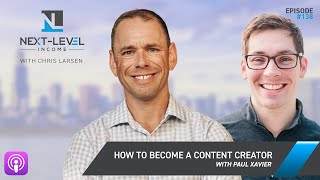
Interview (Next Level Income) with Paul Xavier about his path from coder/government contractor to entrepreneur and investor. Paul explains building recurring-revenue services, transitioning to coaching and DIY courses (notably 14 Day Filmmaker), and deploying business cash flow into investments—short-term rentals, car washes, triple-net leases and long-term rentals—while emphasizing marketing, stacking clients, and creating offers that help beginners achieve specific goals.
You know, one client with $5,000 a month, one client could be worth, you know, $2,000 a month or $500 a month. It really varies and so you can quickly stack three to five clients. Great passive leverage income source for yourself as a content creator.
Welcome to the Next Level Income show where it's our goal to take your income, your investments and your life to the next level. I'm your host Chris Larsen. If you haven't yet, get a copy of our book for free at our website, Next Level Income.com. that's www.nextlevelincome.com. just click on the book link and I'll even send you a copy if you put your address in. On today's show we have Paul Xavier. Paul's an investor and co founder of content creator.com and content creator templates.com his companies help content creators save time learning valuable skills and building successful businesses in the content creation industry. He actively invested in car washes, short term rentals, triple net properties and long term rentals in Asheville, North Carolina. Paul, welcome to the show.
Great to be here, Chris.
Yeah, and I'm fired up. It's great to see you, Paul. You've become a business partner, you've become a friend here over the past couple years and I'm really excited for you to share with the audience some of the secrets that you've really used in your personal life. And I think if people listen to the intro, what they're going to hear is the common theme through all this, Paul, is you've really built a portfolio of cash flowing businesses, whether that's real estate or other. When did you, when did you get started on this journey?
Around 2016. I really jumped in and I think a lot of people will be able to kind of, you know, have a similar, you know, at least mind towards wanting to jump into business like the transition that I went through in my life. So hope that it's valuable for a few people to hear my story.
Yeah, well, you know, you and I have discussed it at length, you know, one on one and you know, just, just with some, some of our friends here and share a little bit about your background because I know you're, you're, you didn't have entrepreneurial parents.
No, my father was a mailman. Split from my, my mother when I was a young kid and my mom is, she's done a variety of different things. I like to call her just a hippie. She's done a little bit of everything but no entrepreneurial bone in my family. Um, I'm, who kind of got stung with it. Kind of like a rich dad, poor dad scenario or. My best friend' was a very serious entrepreneur. He built a government contract firm. I kind of got to see it when I was in high school. My best friend, you know, his dad was always working and always, just always excited about something. His name was John Kovac. He just loved what he did for work. And so when I got out of high school, I kind of was thinking, I'm just going to join the military because those are my best prospects. It was join the military or go to community college. And my best friend's father said, well, hey, you know, I gave my son a job working at my government contracting firm. If you read these two books here, I might have a job for you coding for our company. And so I said, oh, well, let me try that out. And so I just read the books, put in the effort, and sure enough, a kid who's used to getting C. B grades, right, not the best, not really trying that hard in school, realized he could learn something if there was a big enough incentive. And so I read the books, I became a coder, I got a job, and I worked a 9 to 5 for about four years as a government contractor. That experience of working alongside John, who was this entrepreneur who loved building a business and just being entrepreneurial, that's where I got my. My, you know, gum for it and my. My love for it.
Yeah. And it really is like rich dad, poor dad story when you think about it. Because, I mean, my. My mom was a. Was a teacher, an assistant teacher, you know, and it's. It's wild when you grow up in that environment and then you get exposed to these sorts of things. And you said something that's interesting. And I think rich dad, poor dad says it, or Robert Kiyosaki says it. I heard it first when I was in college from one of my veterinary roommates, my veterinary student roommates. And the way he described it, he said, you know, Chris, he said, a students make the best professors, B students make the best vets, and C students make the most money. And I think Robert Kiyosaki said it somehow. He said, b students work for the government, and A students work for C students. It was something, Something to that.
Yeah, I've heard that quote, too. Yeah.
Yeah. And it is. Yeah. And I think there's. There's a common theme, you know, and when I got. I got good grades. I didn't get amazing grades. When I went to college, it was even, even more Challenging my grades started to come back down to earth a little bit. But why do you think that is? Do you think it's a motivation thing, Paul? Do you think that entrepreneurs have, you know, their, their brains work differently, or do you think it's just basically confirmation bias where if you're, you know, going out and you, you're intelligent, you get pushed into a professional field, you know, you end up in that. What do you think causes these scenarios?
I think a lot of it has to do with like, well, how, how willing are you to, to really pay attention to what matters to you in life? And I think that's one of the trends is like A students will oftentimes their, their value is getting the A. It's performing within a rigid guideline. Right. That and maybe believing in certain belief systems that, that put you towards academics, towards schooling, and that's to fit into a certain box. And where you see people who succeed in entrepreneurship oftentimes to throw the box out the window and say, what do I care about? What am I going to do? How am I going to live life according to my own set of rules that are different from everyone else's? Because where you see a lot of success in entrepreneurship, there are people who are willing to take bigger risks, people who are willing to go against the norm. People don't necessarily care about the current rule structure in the way that it's set up, because they're building a business that's going to change the way things are done in the world. And so, yeah, typically I just feel like C students, perhaps there are quite a few more of them who jump in and succeed in entrepreneurship because maybe it was schooling that, that was kind of failing them. They weren't interested in the schooling, but when they find that thing they are interested in, they can become an A plus student in that thing very quickly. And everyone's got different natural aptitudes and skill sets and so on. And so I think it just really depends on the individual. Right. Some A students are the best entrepreneurs in the world.
Right.
And then some C students end up doing. It really just depends on the individual at the end of the day.
Yeah, no, yeah. I think, I think a lot, A lot of what you said, it's, you know, it's, it's true. And there's different, there's different pieces depending on what type of person you are. And I think if you look at some of these wonderful entrepreneurs that are out there, like Richard Branson has dyslexia and you know, there's. There's books, there's research written on it where, you know, if you're dyslexic, you have to learn different ways to do things. And you, I think, you know, I look back to college and as things got harder, I had to learn to, to socialize. I had to learn to put teams together, to group people together, which helped help further, you know, my success as I got, as I got older, which if, maybe if I had a little bit more intelligence, I wouldn't have had to do that and I could, I could rely on myself and I wouldn't have had to develop, you know, those other skills. Now, Paul, you, you were just talking about developing a new skill in coding and to, to get your first job. But what happened, like, you went from coding to starting your own business and walk us through that transition.
So as the government contracting business that my, my buddy John had built, he decided to sell it. He did sell it successfully. Had a very successful exit. And along the way, that's motivating to watch, very motivating to watch, like, oh, wow, this, this is something that's possible when you build something from the ground up. And so at that time, I was gonna stick around and work at the company, but John pulled me aside one day after he sold the company and said, stay here. You have learned what it takes to build a business. And if you trust yourself enough to go out on a limb to take a risk and put yourself in the exact same position to do what I did potentially in this industry or in another one. And so I listened to that. I didn't immediately quit. I stayed six months and I built a freelancing business on the side, essentially building websites, shooting videos, shooting photos for small businesses, medium sized businesses, to help grow their companies. And so I built that up to a few thousand dollars a month of recurring monthly revenue just by. I build a website, shoot a video, and then I'll help you with being on the side for that and I'll charge you a retainer for it. So that was the thing that gave me a little bit of security, is walking away from my job. I had some monthly recurring revenue already pouring into my bank account from the side thing. And I was like, if I can do this in six months and I'm working, you know, two hours a day or one hour a day on this thing, what can I do if I go full time? And so I took leap, had a lot of ups and downs along the way, and essentially that's where I got my introduction to entrepreneurship was the marketing side of things. Because that was what I was selling as a service. Because I knew how to code websites really easily. I knew how to shoot kind of good videos and photos. You know, I wasn't great by any means as a content creator, but I was good enough. And so I, I really started developing new skills there. And luckily for me, learning marketing, it turns out that that is one of the first skills that you really should be learning as a business is marketing and sales. And so what I was selling as a service was, was turned out to be one of the most valuable skills that I could learn as an entrepreneur, if not the most valuable skills.
Yeah, that's another page out of Rich Dad, Poor dad, which Robert Kiyosaki talks about the value of sales. And we just had a guest on the show, Joe Marcoux, and he talked about how regardless of whether you're a professional or a business owner or actually a sales professional, you know, you are selling, you're out there selling. And I would, I would say, you know, I've learned now as a business owner how marketing fits into that. You and I have talked about this. Marketing is different than sales. Sales is a skill. Marketing is a skill. You have to blend them together to be very effective. And you said something else there as well, Paul, that I think I'd like to underscore because it's something we teach in our passive income course. When we start talking about passive income, there's active income and there's truly passive income. But you mentioned having that business income coming in and that gave you the security to make that leap and really do what you want to do, which is the same thing I found. So I think there's a lot of different ways to do it. When you decided to make that leap, is that when you started content creator.com.
So in, in essence, yes. Content creator.com is a rebrand of what I had been doing for about, you know, since 2016. And since 2016, we. We really specialized in creating sales funnels, content that helps grow businesses to some degree. And so my trajectory throughout my business is offer that as a service to now turn, transition to just doing it for people, to teaching people how to do it for themselves. And I was in more of a coaching relationship where I'm working with people one on one or in a group capacity to teach them how to build a website and sales funnel, shoot great videos, create great photos, and then sell a product or service online, whether that be any type of business, from, you know, lawyers to my. Some of my students work with like pest control companies. To dumpster truck companies, to like you. A whole variety e commerce businesses, the, the, the every type of business under the sun. Essentially, how to create a strategy online to get that marketing, which is the acquisition of attention in conversion, which is that sales. It's the conversion of that attention into sales. And so we did that for a long time teaching it. And then we transitioned from coaching model, teaching people like over zoom, what have you, or in person to courses and DIY courses in particular. So that's our first real big DIY course, coaching students. Actually. My best friend today, one of the biggest reasons I'm successful of any means is my, my business partner, Anthony Gallo. He went through one of my courses when he was in med school thinking that he was going to become a doctor. And he, he went through the course and found so much success in a business passion about which was filmmaking, that he was like, you know what, I'll get my degree, but then I'm going to pursue this filmmaking thing. Because he was making six figures while still just like.
Right.
Getting out of med school. Um, so there's your, there's your.
A student who is a good entrepreneur right there.
Exactly.
Yeah.
There's our. There's. He's the opposite of me in that sense. And so Anthony took off and then with him, he was a content creator that is 100 times better than, exponentially better than his filmmaking photo skills. His eye for things, even though he's colorblind, is exceptional.
Is he really? I didn't know that because I've just for the audience. I know, I know Anthony, we, the three of us do have worked on some projects together, but how about that? He's colorblind.
Yeah. And an amazing filmmaker. So with that, we partnered on a course called 14 Day Filmmaker. And the concept behind the course is to teach people the fundamentals of filmmaking in a 14 day sequential course that we can sell a thousand of them a day. And a thousand people can go to that course and learn with their phone or with their DSLR cameras how to shoot professional video. And that course has gone on to be a great success for us. You know, we have, I want to say 70,000 students have been through it in the past two years. That really kind of changed our business model a lot. You know, getting to that DIY course allows us to really acquire a lot of attention profitably. And then you can convert that attention into other sales, other DIY courses, other group coaching programs and so on. And so when we created that course, that's when we decided, hey, this, this is so successful in business. There's red sea businesses and blue ocean business. Red Sea is where you have a ton of competition. Everyone's doing the same thing, selling the same thing. And when we created 14 a filmmaker, we were the only ones who had a product that was this where it was a speed offer, it was teaching people filmmaking, it was really affordable and we put that out there and we just blew up with it. Then of course, as, as everything, people started copying us. There were tons of people who were copying us and we were like, well, if we kind of want to continue to be the best in this space, we need to niche down and really find a way to, to just be the best at this one thing. And so we decided on Content creator dot com. You know, we're not helping every business in the world to grow, only helping content creators. Now all of our offers kind of center around helping the modern content creator today to, to grow with DIY courses, group coaching or mastermind groups.
Yeah, well, no, I love it. And look for, for the audience, they should know. I, I went through your course. Um, we were, we were introduced through the invest, the local investment community, real estate investment community. I learned about your course. I bought it and because what I learned was I was trying to help people through one on one coaching and very effective. You can work, you know, you can work very effectively and very quickly with individuals one on one. The problem is you run out of time very quickly and you can't help as many people because not everyone can afford to work with somebody one on one. It's typically more expensive. So what I love about what you teach, Paul, you and Anthony teach is that you teach people how to multiply the number of people that they're helping and through that they increase their impact and they increase their revenue producing ability. That's come up time and time again on this, on this podcast. I told my boys about that. We're going to make a lot of money, figure out a way to help more people.
Yeah, absolutely. And by helping more people, oftentimes what happens, a byproduct of that is actually creating a bigger impact as well. So it's not just, oh, a money game where, yeah, I'm going to do group coaching and I'm going to make more money, but they're going to get a word version. It's actually the opposite. When you transition to these other education models, you create a better impact, a deeper impact for every customer you work with.
Yeah, no, it's, it's absolutely true. So you know, we were talking before the show. And you said that, you know, because there's a lot of people that are listening, that they're professionals, they're trying to figure out kind of how do they go from where they are today towards having enough passive income or enough alternate sources of income so that maybe they can shift into a different area of interest or shift into a different area of their career. Because, you know, if you're in sales, it's high risk, it's high stress, you know, it can be high reward, but it wears you out. I used to tell the reps I trained that it kind of chips away at your soul just a little bit every day and it wears on you. So again, you say that anyone with a following or expertise can, can build an online course like this. Paul, can you expand on that a little bit? For people that are listening, they may think like, wait a minute, I've never even thought that I had, I would do something like this.
So I think one of the bigger myths that hold people back from the idea of this could be something for me to, to explore and do is this idea that you need to feel confident and be the top of the top of your expertise in order to create a course or an education program that's going to sell. That is simply not true. So to give a better example of this, use one of our courses on a scale of expertise for filmmaking skills. Like the best filmmakers in the world are level 10. These are the James Cameron's, the Martin Scorsese's for directing. Just the best people in the world. There's that level 10 that's out there, that exists.
There's a lot of people. Tarantino, nine or 10.
Nine or 10. I would give 10. But no, that's, that's like the, the tens of the world, then you go down. Think about it though, like how many people really want to get that good? Well, there's only out of the people who want to learn how to shoot professional looking videos. Cinematic videos. Cinematic films potentially. Not everybody wants to be a 10 for it first and foremost. And a lot of people don't really want to dedicate that much time. There's a lot of people who just want to go from zero to one, which is, hey, I pick up my phone and I try to shoot a video and it looks terrible. What can I do to go to a 3 or a 4? Now Anthony, from a filmmaking perspective, he's, he's up there, he's a six, he's a seven. He's really good and talented. But we're he's not a 10. He doesn't have the accolades. He had no following really whatsoever when we created the course and we decided, okay, well, let's just create a course teaches people how to go from a 0 or a 1 to a 5. Let's just make them good enough to shoot videos that are going to be. Make them fulfilled. Make them feel like they're creating something that is cool and exciting. And so let that, Let that sink in, because that is a lesson that you can take on any single type of offer for a course that you could ever want to build. Sure. There's a guy who's a salesperson who. He's the best in the world. He sold a billion dollars worth of product in this space. Fantastic. Not everybody is trying to do that. Sometimes people are just trying to go from zero to, I get my first sale.
Yeah, right. Yeah.
And that person, you can help hundreds of thousands of those people trying to learn that first sales skill to get their first client in their new business. And so when you let that sink in, you can become the best person at helping people go from zero to a three in capability for any part of their business, Any part of any skill. And so there are two types of courses that you can create. There's courses that help people develop skills, and there are courses that help people achieve specific goals. So, Right. Developing a skill would be like, here's how to learn. Learn how to do the perfect bar in mixed martial arts in a specific. There's skills like, hey, I'm going to learn how to. Here's the set of doing a great arm bar. Right. Or a specific type of arm bar in mixed martial arts. And then there's the goal of winning your first mixed martial arts company.
Got it.
Now those are two very different courses that someone can go through.
Right.
And objectives. And so, um, you can create a course that helps people win competition. It's going to teach them very holistically. Or you can create a course that's just going to teach them that one skill on that one type of arm bar.
Yeah, I love it. Yeah. So if you're. If you're listening and you're like, okay, I really like the sound of this. I think there's a few things. One, if, even if you're not the best, you actually may be better placed to help those people because maybe you're more relatable, you're closer there. I love the. I love the saying. I think it was from the movie Catch Me if youf Can. And they're. They're questioning, they're questioning the character Leonardo DiCaprio, right? Oh yeah. And they said they're asking about all this stuff and they're like, I got one question for you, like how did you teach that course, that college course? And he said, I just read a chapter ahead in the book and that's what I love, you know, to be a coach, to teach a skill, to have one of these courses, you only need to be a chapter ahead. And sometimes if you're a chapter or two ahead, then the students or the people you're working with, the clients you're working with, you may be more relatable and you may understand what they're going through. Versus that professor that I had that was teaching, you know, some Fluid Dynamics class, Complex Flow in college, he was so far ahead of where we were that he couldn't relate to us, you know. So I got an 11 one time on one of his tests and 11, yeah. And it was a C minus for the record. That's how, that's how big the curve was. And then you also said you can help people either develop a skill or achieve a certain goal. So I love those three points you made there. Paul, before we jump to kind of where you're heading with the future of your business, I would love for you to share how you've taken your ability to grow these cash flow businesses and apply that to the investment world. What are some of the things that you're investing in to help grow not only the diversity of your portfolio, but the diversity of your cash flows?
I think that's a great question. And this is where I think it's really relatable for, for anybody, whether you're, you're entrepreneur already with your own business, single business, maybe you've got multiple or someone who's in a 9 to 5 job who's trying to figure this whole retirement and financial freedom is like you said earlier, there's vertical income, then there's horizontal income, there's that income you actively are working towards, and then their income that's working on your behalf, generating, you can create different assets that grow on your behalf. Now one of my favorite things that I've learned is that building a cash flowing business, a high vertical income is a necessity for everybody. A lot of people go into trying to just acquire a bunch of assets with no vertical income or build assets. That's a really one risky thing to do because you have no real reserves. And it's not. It's the place where I would recommend everybody put their focus in the beginning I didn't really know I was doing it right until you know, my business was successful and then I was like, well, what do I do with this excess cash? So as far as how I'm doing things now, what we have is content creator.com, content creator templates. Those are our two main cash flow businesses. They really generate a lot of excess capital for us and then we're investing that into a variety of different types of assets. Primarily real estate right now because it pairs really well with our marketing skills, right. We can a lot of content and with that content we can market thing real estate better than other companies can, which allows us to get higher rents, it allows us to better tenants and so on. So the assets specifically I love right now that I'm buying are short term rentals because again they're marketing heavy and that fits really well with our success. So like we bought a couple cabins here outside of western North Carolina. They were making want to say like maybe $50,000 a year. We got both of them over $100,000 a year in the first year because of the marketing capabilities that we have then an industry I don't have a lot of experience in, but we do have one investment in is triple net commercial real estate. So that is really exciting to me simply because of the passivity of those types of assets. You can buy them and then you don't really have to think about them for 14 years. Granted it stays then. We've got car washes which of course partnered with you on our our first off market car wash deal here outside of North Carolina. So that was really exciting. That business is going really well and with our marketing chops we have a lot to test and do there. But I'm highly confident we're going to be increasing revenue on that in the next couple of months here as we roll out some new marketing strategies for the wash. Just purchased that a couple months ago. It's been going great. Now we just have a long term, long term rental portfolio as well that you know, we grow as opportunities present themselves. Those are my primary investments at the moment. I do have a small stock portfolio with my just reference. Currently I am 31 and I'm staying really active in my investment so I can get higher returns at the moment. So I'm not so much looking at passive syndications and things as much at the moment because the returns are a little bit lower than what I can aggressively get for the next three years as I'm building my financial from assets.
Absolutely no. And look you made some great points there as well, Paul. And that's one thing we talk about in our courses. You should expect 50 to 100% higher returns in your active investments than your passive. So if you're, if you're on the younger side like Paul, you have more time and you're going out there or you just want to learn a business, you certainly can and should make more money if you're actively managing. And the other thing you mentioned, what I love about your portfolio is you have some more passive endeavors like triple net leases, some of those longer term rentals that even if you're self managing are more passive. But then you also have what I would classify as operating real estate, Paul, which is, you know, yeah, the short term rentals, the car washes, you know, we overlap in those areas as well. And if you're getting started, I think those are some of the best areas where you can go and you can take what is really a piece of real estate where you get all the benefits of the real estate and a business component like, like Paul was saying, for instance, you buy a car wash, you have marketing expertise, you go and you ramp up the marketing and improve the revenue and profits like that. So I, I think it's always a great idea. If you're looking for an area of investment, look in the mirror and say, hey, where's my competitive advantage? Is there something out there? Is there an investment out there that I can bring my expertise to and layer that on top? So I, I love, I love all that. And I think, you know, it's, it's like Warren Buffett, right? He goes and he buys businesses. He does it in a different way than, than you and I do. But you're doing the same thing, Paul. You're buying these businesses, you're improving cash flows, improving the value, moving on and doing it over and over and over again.
Yeah, exactly. And I think something that everyone can, any, anyone can and should be doing if that's an objective for you. If you want financial freedom, you have to figure out first like time management. You know, you and I talked about that a while ago. You got a 9 to 5. If you have a family, your situation is different from people like, like Chris and I. So you have to figure out what, what can you sacrifice to get that time to start exploring the business you're going to start, get that focus, get your cash flow up on that side or investments you're going to be investing into. Right. And so there's no need to build a cash flowing business if you have a really successful high vertical income as a 9 to 5 employee. I think I read a statistic the other day. Most millionaires are actually, they work for someone and they have a job. Most people who make a million dollars a year. And so if that's the case, you make a million, you're a couple hundred thousand dollars a year, then you can take that income and maybe with that hour a day, you talk to someone like Chris. Right. Chris is one of the best resources I think in the world that you can go and talk to and learn about passive investing opportunities. Your course is a fantastic resource. So I would find mentors like Chris who can really help you to create that plan for yourself and start building up those horizontal income lines. Whether it's just becoming good at vetting solutions or vetting funds, depending on where you're at, you know, you want to be surrounded by people who have achieved the financial freedom you're looking for and have them an email or a phone call away or within a group or community that you're a part of that you can get that support.
Yeah, no, it's great advice and look, you, I appreciate some of the kind words there, but you said something that I think a lot of people overlook. It's sexy to say, hey, I'm going to retire, I'm going to go do something different. But most people are better off and we talk about this, making as much money as possible in the current role you're in, that's going to be your lowest hanging fruit. So if you already make it a couple hundred thousand dollars, can you make 250 or 300 in your current role? Can you add different lines to your business? Can you, like Paul is doing, right, you went from content creator.com to content creator templates.com and you've added more opportunities and more sources to your business. So Paul, for those that have been listening and they say, well, yeah, this is great, like I want to learn more, they can go to contractcreator.com what else, what else? Where else can they find you, Paul, and your business that are out there to help teach others the skill set that they've acquired?
Yeah, yeah. So I mean, if you're interested in learning how to build a business relative to content creation or find success space, you can just run the content creator.com. we have a variety of awesome DIY courses. We can teach you how to become a content strategist, which is what I did when I started basically going to small businesses, creating sales funnels, running ads, doing video and photos. For them to generate very fast monthly recurring revenue. You know, one client, $5,000 a month. One client could be worth, you know, $2,000 a month or $500 a month. It really varies. And so you can quickly stack three to five clients. Great passive leverage income source for yourself. As a content creator, you can do learn how to do courses. So if you want to build DIY courses and sell them the same way we do on content. Com, we have a program that teach you how to create, market and sell your first course in just 30 days. So things, little things like that, that will help you to accelerate those business models if you're interested in them. That's primarily it. I mean, other than that, I'm, I'm mostly focused on building my own companies today. I don't do a lot of coaching. We have staff and team members who are experts in each industry that are doing the coaching. And I focus on investing and with people like you and surrounding myself with really great investors because that's my vertical income is in a place where that's what is the right thing for me to do at the time. And so yeah, that's, that's where I'm at with, with those elements. As far as you want to learn more about me, go to content creator.com though.
No, I highly encourage it. I've, I've used it. I've helped help me build my course. And the other thing I love about what you do, Paul, is you don't just invest in businesses and real estate. You also invest in people and you've brought on individuals into your team that you've invested in that are amazing at what they do. So I think that's, that's a lesson for everybody that's out there. So check out content creator.com. paul, thank you so much for sharing your story here with the audience. It's always good to see you, my friend.
Yeah, absolutely. Thanks, Chris.
Hey, Chris, here again. I hope you found this episode valuable. Now I have one more thing to give to you. We have a page for my coaching clients where you can get a free copy of my book as well as much more from previous guests on the show. Just check out next level income.com coaching to get a free copy of my book, audiobook and much more. I'll send you a copy of my book and cover all the shipping costs as a thank you for listening to the podcast. Also, please like share and take just 90 seconds to give us a rating on Apple podcasts.










