How to Become Limitless with Dr. Vik Raya
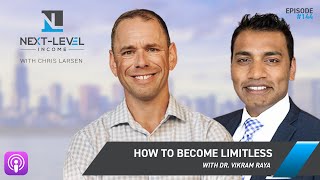
Dr. Vik Raya left cardiology to build Viking Capital and Limitless MD, a coaching business. He uses the 12-week year framework and DISC profiling to help doctors scale businesses and clear what he calls 'head trash' that blocks performance.
And then he decompresses and then he gears up. He gets his psychic energy, his emotional energy, his physical energy, and then boom, he's out at it again.
Welcome to the Next Level Income show where it's our goal to take your income, your investments and your life to the next level. I'm your host, Chris Larson. If you haven't yet, get a copy of our book for free at our website, nextlevelincome.com. that's www.nextlevelincome.com. just click on the book link and I'll even send you a copy if you put your address in. On today's show, we have Vikram Raya. Vikram is a trained cardiologist and functional medicine physician. He's an international speaker, high performance coach, and a real estate expert. He's been active in real Estate since 2015 as the founding partner and CEO of Viking Capital Investments. As a real estate investment private equity firm, Viking Capital is approaching 400. I'm sorry, 4300 units and 600 million of assets acquired. Vic was elected into the Forbes Business Council, was commemorated by US Congressman Tim Connolly and Don Beyer into congressional record for excellence in entrepreneurship. And he's helped high achievers, doctors and other professionals around the world achieve ultimate vitality, financial abundance and a bulletproof mindset through his coaching limitless MD he recently gave a keynote lecture at the CNN headquarters in Atlanta with Dr. Oz on entrepreneurship. And he's the recipient of the prestigious Outstanding 50 Asian Americans in Business award on Wall Street. Most recently, he's made the Inc. 5000 list of the fastest growing private companies in the U.S. vic, welcome to the show. My friend.
Chris, I'm excited to be here, buddy. Let's go.
Yeah, I'm excited as well. So I think it's great for the audience to know that we first came to know each other a few years ago when we bought a deal from your group, Viking Capital down in the Atlanta market. And that might surprise some people that heard the intro and they said, wait a minute, you got a cardiologist? What's going on? So I guess first off, Dr. Raya, tell us a little bit about your background in cardiology and what, you know, when did you make that switch to doing what you're doing now?
Yeah, Chris, it's interesting. We got a lot of similarity. I mean, you're a device, you know, scientist, if you will, or a device lead salesperson. And you were able to sort of navigate toward real estate and investments. And now you've become sort of a financial guru, a wealth Coach and sort of a. A multifamily master. And, you know, that was sort of a similar journey that I took, too. Like, I loved what I was doing as a cardiologist, and I did it because, I mean, hell, I had six people in my family die of heart attacks while I was training. And so while I was training, internal medicine. Internal medicine is sort of a gateway profession, and a lot of people end up staying as internal medicine, which is primary care. Or you say, hey, you know what? I want to specialize, become a GI doctor, where we take care of the gut and the colon and all that. Or I want to be a neurologist, take care of the brain. Or I want to. And in my case, I was like, I need to be a cardiologist, take care of the heart. So I'm like, let's go all in. And that was my dream. And it was interesting. Like, our dreams in our 20s and 30s, like, they evolve sometimes. And so, yeah, like, I dove into it. I loved what I did. I started practicing. But I noticed, you know, a lot of people around me weren't very happy, and they were also doing things just for the sake of money. And that's one thing I swore to myself I would never do. So I was like, what's the smart way to think about this? Well, it's what you teach, Chris. Hey, how do you diversify income? So I wanted to, like, create multiple streams of income. So I had my hands at options trading, and I got my butt kicked. It was. I didn't understand. It was complex, and as Warren Buffett says, you know, invest. No, or invest or. Or go into things that. That you have a capability of understanding. So I was like, well, I know even simple people could make money in real estate. Let me go into that and heard.
This guy, Chris Larson, was doing okay. He can do it.
Right? Right. And I was like, it's not in. In real estate, it's really not about iq. It's about nasty perseverance. It's about looking at patterns. It's. It's riding the wave sometimes. And it's also one thing that I find very forgiving in all the businesses I. I've been exposed to my life, real estate's quite forgiving. If you can hold on, there's always going to be an opportune time to sell, and you will make money. So that being said, right, you know, let me start at the bottom. I tried wholesaling. I was like, this is too freaking hard. I was running a cardiology clinic, and someone was telling Me, I have to keep flipping real estate. No way. And I ended up trying, you know, I was trying to buy single family homes in D.C. too expensive. So then partnered with dad in Atlanta and said, hey, I'm in D.C. you're in Atlanta. Let's some homes. Built up a small portfolio, private portfolio, about 30 homes. I'm like, okay, this is good. This is exciting, but ain't gonna retire me. So then I heard. I talked about syndications and multifamily. I'm like, oh, that sounds sexy. It also sounds illegal, but let me. Let me look into it. And, you know, to cut a long story, I went from, you know, owning a couple of homes and that kind of thing to now, you know, we're at the point where we're at about $700 million acquisitions approaching 5,000 doors. I have a team. I have a business partner named Ravi who's also a physician.
Yeah.
And now I've sort of transitioned to making this sort of my main. But what happened in Covid was an interesting thing. So real estate gave me the keys to the kingdom. It gave me time, freedom, and freedom, but it allowed me to pursue my passions. And one of my passions was health and wellness and biohacking and anti aging. And so I opened up a clinic called the Vital Institute in D.C. where I. I was literally taking people who had heart disease and, you know, diabetes and blood pressure and reversing it. And then during the COVID crisis, to shut my clinic down. And so I made it more of a virtual clinic. But I noticed doctors were coming to me and say, hey, I love what you're doing. You're doing real estate. You're doing this wellness institute. Can you coach me now? That's when the whole coaching thing happened. So that's where we are now, Chris. I have Viking Capital, my real estate, Limitless md, My coaching, and Vitology is my health and wellness institute.
Yeah. As we can see over your left shoulder there. And I love that. And I really want to focus, you know, specifically on. On your coaching today, Vic. But, you know, I. I do. I want to touch on something. So, you know, one of the things. When I was with Medtronic, they had this rule that you couldn't fly in a private plane with doctors. And, you know, there's. There's some statistic statistics out there that doctors die in fairly high frequencies and plane crashes, and people say, oh, doctors make terrible investors. And. Yeah, look, I'm not the doctor here, so I want to get your thoughts on this. But the idea is, you know, Doctors are very intelligent. They think they can outsmart the system. Where the flip side is, I spent, as you mentioned, you know, basically the entire, my entire career working with doctors, working with surgeons and specialists. And as part of that, you know, I got to train reps. And as part of that training, you learn about communication and different communication styles. And one thing that I found interesting was that doctors always had a component of an analytical style, an analytic style. And there's different ways to classify that in these different spectrums and everything. But, you know, when I always talk to the sales reps, I said, you have to always have a discussion with a surgeon through that clinical lens, through that analytic lens. I think that if you can master, you know, the, you know, the ego and keep that in check, surgeons, physicians with that clinical, that analytic background really are set up ideally Vic for investing in real estate. What are your thoughts?
Yeah, absolutely. And it's interesting, you talk about the analytical mind when I'm coaching a lot of my high performance doctor clients all over the country. It's their superpower, but it's also, there's a dark side to their superpower. And how do you know you have this analytical mind? Well, me and Chris, we use sophisticated tools such as the disc score. Disc score, Right.
There you go.
And so when you do that disc score, it's very simple. You can do it in about 10, 15, it's anyone anywhere in the country can do it. And then when you get the disc score, if you have a high sc, that means you're really smart, you're conscientious, you can parse through data, come up with decisions. But the problem is with analysis can come paralysis, as we know. And the, the problem with physicians is sometimes they instead of analyze, they analyze and they get to the point where, you know, it's very for them to make a decision. So ready, aim.
Aim.
No, let me check it one more time. Aim. And then fire. As entrepreneurs found that success loves speed, as both our, our mentor, Craig Valentine likes to say. And delay kills dreams. And the problem is you have to be imperfect. You have to have imperfect knowledge and take imperfect action and course correct along the way to be successful in business and entrepreneurship. But that imperfection can, can harm you in medicine because that could kill a patient. And so learning to navigate nuances is what the next breed of doctors is doing. So the doctors from the, that were practicing from the 70s to the 90s was this, you know, generation one or generation two docs who are, they're uber wealthy, uber successful, and they thought they could do anything. And they made great successes, but great failures. This next generation of doctors that I'm seeing are very savvy. They're starting to get, you know, they're reading Rich Dad, Poor dad. Early on, they're going to conferences. They're realizing that this is Their identity is not just a doctor. I'm a doctor, but I'm an entrepreneur. I'm a father. I. I love rock climbing, you know, and I do this and this and this. And so, you know, we have so many friends in common who are physicians, but they're doing so many things outside the spectrum.
Yeah.
And so I love this new breed of physicians, and that's who I'm speaking to, like right now, or the new breed of entrepreneurs out there where. Where we want to be good at everything, and we are learning that we can't. We don't need to do everything ourselves. Sometimes that book, who not how, written by Dan Sullivan, really hits home. It's like, hey, what is your superpower? Go and dive into that and build a team around things that are not your superpower. And then you have all, all the weapons at your disposal.
Yeah, man, you made. You made so many good points there, Vic. And I think a few things just to kind of, kind of tie it together, you know, as a physician, as a surgeon, you've. You've had to rely on your intellect, your training, your risk avoidance to be successful. And really, you know, in, you know, being in the or, you're the one, everything ultimately comes back on you. Whereas with the entrepreneur, yes, everything comes back on you. But to be successful as an entrepreneur, you have to let go at some point to grow that. I've faced challenges doing this. You and I have discussed this, and it's a real dichotomy because it's like the old saying, right. What got you here is not going to get you there. Right. And doing that. So at what point in your practice did you decide, hey, this, you know, I'm gonna. I'm gonna basically shut down my cardiology practice. Cause that's. That's a pretty amazing thing to do. Right? You spent, you know, I mean, geez, with. With school. All the years. What, 25 years in school?
Yeah, 26 years.
And then training.
Yeah. Yes.
And then. And then you practice for how many years as a cardiologist?
Almost a decade.
So you trained for 26 years. You, with all due respect, only practice for a decade. What went through your head when you made that choice? And how did you. How did you kind of overcome, you.
Know, that process one is like in our human lifespan. You know, they're saying now the statistics are saying, like, if you listen to Peter Demandis, who's a futurist, or some of these other guys out there, they're saying that the average human is going to have eight or nine careers in their lifetime. Not eight or nine jobs, but careers. And so I think adaptability, flexibility, and being dynamic must in your DNA, as anyone who's listening to your podcast right now. And I didn't know all this back then. All I knew was, what's the next step? And, you know, you're, you're, you're all about next level, right? Next level income, next level growth, progress. So am I. I love in that. I love think step. So I was not thinking I was going to reinvent the wheel. I was just like, all right, well, cardiology is great. Can I add something on the side? And then what happens is when your side hustle becomes better than your main hustle, it just makes you reconsider things. And then I was like, look, because I have, I, I, I'm not, I don't have the golden handcuffs, meaning my, I'm not worried about income anymore. If you're not worried about income, what would you do in your life? It's similar to the question a lot of my mentors ask me. Hey, if you know, in 2023 you couldn't fail, what would you take on? Now I'm going to ask that again to your audience in 23. If you knew you couldn't fail, what else would you take on? Right? And so I was like, all right, well, I don't like practicing traditional cardiology because I think that's reactive, that's waiting for going to where the puck already is. And as we all know, we want to go to where the puck will go, right? That's what Wayne Gretzky did and made him great. And so how do we, you know, how do, how do I anticipate where medicine's going? And so one of the things I wanted to do was I want to go upstream. So I started talking about how to reverse cardiology diseases. How do I actually go aging versus active aging? How do I take people and, you know, make them not have diabetes or insulin resistance or belly fat? And then, you know, I'm at this point is like, now with my coaching, another component of it is I still think that's not enough. Now I'm like, all right, that's great. A lot of folks who are still, like, having issues, and we're not trying to reverse it, but now I'm trying to take people like Chris Larson who is an absolute all star rock star in peak health and he's like I want to live to 120. Right. How is LeBron 122. But yeah, okay, how is LeBron James who just when you guys are listening to this, I don't know when but LeBron James just passed the all time career record for points in the NBA.
Amazing.
And he's 38, right. How much money is he investing his body to where literally he probably biologically he has a 30 year old body, 25 year old body. And if you did that and you're just thinking about the lens of what Chris teaches you and coaches on which is income now you're extending your capacity for your life wealth span. A wealth span, right. You have your lifespan, your health span and your wealth span. Now your wealth span is just doubled or quadrupled. Right. So you're more likely to hit your net worth goals. You're going to create legacy wealth for your children. So it's, there's so much to it. So now like back to your question about coaching. So now my mission is to literally up level every single human soul that I'm in front of and I'm going to help them achieve the easy stuff. And I'm saying easy mean you have achieved it, Chris. And we are helping a lot of people already achieve it. We know time freedom and financial freedom are there, but what about this mindset freedom where literally there have equanimity equipos a divorce happens, but they can withstand it and move through and find their next companion. Perhaps you know, someone in their family died, you know, a business challenge like me and you face so many business challenges. We can handle that. But then we can come up with solutions and become resourceful. Right. And, and not wait for someone to bail us out. And then finally the vitality freedom. How do we literally re engineer our body to where we can keep with our kids to where when they become 18, 19, 20, 25 they still have to struggle as we're climbing Mount Kilimanjaro or you climb Mount Rainier.
Right, right.
That's what I'm talking about. So absolutely I invite the listeners here to say look, let's raise the standards on everything. This is not a financial show, this coaching show, this is not a mindset show. This is not a physician show. This is not a real estate show. This is a life show where I want you guys to stake your claim at what's possible in life. And let's go after it.
The biggest and best real estate syndication event of the summer is back, and I want you to join me there. I'm very excited to announce that I will be a guest speaker at Mfincon 2023, which is taking place live in Charlotte this June 12th through the 14th. You can learn more and get your ticket at www.mfincon c o n dot com. That's M-I-N-C-O-N.com or MF&CON, as Shaq called it last year.
All.
Also, I'm sending you a special promo code because if you're serious about apartment syndication, multifamily investing, just real estate investing and commercial real estate in general, mfincon is for you. I'll be speaking alongside an excellent lineup of over 70 real estate experts and professionals, as well as celebrity guest speakers a rod that's Alex Rodriguez, Dr. Robert Cialdini, and Mark King. The opportunities at this event for networking are endless and you do not want to miss out on the great stuff sessions that are planned. My promo code is next level. That's all caps. Next level. And you'll get $200 off your ticket. Again, go to mf I n c o n dot com. Get $200 off your ticket with promo code Next level today. Heck yeah. I love it, man. So underlying all that, Vic, and first off, like, I've spent, I've spent time with, with Vic. I, I can tell you that, like this is how he thinks all, all of the time I worked out with them. We've done presentations together. The thing is, the way what, what Vic just laid out with Dr. Rai just laid out is different than your traditional thought processes, right? People say, hey, I'm going to have a career. I'm going to retire. That's very small thinking. I'm going to, you know, live to be 70, 80 years old. Well, how would your life change not only if you could, couldn't fail in 2023, but how would your life change if Instead of being 80, you were 90? 100. 120. 122. Like I just talked about, Vic, you said you can double your wealth or quadruple your wealth. The thing is, if you live those extra years, as we all know, the magic of real estate, you hold on. It's compounding interest, right? It's leverage and compound interest. All the things you talked about all are underlined by that exponential growth, changing your thinking from linear to exponential. So if you, if you don't accept what conventional wisdom says in finance. If you don't accept that you have to wait until you get sick to seek care and, and better treatment. If you don't accept that, oh, I'm gonna, I'm gonna get old and I'm gonna get slow. I can't keep up with my kids.
I.
My son's like, dad, I'm gonna beat you when I'm 13 on the bike. I said, you just bought yourself another three years because I'm gonna train my butt off to do that. Find people like Dr. Raya that can help push you, change your mindset, and then surround yourself with people that can help expand your skill set to achieve what you now believe can be done.
And I love what you said about that. I love the story about your son too. That's awesome. What really thrills me is this, like, Chris, you follow what he says, you listen to his podcast, you work with him. He's a seven figure income. But let's talk about seven figure relationship. Let's talk about, do you have a seven figure relationship with your wife? Like, do you have a seven figure relationship with your children where they're like, I want to be like my dad, like, or, you know, seven figure charitable strategy. Like, what's your foundation look like? What's. How many people are you going to help and touch before you die? You know, like, like there's a quote that from one of my favorite authors, Robin Sherman. He goes, live your life in such a way that you know, when you're, when you're born, you cry and you know, and the world rejoices. And so life in such a powerful way so that when you die, you rejoice while the world cries. You know, I'm like, boom. Like, that's a mic.
That is amazing.
Like, that's like, I want to be fully spent when I'm 123, you know, one year after this, right? I want to be fully. Because, man, I maxed out my life, right? And so it's, it's. And, and how do we do this? Right? Let's get tangible here. What's your morning routine look like? Yeah, are you. And everyone sets big goals, like 10 year goals, 5 year goals, 3 year olds. You know what I found the problem is with that, Chris? I found the problem is they don't connect their short term strategies and tactics to their long term goals. So they have all these big visions which, okay, granted, most of the country do any of this, but the high performers that we talk to, 30% of them in the world. They do the big, big goals, but they don't know what this week day, this hour, this minute. And this translates into their quarterly goals which translate into their annual goals. That's the, that's the gap, miss. They may have an annual goal, but then they know they have 12 months to do it. So they sit on their butt for nine months and then they try to push hard for the last three and it doesn't happen. And then they get disappointed and they reset their goals or they downgrade their goals or they, you know, they alter their goals because it just, it's impossible. And so if you are tactical and say, hey, look, there's a book by Brian Moran called the 12 week year. And he really outlines. Stop living your life in 12 month terms. Pretend you only have 12 weeks on this earth and you, you act in unison. All the, all the, your, your team is rowing in the same direction and you're all focused and you're asking the question, hey, and I have to tell you a story. So the, the British Olympic team sucked for like many years. And, and they brought in this consultant and this coach and then he basically asked one question, will this make the boat go faster? And they had four years before the next Olympics and they were worst in their league. And so they're like, oh, with this different outfit, will make it go faster. Great. Hey, will going out to the pub on Friday night make the boat go faster? No, it won't because I'm going to be hungover the next. Okay, great. I won't do that. Well, eating donuts now because I'll be fat. Okay, great. Okay, well. Sleeping better? Yes. Okay, great. And hey, if we get our hair cut in a certain way, fine. So anyway, all these little micro decisions kept going to the main focusing question, will this make the boat go faster? And literally in four years, they went from worst team to best team, got the gold medal. So the question is, what is that focusing question? And I would, I would urge you say Instead of the 12 month question, ask a 12 week question, the 90 day question. Will this. And once you have that linear goal to delineate it out, every action in these next 12 weeks to hit that goal. But if we are always pushing ourselves so hard. Doc, Doc, aren't you gonna burn out? Yes, you will. That's why the 13th week you take a break and you have like a deep sort of a, a refueling cycle and then you push another 12 weeks and then the 13 is a refueling cycle. That's why. Chris, where'd you guys go? Where'd you go? Skiing. You went skiing somewhere, didn't you?
We just skied in Big sky. Yeah, we got, boom. We got next one set up here. Absolutely. Yeah.
So Chris, he follows this. I mean, literally, the guy is like crushing it in all his categories with his family, with his work, with his podcast, with his investors and. And then he decompresses and then he get, he gears up, he gets the, his psychic energy, his emotional energy, his physical energy, and then boom, he's outed again.
Yeah, yeah, that's a great point. I think, you know, we, if we think in cycles, right? And that's another thing, like conventional. Right. Wisdom. Right. We do, okay, get in your routine and do that. It's okay not to be balanced. And that's, you know, I'd love to hear your perspective on this. We talk about work, life, balance. It's like, well, it's okay to not be balanced. Athletes aren't balanced like that. That rowing team that you mentioned, we go deep. I was at the gym this morning, right? I'm like laying on the floor in a pool of my own sweat at the end of the workout. I'll train hard for a few days and then I'll take, not like a day off or a half day off. I'll take two days off, three days off. I'll totally recharge so I can go back in there and have that intensity. And if you look at any great athletes, you know, they train hard and then they have days off, they have uptime, they have downtime entrepreneurs. If you're out there trying to achieve things, you need to be okay with that. You can't run 16 hours a day and, and not burn out. You need time to recharge. So I think when, when I plan my years, Vic, I love, I love the quarterly plan. And maybe that's the sales guy and me going back to the quarterly quotas that I used to have. But I always plan my vacations first. And I know Craig has been big on this, our coach, which is, hey, when are you going to take your time with your family? What are those most important things? Our kids are similar ages. I say, okay, how am I going to spend time with my family and do this and then I plan stuff around that. How do you help your coaching clients? You know, really take that 12 week model that you said and then map it out over the course of the 12 months. Because a lot of people that are high achievers are saying, well, I don't want to take time off. I want to just go that's not the best thing to do.
Yeah, well, one of the things I like to do is there's so much circling around in some of these guys heads that the first thing I usually do is we create sort of a. What I call a limitless map. You know, our company is called Limitless md And so we really create this limitless map where, you know, tell me your goals and I go. We go really short term because I want them a quick win. And then I go, you know, 1, 3, 5 year and long term, then we talk about. This is all great, but there's something called ends. Goals amaze goals, Chris. And I know you know that ends goals are. I mean, means goals are like, look, I want to create a million bucks Great. So that. What? So that. Oh, I want to retire my. They've been working their whole lives and they've never had a decent vacation. I would love to take them on a vacation or. Or, hey, look, I want to buy my mom a house. She's always lived in her apartments, right? That's the end goal. But sometimes we forget if there's other ways to get the end goal. There's better ways. So I always figure out what's. What are you really chasing, you know? And, and how do you know this if it's a means, goals, or end goal? Because usually it's, I want to do X, Y and Z. And then if it ends with so that, that means that's not the final destination.
Gotcha.
So I have these, the goals laid out. I sort of get a pulse on where they are in all their life categories. Then I, I talk about. I talk about what they're really chasing. Then we get interesting. We go into their head trash. What the. Like, the way I see it is, let me see if I. I don't have in front of me. But if you imagine like if you had a rubber band right here.
Yeah.
And you have like two or three fingers pushing out against rubber band. I have one finger back. That's your limiting beliefs. That's your head trash.
Yeah.
The moment you release that head trash, boom. What happens? That. That, that rubber band launches forward. And as a coach, as a consultant, as sort of a mentor, you want people to go through your head trash. You say you're going to vomit out a ton of information to them and they're going to piece through and they're going to go through all that. It's gross. But, yeah, that's what happens is gross. What people put in their head anyway. And you're like, all right, that's what's holding you back. What if that wasn't true? How do you know that's true? What if I challenge? What if we reconfigure that belief, Boom, they get released and then what we do is it's good to have that rah, rah, rah, good feeling. But then you really need to have an action plan. You come up with a 30 day action plan and then boom, they're on their way. And then the last thing is accountability. And those are three types of accountability. There's accountability, there's peer accountability. Like you, you're around, you know, the five people you're around with kind of theme or meme you've heard. And then finally there's professional accountability. People like me or you, Chris, where we're like, look, I got your back. I'll, I'll take a bullet for you, but also going to kick your butt. Let's go.
That's right. Yeah, I love that. And that's so important. You know, you, if you know you have the plan, you have all these things in place, but you must have that accountability to keep pushing you forward, especially when you reach the level that you are at. And a lot of people that are listening, if you're at a high level, you need to find people that can push you to go to a higher level. Because most of the people that are around you, they're like, oh, take a break, you're doing okay. You need to find those people that are constantly pushing you, pushing you to do more, achieve what you're capable of. And that's what really gives you the juice of life to get excited. I heard Jesse Itzler speak a couple weeks ago. This is a guy, he and his wife, billionaires, Sarah Blakely's, his wife started spanx. And Jesse's 15, 50 something years old. He's got like 10 years on his vic. He's running 100 mile races, right? And he tells a story about running with a gentleman called Chad Wright. So look it up, Jesse. It's learned Chad Wright. And the, the topic of this conversation was words matter. And what you just said, your thoughts matter, your words matter, those are your limiting beliefs. And he talked about getting from mile 70 to 100 in this race just by using the thoughts and words in his head. And he said, there's no way I thought this was even possible. But it is. Our minds are, are just, are amazing. And that's exactly what you teach, you know, with, with your, with your coaching, with Limitless.
That's awesome, man.
Yeah. So, Vic, you know, a lot of people, you know, kind of shifting gears here a little bit as we wrap up. A lot of people as we're here in 2023, there's a lot of uncertainty swirling around, you know, in the world, in investments. You know, what. What are some things that your company's doing in 2023 to focus on the opportunities that you see that are out there.
So one of the things is really understanding and getting an accurate representation of the world, you know, not seeing how worse than it is, not seeing how it's better than it is, just getting an accurate representation. How do I do that? Well, I don't care what industry you're in, but there's always trade shows, information conferences, things like that. So you go there, you, You. You talk to, you know, people other than you who are starting out, who are, you know, industry leaders. You, you know, read publications, you read the news, and then you get a sense of assessment what's going on. Number two, you realize that, you know, history maybe doesn't repeat itself, but it rhymes.
Yeah.
So recognize patterns. And so one of the things I do at the beginning is one, just to be aware that there are patterns in the world and cycles and. And things that repeat. Number two, under those patterns and use them to your advantage. And finally, number three, when you become big enough and you become, you know, the leader of your industry or you become the master, you start creating pattern that other people follow. So what I've done is one, I really, you know, we have these annual retreats for my. Both my companies. And so for Maryland, we. We met, we. We discussed, we create goals. We. We took into account headwinds and tailwinds. We took out new information that we've gotten capabilities, new partners, and we've made goals, and we're. We're very strategically going after them, similar to Viking Capital. We're like, all right, how did we do last year? What went right? What went wrong? Are all the right people in the right seats? Is there people that we need to add or people need to subtract? Who can we coach up and who can we out and. And then it's like, all right, are we all rowing? Like, we talked about rowing the same direction and boom. And then it's as a leader of the companies, giving them confidence, making sure that there's still alignment with the vision and the mission. And also, is it like, for example, in multifam, like, we're not just about chasing units and chasing AUMs assets under management. We decided, hey, each one of those units is actually a. So how many families are we helping this year? That sounds more exciting than oh, I have that 400 more units. Okay, fine. Or a thousand more units, but thousand more least. Hell yeah, sign me up.
So I love that.
Perhaps reframing, you know, what your. What your goals are so it's meaningful. My, my, my partner, Ravi Gupta, he's he esg. Environmentally, you know, environment, environmental sustainability, growth, green energy. And so we're like, hey, how do we like, you know, can we add solar? I'm sorry, Add, you know, car chargers.
Yeah.
Because everyone's starting to get EVs to our apartment complexes. And if it's free, why not. And it's adds additional, you know, value add, if you will. So it's, it's being innovative and, and if I had to just share a quick piece of insight to your listeners. When you're first starting out, you're imitating people better than you. Next you start iterating. You. You see what they're doing. Oh, Chris, I like what he's. But you know what? I'm actually going to add a little bit of my own spice to it. That's second level iteration. And then finally, you know what? I'm going to do something completely different that Chris has never done before. I'm going to. And so that's sort of the 3i methodology that both our companies use.
Yeah. You've come so far, Vic. You got so much further to go. If people are listening and they want to work with you, they want to learn more about your company and learn how to go faster on their journey, what's the best way to get in touch with you?
The best way is just my, my personal website, vikram raya.com that's V I K R a M R A Y a dot com and you can get a hold of me that way.
Awesome. Vic, it's always a pleasure, my friend. Love to have you on. Love that you share with the audience. We're going to have you back on. Thanks so much. Hey, Chris, here again. I hope you found this episode valuable. Now I have one more thing to give to you. We have a page for my coaching clients where you can get a free copy of my book as well as much more from previous guests on the show. Just check out next level income.comcom coaching to get a free copy of my book, audiobook and much more. I'll send you a copy of my book and cover all the shipping costs as a thank you for listening to the podcast. Also please like share and take just 90 seconds to give us a rating on Apple podcasts.










