How to Passively Invest in Online Businesses with Kyle Kuderewski
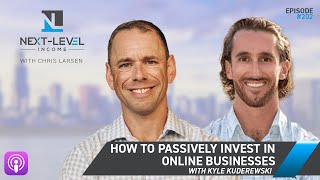
This is a May 2024 YouTube interview on the Next Level Income show where host Chris Larsen speaks with Kyle Kuderewski (operations manager at Web Street). Kyle describes his engineering background, remote lifestyle and travel, and transition from corporate engineering to entrepreneurship via short-term rentals and interest in online businesses. He explains online-business categories (affiliate/content sites, Amazon FBA/KDP, SaaS), how brokerages like Empire Flippers list and sell sites, and how Web Street enables accredited investors to passively invest in pooled funds that acquire online businesses. Key operational and financial facts: many online businesses trade around 3–4× yearly earnings; Empire Flippers has facilitated over $500M in sales; Web Street distributes 2/3 of quarterly profits to investors, operators retain skin in the game (~5%), and typical hold periods are 2–4 years. The episode closes with CTAs to empireflippers.com and webstreet.co and the host's coaching offer.
Questions this video answers
Began renting a room/short-term in 2015–2016; purchased the vacation rental duplex in 2018.
Many online/content/SaaS businesses discussed trade around 3–4× annual (earnings) multiples; the guest also cited a general 4× annual range.
Empire Flippers has done over $500 million in businesses sold in the last 10–12 years; their largest listed business was about $15 million.
2/3 of the profits each quarter are delivered to the investor's Web Street wallet (the remaining 1/3 retained by operators/manager).
Generally a 2–4 year hold period after acquisition.
Obviously, if they've got $2 million of cash, if they're competing with somebody who's only got, you know, a million 1.5 that wants to do retained equity or whatever the case, they can get a much better acquisition price, which only helps investors. So we tried to build this model for a lot of different reasons.
Welcome to the Next level Income show, where it's our goal to take your income, your investments and your life to the next level. I'm your host, Chris Larsen. If you haven't yet, get a copy of our book for free at our website, nextlevelincome.com. that's www.nextlevelincome.com. just click on the book link and I'll even send you a copy if you put your address in. On today's show, we have Kyle Kutareski. How is the operations manager of Web street investment platform, allowing people to passively invest in online businesses and digital assets? Kyle's an engineer turned investor entrepreneur. Prior to joining Web street, he worked in an engineering role for nearly 10 years. Before leaving corporate America, he saved his money, began investing in real estate and now owns multiple vacation rentals. He also became passionate about investing, and in a roundabout way, this led him to the online business world and he hasn't looked back. He has a true passion for life and his free time. Enjoys pretty much anything active, including triathlon, snowboarding, traveling the world, which we'll talk about a little bit today, scuba diving and much more. Kyle, great to see you again. Welcome to the show.
Hey, Chris, thanks for having me. Happy to be here.
Yeah, no, I'm happy to have you. And, you know, we, we've done some work together as we were, we were catching up before the show, and I was, my first question was, where are you? And I'd love for you to start off, you know, share a little bit about your background. But you have really built, you know, really consciously built a lifestyle for yourself. I'd love to share a little bit with you about that, with the audience, if you don't mind. Just kind of some of your, your recent adventures that you've had for sure.
Yeah. Let's start on a fun note. And, and I think that's a perfect way to do it. We kind of back into to how I got here, but right now I'm, I'm in St. Silence Island, Georgia, where I reside. So it's a great place in America. It's a little not as interesting as where I normally am or partially am. So we can talk about my lifestyle, but the gist of it is my team is a small, fully remote team, and because of that, we have team members in Egypt and Portal Thailand, all over the world. It builds a great culture, but you can't do all the work you want to do remotely, or at least not. So once or twice a year, we'll get together somewhere fun in the world. I've been home for about a week now, but prior to this, we're recording in March, January and in South America. So did some hiking in Patagonia, met the team in Buenos Aires and did some strategizing and spent some time in Colombia as well. So that's the most recent ones, but yeah, we have a lot of fun doing that and we get a lot of good work done as well.
That's awesome, man. No, I love it and I love, I love to explore most of the time these days. I, I'm, I'm taking my kids with me and doing those sorts of things. So, yeah, I'm a little envious when I hear about some of your adventures and, you know, look at some of the things that are going. My boys are right in the thick of, you know, team sports and different things like that. But we still get to travel and they're actually, they're in a school. They're both heading to Costa Rica with their school for a little adventure and service trip. So they get to, they get to explore the world internationally, too, which I think is, is so valuable. I love that you're.
Yeah, that's great. Costa Rica is a great place for remote work as well. I think we have a team member there right now. But you're 100, right? I mean, it gives you a lot. It really widens your mindset, and there's just a lot of advantages to seeing other cultures and getting out there and exploring.
Yeah, absolutely. You know, so we're going to get into what, what you're doing right now, Kyle, with Web Street. But, you know, we share something in common. We both have engineering backgrounds, which I know it's hard, it's hard to read on the wall behind me here for those of you that are watching. But, yeah, we both have engineering backgrounds. And one of the things that I get asked most often when I'm on a podcast is, hey, like, what, what did your engineering background, you know, bring to what you currently do? And I'd love to ask you the same thing, Kyle. Like, you, you think it's helped you in your progress with your current business? Some people, you know, have a stigma around engineers. Like, we're not good with people or good with conversations. And I've certainly had to work on my writing skills, which didn't come as naturally as, say, math, for instance. But what's your experience been, you know, both through your education and also how you've been able to apply some of that in your current business?
Yeah, I think everything you said there is pretty spot on. So I try to get hit on each of the points. I mean, and mine, mine are on this wall, so you can't. But looks, looks similar. The, the first thing would be just in undergrad. You know, engineering really drives home perseverance and problem solving. So I think that would be the biggest thing. I don't use a lot of the technical skills I did in undergrad or, you know, used in undergrad. Some of them I do from time to time, but not so much generally just learning to persevere and like, when problems get in the way, dig in and don't let them slow you down. So that's huge. Um, I did do my master's as well, which was in engineering management. That was probably more relevant. Not probably, definitely more relevant. It was more project management styles and managing teams and managing people and different personalities. So that is pretty relevant. And the last point I'll kind of hit on, you said there about not being good with, with people. I mean, that that stigma is kind of true. I think it's something that I realized early on in engineering school was like, hey, you, you might have the technical capabilities, you're definitely not the most technical savvy here in the classroom, but you have a skill set with people that you should try to leverage. And so that kind of always in my mind when I got into the corporate engineering world and kind of the reason I'm in the spot I am today.
Yeah, I always joke. I said, I tell people, and some people believe me, which is. Which is just as funny. Say, my, My advisor pulled me aside one day and said, Chris, you're. You're not smart enough and you have too much personality to be an engineer. So we need to, we need to look for a different pathway, like maybe something like sales or something like that. But all joking aside, you know, it is interesting. You don't look at, you know, you look at engineers or, you know, I got to work with, you know, surgeons, neurosurgeons, orthopedic spine surgeons. And, you know, it's rare to find a mix of somebody that's like, hyper smart, like, really, really intelligent, and also has, you know, really good interpersonal skills. And those Sorts of things almost like, you know, there's, there's only so much room in our brain. But certainly again, joke, joking aside for me and I'd love to hear your experience. You know, you mentioned like persevering through problem solving. You know, when you're faced with a problem in engineering, there's a process that goes along with it and you know, the first step is make, make assumptions, then you solve the problem and then you iterate, you kind of go back and you, you go through it over and over again. And for me, running through that process repeatedly, especially in problems that there wasn't a ready solution or sometimes, you know, there was, there was multiple solutions, you know, depending on, I think that lends itself very well to business and also in, into life these days because one of the things I find Kyle is people have the wrong assumptions and what's his shoot, what's his name? He wrote Nassim Taleb wrote Antifragile. And he, he talks about this and he cannot in the same way, but he calls these people intellectuals yet idiots. And basically people that are very smart, they're very well educated. And that's funny, you got your little bubble almost. But you know, these people are very smart, they're very well educated, but essentially they made the wrong assumption. So their conclusion in the world is wrong. And to me that's what I always tell people. The biggest benefit I got from engineering was that I learned how to solve these problems, but I also learned to question my assumptions. Yeah, yeah.
And I think it's well said. I won't add a ton there, but I was, you almost read my mark going back to first principles. So building those assumptions on the first principles and tearing down other people's assumptions or their world just and really getting to like what you think the first principle is. And then working through the process like you said from there is super, super important and not easy to do even with training.
Yeah, that's a good point. And you know, you gotta be careful because if you just, if you challenge somebody's assumption, especially as my wife would remind me in like politics or religion, you're, you're probably not gonna get a great response right away. So you gotta be careful how you come at people. Maybe that's the interpersonal skills like I was joking about earlier.
Yeah, for sure, for sure.
So we were talking about your pathway, so engineering to web street and investing in alternatives and businesses like that. But you came about it and something that we also share, which is short term rentals. So maybe you can Share kind of like that next step in your path. So you left your engineering education. You did a master's degree as well. Walk us through what was the next step in the corporate world and then where did you go from there?
Yep. So, you know, graduated college, was relatively broke like most, most of us are when we get out of university and accepted a, you know, a corporate engineering role that taught, taught, treated me well for between eight and 10 years. You know, gave me a good start in life, taught me a lot of skills. But I always knew there was something more I wanted to do. I had an entrepreneurial itch. So got money I knew I wanted to get into, start a side hustle so that I could one day leave. I didn't know what that was going to be and actually just started a room in my house shortly after my wife and I purchased it. Just because again, we used most of our money for the down payment on Airbnb and we did it in a halfway manner, little to no effort. And it was starting to run out every weekend and we were like, okay, this market here, we live fairly close to the beach. This market's really, there's something. So followed that market trend and ended up purchasing a vacation rental duplex, which we still run today. And it's, you know, it's been a blessing for at that same time I was looking at a bunch of other side hustle options. Right. It didn't have to be real estate. I just, I didn't know what it was going to be. And that's when I learned about the world of online businesses. A brokerage called Empire Flippers. And I looked at purchasing a site or sites and running them. You know, again, wanted to develop a lifestyle where we could travel together and I could work remotely and didn't end up doing that, but I kept an eye on that space. And we can get to what Web street does and what I do with Web street now. But that's what eventually led me to Empire Flippers and the Web street and just the world of online businesses in general.
Yeah, I love it. And you know, it's, we have, we have two short term rentals here in Asheville and people are like, wow, like you. Why, why would you want to have short term, you know, renters or Airbnbs on your property? One's a midterm ones, but what we found is like you, you know, we didn't have somebody like necessarily in, in like a bedroom next to us, but it's, it's on our property, it's in our House and it helps really pay, pay the entire mortgage, which is great. What year was that that you guys started doing that? Kyle?
That was 2015, started 2016. And then we bought the rentals. The, the actual. We own now in 2018. So it's been five, six coming on six years now. It's been a good while. I think we have over a thousand reviews and stays. Yeah, we've been ahead of the curve and.
Yeah.
And all that.
I love that. No, it's, it's, it's a great business. And again I think it's, you know, if you're listening and you're trying to figure out like what's your first step into the world of real estate? Like do I buy a single family rental? I think short term rentals. Wow. It's a little bit more work, it's a little bit more operations. The profit is there and you know, you can, I've had multiple coaching clients. They rent, you know, a basement or they have basically a duplex. Whether it's side by side or above or below or they, they have a house that they rent short term on their property and they subdivide it and build a house on there. There's so many different things that you can do.
Yeah, 100%. And I should have, I should have been, I was trying to be concise but ours are actually is like a mother in law over the garage. Our garage is slightly separated from our house. So not that there's anything wrong with doing a room in your house, but if you, you know, if you don't want somebody in there, there's a ton of different ways to do it like you just mentioned. And yeah, actually don't rent that anymore. We just let family and friends stay there. But you know, it really proved to us like, hey, this market is something that you should take advantage of. I always try to listen to the markets if I can. Especially when they're kind of knocking on your front door.
Yeah, absolutely. And I think, you know, one of the things that I think is going to be really big going forward from a demographics perspective is this silver tsunami that we hear about. And you know, we have, and people have heard, you know, 10,000 people a day turning 65, but those same people are about to start turning 80 every day. And when you're turning 80, you typically need some sort of assistance in your activities for daily living. So I think to me, you know, somebody that you know is whether they're building out their house now or looking for kind of to future proof their home Kind of like we did. It's like, well, hey, if we ever have a family member that needs to be close by, you know, we have that option. So I think if you're building a house or you have a home, it's something that you could have a short term rental now in your property, but you can also make your property more valuable for the future. When we're going to have this again, what I think is really going to be a crisis in this country of how we're going to care and house, you know, our senior population at some point.
Yeah, yeah, I couldn't agree more. We could, we could talk probably for hours about that. I've got some relevant things going on in my life right now. And also, you know, in the area that I'm in, a lot of coastal towns have overpopulations. So I'm seeing different, different models built, more innovative models built with different, different ways you step into, you know, graduated care, et cetera. But you're, you're. I couldn't agree more.
Yeah, no, I think again, so if you're listening, write that down. That's my prediction for the next 10 years about an area that's going to be very popular. But one thing that people that are highly wealthy have in common typically, Kyle, and is that they own businesses. And this is why I wanted you to come on because, you know, when you started with the Rockefellers and the Vanderbilts and you know, businesses, a decade, a decade, and I'm sorry, a century, century, a half ago, look very different than they do now. We have franchises now we have online businesses and even like real estate. Like I would, I would call real estate even an apartment building. It's a business. You know, if you have 100 unit apartment building, you have 100 clients or customers that are, that are paying you or have almost like a monthly membership that they're staying. So all these things are businesses. Why did you choose and what type of businesses did you choose to focus on? When or why did you choose online businesses? And you know, what are the advantages that you found with that? What's the evolution been?
Yeah, to me, you know, it feels like to everybody, the Internet's been around forever. But if you compare it to like the time frames you were just talking to, I mean, it's still early in the game. I still, of course love real estate, you know, not never, just completely out of real estate. I think, you know, it's an excellent asset class. But I saw a lot of opportunity online in online businesses. And I'll specify A few of those examples so fulfilled by Amazon, otherwise known as Amazon fba, Amazon Kindle Publishing.
Yeah, just had a, just had a guest on Neil twa. I mean I think, I think the podcast actually aired today with Neil. So if you're listening, check that out. Neil twa, like the, like the old airline for those of you that are.
Old, my age and older in the Amazon space.
Yeah, the fba. Exactly.
Awesome. Yeah, so I'll give that a listen as well. Yeah. So fba, Kindle Direct Publishing is a much smaller but very profitable monetization. All of these sites, we call them content or affiliate sites. So if you're going and looking at top 10 travel backpacks or top 10, whatever the case is, or just reading blogs, all those affiliate, you're clicking those links, if you make a purchase, that person's getting paid. And then of course a big one is SaaS. So we do software as a service. Anything not quite as big as what we're talking on here, Zoom. But there's tons of softwares we all use. We know HubSpot, we know Monday.com, we know all of these, even the $1 a month apps on your phone. Those are all what we consider online businesses without physical assets.
Interesting.
There's a lot of opportunity there. It's still very early. A lot of people that are visiting these sites don't even realize that, you know, they're being monetized. And so what we do Empire, like a brief background. Empire Flippers is a brokerage for online business. You all know what a brokerage is. If Chris built a site and he or web and he wants to sell it and Kyle wants to buy it, he might go to a place like Empire Flippers. There's other places like that too. But what Web street does and what really brought me made me want to leave. My, my corporate role is we make it possible for people to invest passively in these websites. So somebody that doesn't have a clue how to run a site, how to buy a website, how to code, how to do whatever, manage inventory, they can invest in these same exact websites through our company where you would, you know, real estate or art or wine in a fractional manner. It's like a SPV type model.
That's awesome.
So that's what me and I actually looked at investing in the websites and then I didn't pull the trigger. I decided to keep the savings and then join this team and start this branch of the company.
Yeah, I love it. So yeah, I mean this is to a lot of people. This is, it's kind of mind blowing. Right? Like a lot of people have heard of business brokerages if you haven't. You know, I've talked to several business brokers over the years. You know, you say, hey, I'm looking at buying, you know, a business. Just like if you're looking at buying a piece of real estate, you talk to a broker, they'll say, hey, these are what, these are the options that are out there. We've looked at everything from in home services to restaurants to oh geez, I could, I go, I go, oh yeah, I mean health care and those sorts of things. You know, what, what are you seeing in the online business world and kind of compare and contrast that to, you know, for instance, like, like a franchise Kyle, or a brick and mortar, you know, are the numbers similar? How scalable are these, what are some of the challenges, et cetera? Are you a high income business owner or professional earning 2, 300,000 or even more a year but still feel like you're living paycheck to paycheck? Are you comfortable working until you're 65 or 70 to retire? Or do you want to achieve financial independence and live life on your own terms? You could join myself and Matt Foer and learn how we both became financially independent in our early 30s. We will teach you how to make, keep and grow your money, teaching you strategies to maximize your earnings, keep your income that you've earned through tax strategy and legal structures and ultimately teach you how to grow it by determining your personal investing strategy as well as teach you how to analyze investments so you can grow your passive income to the point to live life on your own terms. Our coaching clients reliably do this in seven years or less. To learn more, check out our coaching program at nextlevelincome.com forward/coaching. That's nextlevelincome.com forward/ coaching.
Yeah, so like a brokerage side, the numbers as far as multiples are a lot different. So generally depending on the monetization, most of these states or businesses, I say sites, they're generally could be packages of sites or what they're much more businesses are trading in the 4x annual or selling in the 3-4x annual range. So you know, if you know what you're doing, you have a team that knows what they're doing and you come in and buy one. These businesses recoup your money pretty quickly.
Yeah.
So that's a general like range on the numbers now comparing and contrasting.
Yeah, just for example, like the car Washes we buy, we're buying, you know, a single site from a single operator and it's, it's, you know, run in a decent fashion like an express tunnel wash. And it's, it's kicking off say half a million dollars a year in revenue. It's typically going to trade at about an 8x multiple of EBITDA or about $4 million somewhere in there, which is still good.
I mean it's, it's still, it's still good. Right, like, and, but yeah, that's, it's a really good thing to point out. So those are the similarities there on the numbers and then I guess we can compare and contrast some of the trends and some of the risks. Right. So car wash or a, an apartment, you know, syndication. Some of your risk would be that, you know, construction around what's going, community around it.
Right.
Is there industry moving? There is people moving to it. Are people leaving? Of course, physical risk with the business generally. I think you guys do a great job with your research. Generally that's probably more predictable than what we're dealing with. The online business space, which is part of the reason for the multiple differences, right? Like a lot of ours are more dependent on if Amazon decides to up and change their algorithm completely or changes their search algorithm completely, then you really have to be able to adapt. Now a lot of our operators have done this for years and years and years and 10 plus years. They've seen many, many changes and they know how to adapt. But those are some of the risks, right? Like AI and just the rapid speech of technology. You know, I don't want to sit here and say 3.4x multiple without any risk because that's certainly not the case. But you know, it's. Is that a good comparison? Do you have other things to add on the, the physical real estate side?
Yeah, I think, no, I think that's a good point. You know, one of the, you know, if you look at real estate, I mean when you really get to core real estate and those sorts of things, you know, typically you're looking at a, a class A apartment building training and say a five, a five cap. So you know, you're talking about, that's a 20x multiple in that case, but you're talking about an asset that is that it's a hard asset that you're, you're talking about, you have replacement costs and those sorts of things. And you also have financing, you have high quality financing that you can get by agency backed or basically government agencies essentially. What does that look like? Are you typically only paying cash for these businesses, Kyle? Because that's another thing. Right. The financing looks vastly different from a class A apartment building to a small car wash to an online business, I would imagine. What does that look like in your space?
Yeah, that was a big reason. Another big reason we started Web street was not just to give investors access but was to give what we call operators or portfolios managers access to more funds. And I'll back up there. So yeah, generally on the brokerage side when somebody's buying or selling a business, it's mostly cash financing. There's obviously different seller structures, retained equity, profit sharing. Sometimes the seller might stay on for six months or a year and help transition. Like there's all kinds of different models there, there are some private financing options but like SBA loans and stuff like that. Banks like there's just not a physical asset to collateralize. So like right there, that's very rare for those. You know we very rarely actually I don't think Empire Flippers even does selling for SBA loans anymore because they've fallen through so many times when people thought they could get. So what's nice about what we're doing at Web street is we're raising the money from investors. It is cash. The operators also put in 5% of so million dollar fund. They're putting a hundred thousand of their own money. So they do have a lot of skin in the game. Yeah, but, but maybe they don't, they don't have $2 million to go buy a business. Skills they think right, they've got a good track record of building businesses but they want to go take it up to the next level and they can't get the financing to do it. Well that's a nice for us to give investors good returns, access to a top notch operator and let them go out and buy the businesses. And then the last thing I'll add, obviously if they've got $2 million cash, if they're competing with somebody who's only got you know, a million 1.5 that wants to do retained equity or whatever the case, they can get a much better acquisition price. Which investors. So we've tried to build this model for a lot of different reasons.
Yeah.
So yeah. Does that answer?
No, it does. And I think you know, you're, you're basically spanning the gap between you know, the legacy model that we've had in like we were talking about where you have these brick and mortar businesses and you the financing options out there and you know, the, the banks just haven't come around. You know, the, the financial world hasn't come around to these sorts of models. And, you know, that's one of the things that appealed to us in the car wash space is that, you know, there's, there's been a lot of development in this space. You know, we're still about, you know, we, we started into it, we're about 15 years out from the space being, being fully built out. But 80, 85% of these locations are just, are just small, mom and pops. And you know, we were talking, you know, I mentioned earlier and I, you know, this probably overlaps some of your thought process as well, but if you have 10,000 people retiring a day and 10% of those people own small businesses, there's a lot of small businesses that are just flooding the market right now. And the challenge is you don't have enough people ready to buy those businesses or enough people that have the cash ready to buy the businesses. So I can imagine that that's an area of opportunity for investors or just people in general that are looking to go out and find a business for themselves.
Yeah, I completely agree. And some of those businesses just kind of had a stigma for being a pain to run or whatever the case is. And that's not necessarily true. Now with a lot of these softwares as a service like we were talking about, you can do a lot more automation with you, you know, you can also outsource a lot more of your scheduling and like, there's ways to run these legacy businesses, Laundromats, cleaning services, things like, and you can cut your, you know, your team or your workload or overhead by a lot by using just these softwares that are available. So I think opportunities there if people know where to look.
Yeah. And Kyle, that's where, that's what brought us together through our mutual friend, which was, you know, we're using, we're using a system, a CRM and trying to build that out. And you'd built that out. And, you know, I think having that engineering background appealed to me. But, you know, this, this applies everywhere. You know, if you can, if you can develop scale, you know, whether it's scaling a medical device business like I had, or scaling a small business or scaling an investment company and those sorts of things, you know, if you can scale, if you can apply these same principles that you're talking about, it's going to add to profitability. Right?
100%.
Yeah.
Very well said.
Yeah. Awesome. So talk about. So how is Empire Flippers different than Web Street? Talk about that transition, Kyle, before we share a little bit more about how investors and listeners can learn about that.
Yeah. So Empire Flippers is just, just like I said, it's a purely a brokerage now. It's a very large brokerage in the space. They've done over 500 million in businesses sold in the last 10 to 12 years. So I think the largest business on $15 million. And you know, they started out selling five $10,000 businesses. Five to $10,000 businesses. So large player space. I made it sound earlier like Web street was born because we were so smart and we knew investors wanted as an operator.
This.
That wasn't the case. We continued to hear from people in that audience, in the EF audience that you know, can I just give you money and you run these sites for me or can I, can I invest in these sites? And we said no long enough to the finally we were like, okay, let's follow the market trend like I was saying earlier, and let's give these people a way to invest these operators a way to buy bigger businesses. So that's how Web street started. It started as Empire Flippers Capital, which is just another branch of the company. The plan was always to separate, but we knew we wanted to share resources at the beginning, get our feet under us. And it also gave us access at the beginning to really good deal flow. So when we raise the money for these operators, they go out to now they go out to anywhere they want. They can go to any brokerage. They go get private deal flow. Obviously we vet all the deals and make sure the high quality. But at the beginning they only went to Empire Flippers and that because we knew the businesses getting listed at that brokerage were high quality. So that's kind of the difference. Empire Flippers buying and selling Web street for investing.
Gotcha. Awesome. So if somebody's listening today and wants to learn a little bit about this, you know, and maybe you can share also. Like somebody wants to learn how they can take a look at businesses if they're interested in buying or if they like, like the latter, as you just mentioned, they're just interested in potentially investing in these businesses as a passive investment. How can listeners learn more?
Yeah, so empireflippers.com, super easy to sign up if you want. Unlocking businesses, all they require is they do like a verified liquidity. So this is just for competition purposes. You can't just go start unlocking people's million dollar plus businesses and seeing their P Ls and all this stuff. But if you verify plus or minus 50% that you have, you know, a million dollar business. You have $500,000 in the bank. You can go on businesses and start seeing about if you might want to buy one. On our side, we're currently for accredited investors only. So you just, it's very, you know, self certification now you sign up on our platform and then you can see all our past funds, our current offerings. We do them pretty much have an open investment opportunity all, all year round. Now we do them in different rounds where we group different types of businesses together. So if you invest in a fund, you're getting access to several different types of assets versus just throwing a dart at a dartboard and. Yeah. So accredited investors in. Yeah, all the, all the details are on there. The. I know you would say the same thing. It's super important to get educated to know what you're investing in. So we have, we have an investor relations team if you want to talk to them. They're very helpful to see if it's a fit for your portfolio or not. You know, it's not sales call. We don't want people who don't know what they're investing in. But it is completely passive. You're not expected to bring anything to the table. And one thing I like about our model and we were pretty deliberate about this is instead of just an appreciation play, this is a cash flowing place. So these are businesses from day one, from the time we purchase them. And 2/3 of the profits each quarter get delivered to your Web street wallet which is you can withdraw that money, you can reinvest it, you can let it sit there. So each quarter after the businesses are purchased, you get 2/3 of the profits to your account. And then generally our hold period on these businesses is two to four years. So after we buy them, we let the operators grow them two to four years, their strategies and then they'll go out to a brokerage like EF and sell them and then you get 2/3 of the profit split there as well. So it's a 2 3rd, 1 3rd split and yeah, that's pretty much it. It's pretty wonderful.
So empireflippers.com and then is it Web Street Co? Is that correct?
Yeah. Co. Sorry, clarification. Co. Yeah, perfect.
Kyle, it's been a pleasure catching up with you again my friend. Thank you for sharing more information with the audience. And if you want to check out more on Kyle's company, check out empireflippers.com as well as webstreet. Co. Kyle, thank you so much.
Thanks Chris. Cheers.
Hey Chris, here again. I hope you found this episode valuable. Now I have one more thing to gift you. We have a page for my coaching clients where you can get a free copy of my book as well as much more from previous guests on the show. Just check out nextlevelincome.com coaching to get a free copy of my book, audiobook and much more. I'll send you a copy of my book and cover all the shipping costs as a thank you for listening to the podcast. Also, please like share and take just 90 seconds to give us a rating on Apple Podcasts.










