How to Profit from the Decentralization of Water with Riggs Eckelberry
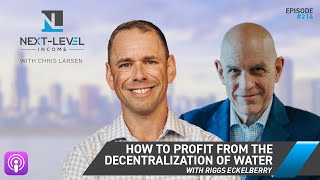
This content was created by Chris Larsen. This content was uploaded by Chris Larsen. This is a YouTube video titled "How to Profit from the Decentralization of Water with Riggs Eckelberry" created in July 2024. It features a conversational interview between Chris Larsen, the host of the Next Level Income show, and Riggs Eckelberry, the founding CEO of Origin Clear. The discussion covers topics such as water industry challenges, innovative water treatment solutions, water as a service, investment opportunities in water infrastructure, and the company's plans to go public. The content is an in-depth exploration of water decentralization and investment strategies related to water technology.
Will turn our talents to more of the products. And to do that, we've launched a crowdfunding for Origin Clear. So it's called regulation A, which is for anyone to fund those activities. But the accredited investors, they get a piece of water.
Welcome to the Next Level Income show where it's our goal to take your income, your investments and your life to the next level. I'm your host Chris Larsen. If you haven't yet, get a copy of our book for free at our website nextlevelincome.com that's www.nextlevelincome.com. just click on the book link and I'll even send you a copy if you put your address in. On today's show, we have Riggs. Echo Berry Riggs is a nationally renowned entrepreneur who deploys his personal break to build process to help rebuild the water industry which has reached a critical breaking point in recent years despite being essential to the planet's survival. As the founding CEO of Origin Clear, Riggs has developed innovative solutions to help businesses face rising water bills by tapping into new investment markets. He is even pioneering the development of water stablecoins, a cryptocurrency backed by water assets. With a diverse background in nonprofit management, ocean going, navigation and technology to disruption, Riggs is uniquely qualified to bring change to an outdated and overrun industry. And today we're going to talk about Origin Clear, the history of water in this country, where it's going and how you can take advantage and potentially profit. Riggs, welcome to the show.
Chris. It's such a pleasure to be talking to you today. And up in Asheville, we're in the right side of the, of the country right now.
Yeah, literally and figuratively. Right? Yeah, we were chatting before the show. You escaped California right at the beginning of COVID you're down in Florida. And you know, we were also talking before the show. This topic is really fascinating to me. I'll never forget I've been following T. Boone Pickens for a long time and one of the things that T. Boone Pickens says is he likes to pick long term trends to bet on, which really is how we see things with, you know, our demographic based investing. And we're going to talk about water today. And I mean, it seems to me that there are a lot of problems going on in the western part of the country with water. But before we kind of jump into that, Rigs, if you don't mind sharing a little bit about your background and you know, why, you know, as you say, why you're so perfectly fit for the solution to the problem that we have.
Well, it's interesting because the water industry, we take water for granted, right?
Yeah.
Oh, yeah.
Turn on the faucet. Yeah, I got a can of water, bottle of water, water out of the faucet, water in my pool. Yeah, totally take it for granted.
Right. But there, there's real problems and the water industry is very resistant to change. They too are like, no, everything's fine. So what my background really is a very international one. I. My dad was a country manager for Procter and Gamble. So we went from country to country and, you know, he was very well paid, but we were vagabonds, basically.
Yeah.
And then I spent a lot of time at sea, for example, in my adult years as a ship captain, South Pacific, all that wonderful stuff. By the way, it's not as romantic as it's put out to be, believe me. It's extremely slow. Anyway, so eventually I, you know, lots of adventures and I ended up in the dot com. And that for me was a revelation because it was the time computers were being used for communicating, not just computing. Right.
Yeah.
And it opened up a whole thing. And I was part of that gold rush. Some got some great exits during that time and in fact did some of my best work after year 2000. Because that's when the real companies survived. Right?
Right. Oh, yeah. Big shakeout.
Yeah. Yeah. So, you know, it was after 2000 that I got a couple really good successes. And then I wound up finally as the COO and president of the a company on the way to the nasdaq. And it in fact successfully did make it to the nasdaq. But excuse me. The time I saw the seeds of its demise being the number two, you see everything. And I was like, oh, this place is not gonna. Not gonna do well long term. And also I had the fatal flaw of a number two is that you always want to be number one. And so, so I, I.
Most of us. Right. Yeah, I can relate.
Like, I can do that better. It's a very rare lieutenant that does not want to be the captain. Anyway, so I contacted a fund and I told them, you know, I'd like to be a CEO. And they, they knew me from my work and I said, yeah, sounds great. And they helped me start a company. They, they specialize in going straight into the public markets as penny stock and invest by accredited investors in new technologies. So I was a new technology CEO with a patent and a bright idea which was to make biofuels out of microalgae.
Yeah.
Which Wasn't one of those. Huh. Ideas. And I had a ball. I, I, I debated T. Boom Pickens, I debated Jim Rogers, I did all kinds of people. I remember being on the stage with Tebow and Pickens and saying, you know, an area the size of the, just the fracking area of the Dakotas would, would handle all the biofuels of easily if you just had nice, you know, non toxic algae ponds.
Yeah.
The problem occurred.
Yeah. I mean like how deep would a algae pond have to be? A couple feet deep?
Two, two feet deep. Because the, the effectiveness, you know, the shadow effect. So yeah, they had the shallow and they're wide. Right.
Wow. Yeah.
The, the, the algae wants the sun. Anyway, there's all kinds of fun stuff and it was very popular. Stuart Varney said you'll be algae man on this program, you know. So that, that was great. One small problem and that is Exxon came up with fracking and they interesting. We, we forget that at the time now 2007, 2008 crude was at $120.
Oh people were talking about peak oil.
Back then and that's in $2,000. Right. Think about it today. So. Oh yeah, we think, we think oil is a lot but it was expensive on purpose. The administration's these days, we call it the deep state. Whatever we call it, they were keeping prices high to encourage renewables. Yeah. And which is a fine goal except Exxon found a loophole which is hey, we can do it cheaper and just you know, take over. And that's what happened. The price of crude dropped to below $50. And like you know what? We don't have a business model. We're done.
Interesting.
We were like Kodak film after digital happened. It's like oops, who wants film?
Yeah.
So, so then we really had to soul search and our technology which was to extract the algae from the water was really well suited to, to extracting sewage from water.
Oh, interesting. Yeah.
We pivoted into the water industry and I found out very soon that it's technology phobic. There's many, many technologies out there in water that are not seeing the light of day because it is funded. And this is a problem that we are actively solving today as origin clear. Now having finally figured out that alone was not going to be a player, we decided to make a transformation of the business of water. And that's where a really key webinar came along from lux research in 2016 where they outlined this new trend called decentralization. Now think about it. We somehow have decided to Treat all the dirty water at a central location. Which means that, okay, household sewage is benign. It's really not toxic. Right. It's got some drugs in it. Fine. But mostly easy to treat. The hard stuff comes from the factories.
Ah, okay.
Why are the factories being allowed to intermingle it with. With the domestic waste creating.
Why blend it all in? Yeah.
Why not treat it where it's being made dirty?
Yeah, that makes sense. Yeah.
When you think about it, it's like, duh. Right. And that's decentralization. Here's the interesting part. Those factories, when they see the economics of it, love it. Here's why we have a chronic underfunding of water infrastructure in our country today. Back in 2016, Lux was predicting that by 2030 it would be, you know, $150 billion a year, net. No, no, no, it's not even that. The newest number from the American Society of civil engineers, ASCE is 430 by 2029. Per year.
Per year. Under underfunded or funding needed.
Not unmet. Unmet requirements.
Unmet requirements, wow.
Yeah. Why? Because on top of all the neglect and underfunding, we now have the effects of what's commonly called climate change. And we will not discuss climate change this podcast, but suffice it to say, it's changing.
We just don't know what. We don't know the exact causes and the different things, and we don't know what ultimately is going to happen. But yeah, it's obviously the climate's changing.
Right, Right. We can observe that there are storms where there weren't droughts, where there were not floods, where they were not sea level intrusion into Miami, Florida's freshwater aquifer. Things like that are happening all the time. So that is complicated. So what we really. So what's happening is utilities are starting to really hammer their customers with rates. Rate hikes. Yep. Oh, yeah. Utility rates are inflating faster than college tuition and healthcare costs.
Right.
Which is.
Yeah. Which. Which have been on a tear forever.
Right. So we have a real problem here. And so these industrial clients, like, hey, guess what? I'll get my own system. I won't be part of that inflationary thing because I'll know the cost of. There it is. It'll inflate at the rate of, you know, the pumps and filters that have to replace. But so what? The second important thing is that they can reuse or recycle their water.
Ah, yeah.
Because if you send your dirty water to this, it's gone forever.
Yeah.
The cities don't recycle except in unique places like Las Vegas, which is a model for water conservation. The country as a whole recycles less than 1% of its water, whereas Vegas is close to 100%. And what stops other people from doing it? Well, here's the problem. It's the design of the infrastructure. So we like to say, save the planet. Recycle water. Do your own water treatment at your own site. Save money on that. You're isolated from the problem, and you get lower incoming water costs, so you're not affected by droughts and so forth. You're helping the planet. You're getting ESG credits, which still exist to this day.
Interesting.
And the third thing is, you're no longer subject to the politics of the local utility because they. They get into, like, unfunded mandates and that. The other thing. No. As long as you meet permit requirements, you're good. Yeah. So basically, it's secession. It's water secession.
Right. It's like, yeah, water. Or. Or you can say water independence. Right? Yeah. Some people. Some people may like, secession. Some people.
Yeah. Well, you know, if you're Confederate money, both south again.
That's right.
But. But seriously, they are able to secede or. Or privatize.
Yeah.
And what they do is they exchange the meter. Now, here's the second problem. Having realized that is. Okay, now that you've got that, how do I pay for it? I'm a brewery. I make beer. I don't have a million dollars for a water treatment system.
Okay. Sierra Nevada does probably here in. In Asheville. Those. Those guys spent like 300 million building their thing. But, yeah, your average. Yeah, we got 50 brewers here. Yeah. Let's say you're small, Small brewery. You're like, no, I can't spend a million up front. How do we pay for that?
Yeah. And if you want to, by the way, you probably have an SBA loan that's blocking you from getting leases and so forth. You've got some secrets, some secured instruments that are holding you together. And I talk to these people all the time. They're like, I can't borrow and I can't. I can't lease and go to merchant cash advance, and then I'll just go out of business. So.
Yeah.
Right. So what's the solution? Well, we came up with an idea, which is water as a service, which is that investors buy the system at that brewery.
Okay.
And then the brewery pays on the meter, just like they're accustomed to a gallon. And it's. And. And we mediate the whole thing. As a fintech and the investors, it's just like an oil well. We like to say water like an oil well. You know those, those master limited partnerships have been around since 1981 are very, a very, very good idea. We're doing the same thing, but with water. Right. How about that?
Yeah.
So created a way to have a frictionless implementation. Look, you can have all this fully maintained. You won't have to get a water expert or anything. And we'll just go ahead and have an, an accredited investor because we're the only player in water as a service who actually talks to the everyday investor. And that investor is investing not directly in that machine because that's very complicated, but in a bundle. Just like the master limited partnerships. It's a, it's a basket of, it's a basket of assets. Right?
Yeah.
They have a lean right to enforce the royalty that's built into their, their, their investment. So it's a, it's a, it's a secured asset for them and they receive a royalty from that. Now in addition, one problem is that master limited partnerships benefit from tax advantages.
Yep.
We don't.
Okay.
To make up for that is we give them equity in the parent company, Origin Clear and the new venture, Water on Demand, which is the water as a service company. Both of them. Now interesting in a minute what's happening with Water on Demand, which is super exciting, but maybe you got some questions.
Yeah, no. This is fascinating. And you know, I tell people, you know, being a numbers guy, being, you know, having an engineering background, had all these spreadsheets for my wife and I when we were in D.C. and looking for a new area to live. And Asheville kind of rose to the top and it was, it was number, actually number three on my list, but it ended up being number one. One of the things I learned in Ash about Asheville is we have our own water supply from the mountains up high up kind of just, just north of here. Blue Ridge.
Blue Mountains, is it?
Yeah, we're in the Blue Ridge Mountains right here. Just you know, smokies are just to our, to our west. But Asheville's in a temperate rainfore so we get a ton of rain, ton of water, which is, which is nice. We don't have to rely on a river that can be siphoned off like the Colorado for instance, and that sort of thing. So you know, it's one of those things that made me maybe pretty comfortable from a long term perspective. A couple questions rig. So when you look at somewhere like Vegas, you Know, they're getting water from, from the Colorado, right? Is that where they're getting their, their water too?
I'm trying to remember. From the Colorado, but a lot of aquifers.
So they get it from.
Well, you know, the Hoover Dam. Right. So that's. Oh, yeah.
Yep, yep.
And the problem is the Hoover Dam's been going down. It's, it's gotten down to its inlet. Inlets. Right. So it's, it's, it's actually in deep trouble.
Yeah.
So they, but they also have deep aquifers, you know, artesian wells. They have ways to get water, but it's finite, it's quite fine.
Right, right, yes, that was my question. Like, you have to, you have to. Once you get the water though, then you can recycle it. Right? Is how you do it. Can you get the water from like rainwater? Can you get it from other sources? Can you do collection? You know, so like, if you were in a real, you know, real dire situation, like, how can Vegas get more water if their water supply runs out, for instance, even if they're recycling 100.
Well, they have a small problem. They don't get a lot of rain.
Right.
Yeah, they, there are, you know, air harvesting technologies, you know, harvesting water from the air. But again, it's very dry.
Yeah.
So they're kind of in a pickle and. But they're, I have to say that they're doing an amazing job and they're a model for the country. You see if you can recycle. We've calculated that if, okay. Industry and agriculture is 90 of all water demand in this, in this country, okay. They. Humans are only 10% of the demand.
Industrial, agriculture.
Industrial or agriculture. Those two categories.
Oh, okay. Industrial or ag. Sorry, gotcha.
And they vary by country. Like it's. Somalia is mostly agriculture. Right. America, it's half and half. And in other countries, like, I don't know, Germany, maybe it's more industrial, whatever it is, but it's 90 across the board. And so they dominate in their water use. And what we've calculated is if industry and agriculture recycled just 15% of their water, we would double the available fresh water availability in this country.
Wow. Yeah, that's. Yeah, that's. So a 15% recycle rate increases a hundred percent of the available freshwater. That's a good, that's a good payoff. That's a great payoff.
I mean, why aren't we doing it? Well, yeah.
Are you a high income business owner or professional earning 2, 300,000 or even more a year, but still feel like you're living paycheck to paycheck. Are you comfortable working until you're 65 or 70 to retire? Or do you want to achieve financial independence and live life on your own terms? You could join myself and Matt4 and learn how we both became financially independent in our early 30s. We will teach you how to make, keep and grow your money. Teaching you strategies to maximize your earnings, keep your income that you've earned through tax strategy and legal structures, and ultimately teach you how to grow it by determining your personal investing strategy as well as teach you how to analyze investments so you can grow your passive income to the point to live life on your own terms. Our coaching clients reliably do this in seven years or less. To learn more, check out our coaching program at nextlevelincome.com forward/coaching. That's nextlevelincome.com forward/ coaching.
Actually it is happening, right? So the waters of service movement has been growing. There are players out there, one of them, but they're all funded by either private equity or by venture capital. Nobody is offering like what we get with oil wells, an ability for the everyday investor to get a piece of it. Right. The only ones doing it. And that comes from the fact that for a long time we have, we have worked with the accredited investor. That's what we do. And we know how to make the accredited investor happy. Because what are some of the problems the accredited investor has? Number one, time. So much time goes by before things happen. You make your money. And that also means dilution. So many early investors get crammed in the early stages and later on they're like, what? I was an early guy, now I'm nothing. So we pay very close attention to that. And we have everybody who stuck with us, we have kept whole the entire way. And that means that, you know, they have a huge piece of our venture, but they are also in good shape. And that's super important because as we're doing this water on demand thing or this, this going to the NASDAQ thing, which I can talk about in a bit. Yeah, we're positioning Origin to do more of these and to be a water incubator that works with regular investors, not the institutional or VC sector and that is, it's actually a huge marketplace. Right. And I don't know about you, but I have a really hard time finding to invest my money. You know, real estate assets are either at a way high or they're completely crumbled depending what sector, you know. And the Oil and gas should be going up, but it's not. And. And Gold's doing okay, but it should be doing better. Bitcoin is like. It's like a black swan. I have no idea. Right. So. But here is an opportunity to come in early. You know, Airbnb didn't get to get in early on Airbnb, except Ashton Kutcher did. Oh, yeah, he came in with, with Sequoia on the A round and he made 350, 000 on his money.
Wow. Yeah.
Well, good for him. I'm not. Yeah, go for it, dude. I'm glad even at least one individual got in there. But what does that mean for the rest of us? We get the pickings, the, the, the leftovers. And, and that's not good. So what I believe is let's give the register shot at an early space that is just beginning, but it's huge. Water, as we break up the water monopoly is what we're doing. Really?
Yeah.
Privatizing the water treatment, then it ends up being a much larger market, more interesting market, and it solves all kinds of problems. One thing I want to say is we do not want to replace the fresh water supply. It's not been a good thing where the cities have private their fresh water supply and inevitably it creates problems. We believe that it's governmental trust to supply water or else get your own from the ground. That's fine too. But what we're saying is we'll facilitate it, but we're not in the business of privatizing fresh water. The real problem is the wastewater. That's what's causing illness, you know, and these forever chemicals that are potentially the source of all kinds of immune diseases, etc. It's all coming from industry. So let's fix that.
Yeah. Interesting. I like that. So, you know, Riggs, one of the challenges that we found when we put solar panels on our house was that, you know, you can't just disconnect from the grid.
Yeah.
You, you are obligated by law to stay connected to the grid, and there's really no way around that. So do we see similar things in the water system or how does that work compared to the electricity grid?
Yeah, I noticed that because you're right, the energy companies are very jealous of their turf and so forth. The water companies, first of all, they're much more. They're not as private, they're municipal, they're not typically governmental entities. And they're like, great, great. I can't handle it. You know, I just got A mandate from the ep Move all of the forever chemicals from my water. Oh, they didn't give me money to do it with. EPA put out a mandate this year, get rid of forever chemicals, which they need to. And here's $5 billion. There's 150,000 sewage plants in America. $5 billion is like nothing.
Yeah.
So, yeah, it's an unfunded mandate. And so these people are like, God. Okay, fine. You'll take the problem away. Good, good. Get them off. Get them my plate. Because what's, what's the natural constituency for a municipal water system? It's the people. Yep, it's the people. As they might have said back in the day. So we want to serve the people. And that means, you know, like in Ireland, water is free. Well, why wouldn't it be free here? Well, it's because 90% of the usage is by corporate. So let's get those guys off the grid. And they're delighted too. So that's our mission.
Interesting. I love that. I love it. Okay, so we've kind of talked about some of the history behind this rigs. You said you guys are now looking, looking to go public and, and do that. Let's. Let's talk a little bit about that.
Okay, so back in late 2022, this fabulous lawyer that we have said, why don't you get acquired by spac? Right. Special Purpose acquisition Company, Blank Check company. And at the time now there were too many of them. They're all dying. There's still about 500 of them, but they're all just kind of just running out of time because they only get just. They get funded with $100 million, let's say, and they have two years to go find a company. And there's minority holders that are called the sponsors. They don't put. They are the sweat. And they own about 25% of the company. And their job is to go get that deal done. And so you find a company where that has, that has failed. They've. They've gotten the end of their rope. They're out of steam. They're done. And you say, okay, you buy out the sp, they go away. Half a million dollars. Bye bye, go away. Now, you're the sponsor. Now you to the spac, you are now the sponsor to say, let's buy that company over there, which is you.
Gotcha.
And fully disclosed. I mean, it's out open. There's no secret about it. We're making it clear. That's how, that's how it's done. But so we decided that we would do this. But the one problem is that that Origin Clear its cap table was a bit complicated for rapid action. So we just to take that new Water on Demand venture and put it up to be the target. And in order to make it valuable, we took, excuse me, two existing divisions. So Water Demand itself had the mission, still has of doing these water service deals. Right. So it's a pure fintech, but still in development stage, doesn't yet have a customer. It's still these water deals take forever. So it's doing, it's, it's got no revenue. What we did is we took two divisions that are in revenue, you know, growing fast, merged them into that and then we achieved sufficient to meet the regulatory requirements to be acquired. And so now our baby, Water on Demand is now up and it's going to college and Water on Demand is, is going to be acquired. It's, it's, there's a filing called S4 that's currently going on right now with the SEC, the NASDAQ application process and of course I can't discuss how it's going or when it's going to be. But yeah, it's, it's a process and has, it will end, I'm told. So then we'll have, we'll have Origin Clear, will have big ownership of that NASDAQ company and then we'll turn our talents to more of the startups. And to do that we've launched a crowdfunding for Origin Clear. So this is called Regulation A, which is for anyone to fund those activities, but the accredited investors, they get a piece of Water on Demand and that's the difference. So they get that royalty play. They get, they get equity in Water Demand, they get equity in Origin Clear. It's a beautiful thing. And because they, you know, Regulation A is very powerful, but you have to build a head of steam. You.
Yeah.
And so Kevin Harrington got very excited about us and so he came on board, he's now championing our crowdfunding. It's going to be a lot.
Oh, nice. Yeah, yeah.
And so it's going to get a lot of visibility and a lot of small investors and they will participate. Is Origin Clear, which is currently a penny stock, presumably will appreciate based on owning a chunk of this NASDAQ company, whatever it is, and but addition, all the new incubation deals that we'll do to take some promising technology or company, package it, clean it up, make sure it's going to succeed, get it funded and then take it out through Various means. You don't want to leave companies on the, on the OTC that it's only, you only get drip funding. I, I don't. OTC is not what it was when I started 16 years ago. It's. It's been regular to a point where it, it was too many people took advantage of. Of people like you and me.
And so Wolf, without Wall street, right?
Or Wolf.
Wolf on Wall street, right.
Oh my. Well, no, you're so right. And on top of the toxic lenders, I mean it's, it's been a party for Wall Street. But NASDAQ is good. NYSE is good. And now there's that new Texas I just heard about today. Txl, I think it's called. It's a blackrock and Citadel are sponsoring the a stock exchange in Texas that will r the Nasdaq. And then how about that?
Look at that.
So those are good. And so our job will be to get these on and then either acquired by a big water company or become itself a big player.
Yeah. Wild. So, Riggs, I want to, I want to continue this conversation. I love this topic. For listeners that want to learn more about Origin Clear that may want to get involved, what's the best way to contact you guys?
All right. Well, the simple way is to go to origin clear.com and there's a green Invest now button. And that takes you straight to a video by the amazing Ken Barringer who helped me create Water on Demand. He is so knowledgeable and they will have an opportunity to speak personally to him. This I don't think will be for long because he's just running out of. He's. He's working 12 hours a day. He's talking to people, but there's still a chance to talk to one of the originators. So that's what I recommend. Moodle around the Origin Pier site. Jump on to our LinkedIn, the origin clear LinkedIn and also my rigs and rigs E and on Twitter on X I'm rigs E and so. But the important thing is, is get into those videos. Yeah, forget that green button. It's got a whole lot of interviews, Nasdaq and all that. And I here's what's happening that Chris, we are at the early stage. What one water industry CEO said that the first trillionaire will be in war, right? Wow. Well, we don't think so. We want a million millionaires.
Ah, there you go.
We want to democratize it. Enough of this big guy stuff. They, you know, what happened during COVID it was the the, the high, the, the most the wealth got 3.8 trillion and the the poorest lost 3.8 trillion. An even exchange. No more. So we want, we want us to get a piece of this new asset class. Love that.
Love that. We'll have all these links in the show Notes Riggs if you're listening today, you can check all that out. You can check out originclear@originclear.com and we're going to keep following this story. Thank you so much, Riggs, for joining us today, sharing your story and sharing more about your mission at Origin Fear.
Such a pleasure. Thank you, Chris.
Hey Chris, here again. I hope you found this episode valuable. Now I have one more thing to give to you. We have a page for my coaching clients where you can get a free copy of my book as well as much more from previous guests on the show. Just check out nextlevelincome.com coaching to get a free copy of my book, audiobook and much more. I'll send you a copy of my book and cover all the shipping costs as a thank you for listening to the podcast. Also, please like share and take just 90 seconds to give us a rating on Apple Podcasts.










