Investing In Mobile Home Parks With Charles DeHart
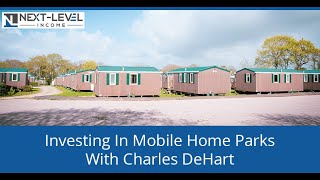
A December 2020 interview on the Next Level Income show where Chris Larsen interviews mobile home park investor and broker Charles DeHart. Charles recounts his path from the Marines to real estate, explains why he shifted from single-family to mobile home parks, contrasts mobile home parks with multifamily (tax benefits, lot-rent model, tenant-owned homes, longer tenancy), and discusses operational levers (roads, signage, office/amenity refreshes), management challenges, market pricing pressures, and a planned $20M fund (Requity Group) focused on Southeast parks. The conversation also notes production figures for Charles’s team and prior portfolio scale.
Foreign. Welcome to the Next level Income show where it's our goal to take your income, your investments and your life to the next level. I'm your host, Chris Larsen. You can get a free copy of our book@nextlevelincome.com and just click on the book link. Today's show is sponsored by Money Insights and their investment optimizer strategy. In my book, I share how I've used this strategy to invest my money in two places at the same time. This strategy has also been used by the wealthy for generations for estate planning, minimizing taxes, preserving wealth, as well as increasing stability for investments. Money Insights can help you build an emergency fund, pay for college fund, a business plan for retirement, as well as optimize your investments. You can check them out@nextlevelincome.com banking on today's show, I'm excited to have Charles DeHart. Charles currently co manages a team of brokers at Marcus and Millichap alongside his partner Glenn Esterson. Coming to the end of their first full year together, the team is on track to close out close to $250 million of mobile home park transactions this year. And prior to transitioning to brokerage, he also co founded Sunrise Capital Partners alongside Kevin Bupp and Brian Spear and they grew to over 2000 units within three years of founding the company. Charles still buys communities and has partnered with Dylan Marmot to form the RE equity. I'm sorry, I might have to have him tell me if I said that right. I believe it's the Requity group which focuses on buying high quality, underperforming commercial assets. And to date they have closed on 163Mobile Home park spaces and is prepared to launch a $20 million fund to pursue more assets. Charles currently lives in Tampa with his beautiful wife. Charles, welcome to the show today.
Hey, thanks a lot.
Absolutely.
Glad to be here.
Yeah. So sorry, man. How did I pronounce that? Did I do it right? Did I do it wrong?
I don't, I don't know how to pronounce it either. That's Dylan's Dylan. So sometimes I purposely mispronounce it just to bug him.
But yeah, it's requity and I see re and I always say re. So yeah, so the Requity group. R, E, Q, U, I, T, Y. So Charles, we've talked several times here, but for the audience who doesn't know much about your background, kind of talk about your journey to where you've gotten today.
Yeah, so it's been kind of a. I Guess a mess of a journey, I guess say, to get here. But I started off in the, in the military. I actually did my first, I guess you could say it was my first real estate investment while in the Marines. Went overseas, did a deployment, had some money and my grandfather suggested that we build a house. And so I took that money, used it for the, for the land and funded some of the construction of the house. And him and I, and my, my dad built a house which ended up getting used kind of as a rental property at times when I was gone and then as a personal residence. And so that was probably my, you know, and a personal residence really isn't a, an investment property. But that was, that was kind of my start, I guess you could say. And after the Marines, I did some private contracting. And at that point I had, you know, I was getting paid good money. So had a friend that Atlanta and he was telling me that he was doing some single family home investing. And I bought two or three single family homes. Probably not the wisest decision, but the market at that time kind of bailed me out. I actually made quite a bit of money on those three homes. But operating that from overseas was very challenging.
And then talk about out of state, right?
Yeah, yeah. It was a little bit different than out of state closing it was weird too because, you know, you have to use specific degrees that have international. Have the ability to do it internationally. So it was kind of, I don't know, it was just a learning experience, I guess. So did that and realized pretty quickly that I was like multifamily is probably better than the single family. It was pretty obvious. And so I started looking for apartment buildings, like smaller apartment buildings. Put a seven unit in Charlotte under contract. It fell out. I really didn't know what I was looking at, so I just got spooked off of it. And then a broker eventually showed me a mobile home park and the owner of that park kind of walked me through business model and it just, to me it just seemed genius. You got tenants who own the thing and they own their own home and you take care of the roads and the water and sewer line. Then you just charge them lot rent. And he was kind of telling me about the profit margins versus apartments and things like that. And it just just seemed like a deal. So ended up doing some getting into some coaching there, like bought some coaching, learned the business, and then took about two years to buy a park. But that was ultimately what freed me up from that overseas job. So bought a park. Had met Kevin along the Way bought that park, quit my job, moved to Tampa, and then we. We bought 20 more is basically the short end of the story there.
So 20 more communities, right? 20 more mobile home parks.
Yeah. We ended up on, I think, 21 or 22 communities. We've sold some since then. I think I own 16 now. But it's been a good business.
Yeah, that's awesome, man. And obviously we share some commonality when it comes to our penchant for multifamily mobile home and that. So I want talk. So where were you stationed, by the way, when you were overseas? Can you say?
Yeah, yeah. When I was in the Marines, I to. I deployed four times in six years. Went to Fallujah in 2006, 2008, I was south of Samara, Iraq, and then 2009, went to Al Assad Air Base. That was a pretty boring one. And then went to.
Boring is good over there.
Yeah, I was kind of all over the. And the last one was Afghanistan. And so I went to. We were at Camp Leatherneck and then spent some time in Kaji and a little bit of time in Sangin. So it was a good. It was a good mixture of. I was all over the place when I was in the Marines. And then after that I went contracting and lived in Baghdad for about five and a half years.
Interesting. Yeah. One of my former business partners was a Marine. And yeah, I just appreciate everything you guys do. My family, my uncle's father, grandfather, they were all Navy, so I grew up not too far from the Naval Academy, coincidentally. But yeah, so I guess talk about. You talked about kind of the scalability going from single family to really mobile home parks. You know, we've had a lot of people on the show talking about multifamily. That's. That's next level income's big focus. That's our focus.
What.
What is the difference between owning a mobile home park and owning a multifamily building? You talked about, like, lot rent versus that. If you can kind of go a little bit deeper into that.
I've actually never owned a multifamily building, but so I have to kind of imagine what it's like. Some of the differences are. You know, really the biggest difference is there's two big differences. One is the tax difference, the tax advantage difference. Like our entire investment is pretty much land improvements. And so for all the accelerated depreciation stuff, it was a tremendously better deal on the tax side. You know, multifamily is kind of caught up with the new, you know, accelerated depreciation all that stuff. But, you know, we were on a 15 year schedule for pretty much 75% of the investment. It's been that way forever in this industry. And so that seemed like a much better deal, which was one of the reasons that I picked it. That was one of the big reasons. And then just from a management standpoint, when the tenant owns their own home, there's kind of a couple of different ways to look at it is as a landlord, the turnover rate is so much less frequent. However, it also does give you a lot of leverage as a landlord. And so there's a lot of ethics that play into. You manage those tenants because you do have a lot of leverage there. You could raise their rent however much you want to. And really it's very difficult for them to leave. And so that's been a thing that's happened in our industry where I've crossed the ethical line occasionally and just trying to find what our company's ethics are on those kind of things. And that's been part of the learning experience that I did not anticipate. But as far as turnover rate, I would say your typical tenant owned home person, the person owns their own home there and is probably going to staying on average maybe 10 to 15 years.
Wow. So, yeah, I mean, you Compare that to 18, 24 months on the multifamily side, that's a big difference.
Right. And so, you know, occasionally we'll own some of the homes inside of the park too, and we'd see turnover rates that are very close to apartments. Like average lease length, depending on the type of community, might run from 20 to as high as 30 months. But on home side, I mean, there's people that live in some of these parks for like 50 years. They bought a home when they were 30 or whatever and they ended up living there their entire life.
Yeah. That's incredible. And what. So, you know, the communities that we're buying, Charles, you know, we're looking at rents somewhere. You know, today's acquisitions, 1000 maybe to 1200 or maybe upwards of $1400 a month. Affordability is becoming a huge thing. I'd like to talk about that, but before we do, what are you seeing for average? And we're talking about lot rents. Right. So we're talking about what you're paying for a lot. But what do you see as an average lot rent on a monthly basis in the mobile home space?
I'd probably say, and it's gone up a lot since I began a lot faster than apartments have. And I think it's because of the constricted supply that, that we've got. But I'd say nowadays it's probably somewhere between 350 and 400.
Okay. So if you're looking at, you know, if you're looking at somebody that's living there, I mean, this is. I was having this conversation with my uncle. He lives out in Colorado, kind of in between Aspen and Glenwood Springs. So it's one of these tourism towns. You know, they're facing a lot of issues where people can't afford to live in these cities. But there's all this space kind of on the plains in between the mountains. And, and I was looking at these really great mobile home parks. I was like, this is a terrific option. It looks like in areas that there's an abundance of land and you're looking for affordability and there's some really nice, I don't know if you call it manufactured housing or even like tiny homes today that you could put on here. So if you say, okay, what's the total cost? Obviously there's lot rent, but if I'm going to go live in, call it a mid tier, maybe upper and park, what's the total cost for a resident living there?
I'd say for a. I don't have a lot of experience in that part of Colorado, but I'd say lot rents.
And yeah, just in later communities.
Yeah, it's total cost for a tenant might be, I mean, in a park like in that, that part of Colorado, you might see the lot rents being 1000 or more in and then the mobile home and actually might be over 100,000 in some cases, depending on where it is, it might be a half a million for that home.
Wow.
I was at in Colorado re too, and my wife had to bear with me while I swung through one of those parks and asked some people some questions.
So I love it.
But I don't know, it's in our parks. I'd say we usually hold our rents probably about 10 to 20% below market. That's kind of where we're at. We're slowly creeping those up to market. So we bought a lot of our communities well below market. So I don't have any of our communities that are at market rent right now, but we're probably sitting around 10, 20% below market on most of our parks.
And then.
We typically try to pass through the utility costs and then if it makes sense to pass through like trash and stuff. I don't like nickel and diamond people. I'd rather just do it through rent. But if it does make sense, if they're getting like individual can service at their unit, they're probably gonna get that passed through. If they're taking their stuff to a store, we probably won't pass that through.
Yeah, yeah, that makes sense. So, okay, so in the multi family space, there's a lot of different ways that you can improve the income on these properties. So these mobile home park, multifamily community, they're both valued on net operating income. Correct. So we raise rents typically through improvements. Then we have operational efficiencies. So in a mobile home park, if you don't own the home, what are the improvements that you can make? You were talking about land improvements. What do you actually do to increase the revenue on that park?
The biggest one is the biggest you see with people who, when a community turns over, is repaving the roads. And so a lot of people repave the roads, new signage, and then maybe do some improvements to the office or a lot of the amenities. And some of these parks have gotten old and tired, so they'll just refresh them and then they'll go in for a, you know, a significant rent increase out of the gate and then slowly creep it up to market after that. That's kind of like the bread and butter strategy most people do with them. I think one of the unique things about parks, Dylan was kind of explaining this to me that in apartments, it's just odd to me that apartments transact every five years. Just makes. Doesn't make a whole lot of sense. 5 to 10 years. Why would you take the risk of bailing out of one community and going into one? Uh, but he kind of filled me in that, you know, that's kind of the timeline where the capex needs to be done. Again, you're just refreshing. And so you send it back out to mark. New guy comes in, they do their improvements. They. They basically just do the same blueprint.
Yep.
But in mobile home parks, I mean, your roads, you know, how often do you really replace a road? It's not that often. So you see a lot of these communities get held for 20 or 30 years. It's just not uncommon.
Yeah. So, I mean, Dylan's spot on. And you know, we just bought a community. We closed on it last month and it was a 2018 build. And we're still being able to go in and make some improvements. Just because the market has changed in that particular area to the point where, you know, some small changes with respect to the finishes is going to allow us to increase that. And then you have other like we'd sell to people, to groups that they want something that's stabilized. That doesn't take a lot of capital investment. So even three years may not be an unreasonable timeline to go in and do that and flip and redo the strategy. I think that's one of the areas that I've looked into. It seems like mobile home parks tend to have higher cash on cash returns than multifamily, where the overall returns they can be similar or maybe a little bit higher, depending on where you go. Can you speak to that? The cash. Cash returns. And you don't have to talk specific numbers, but it seems like these can be real cash cows if you get them stabilized.
Yeah. Because what creates that is there's two types of valuations that go into these things. So the lot rents, all of the revenue and expenses. You have to kind of imagine the park is two different views. Let's imagine because you'll get a park and however it comes, but the optimal business model is to have everyone own their own home. What does look like when that happens and those expenses and those revenues that are still present after the homes are all sold off, that net operating income is capitalized, whereas everything that spins off of the mobile homes, none of that income or that expense is capitalized and is done instead is you value the home based on what it's worth. So it's kind of like a car. If I buy a used car or if I was buying a taxi company, I wouldn't probably. I don't know how to buy a taxi company, but I probably wouldn't buy the cars based on their noi. And so that's the way that, you know, mobile homes are done is that makes sense.
Yeah.
And that typically creates. If you look at. If you look at the revenue and expenses on your typical mobile home and look at what the prices that investors are paying for that mobile home, it probably works out maybe a 12 cap if you were to capitalize it.
Yeah. And that's. I mean, we're seeing, I mean, four to seven caps in the multifamily space. So a big difference. So cap rate is for those that don't know. You can check it out in my book, I talk about it. But it's basically, if you buy something for a million dollars, a 10 cap would be. You're getting $100,000 of net operating income on the back of that.
The difference is though, you can't push because it's not valued on the cap rate. You're getting a high cash flow but on those homes you can't push its value.
Right, right, right, yeah. And that makes total sense. So it's a blended strategy when it comes to that. So what changes have you seen? So you started, was it 2014, you started in the mobile homes park space?
Yeah, right at the tail end of 2013. 2014.
Terrific. So what changes have you seen Charles, over the past six years?
It's been a lot, I think, you know, we've, it's been, you know, being on the broker side, I get to see a lot of what's happening, all the relevant things and seen a lot of people coming from apartments. Just tons of people coming from apartments. When I first started in the business, people, people did value the upside. I don't think that ever existed. Where people say all the time they don't pay for upside. I don't think that ever existed in any market cycle. But there was still a little bit of that going on. Now it's super, super aggressive. It's to the point where there's. You still to buy a park even at a market price and have a margin of safety to give your investors the rate of return they're expecting nowadays, you have to be very. I look at it as the market has priced itself to a point where operators who aren't very good aren't going to make it. And so the very good operators, they can still function now, but the ones that aren't very good, they're going to have a hard time.
Yeah, absolutely. So who's operating your parks? Who's running that side of the business?
We are, we tried third party management. There's, it's a problem of geography where it makes it really hard for a company to get third party management. And so one of the companies we went with had a very big management portfolio, about 40,000 lots, but they were in 30 different states. Oh wow. And so they did a fairly good job, as good as you could expect being stretched so thin. But there's just not that good options for that kind of thing.
Yeah. And I mean even us, we have different management companies in different geographies also in, you know, depending on, you know, where that property is, you know, in the, in the stack, you know, is it B, is it A, where's it going to be? So it's so important. And that's what I talk about like that's, and you know this, that's where the rubber meets the road. Right. You can have the best property in the best market and have crappy management and it's not a good deal. So that's, that's terrific. So let's, let's talk about, let's talk about the equity group. Let's talk about the fund you guys are raising. You know what you're targeting? $20 million fund, that's a good size. What, what are your targets and what are your goals with that?
Yeah, we like the, I don't know, Dylan and I, we've, we've spent some time, I've kind of walked him out. Markets, price in these things, it's a little bit different with two different types of evaluations that go into it or some of these mobile homes are sold on. So you're then basically doing some note buying as well. So we spent some time doing that and really our targets are the Southeast. We like Southeast. And since he's now in Florida we're basically our investment thesis is still together but we're building the Alpha and Tennessee and North Carolina, Georgia and hoping that that allows us to get competitive on deals in Florida.
So Charles, one piece of or one question we ask for every guest that's on the show is if you go back to your 25 year old self and give yourself one piece of advice, what would it be?
Oh, okay. I probably wouldn't have listened but I guess I don't know. I actually really, you know sometimes I think it have been really nice to have gotten into real estate a lot sooner. But on the other hand I got to do a lot of things that there's very few people that got to do the things that I got to do. So I probably would suggest that I'd get into real estate a little bit sooner though. Just a little bit. Just a little bit sooner.
Now it's never too early to invest so if you're listening and you're like oh man, I missed the boat or the best time to invest is yesterday. The best time to invest, second best time is today. So if people want to learn more about you, what you do at your brokerage, Charles, if they have any questions or maybe they're looking to transact or buy something and they want to learn more about the requity group, what's the best way to find out more information and connect with you guys?
Yeah, the requitygroup.com is the site for Dylan and I on our capital raise and what we're doing on mobile home park buying side and then my brokerage partner, it's the MHP expert domestic that's you know, if you're looking for mobile home parks to buy. You can go there. And we've got five agents that are all country. I mean, we've, we do them all over the place. We've got them all the way from we got one deal in Silicon Valley, California, and then, you know, pick out the most random tertiary market. We've done them there, too.
That's awesome, man. Now I'd love to hear more about that. And if you want to learn more about what we do at Next level income, you can check us out@nextlevelincome.com again. You can get a free copy of our book by clicking the book link again. We're going to have the links for Charles and Dylan's information. It's the recity group.com and it'll be in the show notes. Charles, thank you so much for being on the show today.
Thanks a lot.
Providing Absolutely, man. Great to see you.










