Maximizing Income-Generating Options to Maximize Growth with Laura Alamery - Episode 101
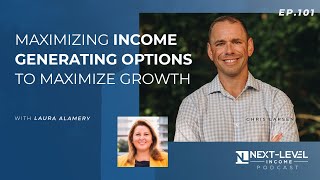
Podcast episode (Next Level Income, Episode 101) featuring host Chris Larsen interviewing Laura Alamery, a residential real estate investor and mentor with 30+ years experience. Laura describes her path from Italy to the U.S., early influence from Carlton Sheets-style creative-financing techniques, and building a portfolio focused on multi-family residential properties (40+ doors) using lease options, owner financing and other creative methods. She outlines strategies she teaches (wholesaling, fix & flip, buy-and-hold, Airbnb arbitrage), coaching formats (masterclasses, live events, quick-win challenges), student outcomes (students with 50+ Airbnbs; a student buying 21 houses in 11 months; daughter wholesaling 6–10 deals/month), and her view that market cycles create shifting opportunities rather than a permanent stoppage of deals.
Today's show is sponsored by the Airbnb Kickstart course. My wife and I started our first Airbnb here in the last year and we've come to love the ability to earn more money than we would if we had a long term rental. If you're interested in starting your Airbnb business with little money, scaling your Airbnb business, or just learning tricks about the industry in general, check out our airbnb course@nextlevelincome.com Airbnb BNB. That's a I R, the letters BNB and you'll get a 20% discount code. On today's show, we have Laura Alameri. Laura is and has been a real estate investor for over 30 years. She now mentors new and experienced real estate investors nationwide. Laura has experience in all aspects of residential real estate investing, from wholesaling to buy and hold, fix and flip, as well as raising private money from acquisition to disposition of the properties. She has a team of investors and partners with a proven track record who can do it all. Welcome to the Next Level Income show where it's our goal to raise your income, investments and life to the Next level with your host, Chris Larson. Get your free copy of his book@nextlevelincome.com book also, if you're an accredited investor, check out the Invest link to learn how to gain access to institutional quality real estate opportunities. Laura, welcome to the show.
Thank you for having me today.
Absolutely, it's my pleasure. And I had a great time being on your podcast. We shared a lot of similarities in our, like, our real estate journey, yet we have very different backgrounds. I'd love for you to share your background and some of your history with the audience here.
Sure. Well, first of all, I'm sure you will notice my accent. I actually grew up in Italy and I came to United States in 1985 and it took me about two years, only two years to realize that real estate for me was the way to go. I was actually Hawaii at the time and my husband was in the army and I saw what real estate was doing back in the 80s. The end of the 80s in Hawaii was totally booming and I said, I want to be in that. I was looking for something part time to pay for college and that seemed the way to go. And then I caught real estate bug and that's what I've been doing since 35 years now. But I started actually as a real estate broker in Hawaii and then when I moved to England in 91, I got into investments.
Awesome. And yeah, that is a very high level overview of your story and there's a lot I want to kind of pick up through that part. So you started as a broker, but then you started investing on a part time basis. And now one of the big things you do is you teach other people how to do the same thing. I did the same. I was working, I was managing real estate part time. Tell us about your first deal and how that came to be.
Yeah, well, while I was in Hawaii, I was reading up about real estate investing. I was intrigued and interested in getting into the investment and I picked up some books. I remember one of them was Robert Allen, no Money down. And then I saw an infomercial with carton sheets and I bought this course. You know there was $150, I remember that and I thought that was a lot and I studied that, I devoured the information. So when I moved down to the mainland, I saw that was my prime opportunity. I moved into the Midwest and we lived about two hours away from the major metro, any major city. And so I wanted to build a rental portfolio. I wanted residual income. I had two small children at the time, a two year old and a few month old baby. And I wanted to build a residual income because so I didn't have to find job. And so I started investing from, you know, two hours away. Started investing into the main metropolitan area, which was Lewis at the time. And then I also went back to college. So here I'm raising two children investing part time and I went to back my mba. So that's where I started. And my goal was to accrue a $5,000 residual income every month from rental. So that says that would be enough for me to afford the lifestyle with my children that I wanted without going back to work. Well, I well surpassed that. My goal is 5,000 in a year. In about 18 months I actually had reached 10,000 in residual income.
That is awesome. That is awesome. I read Robert, I think I had Robert Allen's Nothing down for the 90s. He came out with like that. The second version had Carlton Sheets course. Were you using those strategies, Laura, to pick up these properties? Were they resident?
Were they all residential properties, the Carlton Sheets? I don't remember much, much about Robert Allen, but I'm sure I picked up a lot from his as well. But I remember that the biggest thing for me was Carlton Sheets and was kind of because I bought this in 1991 and obviously I lost the course for the ages. But a couple years ago I went and bought a tape on eBay. Because there was a VHS tape that really resonated with me. And it was when you opened up the big box, it was at the top called Quick Start.
And it was yellow tape, big plastic box that looked like a book, right? Yeah, yeah.
But there was a VHS tape, which I still have because I bought it two years ago, eBay. And it says Quick Start. And so I bought the tape. And I remember two years ago, my husband said, do we even have a vcr? I was like, yeah, we do. We do in garage. So I went to garden and we were. I listened to it. And what really got me, I think, is that his strategy was really simple, but very. It was a genius. So basically you show. It shows him sitting at the kitchen table, you know, with one of those big phone with a long cord that come from the wall in the kitchen, sitting there and getting the Sunday paper and circling everything in the sign, the paper that was rent or for sale by owner. And then he would call these people, and he shows him. Him calling people, and he would say, well, I see that you have your house for rent at such an address. And he would say, do you think you might consider to sell this house in the future? Okay, what is that? And, you know, it shows him the tape. It shows him the conversation. So I was like. So I said, what do I have to do? Right? I started doing the same thing. So I'm gonna send paper circling and start calling. And. Well, basically, he was doing lease option to buy, right? So he was doing a lease option and he was doing a sandwich lease, right? And then he was doing some contract for deeds, and he was doing a subject to, you know, this, that. But he was keeping it really simple. He never. He never mentioned these big words. He always said, you know, and so he was having these conversations, and then he was in driving his old big cat, I think was a Lincoln Town Car or something. It shows him going to the properties and looking at the property and information, having his conversation with the seller. So. So the whole tape was about him doing this. And that's how I started doing it myself. I started doing so. But one of the things that happens as you start having these conversations, as you go out there and conversing, as you go out in the field and start looking at things, one thing spools another. So I started doing owner financing, lease options. I started buying some REOs from smaller banks, local banks. So one thing pulled to another and over and over, and that's how I built up the business. So that was actually the most Important tape of the whole course for me. And now everybody is going to go get the $0.99 tape on eBay.
The hardvar won't be finding the tape, will be finding the VHS player. Absolutely. No, I love it. So how many properties did it take you to build up? 10,000amonth.
I have over 40 doors, meaning there are multi families mainly. I had I think one or two single, but most of them were two, four, six and eight units. So that's how. Yeah. And all of them were done with creative financing.
I love that. So, yeah, if you're interested, like lease options, you know, these, these wrap leases where you call it a sandwich lease. I think a lot of this creative financing people have forgotten about. You know, investors call me Laura and they say, oh, you know, I want to. I'm going to go buy a rental today. And I'm like, well, how much is it going to cash flow? Oh, $500 a month before expenses. Which, you know, it doesn't. You're not really making any money. Do you think these strategies can still make money today? What are your, what are your opinions on the strategies?
Oh, definitely. I have students right now that still do that. I have one student actually right now. She has over 50 Airbnbs. She does a lot of arbitrage with Airbnb and short term rentals. Actually, she's teaching. I hired her to teach to the other students how she does that. I. Another one, she bought 21 houses in 11 months using strategies. So yes, they do work now as well.
No, and I love that. That's one of my favorite strategies is short term rentals. Today. The margins are so much bigger. My wife and I have two here in Asheville, North Carolina. And if anybody's been listening to the podcast at all, they've heard me talk about it. Are you seeing the same thing in short term rentals versus long term rentals?
Yes, yes, definitely. Actually, she has a rentals in Greenville, which I believe in.
Oh, yeah, right.
That's.
Yeah, that's like an hour away from us right here.
Yeah, so that's where most of our rentals are. And she also does fix and flips there. But yeah, no, I still see that being very. Works for both of them. And so, yes, having this conversation, you know, and I like when we deal even because we do fix and flip and wholesaling as well. And a lot of you come across the seller. I'm sure a lot of you do. They say, oh, yeah, well, you know, if I don't get my price right now, I Just keep renting, right? And so, like all the time, I come across that, yeah, if I don't get my price, which obviously they want market or more, I'm going to keep renting. And then I'll say, great, I rent from you. And they take him back, right? So say, okay, what are you talking about? Well, can I rent from you? And then maybe we can come with an agreement for me to buy in the future because you're also interested in selling. Otherwise we will have this conversation. So by doing it that way now you can turn around and say, I'm going to rent house from you and you can do arbitrage, you can do sandwich lease, you can do whatever you want, and then you buy from here a year, two down the road. But what's going to happen is when you do it that way, you can kind of, you know, come to an agreement now and block the price at the future value. So if he wants 100,000 in the market right now, property is 100,000 where you're not making any money today, but you can say to him, okay, I'll give you 100,010 two years from now. And it's like, whoa, okay, it's going to go up and down. And she's still willing to give me 110. Now my contracts are also built that we can renegotiate if there's a market fluctuation of more than percent. But you know, that stuff that we have in the contract. But the thing is, yes, now you can turn something that says, well, I'm not interested in selling, discounting the price, but I want to rent now. They become owner financing.
Yeah, I love it. I feel like, Laura, you know, so many people, you know, they. It's like they have, you know, their one utensil and they're trying to figure out a way to make real estate, especially residential real estate, work in today's market. And what you teach your students is more like a Swiss army knife. You have multiple different options. If, if one isn't a great fit, you're able to pivot and do that. So tell us a little bit about your coaching program, who you specialize in working with. And, you know, you've mentioned a lot of different strategies now, which I'm sure, you know, some listeners are a little bit glazed over. Maybe you can shed a little bit more light on that.
Sure. Well, mainly ideal. First of all, I deal only in residential. Okay. So I don't do any commercial. That's not my niche. Residential up to four years is considered Residential. And we do anywhere from wholesaling, fix and flip and buy and hold. Now personally, I'm actively with my daughter. We work with my daughter. We do wholesaling and fix and flips, mainly wholesaling. But I do cherry property, cherry pick properties to do fix and flips as well. The rent that I have are with a business partner. Most of our rentals have been paid for. So you know, we started buying back in the 90s and so we do teach nationwide. Thing I also do is a private money raising private money in syndication. So I have a lot of experience with that as well, which exponentially grew my business started doing it. So with that said, we do teach residential wholesaling seems to be a big one because I think honestly a lot of the students that come to me or want to be investors are really new beginners in the business. I do, I would say the second one that come for us is buy and hold, especially rental and Airbnb and then also there is a fix and flip. But we do teach in all of them. And our strategies is mainly what works right now in the market. And they're very direct, very step by step, we give you a straight path. You know, right now I'm going for what I call a quick wins challenge. Students. So when I have students that come to us new, we give them seven strategy, one every two weeks to put deals under contract right away with marketing. And right now we had a quick win strategies last week and I have, I think all together we had over 50 contracts by all my students in different things. So using a strategy that doesn't require any cost in marketing, no cold calling, nothing like that. We have a lot like that, as I call them quick wins. You don't make huge profits. I think the most profits they make is anywhere from 2,500 to $10,000 per deal. But still, right, you want to do one or two of those and you. Yeah, every month.
Yeah, yeah, I love that. What are your favorite strategies today for? Cause investors call me, they're like, hey Chris, where would you start today? Like, I'm looking to build my first fifty thousand or a hundred thousand dollars. You know, what are some of your favorite strategies today, Laura?
I love, I always love wholesaling with fix and flip. Like I said, I'm very selective with the fix and flips though. So I would say I love wholesaling. It's quick, it's easy, you can do it anywhere. You know, you can travel. I do a lot because it's virtual and you don't need any money to start with. You know, my daughter, when she started seven years ago, she had no money whatsoever. She was working for something on the side. And now she wholesale six to ten properties a month. So it's. Anybody can do it. I mean she was in her mid-20s when she started money. So yeah.
So do you mind for anyone that is just hearing wholesaling for the first time, do you mind articulating what that is?
Sure. So you basically one of the best. One of the main thing you have to understand, because I know there is a lot of bad rap about wholesaling is that you are not selling property properties. Okay. You're not an owner on the property. What you do is you come across an owner. Like I said in the example earlier, you get an owner that you're willing to talk to. It gives you a contract, either a sale contract or a lease option. You can do it with both. And then you're going to sell the contract to somebody else. You can assign the contract, you can assign the lease option. You can do it what they call a double closing, where you actually close, but you close on the contract, not closing. You're not selling the property. So when you go out there and market your market a contract, I never say a market in a property because that's not what I'm doing. I don't own the property, but that's what it is. So let's say the property is worth 120 and you get a property on the contract for 100,000. You know, and people say why would the seller take 100, the properties 120. Especially in this market, those second guess why people do things. It's not always about money. You know, a lot of time don't want to have to deal with having agents and they have tenants in the house. They don't want to have all this marketing, all these people coming through. They don't want to deal with all kinds of inspections. So there is a lot of reason why people will take a lower offer. But so you put in a contract 100,000. Now you're going to find a buyer for 11015. Remember, you're wholesaling, you buy low and sell low. So you have to still give a good deal to somebody and you make 10, $15,000. So as simple as that.
Yeah, that's. I mean, and look, that's how that was one of my strategies starting out. I have coaching clients that have used that. I have good friends here in Asheville that use that strategy. And it's it's an amazing way for stepping stone as you're building up capital. If you say, hey, like you said, I don't have a lot of money to get started, where do I start?
Right.
I love that. One of the other things I love about you, Laura, is you work with your daughter.
And.
And my boys are 10 and 12, so I'm starting to teach them kind of like the family business. What are some tips that you have for people that are working with their family or trying to just teach their children some of these financial lessons that you've done such a great job teaching your daughter?
Well, first of all, your children must want this, because I have four children and she's the only one who has an interest.
Okay, fair.
That said, don't try to force feed into somebody that with her many years, she did not have any interest because she was born in the business real estate when she was born back in 1989. So she was. She grew up in it, but she never had an interest. She went to school for totally something else in the medical field and then. But she, when she started going for some things in her life and she was going through a divorce at 25, already had a small child, and she was looking for something else of supplementary income. And. And so she became my assistant with real estate. And all of a sudden, hey, she started paying attention, right? She said, oh, my gosh, she's making all this money. She has the freedom. Her students have the freedom. It says, I wanted that. So. But it was her getting into it. So my other three children have no interest. None whatsoever. So you have to really see what it is. I mean, you live by example, right? So they see you and they say, okay, I want to be like that or I want to follow in the footsteps. But you can't force anybody because at the end of the day, if I don't have the interest and that drive, they're not going to be successful.
Absolutely. No. That's so important. Again, it's awesome that you get to share that with your daughter here. So one of the things that I've talked a lot about here recently is where we are in the real estate cycle, and I see a lot of similarities today with the millennials forming households as we saw back in the 80s. As you mentioned, the real estate market was on fire. The baby boomers were buying properties, have really drove housing prices, has drove the stock market up. And we've seen a lot of the similar, similar things today in this cycle. What do you think the future holds for real estate? Laura?
Well, like you said, there are cycles, right? So, you know, I always say I've seen three different recessions over the years. And so we're going to have a slowdown and a setback. We're going to have adjustments. I don't think that we're going to see the prices drop to pre level of what we had the last couple of years. I think we're going to adjust some parts of the country more than others. You know, I think that this year we're still going to ride the wave. Pretty high appreciation is still going to be there. Not the size last year, but we're still going to see it. And then I think in next year, you know, things are kind of slow down and adjust, which has to. Because obviously, you know, the income for people qualify for mortgages is not keeping up with this inflation that has been happening. So with that said, you know, right now is a prime time to really position yourself to go out there and make deals. And you can always make deals. That's the thing about real estate, you know, when one door closes and everyone opens. When 2007 happened and everybody running for cover, well, there was so many opportunities in real estate. You know, I started doing a lot of short sales, you know, so all the sudden I shifted gear and got into short sales and made a lot of money doing that. And so there are always opportunities there. People say, oh, it's too competitive, it's too this, too that. Well, it's all about a mindset. You know, if you see competition, there's going to be competition. I had a student here in Miami right now, which is probably one of the most competitive markets. She just $80,000 on a wholesale deal in Miami. Okay? So it's not, don't think of that being competitive. It's what you believe. Don't tell yourself the story. And the opportunities are there. And when the market changes are going to be different opportunities. And so you can always make money. I've been in real estate for 35 years and trust me, you know this. I never been out of a job.
Yeah, no, I think you're exactly right. I think, you know, just like if you're on the sports field and the defense changes, you have to be ready to change. If the offense changes, you have to be ready to change. You have to move with the market. And that's why I love the strategies that you teach your students, which, you know, you teach multiple different strategies that not only work today in different settings, but can also work in the future when that changes. So if people want to get in touch with you, Laura, if they want to learn from you, if they want to work with you and learn about some of these strategies that you get to teach your students, what's the best way to get in touch with you?
Sure, just check out my website is Laura Alamery.com that's Laura Alameri. A L A M E R Y com. And we do all kind of training. We have master classes every month. I'd be very successful. Five day master classes we do at the beginning of every month. And then we do a lot of training. We do a lot of events. We do live events. The next one is in Orlando next month in May. We do them three times a year by the airport. So we do training. And what I do is I bring a lot, I bring a lot of my successful students in and they teach. I have them teach actually. So that there will be Don, it teaches about Airbnb and arbitrage. There will be somebody else. He makes a 50 to $100,000 a month for dollars will be him teaching a class. I have another one. He trains acquisition teams around the country doing virtual. You make over six figures a month. And this successful story of students. So what better than to learn from our people that are there? So you don't say, oh, she's been doing it for 30 years. You know, she is easy. Or what if somebody just started last year and now they're making already six figures a month. That's the type of caliber people I bring in.
Yeah. No, it's amazing. I urge you, if you're interested in learning any of the strategies that Laura and I have spoken about today, check out our website. We are going to have it in the show notes. We are going to show you how to get in touch with her. And like Laura said, you know, if you haven't been doing it for 30 years or you know, 20, 20 some years like me, learn from those that have so you can shortcut your path to success. Laura, thank you so much for sharing your story and all these resources with our audience today.
Yeah, thanks for having me and everybody here. Just go out there and do it. Make it happen. Okay?
Make it happen. I love it. Hey, Chris, here again. I hope you found this episode valuable. Now I have one more thing to gift you. We have a page for my coaching clients where you can get a free copy of my book as well as much more from previous guests on the show. Just check out nextlevelincome.com coaching to get a free copy of my book audiobook and much more. I'll send you a copy of my book and cover all the shipping costs as a thank you for listening to the podcast.
Also.
Also please like share and take just 90 seconds to give us a rating on Apple Podcasts.










