My Most Successful Coaching Client
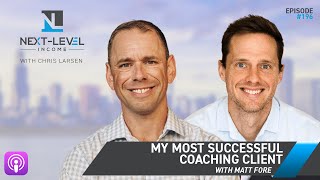
Chris Larsen talks with coaching client Matt Foer about building wealth through real estate and whole-life insurance. Foer moved from single-family rentals to commercial properties, using equity and policy cash values to grow his money while managing three major risks: taxes, legal liability, and medical emergencies.
Questions this video answers
April 30th (year referenced in episode context: cohort starts 'here on April 30th').
Listed price $5,000; the show mentions a 50% off offer.
Achieved financial independence in 3 years by the age of 32.
Nashville, Tennessee.
200th episode of the Next Level Income show.
What is your investment box? I know the more I grow financially, more and more opportunity hitting me in the face and being able to say no to things that don't fit into my buy box helps me be more strategic and more skilled. And in saying yes to the things that do meet my buy box.
Welcome to the Next Level Income show where it's our goal to take your income, your investments and your life to the next level. I'm your host, Chris Larson. If you haven't yet, get a copy of our book for free at our website, nextlevelincome.com. that's www.nextlevelincome.com. just click on the book link and I'll even send you a copy if you put your address in. On today's show, we have Matt Foer. Matt is a real estate investor based out of Nashville, Tennessee and is our head coach with Next Level Income coaching. In his professional career, Matt has spent over a decade in sales and sales leadership positions at one of the largest technology companies in the world. After finding real estate, Matt was able to achieve financial independence in 3, 3 short years by the age of 32. Today, Matt is a partner with me at Next Level income. We've done $200 billion in the real estate space and multi family self storage, mobile home parks, car washes, as well as various real estate debt products. When Matt is not working, he enjoys reading, training for Ironman triathlons and convincing his brother that he is the favorite twin. Stay tuned to learn more about our new coaching cohort starting next week. Matt, welcome to the show.
Thanks for having me.
Absolutely, man. You are joining an elite rank of just a handful of guests that have returned to the show here. And I'm super excited because we wanted to do a special episode. We've been doing this show for now more than five years and this is a special show because you and I have been friends now for at least the past three years, going on four years. Right. And we have a special relationship because you were my second coaching client. And we're going to be announcing a special launch of our new coaching program, the new edition of our coaching program. But I'd love for you to share a little bit about your background, your background as a professional, as a real estate investor. And then we're going to get a little bit more into, you know, why you chose to join our coaching program and, and how we're expanding that now together.
Yeah, absolutely. So based out of Nashville, Tennessee, bonus dad of two real estate investor. But before all of that, I spent two Decades in sales and sales leadership at some of the largest technology companies in the world and really got involved in real estate space. I grew up in rural Appalachia town. 7,000 people. Grew up dyslexic, like, never was. Big into cars, watches, boats, all that stuff. But I was very fortunate to be in a sales role where I would get lumps of commission checks that I was trying to figure out how to invest. So started investing in single family route. And then ultimately I was getting to a point where I realized I was doing everything myself. And one of the things they talk about in real estate is it's a team sport. And I knew that if I was going to build out the right team, I started, I would have to start reaching out to people and getting connected. And that's ultimately what led me to you is I tell people all the time, you went into tech. My mom taught at Virginia Tech. You're a cyclist, I'm an ironman. You live in Asheville, I live in Nashville. So there were a lot of similarities there. And what started with a single phone call led to a lot of success that I saw personally and professionally, as well as a friendship. So that's a, that's a little bit about me.
Yeah, no, it's been, it's been awesome, man. And, you know, I'm very fortunate to count you as one of my closest friends now. And I've seen your evolution, I've seen, you know, how you scaled things. But one of the cool things, Matt, is that, you know, we both kind of followed similar, yet slightly different paths in the real estate space. And you were able to put together a plan, but not only a plan, but also execute a plan to become financially independent at a very young age. You know, Matt's about 10 years younger than me and, you know, so tell. What did. What was your original plan? What was the path that you followed to become financially independent? Matt?
Yeah, so I was trying to solve this problem of lumpy commission checks. We kind of joke about it sometimes, but when things are good, you're going out to Ruth Chris, and when bad, you're stealing the extra pizza crust off your kids plate at night, just trying to find some food. And I wanted to solve that problem. Initial plan was, hey, I'm going to go out and just buy some turnkey rentals. And I started doing some math, realizing that that wasn't really going to scale to where I needed to go. So ultimately I, I kind of pivoted and started doing a little bit of burrs, a little bit of Flips, things like that, just to build a cash position and recycling my money. And I got to 10 units. And at 10 units, I said, hey, if I can have 30 of these in 25 years, I'll be paid off. It'll be spitting off X amount of dollars. I feel comfortable. But the little lesson I learned is that Fannie and Freddie don't want to lend you any more money after 10 years. So you're going to have to go find additional sources of capital, private banks, commercial banks, things like that. And I was also taking off in my career at that point. I was getting promoted, I was taking on new roles, I was moving all those sorts of things. And that's when I found commercial real estate. And when I found commercial real estate, I said, oh, wow, this is just a couple more zeros. It's not that difficult. And that's true to a certain extent, but it's also not true to a certain extent. And that's when I heard you on a podcast about your coaching program and your background and your commercial experience. And I thought there would be some good synergies. And if I'm going to go down this route of investing passively and then actively, then it makes sense to have somebody that's been there before. And that's ultimately what led me to you and kind of bloomed into the coaching relationship we had.
Yeah, no, and that's, that's the dirty little secret of kind of like residential real estate investing, which is no one really wants a hundred residential units. No one wants 50 or 30 or really even 10. Like, they're just, they're just kind of a pain in the butt. Now the thing is you, you have to start somewhere. And you know, that's the big thing. People ask, oh, should I be active? Should I be passive? Well, nothing's really passive. You should have an active role in your passive investments. But you and I share that philosophy, which is you can do both. And you know, Matt, maybe you could share a little bit about some of the synergies of having that, that income come in from your residential portfolio. But some of the benefits, like the depreciation benefits that end up, you know, giving you higher returns from your, your blended portfolio.
I think the depreciation benefits are the most over talked about, yet misunderstood benefits of. So when I first read Robert, his book, when I first listened to Biggerpockets, everybody said, oh, depreciation, depreciation. What they don't tell you is that if you make over $150,000, you file a net loss on your, your taxes. So my first year.
So hang on one second. So what, what Matt's referring to. And look, I fate the year I got married. I'll never forget my tax rate, not my taxes. My tax rate doubled. It went from 10 to 10% to 20%. What Matt's talking about is when you're, when your income is above $150,000, you can't pass through the losses from your real estate to that. Now below that, there's some really cool benefits that I was experiencing and you were experiencing. Right?
Yep, yep. Now you can carry those losses forward. Right, Right. But I started realizing is like it wouldn't help me offset my active income.
Yeah.
So I was trying to figure out this problem of lump cash flow in my personal economy on the single family side, it's also lumpy. Like you make money if you don't turn tenants, meaning you don't have a tenant, move out, don't have problems. If you do have problems, which are always going to happen in real estate, then you're back into this lumpiness.
Yeah.
So I figured that investing or even worse. Right.
Yeah.
Loss. Yeah. I mean, I had, I don't know if I've told you this yet. I had a $30,000 issue on one of my duplexes this past year. Somebody decided that since the bathroom wasn't working, they would use the house. So they never tell you these things when you're listening to bigger pocket. But I was trying to figure out, okay, I've got lumpy cash flow now here too. How can I stabilize that? And usually, look, you're going to make more money being active real estate investor, but the predictability and the depreciation is going to increase when you move more onto the passive side.
Yeah.
So I think talking through those strategies with you really helped me understand how I could be more predictable and get better tax benefits and synergies with my while also still I still have an active portfolio that I do. I'm still always looking for deals and I know you are as well when we still actively invest as well.
Yeah. And I think that's, that's great. It's like, you know, the, the skill set that you learn as an investor can be applied to multiple different asset classes, not just your passive. And you know, one of the things that I, I, I see this repeatedly and you just kind of alluded to it, Matt, is novice investors, they start out and they're like, I'm making a 30% return on my investment. You know, so say like a single family house, you put say $100,000 down and you're getting $30,000 a year in income. That's a 30% return. That's, that's pretty good. But inevitably when I say, hey, what are you, how much are you setting aside for repairs? Oh, it's a new property. I don't have any repairs. How much are you setting aside for, for turnover or vacancy? Oh, well, I haven't had any of that yet. And it's like, okay, how much are you setting aside for management? Oh, well, I self manage the property. Well, there's a reason why the bank only credits you about 75% of the gross income you get from a property because they know it takes about 20 to 30% of expenses or of income in expenses to run that property. And you know, that's what having a commercial property or being an investor in a commercial property will show you is you see what it's like to pay somebody else to manage, to set aside those reserves, you know, for vacancy, for maintenance and do that. And you know, you and I know this at this point, but the banks actually require you to set that aside. If you underwrite a property and don't set those things aside, they're going to put it in there for you and say, hey, this doesn't, this doesn't make any sense. So yeah, when you, when you do that again, if you're, if you're getting started and you're looking at your individual properties, even if you self manage, even if you don't have those turnovers, you still need to account for those as if it's going to happen, right?
Yeah. And that's the thing I tell every new investor. It's not if something will happen, it's when something will happen. Because if you're in the, this game long enough, you're excellent. There are going to be issues that happen in your economy.
Yeah, without a doubt, without a doubt. Now the, the next level income kind of strategy method that Matt, you and I have gone through and that we now teach in the coaching program that is really the, the, that was the genesis of this show is how to make more money, how to keep more money and ultimately how to grow your money. We're going to go through each portion. You know, we, we help people, if they're not already accredited to get to that point where they're making over $200,000 of income. You just mentioned, one of the challenges is you, you lose some of your tax benefits that are out there, you know, so, you know, if, if you're getting started and you want to learn how to make more money. You want to look at some side businesses. You know, we go through all that stuff in our coaching program. One of the biggest pieces that you know, I think that you know, you and I worked on initially and that I've seen and that we make a hallmark of the program is is that keep portion. Maybe you can share a little bit about that with the audience about, you know, what we do from attacks and legal structure and strategies to help our coaching clients.
Yeah, I would say there's a couple different things there. One is this idea of where can you to get native tax benefits. I talk to a lot of investors who are looking at things that say hey, if I do this strategy, couple this strategy and I put it in this wrapper, then I'm going to get a tax benefit. And it's like, well if any one of those things fails now all of a sudden you don't have a tax benefit. So helping people understand the tax code and how it's written and where you can take native advantages that are already written in not all these gimmicks. The second thing that you really helped open my eyes to too was this idea of return on equity. So I remember I came to you with a property that I had purchased under an $80,000. It was doing 12% cash flow, cash on cash returns every year, but the property was now worth 350. And you're like hey, what are you doing with this equity? It's just dead equity. And I really, that really changed my mindset on at a certain point in your investing journey, you need to, you need to look at return equity. Now most investors would go out there and say okay, well I'll sell this 350 property and move it into something else. However, you really opened my eye like why don't we loan against that? Because anytime we take loans against something in the form of debt, it comes back to us tax free. So whether that's insurance policy is heat locks, security based lines of credits, there's other way we can kind of tap into the equity that we already have to move it into another asset and now growing in two different spots at once.
Yeah, I love that. And I just, just talked to one of our coaching clients that came through our last cohort and he's newly married, he's got a house with a, a big gain on it. He's running it out and we looked at the same thing. Hey, how can you unlock that equity now? Because he's married, he now qualifies for twice. Twice the.
Standard deduction.
The standard deduction that he would. Otherwise. So he wasn't thinking about that. And he also. He didn't know of the other investment options that are out there. You know, one of the other things that I see a lot of, you know, kind of newer investors, and I've even had family members with this. They don't have the proper legal structures in place. You know, we have a lot of investors with. With our investing side of the business that are professionals, that are doctors. I mean, I had surgeons I worked with that face these frivolous lawsuits throughout their career. You know, if you're a professional, especially if you're, you know, a doctor, a surgeon, you know, you don't need any more liability that's out there. So, you know, that is one of the other things we do. You know, we talk about the three things that are insidious, that can eat away at your wealth. You mentioned the first one, Matt, which is taxes. The second one is legal. Legal issues. Right? You must have the proper legal structures. And we have a whole section in our course that. That my account, my attorney put in there. He said, hey, this is awesome. Like, here, here's my whole course that you can put inside your course for free and inside of our course that you'll get. And then the last one is, you know, a major medical issue or death. And look, I, you know, I know you've. You've experienced loss in your life. I lost my father at 5. I had this conversation last week with an advisor, a financial adviser, and he said, I'm not a big fan of. Of life insurance, specifically whole. Whole life insurance or, you know, permanent life insurance as. As we call it. And, you know, he's like, you can get a better return here and there and so on and so forth. And I said, well, what about my friend whose wife died at 43 years after that, they got their policies. Oh, that's different. What about. What about. If you're planning to leave a legacy, you know, in a state for your family, you know, of. Of eight or nine figures, which is very reasonable to do for. For anybody that's. That's making. And he goes, oh, well, that's different. That. So, you know, it's just interesting that if you. If you talk to the Dave Ramsey crowd, you know, whole life, you know, permanent life insurance, quote, unquote, doesn't make sense. But as soon as you say, well, what if. What if you actually have to use it because someone dies, or what if you want to, you Want to use the cash value to leverage? Or what if you want to plan to leave a legacy for your family? That changes the equation. But that doesn't change the equation. That is the equation. Matt, you've used some of these same strategies. Have you used that to kind of smooth out your, your high earnings and those commission checks. Have you used that in your, in your investing career? Are you a high income business owner or professional earning 2,300,000 or even more a year but still still feel like you're living paycheck to paycheck? Are you comfortable working until you're 65 or 70 to retire? Or do you want to achieve financial independence and live life on your own terms? You could join myself and Matt4 and learn how we both became financially independent in our early 30s. We will teach you how to make, keep and grow your money. Teaching you strategies to maximize your earnings, keep your income that you've earned through tax strategy and legal structures in to order ultimately teach you how to grow it by determining your personal investing strategy as well as teach you how to analyze investments so you can grow your passive income to the point to live life on your own terms. Our coaching clients reliably do this in seven years or less. To learn more, check out our coaching program at nextlevelincome.com forward/coaching. That's nextlevelincome.com forward/ coaching.
Yeah, on the whole life policy, I, I want to say two things. One, it's not a matter of if you're going to die, it's when, right? So how do you set yourself up legally and through policies and things like that to pass down your wealth as tax free as possible? I think, you know, the attorney that we have that comes on and talks through that does a really good job not only on protecting your assets and your active business and your investing, but also through the probate process and making sure that it gets passed down through estate planning and things like that. A very, very critical part if you are a high net worth individual in terms of whole life policies. Look, I, I am a big fan. It is not an investment. First and foremost, it is not an investment. And oh by the way, if it was investment, your friend whose wife passed, they made three payments and got the full death benefit. That is a tremendous roi. If you want to look at that, they might have 75 grand in and got 2.5 million back. That's a pretty good ROI. But it's not an investment. It's a cash warehouse and that can be leveraged for a lot of different things. And I've used it in my personal economy. As we enter these next couple of years and banks become more restrictive on lines of credit, on mortgages, on rental properties, on all those sorts of things, I know that I have more than six figures stuffed in these policies that is contractually guaranteed to allow me to lend against, to go out and make other investments and take advantage of the opportunity. And so look, I think there's a lot of different tools out there. One of the things we talk about is in the Dave Ramsey crowd, if you're under a million dollar net worth, it's eat rice and beans, stuffed bunny and a mutual fund.
Don't three or four bucks for a coffee.
Yeah, yeah, exactly. And if you're above 25 million, it's set up your own family office and charity deductions and all this sort of stuff. We've all thing for you. But if you're very successful and have a net worth of two to $10 million, no one's calling on you, no one's trying to help you because you don't fit into one of those boxes. And I think that's kind of the void we feel here is saying, hey, here's some of the strategies that the family office teach and here's how you can implement them in your economy before you get to that stage.
That's a great point. And you know, it, it is, it's a challenge, right? Because, you know, being a millionaire used to be a big deal and now it's, it's just frankly not enough. And if, look, if you're out there and you're making 2, 3, 500,000 dol a year, you know, if, if, if you're not, if your net worth's not already a couple million dollars, it's going to be soon. It should be soon, you know, and you know, it's if, if you're at a couple million dollars, you're on your way to having a net worth that's eight figures or more. And what's wild is with some of these, I realized this when I met with my estate planning attorney. Oh, geez. Going back about 10 years now, they looked down, they said, hey, Chris, this is your net worth. And I was like, that's like two and a half times what I thought it was. They were counting my permanent life insurance in there because they were looking at my estate worth. And it really blew my mind because we've been able to literally double, not only double our net worth in the past several years after Covid, but then Double it again with some of these strategies. And it's like you said, Matt, it's a contract, it's a private agreement. We get guaranteed rates to return in these policies. Where else can you get a guaranteed rate of return in the investment space? Right? And then, you know, the, the big part is, how do you leverage that and weave it into your investment strategy? So I know we go through all that, but if you've gone through all this, if you're, if you're making a lot of money, you get your tax and your legal structures dialed in, you know, then the fun part of the course, the sexy part of the course of our coaching is how do you grow your money? And I'm really excited because we have the deal analyzer. We teach how to ask the right questions when looking at a deal, how to take that qualitative information and then quantify that information so that we can ultimately look at investment and say, hey, does this, this really make sense for us?
That's right. And I know as people get involved in passive investing, the first question I get is like, how do I even underwrite this? And so we'll spend time walking through different deals, like development deals, value add deals, things outside of the traditional multifamily talking about, there's no, there's no questions I can give you that's going to answer everything you need to know about a single investment. However, with going through different case studies, you'll get a chance to see how we think about looking at investments and the questions you should be asking when you're looking those investments. And every deal will be different. But what are the core competency questions we need to ask here to say yes or no? And I think part of that, and that we haven't really talked about is developing your zone of genius. What is your investment box? I know the more I grow financially, more and more opportunity hitting me in the face and being able to say no to things that don't fit into my buy box helps me be more strategic and more skilled. And saying yes to the things that do meet my buy box.
That's a great point. And look, we literally bring on one of our partners that wrote the book on underwriting. So he comes on, he teaches our coaching clients how you underwrite a big institutional quality property. You can get a, you get a copy of his book with the coaching course. It's phenomenal. And you brought up another great point, Matt. What do you say no to? Look, if you want to have more time in your life to do what's Important for you if you want to use that time to make money, to get in shape, to spend more time with your family, as you and I have been able to do. If you want to figure out how, how do you protect yourself and then figure out how to ultimately grow that, you really need to know not just what to say yes to, but also what to say no to. So you can just sweep that aside and, you know, whether it's cleaning out your inbox or saying no to a deal, these things can really help you improve. Now, Matt, we are, we are starting our next cohort of the coaching program in just a week here on April 30th. I'm really excited because when you and I started working together, I was just coaching one on one. I could only handle, you know, about a dozen coaching clients. We just had 20 students come through our first coaching cohort. We continue to grow that network, that community that our prior coaching clients get to be a part of. Talk a little bit about what someone's going to get if they join the next coaching program that starts here next month.
Yeah, I think everything we've kind of talked about, right, this make, keep, grow framework, everything from our tax CPA that both you and I use to our attorneys that both you and I use for our legal structure in the states and all that. But two things that we really haven't talked about is one, the community aspect of it. So what I've noticed with being a real estate cohort, groups and masterminds and things like that is somebody else is dealing with a similar problem that you either haven't dealt yet or you're about to deal with. And seeing them go through it will actually help prepare you for that moment. So maybe you're not looking at an active investment today, but seeing somebody else go through that process makes you a better investor for the next time. And then the second thing that we really haven't talked about is this idea of accountability. I believe that everyone needs a coach. I have an ironman coach. I have a finance coach. Michael Jordan had a coach. Tiger woods has a coach. Everybody coaches. And it's more to help steer you out of the corners, away from the corners that you're about to round that you don't even know about. As well as I know with my ironman coach. Just the simple idea of me having to upload my workout will make me want to do the workout when I don't want to do it.
Yeah.
So accountability is huge. And it's not necessarily a negative as much as, hey, you said you were going to do these things this week. Just tell me if you did them or not. And me having a set of eyes there will help you grow tremendously. So not everything from the make keep grow, but also from the accountability, ability standpoint and the community standpoint is something I think a lot of people can take advantage of.
I think it's a great point. I just sent my coach all my, my stuff that are priorities for the week here. What I'm targeting, what I did last week, and just knowing that helps me become more efficient, you know, so if you're out there and you're thinking, hey, should I do this? You know, I. I can just, I can go find this information online. I can listen to the podcast. Yeah, you can. But I would ask you if, if you can do that, why haven't you achieved the goals that you set out to do? And there's a great scene in Catch Me if youf can with Leonardo DiCaprio. It's at the very end of the movie. If you haven't seen it, you should, you should watch the movie. I think it's fantastic with, with Tom Hanks and Leonardo DiCaprio. But Tom Hanks asked Leonardo DiCaprio's character, he said, you know, how did you teach that course? And he was a college professor, like, how did you teach that course? He said, I just read a chapter ahead. Having a coach is working with somebody not that knows everything, but that has walked the walk, that has gone down that path in front of you and that can warn you where the rocks are, where the pitfalls are, can also tell you where the shortcuts are, and has read the book of life and is just a chapter or two ahead of you. And that's really, in addition to the accounting, like you said, Matt, it's helping you become more efficient with your time. So if you want to buy back your time, if you want to figure out how to safeguard your family's wealth for the future, and you want to get a plan together for how to develop that path, how to grow your money and ultimately achieve financial independence, join us with our next coaching cohort that starts here in just a week. Matt and myself will be leading that. And Matt, I think we're also going to be given a special offer that we have here in the Show Notes as well. You can click on that link and save 50% off the $5,000 price.
Awesome. Yeah, we'll keep that in the wonderful.
We'll join us. Take a look at the Show Notes here, Matt. It's Been great seeing you here today. Thanks for joining us for our 200th episode. Big milestone in the Next Level Income show and share a little bit about your program, your podcast, all the resources that you have as well.
Yeah, sure. So one of the things you actually helped with was starting a podcast back in 2020, started a podcast called Ice Cream with investors. I'm just a fat man living in a skinny man's body, but ultimately it was a way for me to find interesting people in the real estate niche to really uncover everything that they do. When I first started doing real estate, I thought it was the fix and flip you see on HGTV or just buy turnkey rentals. I had no idea about all the different sorts of investing you can do, from investing to debt to parking lots to mobile home parks, everything under the sun. I'm just trying to bring on guests from those different niches so that our investors can learn as well as myself. So it's a. It's a Ice cream with investors. Check us out on any podcast playing app out there.
Yeah, check it out. We'll have the link in the show notes here as well. Matt, again, thank you for joining us, my friend and sharing all your knowledge and what we have coming up with our coaching group with the Next Level Income show audience.
Awesome. Thanks for having me.
Hey Chris, here again. I hope you found this episode valuable. Now I have one more thing to gift you. We have a page for my coaching clients where you can get a free copy of my book as well as much more for previous guests on the show. Just check out nextlevelincome.com coaching to get a free copy of my book, audiobook and much more. I'll send you a copy of my book and cover all the shipping costs as a thank you for listening to the podcast. Also, please like share and take just 90 seconds to give us a rating on Apple podcasts.










