Episode 10: Transforming Company Culture and Business Growth with Michael Murray
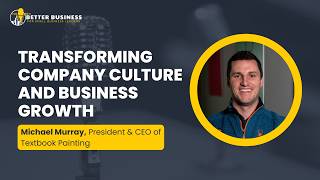
A recorded YouTube interview with Michael Murray, CEO of Textbook Painting, about building company culture, leadership, and scaling a residential painting business. Murray describes founding the company in 2006, the company’s customer-focused culture (including an in-house interior designer for color selection), leadership lessons learned from coaching youth sports, the importance of asking for help and tracking a few core metrics by breaking annual goals into daily/weekly activities, using technology and automation to improve customer communication, and maintaining a 'stop doing' list to delegate and simplify the CEO role.
Questions this video answers
2006
Michael Murray
January 15, 2025
Cleveland area (Northeast Ohio)
Chapters
Biggest things that I can do is eliminate things off of my list and simplify the business, simplify my tasks so that I can be a better leader. That's what I would tell somebody.
Michael Murray is the CEO of Textbook Painting, and he has created a masterpiece in company culture and continuing to paint one wall at a time in the state of Ohio. So, Michael Murray, can you tell us a little bit more about your business, what you do, and then we're going to have a conversation about company culture and leadership.
I would love to. Yeah. Thanks for having me, Chrissy.
Absolutely.
So, give you a quick update. I guess I started the company in 2006, right when I graduated from college. Grew up in the Cleveland area, went to college at Miami, started a small painting company when I was in school. Nothing fancy, literally going door to door. And when I graduated from college, I knew everything I didn't want to do, which was going to corporate Americ had an opportunity to kind of just keep doing what I was doing in college and so decided to start this company. And the expectation at that point was, let's, you know, do this for another year or two while I figure out what I want to be when I grow up. And here we are, what, 18 years later, still trying to figure it out, I guess. So it's going well.
So what keeps you moving in business as you make that decision every year, that you want to keep being a textbook painter?
Yeah, I think the just like the ongoing challenge of it. There's still so much that I can do to get better, to provide better experiences for our team members, provide better experiences for our clients and things like that. Figure out ways to just continually improve is, I think, what keeps me going.
So when you started in college or right after college, it was you and a couple of people.
I mean, at that point, it was really me. I had a good friend of mine who was in college who had kind of worked with me while we were in school and then. But he was two years younger, so I graduated. I actually moved to, like, the Washington, D.C. area, thinking that was like a cool place to live.
Okay.
Ended up being there for about a year, realized how expensive it was, how much traffic there was, didn't really like it, but went out there more or less started on my own. And then the buddy that I was talking about came out for the summer and helped. So, you know, he was involved early, but not quite full time, if you will.
Okay. So 18 years later, it's not just you anymore. You have a pretty large team. So how do you maintain Your company culture. Tell us a little bit about the culture that you like to keep at textbook painting.
Yeah, I think, I mean, culture is so hard to define. I would hope that we have a culture that we don't take ourselves too seriously, but we take our, like, what we're trying to do for a client pretty seriously. I think it's a unique opportunity that we have that we get to go work in somebody's home. Whether it's the inside or the outside, we're at their house. And so, you know, we have a lot to. A lot of influence over their, like, you know, emotions and their life just for that time we're there. Most people have a probably more negative, like, expectations when there's a contract at their house. And so we have an opportunity to really try to exceed that. And so I think, like, I would say that our culture is again, like, fairly fun, fairly laid back, but we're very intentional about, like, trying to lean into a, I don't know, customer focused and employee focused mindset.
Okay. So I don't think there was anything more challenging in my marriage than what we were going to paint our living room at one point in time, like, we had to, like, had to hire someone to tell us what to paint it because we could not agree. So we had to, in essence, hire a paint therapist. So how do you take care of. Of your customers as they're walking through some of these big decisions? Because I know some people may think it's just a kitchen color, but to a lot of us, it's. It's a big deal for sure.
It's very stressful. Yeah, I think, like, that's one of the things I think we're pretty good at is trying to, like, under or I would say, predict a customer's like, pain points and stresses. You know, haven't done this for, you know, quite a while. I think we've have a good, like, understanding of what are the things that somebody might complain about, for example, picking out colors. So we have an interior designer on our team. It's very. It's a complimentary service for her to go out and meet with a client as part of our general, like, prep work of getting ready for a project. Not everybody needs that, not everybody takes advantage of it, but most people do. And I. We get great feedback as you just referenced. It's one of the most stressful parts of a project. So taking that away from somebody is a huge value add that we love to provide.
So, Michael, I have the pleasure of getting to know you not just as someone who paints and runs a business, but as someone who truly runs a business, understands their numbers, and knows how to grow a business. So I know that when we've talked in the past, you've said that asking for help and knowing your numbers is really crucial. So what are some of the practical tips that you can share with our listeners for overcoming the fear of asking for help? And then how can they effectively track those Right. Metrics for their business? Yeah, two part question.
Yeah, so, you know, the first one, asking for help, I mean, that's the thing that I really struggled with, you know, so starting the business when I was like 21, 22 years old. And again, even in college, I ran my own business. So pretty much everybody that knew me as an adult knew that I ran my own business. And I think, like, there's some sort of, like, I don't know, the idea of, like, an entrepreneur as, like, this special hero figure and, you know, has it all figured out and has all the answers and. And whether that is something that I had just kind of built up in my own mind or that pressure was coming from other people, I really felt like, especially in my 20s and early 30s, that, like, I should have this stuff figured out. I should know what I'm doing. I went to college, I read. I read a lot of books and things like that. And it wasn't until I got, you know, had quite a few years of just, like, really poor performing business that I realized that, like, most people don't have this stuff really all that figured out. And the ones that do are more than willing to share from their experiences because most likely somebody helped them to get to the point that they're at. And so once I was willing to be humble enough to say, I don't have this all figured out, and I'm not some rock star entrepreneur, whatever the heck that means, and just be willing to ask for help. You know, it was amazing how there was people around me that had done a lot of the things that I was struggling with on a daily basis.
Yeah. What about numbers?
Yeah. So, I mean, I think that was one of the big things is like, being open and honest with our numbers, with business coaches, mentors and people like that. Again, it really comes back to, like, having that humility and saying, okay, I'm struggling, I need some help. And, you know, in business context, it's often, you know, whether it's not enough sales, not enough profit, you know, too much of a certain expense, whatever it might be, we've got to be able to like, dig into the numbers in a very real way to be able to, like, assess the problems. I think it's probably like very similar to going to see the doctor. Right. If the doctor is trying to give you an assessment without any sort of metrics in terms of blood pressure, cholesterol, weight, height, whatever that might be, it's going to be much more difficult. Um, and so I think one of the things that we've gotten really good at, especially over the last, like, let's say five to seven years as, as the business has really started to take off, is being able to break down maybe bigger complex goals and numbers into like the simple daily or weekly activities. What is like the couple numbers that we really need to keep an eye on. And if we really, like dial in those numbers and just compound those over time, we're going to hit the big numbers. The success is going to happen. Instead of getting so worked up about, you know, the annual revenue or annual profit, it's just breaking it down into like a daily or weekly activity, goals.
I appreciate your authenticity. I think oftentimes, especially as emerging small business leaders, we think that success happens all the time. And it's really the ups and the downs of learning how to deal with the torque of success and the torque of dealing with difficult situations. If you've been in business long enough, you're going to have a down economy, you're going to have an up economy, you're going to going to have different challenges to navigate. And I appreciate your willingness to be authentic and say, no, I don't always have it all figured out. And sometimes we have to sit down and say, I need help. And I think as small business leaders, that's something that oftentimes we forget is we think that we're invincible or we have to be invincible. And I think that really the growth happens in failure and learning that, you know, it didn't work this time, but it was only the first attempt in learning. I'm gonna continue to move forward. So thank you for sharing that as well and talking about what it means to ask for help. So I'd like to pivot to something else. Cause one thing we haven't talked about yet is family. And you've taken your leadership skills and transitioned them to a place where not everyone is willing to go. I know I would never go there, and that is coaching kids sports. I love it. So you coach your kids in some various sports. What are some key lessons you've learned from coaching them that translate? I'm assuming they can translate into Your business life, for sure.
Yeah. I think the lessons go back and forth.
Okay, tell me more.
So a lot of like the leadership books and things like that are very applicable to working with, you know, 8 to 13 year old boys and girls. I've got a 12 year old daughter, I've got an 8 year old son and I love coaching them in baseball, softball, whatever, basketball, whatever they're doing. And so I think, you know, first of all, like patience, as you might imagine. Yes. And again, whether we're talking about employees or we're talking about youth sports, I think a huge level of patience. You know, oftentimes we bring in a new employee and we want them to come in, fix the problems right away. And again, if you've been doing this long enough to know if you've been doing this long enough, you know that that doesn't always happen. Doesn't usually happen. And I think it's the same thing with like young kids where they want to do well. They, you know, have, they're coachable, they're excited all the things, but they're lacking some sort of maybe important skills and just having that patience with them to develop it and you know, and certainly like have that enthusiasm and encouragement to keep going. You're doing great. You know, even when things, you know, somebody's struggling or whatever the case might be, it's providing those like daily affirmations and encouragement to keep going. I think translates both ways.
I would think so. I mean, the one thing that struggles with me is that you can't put your kids on. Well, you can put your kids, but if you're coaching other people's kids on performance improvement, I mean, that's, that's hard. That would be my struggle. I would want to do that.
There's no firing in that world, generally speaking. No.
And it's really hard to fire volunteers. I don't know if you've ever had to deal with that, but that can always be a challenge too. Especially if you got to see them in the carpool lane the next day. Yeah.
Sometimes the parents can be the issue, just like sometimes the customers can be challenging. But again, same skill set. Right. It's those same calm conversations of let's get to the problem and come up with a solution and you know, everybody can get what we want out of this.
So I know you're a fan of Dale Carnegie.
I am.
So can you give me a principle or technique that you've learned from him that you found most impactful in your leadership? Whether it was coaching kids, softball or working in your business.
Yeah, I mean, man put me on spot a little bit. So, you know, it has been a very transformational book. I've done some of the leadership classes and things like that. You know, one of the principles is. And I'm going to probably misquote it exactly, but it's basically like seeing a like greater potential in somebody and helping them to see that. And I think again, that goes back to what we were just talking about with the sports, but especially with business. You know, a lot of times a like team member, maybe whether they're young or not doesn't really matter, I guess, but they might not fully see their potential. And as a leader, I think if we can help them to see the potential that we see in them, that is critical and then we can work together towards like that greater future. And I feel like. Pretty sure that's a Dale Carnegie, you know, one of the 20 principles that are laid out in his books.
Completely agree. Thank you. So let's talk a little bit about innovation. So changes to your industry. Fine. But I know that as a small business leader, you're always looking at different ways that you can be more efficient and you can innovate. So what are some things that you're looking at right now and kind of diving into to kind of make yourself a better business leader and build a better business?
Yeah, I mean, I think the big one that comes to mind is how do we better utilize technology to put our team members into positions to do like the customer service stuff as well as possible. So whether that's typically, that's going to be through like communication type platforms. I think one of the biggest complaints that most homeowners have when they're working with a contractor all kind of comes somewhere around communication. Can't get ahold of somebody, don't know what's going on. You know, they were here or they left, I don't know where they went, things like that. And those are all things that we want to solve for. You know, we hope to be the contractor that has the best communication with our clients, but that can be challenging. And especially if we only think of communication in maybe older school ways of phone calls or even maybe emails where people might appreciate text messages. And so we're trying to utilize different automations, even artificial intelligence inside of like some of our communication tools to help keep our customers in the loop, let them know what's going on, what they can expect, you know, how to pick out colors, whatever the problem might be that they're experiencing. So that we don't have to just keep adding headcount, which obviously causes expenses go up and things like that, trying to figure out ways to utilize some technology to make that better.
Wow. So we're looking at the future. I want to ask you a couple more questions, and let's look back to the past. You've built a successful business, successful career over the last 18 years. What do you wish you knew about growing and scaling your business that could have benefited new business owner Michael A long time ago.
Man. I mean, there's so much right in 18 years. Again, I think it goes back to understanding that, like, most businesses aren't that complicated, that there's really just a few simple numbers and few, like, simple concepts that we need to understand and just compound over time. That sometimes, like, you know, what you need is just do the right things consistently over time, and it's not actually about trying to find, like, a magic solution, if you will. I think when I was younger, I would. I would get so frustrated that we weren't growing, we weren't as profitable as I wanted to be, and I was just constantly looking for maybe a magic solution where, in hindsight, we were probably on the right track a lot of the time, and we just needed to keep going and just keep compounding some of these simple things that we were doing.
Well, I know sometimes for me as a business owner, I can get stuck in that, but I wanted to be this far ahead. And while I've only got. I've gotten 60% there. Instead of being happy and celebrating the 60%, I get stuck in that 40%. So that is a good reminder. So as we're getting ready to wrap up, one thing that we like to ask of the business owners that are on the podcast is to talk about the one thing that you do or that you think that other business leaders should do to become 1% better in their business every day. What is that one thing that you would say can help someone get to be 1% better?
I think the one thing that I love to talk about if I'm chatting with a business owner is having a stop doing list. For me, that's been, like, critical as I've been able to grow the business, it's only because I've become better at delegating and just getting out of the team's way and realizing that, you know, going back to what we talked about before, I don't need to be the hero. I don't have to be the person that has to do everything and that there's actually Very few things that I need to do and that, you know, one of the biggest things that I can do is eliminate things off of my list and simplify the business, simplify my tasks so that I can be a better leader. That's what I would tell somebody.
I want to dig in a little bit more to this, because that is a great concept. So tell me when you were first starting your stop doing list, what some of those things were, because I feel like you've probably been doing it for a while and now what some of those things are as you've continued along that path. Give. Give our listeners some ideas.
Yeah, I mean, I think, you know, one of the first ones. And it took a while. It was like getting out of the, like, sales seat within the business. And it again, it took quite a while. And we would hire sales reps, and then for one reason or another, they might not work out, and I would find myself back in that role. And, you know, that was critical. And what I realized was that I was pretty good at sales, but I wasn't great at it. And so I needed to hire people that were really gifted there so that I could spend more of my time doing the things that I think I'm better at.
Okay, and what are the things that you're working on now to stop doing as your business continues to scale?
Yeah, I think the big one is, like, you know, right now, for me, it has a lot to do with, like, our marketing. And so that's something that I have really, like, held onto. It's probably the thing I enjoy the most. I would say somebody who's just getting started with this idea of, like, stop doing this. The easy things are the things they don't enjoy doing.
Yeah.
For business owners, it might be, you know, accounting. It might be the monthly financials, it might be answering the phone, some of the administrative tasks in the business. But, you know, as having been done having. Having been going through this stop doing list for the last probably, like, seven years, I'm now getting well into the list of the things that I actually enjoy, and I think I'm pretty good at. But I need to eliminate things like overseeing our marketing, because I can hire somebody better to do it, and they can be fully focused on it all the time, which I just can't do as also being the person who's kind of sitting in that CEO seat overseeing the entire business.
So part of it, too, is making the hard calls and the decisions of where are you best at?
For sure.
Okay.
Yep. And, like, trying to just you know, limit that so that I have as few important responsibilities as possible because then I can have like one person I can hold accountable to each different, you know, metric within the business. And to be honest with you, it's pretty hard to hold myself accountable to, you know, performance and things like that. It's a lot easier for me to hold somebody else accountable.
I understand.
Yeah.
Yeah. So, Michael, thank you for today. Thank you for your time. We've covered a lot of different things from team building to picking paint colors to coaching kids softball to figuring out what we're not going to be doing in our businesses anymore. Thank you for sharing your wisdom and your time, and I wish you nothing but success as you continue to paint all of the rooms in Northeast Ohio and beyond.
Yeah, Well, I appreciate it. Thanks for having me. This is fun.










