Episode 12: Podcasting Success with Josh Troche
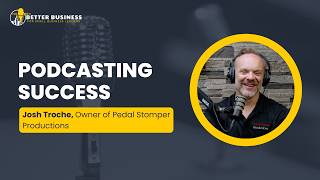
Episode 12 (YouTube) — Conversation between host Chrissy Myers and guest Josh Troche about podcasting for small business leaders. Josh describes discovering podcasting while creating cost-effective content for clients (vs. $10–15k video), emphasizes embracing imperfection, choosing a specific listener avatar, authentic presentation, and using AI (e.g., GPT) to generate topics, questions, and clips. He advocates "borrowing" guests' audiences by featuring them and cross-promoting, recommends deliberate listening to other podcasts for production ideas, and frames steady 1% daily improvement as the key to progress.
Chapters
I always like to say, a smart person learns from the mistakes. A wise person learns from the mistakes of others you sought out. Like, okay, what are the. What are the things that I'm really going to make the mistakes at? First off, here, Meet Josh Troege, a master of multimedia who's taking storytelling to new heights.
Literally.
From podcasting to professional video production, Josh knows how to connect people through the power of relationships and creativity. Josh, thanks for coming on the show.
Josh, I am so excited that you did your own intro. What better way to get started than to have you do your own intro? So thank you.
Yeah, no problem. Happy to help out.
All right, so I know you started podcasting as a favor for someone, but you seem to be pretty fantastic at it. At least that's my opinion. Others may disagree, but I think you're great. So when did you discover that this was something you should really be doing and the potential of this medium, what sparked your passion for it?
It's kind of twofold. So for me, when I got a call to say, hey, look, can you help out doing this for someone that had actually run for state office, had run to become mayor of Cincinnati. So a well placed individual, he was doing this for the content creation. He was doing it to create the connections from the photo and video side of the business. I saw that there's a lot of business owners that just can't fork out 10 to 15 grand for a video, but they still need the content. What a great way to do this. And then as I started to do it, I started to talk with people. I started to see the connections that happen. I started to see the. Just the great information that comes out of them. And I'm like, this. This is my thing. Stories. My thing. And what a great way to get people's stories.
So first I need to say thank you. Thank you for saving all of us business owners from the awkward angles of our iPhones and trying to film ourselves and trying to do all the things and the editing and the long pauses and the. So thank you for realizing your gift and also saving us all a lot of money in seeing how to be more efficient and effective.
It's funny. It's a. To me, it's that mutually beneficial thing. You come in here, the lighting's good, the microphone's good. It is. The phone's not going to be at a weird angle where people like, did they not have their V8 today? You don't need to worry about it. And it is. It's that price point that makes it like giving you. It's worth it for you to get your time back.
Yeah. One thing you told me when we started venturing down the podcast venue after I did, I did an audiobook with you. It was not terrible. I did not die. Thank you. I didn't have to edit it, so that's probably why I did not die. I appreciate that you managed muscle through it, but one thing you told me when we started venturing down the podcast route was be willing to be terrible. And, you know, as a recovering perfectionist, that really hurt my heart. I know what to do. You're gonna be awful at this, Chrissy. But it's gonna be great. But you're gonna be awful. But it's really powerful advice. So what are some specific ways that small business owners can embrace that mindset and overcome their fear when starting to think about doing a podcast? How do you get people to get over the being awful part?
It's interesting. There's two ways. There's two schools of thought on it, and you took the, what I like to call the better road of school of thought on it. Really? Yeah.
Okay.
You asked the questions up front. I always like to say, a smart person learns from the mistakes. A wise person learns from the mistakes of others. You sought out, like, okay, what are the things that I'm really going to make? The mistakes at first off here, and we talked about those and went through those and said, don't do this, don't do this, don't do this. And then approach it this way. And you're like, oh, yeah. So your first episodes didn't come out as this giant pile of gobbledygook. Like, hey, I'm going to make awkward conversation about nothing, and we're going to record it, and then I'm going to put it out on the Internet for everyone to see forever. So it's that piece of it. The other thing with it is people just have to realize that when you post that content, both people are going to see it. One of those people is probably going to be your mother, who's still going to just love you no matter what. Right. She's going to love you no matter what. So those first ones where you're terrible, you realize not many people are going to see it, except you're going to be critical of it. Sure.
Yeah.
You're going to be 20 times more critical of it than anyone else is. So really, the advice, if you're just going to start, get over yourself, realize that both people are going to see it. And one of Those. I mean, it's going to be your mom, maybe your spouse, maybe not your spouse.
No, no, he's not. He's like, I don't have time for your podcast, right?
So not many people are going to see it, so be aware of that. And most of the people aren't there to look at you to. They're here to pick up advice. So as long as you're trying to add value, you're golden.
Nice. Well, in small business, we often need trusted guides, coaches, advisors to help us along. I consider you to be one of those. You can pick whether you want to be a guide, a coach, or an advisor. I mean, it's up to you which title you want. Supreme ruler of the podcast studio, whatever you pick. But you share with business leaders the importance of building a solid foundation for a podcast. So, question. Can you throw the listeners a little sage wisdom here as a coach and advisor or guide? What are some of the most common pitfalls that small business owners need to avoid in the early stages of their podcasting journey? Embracing the fact that you're going to be awful, and also realizing that for the first few months, no one's going to care about your podcast.
The biggest mistake is people want to talk to everyone.
Oh, tell me more.
Pick a person that you want to talk to. You have to pick your avatar. Pick that one person that you're going to talk to. And the example that I always like to give, if you and I are talking at a dinner party or at a networking event, if we're having an interesting conversation, I mean, you're the intended audience, but other people are going to come listen in.
That's a good point.
If. If our conversation is terrible, no one's going to listen. So if you have a good conversation with one person, other people will listen in. If you go to that same networking event and just stand in the corner and yammer on, thinking that you're talking to everyone, people are just going to look at you like you're nuts. You might be fair. Pick a person to talk to. Pick that one specific person that you want to reach, and you will reach them.
I love that. So oftentimes when we're thinking about having a podcast, we think about having to be this Persona in small business, the small business leaders. We're thinking, okay, who do I need to be to be a podcast person? I have this idea of what I need to be. It's the right balance between being yourself, having the right content, being authentic, being well structured. So I know you talk a lot about Authenticity. And use that word a lot as part of preparation. So can you offer some advice for those people who are thinking about venturing into the small business podcasting space for their business?
There are 8 billion people on the planet. There's an audience for you, you, not for the Persona you think you're going to be. I mean, my voice changes a little when I get on the microphone. I'm pretty much me. Yeah, you're very much you. We're going to appeal to a certain audience. I am. Okay if I don't appeal to certain people because they're probably not going to want to work with me anyways. So let's appeal to the people that I am going to genuinely appeal to, because if you show up inauthentic, people see right through it and are like, nope, I want nothing to do with this person. This is a snake oil salesman.
Oh, I like that. I do not want your one star review. If you do not want to listen to my podcast, though. I'm just saying, if you don't want to listen, just switch.
You know what? The one star review still isn't bad.
Really? Tell me more. Because as a perfectionist, I'm dying if I get one.
So it's still a review. It is engagement. Oh, it is engagement with your podcast. Now, if you get 51 star reviews, maybe it's time to consider a career change. But especially if it's. If you have 51 reviews and 50 of them are one star, maybe it's time for change. But really it's engagement. So people are so afraid of like a one or two star review. Take that. The other thing is with it is realize when someone gives you that one star review, they're giving you feedback.
That's true.
If it's not feedback that aligns with where you're headed, then okay, great. I mean, do the same thing that you did with feedback you get from your parents. Your mom's still going to tell you you're great.
That's a good point. Okay. I don't know. Not always. She may tell me it was awful.
That is true.
She will tell me. She'll give me good feedback. So let's go from talking about perception, reviews from people, and let's talk about the robots, let's talk about AI. All right. So with AI on the rise, you see human connection as a key differentiator in podcasting. While There are some AIs that can create a podcast for you, you still see a lot of value. I see a ton of value in bringing your own Human, authentic self to the podcast booth. So without deferring completely to the robots, how can small business owners leverage the elements of AI to help build stronger relationships with their audience?
There are so many different ways with this. When you take the conversations that you're having with your audience or with your, be it your customers, clients, whoever, it could be internal, take those conversations and dump that into a GPT of some sort. Figure out what your next topic is. If that's what's important to people right now, well then great, go ahead and talk about that use. I mean, we work together to help you come up with the questions through AI we do. You dump in information about the person, you dump in some personal information about the person and you say, hey, what should I be asking them? It's a little more complex than that, but really it's helps us ask those better questions. There are so many AI tools that we are using in our business to help with cutting up clips, to help with figuring out what the right thing to say is to help with. I mean, finding the right guests even. Does this person align with my views or are they just off far enough to make it an interesting podcast? It's all those types of tools that AI is helping with and it's, it's raising the level of what we do.
Nice. So I've heard you talk about a strategy called borrow someone else's audience. I think when we first started talking about podcasting, you said you can borrow someone else's audience. And I'm like, what does that mean? So can you talk about that, give some practical tips and what that, first of all, what that means and then how impactful it can be to a small business owner.
Yeah. The saying that I have is the easiest way to grow your social audience is to borrow someone else's. And if like you have someone as a guest on your podcast.
Not steal, just borrow.
Right, correct, correct, correct. You're not gonna beat them up, leave them in a b back alley and say, haha, I've got your social media audience. But what happens is you're helping me generate content too, as well as yourself. So now I've got a motive to share this out. Well, guess what, you're going to be on there. So now you're in front of my audience, I'm in front of your audience. We're going to have some overlap there. Obviously, if we did competing things, if I did hr, it's a good thing. I don't. If I.
No, we could have some good conversations, Josh.
But because there's some competing nature there that. I mean, we may not want to share that audience, but as small business owners, we have a lot in common there and we can share those audiences and we can help each other grow that way by the tagging each other on social media, by sharing those. I mean, sharing that cross platform. Heck, I mean, you're going to end up in my email newsletter, Amy, all these things.
Let's talk about listening, how listening is essential for podcast improvement. I know that for the individual that is doing the podcast, it's important to listen, to see how you sound, how you're asking questions, how you can get better. That sometimes can be effective torture. So thanks for that word of advice, but I want to talk more about business owners that are starting to think about wanting to be in a podcast or wanting to kind of look at different genres. So one thing that you told me when I was starting to go through this journey was to listen and see what's in other podcasts, listen for other podcasts. And so I'd like you to kind of tell the audience the same thing that you told me about, like, how owners should be listening when analyzing. How can we apply those insights as we're thinking about moving into different podcasts ourselves?
It's interesting. Everyone's got a couple of favorite podcasts that they listen to. I would hope if they say, hey, I want to do a podcast, I would hope they've listened to one or two. You don't necessarily want to take, like, the form of what someone has, but take listen to it from a production side and take bits and pieces, whether it be the introduction, whether it be how they move from segment to segment. Maybe they've got a segment that you love. The way I finish podcasts is something that someone else said that I'm like, boy, I'm. I really love that. It's a great way to finish. It's a nice, positive message. That's. I'm going to apply that to mine. So it's literally, it's usually, I don't want to say there's no original art, there's no original music, but we learn music by listening to other music. We learn how to create artwork by seeing what other artists have done. Podcast is going to be the same way.
Nice. Can we move to personal?
Sure.
All right, so I know that you love motorcycles and your love for motorcycle adventure speaks to your spirit. How does that sense of exploration and discovery translate into your work with small business leaders? How do you take something you're passionate about that wouldn't necessarily Relate. How do you pull it together?
It's funny because for me, it's about that exploration and getting out there and finding new things, learning new things. I just experienced this the other day. There was a podcast host that had an expert on and spent the entire time talking over the expert. Correct. 100%. It was one of those things where I was like. When I heard it, I'm like, why did you bother having the expert on? To me, I love sitting across the table from people and hearing what they say, and I realized that I'm educating my audience, so I'm adding value to their day. If you aren't adding value to someone's day, they ain't going to listen to you. Adding something to my audience's day, because when I'm sitting across the table, they're adding something to my day, too. The other thing that I have to say that I found really interesting with it is many of my podcast guests that have come on. These are. So many of them are people that I've known for a long time. And I walk out of the studio, A, knowing something new about them, and B, feeling much closer to them. The same thing happens for me on the motorcycle. I can be on the same road all the time, and I go around a corner and there's a new mailbox. There's. I learn something every single time that I'm out there.
Are you ready for the 1% question?
I am, because I've heard this one.
I know.
Go ahead. Are you ready?
Okay. So from your expertise and all the things that you've done in business and all the things that you do now in podcasting, what's the one thing that you believe small business owners can do to get 1% better in their business today?
It's interesting, and I. You've asked this of enough people, and I've sat right over there since I hit the desk, hearing it so many times that I've really put a lot of thought into this. And it kind of hit me the other day is I lift weights, and I'm very intentional. I'm not just swinging weight around in the gym. I mean, I realized that 1%, just, you have to be intentional about something every day. It's moving just 1% every day on one little tiny thing. If you do that intentionally every day at the end of the year, you're gonna look back at the beginning of the year and you're gonna be like, wow, look at how far I've come. But so many people think about it, and they just don't put it into action, and that's the biggest piece.
Well, thank you, Josh, for your time today. You wanna do the outro, too?
No, I'll let you do that.
Okay. Well, I appreciate you being on the show, and now everyone knows the producer behind the Better Business for Small Business Leaders podcast. So thank you for your time today.
Thanks for having me on.










