Episode 14: Empowering Youth Careers with Chris Canova
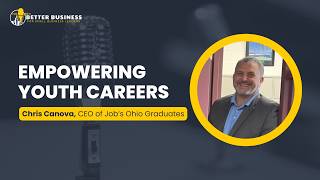
This is a transcript of a YouTube podcast (Episode 14) where Chrissy Myers interviews Chris Canova, State Director of Jobs for Ohio Graduates (JOG). JOG helps young people (ages 14–24) graduate high school and build career pathway plans leading to employment or postsecondary education through school- and community-based programs, work-based learning (micro 40-hour experiences, longer 120–160-hour paid placements), and job coaching. JOG is an affiliate of Jobs for America’s Graduates operating in 39 states; Ohio programs include Cleveland, Cincinnati, Dayton, Akron, Canton, Appalachia, and Columbus-area sites. Canova describes outcomes (about 50,000 youth served historically; high employment rates among participants—~90% working, ~80% full-time; 40–45% attending college), organizational growth (from an ~$300k annual budget when he started ~30 years ago to a multimillion-dollar budget), culture-building practices (staff recognition, shared “one JOG family” ethos, collaboration with nonprofits), and practical advice for small businesses and parents. Contact: jogworks.org; phone 330-374-9445.
Questions this video answers
14–24
39 states
Cleveland, Cincinnati, Dayton, Akron, Canton, Appalachia region, and surrounding Columbus
About 50,000
Micro experiences: 40 hours; longer paid on-site placements: 120–160 hours
Chapters
I'm even more proud that, you know, we've created a culture and that culture has been adopted by school systems, by other community based organizations.
So if you're looking for ways to add to your team, Chris Canova from Jobs for Ohio Graduates might have some solutions for you. So, Chris, thank you for being on the podcast today.
Well, thanks for having me. I'm excited.
Yes. Can you tell me what Jobs for Ohio Graduates does? What's your mission, purpose, and what do you do in the community?
Jobs for Higher Graduates helps young people 14 to 24 to graduate from high school. And we help them to create a career pathway plan that will lead to employment and or post secondary education. We have several programs helping young people in schools, those who have dropped out of school to those who have graduated, looking for, you know, opportunity.
Okay, so Jobs for Ohio Graduates is more of a local program to Northeast Ohio. Are there other programs that do this across the country, as people are starting to think? Because we have a wide, wide audience, yes, they are.
So Jobs for Ohio Graduates is a part of or an affiliate of Jobs for America's graduates. We're in 39 states. I happen to be the state director for Ohio. So in Ohio, we have programs in Cleveland, Cincinnati, Dayton, Akron, Canton, Appalachia region, and then surrounding Columbus, to name a few locations nationwide, we have locations that range from California to Vermont, down to Florida, Texas, and of course Ohio, Michigan, et cetera.
Okay, so as a small business owner, how can jog be beneficial to them?
Absolutely. So basically we go into businesses. We have a business engagement team that goes out and really recruits different business sectors. And within those different business sectors, these small businesses tell us what their needs are. We help them to identify those needs if they need assistance in that way. But beyond that, we create a career or work site plan and then we're able to connect them to qualified young people to help them deliver on their, on their business.
Okay. So oftentimes in, in the business community, small business community, as we're looking at scaling, there's the we need an intern or we need someone to help us with X. Could we maybe get a student to do that? How does jog kind of fill that gap? And tell me what makes jog special because your funding is a little bit different as opposed to just we're going to go out and find a random intern. You're purposeful in how you do that, right?
So the simple question is, yes, we do all of those things. So we could obviously identify an apprentice, an intern. What we're known for is Work based learning programming. So we identify young people, typically in high schools, that are looking for work experience. A number of our young people live in poverty or are facing other barriers. So our job is to work with them, to mitigate those barriers, to make them employable so that they can be beneficial to the business that we place them in. Now that takes the form of a couple different things. First, we can do micro work based learning experiences. So basically what that means is you get a young person for 40 hours, so it's a career exploration opportunity for young people. At the same time, the employer gets to know the young person and maybe there's a fit. We have longer experiences as well where we pay for the individual to work on site at a location with a business. Those are usually 120 to 160 hours in nature and they're our employee, but they're housed within the business. Then of course we have direct hires. So most of our kids work about almost 90% work. Of those, 80% are full time and another 40 to 45% are going to college. So pretty well rounded group.
Okay, so a few things that I love about jog. One is that you're working on finding meaningful employment for young people. The other part, as opposed to just finding a young person and employing them, you are giving them additional skills. So can you talk a little bit about the job coaching that helps facilitate successful employment of jog students?
Absolutely. So it's really a partnership. So we work with schools and other community based organizations to identify these young people. But oftentimes they're in a college and career pathway program. So what we're doing is we're combining that technical training in their field with the job coaching that you mentioned. So we are working with them on employability skills, soft skills. At the same time, we're helping them to identify, they may know this, they may not know this, the barriers they may have to employment. And oftentimes it's things like a lot of our kids don't dream very big. As a matter of fact, they know what's in front of them. And what's in front of them is typically parents. They live with their parents hourly work that may not be, you know, maybe more labor oriented or service oriented. So they're not thinking outside of that box. So we do a lot of career exploration with them. And oftentimes that leads to young people, you know, picking even different pathways that they're currently in so they can be trained post graduation.
So one thing that I have noticed in specifically Summit county is the reach that you have of I was a jog student. How many people there are in the workforce that are extremely successful in careers now of I was a jog student. So can you speak a little bit to the history of jog and how you've continued to work and turn out those individuals that continue to grow and impact the community? I mean, I know your outcomes, but I think our audience should know as a nonprofit, you've done an amazing job of accomplishing key, key factors continuously.
Yeah. So I can go back many years. I've been here quite some time. I came to this organization about 30 years ago and frankly, with the intention of probably being here a year or two. What I loved about it was that obviously I got to work with young people, but I also got to work with businesses. But that pipeline from school to work wasn't really all that defined for jog. So over the course of time we've done that. And as we've done that, we have morphed from a school based program to a community based organization. Now why am I sharing that? I'm sharing that because we used to serve a couple hundred kids a year and now we're serving thousands of kids a year. And over the course of our program, 50,000 kids have gone through our programming. And you know, I couldn't be more proud of that, but I'm even more proud that, you know, we've created a culture and that culture has been adopted by school systems by other community based organizations. And we may not be the, I don't know, you probably don't recognize our name. Oftentimes jogs doing this, jogs doing that because we're like a second tier organization. So you might go to school at Akron, Garfield, you can go to school at Stowe High School. But the organization oftentimes that's linking those kids to jobs, then after they graduate, following them for one year is us. So I think kids families have grown to appreciate that. And even better, the school systems and other organizations have as well. So we've been very fortunate. We've grown quite a bit. I remember when we started, when I started with this organization, I think our annual budget was 300,000 a year. Ish.
Okay.
Now it's quite a bit more than that, significantly. So I'm very proud of the fact that we've been able to grow. We have fantastic staff and you know, I always wonder about how things might be different if we haven't been able to retain quality staff. Been very fortunate. And we're a non profit. Right. So we don't pay top, you know, top wages necessarily, as compared to our private sector peers, but our people love what they do.
Yeah. So let's talk a little bit about culture, because it is clear whenever I am at jog that the individuals absolutely love what they're doing. What have you done, again, because you work in workforce for young people, what are you doing in your organization to improve and kind of keep and maintain that culture?
Well, I think this is more simple pre Covid.
Yeah.
You know, our concept is, you know, we're all one jog family, and treating each other as such is really important. And that means doing things that employees value, whether that's benefit packages that we pay for or it's other incentives that you may not otherwise normally see, like staff functions, celebrating each other on a routine basis, going to the Guardians game as a group, or things of that nature. But really it's about acknowledging their successes as they achieve them and doing it consistently. My perspective on compensation is a little bit different than a lot of people like my HR person.
Tell me more.
And I would rather pay somebody a reasonable wage, something that's what the market's paying, but at the same time being able to acknowledge their efforts on a more continuous basis. And I think people appreciate being acknowledged and not just one on one, but to their peers. And I think it's paid off for us.
I think so, too. I would say that JOG has a culture of cheerleaders. You are always cheering each other on, whether it is manager to individuals that they're managing or just across staff and coworkers. Coworkers. You always seem to be excited for each other, encouraging each other to dream bigger, do bigger things, whether it's. It's personal or it's professional. Other thing I would say about jog, and I'd like your. Your opinion on it, is, you know, in nonprofit space, oftentimes you can get siloed. And you seem, in part, probably because of what you do, to have a. A culture of collaboration. So working with other nonprofits, even doing work on behalf of other nonprofits that you don't necessarily get. Pa. Tell me about how that has grown over the years, because again, you started as a very small organization. You've continued to grow, be successful.
Collaboration. Collaboration.
Because you work with government agencies, too.
Yeah. What an interesting word that is. It's one that is often used, but rarely do you see it in our sector. And, you know, I think some of that is about making sure that you're retaining your footprint and protecting your space and Your funding and things of that nature. But my perspective is totally different.
Tell me about it.
And that is, in order to impact the community, you have to be able to be more holistic in the services that you provide. You can't be all things to all people. Why don't you identify people that are excellent at transportation, food, shelter, et cetera, or mental health, et cetera? That's not what we do. We are an educational workforce organization. Let's team with people who are good at it and let's work together to achieve really outstanding outcomes. And that's what we're known for. It's about graduating young people, it's about putting them in employment, it's about getting them additional training. And when that happens, it really widens your bandwidth. Right?
Yeah.
And other opportunities come to the plate that maybe you never experienced before or that you never thought of before. That has really been the biggest reason for growth, at least in my mind. There are several nonprofits that aren't willing to do that. Hey, let's talk. Well, the reality is we never talk, and that's unfortunate. Our door's always open. We want to talk to people, whether it's a grassroots nonprofit or it's a larger nonprofit. I would say nowadays people come to us to open the door to other nonprofits on their behalf. And I'm really happy to see that.
Nice. So let's shift for a minute and talk a little bit about workforce trends and working with young people. So you've been in the jog business for over 30 years. You've seen a lot of generations of teenagers. What are you seeing now in trends and how to reach young people, engage them in the workforce? How does it look different now than it even did five, ten years ago?
I should write a book like you, right?
Yes.
I don't think there's one answer. Chrissy, to be honest with you, I think that we do three things. We do three things well. One, we engage young people where they're at now. One of the things we're kind of known for is creating this third space environment, this out of school environment that young people gravitate towards. Think Starbucks, think Panera, think a bistro if you're an adult or bar type atmosphere.
Not a bar.
I shouldn't say that really, but it's about a very cool space, a gathering space. Gathering space that they want to hang out in. So creating an engagement, engaging environment allows us an opportunity to start on a very small level to build a relationship. And like it or not, you can't. Yes. We serve thousands of kids at the same time. It's. It's one kid at a time. It's one relationship at a time, driving, using that engagement piece to build individual relationships. Once those individual relationships are formed, then you can be transparent, right? You have to be transparent with young people, with anybody, frankly. And that transparency allows us to establish some goals and drive towards those goals. And our young people know that we're going to be with them. Good, bad, ugly. We're not going to judge them. We're not always going to agree with them. But that's reality. That's the real world. Right. So putting that front and center, I think, is a difference for us. I think that's the biggest one.
Okay, so let's shift from teacher to parent. So, I mean, you've raised two successful children. They're now in adulthood. I am working on getting mine through survival of teenage years. For those parents who tend to be driven or trying to get their kids into the workforce, what are the. What are the things that you would say? What are the things you've said to me, Chris?
Wow. So my young. My kids are two totally different people. I think yours are as well, right?
Yeah, very much so.
You know, it's giving them space to explore. I think that's really important. Letting them know that really anything is possible, but also instilling in them that you're gonna have to work to make it happen. And, oh, by the way, you're probably gonna fail once, twice, three times, whatever it might be. Get up, work at it. And, you know, and quite frankly, you might change your path two or three times. That's more what I'm seeing nowadays, I think when I. When I was in high school, you know, prehistoric times, I guess now. But you picked a path, you went with it. That's what you did. And your parents expect you to just go down that one path. Nowadays, kids change their mind all the time, but that's okay. Support them with those aspirational kinds of thoughts, but also provide to them what it's going to take for them to achieve in that arena. Right? Yeah, that's the most important thing. I have a young. My youngest son works in, you know, he's. He did not go to college, but has always worked and he's still, like, finding his space, but he makes a good living, right?
Yeah.
My oldest son has found his space and is a professional and just making sure that you make your kids know that you're proud of them regardless. Right?
Yeah.
I'm talking obvious, right? This is not like A secret, but being involved and showing support, most important thing.
Yeah. It's simple and obvious, but I think sometimes we just need to hear it again from someone else that isn't ourselves. So thank you.
Well, yeah, I mean, so there's this expectation that I work with kids every day anymore. I don't work directly with kids all that much anymore. But there's this expectation that, oh, your kids must have this. The secret sauce. No, they don't have the secret sauce. And sometimes they're a disadvantage because I'm throwing all kinds of things at them. You're much the same way, right?
Oh, absolutely.
And I think our kids are better off for it. They've been exposed to a bunch of different things and I think that's really, really important in this day and age of social media and what's a story today is not a story tomorrow and AI and technology and all of these things coming at you a million miles an hour, man. It's tough for me to even decipher that stuff. They've grown up with it. They're at an advantage, but it doesn't make it any easier.
Yeah. So I want to shift back. We talked about growing the workforce of tomorrow. We talked about a little bit of parenting and how to raise good, good team members, good employees. I want to shift back to the business part of what you're doing because you've grown an organization from a small budget now to a much larger budget, a multimillion dollar budget. So can you tell me, as you've been scaling, what some of those lessons are that you'd love to share to our small business owners? Because you're definitely still in that small business space. You're a nonprofit, but you're still very much growing an organization and doing solid business practices.
So I would, I would. I'll. Two things. One, if you are a nonprofit, view yourself as a business.
Yes.
Treat your operations as a business. You have to do that to be successful. If you don't, and I understand that we all have a mission in the non profit world. If you don't, you'll drown. You'll drown in requests and wanting to help people and, and that's important. But if you're not operating your business properly, then you can't help people. So that's number one for nonprofits. I think as far as a small business goes in general, my biggest mistake is not investing in infrastructure soon enough. Excuse me.
Tell me about that.
That is, you know, we probably would have grown. We've grown at 20 plus percent a year. For many years now. But, you know, when I first took this job, I tried to do everything myself. I was hr, I was the accountant, I was the marketer, I was the operations manager. And there's some of that that always has to go on, right?
Yes.
And did I grow as a professional? Yes. But what I should have been focusing on is growing the organization in a way that was more efficient. Would it have cost more? Probably yes. But we would have gotten to where we are now much, much quicker. And I underestimated the amount of support that is available for small businesses. Whether that's the chamber or other business kind of organizations, or even getting a job, coach or in our world, foundations, et cetera, people are there to support you. They want you to be successful. Even your likes, your cities, your city of Akron, city of Barbara, etc. They want you to be successful because everybody benefits. Seek out those resources, become engaged, become involved. One of the things I most respect about you, Chrissy, is that you're not afraid to be involved or engaged in multiple environments. Right. You do that. And I think that that benefits you professionally, it benefits your business. Plus it helps you to grow as a professional. It gives you better perspective on the landscape of your community.
Yeah, I think it does too. All right, so two more questions. The first is we always want to try to get 1% better. And I think you've already given most of this answer. But if you'd like to give the listeners again, what to do to get 1% in their business, 1% better in their business today, what would that be? The one thing.
Spend time with the people you work with that are reporting to you. If you're a business owner or even up here. And there's something to be learned from those people, you know, gravitate towards the positives. Right? Learn from them. I think that's really, really important. It's very, very simple. Right. And I'm not talking about, you know, annual goal or five year goal. I think those conversations are important. You're helping them to grow and you're growing at the same time.
I like that last thing. If organizations are thinking they'd like to get more involved with jog, with potentially having a jog student, how can they reach you or reach Jobs for America?
So the easiest way is to go to our website, which is jogworks.org j o g w o r k s dot o r g and our phone number is 330-374-9445. So either one of those ways is probably the best way to go about it.
All right, Chris, thank you for your time today, sharing about jog and all the different things about running an organization and also impacting the workforce of the future.
Well, thanks for having me.










