Episode 17: Leadership Lessons from 10,000 Small Businesses with Erika Hill
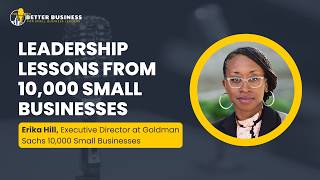
A recorded interview (YouTube) where Chrissy Myers speaks with Erika Hill, Executive Director for the Goldman Sachs 10,000 Small Businesses program at Cuyahoga Community College (Tri C). They describe the program’s mission (help established small businesses scale and add jobs), its in-person cohort format, core curriculum topics (leadership, finance, HR, marketing, operations), alumni networking and advising, and application details. The conversation emphasizes practical, implementable training and ongoing alumni support.
Questions this video answers
12 to 14 weeks.
Full day once a week (in-person).
19 sites.
10ksbapply.com.
Over 80%.
Chapters
Whether you're working for someone or working for yourself, you do that every day and that's your life. And so you want to definitely leverage the time and apply when you are ready to improve your life. And as a business owner, this is definitely a program to help you do that.
Part of being a great small business leader is also being willing to learn new things. And today I am talking with Erica Hill from Goldman Sachs 10,000 small businesses at Tri C. And we're going to talk about executive education. So Erica, thank you so much for spending time with me today.
Thanks for having me.
So can you tell me a little bit? I mean, I know a lot about the program because I'm a graduate. But can you tell the audience about what you do with Goldman Sachs and thousand small businesses at Tri C?
Sure. So I'm the executive director for, for 1 out of 19 sites across the country that provide the Goldman Sachs 10,000 small businesses program to local small business owners. And so when we say small business owners, this is beyond the startup phase of a business. This is having the business operations successfully going and providing products or services in a way that that has been checked off. It's proven that this is a viable business. We are making traction, we are impacting our community, whether that's nationwide or locally. And now we are in a position to where we are thinking about growth. And so the business education program that 10,000 small businesses is is about ways to grow their business. So the two objectives that Goldman Sachs foundation, who fully funds the program, wants to accomplish is to add jobs to the economy and also strengthen and fortify the economy by helping that business have more of those transactions, more of those sales, more of those offerings that they can provide their clients and customers.
So can you tell me a little bit about the program itself, how long it lasts, some of the curriculum and the things, the goals and the objectives of the learning and your target in the small business leader and why Absolutely everybody who's a great small business leader should want to be in this program?
Sure. Well, I'm already glad you think so, even before and after in your own experience. But definitely, as the executive director, we have a team. I have a team of six people who operate the program. And so who we're targeting is business owners who in proving their success, things may be a little messy, which is, you know, every business has that. Every large and small business has that. You may have been successful by certain ways of doing business that have worked for you to a certain point. And now you want to just reflect on, okay, do I want to keep going with this in this manner. Are there areas that I need to streamline? What does growth look for me? Does it look like more locations? Does it look like a new territory? Does it look like a complimentary product or service? Does it look like me partnering with someone? You know, what does growth look like for me and my business? And so we accept businesses from pretty much any industry. We have our accounting, we have our hr, as you know, we have our pooper scoopers, we have our chefs, we have our, you name it, pet care and grooming variety of industries. And so that's part of the magic of the program is, is that within that variety, you have just practices from different businesses that you realize on one hand that every business has an operation that needs to run in a pretty similar way, but you are also able to think outside the box as you learn from each other, as business owners learn from each other, and that there are multiple ways to get creative in how you run that business.
Yeah, well, one thing that I loved about the program, there were a lot of things I loved about it, but one of the things I thought was the most impactful is that you're with a cohort of other business owners that you didn't realize sometimes when you're. You're working in your small business, you're kind of in that island where you're thinking, everyone doesn't know what I'm dealing with. And so you're with, whether it's 20 or 30 other individuals who also own businesses or they're key leadership employees, they own a percentage of the business. And it was so nice to be with other people that are like, you deal with the same situations that I do. Whether you are an IT firm or you do event planning, or you're an accounting firm, or we're an insurance firm, we have similar situations. And then you can also learn and grow from each other. So I know that there are individuals, relationships that I built in Goldman Sachs that I still carry with me. We're referral partners. Some of them are vendors for me, we're vendors for them. And just that other connection, that brain power of, hey, I'm figuring out that I need to buy this building, and someone's like, hey, I can help you connect with a good attorney, connect with a different people that can help you kind of grow your business in a different way. So let's talk a little bit about curriculum. Like, I know that for me, I went into 10KSB, which is what I think we like to call it when we abbreviate things. I'm from the insurance industry, so we abbreviate everything. So when it said 10 KSB, I'm like, that's so much more efficient. So when I went in, I was in the process of finalizing the full transition of our family business. So I actually signed my paperwork in the middle of the program, which was really awesome. And so the other part that came out of creating that growth plan for me was deciding that we wanted to open another part of our business and go from just doing insurance to HR consulting. And so the growth plan and building your growth plan is such an important and integral part of the curriculum, or at least it was for me. And what I can appreciate from the organization and from the work that you do at Tracy and with Goldman Sachs is that so much of it is focused on how do we grow our business. Whether that is adding a new location, adding a new product line. But rarely do we as business owners sometimes, if we're usually always working in our business, we're not thinking about the big growth opportunities. And so can you speak a little bit more to kind of how you get business owners to kind of think more high level as opposed to those of us that are in the trenches every day, including learning how to separate from our business and actually put our phones down and do the work with you?
Well, that is the challenge. That's the challenge that we do take on through the program is exactly that. How to get the business owner to elevate up and be able to have a bird's eye view of their business and not only identify as whether it's just the leader or one of the people working in their business, you know, how will my business survive without me answering those types of questions? So the challenge that we do have that we take on is let's progress you to a position that where you can say, how is this business impacting my life? And that's what we start out with, which I think a lot of business owners are thinking, okay, well, we're going to talk about marketing and we're going to talk about processes and we're going to talk about HR and we're going to talk about being a leader and we're going to talk about our finances and we cover all of that in our curriculum. And so this is a 12 to 14 week program where business owners meet for a full day once a week to go over those topics. But every time they meet, it's a holistic view of what does this mean for me and my family and my life. In me having this business.
Yeah.
And so as far as, you know, the curriculum, delivering on, um, what are the steps I would need to take to remove myself, to say I could do what I want with this business, I can keep it, I can sell it, I can pass it on to, you know, another relative who is going to be a successor. I can partner and turn it into something different. I can add an additional business. So all of those things that you mentioned is part of the challenge in making sure that that business owner has a more holistic view and vantage point in their business and not being stuck in their business.
Yeah. Something else that I thought was really great about the program is, you know, you go to business school, you get your undergraduate degree, Some of us have our MBAs. So we learn all about the big companies, GE, Southwest Airlines, all of the large organizations. We're doing case studies. When we're talking about being in Goldman Sachs program, we're talking about our business. And so they, there, there may be case studies, but we take the case study and we're literally just doing the work as it relates to our organization. So I saw immediate changes within what I was doing as a leader, what we were doing as an organization, because I could take things that I learned on Friday and implement them on Monday, Tuesday, Wednesday. And so the impact and the traction that we had moving forward was just so powerful. I felt like the first year of working after I graduated from the program, it just amplified things. And I graduated in summer of 2019. So of course, you know, winter and spring of 2020 was. It was a little bit different, but I had some really great skills that I had amassed from going through 10 KSB that really sustained us through some challenging opportunities and challenging times that we had. And I would say that I was prepared for 2020 because I went through the Goldman Sachs 10,000 small business program. Like, we've gone in high parts of the economy, we've dealt with dips in the economy. I've been in this business for 20 years. But really that education around, you know, how to ask for financing, how to not be afraid of having a banking relationship, building good relationships with some of your vendors and your partners, creating more cohesion with your customer base, those are things that in principle, you learn through 10KSB and they can really sustain you through positive times and then through challenging times. And then there's something else I'd like to kind of talk to you about, because when we first met, you were working with the alumni community and like when you graduate from 10K KSB it doesn't just go away. So can you talk about how the program continues to extend? I appreciate all the education that Goldman Sachs and Tracy provide to me as an alumni, which is super awesome.
I do love that it is a revolving door. So we always have opportunity to welcome back graduates from the program as a local community, as a community just within your cohort of who you went through the program with. In addition to, we are going to have our 35th cohort coming up soon, and that's over a 12 year span. And when I. When you and I first met, I actually that was cohort 19 was my first.
Was it really? Oh, my gosh.
I didn't realize it was my first cohort. And I think I won't make you.
Choose a favorite, but I know it was cohort 19. It's okay.
Well, it's funny because my team rolls their eyes because every cohort is my favorite cohort. And they're like, okay, that's great. I'm like, you know, that covers everyone, thankfully. And the beauty of the program is that it is a fun program. It's a challenging program, but it's a fun program. So, you know, being able to connect with the graduates afterwards gives them opportunity to connect with each other, gives them opportunity to reach back and welcome the newcomers that are a part of the program. Each coh we have them get together to discuss with the newbies. Okay, this is the best way to handle this. This is the best way to stay on top of, you know, the work that's involved. This is the best way to leverage the program and maximize it for their benefit. And then in addition to that, that camaraderie, we want to make sure that that's sustained and that you're able to strengthen that. So whether that is through the bond that you have through your fellow cohort members, or if you're meeting people in your industry where you have certain best practices or a part of certain associations that you are able to see a familiar face, you know, within each area of town that you network in. So that's very important to not only TRI C, but definitely also to Goldman Sachs is that that's part of the holistic point of the program, is that not only do we provide that business education while you're together and foster that relationship while you're together, but we want you to keep it going and we want to help you keep it going. So it is a beautiful thing.
Oh, I love it so much. And I think, you know, as you continue to have new cohorts, New organizations enter the program. There is. There's a language of business, and then I feel like there's a subset language of those of us who have been through 10 KSB. And so you can identify the individuals that have walked through the same curriculum that you have and that we have shared not always the same vision for our businesses, but we have the same set of language. And then we probably also have a lot of the same appreciation for some of the skills and the things that we're continuing to grow within our organizations. So for those individuals who might be on the fence or kind of thinking, you know, I want to invest in myself, I want to invest in education. The one thing we didn't talk about is the fact that this program is free, which is amazing. Thank you to the foundation, Goldman Sachs foundation, for providing all of that. Because my MBA wasn't free and almost anything mine either. No. Anything else I've done in education tends to be at a high cost. This is a program that I feel. If you talk about value, you ask Chrissy, what's the most value you've gotten from any program you've done in education? I would say it was through 10,000 small businesses. And I don't say that just because you're in front of me. I say that to anyone who's a small business owner that's looking to really level up their organization. You've gone from the startup phase. You've been through your first high. You've been through your first, oh, my gosh, my business is going to fail. Maybe you've got through those, like, first five, oh, my gosh, I'm not going to sleep. And you're really wanting to move forward. So I think that it's extremely valuable. But what are some of the things as people are starting to apply that you would encourage them to think about, you know, caring and investing in themselves as a business owner and a business leader with this type of education.
So with us taking on the challenge to help business owners grow their business, that means that they have to take on that challenge, too. And so there are certain attributes that make sense and need to be there in order for it to work for that business owner. So if you have a business that meets your needs, where it's at, and you're not having the itch to grow it and expand it or scale it, and you're like, I'm great, right where I'm at, then that is not the time to apply for our program. The time to apply for our program is when you feel a compelling urge to say, I want to do more, I want to be more and I want to accomplish more through this business. And so we can help you do that. Again, the holistic part is not only about the business, but about the business owner. So that means that you are ready to be open to having advising from our one, our business advisors who provides that one on one coaching which is a great component of the program. And that is not only in the class are they there with you, but also outside of the class on those one on one times which you can schedule just based on your own time. And also, you know, with the fellow business owners that are in the group, you are open to hearing about the way that they do business and you can take or leave with a smile on your face. Okay, that makes sense. Okay, that doesn't make sense for my business, but it gives you ideation that you wouldn't get anywhere else. It gives you a safe space that you know, you can say to a fellow business owner, how do you meet payroll? You can't ask that of your team.
No, I tend to freak out just.
A little, just a tiny bit. But you can in this space because you all have the challenge of what it means to meet payroll. And like you said, you may have had those ebbs and flows in your business that you think you're the only one going through it or you're the only one going through it of this kind. But there are so many other stories and versions of what you're going through to where it is a bit cathartic to say, okay, I'm not the only one. And they've also found ways to solve for this problem or solve for this issue. So you, in addition to being together to commiserate on the hardships of owning a business, but you're also there to celebrate. You're also there to brag about some accomplishments that you've made. You're there to say, we just won this award or we've just been nominated or we just opened our next location, or we just hired the right accountant because we were brave enough to get rid of the one that wasn't the right accountant. And so this is life changing. And the reason I say that is because whether you're working for someone or working for yourself, you do that every day. And that's your life. And so you want to definitely leverage the time and apply when you are ready to improve your life. And as a business owner, this is definitely a program to help you do that well.
And I think it's a program that you absolutely get what you put in to it. So, Erica, before we close up, what I'd like to ask is how do individuals apply? Where's the website? How do they get there?
Sure. So the simple URL is 10ksbapply.com okay. That's the short of it.
We'll put it in the show notes.
And that will definitely get you to the information about the program to learn more about it. We do have a second link that goes specifically to the site for Tri Seas location. So again, we're one of 19 sites across the country that offer the program. So for Northeast Ohio business owners, it's an in person program. So it's not virtual. We don't do it over a webinar. This means that you have to get dressed and get in your car. Yes, you do drive at least once a week to come be with fellow business owners in a physical space. And so we hold it at Metro campus at Tri C. And so we can also provide that link directly to what Tri C offers as the site. Same program across all the sites. That speaks to what you mentioned before, Chrissy, about knowing that, okay, this person who's also been through the program knows what it's like, knows where it's coming from. So you sort of vet each other as potential partners, collaborators doing business together. And it's great to hear that over 80% of business owners in the program do business together.
Yeah.
So whether it is a transaction or it is a partnership is great that you have this other network that is enriched in that you can tap into at any time.
Well, Erica, I want to thank you for your time today. Normally we ask individuals how to get 1% better in their business every day. I think it's really simple in this situation. They just need to think about and apply for this program, seriously consider investing in their education. So I just want to say thank you for the work that you do at Tri C with Goldman Sachs and I'm looking forward to helping and encouraging more people to be in the program with you.
Thanks for having me, Chrissy. This is a pleasure.










