Episode 19: Finding Purpose After Entrepreneurship: Gary Sirak Talks About Retirement Without Dying
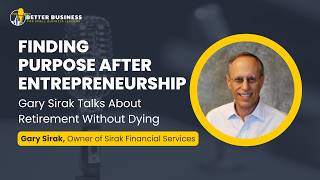
This is a transcript of Episode 19 of Chrissy Myers’ YouTube podcast featuring Gary Sirak. Sirak describes his lifelong entrepreneurial/sales background and emphasizes that retirement planning must pair financial readiness (simple math: income vs. living costs) with purpose—what he calls a ‘wish list’—to avoid the loss of meaning after exiting work. The conversation covers practical advice for business owners (build assets outside the company, be patient, use deferred comp/401k), leadership practices (treat employees like family, listen to opinions), family-business realities, the value of mentors, and Sirak’s book/masterclass about "how to retire and not die."
Questions this video answers
May 21, 2025
11,000 books worldwide
Chapters
I started waking up in the morning and thinking, whose problem can I solve today? Not how much money can I make, how many policies can I sell, whatever. I stopped thinking about all of that. I said, okay, someone's going to have a problem, I get to help them solve it. And whatever happens, happens.
So we've all heard those stories about the small business owner or the employee who's worked for an organization for 20, 30, 40 years. They retire and then they pass away almost immediately. It's like they lose the ability and the focus, the purpose that they have. So today I am talking with Gary Sirac, whose passion is to ensure that that does not happen to people. The people don't die as soon as they retire. And I think as small business leaders, it's so important that we think about, you know, longevity and how we're going to continue to live and survive and enjoy life after our business. So, Gary, welcome to the podcast today.
Thank you for inviting me.
So, before we talk about some of the things in finance and talk about retirement, I would love to know a little bit about your entrepreneurial journey and of course, tell us about your business.
I was thinking about my entrepreneurial journey this morning and it really started when I was a little kid. I would make potholders and sell them door to door. I would shovel snow, I sold illegal fireworks, which by the way is very lucrative. I guess I was born to be an entrepreneur and definitely a salesperson. So as I kind of went through life and went to college as an English major, went to Miami of Ohio, graduated from there, and English majors and sales aren't necessarily the same thing, but knew that I was going to gravitate to sales. So eventually I did. And it really led me into working for someone for a few years and realizing that I'm pretty unemployable. I need to be on another situation where I could control my own destiny. And that's really the journey. I mean, it took me a long time to figure that out and in some regards, and then I think, eh, not that long. It was a pretty fast start.
So let's talk a little bit about retirement financial planning, which is some of the things that you specialize in. You know, you talk about having heart to heart conversations with clients. I know that's something you're very passionate about. So what is a recurring fear, concern, that constant conversation that you're having with business owners as you're, you're having those heart to hearts. What's, what's the common theme?
Well, the number one theme is money. First of all, do I have enough money to retire? How do I have enough money? What do I need to do? All the conversations start with money. And that's great. And you got to have those conversations. But the reality of it is when you get to retirement, how much money you have is important, but it's not nearly as important as what are you going to do with the rest of your life. So I have a tendency to focus on the financial part because I have to and we need to. It's really critically important. And everyone says, well, how do you make a decision that someone's got the financial ability to retire? I said, well, it's actually mathematics and I was pretty good in math, English and math, two good subjects. So math is pretty simple. And I say, well, what does it cost you to live? And then they tell me, and I say, okay, how much money do you have coming in? How much can we draw from your 401k, your other assets? And if it's more than you're spending a month, we're in pretty good shape. If it's the same as a month, I said, eh, maybe you need to keep working and if it's less than a month, you're absolutely going to keep working. And people look at me and say, well, you know, that's it. And I said, yeah, it's pretty much it. I hate to say that, but that's what really happens. So that conversation occurs, Chrissy, and then we get to what's really burning in my brain and that is, what are you going to do for the rest of your life? Because that's a really big question. That's a, you know, that's a 26 year marathon in my mind.
So let's talk about that question. How often when you have conversation with business owners or key employees that have helped build a business alongside a business owner and you're saying, well, what are you going to do at retirement? And they say, I don't know. So how, how do you build that conversation? Because I know I, I'd love to talk a little bit about your book and kind of where, where writing it came from because you, we talked previously and I know you've got a lot of passion around ensuring that people continue to live after work. I mean, for us as small business owners, sometimes we think it's the only thing we want to do forever, but eventually, whether our spouse makes us retire or we decide we want to sell the asset. So how do you have that conversation? How do you prepare people for the future?
Well, it depends where they are in the retirement mode. But I just had this conversation yesterday with someone, this gentleman retired as the vice president of a hospital. Plenty of money, lots of. And the question was, I don't have a clue what I'm going to do for the rest of my life. Because I asked him a very simple question. Tell me about your first day, your first week, your first month and your first year of retirement. And Kristy, normally the question is, well, I'm going to go on vacation. I said, okay, that doesn't count you back from vacation. Let's start again. Tell me what you're going to do because you have 40 hours a week to fill and you've not had to think about that for 40 years. Yeah. And that's a whole lot of time. And it's. If you don't have that figured out, it can be very daunting and quite depressing actually. And that's what really motivated me to get into the book. My son and I wrote this because I kept having clients have the financial wherewithal to survive. Plenty of money, but no idea, nothing that really lit their fire. No purpose, no passion and zero planning. And those are three really key things to retirement. If you don't have those figured out, you're going to have a really rough road. Now people eventually, maybe will get there, some never do. And I've been to way too many funerals, too many nursing homes, just too much bad stuff where people couldn't figure that out.
So how do you steer them initially in that conversation? Because I would think that sometimes you've got the I don't knows. So what's the next. What's the question? What's the follow up to the I don't knows and that you have to figure it out? Because I mean it's clear I don't know. You got to figure it out. But what's the next step?
You know, it's a really interesting thought process that I went through for myself and I, I used to get in trouble in school for this, but I would have tendency to look out the window. And they called it daydreaming. I call the thinking out the window. I didn't get good grades for thinking out the window. Always check marks and you know, all that stuff. But I was able to look out the window. And then I realized one day that I was looking out the window thinking if I wasn't working today, what would I be doing? And I started making a list. Chrissy. And I started writing those things down. I said, well, if I wasn't Doing this today, I'd like to play golf somewhere south where it's warm. And I would write the course down or whatever. And so pretty soon I started having vacations on there. Just stuff I wanted to try and do in my life. And it didn't matter if it was reasonable, unreasonable. My first book, it was a, it was way on the bottom of the list. Oh, I'm going to write a book. Well, eventually I did write one. Then I end up writing three. And my music, I said, okay, I want to write. I write lyrics. I want someone to actually, I want to turn this into a song. Well, lo and behold, it became a song. So I tell people, I said, listen, what did you like to do when you were a kid? What was fun for you? And start there and tell me, you know, what was that? Well, I used to bicycle. I said, okay, maybe. What else did you like to do? Well, I used to like to walk in the park. Okay, that's a good start walking. So, you know, all those kind of things, Christine, is a matter of getting them to go back and think about what they really enjoyed in their life and what made them happy. I got one guy, he said, you know, I used to cook when I was in college. I haven't cooked in 40 years. I said, well, what do you think of that? He said, you know, it's funny. Think I'm going to start watching classes online and start watching those cooking shows. I said, well, I think that's pretty cool. He's actually become a pretty decent cook. His wife is thrilled.
That's fantastic.
And she's pretty much turned over the kitchen to him. And she said, sometimes we have to go out and eat because it's not such a good result. But, you know, mostly he's figured it out. So I think those are the kind of things that people really need to grasp and say, okay, what would make me happy?
Yeah. So unless we're. Whether we're talking about an out the window list or a bucket list or what I want to do with the rest of my life, any of those things. Just kind of starting to think.
I call it a wish list.
A wish list. Okay, I love that. So we talked about a little bit about the retirement part. I want to talk to you about those business owners who are so in their business and they're thinking about their employees and everything else, growing their organization and they're forgetting to even think about their own financial future because I know you've dealt with those as well. So how do you shape the path for some of those business owners who don't always think about their retirement. How do you get them to think about retirement?
Boy, there are a lot of those. Yes, and way more than people think. And they're so wired in. They're so drilled into their business, their employees, their company, growing it, they forget to protect themselves. And so we get into the idea of, listen, at some point in time, you're going to sell this company, you're going to turn over to your kids, you're going to do something, and you need to start planning for that now, not waiting 20 years. And so we try and gear them into doing things, whether it's putting more money in their 401k, doing some kind of deferred comp. Whatever it might be, something that will help them build an asset so that what they sell the company is important, what they sell for, but not as important. And they start to build some assets outside of the company because owners have a tendency to pour it all back in, and then if it goes sideways, all of a sudden, they have nothing. In fact, I just had that conversation with someone this morning, and it was pretty sad. And he's going to get out a pretty sizable chunk of change that he really couldn't afford to lose. And it's too bad. My father said something very. My dad said a lot of smart things, but he said, don't chase money you don't need with money you cannot afford to lose. And this gentleman did exactly that against my. My advice. And he said, you know, I appreciate what you're saying. I'm going to do it my way. And I said, okay. And then today he said, yeah, I probably should have done it your way. And I said, well, okay, thanks. I will never tell you I told you so, but I thought about it. So my. My thought is that you really have to prepare yourself financially, mentally, and think about what makes you happy. And if it's just your business, that's a problem.
So let's talk a little bit about something that some of us lack. I don't think you do, Gary, but I think I do in entrepreneurship, and that's patience. So sometimes as small business leaders, okay, fine, we'll listen to you. We'll. We'll put money aside, But I'm watching it, and it's growing slowly. And I don't know what, like, how do you continue to instill value of patience and time with small business owners who sometimes have a short attention span and want to be done with a project or done with, like, maybe I want to retire at 40 and I'm 35. Or maybe I want to, I want my investments to grow by a certain percentage and I'm not willing to sit and be patient. How do you, how do you instill the value of patience of people who may not have patience?
Well, some people you can't. This is the impossible. They're, they're just so impatient on every aspect of their life and there's really nothing you can do about them. And I kind of wash my hands of them because they're going to end up not being good long term clients, relationships that I want. Then there's the other side where they know they need to be patient, but they're impatient. And then it comes to me, how well can I explain why patience is so important, so wonderful example, I have a client of mine, I just recently had this conversation and his money is growing at about 6%, which I'm very happy with. And he thought it should be 10. And I said, well, if you want to grow at 10, you have two choices. And he's. What say? I said one, you can get a lot more aggressive in your portfolio or you can go to Vegas and see what happens. And, and he looked at me and said, what do you mean? I said, what I mean is that I'm only a part of your portfolio. I'm going to grow this very conservatively. And you need to let that part do what it's supposed to do because you can't hold all your money on the table, you can't have all your, in the company. You need to have a section of it. And I said, so what you need to do is do whatever you want with the other side, your company. Be as aggressive you want to be, knowing full well that because we're patient on my side and because I've got you in a better situation, you have a backup plan. And that's what I try and instill in them.
Well, and I think for you, something that's been, that's made you successful for decades is that you're, you're also a small business owner and you're a leader. So you understand a lot of those perspectives. So I'd like to shift a little bit and talk about your own business and kind of your, your secrets to success if you're willing to kind of share them. So you built a successful business for many decades. I'm not going to say how many, but you can.
Thank you. Want a bunch?
Yeah. But what's the most, what you feel is the most important lesson in leadership, that you've had as a business owner that you'd like to share with the audience.
It's tricky, but I treat my employees as a family. And I have this family first idea about business. I know everybody wants to make money, that's great. But family really matters. And so when there's something that comes up and their family's involved, whether it's an illness or a basketball game or something, I'm pretty flexible on letting my employees go do that and enjoy it, because business is business. And quite frankly, most of the things that had to be done today could be done tomorrow. There's some that can't, but most of them. And I know that having done this for a few weeks, the other thing is I've let my employees know that I value their opinions. And so if they have an opinion, I give them respect. They don't tell me and I roll my eyes and say, oh, great, that's not what I do. I listen and, and hear what they say. I don't always agree with them and I don't always do what they suggest. And if I did, they'd all be working three days a week from home. But that isn't going to happen. So the real world is we work together as a team. And I think they feel the same way. They feel like this is a team and not just a company.
I love that. And I think it's evident in your organization. You have longevity, you have employees that had been there for a long time and, and the balance shows in how you take care of your clients and you continue to build a successful career. So another question, you being in financial services, having been in insurance, all of those things, you've had some significant changes to your industry. You've had significant changes to the type of business that you're doing. So I want to ask you now, as you're starting, if you were starting a business today, knowing what you know now, how your industry's changed, just the nature of business in general and how it's changed over time, what's one thing that you might do differently and why?
I'd be more patient with myself and I would be a lot more. I would say in the very beginning of my business, Chrissy, I was like everybody else, trying to figure out how to feed my family and how to make money. And that switch flipped totally many years ago with a conversation with my father. And we were having a drive back from a client meeting that didn't go well because of me. And my dad said, gary, you're more interested in making money than you were solving his problem. I said, okay, dad, what does that mean? And he explained it to me, and I didn't like it at all. But he was 100% right, and that made a huge difference in my thought process. And I said, okay, we're not doing that again. So I started waking up in the morning and thinking, whose problem can I solve today? Not how much money can I make, how many policies can I sell, whatever. I stopped thinking about all of that. I said, okay, someone's going to have a problem, I get to help them solve it, and whatever happens, happens. And then I tell people I'm skinny but eat all my meals. So if I don't get paid today, it isn't going to change anything. I said, I'm still going to have my favorite macaroni and cheese or kosher hot dog or whatever the heck it is I want to eat. The reality of it is, though, thinking about them and not me made all the difference in the world. So I would tell people, starting out, if you just focus on helping people, it's hard and you have to have patience because it takes a while for that to pay off. But it does pay off.
I love that. So as you're learning to be more patient, as you continue to do that, I mean, we all make mistakes and business. How do you forgive yourself and kind of pivot when things don't go the way they thought they were going to, as planned? Because I know you're a planner, I'm a planet. How do you. How do you manage that? I know I'm not always good at it. I'm continuing to work on improving that resilience skill. So how do you handle when things don't always work out well?
My first word is poorly. But in reality, what I really think about is if I'm really thinking in terms of having problems or having a conversation with someone. I like the 24 hour rule. I will not have that conversation for 24 hours. So if something comes up and there's something wrong and something isn't feeling right, I will hold off and make. I just give it some time. I want it to marinate. I want me to get a better feel for it. And I. And I want to think about it a little bit more rather than just automatically react. So that's the first thing I learned. And once I started doing that, a lot of those issues became less important and less dramatic. The second thing I do is that some friend of mine told me, some will, some won't. So what next? So some will stay Some will go, so what next? And that's a hard lesson to learn. And I still have trouble doing, dealing with it, but after I think about it, they're right. And then one other friend of mine once told me, said, listen, Gary said, in your total career, you're going to do X. And he said, it's going to be a very large number. So the issue that you're losing a client, how much of the X are they really going to be? In reality, it was a fraction, and that helps, too. So those are some of the things that I do for myself, Christy, because you got to figure out ways to process things that don't go the right way.
Yeah, I really appreciate that advice. It's pretty good. Couple more questions. So you talked about, you know, doing things with your dad. I know you wrote your books with your son. Do you have any tips for those people who are in family businesses together, how to survive?
My first one. Good luck. It's not easy. Yeah, that is a. Oh, you're in family business.
Yeah.
Okay. Anyway, there were four of us one time, and then there were three because my brother and I fired our uncle. I mean, it was just one of those things where it's a tricky. It's a tricky road. And separating family from business is difficult. And family outings were not as much fun, I will say that. Because Tenzie's seed would be to drift over into business, which always used to irritate all the wives and spouses and everybody else at the table. So we had to really protect that as much as we could and try not to do that. But reality of it is, it was a wonderful experience. I mean, I got. I was not that close growing up with my father till I joined a business. I mean, we clashed a whole lot, and somehow we fanned. We managed to figure that out when we got in business together. And it worked out quite well. My son and I wrote a book together. We get along. It's great. He lives in Keystone, Colorado, up in the mountains, so he gets to do skiing, and he's a freelance writer. And. But he and I have just a really special relationship. So when we started tackling the book, he would interview me, and he interviewed me for 24 hours. And then he wrote the original script, and then I edited and he edited. We went back and forth until we had a book that we were both happy with and wonderful experience. We did a master class last year in November. He and I spent 10 hours in a recording studio, and we have a video and an audio recording, and we took 10 hours and turned into 3 hours and 45 minutes. And it's basically how to retire and not die. Wonderful experience, Chrissy. Just if nothing else, even if that thing never sold one, it would have still been a great experience. But it is going to sell. It's. It's pretty cool how it worked out so well.
And I think that, I mean, for those of us that have worked in family business, there's. There's always a relationship thing, and it can be different. Oh, I agree. And echo with you, do you talk about business all the time? Like the spouse conversation? I'm like, are we really going to talk about this again? We're like, yes, because every. Every meal is a meeting. So it's nice to hear that other people have. Have dealt with that and kind of having the balance. But the other part that I agree with you on is the memories, the relationship that I had with my family, some of yours, it's. It was different and closer, probably because we spent a significant amount of time together, and some of it was more about, you know, how we sell insurance. But the other part was, you know, just time and proximity. So, last question for you. So one thing that we. We close the podcast out every session with, you know, what is the one thing that you would tell small business owners that they need to do to get 1% better and their business? So I'm going to ask you, Hiri, with your amazing career and your longevity in a family business, and then also just in business in general, what's that one thing to get 1% better that you'd like to share?
I think finding a. A mentor is huge. And, and I really value the mentors I've had in my life. I value the mentors I have now. And there are just people I can pick up the phone and have a conversation with, and they can help me solve problems or they can help me see something. And realizing that it was just gigantic for me. I mean, my father was certainly a mentor, but I had other ones, too, that were outside of the family, which was good. And they played an important part in the success of Serac Financial, no question about it. And they played a part in my life. They impacted me in positive ways. And I would think that would be 1%. That would be a huge 1%. You get a lot for your one.
Yeah. That is a lot for your one. I completely agree with you. It's something that I don't know that anybody has ever said on the podcast about the importance of a mentor, but you are. You're so spot on. And that I think not just in the, the education and the business like, but it's the balance part of the living your life and not just being tied to a business. I think you have really been inspirational for some of the mentors that I've had and I consider you one of those as well. So you just showing how to live a full and expressive life and getting to do all of the things in your I want to do before I die out the window thinking list. So, Gary, I thank you for the time that you've given us today. I feel like you've taught a master class and you know, financial planning, retirement, how to think outside the box, how to make sure that you're enjoying your life, how to survive family business and continue to just grow and be better and grow your business for the long call. So thank you for the time that you've given us today.
Oh, you're very welcome. And I will throw one little plug in for myself. We've sold 11,000 books worldwide.
Wow.
And considering no one knows who we are, it's pretty cool. So I think it's kind of fun. We're in Australia, the uk, Canada. I don't know, every time I look on Amazon I look and say, whoa, I wonder how they found me. But. But it's fun. And you know, it's one of those things where you just look at things and say, wow, this is pretty cool. It's definitely on my list and I get to chalk it off. So. And doing podcasts like this, I consider the same thing. I get to share my stories and learn from the people who are interviewing me. It's a two way street. So thank you.
Well, I appreciate it. Thank you for your time today. Thank you for sharing again with the audience. We'll have all the links to your books in the show notes. We can make sure that everyone. I think it's a read that everyone should have, especially as a small business owner because we're emotionally tied to our businesses. But making sure that we have something else when we do decide to retire is so important. So thank you for the work that you're doing and continuing to help other business leaders as well.
My pleasure. And thanks for having me on as a guest.










