Episode 21: How to Win the Talent War with Strategic Insurance Plans with Alice Rhodes
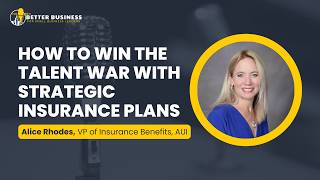
Podcast interview (Episode 21) featuring Alice Rhodes (AUI) on using employee benefits strategically to attract and retain talent—especially for small employers. Alice explains common small-employer pain points (cost, high deductibles, lack of broker attention), practical broker behaviors that add value (frequent communication, targeted shopping, education), product options (ancillary voluntary benefits, HRAs, self-funding), and compliance thresholds (50 full-time-equivalent employees for ACA employer mandate). The episode includes myth-busting rapid Q&A, client anecdotes showing cost savings from shopping/plan design, and a call-to-action with contact details.
Chapters
I never just send stuff because their head's going to pop off. So you just call them, talk to them, see what they're looking for, explain what you're going to send.
Health insurance isn't something that everyone thinks is fun, but Alice Rhodes from AUI absolutely thinks it is. So we're going to talk today about benefits and how to be a good insurance broker, all the things that are fun about aui. So, Alice, thank you for coming on the podcast today.
Thanks for having me.
Yeah. So can you tell me a little bit about your journey and why in the world you ever wanted to be a health insurance broker?
So in my prior life, let's see, I started at AUI when I was 10.
I know, me too.
So I've been there 25 years now. So in my prior life, I was HR for a department store. And it's retail. It's horrible. We had high turnover. And I'm like, I need out of here. But what works well with HR? Well, benefits. So I started doing customer service at AUI. Came when I was 10.
Yes.
So hard to believe it's been 25 years. Where does this go? So seems like just yesterday, but boy, has it changed. So. So that's it. And it's always something different. So that keeps you interested, it keeps it interesting, and it's.
Never boring.
Yes, exactly.
So what's a common frustration that business owners have with benefits brokers and with health insurance in general?
Yeah, so it's no secret. Health insurance is expensive. So that's always the number one issue. We run into brokers, especially in small employers, they have trouble finding somebody that wants to work with small employers. And if they do find somebody that'll do it, they never hear from them. They're going to a call center. They don't ever find a person that they can work with. So that's where we try to be different.
So you like being the person that returns phone calls?
Yes, exactly.
So I know that for a lot of small businesses, health insurance feels like a necessary evil. Like we have have to have it. So how do you help small businesses, especially those employers that have less than 20 employees, see employee benefits as a strategic advantage.
So in today's labor market, you've got to try as an employer, you've got to try to make people want to work for you. And benefits is a key way to do that. And it's not just health insurance. It's things dental. Everybody wants dental vision. As a vision person, you know, it's very valuable to me being able to get glasses and contacts. So you gotta kinda put yourself in their shoes too. And things that people don't think about, like life insurance and disability, whether it be short term or long term, because you don't. You always think, it's never gonna happen to me. But until you either know somebody that it happened to or it does happen to you.
So what's one mistake small business owners make when they're choosing or managing their benefits? I can think of five. I'm sure you can't too, but what's one?
Going for the cheapest plan.
Okay, tell me why.
Sometimes when it's cheap, doesn't mean it's the best option. You know, they're just, oh, I want that plan. It hits my budget. It's an $8,000 deductible with no co. Pays well, depending on what you do. That's hard to work with, so. And your employees don't always understand. They're like, oh, my benefits are horrible. So. So they just look at things a little bit different.
Yeah, I would agree. Definitely the higher deductible. If you're not educating your employees around what is the right way to manage that plan or how to use that plan effectively. I agree. Going for the cheapest plan can oftentimes be a struggle. Another one that I would say is, let's talk about the fear of shopping. Like, I don't ever want to shop for my benefits. It's complicated and hard.
And it is. It's. There's a system, and it's an electronic application system we use in small employers to be able to shop. Everybody hates it because every employee has to go in and complete it. And sometimes it's like herding cats. So they don't do it. They don't want to do it. There's always, you know, usually it's the owner that's the last one to do it.
No, never. We don't speak from personal experience there. I am always the last person at the platform fire.
Yes, yes. I'm tracking her down when it's our turn. Yeah. So it's. And then going through that whole process, and then, you know, what if something doesn't come back? But then at least you know what's going on in your group.
So how do you kind of. You walk through the form fire process with people, you help them get their applications in. You shop, you've got all these quotes. What do you do as a broker to kind of help navigate, steer them in the right direction, make a good decision? Because oftentimes I think people think of their insurance broker as I've got to fill out this form and then they send me like 10,000 pages that I'm supposed to spoon through and figure out what I'm supposed to do. So how do you make this manageable?
Especially some of the small employers, they get these quotes in one carrier. It's an 80 page quote. So once I get everything back, I never just send stuff because their head's gonna pop off. So you just call them, talk to them, see what they're looking for, explain what you're gonna send. Sometimes you can narrow some things out, you know, based on network or you know, their doctor's not there or things along those lines. But you just talk to them and you communicate with them. And then you can narrow it down and say, okay, I'm gonna send you these three options that I think are great and go from there.
How much about what you do is understanding the group. Like, do they have kids? Do they have people that are going to be retiring soon? What are they trying to attract? How do you kind of position yourself in understanding what the business needs from an employee benefits perspective?
Yeah, so I like to get to know my groups. So what are their needs? Do they, you hit the nail on the head. Do they have people that are going to be retiring that may be, you know, the Medicare, they don't know what to do. They, some people, they start calling 18 months in advance. And some people are like, oh, I turn 65 tomorrow, what do I do? So they don't know how to navigate. And some of it depends on the employer size. What do they do? Do they. They're confused. So it's always something new every day.
Yeah. And oftentimes I think navigating. When you're a small employer, you know what's going on in your organization. So you know, if a health issue or if they've had an emergency. And so you take some of those things more personally and kind of figuring out how they navigate the insurance. So I would think that as you have those conversations, you're getting some of that feedback as you know, well, we don't like this hospital system or we have to make sure that this drug is absolutely covered because our VP of sales is on this medication and so it has to be affordable for them. So how do you kind of is that continuous dialogue and kind of helping them figure out what things are? Because I would assume that things change all the time.
Oh yeah, yeah. Heck, at the end of every year there's some new contract up with a hospital with a carrier and it changes all the time, you know. You know, if you're in Akron and you're going to lose one of the major hospital systems in a network, you got to be proactive, let people know because they get nasty. They do.
And those hospital systems, they send letters to the insurers, their patients, they said those hospital systems and those major doctor's offices, they'll do the same thing. And so you get those, I assume you get those phone calls.
Oh, yes, yes.
I think this doctor is going to be leaving the network. What do I do? Okay, we'll shop at that time.
Yeah, exactly. You've got to be nimble and be able to shop it. And you know, sometimes you got to make a hard decision of do I just wait and see what happens? Because normally that stuff settles and it calms down, but you got to be prepared to jump if you need to.
Yeah. So I know that as we talk about, you know, navigating things, one thing that it can be a challenge is cost. So I know a lot of small businesses think they can't afford good benefits. So what's your response to that?
There's all sorts of different options out there. And we're very fortunate. In northeast OHIO we have 10 different carriers with a whole plethora of options. And sometimes it's maybe not a group option, but then there could be an individual option available for them as well. Because there's different mewas, there's self funding, there's level funded, and it just kind of depends what you're comfortable with and what makes sense.
Yeah. For those in our audience who aren't insurance nerds like we are, what are the requirements for when I have to offer benefits and those types of things like can you give us the thresholds real quick?
So based on the federal regulations, you do not have to offer benefits until you have 50 employees, 50 full time equivalent employees. So there's some part time stipulations in there as well as what counts as a full time.
Okay. So up until then I can put.
People where or do what you can do small. You can do different types of health reimbursement accounts, whether it be a QSE HRA or an ichra. And those kind of depend. There's also some different things depending on your employer size. If you're under 20, you don't even, you don't have to do Cobra 20 Plus. So there's different thresholds of, you know, what's what your requirements are as an employer. You know what counts. What count, you know, is it A half of a person or is it a full person? Sometimes things sound kind of morbid. No, it's a half a body.
So as you're kind of thinking and planning with a group, you can kind of talk about, you know, what are your needs? What are the things that the organization, as they continue to grow and scale, attract and retain people with some of their benefits. But then these different things that you just talked about, the Alphabet soup, they give you different options for different price points, different types of coverages.
Yes, definitely.
Okay, so how's the landscape of employee benefits changed in the last few years? I know we dealt with a lot in the Affordable Care act, but what are you seeing right now as far as trends with. With where the labor market's going, with where the economy's going, with where cost of healthcare is going? So what are things that small businesses should really be paying attention to and maybe even asking their broker to pay attention to?
So there's obviously health insurance. If it wasn't changed, we wouldn't know what to do.
Exactly.
And you're right. ACA was a big shift in how we did things, trying to think. And then with the advent of the ichras, icras, or qsehras, which is the qsehras, those are things people are starting to look more at, but it really just depends on your group as a broker. One thing I always like to look at is, like I said before, getting to know your groups, keeping an eye on that census. Do they have 15 employees and two of them are getting ready to go on to Medicare? What can we do with them? Will it help the group? Do they. Do they stay with the group? Do they come off and go Medicare? What are the rules around that? Because they're all a little different.
Are there any big compliance changes you're seeing on the horizon?
Oh, well, that we have a new Department of Health and Human Services director and a new CMS director coming up. So just last week in the spending bill there was about extending telehealth. So it changes all the time. And I'm expecting more changes, just not 100% sure what they're going to be.
And compliance changes, too, on reporting for employers. Same thing for individuals. And I think ACA dealing with Medicare. I know we've seen some significant changes to broker requirements. Do you want to talk about things that your broker should be doing if they're not doing?
Yes. So in the Medicare arena, when you get into part D plans, they all cover different drugs. So in just this past open enrollment, there were a Ton of changes where drugs that were covered aren't covered anymore. Maybe a plan that was $5 a month is now 30 or it was crazy. Yeah. So you need that broker needs to keep an eye on it and find you the most reasonable plan for you.
So having a broker that can pay attention, that can understand that you can ask questions too, is really important. Oh, yeah, Definitely not just in Medicare, but in the small business space as well.
Yeah, yeah, small business, individual Medicare.
All right, um, I'm going to ask you some really quick yes and no questions.
Okay, Ready? All right.
Health insurance is too expensive for small businesses. Yes or no?
No.
Employees only care about salary, not benefits. Yes or no?
No. Duh.
If I work with a broker, I'll pay more for insurance. Yes or no?
No.
Right. All insurance plans are basically the same. Yes or no?
No.
Once I pick a plan, I don't have to think about it until renewal. Yes or no?
No.
All right. I want to unpack some of those. One that I think I love, but I think people always forget that is if I work with a broker, I'll pay more for insurance. So can we talk about that, Alice?
Why sure. So especially in small group, the carrier set commissions and you pay the same commissions. For one, the carrier won't work direct with you. And you pay the same whether you work with us or ABC Agency down the street. It doesn't matter. So you pay the same whether you hear from us or you don't hear from us. Whether we shop you or don't shop you, we get paid the same. So.
So let's talk about renewal and shopping for a minute. So it's not, I don't think it's something that I told you we're going to talk about, but I want to. And so oftentimes we have groups that go, oh, I'll just renew it. It's a 5% increase, it's a 10% increase year over year. And as long as it's under 10%, I'll just keep renewing. Why would you tell a group that that's not a good idea?
Let's face it, even 5 or 10% of a large number is a large number. So it's not like we have a $200 a month single rate anymore. We've got some that are 1000 1300, 1500 or more that they're paying for a single. So it never hurts to shop. It doesn't even have to be on cycle. So. And it's. If nothing else, it lets you know if what you have is a good rate and sometimes maybe you still don't want to move, but you can always take that market data to your current carrier and say look, this is what the market brings. Do you want to keep this group or not? And sometimes they'll drop their rate, sometimes they don't. But then it's your decision to, to do what you want to do.
So using it as a point of leverage for negotiation.
Oh yeah, definitely.
How, how do you present that to your client and saying I know you don't want to fill out these applications but it can help and be beneficial. What are some of the cost savings you give us? Like kind of a story that you, you've dealt with in the recent past or cost savings?
I just had a small employer, 20 employees they had again been with an agent that they had continued to just take the increases on. They were on grandmother plan. So it was $3,000 deductible. 80, 20 after that we were able to shop it, move them to a $500 deductible with a new carrier and save them 20% off of their current rate before even the renal so much.
Richer plan, much cheaper repetitive data.
Exactly. Wow. Yeah.
So tell us about a time when a business owner came to you overwhelmed by insurance and you completely turned things around for them. You do this all the time.
So I think I do it and don't even realize I do it. So again, you know, insurance is complicated. Nobody ever likes to see me coming. You know, back during when employer reporting came out, I kind of joked I had this black wool coat and if it had a hood on it, I looked like the grim reaper. I was coming. So trying to think different situations. One of our co groups with, with clarity had kind of reached a size. They had gotten 15, 20% increases again year over year. Didn't know what was going on in the, in the group. They're like, oh this is horrible. You know, everybody's healthy. Why are we keep getting these 20% increases? We were able to shop it moved them to a self funded plan, totally changed how they, how they do things. Now they get reporting, they know what's in there. They know that part of the group doesn't get their preventative care. So they've been able to change some education, make sure those employees are getting their preventative care done. So it kind of changes some things on that education side because you can go in and tell people oh you know, you need to do this but everybody could be doing it. But at least you know what you need to educate them on Especially when.
You can see the numbers on this.
Yeah, definitely. Definitely.
So if a business owner is listening, they're wondering whether they have the right broker or not. What's one question they should ask themselves?
When was the last time they heard from them?
Oh, and if it was renewal, that's not the right answer. How often do you like to talk to your organizations that you work with?
In a perfect world, if there's no dumpster fires going on, that group, about every six months. Okay. Sometimes a little more. Depends on what's going on in the group. Sometimes there's a dumpster fire and you need to touch base a little more often.
So if they've got challenges, maybe quarterly. And then also, do groups reach out to you throughout the year?
Oh, yeah, constantly. Okay, constantly.
So if a business owner could take just one step today to improve how they handle their health benefits, what would it be?
Call me.
I like that one, too.
What else?
Like, let's say they're in Montana and we're not licensed in Montana. We could get licensed in Montana.
Yeah, we could get licensed in Montana.
What would you tell them then about how they can handle their health benefits? What's the step they can do to improve it?
Make sure they talk to their broker, or if they don't have one, find a new one. Yeah. And there's also benefits they can offer that don't require any funding out of the employer. There's voluntary benefits.
Oh, talk about that for a minute.
So there's a ton of different. We call them ancillary benefits. So voluntary life insurance. They can benefit from a group rate and possibly get a plan less than they can get on their own. It's payroll deducted. The employer doesn't have any cost out of their pocket. It's totally funded by the employees. You can also do that with dental, vision, disability, cancer plans. There's all sorts of accidents.
And working with a broker enables you to have access to those types of things. You don't have to worry about finding them yourself.
Exactly. All right.
Where can people connect with you?
Easiest place is on LinkedIn. Or if you're not on LinkedIn, call me. So our 1-800-number is 1-800-671-7665.
All right. And the last thing we do, it's the question we ask with every podcast, is what do you think a business leader could do to get 1% better in their business today?
Oh, call me.
I agree. Call your insurance broker or call Alice, because she should be.
If you have employees, make sure you communicate with them. Make sure you let them know what's going on and just talk to them, find out what their needs are.
Yeah. Especially around benefits. I think oftentimes the the employees forget that benefits are something that is at the cost of the employer, too. And oftentimes the employer, well, not oftentimes. Almost always the employer is paying more for the benefits than the employee is. They should be, at least because that's the rule.
Yes. Yeah.
Alice, thank you for your time today on the podcast.
Thanks for having me.
I look forward to we're going to have more of these conversations and more insurance learning. Thanks a lot.
Thanks, Ra.










