Episode 23: Why Digital Accessibility Matters: Elizabeth Orley is Back Another Wake-up Call
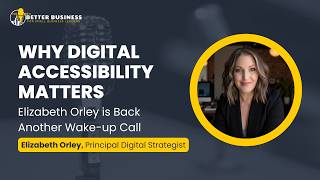
This is a podcast interview (Episode 23) where Chrissy Myers speaks with accessibility advocate Elizabeth Orley about why digital accessibility matters for small businesses. Orley explains accessibility as applying to websites, social media, email and video, gives a personal story (temporary loss of hand use) illustrating universal need, connects accessibility practices to SEO benefits (proper header structure, crawlability), warns of legal risk (state lawsuits and remediation costs), and offers practical checks and fixes—use WAVE (wave.webaim.org), review Google PageSpeed (aim for accessibility score ≥80), add alt text for images, and add captions for video. She also warns that overlay plugins (e.g., AccessiBe) are not a guaranteed fix and notes AccessiBe faced litigation in 2024. Contact via Linktree: linktr.ee/Elizabethink.
Questions this video answers
wave.webaim.org
Google PageSpeed (PageSpeed Insights); accessibility scores under 80 suggest you should consult an expert.
Approximately $15,000–$20,000 (not including remediation costs).
AccessiBe (suit noted in 2024).
linktr.ee/Elizabethink
Chapters
So, you know, if you're thinking about wanting everybody to access your stuff, because that's all we want, right. Is to reach the biggest audience. That's the whole point of social media. Right. We want to reach the biggest audience we can. So if you're not designing things to be accessible, you're not reaching the biggest audience.
Website accessibility may be something that you haven't thought about as a small business owner, but today we're going to talk to an expert who knows it's something that you should be thinking about. So, Elizabeth Orly, thank you for coming on the podcast again today.
Chrissy, I am honored that you let me back.
So let's talk a little bit about your background and how you became an advocate for digital accessibility and kind of what it is, because I think it's really important for small business owners to think about.
Absolutely. So digital accessibility is anything online that, that is part of your digital footprint. So what we're talking about is websites, we're talking about your social media accounts, email newsletters that you might send out as a business, all of the above. So anything that is processed in a digital way, we want to talk about how to make those items more accessible to all users.
Tell us what that means.
Okay. I think the first question I didn't answer was why am I passionate about this? Right. So let's go back to the beginning. I had like this giant epiphany about the why accessibility is for everyone when I broke my arm. So I am super dominant, right handed. And about, I would say, five years ago, my dog was playing on the carpet and I grabbed her collar and she kind of like wrenched back and hairline, fractured the bone in the middle of my right hand. And my ring finger was like an inch longer than my middle finger. And, and my husband's like, oh, it's probably fine. I'm like looking at it, honey, this is not fine. So I went to the, you know, I went to the emergency room and I ended up having my hand like completely not usable for eight weeks. Wow. And I'm in digital marketing. So imagine being on your computer like basically 247 and not being able to do the things you normally do. It was a huge eye opener for me because I realized, wow, this is crazy. I can't use the mouse. And if I try with the left hand, it's a hot mess. I was trying to learn how to do stuff verbally. I was learning how to do keystrokes, control, just to try and move through the Internet. And it is very difficult that is when I started being super passionate about, okay, how do we make this work for all humans?
A lot of business owners think that accessibility is just about helping people with disabilities. But you say it's for everyone. You shared some of those things. So what are some things that you need to be thinking about as far as accessibility goes with your website or your digital footprint in general?
Well, I say it's for everyone because think about it. We might have bad eyesight and forget our glasses and want to make the font bigger. Right. We might have issues with colorblindness. I mean, we could break our right hand. We could have friends and family as we get older, and our dexterity changes. And things that were easy for us to maneuver online are a lot more difficult when you're trying to use a mouse. So, like, the size of the buttons on your webpage, for instance, can be a hindrance to somebody that has a hard time with dexterity. So I think all of these things matter because it can be anybody in any time of your life. And if we're not designing for everybody, then what are we doing?
Well, and what I'm hearing from you, too, is in designing for everybody, we're designing for all of your customers, because not every one of your customers is going to look, feel, do things all the same way. Is that right?
Absolutely. I mean, why would you want to limit your customers? The other part of it is it's the law. Oh, it is? Yeah. Okay, we can talk about that later.
Yeah, let's talk about that. So I know that you talk sometimes about accessibility being a mindset, not just a box to check. Can you help me understand that? Help our own listeners understand?
So, you know, if you're thinking about wanting everybody to access your stuff, because that's all we want, right, is to reach the biggest audience. That's the whole point of social media, right? We want to reach the biggest audience we can. So if you're not designing things to be accessible, you're not reaching the biggest audience. Let me give you an example. When canva came out, it's like the coolest tool ever, right? Everybody gets to be a graphic designer. We all get to make all this cool stuff online. You can. Here's the problem. If you put all the text in your graphics and then add that graphic to social media, but you don't describe what's in the graphic. Somebody that can't see and is using a screen reader might miss your entire event.
Oh.
Or how to go there or where it is or what time it is, because all that information lives on a graphic that's. I mean, it doesn't unless you have an alt tag. So I think there's a couple things we can talk about that are applicable to everybody. Not even just. Not only just business owners, but everybody in the universe can do this and make everything that they do online more accessible. So the first thing is to put alt tags on your images. So you can do that on all of the social media platforms, including your website. If you use Facebook, LinkedIn, Twitter, any of them, there's a button on the posting that allows you to give an image description. And so let's say we made that graphic in Canva, and all of the information and data is on that Canva graphic. When you hit the description, if you add what's on the graphic to the description now, you've made that image more accessible and anybody can read it.
Okay, so let's talk about why accessibility matters as far as, like, marketing performance, different things. I know you're an expert in SEO. Excuse me. So how does Google reward accessibility or incentivize organizations? What does that look like?
So it's an interesting. I felt like it was an aha moment in my digital, you know, my digital landscape life for what, what I do for work is that I realized that the very same things that Google wants for SEO are the same things that make your website accessible.
Really.
Aha moment. Here we go. Like all that Google wants. And there's a reason for that. The bots crawl your website the same way the accessibility tools do.
Okay.
So if you have content that's laid out with the correct header tags. Now, a header tag is the title of your website is an H1, or the title of a page is an H1. And then. And underneath that, you can't skip. It has to go H1, H2, H3. You could go back to H2, but you can't do H2 to H5.
Okay.
And if you think about it, how a screen reader would read a website, it wants to know what the most important thing is, right? And then when it knows the most important thing, it can skip around the page to the second headers, the second most important things. And if something's like a bulleted list, that would be lower on the list. So that might be an H3 or an H4. Right? So somebody that's using a screen reader gets to choose what they can read. They don't have to read your whole website. They can scan it. So let's talk about how that also works for Google bots. So if you're talking about Google bots, what you're doing is you're basically setting up the bots to know what the most important topics are on each page.
Okay.
So the correlation between what Google wants for, for websites for SEO and what accessible people need for screen readers are ended up being very close to the same thing. So it does help your SEO.
Okay, so some of this sounds really complicated to me because I'm not, I'm an insurance and HR person. I'm not, I'm not an SEO expert. I don't design websites. But for small business owners who are just like, you know, I just want to sell my things online. I don't really care about accessibility. Tell them why they should care from a legal perspective.
So the new ambulance chasing lawyers are ones that are going after websites that are not accessible. Oh, do you remember during COVID there used to be a whole bunch of lawsuits for little mom and pop shops that didn't have accessible access to their storefronts. ADA requires that digital spaces also be accessible.
Oh, okay.
Okay. And let's, let's go back to the fact that you just said that you want to sell things online. If you have customers in California or New York or some of the other states that are imposing, like they're, it's not even imposing. What do they call it when they, when you, you require that people do the accessibility stuff, it's not imposing.
I don't know. Oh my gosh, I thought it was imposing.
Well, maybe. No. Well, maybe it is. Imposing does have legal requirements. Yeah, it's a legal requirement. And by law in their state, you have to meet. And if you don't, you can get sued. Well, let's say you're an Ohio mom and pop shop and you're selling widgets to California. A lawyer from California can order a widget from your website and then sue you claiming it wasn't accessible. Oh, and guess how much that costs on average? By the time you pay a lawyer and you go through all the process, guess how much you're out on average?
Like 20, $30,000?
Yeah, 15 to 20. But that doesn't even cover the remediation to fix the problem on your website.
Oh, so you're paying the legal fe and you're paying then.
Unless you want to get sued again. Right. So I mean, it's crazy because not only is it the right thing to do, but it protects your business online, especially if you're selling stuff. Okay. Another example that's really important is let's say that the only way customers can contact you or book an appointment is through your web forms on your website. If they're not accessible and somebody can't use it to book a meeting with you.
Oh, okay.
You're losing a client. You're also opening yourself up for a lawsuit.
Okay, so what are some of the ways that individuals can solve this problem? I know that I've. We've worked together for a while, and accessibility has been something that we've been working with on our website. And so we've talked to a bunch of different people, and some say, well, I just use this plugin. So tell me what people should know when they're thinking about, like, what are the right types of tools? Or who are the types of people they should make sure they work with?
Okay, so there are these overlay tools that people are putting on their website with the idea that by just adding this little plugin on their back end of their WordPress site, that they are making their website compliant. The problem is the plugins themselves don't guarantee that your site is compliant. And the second piece of this is it basically puts an overlay on top of your website. Okay, so what is there that the screen readers want to read is still wrong.
Oh, so you're giving wrong information.
Well, it's not always more accessible. In fact, sometimes they screw stuff up. So one of the biggest Tools, it's called Accessibe in 2024, was actually sued because they claimed that their tool made people accessible, but they didn't back it up with anything. So people that use their tool and paid for it and hoped that that met compliance, they were hoping that that would work.
Right.
But it didn't because the tool itself wasn't actually accessible in all the ways it needed to be.
So how can you protect yourself as a business owner and kind of work with the right experts? Are there certifications, Are there anything that kind of set different types of vendors apart? So, you know, you're working with someone who really knows what they're doing.
This is a difficult question because web accessibility is not a skill that most developers learn in school.
Okay.
Okay. So somebody has to really have a client that needs to be accessible or, like, additional training to understand how it works and when it. When it's right. Right. So there's a couple of ways that people can check to see where they're at now. And I think, you know, I kind of want to walk away from this podcast giving every small business owner a couple of tools and tricks to just kind of get a baseline, because to me, it's important as long as you're getting better. I think it would be hard for people to say, oh, well, I'm going to sue you because of this. As long as every step you take is towards compliance. Right. So the first one, for anybody that has a website, it's called wave.webaim.org okay.
We'll link to that in the show notes.
Okay, so WAVE is the WAVE Accessibility Evaluation Tool. It's the international standard for digital accessibility. Okay. So every business owner, take your website URL and throw it in there and on the left hand side of the screen, when you pull up your website, it's going to tell you all the things that are right and where you have problems.
So you have a starting point, you.
Have a starting point, you're going to know you have a problem fairly quickly. The other one that you want to look at is actually a tool from Google. It's Page Speed. It's the Google Page Speed tool. And that tests two things. It tests how fast your website loads on mobile and on desktop. But the secondary part of it that's really, really unique is that it also shows you how accessible your website is. So if you get in there and you have a score that's less than 80, you probably need to talk to somebody nice.
So let's pivot from websites to social media.
Yeah.
As you said that it also matters. So what is the one thing business owners should be doing differently when they're posting online?
Do the extra step. Add the alt tag. Okay.
And then what about video?
Okay, so video, you have a couple of choices. A lot of video platforms now give you the opportunity to put captions on automatically. Okay. That's not necessarily what I recommend because if you've ever tried or watched a lot of videos that use the automatic.
Captions, they don't always do it right.
The spelling, yes.
Bad grammar.
Very unfortunate mishaps that happen when you let AI do all of your captions. So I recommend doing them yourself and or auditing the ones that are there, which most tools will allow you to do. So take the. Again, it's another extra step, which is why a lot of people I don't think are doing this stuff. But if you hire somebody to do video for you, I think it's a requirement that you need to put onto the videographer. And most videographers that are worth their weight and salt should be able to to do that for you. Yeah.
And I think it's also a good reminder that even though individuals may not have issues with accessibility, for hearing most of us still listen, don't listen. We read captions. 80% because we don't. 80%. That's what the number is.
Yeah. 80% of videos are watched with no sound.
I can attest to that.
I'm one of them.
I am. Yeah. Especially like if I'm in a meeting and I'm supposed to be paying attention. Yeah, absolutely.
Never, never, never.
Doesn't happen.
No. I mean, if you think about it, how many times are we sitting in living room at night with our spouse and they are not watching the same thing that we're watching and then we just make more noise. I mean, accessibility is for everyone. Like, it just makes sense. It gives your audience so many more ways to absorb the content you're creating, the experience you're providing. It's just a wonderful thing for people. So for social media, again, when you go to schedule a post, think, is somebody going to be able to get all the information just from the post?
Okay.
Don't leave it in the graphic. I mean, in Canva, it looks fabulous. But don't do it unless you're also going to remember to put the exact same stuff in the, in the meat of the post you're posting.
That's helpful.
I hope so.
Yeah.
So I want to see good things for people. Like, it's just nice.
Yeah. So let's talk about some accessibility myths. I'm going to ask you some quick questions. I just want to hear yes or no. All right, we ready? All right. Accessibility is only for people with disabilities.
No.
If I install an accessibility plugin, my website's automatically compliant.
No.
If my website looks good on mobile, it's probably accessible.
No.
Only big companies need to worry about accessibility.
No.
Alt text is only necessary for blind users.
No.
All right, let's come back to if my website looks good on mobile, it's probably accessible. I thought that was why it's not.
No, no. So all that a mobile website is is it takes and shifts the content to a different format. It changes it from a wider format of a desktop to a narrow format on a cell phone.
Okay, so let's talk about some real world stories because I know that you've got some about accessibility. It's part of the reason why you're passionate, not just because you broke your arm, but because you've also watched some other businesses deal with those challenges. I've heard you share a who faced an accessibility challenge. So you want to tell us a little bit more about that?
Which one? We have so many. You can pick your Favorite.
Okay, your favorite horror story.
Dun dun dun. I'm sorry, no. Okay, so we know a hairdresser in New York and all she did was take appointments online, Right? She got sued because the form on her website was not accessible. Right. Wrong or indifferent, it happened. And it cost her like $18,000. Something crazy. I don't even know the number. But I mean, stuff like that happens a lot. It's unfortunate because that's why I call it the New Ambulance Chaser, because people aren't. I mean, it's a new thing. Developers didn't learn how to do it in school. It's not like it's a class that was, you know, regularly.
And it's not intentional. It's not something where people are like, I'm not going to make my website accessible on purpose. It's just.
Why would you think about that? I mean, just like with Canva, I had a. I had a friend of mine ask me, what do you mean that Canva doesn't include an alt tag? Well, no, why would it? You have to create the alt tag in the format that's required for the platform that you're posting it to. So, yeah, crazy stuff. I had another friend of mine that they do vacation rentals, okay. And they had been sued because people that do, I mean, they may be in one state, but they might get sued from other places because there are clients all over the United States. So remember, even if you have any kind of e commerce store and you're selling to California or New York, those are the big two states that will go after you for accessibility. So you can't leave yourself open to that stuff. I recommend that all of the people that have websites have accessibility statements on their website. And you can go online or go to your legal counsel and have them draw it up and say, okay, here's the things we know are not compliant and we're working on them. Here's the steps we've taken to try and make sure that our content is more accessible to people. A lot of times you get grace when you're trying to do the right thing and you ask questions, you say, hey, if you find something on my website that's not accessible, will you email me and let me know? Right. So we can fix it.
There ways to cover yourself, protect yourself.
But in 2025, I think for anybody that's working online, it's really, really important to put accessibility in the front of your mind. And everything that you touch, everything that you update on a website on social media from now on, from the day you hear this pod.
Yes.
Please make an attempt to make your content more accessible.
Well, I would ask you the 1% question, but I think you just answered it.
Yeah, that is a good 1%. Just from this day forward, think about accessibility. Think about reaching that one extra person.
I like it. So how can people connect with you? Learn more about digital accessibility?
Oh, goodness gracious. Okay, so the best way to connect with me on every platform, everywhere in the world is on Linktree. So it's LinkedIn, tr.ee forward slash, Elizabethink. Okay. And that'll get you to every profile I have, all my websites, everything.
All the LinkedIn stuff.
All the LinkedIn stuff. Okay.
Because I know you do a lot of education around and I appreciate what you're sharing with the audience, what you've shared with me, what you share with everybody about how to be more accessible.
Listen, Chrissy, I am so passionate about helping business owners with stuff like, I want people to win. I do. I want people to win. And if accessibility helps you win, if it gets one more client, then you win. Right?
Absolutely.
So thanks for having me today.
Thank you for coming. Thank you for sharing about accessibility and how we need it not just on our websites, but our social media and other places as well.
Yeah. And everybody. Not just businesses.
Not just businesses. Everyone.
Every time. Ra.










