Episode 24: Alice Rhodes on Why Most Small Businesses Get Employee Benefits Wrong
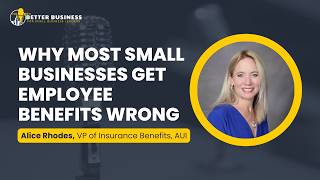
Alice Rhodes, VP of Employee Benefits at AUI, explains why small business owners bungle their benefits packages. Most treat benefits as a fixed cost rather than a strategic tool, skip educating employees about what they have, and wait until renewal to pay attention. Small companies can still compete with MEWAs and HSAs, but compliance mistakes around COBRA and discrimination are costly.
Questions this video answers
About 30 options (she recalled one carrier once had 120).
From a $250 deductible (employee paying ~$50/month premium) to an $8,000 deductible after changes.
$500 a month for medication (example where tools can help find lower cost).
About 75% of their employers renew January 1st.
You have 14 days to send the COBRA notice (from the time the event occurs).
Chapters
Sometimes short term savings can lead to long term pain. So you could lose a key employee because now the plan that they've been paying $50 a month for for a $250 deductible is now an $8,000 deductible and they use.
Today we are talking about a topic that most business owners think they have figured out, but they absolutely do not. We're talking about employee benefits and some of the mistakes that small business owners make around their benefits. And I have Alice Rhodes from aui, the vice president of employee benefits. Alice, thank you for taking some time today.
Thanks, Chrissy. Always glad to be here, especially for a topic like this.
I know it's your favorite. I know benefits, small business changes, huge. They make a huge difference. So you've worked with hundreds of small businesses since you've been an agent for a broker for a long time, even though it's only been like three years.
I started when I was 10.
That's exactly right. What's something that still surprises you about what employers think about their health insurance plan, employee benefits plan? Those words are interchangeable. So what surprises you from employers still?
Most employers still look at it as a fixed expense, not a strategy you can use to help your employees. They don't realize how many options they have. You know, here in Northeast Ohio, we're very fortunate. There are carriers that have 30 different options. We had one at one time that had 120. It can be overwhelming. That's one of those. You get the quote and it's like, oh, no, I need Excel and I need Sort. Yes.
All right, so today we're going to talk about like five mistakes that small businesses make and hopefully how to fix them. Let's start with mistake number one, which you actually talked about in your surprises that treating benefits like a line item costs. So let's start with that big one. Looking at benefits as just another bill to pay. It comes in every month or it goes in. Ach.
It's just.
There it is. What's the risk there in treating it like it's just an expense?
Sometimes short term savings can lead to long term pain. No. So. So you could lose a key employee because now the plan that they've been paying $50 a month for for a $250 deductible is now an $8,000 deductible and they use it all the time and it's gonna impact their wallet. I just had a group do that. They made some drastic changes and I had people in tears.
Oh, yeah.
I had to be the bad guy.
And part of how to avoid some of that is really just it's being proactive and looking at it yearly. Having a strategy for where the cost needs to be. Is that right?
A lot of it, yeah.
Okay.
Yeah. And education.
Yeah. So not necessarily about spending more, but maybe spending smart.
Correct.
So how do you help people spend smart?
Oh, boy. First, it's very important to people have their doctor. So just buying again based on the cheapest cost is, you know, they could lose their doctor. Medications that were covered that aren't covered, we run into that a lot where it was covered under formulary before and not anymore. So you just kind of want to make sure you know what's going on out there.
I like that. So even when you've got benefits in place, if your team doesn't understand them, it can be a problem. So let's talk about mistake number two, which is educating employees. So why does teaching the employees how to use the plan, why does education matter?
A lot of times there's perks in the plan that they don't know exist. Sometimes it's, you know, my insurance nerd brain, you know, I wear a tracker. I did it anyway so that my treadmill didn't kill me, but it tracks my steps. For every so many steps I get, I get points towards rewards, dollars. And some even our own employees kind of forget it exists all the time. And, hey, did you know you have this? So making sure they know what's out there or that there's tools they can use to help them find the lowest cost on their medication, that's $500 a month. So just making sure they know what's going on, educating them. Also, the cost, they a lot of times forget that, oh, the employer's paying this. Yeah, I make, you know, $20 an hour, but they're paying $1,000 a month for my plan. Sometimes that's not appreciated. They're like, oh, I can go here and make $25 an hour, but I don't get benefits.
Yeah, they don't see that. Total compensation.
No. So that's important, too, to make sure they know. Yeah.
A good broker can help you understand the value of creating those total compensation statements. Whether you work with an hr, you have an HR person that does that. Your payroll company can often help run those for you. It's a feature usually in most of the large payroll softwares I see that oftentimes employees can't value what they don't understand.
True.
So if they don't see it, they don't Understand why? Not even just what the overall cost is for the premium, but the value in what they get. And often, even if they have, they have a high deductible, they have coinsurance that they don't necessarily see. Like the value of shopping around, knowing how much things cost. I think it can be a pain point as opposed to a point of clarity and being able to find the right price and the right provider. So I think that quick education can kind of help with that misdirection, Misperception of plans.
Oh yeah, definitely.
So let's talk about mistake number three, which is only thinking about benefits at renewal. And I think that's something, especially as small business owners, when you look at it as a line item in your spreadsheet, you're not thinking about anything. It just runs in the background. There's nothing going on. So we said before, like if your benefit plan is a once a year thought, it's probably broken.
Right.
So let's talk about this one. So tell me about what that mistake is. And only thinking about benefits at renewal.
So we check in constantly. Sometimes you don't want to hear from me because you feel like you're hearing from me too much. It's like, hi, me again. And it's just understanding your business, what's going on? Or you may tell me, oh, I've got three employees that are expecting right now and I don't know what to do. Or they have disability insurance. And how does that work? They forget they have it or, or not.
Yeah. So looking about benefits being almost like an ongoing conversation.
Yes. Yeah. And it's not just health insurance, it's short term disability, life insurance, different things like that.
Yeah. So as we're planning, I know we do benefit planning with our businesses, with our clients throughout the year. Can you talk about why? Like that 30 days before your renewal, especially depending on the time of year, can be problematic. And even coming up with where things need to go, I mean, we can always get people move, we can do that placement. We're nimble. But from a heartburn perspective with your employee groups, why is renewal season too late for some of those big decisions?
Sometimes, especially in small employers, you need some things out of your employees in order to be able to shop it. And it is, it's heartburn for the employees. They don't want to do it. It's like herding cats sometimes to get out of them what you need.
Filling out the application, medical information, especially in small groups.
Yes, yes. So trying to get them to do it, get it back get the quotes out of the carriers, and then to make a decision, making sure that, oh, this plan is going to have my doctors, it's going to have hospitals that they need. That takes time. You don't want to rush into a decision and then realize, oops. And come December holidays. Yes, things slow down. I'd say 75% of our employers renew January 1st. Well, that's also the same for the carriers. So things slow down. Sometimes getting an approval back will take two, three weeks. So we're at the end of January and just getting a January approval letter. So in the meantime, employees have had to go to the doctor. They've had to go and oops, I don't. All right. They have medications to fill, and now they've got to change some things. They're stuck paying a higher premium, maybe not the right benefits for a period of time.
I know the ideal for us when we talk to our clients a lot, especially the ones that renew that January 1st, we're talking about wanting to make sure they've done their application and formfire is what we use. So they've done their. Their form fire. We've gotten the quotes back. When are we really wanting them to make a decision? If it's January 1st, is the goal that. Ideally in the middle of November. So that way we have enough time because.
Yes.
The other struggle that I see is that small business owners make the decision the day before because we think, well, January 1st means I can make my decision December 31st.
Right.
Which is fine.
Right.
If you're just one person, what does that impact you? You mentioned it before, but I'd like to reiterate what that impact is to the employees themselves. When you make a. What does that look like for them when they don't know what's going on?
And it never fails. Something happens. It's Murphy's law. Oops. I have a doctor's appointment on January 3rd. Where's my ID card? Oh, they can't find me in the system, or, oh, I have a sinus infection. I've got a prescription to fill. And then the employees are disgruntled because they've either had to pay out of pocket.
Wait for reimbursement.
Yeah, exactly. Exactly. Which is never quick.
Yeah. And I know oftentimes we've had issues with carriers where they're so backlogged, but again, we may do everything right in getting something even in the middle of December, but not getting an approval until the middle of January and clients not getting ID cards. So some of that is in the expectation of making sure that you are as proactive as possible. So that, that, that drag of people being out for the holidays and the volume of business that's coming through that they can make sure that they're navigating successfully those changes.
Oh, definitely.
Okay, so let's go to mistake number four, which I think is a huge one, especially for those small groups that have less than 25 employees. I think oftentimes that 1 to 25 market, they think that they're too small to compete. And this one gets me. It fires me up in a lot of ways because we've got a competitive market in Northeast Ohio. So this is not necessarily true. But the idea that only bank business can offer great benefits. So what's the real story there?
We've helped employers that have 3, 5 under 10 employees put together killer benefit packages where they've got low deductibles, co pays or even high deductibles. With health savings accounts with dental vision, you can get disability plans, you can put together a nice package for your employees that's cost effective.
Yeah.
And they, they just don't know we have something where you can combine other bunch of smaller employers together to kind of get that the bargaining power of a large employer to get the same benefits.
So those are our mewas, right?
Yes, exactly.
Employer welfare reasons.
Exactly.
No, we speak insurance and I'm sure that some listeners are like, I don't know what they're talking about. Ichras. And we talk about hsa.
Yeah. My husband yells at me all the time. Quit talking in acronyms.
It's like, I'm sorry, it's my life.
That's all I do. That's what I do. I don't know the real word. There's too many of. Too many of them together.
Yeah. And so much on the insurance side and building those benefit packages that are attractive for small employers. I think it's about knowing your team and what they value most. And you made a comment about HSA's health savings accounts. I mean, I think oftentimes if when you're young you think you're bulletproof and so you need something that can be catastrophic. But HSAs can also be a funded investment vehicle for organizations. And if you have. It's all about knowing the types of employees that you have and what they value. I know that that's one of the things that we have at aui. We have a Health Savings Accounts and part of that is it gives us autonomy and that I can spend on not just the things that are in my deductible and in my coinsurance. You want to talk a little bit more about HSAs real quick?
Yeah. So with a Health Savings Account or an hsa, you can set up a side Health Savings Account. And it's not like the old FSA where it's lose it or use it.
Or lose it, use it or lose it.
That money stays in there. So you can let it grow for years and it doesn't. In order to contribute to it, you have to. There are certain parameters around the plan that it has to have. But you can use things like I'm a contact lens wearer. They're not covered under my medical plan under my deductible, but if I need contacts, I can use what's in my Health Savings account to help pay for them. Even too, I had some issues earlier this year where I was going to a chiropractor. I used all my visits under my insurance, but I still needed it to go. I was still able to pay for them because it was a qualified medical expense.
Yeah. So for those of us at the time when we had small children, we may not have been able to accrue a lot of money in our Health Savings Account because we're dealing with all the different types of treatment. But there are years where, you know, you're not necessarily using all of the money that you can contribute into your, your Health Savings Account and employers have the ability to contribute to it as well, which I think is really, it can be an added benefit because it enables them to kind of build money over time. So if they wind up having a catastrophic event, they need to deal with, with paying a higher deductible, that money's there.
Yes. Yeah. And as an employee, since AUI offers an HSA that AUI contributes to, it's nice. I also put money in that is tax free. It's an above the line tax deduction. I don't have to itemize to get it. I've been able to build up because fortunately I haven't had to use it too terribly much. I've got a significant amount in there now that if something happens later, even with my high deductible plan, I don't have to worry about it.
And then it gives you additional choice because you can choose. Do I want to go to an out of network provider? Do I want to do something that isn't necessarily covered the same way that my traditional insurance plan covers it? That's been super helpful in our family because some of the things that we do Tend to be non traditional as well.
Oh, yeah. Or I mentioned contact lenses. Yeah. Last year I got contacts and glasses, so. Which normally aren't covered under vision insurance to get both the same year.
We have a daughter that's got some challenges around her dental and orthodontia work. And our dental plan will only cover so much. So this has kind of enabled us to kind of put some money away so that as she continues to. We work through this lovely expense that we have with her mouth. It's not. It's not as difficult to navigate, so. All right, so let's go to mistake number five, which I think. I mean, it can be terrifying. But for you, as an insurance nerd, it's probably your favorite to work through, which is ignoring compliance and administrative details. So let's. It's the least exciting thing to business owners. I know it's your. It's probably the most dangerous. Oh, definitely exciting for you, though. And that mistake is compliance. So give me a couple of those landmines Speak insurance acronyms. It's totally fine.
Okay. Big one. Cobra. Not the snake again. Huge one. We just had a new example, new administrator takeover group. There's a COBRA person on the group. He's like, well, can I just take them off? No, you can't take them off. That's illegal. They're entitled to their. Their benefit.
Yes. And what people forget with cobra, and we can talk about this is why they were frustrated is that they have to pay the premium. The employer pays the premium.
Correct.
And then they get reimbursed once the former employee pays the premium. So it's really not. And they can charge an administrative fee.
Yes.
So it's not necessarily the cost.
Yeah.
Sometimes it's principal, like, well, I fired that person. It's like, it doesn't matter. They have the right to elect cobra. You cannot take them off.
Right.
It is illegal.
Right. Or it says, you know, it was gross misconduct. No, there's no definition for that. I don't think, you know, they were late three days. That's not gross misconduct.
No. Not in the eyes of the federal government. Relates to health insurance portability.
No, no, no. And with cobra, there's notice requirements. You've got. And you've timeline requirements like you have from the time, you know, somebody left. You've got 14 days to send the notice out. Then they have so many days to elect. If you miss a notice, those. Those fines are pretty substantial.
Yeah. Having a broker that can answer those questions and ahead of time, I think oftentimes what's the size for Cobra 20. Okay.
So. But there's different roles and how employees count for that.
So when they hit that magic number, they don't realize they hit that magic number. So having a broker that checks in.
Yeah.
Kind of help them on the understanding of this. This is new. This is what you need to do.
Right, Right.
Any other compliance pitfalls you'd like to talk about? Like maybe the one with. That's discrimination. That's my favorite.
Oh, yes, yes. What do you mean I can't do this for this employee and not that employee? No, you can't do that. And when we talked about waiting periods earlier, you know, you can't have one employee come on date of hire and one employee have to wait 90 days. So there's.
We have a special plan for all of our key executives that we don't offer to any of our frontline workers. Is that okay, Alice?
No, no, no. It's considered discrimination. Yeah.
And what does discrimination your benefits mean? Like, what can that. What problems can that cause when people think like, oh, it's not a big deal unless I get caught? If they get caught, what happens?
The Department of Labor comes a knock in and there's several fines that are down to per day per employee, per occurrence.
Per day.
Exactly.
That's expensive.
Yes. Yeah. And there are caps that are several hundreds of thousands of dollars.
Wow. And I think some of them, if it's erisa, Employee Retirement Investment securities Act.
Yes.
That comes with jail time.
Oh, yes.
Depending on what you're doing.
Yes.
So kind of good brokers kind of take that off of your plate and they'll tell you where the guardrails are and what you shouldn't. Shouldn't be doing. I think oftentimes you wind up, and this is sad to me, like you're the bad guy because you're coming in and saying, no, you've got disrupt discrimination your benefits, you've got to fix it. And they're like, well, nobody ever told us. And why is that? Is that the broker just doesn't want.
To deal with it or a lot of times. A lot of times they don't. They're afraid they're going to make the employer mad and lose them. Or they don't know because they haven't stayed on top of the compliance issues that my nerd brain loves.
Yes.
So I don't know why I go that way.
That's okay. I know it's not. Compliance isn't glamorous, but I mean, I think it really protects your business and it Saves your sleep.
Oh, yeah, definitely. Definitely.
All right, so we've opened a lot of boxes, We've covered a lot of problems. Let's talk about really quickly some solutions. So what's a thing a business owner can do today to kind of course correct if they've committed any of these infractions or have any of these mistakes?
So look at what you have. You know, are you making sure you know what your waiting period is that somebody has to be on benefits, and are you sticking to it?
Yeah.
Have you looked at your benefits? Is everybody on it that should be on it?
Are you offering it?
Correct. Yes. Have you at least offered it to them? And protect yourself, show that you offered it to them, get a waiver that you offered it to and they declined it.
So you're telling me if I don't want to offer somebody benefits because they have a family, and I know that's expensive, I shouldn't do that?
No, no, no, no.
I shouldn't just say, oh, all the young single people you can be on the plan. All of you older people with the children know.
Yeah. And even though I'm a family, I'm still gonna be on it. But the rest of you families know you can't. Okay.
All the things that you're not supposed to do.
Right. Right now you can say, nope, we're not gonna cover spouses, but you have to not cover any spouses.
Be consistent.
Yes.
And a good broker will help you navigate all of that compliance.
Exactly.
All right, so we're down to the end of the podcast. We always ask the question, you know, what can business owners do to get 1% better in their business every day? So, Alice, what's your suggestion?
Don't confuse this works with. This works well.
Oh, I like that. Especially as it relates to benefits.
Yes.
Alice, thank you for your time. We're going to connect everybody on our socials to you, and I'm excited, and hopefully everyone will talk to you about benefit compliance and not to commit discrimination in their insurance benefits.
Thanks for having me.
Thanks for your time.










