Episode 26: Simple Solutions for Complex Business Problems with Adrienne Wilkerson
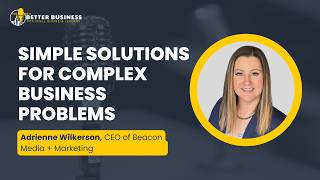
Adrienne Wilkerson, CEO of Beacon Media and Marketing, talks about building a brand that sticks. She explains why a logo isn't a brand, how niching down to mental health clients changed everything, and why repeating your values is how culture actually gets built.
Chapters
So one of my sayings that my staff has to listen to me say all the time is there's always a solution. It might be over, might be under, might be around, it might be straight through, but there's always a solution. And so that stubbornness comes in of like, we're gonna find the solution, we're gonna figure out how to pivot, because there's always a way.
Today I am talking with Adrienne Wilkerson. She is the co founder of Beacon Media and Marketing. And we're going to talk about the messy middle. You know, when you're building your business, sometimes things don't happen the way you want. Your industry can change. You got to pivot all of those things that can be wonderful and terrifying. Adrienne is a two time Inc. 5000 company. She also hosts the Beacon Way podcast. Adrienne, thank you for being on. Thank you. The Better Business for Small Business Leaders podcast today.
My pleasure. I'm excited to be here. Yay.
So let's talk a little bit about. I've known you for a while, but our audience doesn't know who you are or what you do. So can you tell us a little bit about Beacon and what it does?
Yeah, absolutely. So Beacon Media and Marketing started actually in anchorage, Alaska in 2012. We were the first full service digital marketing agency in Alaska. And so we have always specialized in small and medium businesses and kind of your local flavor. And in 2018, we branched out and started working with small businesses all over the country. So we kind of expanded outside of Alaska. And in 2020 we really niched down into the mental health and the behavioral health markets. So that's about 70% of our business. So we work with them, we build websites, we do digital marketing, all the social media, reputation management, paid ads, and like I said, website development, branding, logos, all of that fun stuff essentially really helping mental health and behavioral health companies get their story out there so they can really help the people that that is really on their heart and the reason they started their mental health business.
Nice. So I know you're in that specific niche, but you've got a lot of diverse experience within some of the things that you've done. I know that you've been a volleyball coach, you've been a creative director. Now you're a marketing CEO of a company that, that predominantly deals with the behavioral health space. So what are those, those pivots that you've had and kind of changing in career path and growth? What have they taught you about building a sustainable business, especially in Lots of disruption, yes.
I think the main piece that I've walked away with is you just, you don't give up. Things are always going to. To hit you and they're going to come out of nowhere, even when you think everything's solid. And so it's kind of. You get to that point of expecting the unexpected. And being an entrepreneur, business owner, I found you just have to be flexible. You have to have that stubbornness that is like, okay, something else came that I didn't expect. Something else. AI is disrupting everything, whatever it is. And so it's that thing of like, okay, we're going to find a solution. So one of my sayings that my staff has to listen to me say all the time is there's always a solution. It might be over, might be under, might be around, it might be straight through, but there's always a solution. And so that stubbornness comes in of like, we're going to find the solution, we're going to figure out how to pivot, because there's always a way. Sometimes it really means backing up and looking at the whole situation in a completely different angle. You know, there's a very common saying in business, you know, what got you here won't get you there. And that is very true. So it's being over open to being flexible and being willing to pivot. And that kind of stubbornness of always wanting to look for the. The solution, even if it's maybe not what you've done before, or maybe even not what you're entirely comfortable with. But that stretching helps us grow. And the next time we end up pivoting, hitting something where that we need to pivot, we're typically a little bit more comfortable with it than even the last time we had to do it.
So, Adrienne, you and Beacon live at the intersection of marketing, branding, and culture. And I know that oftentimes that's something that small businesses can get very overwhelmed with. So where should they start when they're thinking about their brand and their marketing?
Yeah, absolutely. That's a fantastic question. So I think one of the first things I typically end up in a discussion with, with a small business owner is, interestingly enough, the difference between a logo and a brand. So logo is usually where most people. Yeah, that's what they think of when you say brand. They think of the Coca Cola logo or the Nike Swoop or the Apple.
Apple.
And they. When you say brand, that. That's what most people think. And. But really that's your logo, and that is a element of your brand and usually one of the most prominent elements of your brand, but it is not your, your brand. And so a logo is incredibly important. And yes, you absolutely need that visual representation of your company, that thing that people see and associate with you. But your brand is actually really seven different elements. So your brand, if you're talking a full, robust brand, it should consist of your story first and foremost. And that's where I tell people to start. What is your story? Just write your story. Everybody's got a story, and especially small business owners. There's some reason we got into this. There's something that prompted us to do this. Whether it was a problem to solve or a family business like you, Chrissy, to take over and keep going. Whether there's that legacy component or, you know, a lot of our mental health clients, they had a really terrible experience or they had a family member who had a really terrible experience. You know, if they're in the addiction recovery space, they probably had a close family member or friend that really struggled with addiction that didn't get help. And so there's a reason you start your company and that's your why. That's your core. And your entire brand should essentially grow out of that story and that why. So there's a really good book out called storybrand that I recommend for people that it goes very, very deep. But it's really good about helping you understand your why and your story. So that's the number that first element of your brand is your story, and then your second element is your values. Why do you do what you. What gets you up every morning? So that's actually part of your brand, your brand promise. What do, what do people think of when they hear your name or see your logo? That's essentially your brand promise. So you've got infamous brands out there, you know, like Nike. Just do it. You know, just, just do it. So some, some brand promises are around, you know, where the last digital agency you'll ever want to hire or want to work for. Like, there's a promise that comes with it. Some brands are customer service, some brands are luxury. So what are you wanting your clients to experience? That's essentially your promise. The fourth element is your brand positioning. So this is where are you at in the marketplace? Are you the high end luxury brand in the marketplace? Are you the scrappy startup that's, you know, fast and cheap, but maybe not quality?
Yeah, that's okay.
Like there's that quality, price and speed and you can't be all three. You either are going to be fast and expensive, and that means you're going to have good quality, but somebody's going to pay for it. Or, you know, there's always going to be two places typically you focus on and one that you're going to have to give on. So maybe if it's quality and price, speed is not probably going to be your other part. So where are you positioning yourself in the marketplace and targeting. Who's your target audience? One of the biggest things we struggle with with small businesses is we all want to be all things to all people.
Oh, yes.
And we can't. Right? You can't. You've got to pick your niche. And that's one of the hardest things, I think, for small businesses and small business owners to overcome. It's scary to niche down. It's scary to say, this is who I am and this is who I serve. The amazing thing that happens that we tell business owners and they never believe us till they experience it, and I get it, because I was that small business owner too, is that when you own your niche, your marketing message, your brand, everything that you say and do becomes more simple and more clear. And when that happens, you target and you get in more of the right clientele. But you're also going to get the fringes, too. The part that you're most scared about that you're going to lose those people that are adjacent to your target audience. You're not going to lose them.
You're talking about a really powerful concept in the marketing and the branding, and I see a lot of it to align with culture. I mean, being the HR person wearing the HR hat. What you're saying, though, as you're, you're niching down within your organization and you're, you're really getting clear. Yes. Is you're also building a stronger culture. So I would like to ask you too, as a business owner, like, what's something simple in building culture that actually works? Because you build brands and you build all of the. You help with clarifying stories. So then how do you do that from a culture perspective too? Just kind of naturally, as a small business leader.
You want your staff to groan every time you start talking about culture and your values and your mission statement. Because you want it, you want to say it so much that they're like, yeah, yeah, boss, we know, we know. If your team's not doing that, when you start talking about company values and mission, you're not talking about it enough.
Oh, I love that.
I was told that maybe five years ago, and it really, it hit me like a ton of bricks. So culture starts from the top. So once you know what your story is, you know what your values are, that then waterfalls down into the rest of your company and your culture. But as leaders, we have to talk ad nauseam about this, because this stuff is stuff that's innate to us. That's why we are the business owner. That's why we started this. But the people you hire, the people you bring in, it's not second nature to them. And I think we as business owners forget that. And maybe we feel like we're talking about ourselves too much in that. But you can't when you keep it as part of the company. And you have to help people understand how they fit into your story.
Yeah.
And when they catch the vision about how they fit into your story, that's when the culture starts multiplying.
That's powerful. Thank you for sharing that. I'd like to talk a little bit more about leadership styles and then a little bit about learning differences, because we've known each other for a while, and I've heard you refer to yourself sometimes as a dyslexic thinker, and I love that term. And kind of I'd like to know how has that term kind of like what you've coined, how's it shaped your leadership, especially when it comes to how your team learns and works?
So one of the big things that I took away from that whole experience as a child was really emphasizing and having a lot of empathy for people's learning styles. And so everybody's got typically a primary learning style, whether it's visual, auditory, or kinesthetic, which is touch. And there's usually a secondary one, and then there's your weakest one. Now, my weakest one is auditory. So if somebody just tells me something, I'm not going to retain it. I have to write it down. Because I'm a kinesthetic learner is my strongest one. So if I'm writing it down, I'm watching myself write down whatever somebody's telling me, then I typically will retain that quite a bit. But it was a really powerful experience to understand that if somebody was communicating to me, which is what was happening before my mom discovered that I was dyslexic and they're Slingerland, she was trying to auditorily teach me. So verbally communicate to me stuff, and I wasn't retaining it. But as soon as we added in the other two learning styles, all of a sudden I started retaining information and learning. So I've carried that into my business environment and working with employees and even vendors and clients where trying to help them understand, you know, how do you learn best? How do you retain information the best? And if that's written, then I'll go, okay, do you have something to take notes on? Or I'll make sure that I provide something to that client in a written format. You know, if it's visual, then we're going to share a screen and they're going to watch me do whatever it is that they're learning how to do. If it's auditory, then great, I'm going to just tell them. But one thing that has really been helpful for me, and I learned this during my years coaching volleyball, is when I would teach a new concept to my team all three ways I was guaranteed to hit everybody that had which no matter what their learning style was. And that repetition, those two or three times of repeating things, helps everybody learn better. Because even if you don't have a learning disability, learning something in the three styles is going to reinforce and help you retain that information better. And so that's something that we talk about a lot at Beacon is learning styles, how do you retain information and how do we help meet you there so that you're able to learn and retain information faster? Which is especially critical in our industry because we do have to move so quickly and adapt so often. So I think that was, you know, from childhood and you know, Slingerland and dyslexia through coaching. That really was a reinforced piece that I love bringing into the company culture now.
Yeah, and there's so much power in that perspective. It's relatable not just on the small business leader, on the culture side within your organization, being intrapreneurial, but that entrepreneurial place too, and being able to communicate with other small business leaders, other individuals in the behavioral health field that are your clients and consumers, and enabling how you can be impactful and getting people to kind of continue to move in the right direction so that your marketing is also making impact. So I'd like to talk a little bit about what you do in relation to, you know, more the macro level small business space. Oftentimes I know you're, you're, you're very niched, which is amazing and extremely important, especially with the work that you're doing. But for those organizations that are looking at their marketing, I think with a lot of churn and things changing in the industry, a lot of, with AI and a lot of the disruption that you've seen, there are things that are really Important that can continue to add value. So I see the conversation starting to move with marketing to talk about value. So can you talk to, to the listeners a little bit about, you know, what are some ways that they can or should be seeing value in the marketing dollars and the marketing work that professionals like you are continuing to learn, leverage and implement?
Yeah, fantastic question. One of the tenets that we kind of live by is that nobody likes to be sold, but they love to buy.
Yeah.
And they want to buy from somebody they know like and trust. Right. So marketing foundationally, the part of marketing that doesn't change is you have to really provide value. You have to know that your customer doesn't want to be sold. They are looking to buy from somebody and you want that person or that company to be you. And so it's about connecting with your target audience in a way that brings value and builds true connection. Because when the customer, the consumer is ready to make a buying decision, they are going to buy from somebody they know like and trust and that opportunity then is open for you to be that connection. It's challenging though, because that's a longer game. So in marketing we look at there being kind of two paces. So lead generation, which is typically branding or sorry, which is typically paid ads, that's the whole purpose of that, is to hit somebody who's ready to make a buying decision now they're in crisis or they, they need your services or product right now. So paid ads is more about that person who's in need, not necessarily that person who has time to research, build a connection and all of they're in a different buying phase. So there is a place for lead generation with paid ads that does get immediate leads and immediate responses. They aren't always as qualified though as maybe you would ideally like. So you tend to have more spam and more not as qualified leads that come in through purely generation. The other side of marketing is brand marketing. It's brand awareness. It's telling your story, it's sharing, it's building that connection that takes longer. That's a long burn. You're talking six, 12 months to see significant return. But when you do start seeing return, you're seeing a lot more qualified clients. Clients come in and through those leads and you're talking about a lot stickier clients because they've had this chance to build a connection with you. So in a perfect world, you do both. But if you need business right away, go the lead generation route through ppc. But just know you're not going to get as Many qualified clients in your whole mix up. If you aren't in like crisis right now and you have the time, go the brand marketing route and take the time, do the work and build that connection. Because then the leads that you will get in, you won't get in as many leads maybe as lead generation, but you'll get convert a whole lot higher rate and they are usually much more sticky is what we see.
Yeah, I completely agree with you on the brand side. If you take the time to build it, the ability to close those leads because they know who you are, they like you, they trust you, and then it makes it easier to just walk through the comfort. Well, this is what the pricing is, this is what we do. But they're already coming to you as an expert. So I completely agree. And I think it's, it's an evergreen concept that can go into any industry. So thank you for that.
Right?
Yeah. All right. Well, as we're wrapping up, we usually we ask every guest the same question, and that is to get better in your business. So what is one thing that you can tell the listeners to get 1% better in their business? Today.
Look for simple solutions to your complex problems. Our tendency is to want to make everything more complex. And in today's world, with AI disrupting things, everything is getting more infinitely complex, which makes it harder to narrow it down to that 1% or that one thing. So look for what's working in your business and find a simple way to duplicate that piece. Because a tendency is to want to focus on the problems and then you just duplicate more problems. So focus, find the bright spots. Find what's working in your organization. If that's a person, if that's a system, if that's a service, a product, and find a simple way to duplicate that. You do that and keep scaling that 1% is going to multiply itself tenfold.
Wonderful. I love that tip. Thank you, Adrian. Thank you for your time and everyone. You can listen to the Beacon Way podcast. We will make sure to link to all of Adrienne and her company's socials. And I just want to say thank you so much for, for being on the podcast today.
Yeah. Thank you so much for hosting me. I really enjoyed it.










