Episode 34: How Zhao Liu Went From Solo Hustle To Scalable Team
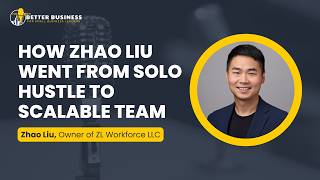
In this interview, host Chrissy Myers talks with Zhao Liu, founder of ZL Workforce, about his evolution from a solo engineer and product designer to building a scalable virtual assistant (VA) agency. Zhao recounts his early years running a niche product business alone, the turning point after joining the Goldman Sachs 10,000 Small Businesses program, and his decision to hire his first VA. He describes how he taught the VA through hands‑on Zoom sessions, then had the VA document the processes, creating a library of SOPs. Zhao explains his rigorous vetting process, background checks, and the use of monitoring software that tracks screenshots, keystrokes, and mouse clicks to generate role‑specific productivity metrics for his 20‑person VA team. To combat isolation in a remote workforce, ZL Workforce holds optional weekly huddles and a bi‑annual retreat in Manila to build culture. The conversation covers the most common VA roles for small businesses (generalist admin/executive assistants), the critical importance of aligning expectations and establishing multiple communication channels, and the key performance indicators Zhao tracks: profit margin for his B2C product line and efficiency/productivity for his B2B VA services. He shares advice on incremental trust building—granting permissions gradually—and stresses the "1% improvement" principle, suggesting small tweaks in pricing, volume, or overhead can compound to large profit gains. The episode ends with Zhao’s contact information for ZL Workforce.
Chapters
I started telling my friends and business partners and things about my virtual assistant from Philippines and they're all like, hey, oh, that sounds great. Can you find me one too? And that's how the virtual assistant business really started. Right. Because I was getting inquiries left and right and before you know it, I have a virtual assistant company.
Today's guest didn't just build a business, he reverse engineered one. And whether it's creating SOPs, managing thousands in ad spend, or building a virtual team that actually sticks, Zhao doesn't just talk about efficiency, he lives it. So today I am excited to talk to Zhao Li, who's the founder of ZL Workforce and some other companies. So, Zhao, thank you for coming to the podcast today.
You're welcome. Welcome. So thank you for inviting me.
Absolutely. Can you tell the audience a little about your entrepreneurial journey, your current endeavor with ZL Workforce and some of the other things that you've been up to?
Yeah. I'm very fortunate to have graduated from the University of Akron in 2013. Shortly after that, I got my MBA degree again. I was very fortunate because my mom worked for the university, so I got a free ride for the whole way. It was very convenient for me. As I was going to my corporate job, I had a job at Lincoln Electric as an engineer. And shortly after that, a year into it, I started my business. My business is my product business, which I'm still running today. It's an 11 year old business now and we design niche products, electronics, outdoor products, all kinds of different products and we'll market them. We do everything except manufacturing. So we'll outsource manufacturing to China. But everything else, when it's design, when it comes to marketing, when it comes to brands, we do it ourselves. But three years ago though, I actually started my new business called ZR Workforce Virtual assistant business and where we hire a bunch of different kinds of virtual assistants from different from overseas and we'll place them in US companies.
Nice. So how has being an operator first, not just a recruiter for the organization that you have changed the way you train and place virtual assistants? And what made you want to start a virtual assistant company?
Yeah, it was I ran my product business since 2014ish. And I ran that probably for approximately eight years while having a corporate job and running it all by myself. I had no employees, had probably maybe one or two contractors, but very, very on a temporary basis that helps me do shipments and things like that. Very temporary basis. So really I had all absolutely no help. But I got into in 2022 is when I actually quit my corporate job and really focused in on my product business full time. And right around that time I also found out about Goldman Sachs 10,000 small businesses. And so I joined it very shortly after I left my corporate job. And. And this is where I learned I couldn't develop my business on my own. Right. I can only do so far now to be honest. By that time I was actually, my business was already at a pretty good capacity as far as revenue goes. It's already qualifying for the 10 KSB requirements technically also qualify for the EO accelerator by then. So it was a good sized business, but I was running it all by myself. What 10 KSB did tell me teach me though is that I can't run a business by my own, by myself. And if I do decide to run the business by myself all by myself, there's a limit on where I can achieve as far as the size of business. Okay. Right. And I'm kind of that kind of person where I will always think, hey, I can do everything by myself. You know, I can, I can do this, you know, I can do the marketing, I can do the accounting, I can do the bookkeeping, I can do the product design, I can do the sourcing, everything. I'll just be able to manage it myself. But soon I realized I was like, you know what? Yes, I could, but I'm not going to be able to as the business gets bigger and bigger. And that's where I hired my first virtual assistant actually shortly after the 10,000 business graduating from there. And I hired the first one. It went so well. Most of my product business is basically on autopilot now.
Wow.
Just because that one kickstarter of everything. So my only role on that business now is new product development. And if I'm not trying to actually design new products and come out with new products, I don't really have to deal with that business that much anymore. And then also because of my own core story about my product business being autopilot, I was able to. I started telling my friends and business partners and things about my virtual assistant from Philippines and they all like, hey, oh, that sounds great. Can you find me one too? That's how the virtual assistant business really started because I was getting inquiries left and right and before you know it, I have a virtual assistant company.
That's impressive. So you made a good point about a lot of founders. Small business leaders feel like they have to have the perfect systems. They feel like they can't delegate. I have to do everything myself. But clearly you've talked about how finding the right person can totally transform your business. I mean, you're not even in the day to day anymore of the one business that you founded. So what's your take on systems before people and when is when is good enough and how do you know when to delegate effectively? What's your. You're learning from that.
Yeah. So I think not everybody, especially small business owners, have the perfect system set. Now. There are some people that they do. Right. But it's great when you do. But it's definitely not the minimum criteria or minimum requirement for hiring some help. So for me, I, when I hired a first person, I barely had any process in place. I remember I basically hands to hands just kind of showed the person the VA everything. We hopped on Zoom Call probably two hours a day. And I just walked through every single step of what I do and have her take notes, have her ask questions during the process and then eventually she's able to do everything on her own. And then once I'm confident that she could do everything, I actually asked her to start writing out the process so I don't have to actually write the process myself. So we actually have a lot of processes now documented, including some of the new product research part of it. So I can ask her to say, hey, you know, we are short on the product pipeline right now. Can you go research some product and we have an exact process that she could follow.
Wow. So I see the value in, in virtual assistants and offshoring. Clearly you do too. But there are still some stigmas around VAs, especially as it relates to small business owners. So what do you do differently with your organization, with ZL workforce to build trust and performance in your VA placements?
Yeah, so we do some, a lot of stuff different, but just going back a little bit. The reason I was so I wasn't hesitant in jumping into the VA business as well, hiring VA myself is because I'm a never say never kind of guy.
Okay.
Right. So I would never knock it. So my, my statement is always don't knock until you tried it. Right. So. So that's so. So that was easy for me to, to get into. And then going back to your question is what are things that we do differently? I think one of the biggest things that people business or small business owners, when they think about a overseas employee, I think a lot of them are afraid of, first of all, they're afraid of getting scammed. Right. And one thing that we do at ZR workforce that we do differently is first of all, we have a specific process. We vet people, we do some background checks on them before we even interview them ourselves. And once all these things passes, once we do the interview and the hiring, once they are hired, we. We actually install a software on every single one of their computers when they are working. Because they're remote employees, the software doesn't only track their hours, they also do screenshots as well as they don't do key logging, but they do track how often they type on the keyboard, how many keystrokes they have, how many mouse clicks, movement mouse clicks they have. So that gives us a productivity number on every single VA and over time. Now we have 20 VAs under our thing on our ZR workforce. And we now know kind of the typical productivity level by looking at these data of a certain kind of role, because not all roles are created equal. So some roles, for example video editors, they are usually more. They price the keyboards more. They price the mouse clicks more. Right. So we know if you're a video editor, what kind of number you should be sitting to be a productive video editor. And on the other hand, people who are maybe a hiring manager or recruiter who's always on zoom calls or doing a client relations kind of thing, their numbers will be a lot less. Right. Which is fine. So we monitor everybody. So to make sure that whoever we hire is doing the work that the business owner wants them to do and they're being productive on it.
How do you build alignment within your organization? I mean, you've got a lot of different VAs working for a lot of different people. But at the same time, how do you maintain culture within your organization that is supporting other organizations and an extension of their team as well.
Yeah. So being a remote team, everybody's kind of working their silos a lot of times. Right. So VA number one will be working for business, you know, one business, and VA number two will be working for another business. They'll probably never talk to each other, really, you know, because they're completing separate businesses. Now, one thing, what we did is for every Monday, we have a weekly huddle. So it doesn't matter who you're working for or which business you're working for. There's an option to join this weekly huddle just of a ZR workforce virtual assistant. And then in our ZR workforce virtual assistant, we get. It's an optional meeting, but we highly encourage them to attend. And then in this meeting, the content of the meeting is we have usually four topics. The four topics consist of three are just Kind of the same every single time. And then the one is a fun topic that we rotate through the VAs to make sure that each VAs have an opportunity to kind of ask the whole group something. So this way we'll actually develop kind of a relationship between the VA so they don't feel as alone as if they were just working for their business. Right. We're working for their clients business. So that way they'll see, hey, there's others out there and I can, you know, communicate with everybody. We also have a retreat every other years where we get everybody together and then the company will pay for the whole retreat. It's a three day, two, two nights retreat in Manila and everybody gets together. People who are not in Manila gets flown in just to make sure that everybody has a chance to meet everybody. And it's not just a remote. Right. It's everybody actually has a. Everybody's a real person. And you know, this is a great event. I think, you know, if. Chrissy, if you want to join me one year. Yeah,
I might. What are you talking about? Video editors. You've talked about customer service and recruiting. What are some common positions that you recruit for within your organization that you support?
Yeah, there's a lot of, for small businesses, a lot of admin assistants or executive assistants. Right. So I think that's in general one of the first thing that people can come up with. It's usually the small business owner who is just too busy, who's working in their business, not on their business. Right. And that's one of the first things. And now those small business owner, a lot of times though, they don't have exact things planned out. So they are usually looking for a generalist, not a specialist, somebody who can check their emails, maybe manage their calendars, do some quick data entry work as well as maybe a little bit of Canva or photo editing work. Right. So I think that's by far the most common.
Yeah, I know when I started we have several virtual assistants that we work with on our team. And my assistant, the first thing that I thought of was calendar management. She can help with my calendar, but she does so much more at this point in time. She helps with meeting preparation. She's an extension of me. And so I can appreciate some of the things that you're saying and talking about, you know, building your culture, making sure that they feel cohesive. If there was one piece of advice that you would give a small business owner who's thinking about hiring a virtual assistant other than yes, you have to try It. Don't. Don't knock it till you try it. What would you tell them about success? If they want to be successful in having a virtual assistant, what's something that they should always make sure they're doing?
Yeah. Align the expectations from the beginning. So one thing we actually, I personally help a lot of small business do is I will jump on the onboarding meeting. The very first onboarding meeting when they. When they hire a va. I will say, hey, you know, what is your communication channels? Right? That's something as basic as communication channels. Sometimes people miss, right? It's like, okay, email is a primary. Do we use what's the secondary in case email somehow gets blocked or doesn't work? Right. We make sure there's two communication channels open. And then on the business owner side, I think I usually ask them to, hey, make sure you set expectations and set goals for your va as much as you could. Give a little bit more details on that and track on that. Because one of the examples I always give is during our EO accelerator days, one of the instructors came to the class and said, hey, this is a classroom full of business owners. Hey, point north. And we're in the think big space. And everybody, like, point all over direction. Because people aren't really familiar, not oriented
with where they are.
Exactly. Doesn't know. Right. You should know. And I don't know if I got it right either. And everybody's just all over the place, right? And then the instructor said, okay, guys, north is that way, right? He's saying he pointed to the actual. Which direction. Was he actually to ask somebody in the class because he's not local. So he was like, actually, what's the north? I think somebody pulled off phone and did a. Did a navigation gps, like, oh, that's north. Okay. It's like, that's north. And then he has to classroom again right after. He's like, all right, everybody now play a point north. And then this time, everybody got it right. So I think a lot of times VAs underperform. It's just because you didn't set expectations. You didn't tell them which way north is.
Yeah, well, and you make a good point. You talk about how VAs can underperform because they're not given expectations. I think that that qualifies for anyone that you're working with within your organization, whether they're in the office and you're seeing them all the time or they're working from across an ocean. I mean, we can build a thick culture. It doesn't matter where we are geographically. But clarifying expectations are what really sets a good organization apart from an elite organization. So you make a really good point there. What's one of the KPIs or business numbers that you see most small business owners ignore that they absolutely shouldn't? I know you've built a pretty data driven metrics company culture of your own. So what's a KPI that you would say don't overlook it.
Yeah. So there's two KPIs. I think it depends on what type of business you are. I have a product based business which is mostly B2C and then the virtual assistant business is mostly B2B. So if you talk about a B2C business, a product based, I think the profit margin is the biggest number that I think a lot of small business owner overlook partially because everybody's so focused on revenue these days. All different kinds of programs, they're like, oh hey, if you're this kind of revenue, you know, then you qualify. Right. It doesn't matter if it's a loan or like education program. I think the profit margin. So everybody's kind of focused on hey, how do I bump the revenue up? Right. But then they, they're not really watching, what are they losing and how much did it cost them to bump that revenue up? So that I think for small business, it's very important to keep a close eye on. For a B2C product. Now for a B2B, especially for my virtual assistant services, I think what we focus on more than others is the efficiency and productivity of your people. Right. Because if you can't, if your overhead is overblown and again it goes back to the profit, if you have too much overhead and people aren't productive, then you're not going to get run a very successful and profitable business.
I totally agree. It's not just how much money you make, it's how much money you keep.
Yes, yes.
And then adding capacity into your teams and the volume of capacity. Because when you're growing quickly, if your revenue is increasing, your volume of work oftentimes is increasing too. And how fast can you continue to add to your team or are you going to burn them out? So yeah, very good advice. So another question. And then we're going to wrap it up pretty quickly. We've got like two more questions left. You know, most business owners, we've talked about hiring help and delegating, but there's this fine line, I think between leaders who struggle to let go. It's like they still want to hold on. What advice do you give your business owners who are hiring virtual assistants in, you know, how to let go?
Mm. I had that problem big time for like eight years, right? So I was literally, hold on. Holding on to my business. I was growing it, but I held on to it for eight years. And until then, I did not let go at all. I did every single thing right. I think the best advice I could give to people is just to slowly learn to trust. You know, do it and then slowly learn to trust. Because I know trust doesn't come from day one, right? But if you don't try, if you don't just let a tiny bit go, you will never get there. So for me, especially when I hire my first va, I did not like unload everything to them at all. I like literally like piece fat, you know, spoon fed them a little by little and then give them permissions. You know, in a lot of accounts, I give them a tiny bit of permission one at a time. And eventually I realized I'm like, oh yeah, I can completely trust this person. And I basically opened up all the permissions of like, all right, you can have admin access to this and that and this and that, right? I was like, okay, open it up, right? You guys not gonna mess anything up. So I think just to slowly get yourself to open up a tiny bit, tiny bit at a time. And over time, I think you'll learn to trust the people. And most people are good, right? They're, you know, there are bad acts out there, but 99% of time, people are not going to intentionally mess up your business.
No, you're right. And I mean, as we continue to clarify expectations, we give good standard operating procedures, we train and teach individuals how to do the work. It makes sense. And you make a very good point of, you know, we're taking that incremental one step at a time. You don't have to give them access to everything all at once, but over time, as trust builds, it's really okay to start loosening the grip so that you can enjoy. I mean, right now you're able to run another business and not necessarily worry about all of the day to day things. So good job in getting to that point. So I want to thank you for your time. As we're wrapping up, we ask every guest this question. How do we get 1% better in our business? So what's one way that you can tell the listeners to get 1% better in their business today?
Yeah, I love this 1% question because there's this concept called the power of one. And this is another EO thing, I think, or maybe EO got it from somewhere else. It's 1 plus 1 plus 1 equals 17. I don't know if it's 17 or 19. Some big number that's not 3. And the reasoning behind that is the 1%. You can increase 1% pricing. You can increase 1% on your volume, like just overall quantity of product or service you sell, or you can reduce 1% in overhead. So anywhere. If you can do all three, then your cash flow is cash flow or profit, it will literally increase by 17%, depending on whether the profit margin is. But I love that concept of just that 1% change could do so many. So I guess my suggestion for the 1% is, hey, look at your volume. If you can increase your price by a tiny bit, that will be good to go. And people probably won't even realize it. And then if you can increase your quantity, rolling the sales by just 1%, that would be the way to go. If you can increase the efficiency or productivity of your existing people by 1%, that's another great thing to do. And if you can do all three, that's the best.
It'll change your business completely.
Yes. Yes.
Zao, thank you for your time today. How can people connect with you? Connect with your businesses?
Yeah. So we are in Zia Workforce. Zia Workforce is my company. Ziaworkforce.com and you can also reach me at contact zrwork workforce.com all right, thank
you so much for your time today. And if anybody has questions about how to find a good virtual assistant, now you know where to go.
Thank you.










